Computationally tractable robust differentially private mean estimation
Pith reviewed 2026-06-27 08:32 UTC · model grok-4.3
The pith
The balloon mean estimator achieves zero-concentrated differential privacy and robustness via iterative clipping over expanding Mahalanobis balls.
A machine-rendered reading of the paper's core claim, the machinery that carries it, and where it could break.
Core claim
The balloon mean is based on an iterative clipping procedure over expanding Mahalanobis balls that satisfies zero-concentrated differential privacy and provides theoretical guarantees under heavy-tailed and contaminated elliptical models while being computationally tractable and robust to outliers.
What carries the argument
Iterative clipping procedure over expanding Mahalanobis balls, or balloons
If this is right
- It is robust to outlying observations.
- It provides theoretical guarantees under heavy-tailed and contaminated elliptical models.
- It outperforms existing differentially private mean estimators in contaminated settings.
- It depends on a small number of interpretable tuning parameters.
- It is computationally tractable.
Where Pith is reading between the lines
- The clipping procedure might extend to estimation of other parameters such as covariance.
- Performance could be tested on data that deviates from elliptical symmetry to check broader applicability.
- The method may integrate with existing private data release pipelines for multivariate summaries.
Load-bearing premise
The data-generating process follows heavy-tailed and contaminated elliptical models, and the iterative clipping procedure produces the claimed statistical performance and privacy without additional restrictions on dimension or sample size.
What would settle it
A simulation study on contaminated elliptical data in which the balloon mean fails to outperform existing differentially private mean estimators or violates the zero-concentrated differential privacy bound.
Figures







read the original abstract
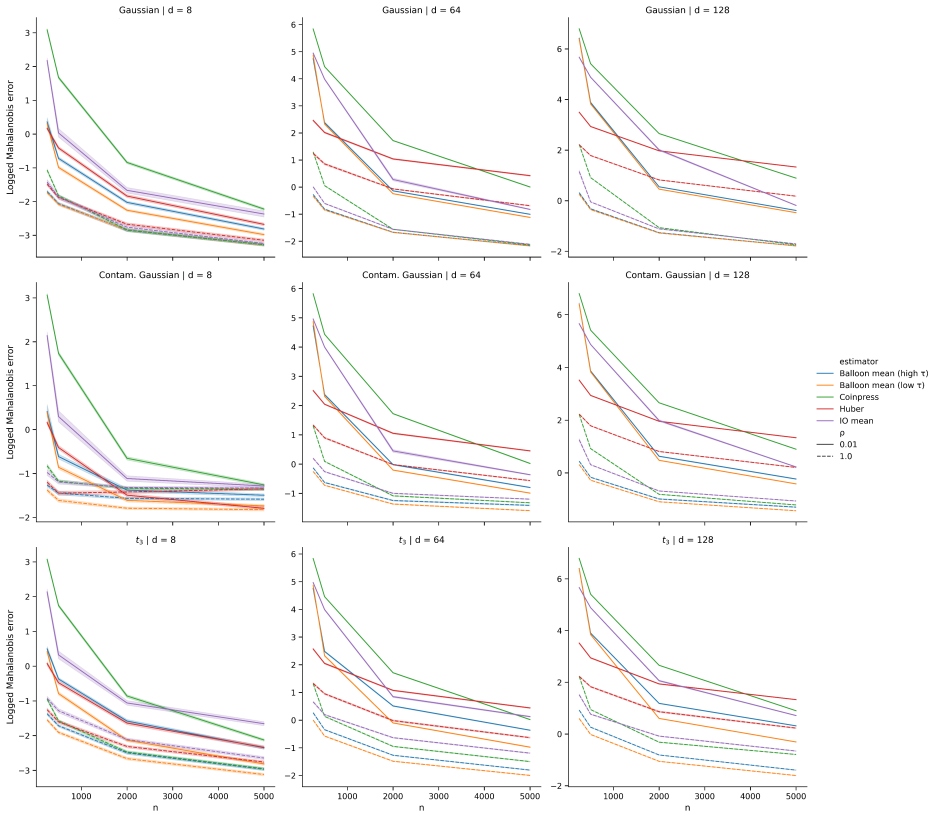
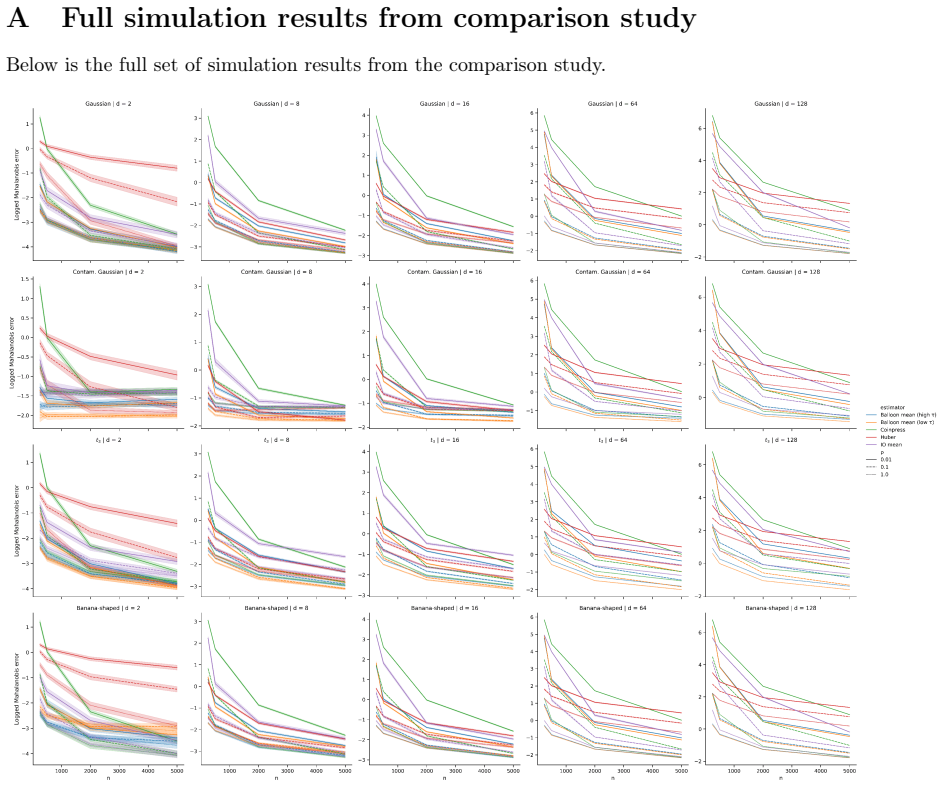
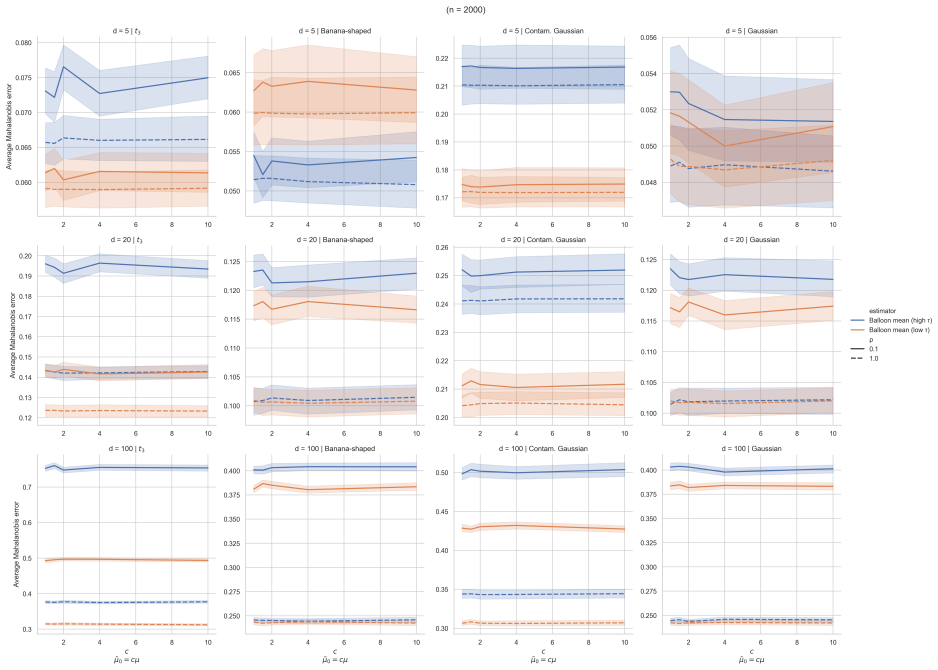
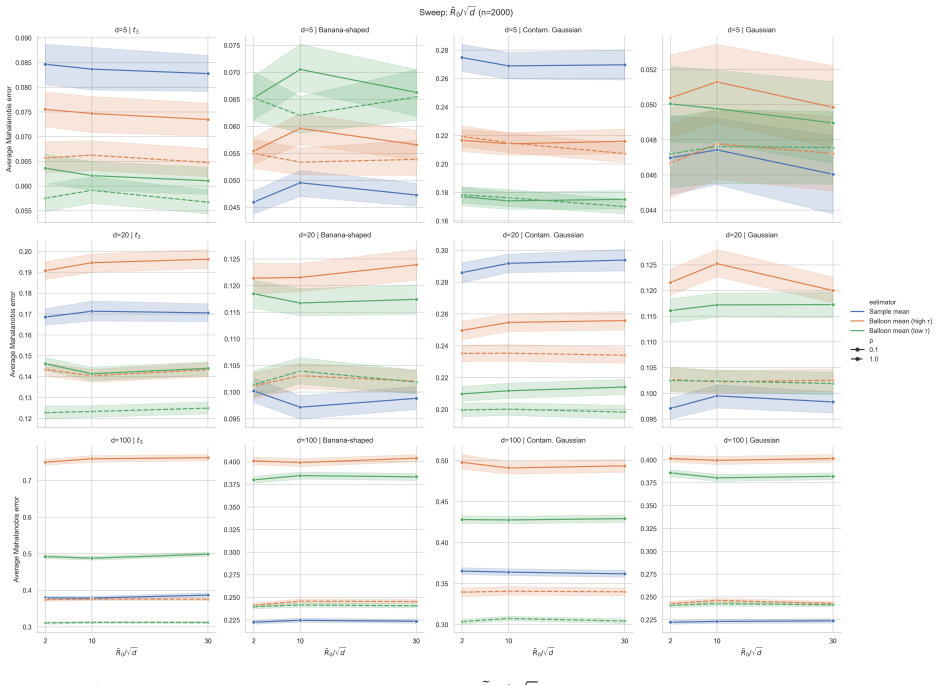
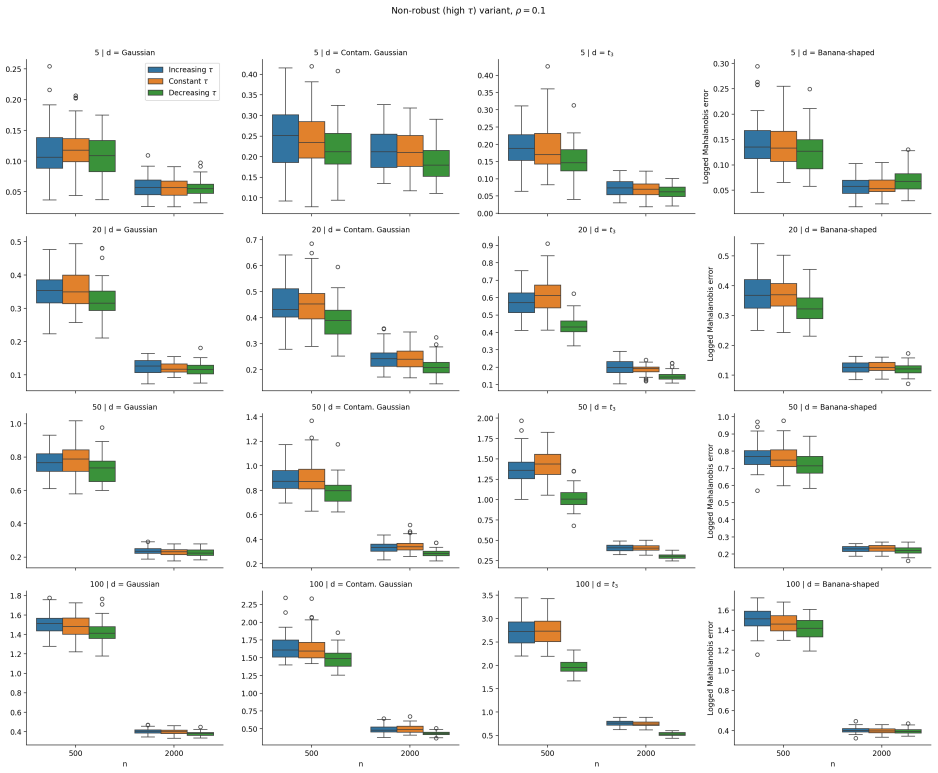
We develop a new, differentially private mean estimator called the balloon mean. The main features of the balloon mean are that it is computationally tractable and enjoys robustness to outlying observations. It is based on an iterative clipping procedure over expanding Mahalanobis balls, or ``balloons.'' The method satisfies zero-concentrated differential privacy and depends on a small number of interpretable tuning parameters. We provide theoretical guarantees under heavy-tailed and contaminated elliptical models, characterizing its statistical performance and robustness to outliers. Extensive simulations demonstrate that the balloon mean is robust to heavy-tailed and contaminated data, and outperforms existing differentially private mean estimators in contaminated settings.
Editorial analysis
A structured set of objections, weighed in public.
Referee Report
Summary. The paper introduces the balloon mean estimator for differentially private mean estimation. It is based on an iterative clipping procedure over expanding Mahalanobis balls, is claimed to be computationally tractable, robust to outliers, and to satisfy zero-concentrated differential privacy (zCDP) with a small number of tuning parameters. Theoretical guarantees are provided under heavy-tailed and contaminated elliptical models, with simulations showing outperformance over existing DP mean estimators in contaminated settings.
Significance. If the central claims hold with explicit dimension and sample-size dependence, the work would advance robust DP statistics by offering a practical method that combines computational tractability, outlier robustness, and privacy in settings where standard DP estimators degrade. The extensive simulations provide concrete evidence of empirical gains, which is a strength.
major comments (2)
- [Theoretical analysis] Theoretical analysis (likely §4 or §5): the error bounds and robustness claims under contaminated elliptical models do not explicitly characterize dependence on dimension d or the number of iterations in the balloon expansion schedule; this directly affects whether the Mahalanobis-distance-based clipping yields the stated rates without hidden n ≫ poly(d) requirements.
- [Privacy analysis] Privacy analysis (likely §3): the zCDP guarantee for the adaptive iterative procedure is stated, but the composition bound across iterations is not shown to be independent of the data-dependent number of steps or the clipping radii; this is load-bearing for the central claim that the method satisfies zCDP under the stated model assumptions.
minor comments (2)
- [Algorithm description] Notation for the balloon radii and expansion schedule should be defined more clearly in the algorithm pseudocode to avoid ambiguity when implementing the method.
- [Simulations] The simulation section would benefit from reporting the exact values of the tuning parameters used and their sensitivity analysis.
Simulated Author's Rebuttal
We thank the referee for the detailed review and constructive comments on our manuscript. We address each major comment point by point below, indicating where revisions will be made to strengthen the presentation.
read point-by-point responses
-
Referee: [Theoretical analysis] Theoretical analysis (likely §4 or §5): the error bounds and robustness claims under contaminated elliptical models do not explicitly characterize dependence on dimension d or the number of iterations in the balloon expansion schedule; this directly affects whether the Mahalanobis-distance-based clipping yields the stated rates without hidden n ≫ poly(d) requirements.
Authors: We thank the referee for this observation. The error bounds in Section 4 are stated in terms of the Mahalanobis norm under the elliptical model and implicitly depend on dimension d through the covariance structure; the iteration schedule is chosen to ensure convergence within a fixed number of steps independent of the data. To make this fully explicit, we will revise the theorem statements and proofs in the next version to display the precise dependence on both d and the (bounded) number of iterations, confirming that no additional n ≫ poly(d) requirement is hidden beyond the model assumptions already stated. revision: yes
-
Referee: [Privacy analysis] Privacy analysis (likely §3): the zCDP guarantee for the adaptive iterative procedure is stated, but the composition bound across iterations is not shown to be independent of the data-dependent number of steps or the clipping radii; this is load-bearing for the central claim that the method satisfies zCDP under the stated model assumptions.
Authors: We appreciate the referee identifying this point in the privacy analysis. The zCDP guarantee is obtained by allocating a fixed per-iteration privacy budget and using the adaptive composition properties of zCDP, which bound the total loss independently of the realized number of steps and the data-dependent radii (the radii are themselves functions of previous noisy outputs under the privacy mechanism). We will expand the proof in Section 3 and the appendix to explicitly derive this independence and include the relevant composition lemma application. revision: yes
Circularity Check
No circularity: derivation self-contained under explicit model assumptions
full rationale
The paper introduces the balloon mean via an iterative clipping procedure and states that it satisfies zCDP with theoretical guarantees under heavy-tailed and contaminated elliptical models. No equations or claims in the provided text reduce a prediction or guarantee to a fitted parameter by construction, nor do they rely on self-citation chains, uniqueness theorems imported from the same authors, or ansatzes smuggled via prior work. The central claims are presented as derived from the procedure under the stated assumptions rather than being definitionally equivalent to inputs. This is the normal case of a self-contained methodological paper.
Axiom & Free-Parameter Ledger
free parameters (1)
- tuning parameters
axioms (1)
- domain assumption Data is generated from heavy-tailed and contaminated elliptical models
invented entities (1)
-
balloon mean estimator
no independent evidence
Reference graph
Works this paper leans on
-
[1]
2025 , eprint=
Robust and Differentially Private PCA for non-Gaussian data , author=. 2025 , eprint=
2025
-
[2]
Sharper bounds for Gaussian and empirical processes , volume =
Michel Talagrand , journal =. Sharper bounds for Gaussian and empirical processes , volume =
-
[3]
The Annals of Statistics , number =
Pascal Massart and. The Annals of Statistics , number =. 2006 , doi =
2006
-
[4]
IEEE Transactions on Information Theory , volume=
Recovering low-rank matrices from few coefficients in any basis , author=. IEEE Transactions on Information Theory , volume=. 2011 , publisher=
2011
-
[5]
On a modification of
Bernstein, Serge , journal=. On a modification of. 1924 , publisher=
1924
-
[6]
1991 , publisher=
Probability in Banach Spaces: Isoperimetry and Processes , author=. 1991 , publisher=
1991
-
[7]
Lecture Notes, Columbia University , year=
A gentle introduction to empirical process theory and applications , author=. Lecture Notes, Columbia University , year=
-
[8]
doi: 10.1080/01621459.2016.1211016
Fang Han and Han Liu , title =. Journal of the American Statistical Association , volume =. 2018 , publisher =. doi:10.1080/01621459.2016.1246366 , URL =
-
[9]
A generalized spatial sign covariance matrix , journal =
Jakob Raymaekers and Peter Rousseeuw , keywords =. A generalized spatial sign covariance matrix , journal =. 2019 , issn =. doi:https://doi.org/10.1016/j.jmva.2018.11.010 , url =
-
[10]
Proceedings of the 54th Annual ACM SIGACT Symposium on Theory of Computing , pages=
Efficient mean estimation with pure differential privacy via a sum-of-squares exponential mechanism , author=. Proceedings of the 54th Annual ACM SIGACT Symposium on Theory of Computing , pages=
-
[11]
arXiv preprint arXiv:1610.05755 , year=
Semi-supervised knowledge transfer for deep learning from private training data , author=. arXiv preprint arXiv:1610.05755 , year=
-
[12]
Advances in Neural Information Processing Systems , volume=
Differentially private bagging: Improved utility and cheaper privacy than subsample-and-aggregate , author=. Advances in Neural Information Processing Systems , volume=
-
[13]
arXiv preprint arXiv:2208.07353 , year=
Easy differentially private linear regression , author=. arXiv preprint arXiv:2208.07353 , year=
-
[14]
arXiv preprint arXiv:1803.05101 , year=
Model-agnostic private learning via stability , author=. arXiv preprint arXiv:1803.05101 , year=
-
[15]
Nissim, Kobbi and Raskhodnikova, Sofya and Smith, Adam , title =. 2007 , isbn =. doi:10.1145/1250790.1250803 , booktitle =
-
[16]
Foundations of Computational Mathematics , author =
Lugosi, Gábor and Mendelson, Shahar , year =. Mean Estimation and Regression Under Heavy-Tailed Distributions: A Survey , volume =. Foundations of Computational Mathematics , publisher =. doi:10.1007/s10208-019-09427-x , number =
-
[17]
2024 , eprint=
Dimension-free Private Mean Estimation for Anisotropic Distributions , author=. 2024 , eprint=
2024
-
[18]
The Algorithmic Foundations of Differential Privacy,
Foundations and Trends in Theoretical Computer Science , title =. 2014 , volume =. doi:10.1561/0400000042 , issn =
-
[19]
Calibrating noise to sensitivity in private data analysis
Dwork, Cynthia and McSherry, Frank and Nissim, Kobbi and Smith, Adam. Calibrating noise to sensitivity in private data analysis. Theory of Cryptography Conference. 2006
2006
-
[20]
arXiv , arxivId =:1906.11923 , title =
arXiv e-prints , author =. arXiv , arxivId =:1906.11923 , title =
Pith/arXiv arXiv 1906
-
[21]
Differentially private projection-depth-based medians. arXiv e-prints , keywords =. doi:10.48550/arXiv.2312.07792 , archivePrefix =. 2312.07792 , primaryClass =
-
[22]
2024 , eprint=
Differentially Private Boxplots , author=. 2024 , eprint=
2024
-
[23]
Electronic Journal of Statistics , number =
Kelly Ramsay and Dylan Spicker , title =. Electronic Journal of Statistics , number =. 2025 , doi =
2025
-
[24]
Journal of Machine Learning Research , year =
Kelly Ramsay and Aukosh Jagannath and Shoja'eddin Chenouri , title =. Journal of Machine Learning Research , year =
-
[25]
Tukey Depth Mechanisms for Practical Private Mean Estimation. arXiv e-prints , keywords =. doi:10.48550/arXiv.2502.18698 , archivePrefix =. 2502.18698 , primaryClass =
-
[26]
Machine Learning , volume =
Bounding the Vapnik--Chervonenkis Dimension of Concept Classes Parameterized by Real Numbers , author =. Machine Learning , volume =. 1995 , publisher =
1995
-
[27]
arXiv preprint arXiv:2501.14095 , year=
Improved subsample-and-aggregate via the private modified winsorized mean , author=. arXiv preprint arXiv:2501.14095 , year=
-
[28]
1974 , booktitle =
Tukey, John W , title =. 1974 , booktitle =
1974
-
[29]
Proceedings of the 35th Conference on Learning Theory (COLT 2022) , series =
Private Robust Estimation by Stabilizing Convex Relaxations , author =. Proceedings of the 35th Conference on Learning Theory (COLT 2022) , series =. 2022 , publisher =. doi:, note =
2022
-
[30]
arXiv preprint arXiv:1603.01887 , year=
Concentrated differential privacy , author=. arXiv preprint arXiv:1603.01887 , year=
-
[31]
1990 , publisher =
Fang, Kai-Tai and Kotz, Samuel and Ng, Kai Wang , title =. 1990 , publisher =
1990
-
[32]
SIAM Journal on Computing , volume =
Efficient algorithms and lower bounds for robust high-dimensional mean estimation , author =. SIAM Journal on Computing , volume =
-
[33]
Proceedings of the 37th International Conference on Machine Learning , editor =
High-dimensional Robust Mean Estimation via Gradient Descent , author =. Proceedings of the 37th International Conference on Machine Learning , editor =. 2020 , volume =
2020
-
[34]
2022 , eprint=
Tight and Robust Private Mean Estimation with Few Users , author=. 2022 , eprint=
2022
-
[35]
Proceedings of the forty-third annual ACM symposium on Theory of computing , pages=
Privacy-preserving statistical estimation with optimal convergence rates , author=. Proceedings of the forty-third annual ACM symposium on Theory of computing , pages=
-
[36]
A Fast Algorithm for Adaptive Private Mean Estimation. arXiv e-prints , keywords =. doi:10.48550/arXiv.2301.07078 , archivePrefix =. 2301.07078 , primaryClass =
-
[37]
Bernoulli , number =
Myeonghun Yu and Zhao Ren and Wen-Xin Zhou , title =. Bernoulli , number =. 2024 , doi =
2024
-
[38]
Proceedings of Thirty Sixth Conference on Learning Theory , pages =
Fast, Sample-Efficient, Affine-Invariant Private Mean and Covariance Estimation for Subgaussian Distributions , author =. Proceedings of Thirty Sixth Conference on Learning Theory , pages =. 2023 , editor =
2023
-
[39]
Advances in Neural Information Processing Systems , volume=
Private hypothesis selection , author=. Advances in Neural Information Processing Systems , volume=
-
[40]
Proceedings of the 41st annual ACM symposium on theory of computing - STOC '09 , pages =
Dwork, Cynthia and Lei, Jing , doi2 =. Proceedings of the 41st annual ACM symposium on theory of computing - STOC '09 , pages =
-
[41]
International Conference on Machine Learning , pages=
Friendlycore: Practical differentially private aggregation , author=. International Conference on Machine Learning , pages=. 2022 , organization=
2022
-
[42]
Advances in Neural Information Processing Systems , volume=
Average-case averages: Private algorithms for smooth sensitivity and mean estimation , author=. Advances in Neural Information Processing Systems , volume=
-
[43]
arXiv e-prints , year = 2021, note =
Differential privacy and robust statistics in high dimensions. arXiv e-prints , year = 2021, note =
2021
-
[44]
Finite sample differentially private confidence intervals , journal =
-
[45]
Privately learning high-dimensional distributions , journal =
-
[46]
Bun, Mark and Steinke, Thomas , year =. Concentrated Differential Privacy: Simplifications, Extensions, and Lower Bounds , ISBN =. doi:10.1007/978-3-662-53641-4_24 , booktitle =
-
[47]
Biswas, Sourav and Dong, Yihe and Kamath, Gautam and Ullman, Jonathan , journal=
-
[48]
Advances in Neural Information Processing Systems , volume=
Instance-optimal mean estimation under differential privacy , author=. Advances in Neural Information Processing Systems , volume=
-
[49]
arXiv e-prints , year = 2021, note =
Robust and differentially private mean estimation. arXiv e-prints , year = 2021, note =
2021
-
[50]
Tony Cai and Yichen Wang and Linjun Zhang , title =
T. Tony Cai and Yichen Wang and Linjun Zhang , title =. The Annals of Statistics , number =. 2021 , doi =
2021
-
[51]
arXiv e-prints , year = 2014, note=
Privacy and statistical risk: F ormalisms and minimax bounds. arXiv e-prints , year = 2014, note=
2014
-
[52]
Advances in Neural Information Processing Systems , volume=
Covariance-aware private mean estimation without private covariance estimation , author=. Advances in Neural Information Processing Systems , volume=
-
[53]
Psychological distress among healthcare providers during the COVID-19 pandemic: patterns over time
Gutmanis, Iris and Coleman, Brenda L and Ramsay, Kelly and Maunder, Robert and Bondy, Susan J and CCS Working Group and McGeer, Allison. Psychological distress among healthcare providers during the COVID-19 pandemic: patterns over time. BMC Health Serv. Res
-
[54]
The Annals of Statistics , number =
G. The Annals of Statistics , number =. 2021 , doi =
2021
-
[55]
Advances in Neural Information Processing Systems , volume=
Unbounded differentially private quantile and maximum estimation , author=. Advances in Neural Information Processing Systems , volume=
-
[56]
P. J. Huber , title =. 1981 , address =
1981
-
[57]
Conference on Learning Theory , pages=
Private mean estimation of heavy-tailed distributions , author=. Conference on Learning Theory , pages=. 2020 , organization=
2020
discussion (0)
Sign in with ORCID, Apple, or X to comment. Anyone can read and Pith papers without signing in.