A likelihood-based framework for simultaneously learning both noise and growth dynamics using biologically-informed neural networks
Pith reviewed 2026-06-27 04:53 UTC · model grok-4.3
The pith
An extended neural network framework learns both population growth laws and the structure of biological noise from data.
A machine-rendered reading of the paper's core claim, the machinery that carries it, and where it could break.
Core claim
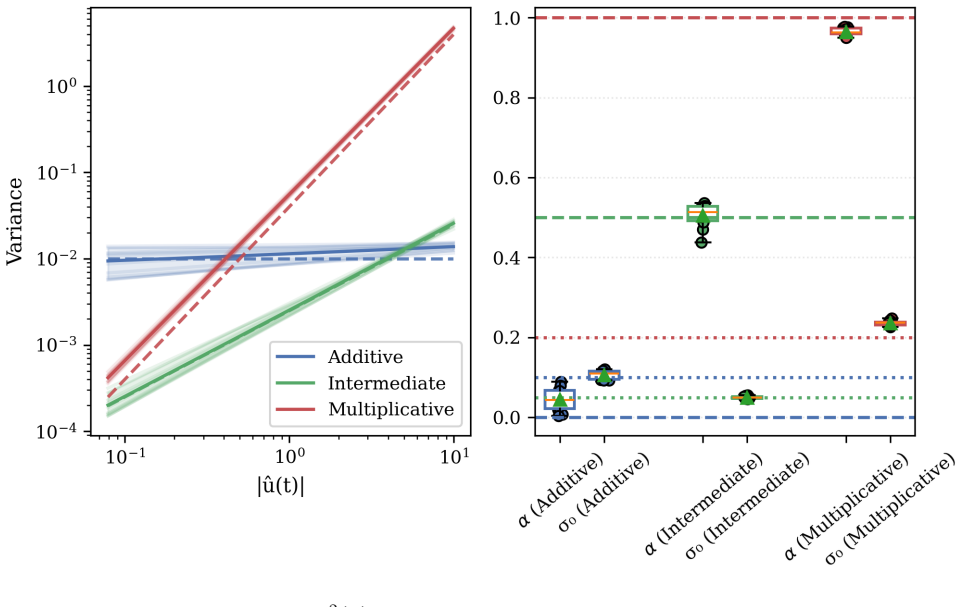
Using population growth as an example, the framework accurately recovers the underlying noise structure and improves predictions of the underlying growth laws compared to existing approaches. This establishes a general likelihood-based framework for jointly learning dynamics and heteroscedastic noise within mechanistic neural network approaches.
What carries the argument
A likelihood-based extension to Biologically-Informed Neural Networks that adds a learnable noise model optimized jointly with the dynamics.
If this is right
- The method recovers the true noise structure from sparse observations of population growth.
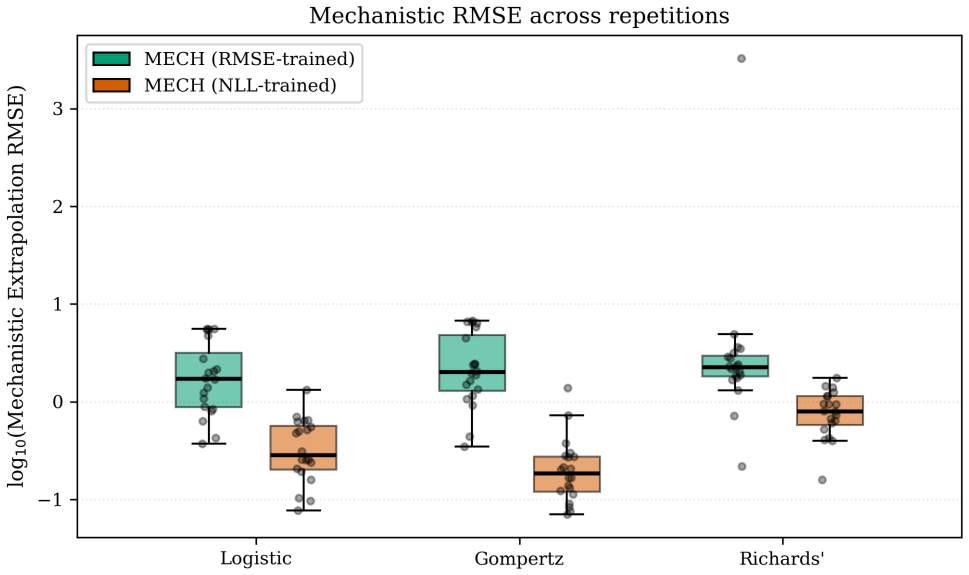
- Predictions of the growth law improve relative to models that assume constant noise.
- The same joint-learning procedure applies to other mechanistic neural-network settings beyond growth models.
- Noise discovery becomes part of the same training loop rather than a separate post-processing step.
Where Pith is reading between the lines
- If the noise model is recovered reliably, experimenters could use it to design sampling strategies that reduce uncertainty in future data collection.
- The approach might allow direct comparison of competing mechanistic hypotheses by letting each hypothesis carry its own best noise model.
- Extensions to spatial or multi-population systems would test whether the same joint optimization remains stable when dimensionality increases.
Load-bearing premise
The joint optimization of dynamics and noise parameters remains identifiable and does not suffer from trade-offs that allow multiple equally good explanations of the same data.
What would settle it
A dataset in which two different pairs of dynamics and noise models achieve equally low likelihood on the observations would show that unique recovery is not guaranteed.
Figures

read the original abstract
In recent years, neural ordinary differential equation frameworks such as Biologically-Informed Neural Networks (BINNs) have shown promise for learning mechanistic laws from sparse data. However, most existing approaches implicitly assume homoscedastic Gaussian noise, and therefore do not account for potentially meaningful structure in biological variability. Here, we present an extension to the existing BINNs framework that includes a learnable noise model, allowing discovery of the noise model directly from data. Using population growth as an example, we demonstrate that the framework accurately recovers the underlying noise structure and improves predictions of the underlying growth laws compared to existing approaches. As such, this work establishes a general likelihood-based framework for jointly learning dynamics and heteroscedastic noise within mechanistic neural network approaches.
Editorial analysis
A structured set of objections, weighed in public.
Referee Report
Summary. The manuscript extends Biologically-Informed Neural Networks (BINNs) with a likelihood-based framework that jointly optimizes mechanistic dynamics and a learnable heteroscedastic noise model. Using simulated population-growth data as the running example, it claims that the approach recovers the true noise structure and yields improved predictions of the underlying growth laws relative to homoscedastic baselines.
Significance. If the joint optimization is identifiable, the framework would address a genuine limitation of existing BINN-style methods by allowing discovery of structured biological variability. The use of simulated data to test recovery is a positive step, but the absence of any identifiability analysis or ablation that isolates dynamics from noise reduces the strength of the central claim.
major comments (1)
- [Methods / Results] The central claim that the framework 'accurately recovers the underlying noise structure' (abstract) rests on the assumption that maximizing the joint likelihood separates dynamics from noise without compensatory trade-offs. No identifiability analysis, Hessian diagnostic, or ablation that fixes one component while varying the other is provided; different (dynamics, noise) pairs can produce nearly identical marginal likelihoods under sparse sampling or flexible state-dependent variance, which directly threatens the reported improvement over homoscedastic baselines.
minor comments (1)
- The abstract and introduction would benefit from explicit statements of the noise-model families considered (e.g., state-dependent variance forms) and the quantitative recovery metrics (e.g., parameter error, predictive log-likelihood) used to claim superiority.
Simulated Author's Rebuttal
We thank the referee for their constructive comments. We address the major concern regarding the identifiability of the joint optimization below.
read point-by-point responses
-
Referee: [Methods / Results] The central claim that the framework 'accurately recovers the underlying noise structure' (abstract) rests on the assumption that maximizing the joint likelihood separates dynamics from noise without compensatory trade-offs. No identifiability analysis, Hessian diagnostic, or ablation that fixes one component while varying the other is provided; different (dynamics, noise) pairs can produce nearly identical marginal likelihoods under sparse sampling or flexible state-dependent variance, which directly threatens the reported improvement over homoscedastic baselines.
Authors: We appreciate the referee's point on the need for identifiability analysis. In our work, we used simulated data with known ground truth to demonstrate that the framework recovers both the correct growth dynamics and the heteroscedastic noise structure. Multiple random initializations consistently converged to the true parameters, providing empirical evidence of separation. Nevertheless, we agree that a more rigorous analysis would strengthen the manuscript. In the revision, we will add a discussion of identifiability considerations and include an ablation study where the noise model is fixed to homoscedastic while learning dynamics, and vice versa, to isolate the contributions. This will better support the claimed improvements. revision: yes
Circularity Check
No circularity: framework and recovery claims are externally validated on simulated data
full rationale
The provided abstract and context describe an extension of BINNs that jointly optimizes dynamics and a learnable heteroscedastic noise model via likelihood. No equations or steps are quoted that reduce a claimed prediction to a fitted parameter by construction, nor does any load-bearing premise rely on a self-citation chain. Recovery of noise structure and growth laws is demonstrated on simulated population-growth data against homoscedastic baselines, constituting an independent benchmark rather than a renaming or self-definition. The identifiability assumption is a modeling risk but does not trigger any of the enumerated circularity patterns.
Axiom & Free-Parameter Ledger
Reference graph
Works this paper leans on
-
[1]
Springer, Germany, 1993
James D Murray.Mathematical Biology. Springer, Germany, 1993
1993
-
[2]
Modeling collective cell migration in a data-rich age: Challenges and opportunities for data-driven modeling.Cold Spring Harbor Perspectives in Biology, page a041757, 2026
Ruth E Baker, Rebecca M Crossley, Carles Falc´ o, and Simon F Martina-Perez. Modeling collective cell migration in a data-rich age: Challenges and opportunities for data-driven modeling.Cold Spring Harbor Perspectives in Biology, page a041757, 2026
2026
-
[3]
Maziar Raissi, Paris Perdikaris, and George E Karniadakis. Physics-informed neural networks: 24 A deep learning framework for solving forward and inverse problems involving nonlinear partial differential equations.Journal of Computational Physics, 378:686–707, 2019
2019
-
[4]
Physics-informed learning machines for partial dif- ferential equations: Gaussian processes versus neural networks
Guofei Pang and George E Karniadakis. Physics-informed learning machines for partial dif- ferential equations: Gaussian processes versus neural networks. InEmerging Frontiers in Nonlinear Science, pages 323–343. Springer, 2020
2020
-
[5]
Biologically-informed neural networks guide mechanistic modeling from sparse experimental data.PLoS Computational Biology, 16(12):e1008462, 2020
John H Lagergren, John T Nardini, Ruth E Baker, Matthew J Simpson, and Kevin B Flores. Biologically-informed neural networks guide mechanistic modeling from sparse experimental data.PLoS Computational Biology, 16(12):e1008462, 2020
2020
-
[6]
Forecasting and predicting stochastic agent-based model data with biologically-informed neural networks.Bulletin of Mathematical Biology, 86(11):130, 2024
John T Nardini. Forecasting and predicting stochastic agent-based model data with biologically-informed neural networks.Bulletin of Mathematical Biology, 86(11):130, 2024
2024
-
[7]
Gaussian pro- cess approximations of stochastic differential equations
Cedric Archambeau, Dan Cornford, Manfred Opper, and John Shawe-Taylor. Gaussian pro- cess approximations of stochastic differential equations. InGaussian Processes in Practice, pages 1–16. Proceedings of Machine Learning Research, 2007
2007
-
[8]
AI Feynman: A physics-inspired method for sym- bolic regression.Science Advances, 6(16), 2020
Silviu-Marian Udrescu and Max Tegmark. AI Feynman: A physics-inspired method for sym- bolic regression.Science Advances, 6(16), 2020
2020
-
[9]
Discovering governing equations from data by sparse identification of nonlinear dynamical systems.Proceedings of the National Academy of Sciences, 113(15):3932–3937, 2016
Steven L Brunton, Joshua L Proctor, and J Nathan Kutz. Discovering governing equations from data by sparse identification of nonlinear dynamical systems.Proceedings of the National Academy of Sciences, 113(15):3932–3937, 2016
2016
-
[10]
Movida: multiomics visible drug activity prediction with a biologically informed neural net- work model.Bioinformatics, 39(7):btad432, 2023
Luigi Ferraro, Giovanni Scala, Luigi Cerulo, Emanuele Carosati, and Michele Ceccarelli. Movida: multiomics visible drug activity prediction with a biologically informed neural net- work model.Bioinformatics, 39(7):btad432, 2023
2023
-
[11]
Interpreting biologically informed 25 neural networks for enhanced proteomic biomarker discovery and pathway analysis.Nature Communications, 14(1):5359, 2023
Erik Hartman, Aaron M Scott, Christofer Karlsson, Tirthankar Mohanty, Suvi T Vaara, Adam Linder, Lars Malmstr¨ om, and Johan Malmstr¨ om. Interpreting biologically informed 25 neural networks for enhanced proteomic biomarker discovery and pathway analysis.Nature Communications, 14(1):5359, 2023
2023
-
[12]
Biologically informed neuralodes for genome-wide regulatory dynamics.Genome Biology, 25(1):127, 2024
Intekhab Hossain, Viola Fanfani, Jonas Fischer, John Quackenbush, and Rebekka Burkholz. Biologically informed neuralodes for genome-wide regulatory dynamics.Genome Biology, 25(1):127, 2024
2024
-
[13]
Beyond the black box with biologically informed neural networks.Nature Reviews Genetics, pages 1–2, 2025
David A Selby, Maximilian Sprang, Jan Ewald, and Sebastian J Vollmer. Beyond the black box with biologically informed neural networks.Nature Reviews Genetics, pages 1–2, 2025
2025
-
[14]
Systems biology: Identi- fiability analysis and parameter identification via systems-biology-informed neural networks
Mitchell Daneker, Zhen Zhang, George Em Karniadakis, and Lu Lu. Systems biology: Identi- fiability analysis and parameter identification via systems-biology-informed neural networks. InComputational Modeling of Signaling Networks, pages 87–105. Springer, 2023
2023
-
[15]
Deep learning of biological models from data: applications to ODE models.Bulletin of Mathematical Biology, 83(3):19, 2021
Wei-Hung Su, Ching-Shan Chou, and Dongbin Xiu. Deep learning of biological models from data: applications to ODE models.Bulletin of Mathematical Biology, 83(3):19, 2021
2021
-
[16]
Systems biology informed deep learning for inferring parameters and hidden dynamics.PLoS Computational Biology, 16(11):e1007575, 2020
Alireza Yazdani, Lu Lu, Maziar Raissi, and George Em Karniadakis. Systems biology informed deep learning for inferring parameters and hidden dynamics.PLoS Computational Biology, 16(11):e1007575, 2020
2020
-
[17]
Robust estimation of causal heteroscedastic noise models
Quang-Duy Tran, Bao Duong, Phuoc Nguyen, and Thin Nguyen. Robust estimation of causal heteroscedastic noise models. InProceedings of the 2024 SIAM International Conference on Data Mining (SDM), pages 788–796. SIAM, 2024
2024
-
[18]
Effective Bayesian heteroscedastic regression with deep neural networks.Advances in Neural Information Pro- cessing Systems, 36:53996–54019, 2023
Alexander Immer, Emanuele Palumbo, Alexander Marx, and Julia Vogt. Effective Bayesian heteroscedastic regression with deep neural networks.Advances in Neural Information Pro- cessing Systems, 36:53996–54019, 2023
2023
-
[19]
Estimation in a heteroscedastic regression model
Herbert C Rutemiller and David A Bowers. Estimation in a heteroscedastic regression model. Journal of the American Statistical Association, 63(322):552–557, 1968. 26
1968
-
[20]
Universally sloppy parameter sensitivities in systems biology models.PLoS Computational Biology, 3(10):e189, 2007
Ryan N Gutenkunst, Joshua J Waterfall, Fergal P Casey, Kevin S Brown, Christopher R Myers, and James P Sethna. Universally sloppy parameter sensitivities in systems biology models.PLoS Computational Biology, 3(10):e189, 2007
2007
-
[21]
Parameter identifiability and model selection for sigmoid population growth models
Matthew J Simpson, Alexander P Browning, David J Warne, Oliver J Maclaren, and Ruth E Baker. Parameter identifiability and model selection for sigmoid population growth models. Journal of Theoretical Biology, 535:110998, 2022
2022
-
[22]
The Gompertz curve as a growth curve.Proceedings of the National Academy of Sciences, 18(1):1–8, 1932
Charles P Winsor. The Gompertz curve as a growth curve.Proceedings of the National Academy of Sciences, 18(1):1–8, 1932
1932
-
[23]
Richards model revisited: Validation by and application to infection dynamics.Journal of Theoretical Biology, 313:12–19, 2012
Xiang-Sheng Wang, Jianhong Wu, and Yong Yang. Richards model revisited: Validation by and application to infection dynamics.Journal of Theoretical Biology, 313:12–19, 2012
2012
-
[24]
Analysis of logistic growth models.Mathematical Biosciences, 179(1):21–55, 2002
Anastasios Tsoularis and James Wallace. Analysis of logistic growth models.Mathematical Biosciences, 179(1):21–55, 2002
2002
-
[25]
Torkel E Loman and Ruth E Baker. Functional and parametric identifiability for universal differential equations applied to chemical reaction networks.arXiv preprint arXiv:2510.14140, 2025
-
[26]
Universal Differential Equations for Scientific Machine Learning
Christopher Rackauckas, Yingbo Ma, Julius Martensen, Collin Warner, Kirill Zubov, Rohit Supekar, Dominic Skinner, Ali Ramadhan, and Alan Edelman. Universal differential equations for scientific machine learning.arXiv preprint arXiv:2001.04385, 2020. 27 Supplementary Figures Figure S1: Left: learned varianceσ 2(u) as a function of the population density,u,...
work page internal anchor Pith review Pith/arXiv arXiv 2001
discussion (0)
Sign in with ORCID, Apple, or X to comment. Anyone can read and Pith papers without signing in.