Hector Galaxy Survey: Optical IFU and Chandra Reveal a Low-Luminosity AGN Behind Extended LINER Emission
Pith reviewed 2026-06-27 03:09 UTC · model grok-4.3
The pith
Optical mapping and X-ray data show a low-luminosity AGN powers extended LINER emission where stars fall short.
A machine-rendered reading of the paper's core claim, the machinery that carries it, and where it could break.
Core claim
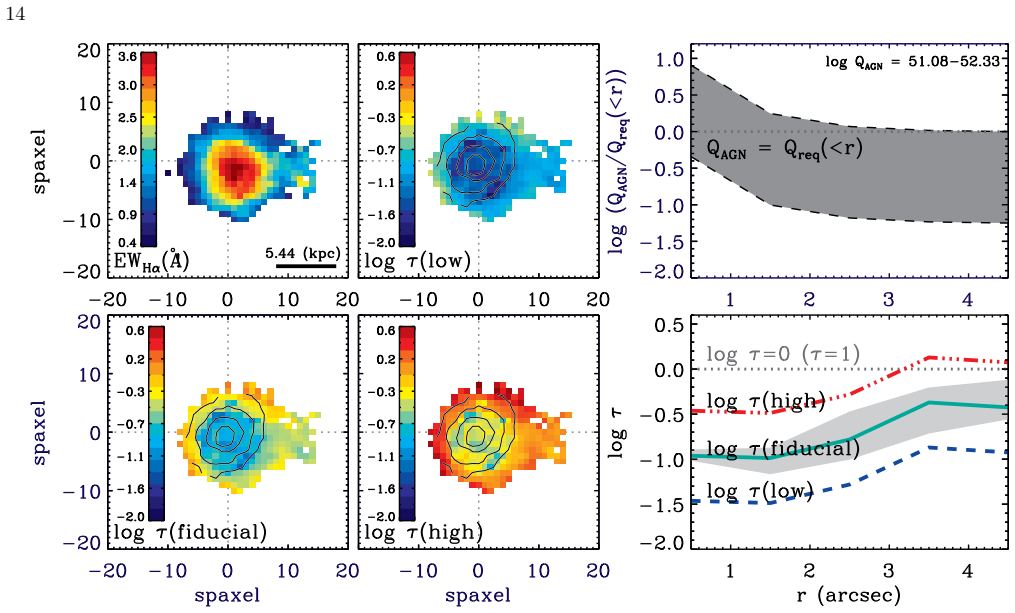
The central claim is that evolved stellar populations alone cannot account for the observed emission, that an additional nuclear ionizing source is required at least in the inner region, and that a weak LLAGN likely contributes to the ionizing budget, particularly in the inner region. This is shown by tau maps remaining below unity even in the most favorable post-AGB normalizations, by the presence of a compact X-ray source, and by the absence of shock signatures as the primary driver.
What carries the argument
Spatially resolved tau maps (Q_pAGB / Q_req) combined with a compact nuclear X-ray detection, used to test whether post-AGB stars suffice or whether a nuclear source is required.
If this is right
- Extended LINER-like emission can conceal a substantial LLAGN contribution even when traditional optical and infrared AGN indicators are weak.
- Spatially resolved photon-budget tests combined with X-ray constraints can effectively reveal such hidden activity.
- The galaxy serves as a pilot validating the photon-budget framework for identifying nuclear sources in other systems.
Where Pith is reading between the lines
- The same photon-budget plus X-ray approach could be applied to the rest of the Hector sample to estimate how often weak AGNs are missed by standard diagnostics.
- If the method proves reliable, it would lower the apparent fraction of pure star-ionized LINERs and raise the fraction of composite or AGN-hosting systems at low redshift.
- Kinematic data with higher spatial resolution could test whether any localized shock contribution alters the photon accounting in the outer regions.
Load-bearing premise
The tau maps correctly quantify a photon deficit under the chosen post-AGB normalizations and the compact X-ray source is an AGN rather than another nuclear phenomenon.
What would settle it
A revised post-AGB model that supplies enough photons across the inner region without a nuclear source, or a demonstration that the X-ray emission arises from a non-AGN process, would falsify the need for the LLAGN contribution.
Figures


read the original abstract
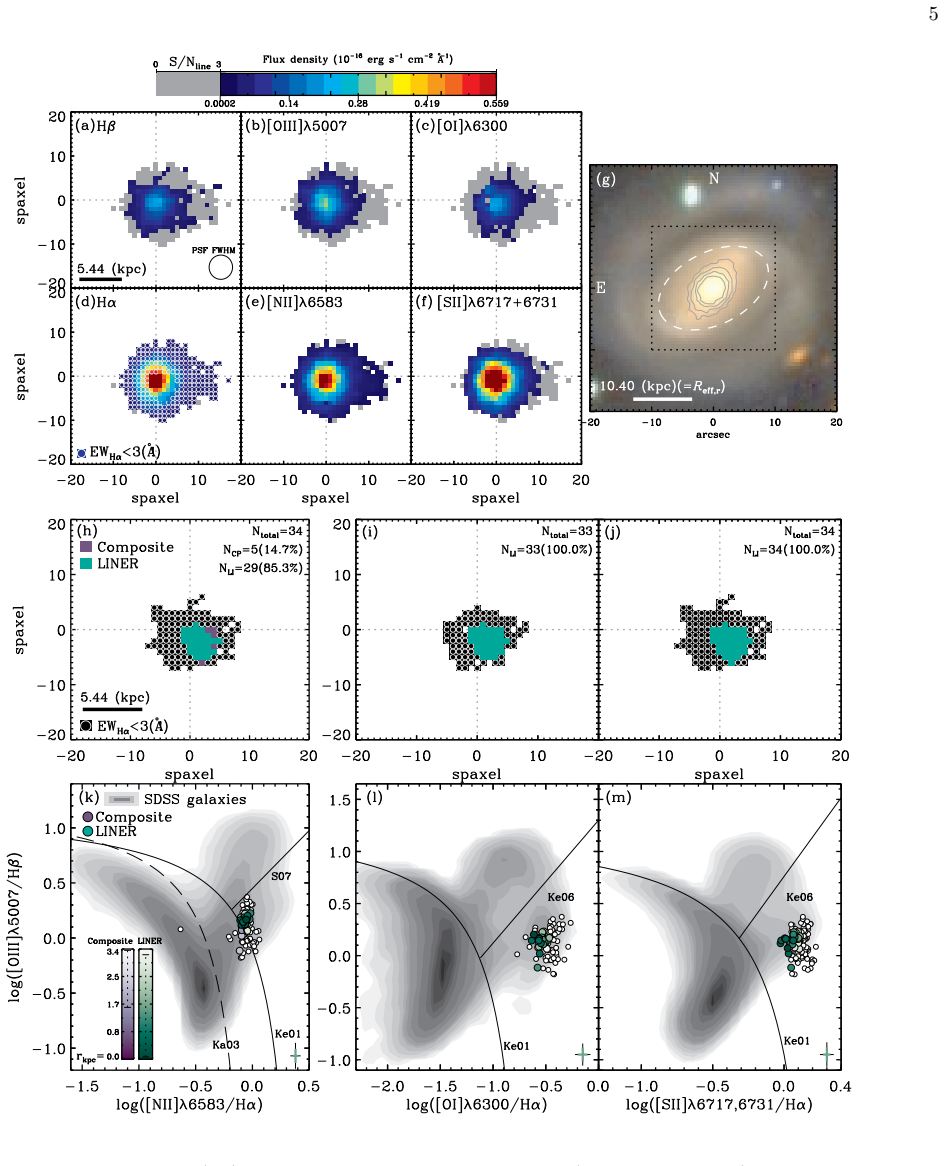
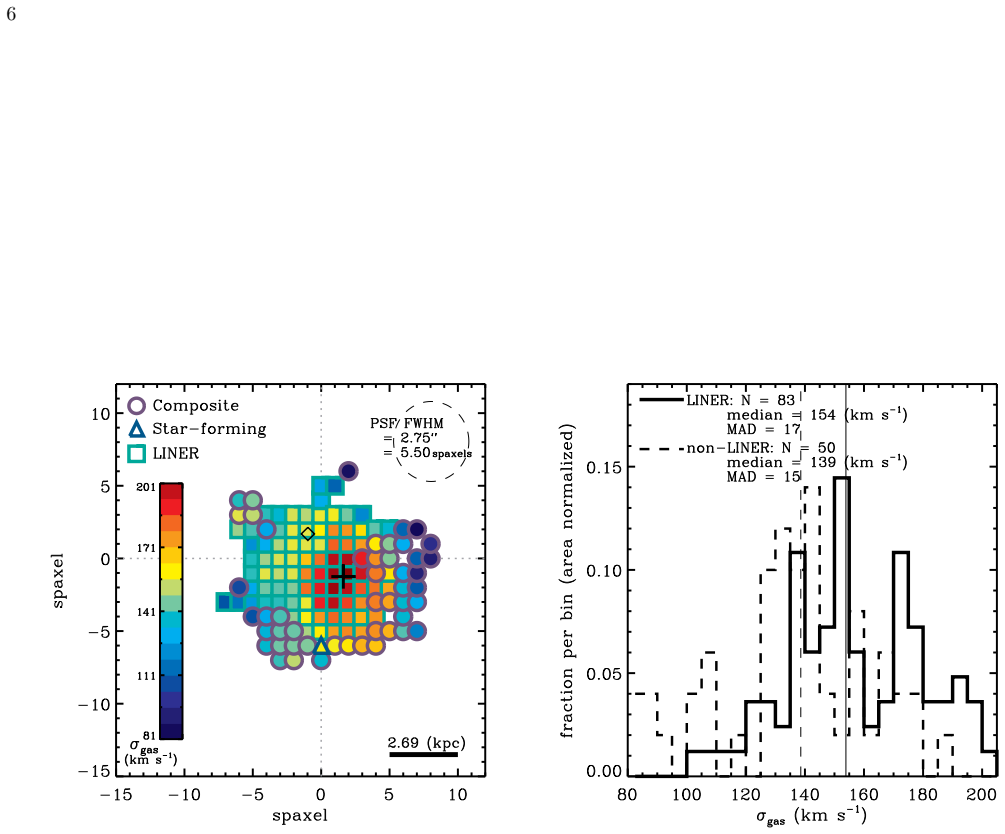
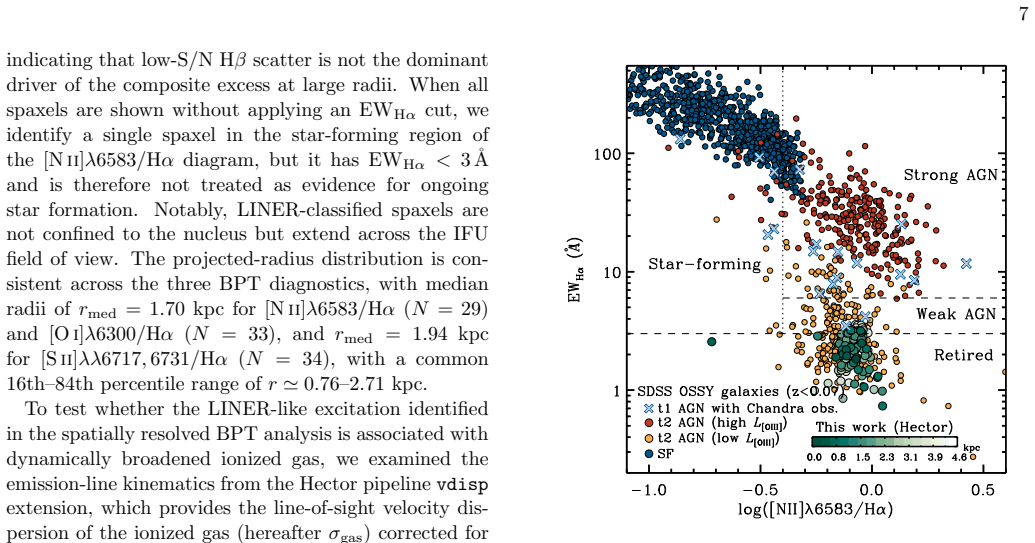
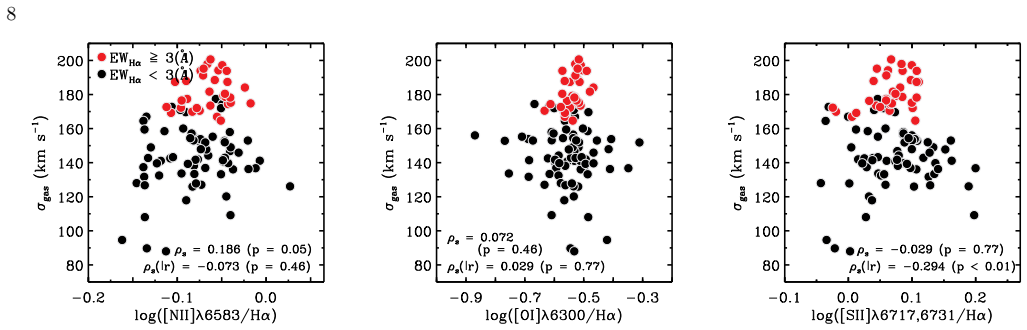
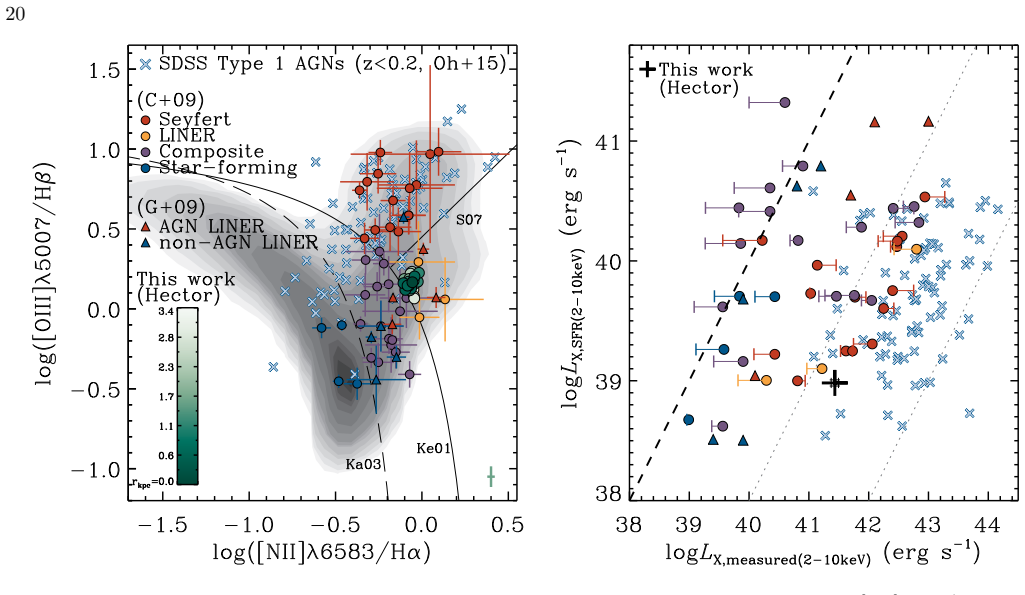
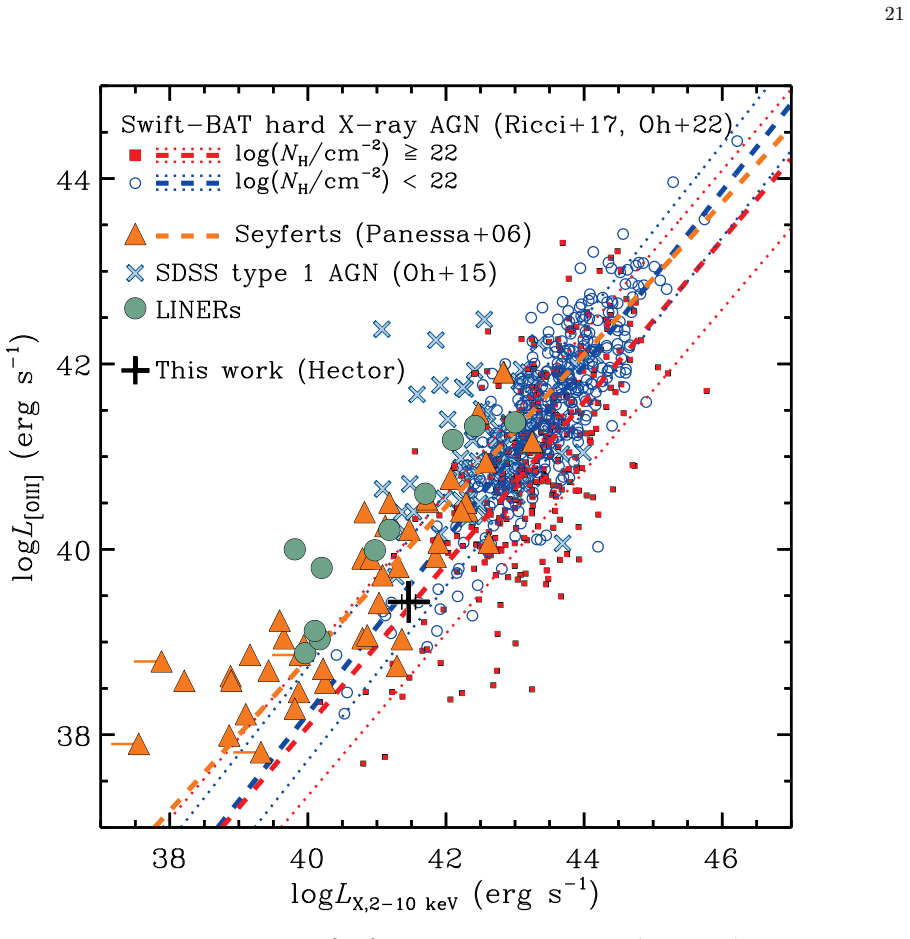
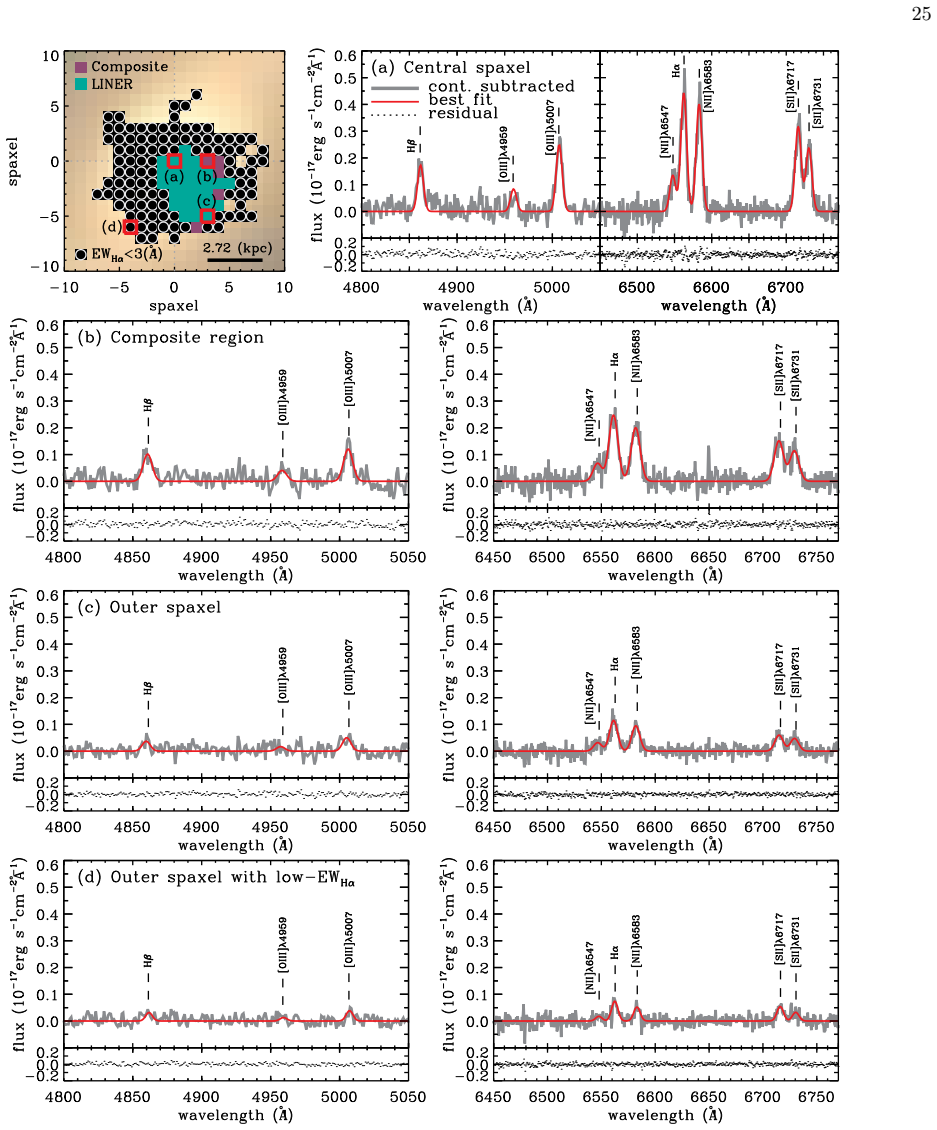
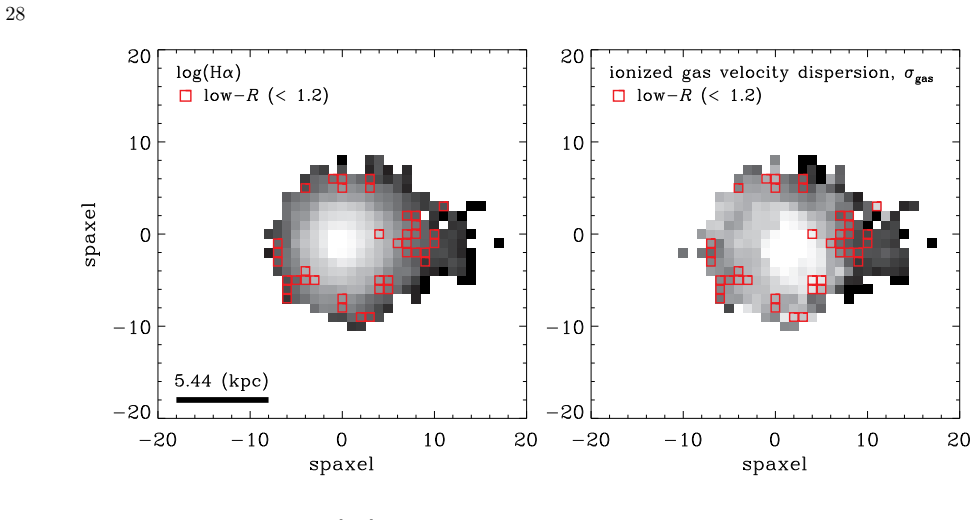
We present evidence that the Hector Galaxy Survey galaxy C901005481609968 ($z_{\rm cl}=0.0553$), which exhibits spatially extended LINER-like emission in optical integral-field spectroscopy (IFS), hosts a low-luminosity active galactic nucleus (LLAGN) that contributes substantially to its ionization budget. Although the galaxy is not selected as an AGN by mid-infrared AGN color criteria, archival Chandra data reveal a compact nuclear X-ray source with $\log L_{\rm X}\approx41.46$ erg/s, supporting the presence of an LLAGN. Spatially resolved emission-line diagnostics show LINER-like line ratios across most spaxels with $\mathrm{S/N} \geq 3$, while spatially resolved $\tau$ maps ($\tau \equiv Q_{\rm pAGB}/Q_{\rm req}$) indicate a widespread photon deficit ($\log\tau<0$ over most of the mapped region), even under the most optimistic pAGB normalizations, the nuclear region remains at $\tau < 1$. Line-ratio--kinematic tests find no evidence for shock-dominated excitation as the primary driver of the extended emission, although a localized or sub-dominant shock contribution cannot be ruled out with the present data. We use this galaxy as a pilot case because the combination of Hector IFS and an independent nuclear X-ray constraint provides a stringent validation of the spatially resolved photon-budget framework. Our results indicate that evolved stellar populations alone cannot account for the observed emission, that an additional nuclear ionizing source is required at least in the inner region, and that a weak LLAGN likely contributes to the ionizing budget, particularly in the inner region. Our results demonstrate that extended LINER-like emission can conceal a substantial LLAGN contribution even when traditional optical and infrared AGN indicators are weak, and that spatially resolved photon-budget tests combined with X-ray constraints can effectively reveal such hidden activity.
Editorial analysis
A structured set of objections, weighed in public.
Referee Report
Summary. The paper presents a pilot study of galaxy C901005481609968 (z=0.0553) from the Hector Galaxy Survey, which shows spatially extended LINER-like emission in IFS data. It argues that evolved stellar populations alone cannot explain the ionization, as spatially resolved tau maps (tau = Q_pAGB / Q_req) indicate a photon deficit (log tau <0 over most of the region, including the nucleus) even under optimistic pAGB normalizations. Archival Chandra data reveal a compact nuclear X-ray source (log L_X ≈41.46 erg/s) interpreted as a weak LLAGN contributing to the budget, particularly centrally. Line-ratio-kinematic tests rule out shocks as the primary driver. The work validates the photon-budget framework using the independent X-ray constraint and concludes that extended LINER emission can conceal substantial LLAGN activity despite weak traditional AGN indicators.
Significance. If the central claims hold after addressing uncertainties, the result would show that spatially resolved photon-budget analysis combined with X-ray data can uncover hidden LLAGNs in galaxies with extended LINER emission, even when MIR and optical diagnostics fail. This has implications for the ionization mechanisms in LINER galaxies and the demographics of low-luminosity AGN. The independent archival X-ray measurement provides external grounding for the optical tau maps, which is a strength.
major comments (2)
- [Abstract] Abstract: The claim that evolved stellar populations cannot account for the emission (and thus a nuclear source is required) rests on tau maps showing log tau <0 even under optimistic pAGB normalizations. However, the manuscript supplies no quantitative error analysis or sensitivity tests to variations in the pAGB normalization factor (explicitly a free parameter in the reader's assessment), nor to potential underestimates in Q_req from extinction or aperture effects; this makes the robustness of the deficit unclear and is load-bearing for the central conclusion.
- [Abstract] Abstract: The interpretation of the compact Chandra source (log L_X ≈41.46 erg/s) as an LLAGN contributing to the ionizing budget is load-bearing but not independently secured. The paper notes the source is not MIR-selected as AGN, yet alternatives such as a nuclear X-ray binary or hot gas are not quantitatively ruled out via luminosity functions, spectral properties, or multiwavelength comparisons; this weakens the validation of the photon-budget framework.
minor comments (1)
- The manuscript would benefit from inclusion of full data tables for the tau maps, line ratios, and X-ray properties, along with explicit handling of uncertainties, to support reproducibility.
Simulated Author's Rebuttal
We thank the referee for their thoughtful and constructive report. The two major comments identify important areas where the robustness of our central claims can be strengthened. We address each below and indicate the revisions we will make.
read point-by-point responses
-
Referee: [Abstract] Abstract: The claim that evolved stellar populations cannot account for the emission (and thus a nuclear source is required) rests on tau maps showing log tau <0 even under optimistic pAGB normalizations. However, the manuscript supplies no quantitative error analysis or sensitivity tests to variations in the pAGB normalization factor (explicitly a free parameter in the reader's assessment), nor to potential underestimates in Q_req from extinction or aperture effects; this makes the robustness of the deficit unclear and is load-bearing for the central conclusion.
Authors: We agree that the absence of explicit sensitivity tests leaves the photon-deficit conclusion less secure than it could be. In the revised manuscript we will add a dedicated subsection (and supplementary figures) that (i) varies the pAGB normalization factor over a factor of five around the fiducial value, (ii) propagates the dominant uncertainties in the extinction correction and in the adopted aperture for Q_req, and (iii) shows the resulting range of log tau maps. These tests will quantify how far the deficit persists under conservative assumptions and will be referenced in the abstract. revision: yes
-
Referee: [Abstract] Abstract: The interpretation of the compact Chandra source (log L_X ≈41.46 erg/s) as an LLAGN contributing to the ionizing budget is load-bearing but not independently secured. The paper notes the source is not MIR-selected as AGN, yet alternatives such as a nuclear X-ray binary or hot gas are not quantitatively ruled out via luminosity functions, spectral properties, or multiwavelength comparisons; this weakens the validation of the photon-budget framework.
Authors: We acknowledge that a single archival Chandra detection does not by itself exclude a nuclear X-ray binary or a compact hot-gas component. In revision we will (i) compare the observed luminosity and hardness ratio to the expected XRB luminosity function for a galaxy of this stellar mass and SFR, (ii) note that the source is unresolved at Chandra resolution while hot gas in early-type galaxies is typically more extended, and (iii) add a short paragraph discussing the multi-wavelength context (weak MIR, strong central LINER, photon deficit). These additions will make the LLAGN interpretation more balanced while preserving the paper’s main point that the X-ray detection provides an independent consistency check on the optical tau maps. revision: partial
Circularity Check
No significant circularity: photon-budget maps and archival X-ray data are independent of the target conclusion
full rationale
The paper computes tau = Q_pAGB/Q_req maps from standard stellar population models (with explicit optimistic normalizations) and observed emission-line fluxes, then compares to an independent archival Chandra X-ray detection (log L_X ≈ 41.46). Neither step fits parameters to the final claim nor reduces the deficit conclusion to a self-citation or redefinition. Line-ratio-kinematic tests are likewise external to the result. The central claim therefore rests on externally grounded inputs rather than construction from its own outputs.
Axiom & Free-Parameter Ledger
free parameters (1)
- pAGB normalization factor
axioms (2)
- domain assumption LINER-like line ratios trace photoionization rather than shocks or other mechanisms as primary driver
- domain assumption Compact nuclear X-ray source indicates LLAGN activity
Reference graph
Works this paper leans on
-
[1]
, archivePrefix = "arXiv", eprint =
Allen, M. G., Groves, B. A., Dopita, M. A., Sutherland, R. S., & Kewley, L. J. 2008, ApJS, 178, 20, doi: 10.1086/589652
-
[2]
Arnaud, K. A. 1996, in Astronomical Society of the Pacific Conference Series, Vol. 101, Astronomical Data Analysis Software and Systems V, ed. G. H. Jacoby & J. Barnes, 17
1996
-
[3]
Bacon, R., Copin, Y., Monnet, G., et al. 2001, MNRAS, 326, 23, doi: 10.1046/j.1365-8711.2001.04612.x
-
[4]
Baldwin, J. A., Phillips, M. M., & Terlevich, R. 1981, PASP, 93, 5, doi: 10.1086/130766
-
[5]
2016, A&A, 586, A48, doi: 10.1051/0004-6361/201526927
Marconi, A. 2016, A&A, 586, A48, doi: 10.1051/0004-6361/201526927
-
[6]
2019, MNRAS, 482, 3915, doi: 10.1093/mnras/sty2935
Baron, D., & Netzer, H. 2019, MNRAS, 482, 3915, doi: 10.1093/mnras/sty2935
-
[7]
, archivePrefix = "arXiv", eprint =
Belfiore, F., Maiolino, R., Maraston, C., et al. 2016, MNRAS, 461, 3111, doi: 10.1093/mnras/stw1234
-
[8]
Belfiore, F., Westfall, K. B., Schaefer, A., et al. 2019, AJ, 158, 160, doi: 10.3847/1538-3881/ab3e4e
-
[9]
G., Stasi´ nska, G., & Bruzual, A
Binette, L., Magris, C. G., Stasi´ nska, G., & Bruzual, A. G. 1994, A&A, 292, 13
1994
-
[10]
Binette, L., Zovaro, H. R. M., Villar Mart´ ın, M., et al. 2024, A&A, 684, A53, doi: 10.1051/0004-6361/202245754
-
[11]
2011, Optics Express, 19, 2649, doi: 10.1364/OE.19.002649
Bland-Hawthorn, J., Bryant, J., Robertson, G., et al. 2011, Optics Express, 19, 2649, doi: 10.1364/OE.19.002649
-
[12]
Blanton, M. R., & Roweis, S. 2007, AJ, 133, 734, doi: 10.1086/510127
-
[13]
2025, astropy/photutils: 2.2.0, 2.2.0 Zenodo, doi: 10.5281/zenodo.14889440
Bradley, L., Sip˝ ocz, B., Robitaille, T., et al. 2025, astropy/photutils: 2.2.0, 2.2.0 Zenodo, doi: 10.5281/zenodo.14889440
-
[14]
Brown, R., Wang, A. H., Bryant, J. J., & Leon-Saval, S. 2018, in SPIE Conference Series, Vol. 10706, Advances in Optical and Mechanical Technologies for Telescopes and Instrumentation III, ed. R. Navarro & R. Geyl, 1070663, doi: 10.1117/12.2313033
-
[15]
Lawrence, J. S., & Croom, S. M. 2014, MNRAS, 438, 869, doi: 10.1093/mnras/stt2254
-
[16]
, archivePrefix = "arXiv", eprint =
Bryant, J. J., Owers, M. S., Robotham, A. S. G., et al. 2015, MNRAS, 447, 2857, doi: 10.1093/mnras/stu2635
-
[17]
J., Oh, S., Gunawardhana, M., et al
Bryant, J. J., Oh, S., Gunawardhana, M., et al. 2024, in SPIE Conference Series, Vol. 13096, Ground-based and Airborne Instrumentation for Astronomy X, ed. J. J
2024
-
[18]
Bryant, K. Motohara, & J. R. D. Vernet, 130960D, doi: 10.1117/12.3016340
-
[19]
, archivePrefix = "arXiv", eprint =
Bundy, K., Bershady, M. A., Law, D. R., et al. 2015, ApJ, 798, 7, doi: 10.1088/0004-637X/798/1/7
work page internal anchor Pith review doi:10.1088/0004-637x/798/1/7 2015
-
[20]
Byler, N., Dalcanton, J. J., Conroy, C., et al. 2019, AJ, 158, 2, doi: 10.3847/1538-3881/ab1b70
-
[21]
G., Ignesti, A., Gitti, M., et al
Campitiello, M. G., Ignesti, A., Gitti, M., et al. 2021, ApJ, 911, 144, doi: 10.3847/1538-4357/abec82
-
[22]
Cappellari, M. 2002, MNRAS, 333, 400, doi: 10.1046/j.1365-8711.2002.05412.x
-
[23]
, archivePrefix = "arXiv", eprint =
Cappellari, M. 2017, MNRAS, 466, 798, doi: 10.1093/mnras/stw3020
work page internal anchor Pith review doi:10.1093/mnras/stw3020 2017
-
[24]
2023, MNRAS, 526, 3273, doi: 10.1093/mnras/stad2597
Cappellari, M. 2023, MNRAS, 526, 3273, doi: 10.1093/mnras/stad2597
-
[25]
Cappellari, M., & Emsellem, E. 2004, PASP, 116, 138, doi: 10.1086/381875
work page internal anchor Pith review doi:10.1086/381875 2004
-
[26]
Cappellari, M., McDermid, R. M., Alatalo, K., et al. 2012, Nature, 484, 485, doi: 10.1038/nature10972
-
[27]
Cardelli, J. A., Clayton, G. C., & Mathis, J. S. 1989, ApJ, 345, 245, doi: 10.1086/167900
-
[28]
1979, ApJ, 228, 939, doi: 10.1086/156922 30 C ¸ akır, O., Owers, M
Cash, W. 1979, ApJ, 228, 939, doi: 10.1086/156922 30 C ¸ akır, O., Owers, M. S., Cortese, L., et al. 2026, PASA, 43, e029, doi: 10.1017/pasa.2026.10157 Cid Fernandes, R., Stasi´ nska, G., Mateus, A., & Vale Asari, N. 2011, MNRAS, 413, 1687, doi: 10.1111/j.1365-2966.2011.18244.x
-
[29]
2009, ApJ, 705, 1336, doi: 10.1088/0004-637X/705/2/1336
Constantin, A., Green, P., Aldcroft, T., et al. 2009, ApJ, 705, 1336, doi: 10.1088/0004-637X/705/2/1336
-
[30]
2018, in SPIE Conference Series, Vol
Zhelem, R. 2018, in SPIE Conference Series, Vol. 10702, Ground-based and Airborne Instrumentation for Astronomy VII, ed. C. J. Evans, L. Simard, & H. Takami, 107028I, doi: 10.1117/12.2314436
-
[31]
Croom, S. M., Lawrence, J. S., Bland-Hawthorn, J., et al. 2012, MNRAS, 421, 872, doi: 10.1111/j.1365-2966.2011.20365.x D’Agostino, J. J., Kewley, L. J., Groves, B. A., et al. 2019, MNRAS, 485, L38, doi: 10.1093/mnrasl/slz028
-
[32]
Davies, R. I., Maciejewski, W., Hicks, E. K. S., et al. 2014, ApJ, 792, 101, doi: 10.1088/0004-637X/792/2/101
-
[33]
Dey, A., Schlegel, D. J., Lang, D., et al. 2019, AJ, 157, 168, doi: 10.3847/1538-3881/ab089d
-
[34]
Dopita, M. A., & Sutherland, R. S. 1995, ApJ, 455, 468, doi: 10.1086/176596
-
[35]
Dopita, M. A., & Sutherland, R. S. 1996, ApJS, 102, 161, doi: 10.1086/192255
-
[36]
, archivePrefix = "arXiv", eprint =
Drory, N., MacDonald, N., Bershady, M. A., et al. 2015, AJ, 149, 77, doi: 10.1088/0004-6256/149/2/77
-
[37]
P., Satyapal, S., Gliozzi, M., & Sambruna, R
Dudik, R. P., Satyapal, S., Gliozzi, M., & Sambruna, R. M. 2005, ApJ, 620, 113, doi: 10.1086/426856
-
[38]
Elvis, M., Wilkes, B. J., McDowell, J. C., et al. 1994, ApJS, 95, 1, doi: 10.1086/192093
-
[39]
1994, A&A, 285, 723
Emsellem, E., Monnet, G., & Bacon, R. 1994, A&A, 285, 723
1994
-
[40]
Eracleous, M., Hwang, J. A., & Flohic, H. M. L. G. 2010, ApJS, 187, 135, doi: 10.1088/0067-0049/187/1/135
-
[41]
Ferland, G. J., & Netzer, H. 1983, ApJ, 264, 105, doi: 10.1086/160577
-
[42]
Ferland, G. J., Chatzikos, M., Guzm´ an, F., et al. 2017, RMxAA, 53, 385, doi: 10.48550/arXiv.1705.10877
-
[43]
Filho, M. E., Fraternali, F., Markoff, S., et al. 2004, A&A, 418, 429, doi: 10.1051/0004-6361:20034486
-
[44]
Fogarty, L. M. R., Bland-Hawthorn, J., Croom, S. M., et al. 2012, ApJ, 761, 169, doi: 10.1088/0004-637X/761/2/169 F¨ orster Schreiber, N. M., Renzini, A., Mancini, C., et al. 2018, ApJS, 238, 21, doi: 10.3847/1538-4365/aadd49
-
[45]
Fruscione, A., McDowell, J. C., Allen, G. E., et al. 2006, in SPIE Conference Series, Vol. 6270, Observatory Operations: Strategies, Processes, and Systems, ed. D. R. Silva & R. E. Doxsey, 62701V, doi: 10.1117/12.671760
-
[46]
2D emission-line patterns and kinematics for 32 galaxies
Gomes, J. M., Papaderos, P., Kehrig, C., et al. 2016, A&A, 588, A68, doi: 10.1051/0004-6361/201525976 G´ omez-Guijarro, C., Gonz´ alez-Mart´ ın, O., Ramos Almeida, C., Rodr´ ıguez-Espinosa, J. M., & Gallego, J. 2017, MNRAS, 469, 2720, doi: 10.1093/mnras/stx1037 Gonz´ alez-Mart´ ın, O., Masegosa, J., M´ arquez, I., Guainazzi, M., & Jim´ enez-Bail´ on, E. 2...
-
[47]
Groves, B., Brinchmann, J., & Walcher, C. J. 2012, MNRAS, 419, 1402, doi: 10.1111/j.1365-2966.2011.19796.x
-
[48]
Halpern, J. P., & Steiner, J. E. 1983, ApJL, 269, L37, doi: 10.1086/184051
-
[49]
Heckman, T. M. 1980, A&A, 87, 152
1980
-
[50]
Ho, I.-T., Kewley, L. J., Dopita, M. A., et al. 2014, MNRAS, 444, 3894, doi: 10.1093/mnras/stu1653
-
[51]
Ho, I. T., Medling, A. M., Groves, B., et al. 2016, Ap&SS, 361, 280, doi: 10.1007/s10509-016-2865-2
-
[52]
Ho, L. C. 2008, ARA&A, 46, 475, doi: 10.1146/annurev.astro.45.051806.110546
work page internal anchor Pith review Pith/arXiv arXiv doi:10.1146/annurev.astro.45.051806.110546 2008
-
[53]
Ho, L. C., Filippenko, A. V., Sargent, W. L. W., & Peng, C. Y. 1997, ApJS, 112, 391, doi: 10.1086/313042
-
[54]
Ho, L. C., Feigelson, E. D., Townsley, L. K., et al. 2001, ApJL, 549, L51, doi: 10.1086/319138
-
[55]
H., Cohen, M., Masci, F., et al
Jarrett, T. H., Cohen, M., Masci, F., et al. 2011, ApJ, 735, 112, doi: 10.1088/0004-637X/735/2/112
-
[56]
2018, A&A, 618, A6, doi: 10.1051/0004-6361/201832790
Kakkad, D., Groves, B., Dopita, M., et al. 2018, A&A, 618, A6, doi: 10.1051/0004-6361/201832790
-
[57]
Kauffmann, G., Heckman, T. M., Tremonti, C., et al. 2003, MNRAS, 346, 1055, doi: 10.1111/j.1365-2966.2003.07154.x
-
[58]
Theoretical Modeling of Starburst Galaxies
Kewley, L. J., Dopita, M. A., Sutherland, R. S., Heisler, C. A., & Trevena, J. 2001, ApJ, 556, 121, doi: 10.1086/321545
work page internal anchor Pith review doi:10.1086/321545 2001
-
[59]
Kewley, L. J., Groves, B., Kauffmann, G., & Heckman, T. 2006, MNRAS, 372, 961, doi: 10.1111/j.1365-2966.2006.10859.x
-
[60]
Kormendy, J., & Ho, L. C. 2013, ARA&A, 51, 511, doi: 10.1146/annurev-astro-082708-101811
work page internal anchor Pith review doi:10.1146/annurev-astro-082708-101811 2013
-
[61]
2017, ApJ, 850, 74, doi: 10.3847/1538-4357/aa8ec9
Koss, M., Trakhtenbrot, B., Ricci, C., et al. 2017, ApJ, 850, 74, doi: 10.3847/1538-4357/aa8ec9
-
[62]
J., Ricci, C., Trakhtenbrot, B., et al
Koss, M. J., Ricci, C., Trakhtenbrot, B., et al. 2022, ApJS, 261, 2, doi: 10.3847/1538-4365/ac6c05
-
[63]
2025, MNRAS, 542, 1901, doi: 10.1093/mnras/staf1280
Kurinchi-Vendhan, S., Rohr, E., Pillepich, A., et al. 2025, MNRAS, 542, 1901, doi: 10.1093/mnras/staf1280
-
[64]
Lee, M.-Y. L., Yan, R., Ji, X., et al. 2024, A&A, 690, A83, doi: 10.1051/0004-6361/202348459
-
[65]
Lehmer, B. D., Alexander, D. M., Bauer, F. E., et al. 2010, ApJ, 724, 559, doi: 10.1088/0004-637X/724/1/559 31
-
[66]
Luridiana, V., Morisset, C., & Shaw, R. A. 2015, A&A, 573, A42, doi: 10.1051/0004-6361/201323152
-
[67]
Mateos, S., Alonso-Herrero, A., Carrera, F. J., et al. 2012, MNRAS, 426, 3271, doi: 10.1111/j.1365-2966.2012.21843.x
-
[68]
2022, in SPIE Conference Series, Vol
Mohanan, M., Bryant, J., Brown, R., et al. 2022, in SPIE Conference Series, Vol. 12184, Ground-based and Airborne Instrumentation for Astronomy IX, ed. C. J
2022
-
[69]
Evans, J. J. Bryant, & K. Motohara, 121847P, doi: 10.1117/12.2630617
-
[70]
Narayan, R., & McClintock, J. E. 2008, NewAR, 51, 733, doi: 10.1016/j.newar.2008.03.002
-
[71]
Oh, K., Sarzi, M., Schawinski, K., & Yi, S. K. 2011, ApJS, 195, 13, doi: 10.1088/0067-0049/195/2/13
-
[72]
Oh, K., Yi, S. K., Schawinski, K., et al. 2015, ApJS, 219, 1, doi: 10.1088/0067-0049/219/1/1
-
[73]
Oh, K., Koss, M. J., Ueda, Y., et al. 2022, ApJS, 261, 4, doi: 10.3847/1538-4365/ac5b68
-
[74]
2025, PASJ, 77, 562, doi: 10.1093/pasj/psaf025
Oh, K., Ueda, Y., Yamada, S., et al. 2025, PASJ, 77, 562, doi: 10.1093/pasj/psaf025
-
[75]
2024, MNRAS, 531, 4017, doi: 10.1093/mnras/stae1382
Oh, S., Colless, M., Barsanti, S., et al. 2024, MNRAS, 531, 4017, doi: 10.1093/mnras/stae1382
-
[76]
2025, PASA, 42, e150, doi: 10.1017/pasa.2025.10106
Oh, S., Gunawardhana, M., Croom, S., et al. 2025, PASA, 42, e150, doi: 10.1017/pasa.2025.10106
-
[77]
E., & Ferland, G
Osterbrock, D. E., & Ferland, G. J. 2006, Astrophysics of gaseous nebulae and active galactic nuclei (University Science Books)
2006
-
[78]
Owers, M. S., Couch, W. J., & Nulsen, P. E. J. 2009, ApJ, 693, 901, doi: 10.1088/0004-637X/693/1/901
-
[79]
Owers, M. S., Hudson, M. J., Oman, K. A., et al. 2019, ApJ, 873, 52, doi: 10.3847/1538-4357/ab0201
-
[80]
2006, A&A, 455, 173, doi: 10.1051/0004-6361:20064894
Panessa, F., Bassani, L., Cappi, M., et al. 2006, A&A, 455, 173, doi: 10.1051/0004-6361:20064894
discussion (0)
Sign in with ORCID, Apple, or X to comment. Anyone can read and Pith papers without signing in.