A catalogue of TeV pulsar environments
Pith reviewed 2026-06-26 23:44 UTC · model grok-4.3
The pith
A catalogue of 128 TeV sources from 66 pulsars finds only weak correlation between luminosity and pulsar age.
A machine-rendered reading of the paper's core claim, the machinery that carries it, and where it could break.
Core claim
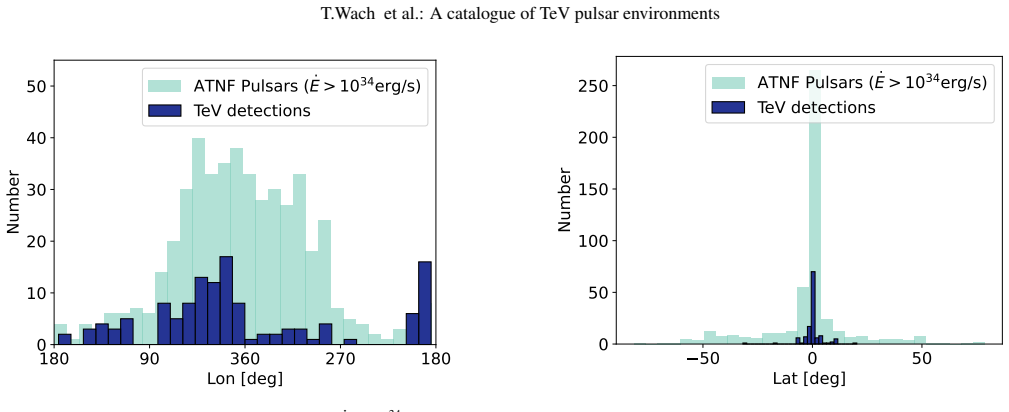
The final catalogue comprises all currently known TeV sources associated with pulsars, spanning all evolutionary stages. The sample consists of 128 gamma-ray sources, connected to 66 different pulsars. It reflects that the TeV-detected population is dominated by young and energetic pulsars located near the Galactic plane, but includes a growing number of middle-aged systems detected as extended halos. Only a weak correlation is found between TeV luminosity and pulsar characteristic age, indicating that TeV evolution is driven by environmental and transport effects rather than by spin-down age alone.
What carries the argument
The homogenized catalogue created by cross-matching TeV source properties from H.E.S.S., MAGIC, VERITAS, HAWC, and LHAASO publications against entries in the ATNF and Fermi-LAT pulsar catalogues.
If this is right
- The TeV population is dominated by young pulsars near the plane but already contains several middle-aged systems seen as extended halos.
- Five specific pulsars are flagged as the most promising targets for CTAO to test what conditions prevent formation of a detectable TeV nebula.
- The catalogue supplies a uniform data set for statistical studies of how pulsar environments evolve across different ages and locations.
- Models of particle transport and energy losses in pulsar winds can now be confronted with a single, consistent set of TeV measurements.
Where Pith is reading between the lines
- If environmental factors truly dominate, then targeted searches around middle-aged pulsars in dense interstellar regions should uncover additional halo-like TeV sources.
- The weak age correlation implies that cosmic-ray escape models must incorporate variable diffusion coefficients set by the surrounding medium rather than pulsar age alone.
- Future multi-wavelength campaigns could test whether the same environmental parameters that suppress TeV nebulae also alter the radio or X-ray morphology of the same systems.
Load-bearing premise
Every source listed as pulsar-associated in the published TeV results is correctly identified and the cross-matching to the two pulsar catalogues introduces no significant misassociations or incompleteness.
What would settle it
A re-analysis that identifies even a modest number of the 128 sources as misassociated with their assigned pulsars, or a new survey that finds a strong TeV-luminosity versus age correlation once the sample is doubled.
Figures

read the original abstract
Pulsars and their environments represent a major class of Galactic gamma-ray sources. Their complex evolution, shaped by the interactions of the pulsar outflow with the supernova remnant (SNR) and the surrounding interstellar medium (ISM), produces diverse morphological and spectral characteristics observable from radio to PeV energies. This work collects and homogenizes data from all major operating TeV observatories, presenting the first comprehensive catalogue of TeV gamma-ray properties of pulsar environments.The catalogue is created from information regarding all gamma-ray sources that have been classified as pulsar-associated sources in published results from H.E.S.S., MAGIC, VERITAS, HAWC, and LHAASO. For each source, the observed gamma-ray properties are cross-matched with pulsar properties from the ATNF catalogue and Fermi-LAT pulsar catalogue. The final catalogue comprises all currently known TeV sources associated with pulsars, spanning all evolutionary stages. The sample consists of 128 gamma-ray sources, connected to 66 different pulsars. It reflects that the TeV-detected population is dominated by young and energetic pulsars located near the Galactic plane, but includes a growing number of middle-aged systems detected as extended halos. Only a weak correlation is found between TeV luminosity and pulsar characteristic age, indicating that TeV evolution is driven by environmental and transport effects rather than by spin-down age alone. Additionally, 5 pulsars which should host a PWN detectable by CTAO are identified as prime targets for future observation to improve our understanding of properties inhibiting the formation of a TeV nebula. This publicly available catalogue provides a uniform foundation for future population studies and for constraining models of particle transport and energy losses in pulsar environments.
Editorial analysis
A structured set of objections, weighed in public.
Referee Report
Summary. The paper compiles a catalogue of TeV gamma-ray sources associated with pulsars by ingesting published classifications from H.E.S.S., MAGIC, VERITAS, HAWC, and LHAASO, then cross-matching positional and spectral properties to the ATNF and Fermi-LAT pulsar catalogues. The resulting sample contains 128 sources linked to 66 pulsars spanning all evolutionary stages; the TeV-detected population is stated to be dominated by young, energetic systems near the Galactic plane with a growing contribution from middle-aged extended halos. Only a weak correlation is reported between TeV luminosity and pulsar characteristic age, from which the authors conclude that environmental and transport effects dominate over spin-down age; five pulsars are flagged as prime CTAO targets.
Significance. A homogenized, publicly available catalogue of this scope would provide a useful reference dataset for population studies of pulsar environments and for testing models of particle transport and energy losses. The reported weak luminosity–age correlation, if robust, would support the view that TeV emission properties are shaped more by local conditions than by pulsar age alone and could guide target selection for next-generation instruments.
major comments (2)
- [Abstract and catalogue-construction description] Abstract and catalogue-construction description: The sample of 128 sources linked to 66 pulsars is assembled exclusively by direct adoption of published TeV-association labels; no section describes an independent calculation of association significance, chance-coincidence probability, or evaluation of alternative counterparts for any entry. Because the headline claims (sample size, evolutionary-stage coverage, and the weak luminosity–age correlation) rest directly on the fidelity of these external classifications, the absence of such verification is load-bearing.
- [Correlation analysis section] Correlation analysis section: The manuscript reports only a weak correlation between TeV luminosity and characteristic age but provides no quantitative details on the fitting procedure, handling of upper limits, treatment of extended halos versus compact PWNe, or assessment of selection biases that could artificially weaken the relation. Without these, it is not possible to judge whether the conclusion that 'TeV evolution is driven by environmental and transport effects' is supported by the data.
minor comments (2)
- [Abstract] The abstract should state the reference epochs or versions of the ATNF and Fermi-LAT catalogues used for the cross-match.
- [Catalogue construction] Clarify whether overlapping or ambiguous associations (e.g., sources with multiple possible pulsar counterparts) were resolved by a documented rule or simply excluded.
Simulated Author's Rebuttal
We thank the referee for the careful reading and constructive comments. Our catalogue is a homogenization of published associations rather than a new search, and we will clarify this scope while expanding the correlation analysis as outlined below.
read point-by-point responses
-
Referee: [Abstract and catalogue-construction description] The sample of 128 sources linked to 66 pulsars is assembled exclusively by direct adoption of published TeV-association labels; no section describes an independent calculation of association significance, chance-coincidence probability, or evaluation of alternative counterparts for any entry. Because the headline claims (sample size, evolutionary-stage coverage, and the weak luminosity–age correlation) rest directly on the fidelity of these external classifications, the absence of such verification is load-bearing.
Authors: The manuscript explicitly constructs the catalogue by ingesting published classifications from H.E.S.S., MAGIC, VERITAS, HAWC, and LHAASO and cross-matching to ATNF and Fermi-LAT. This is a compilation and homogenization effort, not an independent association study; the associations and their reported significances are adopted as published. We will add explicit language in the methods section stating the reliance on external classifications and directing readers to the original papers for association details. This matches the stated scope of the work. revision: yes
-
Referee: [Correlation analysis section] The manuscript reports only a weak correlation between TeV luminosity and characteristic age but provides no quantitative details on the fitting procedure, handling of upper limits, treatment of extended halos versus compact PWNe, or assessment of selection biases that could artificially weaken the relation. Without these, it is not possible to judge whether the conclusion that 'TeV evolution is driven by environmental and transport effects' is supported by the data.
Authors: We agree that the correlation section lacks the requested methodological details. We will revise it to specify the fitting procedure, the treatment of upper limits, the separation of extended halos from compact PWNe, and a brief assessment of selection biases. These additions will support evaluation of the reported weak correlation and the associated conclusion. revision: yes
Circularity Check
No circularity: catalogue is direct compilation of external published classifications with no derivations or fitted predictions
full rationale
The manuscript assembles a catalogue by ingesting published TeV source classifications from H.E.S.S., MAGIC, VERITAS, HAWC and LHAASO, then cross-matching positions and properties to the ATNF and Fermi-LAT pulsar catalogues. No equations, model fits, parameter estimations, or predictions are performed; the headline numbers (128 sources, 66 pulsars, weak luminosity-age correlation) are direct counts and descriptive statistics on the ingested data. No self-citation chains, ansatzes, or uniqueness theorems are invoked to justify any step. The work is therefore self-contained as a data product whose validity rests on the fidelity of the input catalogues rather than on any internal reduction to its own outputs.
Axiom & Free-Parameter Ledger
axioms (1)
- domain assumption Published classifications of TeV sources as pulsar-associated by H.E.S.S., MAGIC, VERITAS, HAWC, and LHAASO are reliable and complete for the purposes of this compilation.
Reference graph
Works this paper leans on
-
[1]
2013 , eprint=
Predicting the X-ray flux of evolved pulsar wind nebulae based on VHE gamma-ray observations , author=. 2013 , eprint=
2013
-
[2]
2023 , eprint=
The First LHAASO Catalog of Gamma-Ray Sources , author=. 2023 , eprint=
2023
-
[3]
Evidence of 200 TeV Photons from HAWC J1825-134. , keywords =. doi:10.3847/2041-8213/abd77b , archivePrefix =. 2012.15275 , primaryClass =
-
[4]
2023 , eprint=
Interpretable Machine Learning for Science with PySR and SymbolicRegression.jl , author=. 2023 , eprint=
2023
-
[5]
Kirk, John G. and Lyubarsky, Yuri and Petri, Jerome. The Theory of Pulsar Winds and Nebulae. Neutron Stars and Pulsars. 2009. doi:10.1007/978-3-540-76965-1_16
-
[6]
The Potential for Hadronic Particle Acceleration in Galactic Pulsar Wind Nebulae. Universe , keywords =. doi:10.3390/universe12030085 , archivePrefix =. 2603.17560 , primaryClass =
-
[8]
29th International Cosmic Ray Conference (ICRC29), Volume 4 , year = 2005, editor =
Search for Pulsed VHE gamma-ray Emission from Young Pulsars with H.E.S.S. 29th International Cosmic Ray Conference (ICRC29), Volume 4 , year = 2005, editor =. doi:10.48550/arXiv.astro-ph/0507388 , archivePrefix =. astro-ph/0507388 , primaryClass =
-
[9]
Smith, D. A. and others. The Third Fermi Large Area Telescope Catalog of Gamma-Ray Pulsars. Astrophys. J. 2023. doi:10.3847/1538-4357/acee67. arXiv:2307.11132
-
[10]
2020, ApJS, 247, 33, doi: 10.3847/1538-4365/ab6bcb
Fermi Large Area Telescope Fourth Source Catalog. , keywords =. doi:10.3847/1538-4365/ab6bcb , archivePrefix =. 1902.10045 , primaryClass =
-
[11]
Discovery of a 136 millisecond radio and X-ray pulsar in SNR G54.1+0.3
Discovery of a 136 Millisecond Radio and X-Ray Pulsar in Supernova Remnant G54.1+0.3. , keywords =. doi:10.1086/342351 , archivePrefix =. astro-ph/0206220 , primaryClass =
work page internal anchor Pith review Pith/arXiv arXiv doi:10.1086/342351
-
[12]
Very high energy gamma rays from the composite SNR G0.9+0.1
Very high energy gamma rays from the composite SNR G 0.9+0.1. , keywords =. doi:10.1051/0004-6361:200500022 , archivePrefix =. astro-ph/0501265 , primaryClass =
work page internal anchor Pith review Pith/arXiv arXiv doi:10.1051/0004-6361:200500022
-
[13]
Implications of the pulsar wind nebula scenario for a TeV gamma-ray source VER J2016+371
Implications of the pulsar wind nebula scenario for a TeV gamma-ray source VER J2016+371. , keywords =. doi:10.1093/mnras/stw1255 , archivePrefix =. 1605.07109 , primaryClass =
work page internal anchor Pith review Pith/arXiv arXiv doi:10.1093/mnras/stw1255
-
[14]
TeV Gamma-Ray Sources from a Survey of the Galactic Plane with Milagro
TeV Gamma-Ray Sources from a Survey of the Galactic Plane with Milagro. , keywords =. doi:10.1086/520717 , archivePrefix =. 0705.0707 , primaryClass =
work page internal anchor Pith review Pith/arXiv arXiv doi:10.1086/520717
-
[15]
Spectrum and extension of the inverse-Compton emission of the Crab Nebula from a combined Fermi-LAT and H.E.S.S. analysis. , keywords =. doi:10.1051/0004-6361/202348651 , archivePrefix =. 2403.12608 , primaryClass =
-
[16]
Discovery of VHE $\gamma$-ray emission from the SNR G54.1+0.3
Discovery of Very High Energy -ray Emission from the SNR G54.1+0.3. , keywords =. doi:10.1088/2041-8205/719/1/L69 , archivePrefix =. 1005.0032 , primaryClass =
work page internal anchor Pith review Pith/arXiv arXiv doi:10.1088/2041-8205/719/1/l69 2041
-
[17]
Precise Measurements of TeV Halos around Geminga and Monogem Pulsars with HAWC. , keywords =. doi:10.3847/1538-4357/ad738e , adsurl =
-
[19]
Water Cherenkov Detectors: MILAGRO. , keywords =. doi:10.1007/BF00195035 , adsurl =
-
[20]
37th International Cosmic Ray Conference , year = 2022, month = mar, eid =
MAGIC observations of HESS J1809-193 using the Very Large Zenith Angle technique at energies above TeV. 37th International Cosmic Ray Conference , year = 2022, month = mar, eid =. doi:10.22323/1.395.0818 , adsurl =
-
[21]
The H.E.S.S. survey of the Inner Galaxy in very high-energy gamma-rays
The H.E.S.S. Survey of the Inner Galaxy in Very High Energy Gamma Rays. , keywords =. doi:10.1086/498013 , archivePrefix =. astro-ph/0510397 , primaryClass =
work page internal anchor Pith review Pith/arXiv arXiv doi:10.1086/498013
-
[22]
Discovery of a Highly Energetic Pulsar Associated with IGR J14003-6326 in the Young Uncataloged Galactic Supernova Remnant G310.6-1.6. , keywords =. doi:10.1088/0004-637X/716/1/663 , archivePrefix =. 0910.3074 , primaryClass =
work page internal anchor Pith review Pith/arXiv arXiv doi:10.1088/0004-637x/716/1/663
-
[23]
Halo fraction in TeV-bright pulsar wind nebulae. , keywords =. doi:10.1051/0004-6361/201936505 , archivePrefix =. 1907.12121 , primaryClass =
-
[24]
The High-Altitude Water Cherenkov (HAWC) observatory in M \'e xico: The primary detector. Nuclear Instruments and Methods in Physics Research A , keywords =. doi:10.1016/j.nima.2023.168253 , archivePrefix =. 2304.00730 , primaryClass =
-
[25]
2024a, The Astrophysical Journal, 972, 144, doi: 10.3847/1538-4357/ad5f2d —
Performance of the HAWC Observatory and TeV Gamma-Ray Measurements of the Crab Nebula with Improved Extensive Air Shower Reconstruction Algorithms. , keywords =. doi:10.3847/1538-4357/ad5f2d , archivePrefix =. 2405.06050 , primaryClass =
-
[26]
Chinese Physics C , keywords =
Performance of LHAASO-WCDA and observation of the Crab Nebula as a standard candle. Chinese Physics C , keywords =. doi:10.1088/1674-1137/ac041b , adsurl =
-
[27]
Astroparticle Physics , keywords =
Study of the IACT angular acceptance and Point Spread Function. Astroparticle Physics , keywords =. doi:10.1016/j.astropartphys.2018.01.002 , adsurl =
-
[28]
Abeysekara, A. U. and others. The 2HWC HAWC Observatory Gamma Ray Catalog. Astrophys. J. 2017. doi:10.3847/1538-4357/aa7556. arXiv:1702.02992
work page internal anchor Pith review Pith/arXiv arXiv doi:10.3847/1538-4357/aa7556 2017
-
[30]
Discovery of a Young, Energetic 70.5 ms Pulsar Associated with the TeV Gamma-Ray Source HESS J1837-069. , keywords =. doi:10.1086/588779 , archivePrefix =. 0803.1361 , primaryClass =
work page internal anchor Pith review Pith/arXiv arXiv doi:10.1086/588779
-
[31]
Observations of the Crab nebula with HESS , DOI= "10.1051/0004-6361:20065351", url= "https://doi.org/10.1051/0004-6361:20065351", journal =
-
[32]
Reverberation of pulsar wind nebulae – III
Bandiera, R and Bucciantini, N and Olmi, B and Torres, D F , year=. Reverberation of pulsar wind nebulae – III. Modelling of the plasma interface empowering a long term radiative evolution , volume=. Monthly Notices of the Royal Astronomical Society , publisher=. doi:10.1093/mnras/stad2387 , number=
-
[33]
Abdalla, H. and Abramowski, A. and Aharonian, F. and Ait Benkhali, F. and Akhperjanian, A. G. and Andersson, T. and Angüner, E. O. and Arrieta, M. and Aubert, P. and Backes, M. and Balzer, A. and Barnard, M. and Becherini, Y. and Becker Tjus, J. and Berge, D. and Bernhard, S. and Bernlöhr, K. and Blackwell, R. and Böttcher, M. and Boisson, C. and Bolmont,...
-
[34]
Discovery of TeV gamma-ray emission from the pulsar wind nebula 3C 58 by MAGIC
Discovery of TeV -ray emission from the pulsar wind nebula 3C 58 by MAGIC. , keywords =. doi:10.1051/0004-6361/201424261 , archivePrefix =. 1405.6074 , primaryClass =
work page internal anchor Pith review Pith/arXiv arXiv doi:10.1051/0004-6361/201424261
-
[35]
J. Aleksić and S. Ansoldi and L.A. Antonelli and P. Antoranz and A. Babic and P. Bangale and J.A. Barrio and J. Measurement of the Crab Nebula spectrum over three decades in energy with the MAGIC telescopes , journal =. 2015 , issn =. doi:https://doi.org/10.1016/j.jheap.2015.01.002 , url =
-
[36]
VERITAS and Fermi-LAT observations of new HAWC sources
VERITAS and Fermi-LAT Observations of TeV Gamma-Ray Sources Discovered by HAWC in the 2HWC Catalog. , keywords =. doi:10.3847/1538-4357/aade4e , archivePrefix =. 1808.10423 , primaryClass =
work page internal anchor Pith review Pith/arXiv arXiv doi:10.3847/1538-4357/aade4e
-
[37]
DA495 - an aging pulsar wind nebula
DA 495: An Aging Pulsar Wind Nebula. , keywords =. doi:10.1086/591653 , archivePrefix =. 0807.0811 , primaryClass =
work page internal anchor Pith review Pith/arXiv arXiv doi:10.1086/591653
-
[38]
Astroparticle Physics , keywords =
VERITAS Detection of LS 5039 and HESS J1825-137. Astroparticle Physics , keywords =. doi:10.1016/j.astropartphys.2019.102403 , archivePrefix =. 2001.03522 , primaryClass =
-
[39]
34th International Cosmic Ray Conference (ICRC2015) , year = 2015, series =
Six years of VERITAS observations of the Crab Nebula. 34th International Cosmic Ray Conference (ICRC2015) , year = 2015, series =. doi:10.22323/1.236.0792 , archivePrefix =. 1508.06442 , primaryClass =
-
[40]
Investigating the TeV Morphology of MGRO J1908+06 with VERITAS
Investigating the TeV Morphology of MGRO J1908+06 with VERITAS. , keywords =. doi:10.1088/0004-637X/787/2/166 , archivePrefix =. 1404.7185 , primaryClass =
work page internal anchor Pith review Pith/arXiv arXiv doi:10.1088/0004-637x/787/2/166
-
[41]
XMM-Newton observations of PSR B1823-13: An asymmetric synchrotron nebula around a Vela-like pulsar
XMM-Newton Observations of PSR B1823-13: An Asymmetric Synchrotron Nebula around a Vela-like Pulsar. , keywords =. doi:10.1086/368356 , archivePrefix =. astro-ph/0211359 , primaryClass =
work page internal anchor Pith review Pith/arXiv arXiv doi:10.1086/368356
-
[42]
Chandra Observation of PSR B1823-13 and its Pulsar Wind Nebula
Chandra Observation of PSR B1823-13 and Its Pulsar Wind Nebula. , keywords =. doi:10.1086/525842 , archivePrefix =. 0707.3529 , primaryClass =
work page internal anchor Pith review Pith/arXiv arXiv doi:10.1086/525842
-
[43]
Detection of very high energy radiation from HESS J1908+063 confirms the Milagro unidentified source MGRO J1908+06. , keywords =. doi:10.1051/0004-6361/200811357 , archivePrefix =. 0904.3409 , primaryClass =
work page internal anchor Pith review Pith/arXiv arXiv doi:10.1051/0004-6361/200811357
-
[44]
TeV Gamma-ray Observations of The Galactic Center Ridge By VERITAS
TeV Gamma-Ray Observations of the Galactic Center Ridge by VERITAS. , keywords =. doi:10.3847/0004-637X/821/2/129 , archivePrefix =. 1602.08522 , primaryClass =
work page internal anchor Pith review Pith/arXiv arXiv doi:10.3847/0004-637x/821/2/129
-
[45]
Detection of Extended VHE Gamma Ray Emission from G106.3+2.7 with VERITAS
Detection of Extended VHE Gamma Ray Emission from G106.3+2.7 with Veritas. , keywords =. doi:10.1088/0004-637X/703/1/L6 , archivePrefix =. 0911.4695 , primaryClass =
work page internal anchor Pith review Pith/arXiv arXiv doi:10.1088/0004-637x/703/1/l6
-
[46]
VER J2227+608: A Hadronic PeVatron Pulsar Wind Nebula?. , keywords =. doi:10.3847/1538-4357/ab48ee , archivePrefix =. 1907.04972 , primaryClass =
-
[47]
Hadronic versus Leptonic Models for -Ray Emission from VER J2227+608. , keywords =. doi:10.3847/2041-8213/ab9ff2 , archivePrefix =. 2006.14946 , primaryClass =
-
[48]
Spatially Resolving the Very High Energy emission from MGRO J2019+37 with VERITAS
Spatially Resolving the Very High Energy Emission from MGRO J2019+37 with VERITAS. , keywords =. doi:10.1088/0004-637X/788/1/78 , archivePrefix =. 1404.1841 , primaryClass =
work page internal anchor Pith review Pith/arXiv arXiv doi:10.1088/0004-637x/788/1/78
-
[49]
X-ray Studies of the Extended TeV Gamma-Ray Source VER J2019+368
X-Ray Studies of the Extended TeV Gamma-Ray Source VER J2019+368. , keywords =. doi:10.3847/1538-4357/aa7201 , archivePrefix =. 1705.02733 , primaryClass =
work page internal anchor Pith review Pith/arXiv arXiv doi:10.3847/1538-4357/aa7201
-
[50]
VERITAS observation of CTA1. High Energy Gamma-Ray Astronomy: 5th International Meeting on High Energy Gamma-Ray Astronomy , year = 2012, editor =. doi:10.1063/1.4772270 , archivePrefix =. 1210.2948 , primaryClass =
-
[51]
2020, ApJ, 905, 76, doi: 10.3847/1538-4357/abc2d8
3HWC: The Third HAWC Catalog of Very-high-energy Gamma-Ray Sources. , keywords =. doi:10.3847/1538-4357/abc2d8 , archivePrefix =. 2007.08582 , primaryClass =
-
[52]
Abdalla, H. and others. First Ground-based Measurement of Sub-20 GeV to 100 GeV -rays from the Vela Pulsar with H.E.S.S. II. Astron. Astrophys. 2018. doi:10.1051/0004-6361/201732153. arXiv:1807.01302
work page internal anchor Pith review Pith/arXiv arXiv doi:10.1051/0004-6361/201732153 2018
-
[53]
TeV Halos are Everywhere: Prospects for New Discoveries
Sudoh, Takahiro and Linden, Tim and Beacom, John F. TeV Halos are Everywhere: Prospects for New Discoveries. Phys. Rev. D. 2019. doi:10.1103/PhysRevD.100.043016. arXiv:1902.08203
-
[54]
Research in Astronomy and Astrophysics , keywords =
Evolution of High-energy Electron Distribution in Pulsar Wind Nebulae. Research in Astronomy and Astrophysics , keywords =. doi:10.1088/1674-4527/ad50b7 , archivePrefix =. 2407.02757 , primaryClass =
-
[55]
Nuclear Physics B Proceedings Supplements , year = 1999, month = jan, volume =
X-ray emission from the 63ms radio pulsar PSR J1105-6107. Nuclear Physics B Proceedings Supplements , year = 1999, month = jan, volume =. doi:10.1016/S0920-5632(98)00222-9 , adsurl =
-
[56]
RXTE Observations of PSR J1105-6107
RXTE observations of PSR J1105-6107. , keywords =. doi:10.48550/arXiv.astro-ph/9809367 , archivePrefix =. astro-ph/9809367 , primaryClass =
work page internal anchor Pith review Pith/arXiv arXiv doi:10.48550/arxiv.astro-ph/9809367
-
[57]
A large age for the pulsar B1757-24 from an upper limit on its proper motion
A large age for the pulsar B1757-24 from an upper limit on its proper motion. , keywords =. doi:10.1038/35018010 , archivePrefix =. astro-ph/0005526 , primaryClass =
work page internal anchor Pith review Pith/arXiv arXiv doi:10.1038/35018010
-
[58]
Proper motion, age and initial spin period of PSR J0538+2817 in S147
The Proper Motion, Age, and Initial Spin Period of PSR J0538+2817 in S147. , keywords =. doi:10.1086/378082 , archivePrefix =. astro-ph/0306628 , primaryClass =
work page internal anchor Pith review Pith/arXiv arXiv doi:10.1086/378082
-
[59]
Pulsar Spin-Velocity Alignment: Kinematic Ages, Birth Periods and Braking Indices
Pulsar spin-velocity alignment: kinematic ages, birth periods and braking indices. , keywords =. doi:10.1093/mnras/stt047 , archivePrefix =. 1301.1265 , primaryClass =
work page internal anchor Pith review Pith/arXiv arXiv doi:10.1093/mnras/stt047
-
[60]
On the maximum pair multiplicity of pulsar cascades
On the Maximum Pair Multiplicity of Pulsar Cascades. , keywords =. doi:10.3847/1538-4357/aaf050 , archivePrefix =. 1803.08924 , primaryClass =
work page internal anchor Pith review Pith/arXiv arXiv doi:10.3847/1538-4357/aaf050
-
[61]
XGBoost: A Scalable Tree Boosting System
XGBoost: A Scalable Tree Boosting System. arXiv e-prints , keywords =. doi:10.48550/arXiv.1603.02754 , archivePrefix =. 1603.02754 , primaryClass =
work page internal anchor Pith review Pith/arXiv arXiv doi:10.48550/arxiv.1603.02754
-
[62]
The Third EGRET Catalog of High-Energy Gamma-Ray Sources. , keywords =. doi:10.1086/313231 , adsurl =
-
[63]
The ASCA Catalog of Potential X-Ray Counterparts of GeV Sources
The ASCA Catalog of Potential X-Ray Counterparts of GEV Sources. , keywords =. doi:10.1086/320352 , archivePrefix =. astro-ph/0012304 , primaryClass =
work page internal anchor Pith review Pith/arXiv arXiv doi:10.1086/320352
-
[64]
Radiation fields in star-forming galaxies: the disk, thin disk and bulge
Radiation fields in star-forming galaxies: the disc, thin disc and bulge. , keywords =. doi:10.1093/mnras/stt1666 , archivePrefix =. 1305.0232 , primaryClass =
work page internal anchor Pith review Pith/arXiv arXiv doi:10.1093/mnras/stt1666
-
[65]
Research Notes of the American Astronomical Society , keywords =
VTSCat: The VERITAS Catalog of Gamma-Ray Observations. Research Notes of the American Astronomical Society , keywords =. doi:10.3847/2515-5172/acb147 , archivePrefix =. 2301.04498 , primaryClass =
-
[66]
doi:10.5281/zenodo.5499840 , url =
CTAO Instrument Response Functions - prod5 version v0.1 , month = sep, year = 2021, publisher =. doi:10.5281/zenodo.5499840 , url =
-
[67]
Exploring a SNR/Molecular Cloud Association Within HESS J1745-303
Exploring a SNR/molecular cloud association within HESS J1745-303. , keywords =. doi:10.1051/0004-6361:20079230 , archivePrefix =. 0803.2844 , primaryClass =
work page internal anchor Pith review Pith/arXiv arXiv doi:10.1051/0004-6361:20079230
-
[68]
Detection of 16 Gamma-Ray Pulsars Through Blind Frequency Searches Using the Fermi LAT
Detection of 16 Gamma-Ray Pulsars Through Blind Frequency Searches Using the Fermi LAT. Science , keywords =. doi:10.1126/science.1175558 , archivePrefix =. 1009.0748 , primaryClass =
work page internal anchor Pith review Pith/arXiv arXiv doi:10.1126/science.1175558
-
[69]
Discovery of a New X-Ray Filled Radio Supernova Remnant around the Pulsar Wind Nebula in 3EG J1809-2328. , keywords =. doi:10.1086/588419 , archivePrefix =. 0802.3750 , primaryClass =
work page internal anchor Pith review Pith/arXiv arXiv doi:10.1086/588419
-
[70]
, keywords =
G359.23-0.92, the Mouse, a plusar powered bow shock?. , keywords =
-
[71]
Heartbeat of the Mouse: a young radio pulsar associated with the axisymmetric nebula G359.23-0.82
Heartbeat of the Mouse: A Young Radio Pulsar Associated with the Axisymmetric Nebula G359.23-0.82. , keywords =. doi:10.1086/344832 , archivePrefix =. astro-ph/0209480 , primaryClass =
work page internal anchor Pith review Pith/arXiv arXiv doi:10.1086/344832
-
[72]
The Second EGRET Catalog of High-Energy Gamma-Ray Sources. , keywords =. doi:10.1086/192240 , adsurl =
-
[73]
26th International Cosmic Ray Conference (ICRC26), Volume 3 , year = 1999, editor =
TeV measurements of young pulsars and supernova remnants. 26th International Cosmic Ray Conference (ICRC26), Volume 3 , year = 1999, editor =. doi:10.48550/arXiv.astro-ph/9906136 , archivePrefix =. astro-ph/9906136 , primaryClass =
-
[74]
Time-dependent modeling of TeV-detected, young pulsar wind nebulae
Time-dependent modeling of TeV-detected, young pulsar wind nebulae. Journal of High Energy Astrophysics , keywords =. doi:10.1016/j.jheap.2014.02.001 , archivePrefix =. 1402.5485 , primaryClass =
work page internal anchor Pith review Pith/arXiv arXiv doi:10.1016/j.jheap.2014.02.001 2014
-
[75]
Abeysekara, A. U. and others. Extended gamma-ray sources around pulsars constrain the origin of the positron flux at Earth. Science. 2017. doi:10.1126/science.aan4880. arXiv:1711.06223
work page internal anchor Pith review Pith/arXiv arXiv doi:10.1126/science.aan4880 2017
-
[76]
The environment of TeV halo progenitors. arXiv e-prints , keywords =. doi:10.48550/arXiv.2507.01495 , archivePrefix =. 2507.01495 , primaryClass =
-
[77]
Fast as Potoroo: Radio continuum detection of a bow-shock pulsar wind nebula powered by pulsar J1638-4713. , keywords =. doi:10.1017/pasa.2024.13 , archivePrefix =. 2312.06961 , primaryClass =
-
[78]
The Norma Arm Region Chandra Survey: X-ray Populations in the Spiral Arms
The Norma Arm Region Chandra Survey Catalog: X-Ray Populations in the Spiral Arms. , keywords =. doi:10.1088/0004-637X/796/2/105 , archivePrefix =. 1409.7701 , primaryClass =
work page internal anchor Pith review Pith/arXiv arXiv doi:10.1088/0004-637x/796/2/105
-
[79]
The Swift X-Ray Telescope. , keywords =. doi:10.1007/s11214-005-5097-2 , archivePrefix =. astro-ph/0508071 , primaryClass =
work page internal anchor Pith review Pith/arXiv arXiv doi:10.1007/s11214-005-5097-2
-
[80]
Discovery of a Young, Highly Scattered Pulsar PSR J1032-5804 with the Australian Square Kilometre Array Pathfinder. , keywords =. doi:10.3847/1538-4357/ad0fe8 , archivePrefix =. 2311.14880 , primaryClass =
-
[81]
Teraelectronvolt pulsed emission from the Crab pulsar detected by MAGIC
Ansoldi, S. and others. Teraelectronvolt pulsed emission from the Crab pulsar detected by MAGIC. Astron. Astrophys. 2016. doi:10.1051/0004-6361/201526853. arXiv:1510.07048
work page internal anchor Pith review Pith/arXiv arXiv doi:10.1051/0004-6361/201526853 2016
-
[82]
HAWC Detection of a TeV Halo Candidate Surrounding a Radio-quiet Pulsar. , keywords =. doi:10.3847/2041-8213/acb5ee , archivePrefix =. 2301.04646 , primaryClass =
-
[83]
X-ray counterpart candidates for six new $\gamma$-ray pulsars
X-ray counterpart candidates for six new -ray pulsars. , keywords =. doi:10.1093/mnras/sty359 , archivePrefix =. 1802.03985 , primaryClass =
work page internal anchor Pith review Pith/arXiv arXiv doi:10.1093/mnras/sty359
discussion (0)
Sign in with ORCID, Apple, or X to comment. Anyone can read and Pith papers without signing in.