Improved proper motion and gravity tests with PSR J1913+1102
Pith reviewed 2026-06-26 19:45 UTC · model grok-4.3
The pith
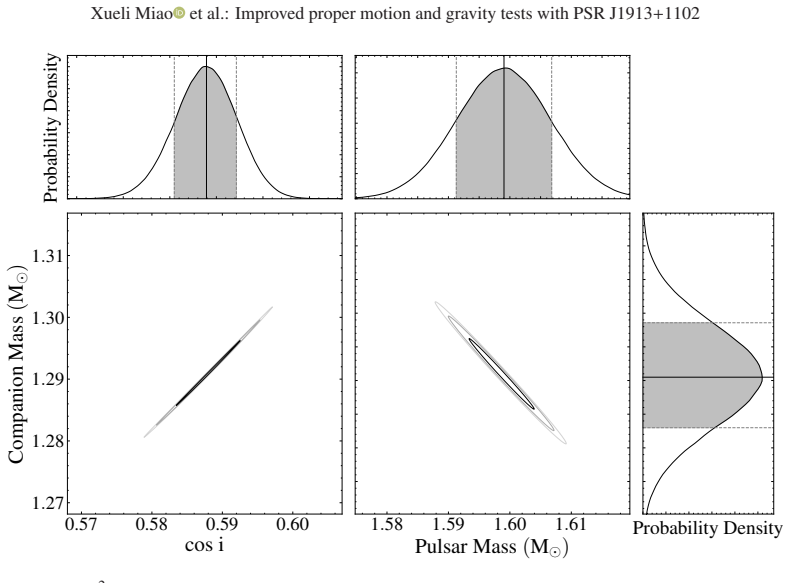
Updated timing of PSR J1913+1102 gives neutron star masses 1.599 and 1.290 solar masses and confirms the general-relativity prediction for orbital decay to five times higher precision.
A machine-rendered reading of the paper's core claim, the machinery that carries it, and where it could break.
Core claim
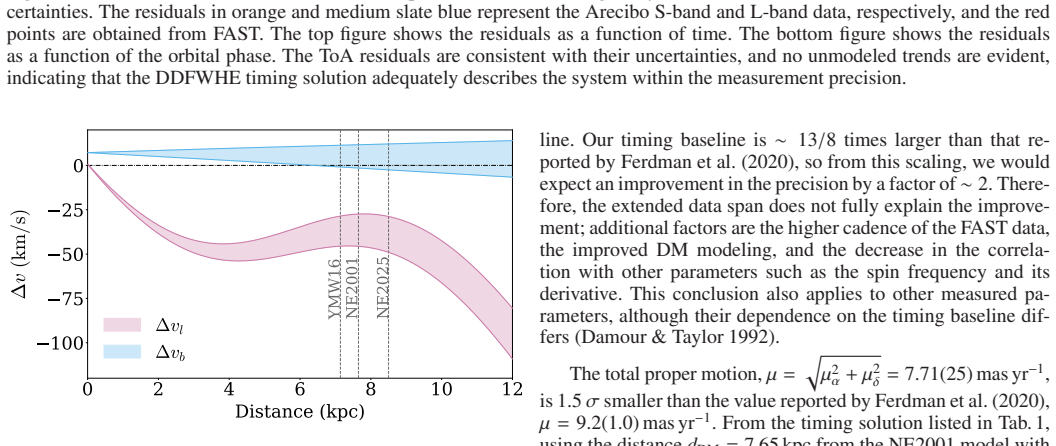
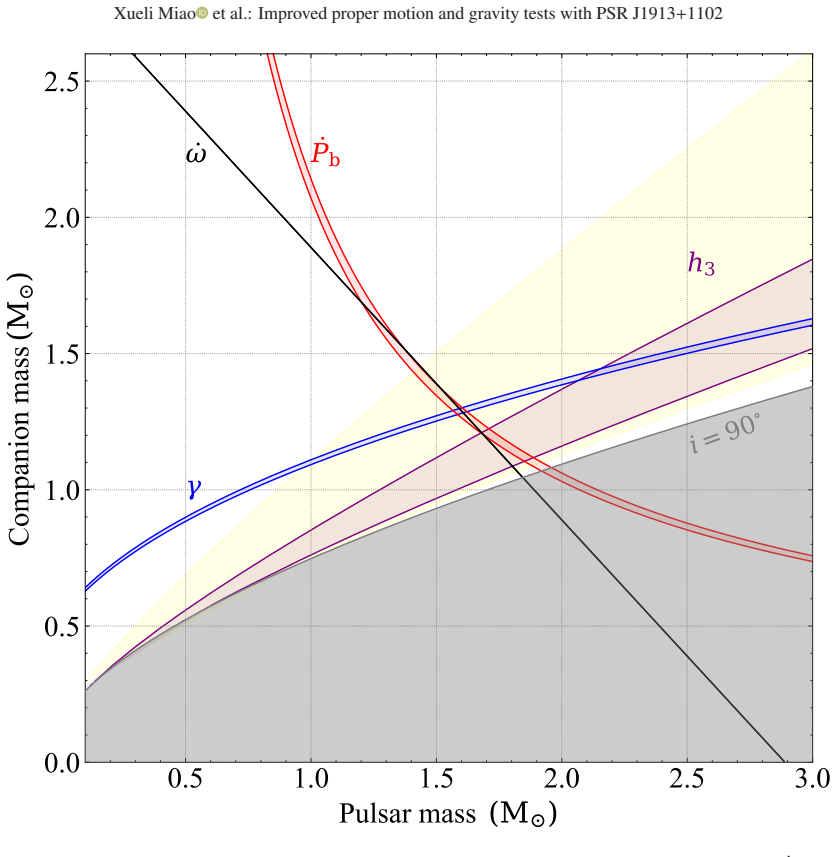
Assuming general relativity, the new timing solution gives a total mass of 2.88948(20) solar masses, pulsar mass 1.599(8) solar masses, companion mass 1.290(8) solar masses, mass ratio 0.807(8), proper motion 7.71(25) mas yr^{-1}, and intrinsic orbital decay -4.60(6) times 10^{-13} s s^{-1}, fully consistent with the quadrupolar gravitational-wave damping expected in general relativity and thereby constraining dipolar emission and scalar-tensor effects around 1.6 solar masses.
What carries the argument
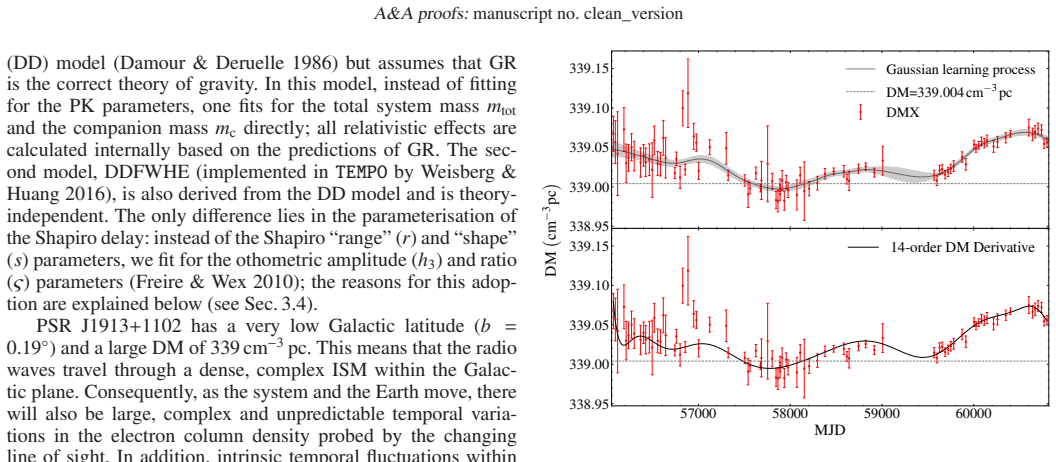
The timing solution that extracts four post-Keplerian parameters while correcting the observed orbital decay for the measured proper motion after modelling dispersion-measure variations with a Gaussian process.
If this is right
- The mass ratio constrains the final helium-star mass immediately before the second supernova.
- The refined proper motion tightens limits on the magnitude and direction of the natal kick that formed the double neutron star system.
- Dipolar gravitational-wave emission in scalar-tensor theories is limited to levels below the new measurement precision.
- The spontaneous-scalarisation window around 1.6 solar masses is more narrowly excluded.
Where Pith is reading between the lines
- Because the system is projected to merge in 470 million years, the measured mass ratio supplies a concrete template for predicting the properties of future gravitational-wave events similar to GW170817.
- Improved distance and velocity constraints from the proper motion allow kinematic modelling of the galactic population of asymmetric double neutron star systems.
- The fivefold gain in orbital-decay precision demonstrates that continued timing of similar asymmetric systems can push scalar-tensor bounds into regimes currently only accessible with binary pulsars of higher mass asymmetry.
Load-bearing premise
Assuming general relativity to derive the component masses from the measured post-Keplerian parameters while modelling dispersion-measure variations with a Gaussian process.
What would settle it
A future measurement showing that the intrinsic orbital-period derivative, after proper-motion correction, differs from the general-relativity quadrupolar prediction by more than the reported 6 times 10^{-15} s s^{-1} uncertainty.
Figures




read the original abstract
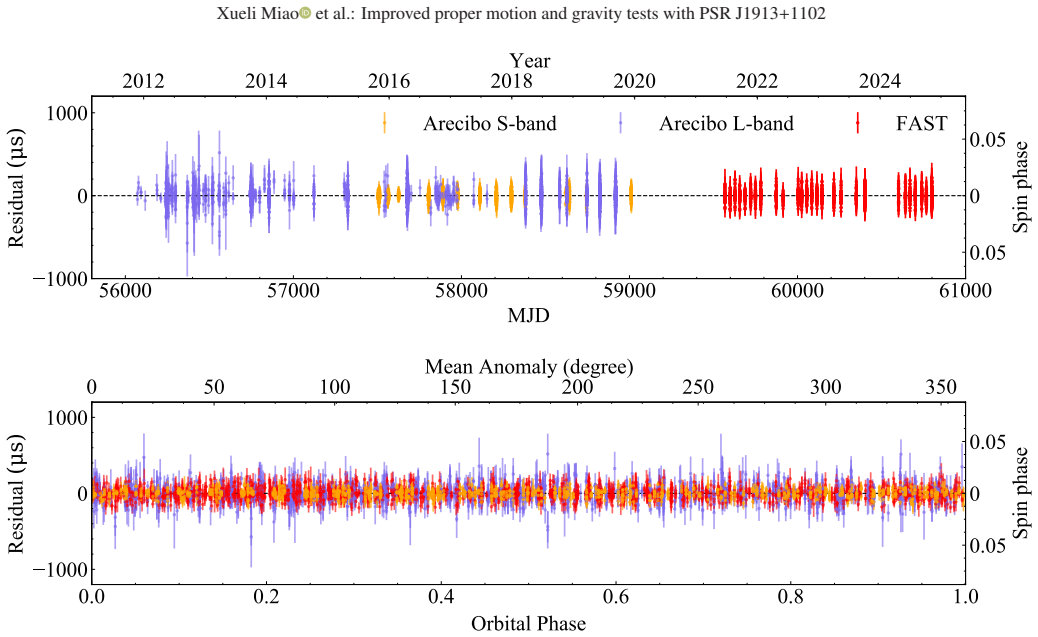
PSR J1913+1102 is a highly asymmetric double neutron star system and an excellent laboratory for testing scalar-tensor gravity theories, as well as a potential progenitor analogue of GW170817 that will merge in 470 Myr. We present an updated timing analysis combining 13 years of historical Arecibo observations and new FAST measurements, using two approaches to model dispersion-measure variations. The new timing solution provides precise measurements of four post-Keplerian parameters and improves the system mass estimates. Assuming general relativity and modelling the DM variation with a Gaussian process, we obtain a three-fold improvement in the total mass, m_{tot}=2.88948(20) M_\odot, and nearly four-fold improvements in the pulsar and companion masses, m_p=1.599(8) M_\odot and m_c=1.290(8) M_\odot, giving the mass ratio, q=0.807(8). We also measure an improved proper motion, \mu=7.71(25) mas yr^{-1}, enabling a more accurate correction of the observed orbital-period derivative. Combined with the improved orbital-decay measurement, this yields an intrinsic orbital-period derivative \dot{P}_b^{intr}=-4.60(6)\times10^{-13} s s^{-1}, five times more precise than the previous value and fully consistent with the general-relativistic prediction for gravitational-wave damping. The improved masses and precise \dot{P}*b^{intr} place stringent constraints on dipolar gravitational-wave emission and the spontaneous-scalarisation window around 1.6 M*\odot. The refined proper motion and mass measurements also provide tighter constraints on the final helium-star mass immediately prior to its core collapse and formation of the second NS in a supernova, as well as on the magnitude and direction of the associated natal kick of the DNS system.
Editorial analysis
A structured set of objections, weighed in public.
Referee Report
Summary. The manuscript presents an updated timing analysis of the asymmetric double neutron star PSR J1913+1102, combining 13 years of Arecibo data with new FAST observations and employing two dispersion-measure modeling approaches (including a Gaussian process). It reports improved measurements of four post-Keplerian parameters, yielding m_tot = 2.88948(20) M_⊙, m_p = 1.599(8) M_⊙, m_c = 1.290(8) M_⊙ and q = 0.807(8) under general relativity, a refined proper motion μ = 7.71(25) mas yr^{-1}, and an intrinsic orbital decay \dot{P}_b^{intr} = -4.60(6) × 10^{-13} s s^{-1} that is consistent with the GR quadrupole prediction. These are used to constrain dipolar gravitational-wave emission and the spontaneous-scalarization window near 1.6 M_⊙, as well as the pre-supernova helium-star mass and natal kick.
Significance. If the results hold after addressing the noted assumption, the three- to four-fold gains in mass precision and five-fold improvement in orbital-decay accuracy would meaningfully tighten existing bounds on scalar-tensor deviations in neutron-star binaries and on the formation channel of this system as a GW170817 analogue. The dual DM-modeling strategy and explicit reporting of the GR assumption in the abstract are positive features.
major comments (2)
- [Abstract / mass derivation] Abstract and mass-derivation section: The component masses are obtained by solving the GR expressions for the four measured post-Keplerian parameters (ω̇, γ, r, s). In the scalar-tensor theories under test, these same PK parameters receive scalar-charge corrections, so the GR-inferred masses are not guaranteed to be the correct values inside the alternative theory. The resulting limits on dipolar radiation and the scalarization window therefore rest on an unquantified approximation whose validity must be assessed (e.g., via iteration or theory-specific PK expressions).
- [Gravity-test / orbital-decay section] Gravity-test section: The measured \dot{P}_b^{intr} is declared fully consistent with the GR prediction derived from the GR-assumed masses. This circularity is standard but load-bearing for the dipolar-emission and scalarization constraints; an explicit estimate of the possible bias under scalar-tensor modifications to the PK parameters should be provided.
minor comments (2)
- [Abstract] Abstract: the notation "\dot{P}*b^{intr}" appears to be a typographical error for \dot{P}_b^{intr}.
- [Abstract / methods] The abstract states two DM-modeling approaches are used but does not indicate which one supplies the quoted mass and decay values; this should be clarified in the main text.
Simulated Author's Rebuttal
We thank the referee for the detailed and constructive report. The two major comments correctly identify a standard but important approximation in our analysis. We address both points below and will revise the manuscript to include the requested quantitative assessment.
read point-by-point responses
-
Referee: [Abstract / mass derivation] Abstract and mass-derivation section: The component masses are obtained by solving the GR expressions for the four measured post-Keplerian parameters (ω̇, γ, r, s). In the scalar-tensor theories under test, these same PK parameters receive scalar-charge corrections, so the GR-inferred masses are not guaranteed to be the correct values inside the alternative theory. The resulting limits on dipolar radiation and the scalarization window therefore rest on an unquantified approximation whose validity must be assessed (e.g., via iteration or theory-specific PK expressions).
Authors: We agree this approximation requires explicit discussion. The component masses are derived under GR because that is the theory being tested for consistency; the resulting limits on dipolar radiation and scalarisation are therefore conditional on the GR masses. In the revision we will add a short iterative estimate: using the dipolar-radiation upper limit already obtained, we recompute the expected scalar-charge corrections to ω̇, γ, r and s, propagate them into revised masses, and show that the shift in the derived dipolar limit is well below the quoted uncertainty. This will be placed in a new paragraph in the gravity-test section and referenced from the abstract. revision: yes
-
Referee: [Gravity-test / orbital-decay section] Gravity-test section: The measured ṗ_b^{intr} is declared fully consistent with the GR prediction derived from the GR-assumed masses. This circularity is standard but load-bearing for the dipolar-emission and scalarization constraints; an explicit estimate of the possible bias under scalar-tensor modifications to the PK parameters should be provided.
Authors: We accept the need for an explicit bias estimate. In the revised manuscript we will perform the iteration described above and report the resulting change (or lack of change) in the GR-predicted ṗ_b. Because the scalar-charge corrections enter at higher post-Newtonian order than the quadrupole term for the small deviations allowed by our data, we expect the bias to be negligible compared with the present 1.3 % precision on ṗ_b^{intr}; the calculation will confirm this quantitatively. revision: yes
Circularity Check
Masses derived assuming GR for PK parameters; orbital decay then declared consistent with GR prediction from those masses
specific steps
-
fitted input called prediction
[Abstract]
"Assuming general relativity ... we obtain ... m_p=1.599(8) M_⊙ and m_c=1.290(8) M_⊙ ... this yields an intrinsic orbital-period derivative Ġ{P}_b^{intr}=-4.60(6)×10^{-13} s s^{-1} ... fully consistent with the general-relativistic prediction for gravitational-wave damping. The improved masses and precise Ġ{P}_b^{intr} place stringent constraints on dipolar gravitational-wave emission and the spontaneous-scalarisation window around 1.6 M_⊙."
Masses are solved from the GR post-Keplerian equations applied to the measured ω̇, γ, r, s. These masses are then substituted into the GR Ġ{P}_b prediction, so the consistency statement and the bounds on extra dipolar emission are forced by the same GR assumption. In scalar-tensor theories the PK expressions themselves receive corrections, rendering the inferred masses theory-dependent.
full rationale
The paper's gravity-test claim obtains component masses by solving the GR expressions for the four measured post-Keplerian parameters, then inserts those masses into the GR quadrupole formula to predict Ġ{P}_b and bound dipolar terms. This reduces the reported consistency and the scalar-tensor constraints to a direct consequence of the GR assumption used to derive the masses. The provided text contains no other load-bearing steps that reduce by construction to inputs.
Axiom & Free-Parameter Ledger
free parameters (1)
- Gaussian-process hyperparameters for DM variations
axioms (1)
- domain assumption General relativity holds for converting post-Keplerian parameters into component masses
Reference graph
Works this paper leans on
-
[1]
Abbott, B. P. et al. 2017, PhRvL, 119, 161101
2017
-
[2]
Abbott, B. P. et al. 2020, ApJL, 892, L3
2020
-
[3]
2025, Phys
Abbott, R., Abe, H., Acernese, F., et al. 2025, Phys. Rev. D, 112, 084080
2025
-
[4]
2023, Living Reviews in Relativity, 26, 2
Amaro-Seoane, P., Andrews, J., Arca Sedda, M., et al. 2023, Living Reviews in Relativity, 26, 2
2023
-
[5]
Antoniadis, J., Freire, P. C. C., Wex, N., et al. 2013, Science, 340, 448
2013
-
[6]
& Cárdenas-Avendaño, A
Bambi, C. & Cárdenas-Avendaño, A. 2024, Recent Progress on Gravity Tests. Challenges and Future Perspectives, ed. C. Bambi & A. Cárdenas-Avendaño (Springer Nature Singapore)
2024
-
[7]
D., Dutta, A., Freire, P
Barr, E. D., Dutta, A., Freire, P. C. C., et al. 2024, Science, 383, 275
2024
-
[8]
2015, Classical and Quantum Gravity, 32, 243001
Berti, E., Barausse, E., Cardoso, V ., et al. 2015, Classical and Quantum Gravity, 32, 243001
2015
-
[9]
& Teukolsky, S
Blandford, R. & Teukolsky, S. A. 1976, ApJ, 205, 580
1976
-
[10]
2003, Nature, 426, 531
Burgay, M., D’Amico, N., Possenti, A., et al. 2003, Nature, 426, 531
2003
-
[11]
2024, in Recent Progress on Gravity Tests: Challenges and Future Perspectives, ed
Ciufolini, I. 2024, in Recent Progress on Gravity Tests: Challenges and Future Perspectives, ed. C. Bambi & A. Cárdenas-Avendaño (Singapore: Springer Nature Singapore), 27–59
2024
-
[12]
G., Padilla, A., & Skordis, C
Clifton, T., Ferreira, P. G., Padilla, A., & Skordis, C. 2012, Phys. Rep., 513, 1
2012
-
[13]
V ., Mourier, P., Bera, S., & Jiménez Forteza, X
Colleoni, M., Krishnendu, N. V ., Mourier, P., Bera, S., & Jiménez Forteza, X. 2024, in Recent Progress on Gravity Tests. Challenges and Future Perspec- tives, ed. C. Bambi & A. Cárdenas-Avendaño (Springer Nature Singapore), 239–274 Colom i Bernadich, M., Balakrishnan, V ., Barr, E., et al. 2023, A&A, 678, A187
2024
-
[14]
Cordes, J. M. & Lazio, T. J. W. 2002, arXiv e-prints, astro-ph/0207156, astro
Pith/arXiv arXiv 2002
-
[15]
S., Berger, E., Villar, V
Cowperthwaite, P. S., Berger, E., Villar, V . A., et al. 2017, ApJ, 848, L17
2017
-
[16]
& Deruelle, N
Damour, T. & Deruelle, N. 1986, Annales de L’Institut Henri Poincare Section (A) Physique Theorique, 44, 263
1986
-
[17]
& Esposito-Farèse, G
Damour, T. & Esposito-Farèse, G. 1992, Classical and Quantum Gravity, 9, 2093
1992
-
[18]
& Esposito-Farèse, G
Damour, T. & Esposito-Farèse, G. 1993, Phys. Rev. Lett., 70, 2220
1993
-
[19]
& Esposito-Farèse, G
Damour, T. & Esposito-Farèse, G. 1996, Phys. Rev. D, 54, 1474
1996
-
[20]
& Taylor, J
Damour, T. & Taylor, J. H. 1992, Phys. Rev. D, 45, 1840 De Greve, J.-P. & De Loore, C. 1977, Ap&SS, 50, 75
1992
-
[21]
Delgado, A. J. & Thomas, H.-C. 1981, A&A, 96, 142
1981
-
[22]
T., Weisberg, J
Deller, A. T., Weisberg, J. M., Nice, D. J., & Chatterjee, S. 2018, ApJ, 862, 139
2018
-
[23]
B., Ferdman, R
Demorest, P. B., Ferdman, R. D., Gonzalez, M. E., et al. 2013, ApJ, 762, 94
2013
-
[24]
D., Ramazano ˇglu, F
Doneva, D. D., Ramazano ˇglu, F. M., Silva, H. O., Sotiriou, T. P., & Yazadjiev, S. S. 2024, Reviews of Modern Physics, 96, 015004
2024
-
[25]
2008, in Society of Photo-Optical Instrumentation Engineers (SPIE) Conference Series, V ol
DuPlain, R., Ransom, S., Demorest, P., et al. 2008, in Society of Photo-Optical Instrumentation Engineers (SPIE) Conference Series, V ol. 7019, Advanced Software and Control for Astronomy II, ed. A. Bridger & N. M. Radziwill, 70191D
2008
-
[26]
D., Freire, P
Ferdman, R. D., Freire, P. C. C., Perera, B. B. P., et al. 2020, Nature, 583, 211
2020
-
[27]
Freire, P. C. C. & Wex, N. 2010, MNRAS, 409, 199
2010
-
[28]
Freire, P. C. C. & Wex, N. 2024, Living Reviews in Relativity, 27, 5
2024
-
[29]
J., Freire, P
Guo, Y . J., Freire, P. C. C., Guillemot, L., et al. 2021, A&A, 654, A16
2021
-
[30]
W., van Straten, W., & Manchester, R
Hotan, A. W., van Straten, W., & Manchester, R. N. 2004, PASA, 21, 302
2004
-
[31]
J., et al
Hu, H., Kramer, M., Champion, D. J., et al. 2022, A&A, 667, A149
2022
-
[32]
2024, in Recent Progress on Gravity Tests
Hu, Z., Miao, X., & Shao, L. 2024, in Recent Progress on Gravity Tests. Chal- lenges and Future Perspectives, ed. C. Bambi & A. Cárdenas-Avendaño (Springer Nature Singapore), 61–99
2024
-
[33]
Hulse, R. A. & Taylor, J. H. 1975, ApJ, 195, L51
1975
-
[34]
& Khoury, J
Jain, B. & Khoury, J. 2010, Annals of Physics, 325, 1479
2010
-
[35]
M., Chen, W.-C., & Fuller, J
Jiang, L., Tauris, T. M., Chen, W.-C., & Fuller, J. 2021, ApJ, 920, L36
2021
-
[36]
2020, Research in Astronomy and As- trophysics, 20, 064
Jiang, P., Tang, N.-Y ., Hou, L.-G., et al. 2020, Research in Astronomy and As- trophysics, 20, 064
2020
-
[37]
Kopeikin, S. M. 1996, ApJ, 467, L93
1996
-
[38]
H., Manchester, R
Kramer, M., Stairs, I. H., Manchester, R. N., et al. 2006, Science, 314, 97
2006
-
[39]
H., Manchester, R
Kramer, M., Stairs, I. H., Manchester, R. N., et al. 2021, Physical Review X, 11, 041050
2021
-
[40]
V ., Shao, L., Balakrishnan, V ., et al
Krishnan, V . V ., Shao, L., Balakrishnan, V ., et al. 2025, The Open Journal of Astrophysics, 8, 54246
2025
-
[41]
Lazarus, P., Brazier, A., Hessels, J. W. T., et al. 2015, ApJ, 812, 81
2015
-
[42]
Lazarus, P., Freire, P. C. C., Allen, B., et al. 2016, ApJ, 831, 150
2016
-
[43]
2025, Classical and Quantum Gravity, 42, 173001
Luo, J., Bai, S., Bai, Y ., et al. 2025, Classical and Quantum Gravity, 42, 173001
2025
-
[44]
2021, Progress of Theoretical and Experimental Physics, 2021, 05A108
Luo, Z., Wang, Y ., Wu, Y ., Hu, W., & Jin, G. 2021, Progress of Theoretical and Experimental Physics, 2021, 05A108
2021
-
[45]
N., Hobbs, G
Manchester, R. N., Hobbs, G. B., Teoh, A., & Hobbs, M. 2005, AJ, 129, 1993
2005
-
[46]
McMillan, P. J. 2017, MNRAS, 465, 76
2017
-
[47]
Meng, L., Freire, P. C. C., Stovall, K., et al. 2025, A&A, 704, A153
2025
-
[48]
& Will, C
Mirshekari, S. & Will, C. M. 2013, Phys. Rev. D, 87, 084070
2013
-
[49]
J., Mazzali, P
Moriya, T. J., Mazzali, P. A., Tominaga, N., et al. 2017, MNRAS, 466, 2085
2017
-
[50]
2015, Tempo: Pulsar timing data analysis, Astrophysics Source Code Library, record ascl:1509.002
Nice, D., Demorest, P., Stairs, I., et al. 2015, Tempo: Pulsar timing data analysis, Astrophysics Source Code Library, record ascl:1509.002
2015
-
[51]
Ocker, S. K. & Cordes, J. M. 2026, arXiv e-prints, arXiv:2602.11838
Pith/arXiv arXiv 2026
-
[52]
V ., Ransom, S
Padmanabh, P. V ., Ransom, S. M., Freire, P. C. C., et al. 2024, A&A, 686, A166
2024
-
[53]
Peters, P. C. 1964, Physical Review, 136, 1224
1964
-
[54]
J., et al
Piffl, T., Binney, J., McMillan, P. J., et al. 2014, MNRAS, 445, 3133 Prša, A., Harmanec, P., Torres, G., et al. 2016, AJ, 152, 41
2014
-
[55]
Rasmussen, C. E. & Williams, C. K. I. 2006, Gaussian Processes for Machine Learning (The MIT Press)
2006
-
[56]
2025, ApJ, 983, L20
Saffer, A., Fonseca, E., Ransom, S., et al. 2025, ApJ, 983, L20
2025
-
[57]
2019, BAAS, 51, 251
Sathyaprakash, B., Buonanno, A., Lehner, L., et al. 2019, BAAS, 51, 251
2019
-
[58]
Savonije, G. J. & Takens, R. J. 1976, A&A, 47, 231
1976
-
[59]
2017, Physical Review X, 7, 041025
Shao, L., Sennett, N., Buonanno, A., Kramer, M., & Wex, N. 2017, Physical Review X, 7, 041025
2017
-
[60]
Shapiro, I. I. 1964, Phys. Rev. Lett., 13, 789
1964
-
[61]
Shklovskii, I. S. 1970, Soviet Ast., 13, 562
1970
-
[62]
M., Nice, D
Splaver, E. M., Nice, D. J., Arzoumanian, Z., et al. 2002, ApJ, 581, 509 Article number, page 16 of 18 Xueli Miao et al.: Improved proper motion and gravity tests with PSR J1913+1102
2002
-
[63]
2015, MNRAS, 454, 3073
Suwa, Y ., Yoshida, T., Shibata, M., Umeda, H., & Takahashi, K. 2015, MNRAS, 454, 3073
2015
-
[64]
M., Kramer, M., Freire, P
Tauris, T. M., Kramer, M., Freire, P. C. C., et al. 2017, ApJ, 846, 170
2017
-
[65]
M., Langer, N., Moriya, T
Tauris, T. M., Langer, N., Moriya, T. J., et al. 2013, ApJ, 778, L23
2013
-
[66]
M., Langer, N., & Podsiadlowski, P
Tauris, T. M., Langer, N., & Podsiadlowski, P. 2015, MNRAS, 451, 2123
2015
-
[67]
Tauris, T. M. & van den Heuvel, E. P. J. 2023, Physics of Binary Star Evolution. From Stars to X-ray Binaries and Gravitational Wave Sources (Princeton Uni- versity Press)
2023
-
[68]
H., Fowler, L
Taylor, J. H., Fowler, L. A., & McCulloch, P. M. 1979, Nature, 277, 437
1979
-
[69]
Taylor, J. H. & Weisberg, J. M. 1989, ApJ, 345, 434 The LIGO Scientific Collaboration, the Virgo Collaboration, the KAGRA Col- laboration, et al. 2025, arXiv e-prints, arXiv:2508.18083 van Straten, W. & Bailes, M. 2011, PASA, 28, 1 van Straten, W., Demorest, P., & Oslowski, S. 2012, Astronomical Research and Technology, 9, 237
Pith/arXiv arXiv 1989
-
[70]
F., Han, J
Wang, P. F., Han, J. L., Yang, Z. L., et al. 2025, Research in Astronomy and Astrophysics, 25, 014003
2025
-
[71]
Weisberg, J. M. & Huang, Y . 2016, ApJ, 829, 55
2016
-
[72]
2014, in Frontiers in Relativistic Celestial Mechanics: Applications and Experiments, ed
Wex, N. 2014, in Frontiers in Relativistic Celestial Mechanics: Applications and Experiments, ed. S. M. Kopeikin, V ol. 2 (Walter de Gruyter GmbH, Berlin/Boston), 39
2014
-
[73]
2000, ApJ, 528, 401
Wex, N., Kalogera, V ., & Kramer, M. 2000, ApJ, 528, 401
2000
-
[74]
Will, C. M. 2018, Theory and Experiment in Gravitational Physics (Cambridge University Press)
2018
-
[75]
2024, PhD thesis, Rheinische Friedrich-Wilhelms- Universität Bonn
Wongphechauxsorn, J. 2024, PhD thesis, Rheinische Friedrich-Wilhelms- Universität Bonn
2024
-
[76]
& Stepniczka, M
Yagi, K. & Stepniczka, M. 2021, Phys. Rev. D, 104, 044017
2021
-
[77]
M., Manchester, R
Yao, J. M., Manchester, R. N., & Wang, N. 2017, ApJ, 835, 29
2017
-
[78]
Zhao, J., Freire, P. C. C., Kramer, M., Shao, L., & Wex, N. 2022, Classical and Quantum Gravity, 39, 11LT01 Article number, page 17 of 18 A&A proofs:manuscript no. clean_version Appendix A: Timing results from a 14-order DM polynomial In the main text, we present the results of the timing analysis of PSR J1913+1102 by modeling the DM variations with a Gau...
2022
discussion (0)
Sign in with ORCID, Apple, or X to comment. Anyone can read and Pith papers without signing in.