Nodal Braess's Paradox and Inertia Destabilization with Dynamic Node and Line Failures in Power Grids
Pith reviewed 2026-06-26 15:03 UTC · model grok-4.3
The pith
High inertia and greater nodal robustness can both enlarge failure cascades in power grids.
A machine-rendered reading of the paper's core claim, the machinery that carries it, and where it could break.
Core claim
In the coupled model of synchronization dynamics and failure events, high nodal inertia amplifies cascade sizes in the absence of compensating changes to other dynamical quantities, and an increase in the ability of nodes to withstand transient disturbances produces larger cascades overall, constituting a nodal Braess's paradox.
What carries the argument
The integrated model that joins the paradigmatic oscillator equations for synchronization with dynamic rules for node failure under transient disturbances and line failure under overload.
If this is right
- High inertia at nodes requires simultaneous adjustment of other parameters such as damping or coupling strength to avoid larger cascades.
- Raising the robustness threshold of nodes can increase the expected number of failures in the network as a whole.
- Cascading behavior emerges from the interaction between synchronization dynamics and failure events rather than from either in isolation.
- Resilience strategies that focus only on strengthening single components may produce unintended growth in cascade size.
Where Pith is reading between the lines
- Grids that incorporate many low-inertia resources may exhibit different cascade statistics than those assumed from traditional high-inertia experience.
- The reported paradox supplies a concrete mechanism by which local upgrades could degrade global performance, suggesting a need to test proposed reinforcements on the full dynamical model.
- The same modeling approach could be used to explore whether similar counterintuitive effects appear when failure rules are altered or when different network topologies are examined.
Load-bearing premise
The chosen oscillator model and the specific dynamic rules for node and line failures are sufficient to capture the collective cascading behavior of real power grids.
What would settle it
A set of simulations on standard test grids in which raising all nodal robustness thresholds produces smaller average cascade sizes would contradict the reported paradox.
Figures

read the original abstract
Large-scale power outages are typically caused by cascading failures. These unfold dynamically through complex interactions between network dynamics and individual component failures. In contrast, the study of cascading failures in physics has focused on analyzing line overloads in the quasi-static regime. We introduce a new model that integrates the dynamics of node and line failures with a paradigmatic oscillator model for power grid synchronization. This enables us to investigate the collective cascading behavior of coupled failures for the first time. We study the impact of nodal robustness, the ability of nodes to tolerate transient disturbances, and inertia, the ability of nodes to resist frequency deviations, on cascade sizes. We discover two novel mechanisms driving system fragility: i) While low inertia is widely considered a major challenge for power grids, we find that high inertia can amplify cascade sizes unless accompanied by appropriate adjustments of other dynamical properties. ii) Further, we find that an increase in the robustness of individual nodes can paradoxically lead to larger cascades. This latter phenomenon constitutes a novel type of Braess's paradox. Understanding such counterintuitive collective effects may become central for achieving resilient future power grids.
Editorial analysis
A structured set of objections, weighed in public.
Referee Report
Summary. The manuscript introduces a dynamical model coupling the swing/Kuramoto oscillator equations for power-grid synchronization to threshold-based dynamic failure rules for both nodes (frequency-deviation tolerance) and lines (power-flow overload). Simulations of this model on network topologies are used to identify two emergent fragility mechanisms: (i) high inertia can increase cascade sizes unless other dynamical parameters are co-adjusted, and (ii) increasing individual nodal robustness can paradoxically enlarge overall cascades, which the authors identify as a novel nodal form of Braess’s paradox.
Significance. If the reported behaviors prove robust under the stated model, the work supplies a concrete, reproducible framework for studying collective cascading dynamics that goes beyond quasi-static overload analyses. The explicit construction of the coupled oscillator-plus-failure system is a clear strength and enables direct investigation of inertia and robustness effects relevant to low-inertia renewable grids.
major comments (2)
- [§3] §3 (model definition), Eq. (threshold rule for node failure): the precise functional dependence of the node-failure threshold on the inertia constant H is not stated explicitly; without this, it is impossible to determine whether the reported inertia-amplification effect is an emergent collective phenomenon or follows directly from the chosen threshold scaling.
- [§4.2] §4.2 and Fig. 5 (robustness sweep): the Braess-paradox claim rests on a single functional form for nodal robustness (a scalar multiplier on the frequency threshold); no sensitivity test to alternative threshold shapes or to the line-failure rule is reported, leaving open whether the paradoxical increase is generic or specific to the chosen implementation.
minor comments (2)
- [Abstract / Introduction] The abstract and introduction should cite at least one prior power-grid Braess-paradox study to clarify the precise sense in which the nodal mechanism is novel.
- [Figures] Figure captions for the cascade-size plots should include the number of independent realizations, the network ensemble size, and whether error bars represent standard deviation or standard error.
Simulated Author's Rebuttal
We thank the referee for their careful reading of the manuscript and for the constructive comments, which help clarify the model and strengthen the presentation of the results. We address each major comment below.
read point-by-point responses
-
Referee: [§3] §3 (model definition), Eq. (threshold rule for node failure): the precise functional dependence of the node-failure threshold on the inertia constant H is not stated explicitly; without this, it is impossible to determine whether the reported inertia-amplification effect is an emergent collective phenomenon or follows directly from the chosen threshold scaling.
Authors: We agree that an explicit statement was missing. In the model the node-failure threshold is a fixed frequency-deviation bound |ω_i| > θ that does not depend on the inertia constant H; H enters only through the swing-equation inertia term. Consequently the reported inertia-amplification effect is an emergent collective phenomenon. We will add a clarifying sentence in the revised §3 stating that the threshold is independent of H. revision: yes
-
Referee: [§4.2] §4.2 and Fig. 5 (robustness sweep): the Braess-paradox claim rests on a single functional form for nodal robustness (a scalar multiplier on the frequency threshold); no sensitivity test to alternative threshold shapes or to the line-failure rule is reported, leaving open whether the paradoxical increase is generic or specific to the chosen implementation.
Authors: The referee is correct that the analysis employs one specific implementation (scalar multiplier on the frequency threshold) and does not include sensitivity tests to other functional forms or to changes in the line-failure rule. This implementation corresponds directly to the physical notion of increased nodal tolerance to frequency excursions and produces the paradoxical enlargement consistently across the topologies examined. We will revise the text in §4.2 to acknowledge the limitation explicitly and to note that the chosen form is the most direct and standard representation of nodal robustness; a brief discussion of possible alternative implementations will be added. revision: partial
Circularity Check
No significant circularity; results are model-emergent
full rationale
The paper defines an explicit dynamical model (paradigmatic oscillator equations coupled to threshold-based node/line failure rules) and reports the two mechanisms as simulation outcomes within that construction. No parameter is fitted to a target quantity and then re-labeled as a prediction; no self-citation supplies a load-bearing uniqueness theorem or ansatz; the Braess-like and inertia effects are stated as collective behaviors observed inside the stated rules. The derivation chain is therefore self-contained against external benchmarks and does not reduce any claimed result to its own inputs by construction.
Axiom & Free-Parameter Ledger
Reference graph
Works this paper leans on
-
[1]
Cru- cially for our purposes, it has two different types of dy- namical nodes, which enabled us to implement dynamic node failures
Network dynamics As a network dynamics model, we use the structure preserving Bergen-Hill model for power grids [40]. Cru- cially for our purposes, it has two different types of dy- namical nodes, which enabled us to implement dynamic node failures. In a power grid, nodes typically aggregate several local generation and consumption units. The net power in...
-
[2]
In power 3 grids, this shutdown is typically not caused by physical damage to the second component
Coupling dynamic node and line failures Failure cascades occur when the failure of one compo- nent causes a shutdown of a second component. In power 3 grids, this shutdown is typically not caused by physical damage to the second component. Instead, protection mechanisms disconnect the component when predefined operational limits are exceeded. To study the...
-
[3]
Disconnection takes place much faster than syn- chronization
-
[4]
The power injection that belongs to the grid- forming contribution is set to zero
-
[5]
It is important to note that the network topology is pre- served after the failure, which means that power can still flow through the affected node
The node no longer contributes inertia. It is important to note that the network topology is pre- served after the failure, which means that power can still flow through the affected node. We do not consider further nodal failures and nodal protection mechanisms. This model does not aspire to be a complete model of all nodal failures relevant in real blac...
-
[6]
In each simulation, we initialize the system at a stable operating state, where all nodes are in synchrony at the reference angular frequency, i.e.ω k = 0∀k∈ {1,
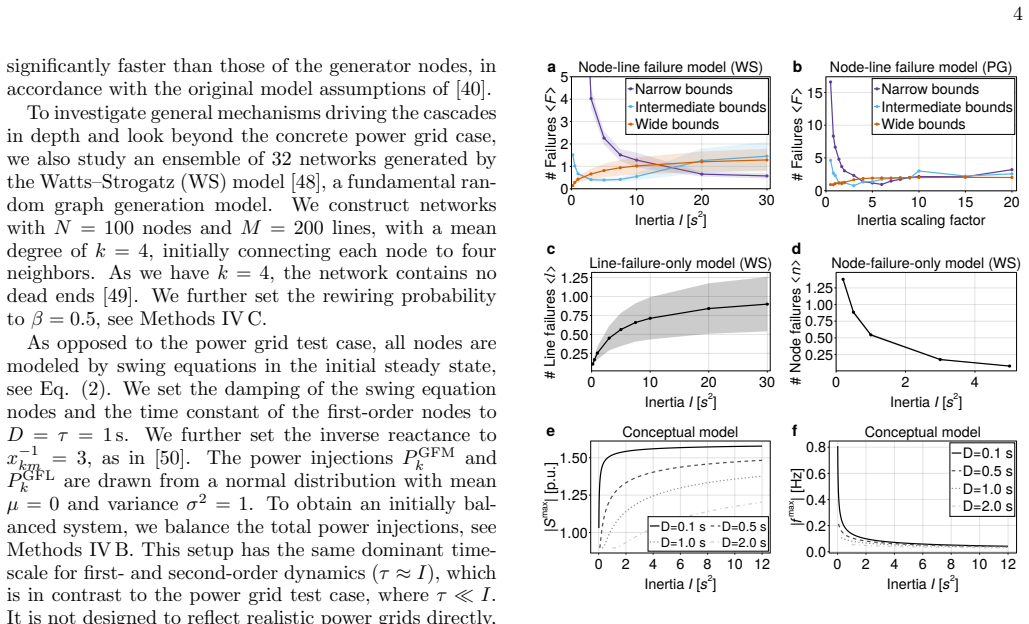
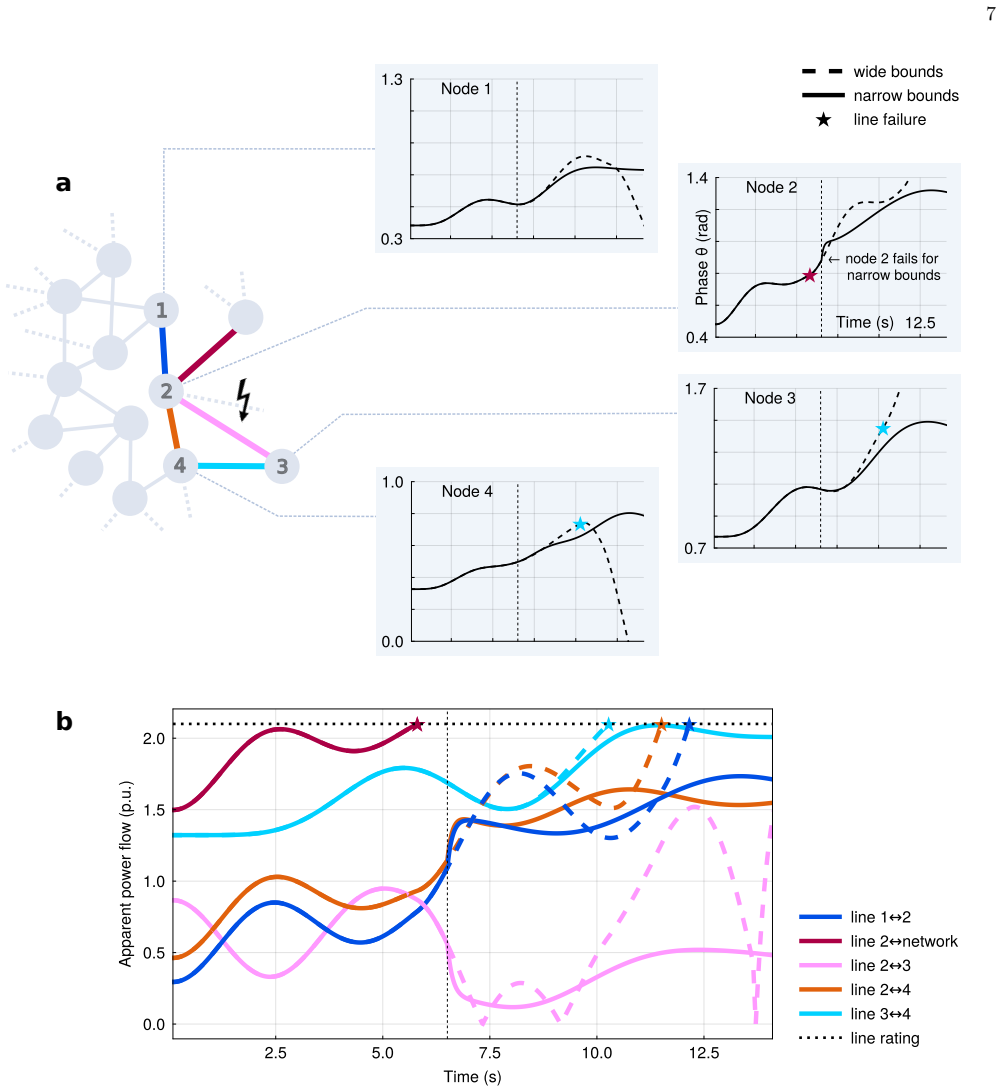
Cascade experiments To study the combined effect of node and line failures systematically, we conducted experiments on failure cas- cades induced by the initial failure of a single line. In each simulation, we initialize the system at a stable operating state, where all nodes are in synchrony at the reference angular frequency, i.e.ω k = 0∀k∈ {1, . . . , ...
-
[7]
Mechanism of inertia-induced destabilization To understand the mechanism behind the inertia- induced destabilization, we consider a basic conceptual model: a single node, connected by a single line to the rest of the network, with no power flowing on the con- necting line in the initial state. If the power injected into the node jumps by a small amount ∆P...
-
[8]
(10) and (11) also pre- dicts that both|S max|and|f max|decrease as damping Dincreases
The role of Damping The analytic model in Eqs. (10) and (11) also pre- dicts that both|S max|and|f max|decrease as damping Dincreases. Further experiments confirm this expecta- tion (Supplementary Fig. 5): the number of failures⟨F⟩ decreases withD, independent of the frequency bounds fb. The analytic model also suggests that jointly scal- ing inertia and ...
-
[9]
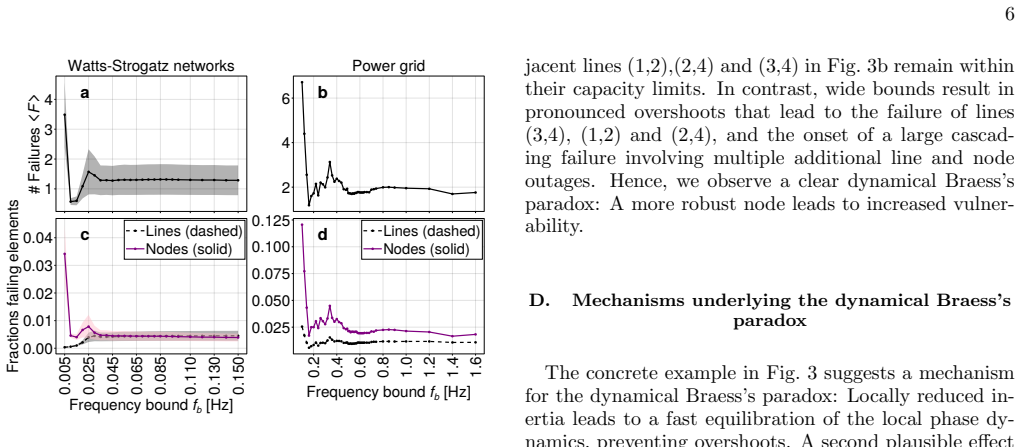
For 52% of the cascades it isB >0. Conversely, only 35% of the cascades exhibit the naively expected behavior, where more robust nodes lead to smaller cas- cades (B <0), while for 13% of the cascades it isB= 0. The Braessness for the power grid that shows a similar behavior andBfor node and line failures separately are shown in Supplementary Fig. 10. We f...
-
[10]
Final report system disturbance on 4 November 2006 (2007)
Union for the Co-ordination of Transmission of Electric- ity. Final report system disturbance on 4 November 2006 (2007). https://eepublicdownloads.entsoe.eu/clean-doc uments/pre2015/publications/ce/otherreports/Final-R eport-20070130.pdf
2006
-
[11]
GB power system disruption on 9 August 2019: Final report (2020)
Department for Business, Energy & Industrial Strategy. GB power system disruption on 9 August 2019: Final report (2020). https://assets.publishing.service.gov.uk /media/5e0e1fa9e5274a0fa7b4d96a/e3c-gb-power-disru ption-9-august-2019-final-report.pdf
2019
-
[12]
What does the power outage on 9 August 2019 tell us about GB power system
Bialek, J. What does the power outage on 9 August 2019 tell us about GB power system. Tech. Rep., University of Cambridge (2020). https://www.jbs.cam.ac.uk/wp-c ontent/uploads/2023/12/eprg-wp2006.pdf
2019
-
[13]
Motter, A. E. & Lai, Y.-C. Cascade-based attacks on complex networks.Phys. Rev. E66, 065102 (2002)
2002
-
[14]
& Marchiori, M
Crucitti, P., Latora, V. & Marchiori, M. Model for cas- cading failures in complex networks.Phys. Rev. E69, 045104 (2004)
2004
-
[15]
Artime, O.et al.Robustness and resilience of complex networks.Nat. Rev. Phys.6, 114–131 (2024)
2024
-
[16]
& Latora, V
Sch¨ afer, B., Witthaut, D., Timme, M. & Latora, V. Dy- namically induced cascading failures in power grids.Nat. Commun.9, 1975 (2018)
1975
-
[17]
Energy9, 526–535 (2024)
St¨ urmer, J.et al.Increasing the resilience of the Texas power grid against extreme storms by hardening critical lines.Nat. Energy9, 526–535 (2024)
2024
-
[18]
& Teh, J
Zakariya, M. & Teh, J. A systematic review on cascading failures models in renewable power systems with dynam- ics perspective and protections modeling.Electr. Power Syst. Res.214, 108928 (2023)
2023
-
[19]
& Latora, V
Kinney, R., Crucitti, P., Albert, R. & Latora, V. Model- ing cascading failures in the North American power grid. Eur. Phys. J. B46, 101–107 (2005)
2005
-
[20]
& Scala, A
Pahwa, S., Scoglio, C. & Scala, A. Abruptness of cascade failures in power grids.Sci. Rep.4, 3694 (2014)
2014
-
[21]
& Kurths, J
Plietzsch, A., Schultz, P., Heitzig, J. & Kurths, J. Lo- cal vs. global redundancy – trade-offs between resilience against cascading failures and frequency stability.Eur. Phys. J. Spec. Top.225, 551–568 (2016)
2016
-
[22]
& Kettemann, S
Rohden, M., Jung, D., Tamrakar, S. & Kettemann, S. Cascading failures in ac electricity grids.Phys. Rev. E 94, 032209 (2016)
2016
-
[23]
Ulbig, A., Borsche, T. S. & Andersson, G. Impact of low rotational inertia on power system stability and opera- tion.IF AC Proc. Vol.47, 7290–7297 (2014)
2014
-
[24]
Milano, F., Dorfler, F., Hug, G., Hill, D. J. & Verbic, G. Foundations and challenges of low-inertia systems (invited paper). In2018 Power Systems Computation Conference (PSCC), 1–25 (IEEE, Dublin, 2018)
2018
-
[25]
& T´ aczi, I
Hartmann, B., Vokony, I. & T´ aczi, I. Effects of decreas- ing synchronous inertia on power system dynamics— overview of recent experiences and marketisation of ser- vices.Int. Trans. Electr. Energy Syst.29, e12128 (2019). 12
2019
-
[26]
Rydin Gorj˜ ao, L.et al.Open database analysis of scaling and spatio-temporal properties of power grid frequencies. Nat. Commun.11, 6362 (2020)
2020
-
[27]
Nnoli, K. P. & Kettemann, S. Spreading of disturbances in realistic models of transmission grids in dependence on topology, inertia and heterogeneity.Sci. Rep.11, 23742 (2021)
2021
-
[28]
Frequency stability in long-term scenarios and relevant requirements (2021)
ENTSO-E. Frequency stability in long-term scenarios and relevant requirements (2021). https://eepublicdown loads.azureedge.net/clean-documents/Publications/EN TSO-E%20general%20publications/211203 Long term f requency stability scenarios for publication.pdf
2021
-
[29]
K., Bolognani, S
Poolla, B. K., Bolognani, S. & Dorfler, F. Optimal place- ment of virtual inertia in power grids.IEEE Trans. Au- tom. Control62, 6209–6220 (2017)
2017
-
[30]
Sci.7, 654 (2017)
Tamrakar, U.et al.Virtual inertia: Current trends and future directions.Appl. Sci.7, 654 (2017)
2017
-
[31]
& Pagnier, L
Jacquod, P. & Pagnier, L. Optimal placement of iner- tia and primary control in high voltage power grids. In 2019 53rd Annual Conference on Information Sciences and Systems (CISS), 1–6 (IEEE, Baltimore, MD, USA, 2019)
2019
-
[32]
& Jacquod, P
Pagnier, L. & Jacquod, P. Inertia location and slow net- work modes determine disturbance propagation in large- scale power grids.PLOS ONE14, e0213550 (2019)
2019
-
[33]
& Jacquod, P
Fritzsch, J. & Jacquod, P. Stabilizing large-scale electric power grids with adaptive inertia.PRX Energy3, 033003 (2024)
2024
-
[34]
Park, S., Kim, C. H. & Kahng, B. Optimal location of re- inforced inertia to stabilize power grids.Chaos, Solitons Fractals199, 116768 (2025)
2025
-
[35]
& Xie, K
Wang, L., Hu, B. & Xie, K. Dynamic cascading failure model for blackout risk assessment of power system with renewable energy.E3S Web Conf.257, 01072 (2021)
2021
-
[36]
& Hel- bing, D
Simonsen, I., Buzna, L., Peters, K., Bornholdt, S. & Hel- bing, D. Transient dynamics increasing network vulnera- bility to cascading failures.Phys. Rev. Lett.100, 218701 (2008)
2008
-
[37]
& Motter, A
Yang, Y. & Motter, A. E. Cascading failures as continu- ous phase-space transitions.Phys. Rev. Lett.119, 248302 (2017)
2017
-
[38]
& Gambuzza, L
Frasca, M. & Gambuzza, L. V. Control of cascading fail- ures in dynamical models of power grids.Chaos, Solitons Fractals153, 111460 (2021)
2021
-
[39]
C., Angulo-Garcia, D
Galindo-Gonz´ alez, C. C., Angulo-Garcia, D. & Osorio, G. Decreased resilience in power grids under dynamically induced vulnerabilities.New J. Phys.22, 103033 (2020)
2020
-
[40]
Olmi, S., Gambuzza, L. V. & Frasca, M. Multilayer con- trol of synchronization and cascading failures in power grids.Chaos, Solitons Fractals180, 114412 (2024)
2024
-
[41]
¨Uber ein Paradoxon aus der Verkehrsplanung
Braess, D. ¨Uber ein Paradoxon aus der Verkehrsplanung. Unternehmensforsch.12, 258–268 (1968)
1968
-
[42]
Commun.13, 5396 (2022)
Sch¨ afer, B.et al.Understanding Braess’ paradox in power grids.Nat. Commun.13, 5396 (2022)
2022
-
[43]
& Timme, M
Witthaut, D. & Timme, M. Braess’s paradox in oscillator networks, desynchronization and power outage.New J. Phys.14, 083036 (2012)
2012
-
[44]
& Jacquod, P
Coletta, T. & Jacquod, P. Linear stability and the Braess paradox in coupled-oscillator networks and electric power grids.Phys. Rev. E93, 032222 (2016)
2016
-
[45]
Tchuisseu, E. B. T.et al.Curing Braess’ paradox by sec- ondary control in power grids.New J. Phys.20, 083005 (2018)
2018
-
[46]
Position on the need for national connection requirements to ensure EU power system stability (2025)
ENTSO-E System Development Committee. Position on the need for national connection requirements to ensure EU power system stability (2025). https://eepublicdown loads.blob.core.windows.net/public-cdn-container/clean -documents/Publications/Position%20papers%20and% 20reports/2025/251211 SDC Position paper on CNC 2 .0.pdf
2025
-
[47]
RDI roadmap 2024 – 2034 (2024)
ENTSO-E. RDI roadmap 2024 – 2034 (2024). https: //eepublicdownloads.entsoe.eu/clean-documents/Publi cations/RDCpublications/entso-e RDI roadmap 2024-2 034 240710.pdf
2024
-
[48]
Grid codes for renewable powered systems (2022)
International Renewable Energy Agency. Grid codes for renewable powered systems (2022). https://www.irena. org/-/media/Files/IRENA/Agency/Publication/2022/ Apr/IRENA Grid Codes Renewable Systems 2022.pdf? rev=986f108cbe5e47b98d17fca93eee6c86
2022
-
[49]
& Hill, D
Bergen, A. & Hill, D. A structure preserving model for power system stability analysis.IEEE Trans. Power App. Syst.PAS-100, 25–35 (1981)
1981
-
[50]
Machowski, J., Lubosny, Z., Bialek, J. W. & Bumby, J. R.Power System Dynamics: Stability and Control (John Wiley & Sons, Hoboken, NJ, 2020), 3rd edn
2020
-
[51]
& Motter, A
Nishikawa, T. & Motter, A. E. Comparative analysis of existing models for power-grid synchronization.New J. Phys.17, 015012 (2015)
2015
-
[52]
Guo, Y., Zhang, D., Li, Z., Wang, Q. & Yu, D. Overviews on the applications of the Kuramoto model in modern power system analysis.Int. J. Electr. Power Energy Syst. 129, 106804 (2021)
2021
-
[53]
& Timme, M
Witthaut, D. & Timme, M. Nonlocal effects and counter- measures in cascading failures.Phys. Rev. E92, 032809 (2015)
2015
-
[54]
W.Electric Power System Basics for the Nonelectrical Professional(IEEE Press, Wiley, Hoboken, New Jersey, 2017), 2nd edn
Blume, S. W.Electric Power System Basics for the Nonelectrical Professional(IEEE Press, Wiley, Hoboken, New Jersey, 2017), 2nd edn
2017
-
[55]
Gonen, T.Electrical Power Transmission System Engi- neering(CRC Press, 2014)
2014
-
[56]
Power Syst.35, 119–127 (2020)
Barrows, C.et al.The IEEE reliability test system: A proposed 2019 update.IEEE Trans. Power Syst.35, 119–127 (2020)
2019
-
[57]
Watts, D. J. & Strogatz, S. H. Collective dynamics of ‘small-world’ networks.Nature393, 440–442 (1998)
1998
-
[58]
J., Heitzig, J., Kurths, J
Menck, P. J., Heitzig, J., Kurths, J. & Schellnhuber, H. J. How dead ends undermine power grid stability. Nat. Commun.5, 3969 (2014)
2014
-
[59]
& Hellmann, F
B¨ uttner, A., Kurths, J. & Hellmann, F. Ambient forc- ing: Sampling local perturbations in constrained phase spaces.New J. Phys.24, 053019 (2022)
2022
-
[60]
& Bizzarri, F
Del Giudice, D., Brambilla, A., Grillo, S. & Bizzarri, F. Effects of inertia, load damping and dead-bands on fre- quency histograms and frequency control of power sys- tems.Int. J. Electr. Power Energy Syst.129, 106842 (2021)
2021
-
[61]
& Hellmann, F
Kogler, R., Plietzsch, A., Schultz, P. & Hellmann, F. Normal form for grid-forming power grid actors.PRX Energy1, 013008 (2022)
2022
-
[62]
& Hell- mann, F
B¨ uttner, A., W¨ urfel, H., Liemann, S., Schiffer, J. & Hell- mann, F. Complex-phase, data-driven identification of grid-forming inverter dynamics.IEEE Trans. Smart Grid 16, 4854–4864 (2025)
2025
-
[63]
& Pota, H
Hossain, J. & Pota, H. R.Robust Control for Grid Volt- age Stability: High Penetration of Renewable Energy: In- terfacing Conventional and Renewable Power Generation Resources. Power Systems (Springer Singapore, Singa- 13 pore, 2014)
2014
-
[64]
V., Frasca, M
Fan, X., Dudkina, E., Gambuzza, L. V., Frasca, M. & Crisostomi, E. A network-based structure-preserving dy- namical model for the study of cascading failures in power grids.Electr. Power Syst. Res.209, 107987 (2022)
2022
-
[65]
Final report - grid incident in Spain and Por- tugal on 28 April 2025 (2026)
ENTSO-E. Final report - grid incident in Spain and Por- tugal on 28 April 2025 (2026). https://eepublicdownlo ads.blob.core.windows.net/public-cdn-container/clean-d ocuments/Publications/2025/iberian-blackout/Final% 20Report%20on%20the%20Grid%20Incident%20in%20S pain%20and%20Portugal%20on%2028%20April%202025 .pdf
2025
-
[66]
Berner, R., Gross, T., Kuehn, C., Kurths, J. & Yanchuk, S. Adaptive dynamical networks.Phys. Rep.1031, 1–59 (2023). 14 Supplementary Information Nodal Braess’s paradox and inertia destabilization with dynamic node and line failures in power grids Nubius Brandner 1,2,3,∗, Frank Hellmann 1,∗, Hans W¨ urfel1, J¨ urgen Kurths1,4, Anton Plietzsch 5, Anna B¨ ut...
discussion (0)
Sign in with ORCID, Apple, or X to comment. Anyone can read and Pith papers without signing in.