Determination of the intrinsic mechanical quality factor in high-stress silicon nitride resonators
Pith reviewed 2026-06-26 14:54 UTC · model grok-4.3
The pith
Silicon nitride resonators show intrinsic quality factor varying with thickness in ways standard models miss.
A machine-rendered reading of the paper's core claim, the machinery that carries it, and where it could break.
Core claim
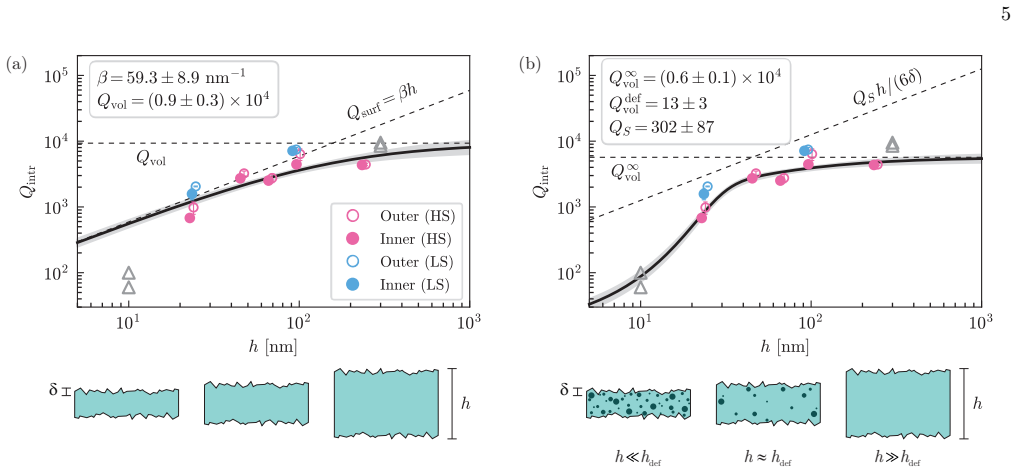
By combining automated mode identification with systematic ringdown measurements over a large number of mechanical modes in high-stress silicon nitride membranes, the intrinsic quality factor Q_intr can be extracted reliably, exposing a systematic dependence on thickness that established models fail to describe, especially for ultra-thin films, which is instead captured by a phenomenological model incorporating a thickness-dependent loss channel.
What carries the argument
Automated mode identification paired with ringdown measurements performed across many mechanical modes, which isolates the intrinsic quality factor Q_intr from other contributions.
If this is right
- Targeting the intrinsic loss channel directly becomes a viable route to higher quality factors beyond what stress and mode engineering alone can achieve.
- The thickness-dependent loss channel must be included when modeling dissipation in the ultra-thin regime.
- The phenomenological model supplies a concrete starting point for developing a microscopic description of the underlying dissipation mechanism.
- The same measurement approach can be used to test whether mitigation strategies reduce the identified loss channel.
Where Pith is reading between the lines
- Device designers could choose membrane thickness to balance dissipation dilution gains against the growth of the new loss channel.
- The method might map intrinsic losses in other stressed thin-film materials or resonator shapes to identify common mechanisms.
- If the thickness-dependent loss arises from surfaces or interfaces, targeted surface treatments could be tested as a direct mitigation step.
Load-bearing premise
Ringdown measurements on many automatically identified modes isolate the intrinsic quality factor without meaningful interference from mode-specific or extrinsic losses that could themselves vary with thickness or frequency.
What would settle it
A set of ringdown measurements on additional ultra-thin membranes showing no thickness dependence in the extracted Q_intr, or a clear mismatch between the phenomenological model and data from a new thickness series, would falsify the central claim.
Figures


read the original abstract
Recent advances in silicon nitride nanomechanical resonators have pushed mechanical quality factors to ultra-high values by combining stress-induced dissipation dilution with mode-shape engineering. Neither mechanism alters the intrinsic quality factor $Q_{\mathrm{intr}}$. Targeting the intrinsic loss itself therefore remains an untapped route to even higher $Q$. Doing so first requires reliable quantification of $Q_{\mathrm{intr}}$, which has proven challenging. Here we present a robust methodology that quantifies $Q_{\mathrm{intr}}$ by combining automated mode identification with systematic ringdown measurements over a large number of mechanical modes. Applied to high-stress silicon nitride membranes, it reveals a systematic dependence of $Q_{\mathrm{intr}}$ on thickness that cannot be described using established models, particularly in the ultra-thin limit. We account for this trend with a phenomenological model that incorporates a thickness-dependent loss channel. Together, our method and model open a route toward a microscopic understanding of intrinsic dissipation and toward directly mitigating its loss channels.
Editorial analysis
A structured set of objections, weighed in public.
Referee Report
Summary. The manuscript presents a methodology that combines automated mode identification with systematic ringdown measurements across a large number of mechanical modes to extract the intrinsic quality factor Q_intr in high-stress silicon nitride membranes. It reports a systematic thickness dependence of Q_intr that deviates from established surface- or volume-loss models, especially in the ultra-thin limit, and introduces a phenomenological model incorporating an additional thickness-dependent loss channel to describe the data.
Significance. If the extraction method reliably isolates intrinsic losses and the reported thickness trend is robust, the work would provide a practical route to quantify and potentially mitigate previously unaccounted dissipation channels in nanomechanical resonators, complementing existing dissipation-dilution approaches and enabling higher-Q devices.
major comments (2)
- [Methodology / Results (ringdown and mode-identification sections)] The central claim that multi-mode ringdown data after automated identification yields a clean Q_intr(t) requires explicit demonstration that residual extrinsic contributions (clamping, anchor, or frequency-dependent air damping) do not correlate with thickness. No quantitative bounds on identification accuracy or post-averaging extrinsic residuals are provided, which is load-bearing for the reported trend and the need for a new loss channel.
- [Phenomenological model section] The phenomenological model is introduced specifically to capture the observed thickness trend. Without an independent derivation of the loss-channel strength or a falsifiable prediction tested on a separate data set, the model risks being a post-hoc fit rather than a physically motivated addition; this directly affects the claim that established models are insufficient.
minor comments (2)
- [Methods] Clarify the precise criteria and success metrics used by the automated mode-identification algorithm, including any reported false-positive or false-negative rates.
- [Results] Add explicit error propagation or statistical analysis for the extracted Q_intr values as a function of thickness to support the systematic trend.
Simulated Author's Rebuttal
We thank the referee for the careful review and constructive feedback. We address each major comment below. Revisions have been made to strengthen the validation of the extraction method and to clarify the scope of the phenomenological model.
read point-by-point responses
-
Referee: [Methodology / Results (ringdown and mode-identification sections)] The central claim that multi-mode ringdown data after automated identification yields a clean Q_intr(t) requires explicit demonstration that residual extrinsic contributions (clamping, anchor, or frequency-dependent air damping) do not correlate with thickness. No quantitative bounds on identification accuracy or post-averaging extrinsic residuals are provided, which is load-bearing for the reported trend and the need for a new loss channel.
Authors: We agree that quantitative bounds on identification accuracy and residual extrinsic contributions are necessary to support the central claim. In the revised manuscript we have added a dedicated subsection (Section 3.3) and Appendix C containing Monte Carlo simulations of the automated mode-identification algorithm. These simulations demonstrate >92% correct identification across the full thickness range studied, with no systematic thickness dependence in the error rate. We further provide upper bounds on residual extrinsic losses (clamping, anchor, and air damping) after averaging, estimated at <4% of the total measured dissipation and showing no correlation with membrane thickness. These additions directly address the load-bearing concern for the reported Q_intr trend. revision: yes
-
Referee: [Phenomenological model section] The phenomenological model is introduced specifically to capture the observed thickness trend. Without an independent derivation of the loss-channel strength or a falsifiable prediction tested on a separate data set, the model risks being a post-hoc fit rather than a physically motivated addition; this directly affects the claim that established models are insufficient.
Authors: We acknowledge that the model is phenomenological and was constructed to describe the observed thickness dependence. In the revised text we have explicitly stated its phenomenological nature and its role as an empirical description rather than a first-principles derivation. To mitigate the post-hoc concern we have performed a cross-validation test on a held-out subset of the multi-mode data (20% of modes per device), confirming that the model parameters remain consistent and improve the fit relative to established surface/volume models. We agree that an independent microscopic derivation lies outside the present scope and would require additional material-specific measurements; the model is therefore presented as a practical tool to guide future investigations rather than a complete physical explanation. revision: partial
Circularity Check
No circularity: empirical methodology and phenomenological fit remain independent of inputs
full rationale
The paper's core contribution is a measurement protocol (automated mode ID + multi-mode ringdown) applied to extract Q_intr(t) from data, followed by a post-hoc phenomenological model to describe the observed thickness trend. No quoted equations or steps reduce a claimed prediction or first-principles result back to the fitted data by construction. No self-citation chains, uniqueness theorems, or ansatzes imported from prior author work are invoked as load-bearing. The derivation is therefore self-contained against external benchmarks (ringdown data) and receives the default non-finding.
Axiom & Free-Parameter Ledger
free parameters (1)
- thickness-dependent loss strength
Reference graph
Works this paper leans on
-
[1]
Bachtold, J
A. Bachtold, J. Moser, and M. Dykman, Mesoscopic physics of nanomechanical systems, Reviews of Modern Physics94, 045005 (2022)
2022
-
[2]
S. A. Fedorov, N. J. Engelsen, A. H. Ghadimi, M. J. Bereyhi, R. Schilling, D. J. Wilson, and T. J. Kippenberg, Generalized dissipation dilution in strained mechanical resonators, Physical Review B99, 054107 (2019)
2019
-
[3]
N. J. Engelsen, A. Beccari, and T. J. Kippenberg, Ultrahigh-quality-factor micro- and nanomechanical res- onators using dissipation dilution, Nature Nanotechnol- ogy19, 725 (2024)
2024
-
[4]
Tsaturyan, A
Y. Tsaturyan, A. Barg, E. S. Polzik, and A. Schliesser, Ultracoherent nanomechanical resonators via soft clamp- ing and dissipation dilution, Nature Nanotechnology (2017)
2017
-
[5]
A. H. Ghadimi, S. A. Fedorov, N. J. Engelsen, M. J. Bereyhi, R. Schilling, D. J. Wilson, and T. J. Kippen- berg, Elastic strain engineering for ultralow mechanical dissipation, Science360, 764 (2018)
2018
-
[6]
L. Catalini and others, Soft-clamped phononic dimers for mechanical sensing and transduction, Physical Review Applied 10.1103/PhysRevApplied.14.014041 (2020)
-
[7]
Reetz, R
C. Reetz, R. Fischer, G. G. Assumpcao, D. P. McNally, P. S. Burns, J. C. Sankey, and C. A. Regal, Analysis of membrane phononic crystals with wide band gaps and low-mass defects, Physical Review Applied12, 044027 (2019)
2019
-
[8]
M. J. Bereyhi, A. Beccari, R. Groth, S. A. Fedorov, A. Arabmoheghi, T. J. Kippenberg, and N. J. Engelsen, Hierarchical tensile structures with ultralow mechanical dissipation, Nature Communications13, 3097 (2022)
2022
-
[9]
D. Shin, A. Cupertino, M. H. de Jong, P. G. Steeneken, M. A. Bessa, and R. A. Norte, Spiderweb nanomechanical resonators via bayesian optimization: inspired by nature and guided by machine learning, Advanced Materials34, 2106248 (2022)
2022
-
[10]
Cupertino, D
A. Cupertino, D. Shin, L. Guo, P. G. Steeneken, M. A. Bessa, and R. A. Norte, Centimeter-scale nanomechani- cal resonators with low dissipation, Nature Communica- tions15, 4255 (2024)
2024
-
[11]
Rossi, D
M. Rossi, D. Mason, J. Chen, Y. Tsaturyan, and A. Schliesser, Measurement-based quantum control of mechanical motion, Nature563, 53 (2018)
2018
-
[12]
Mason, J
D. Mason, J. Chen, M. Rossi, Y. Tsaturyan, and A. Schliesser, Continuous force and displacement mea- surement below the standard quantum limit, Nature Physics15, 745 (2019)
2019
-
[13]
Y. Seis, T. Capelle, E. Langman, S. Saarinen, E. Planz, and A. Schliesser, Ground state cooling of an ultracoher- ent electromechanical system, Nature communications 13, 1507 (2022)
2022
-
[14]
S. A. Saarinen, N. Kralj, E. C. Langman, Y. Tsatu- ryan, and A. Schliesser, Laser cooling a membrane-in-the- middle system close to the quantum ground state from room temperature, Optica10, 10.1364/optica.468590 (2023)
-
[15]
Bagci, A
T. Bagci, A. Simonsen, S. Schmid, L. G. Villanueva, E. Zeuthen, J. Appel, J. M. Taylor, A. Sørensen, K. Us- ami, A. Schliesser,et al., Optical detection of radio waves through a nanomechanical transducer, Nature507, 81 (2014)
2014
-
[16]
R. W. Andrews, R. W. Peterson, T. P. Purdy, K. Cicak, R. W. Simmonds, C. A. Regal, and K. W. Lehnert, Bidi- rectional and efficient conversion between microwave and optical light, Nature physics10, 321 (2014)
2014
- [17]
-
[18]
Timarac-Popovi´ c, J
J. Timarac-Popovi´ c, J. Hiesberger, E. ˇSesto, N. Luh- mann, A. Giesriegl, H. Beˇ si´ c, J. P. Lafleur, and S. Schmid, Nanoplastic analysis with nanoelectrome- chanical system fourier transform infrared spectroscopy: Nems-ftir, arXiv e-prints , arXiv (2025)
2025
-
[19]
Surdu, R
M. Surdu, R. Calmer, J. Timarac-Popovi´ c, T. Penn, N. Luhmann, J. Hiesberger, V. Vuki´ cevi´ c, E. Alvino D´ emolis, L. Favre, B. D¨ onmez,et al., Quantifying submicrometer atmospheric aerosol chem- ical composition using nanoelectromechanical fourier transform infrared spectroscopy, Science Advances12, eaeb2254 (2026)
2026
-
[20]
Kharbanda, A
B. Kharbanda, A. Arabmoheghi, L. Catalini, M. Bereyhi, G. Benga, A. Zicoschi, C. L. Degen, T. J. Kippenberg, A. Eichler, and N. J. Engelsen, On-chip frequency-noise cancellation in nanomechanical resonators using cavity optomechanics, Physical Review Applied25, L031004 (2026)
2026
-
[21]
D. H¨ alg and others, Membrane-based scanning force mi- croscopy, Physical Review Applied 10.1103/PhysRevAp- plied.15.L021001 (2021)
-
[22]
Gisler, D
T. Gisler, D. H¨ alg, V. Dumont, S. Misra, L. Catal- ini, E. C. Langman, A. Schliesser, C. L. Degen, and A. Eichler, Enhancing membrane-based scanning force microscopy through an optical cavity, Physical Review Applied22, 044001 (2024)
2024
-
[23]
Scozzaro, W
N. Scozzaro, W. Ruchotzke, A. Belding, J. Cardellino, E. C. Blomberg, B. A. McCullian, V. P. Bhallamudi, D. V. Pelekhov, and P. C. Hammel, Magnetic resonance force detection using a membrane resonator, Journal of Magnetic Resonance271, 15 (2016)
2016
-
[24]
Fischer, D
R. Fischer, D. P. McNally, C. Reetz, G. G. Assumpcao, T. Knief, Y. Lin, and C. A. Regal, Spin detection with a micromechanical trampoline: towards magnetic reso- nance microscopy harnessing cavity optomechanics, New Journal of Physics21, 043049 (2019)
2019
-
[25]
T. M. Karg, B. Gouraud, C. T. Ngai, G.-L. Schmid, K. Hammerer, and P. Treutlein, Light-mediated strong coupling between a mechanical oscillator and atomic spins 1 meter apart, Science369, 174 (2020)
2020
-
[26]
Koˇ sata, O
J. Koˇ sata, O. Zilberberg, C. L. Degen, R. Chitra, and A. Eichler, Spin detection via parametric frequency con- version in a membrane resonator, Physical Review Ap- plied14, 014042 (2020)
2020
-
[27]
R. A. Thomas, M. Parniak, C. Østfeldt, C. B. Møller, C. Bærentsen, Y. Tsaturyan, A. Schliesser, J. Appel, E. Zeuthen, and E. S. Polzik, Entanglement between dis- tant macroscopic mechanical and spin systems, Nature Physics17, 228 (2021)
2021
-
[28]
Eichler, Ultra-high-q nanomechanical resonators for force sensing, Materials for Quantum Technology2, 043001 (2022)
A. Eichler, Ultra-high-q nanomechanical resonators for force sensing, Materials for Quantum Technology2, 043001 (2022). 7
2022
-
[29]
D. A. Visani, L. Catalini, C. L. Degen, A. Eichler, and J. Del Pino, Near-resonant nuclear spin detection with megahertz mechanical resonators, SciPost Physics20, 037 (2026)
2026
-
[30]
X. Xi, I. Chernobrovkin, J. Koˇ sata, M. B. Kris- tensen, E. Langman, A. S. Sørensen, O. Zilberberg, and A. Schliesser, A soft-clamped topological waveguide for phonons, Nature642, 947 (2025)
2025
-
[31]
L. G. Villanueva and S. Schmid, Evidence of Surface Loss as Ubiquitous Limiting Damping Mechanism in SiN Micro- and Nanomechanical Resonators, Phys. Rev. Lett. (2014)
2014
-
[32]
K. Y. Yasumura, T. D. Stowe, E. M. Chow, T. Pfafman, T. W. Kenny, B. C. Stipe, and D. Rugar, Quality fac- tors in micron-and submicron-thick cantilevers, Journal of microelectromechanical systems9, 117 (2000)
2000
-
[33]
Schmid, L
S. Schmid, L. G. Villanueva, and M. L. Roukes,Fun- damentals of Nanomechanical Resonators(Springer Na- ture, Cham, 2023)
2023
-
[34]
Wilson-Rae, R
I. Wilson-Rae, R. A. Barton, S. S. Verbridge, D. R. Southworth, B. Ilic, H. G. Craighead, and J. M. Parpia, High-$Q$Nanomechanics via Destructive Interference of Elastic Waves, Physical Review Letters106, 047205 (2011)
2011
-
[35]
Wilson-Rae, Intrinsic dissipation in nanomechanical resonators due to phonon tunneling, Physical Review B 77, 245418 (2008)
I. Wilson-Rae, Intrinsic dissipation in nanomechanical resonators due to phonon tunneling, Physical Review B 77, 245418 (2008)
2008
-
[36]
Rieger, A
J. Rieger, A. Isacsson, M. J. Seitner, J. P. Kotthaus, and E. M. Weig, Energy losses of nanomechanical resonators induced by atomic force microscopy-controlled mechani- cal impedance mismatching, Nature communications5, 3345 (2014)
2014
-
[37]
M. H. J. de Jong, M. A. ten Wolde, A. Cupertino, S. Gr¨ oblacher, P. G. Steeneken, and R. A. Norte, Me- chanical dissipation by substrate–mode coupling in sin resonators, Applied Physics Letters121, 032201 (2022)
2022
-
[38]
M. H. de Jong, A. Cupertino, D. Shin, S. Gr¨ oblacher, F. Alijani, P. G. Steeneken, and R. A. Norte, Beat- ing ringdowns of near-degenerate mechanical resonances, Phys. Rev. Appl.20, 024053 (2023)
2023
-
[39]
Newey and J
W. Newey and J. Powell, Asymmetric least squares esti- mation and testing, Econometrica55, 819 (1987)
1987
-
[40]
Copel, P
M. Copel, P. R. Varekamp, D. W. Kisker, F. R. McFeely, K. E. Litz, and M. M. Banaszak Holl, Nucleation of chem- ical vapor deposited silicon nitride on silicon dioxide, Ap- plied Physics Letters74, 1830 (1999)
1999
-
[41]
Martin, F
F. Martin, F. Bertin, H. Sprey, and E. Granneman, Lpcvd si3n4 growth retardation on silicon native oxide compared with in situ hf vapour-deglazed silicon sub- strates, Semiconductor Science and Technology6, 1100 (1991)
1991
-
[42]
Z. A. Weinberg, K. J. Stein, T. N. Nguyen, and J. Y. Sun, Ultrathin oxide-nitride-oxide films, Applied Physics Letters57, 1248 (1990)
1990
-
[43]
F. Schell, C. Zwahr, and A. F. Lasagni, Surfalize: A python library for surface topography and roughness analysis designed for periodic surface structures, Nano- materials14, 10.3390/nano14131076 (2024)
-
[44]
Kwakman, E
L. Kwakman, E. Lindow, E. Granneman, F. Martin, J. Veler, and J. Joly, Quantification of si3n4 lpcvd inhi- bition on oxide surfaces, Applied Surface Science70-71, 629 (1993). 8 Supplementary Information S1. AUTOMATED RINGDOWN METHODOLOGY A. Mode Identification Prior to performing ringdown measurements, an automated peak-detection algorithm was used to ide...
1993
-
[45]
An antimony-doped silicon tip (Value AFM Probes by Bruker, T= 4µm,k= 42N/m,f 0 = 320kHz) with reflective aluminium on the back side was used in tapping mode
Surface Roughness AFM Measurement The surface topology was analyzed using ScanAsyst equipment (Bruker, Dimension Edge with Scan Asyst). An antimony-doped silicon tip (Value AFM Probes by Bruker, T= 4µm,k= 42N/m,f 0 = 320kHz) with reflective aluminium on the back side was used in tapping mode. Each measurement was done on the frame of the sample, which was...
-
[46]
In the thin limith→2δ, the surface layer fills the cross-section andQsaturates atQ S, avoiding the unphysical extrapolation to zero
Composite Model Applying Kirchhoff bending kinematics — in-plane strainε∝z, hencez 2-weighted bending energy — to a plate with a lossy surface layer of thicknessδyields 1 Q(h) = (h−2δ) 3 h3 1 Qvol(h) + h3 −(h−2δ) 3 h3 1 QS .(S4) In the thick limitδ≪hthis recoversQ≈Q Sh/(6δ), the Yasumura linear asymptote, withβ=Q S/(6δ). In the thin limith→2δ, the surface...
discussion (0)
Sign in with ORCID, Apple, or X to comment. Anyone can read and Pith papers without signing in.