Role of the Local Electric-Field in High-Field Conditioning of DC Electrodes:Numerical and Experimental Insights
Pith reviewed 2026-06-26 12:43 UTC · model grok-4.3
The pith
Higher local electric fields raise both breakdown risk and conditioning speed in DC electrodes, balancing to set breakdown locations.
A machine-rendered reading of the paper's core claim, the machinery that carries it, and where it could break.
Core claim
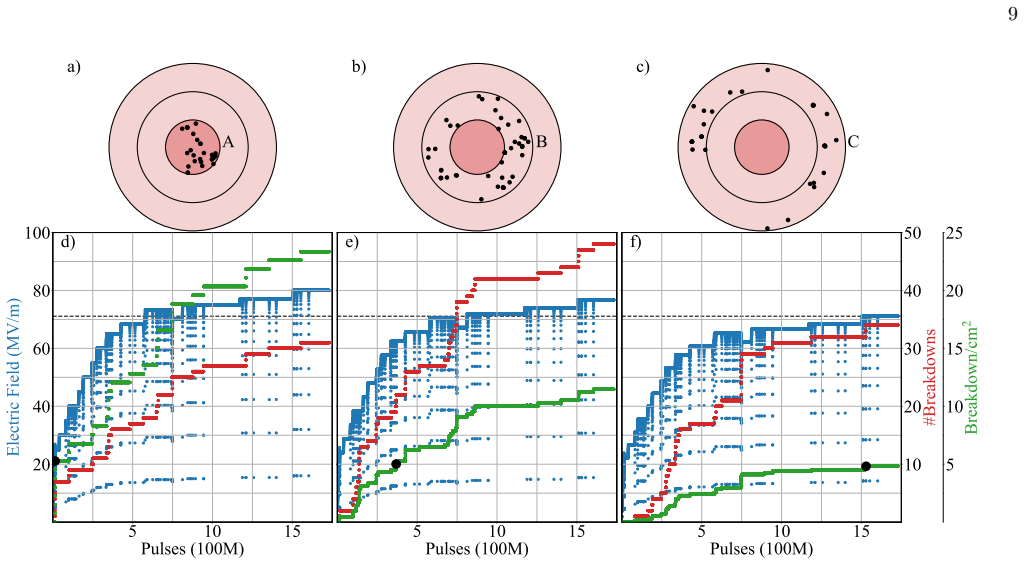
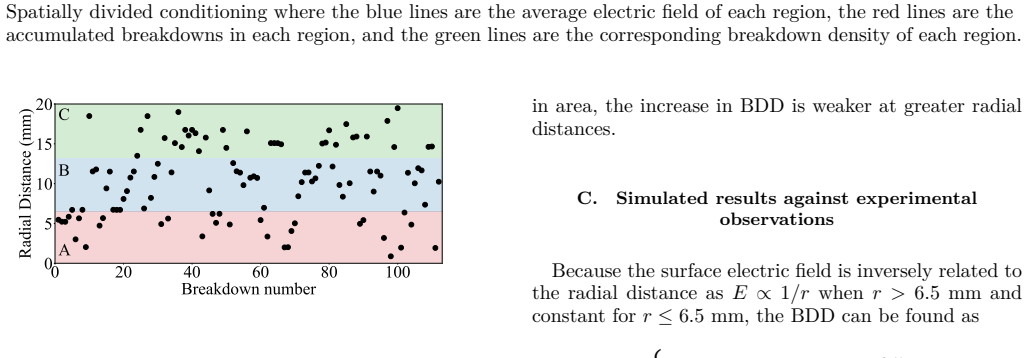
In pairs of high-field DC electrodes with a radially varying surface electric field, the locations of breakdowns observed during conditioning arise from the opposing influences of an elevated breakdown probability and an elevated conditioning rate at higher local fields; Monte Carlo simulations that incorporate both effects reproduce the measured breakdown-position statistics.
What carries the argument
The field-dependent competition between breakdown-initiation probability and progressive surface conditioning, implemented in Monte Carlo simulations that evolve the electrode state under repeated high-voltage pulses.
If this is right
- Breakdowns during conditioning occur away from the absolute highest-field sites because conditioning proceeds fastest there.
- The overall voltage-holding capability improves as the surface conditions at different rates across regions of different field strength.
- Monte Carlo runs using only the measured field map and the two field-dependent rates are sufficient to forecast where breakdowns will appear.
Where Pith is reading between the lines
- Designers could deliberately shape the field distribution to accelerate conditioning in critical areas without raising the final breakdown rate.
- The same balance may govern conditioning in radio-frequency structures where surface fields also vary spatially.
- A controlled test with uniform-field electrodes would isolate whether the observed position statistics truly require the field-variation mechanism.
Load-bearing premise
The Monte Carlo model correctly captures how the local electric field controls both the chance of a breakdown and the rate at which the surface improves during conditioning.
What would settle it
Breakdown-position maps recorded on a new electrode geometry with a different radial field profile that deviate systematically from the Monte Carlo predictions for that same profile.
Figures




read the original abstract
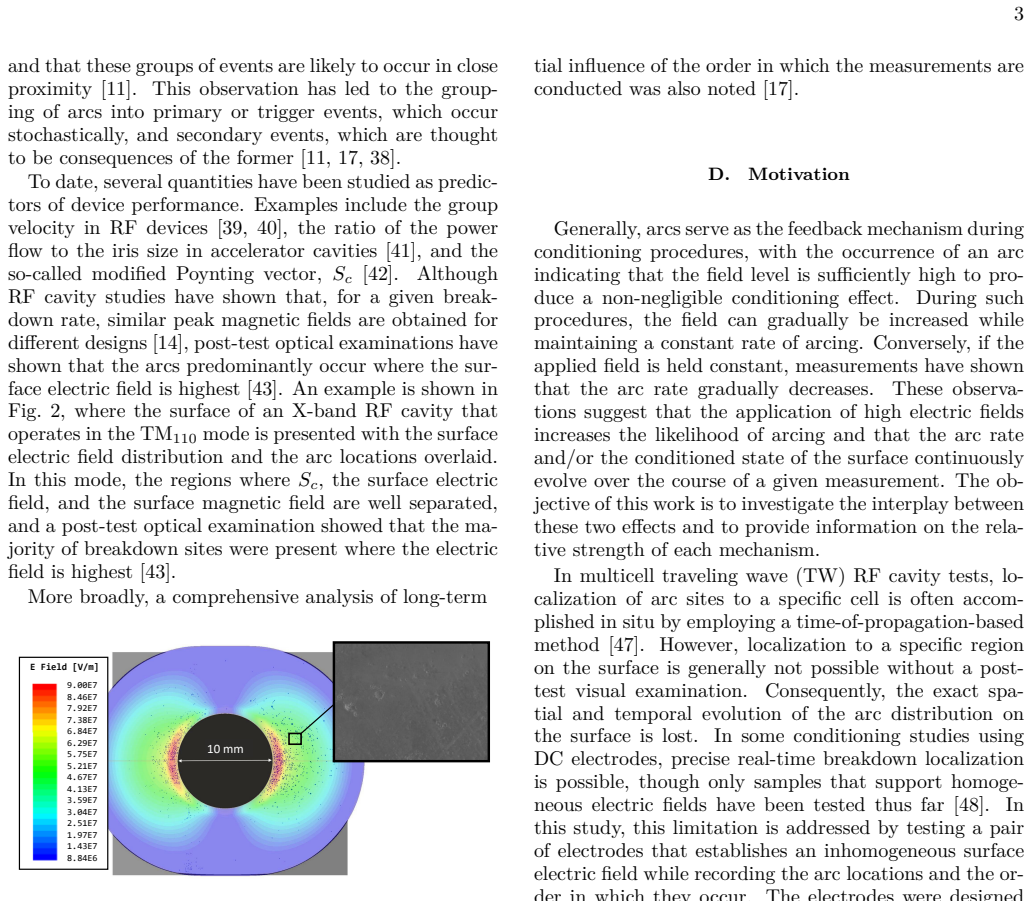
Conditioning, the progressive increase of voltage-holding through the controlled application of fields, is an important and widely used process for bringing high-field and high-voltage devices up to their full operating parameters. Here, a study is presented on how conditioning can vary within a device, specifically, when there is a spatial variation in the surface electric field. What has been observed in high-field pulsed direct-current electrodes and radio-frequency structures is that locations exposed to higher fields exhibit a greater tendency to breakdown, but this increase is counteracted by an increased conditioning rate. This interplay explains the observed breakdown locations and provides important insights into the mechanisms underlying both conditioning and breakdown. This study combines Monte Carlo simulations with experimental results from pairs of high-field electrodes with a radially varying surface electric field. Results are presented from a high-field pulsed DC system, in which the position of each breakdown during conditioning was recorded by triangulation using a pair of cameras, and the results are compared with Monte Carlo simulations.
Editorial analysis
A structured set of objections, weighed in public.
Referee Report
Summary. The manuscript examines spatial variation in conditioning of high-field pulsed DC electrodes under a radially varying surface electric field. It reports that sites exposed to higher fields show increased breakdown probability, offset by faster conditioning; Monte Carlo simulations of both processes are compared directly to experimental breakdown locations triangulated via dual-camera imaging, with the match used to support the claimed interplay between field strength, breakdown, and conditioning.
Significance. If the Monte Carlo model correctly encodes the competing mechanisms for the specific geometry, the work supplies a falsifiable, spatially resolved test of conditioning physics that is directly relevant to high-voltage device design. The experimental triangulation method and the parameter-free comparison to simulation constitute clear strengths.
minor comments (2)
- [Abstract] The abstract states the central observation but supplies no quantitative metrics (e.g., breakdown-rate ratios, conditioning curves, or goodness-of-fit between simulation and data); adding one or two such numbers would strengthen the summary without lengthening it.
- [Methods / Figure captions] Figure captions and the methods section should explicitly state the number of conditioning cycles, the voltage ramp protocol, and the Monte Carlo ensemble size so that the spatial-distribution comparison can be reproduced.
Simulated Author's Rebuttal
We thank the referee for the positive assessment of our manuscript, the accurate summary of our findings on the competing effects of local field strength on breakdown probability versus conditioning rate, and the recommendation for minor revision. No major comments were provided in the report.
Circularity Check
No significant circularity; derivation is self-contained via independent experiment-simulation comparison
full rationale
The paper's central claim rests on a direct, falsifiable comparison between experimentally triangulated breakdown locations (recorded via cameras in a pulsed DC system) and Monte Carlo simulation outputs for a radially varying field geometry. No load-bearing step reduces to a self-definition, a fitted parameter renamed as prediction, or a self-citation chain; the Monte Carlo model encodes physical mechanisms independently of the target spatial distribution, and the experimental data provide an external benchmark. This matches the default case of a non-circular paper whose results are not forced by construction.
Axiom & Free-Parameter Ledger
Forward citations
Cited by 1 Pith paper
-
Direct large-area observation of subsurface plastic activity in conditioned copper electrodes
Large-area EBSD on a sloped-anode conditioned copper electrode reveals three-tier misorientation increases that match the spatial profile of a Monte Carlo conditioning-state variable and indicate subsurface plastic de...
Reference graph
Works this paper leans on
-
[1]
The application of an electric field produces a local conditioning effect, i.e., exposure to high electric fields increases the surface’s propensity for estab- lishing electric fields without arcing
-
[2]
The probability of arcing scales strongly with the local electric field, with higher fields corresponding to an increased probability of arcing. In addition to more pragmatic motivations, such as optimizing conditioning procedures, one of the key ob- jectives was to investigate the interplay between these two counteracting effects and the discrepancies in...
-
[3]
Kulkarni, D
S. Kulkarni, D. Canat, C. Arnoux, and N. Kumar, in Proc. of the 30th Int. Symp. on Discharges and Electrical Insulation in Vacuum (ISDEIV) (2023) pp. 45–48
2023
-
[4]
L. S. Cowie, D. J. Scott, G. Burt, and W. L. Millar, in Proc. of IPAC’18 (JACoW Publishing, Geneva, Switzer- land, 2018) pp. 3852–3855
2018
-
[5]
Catalán Lasheras, H
N. Catalán Lasheras, H. Damerau, R. L. Gerard, A. Grudiev, T. Lucas, G. McMonagle, J. Paszkiewicz, S. Pitman, A. Solodko, I. Syratchev, A. Vnuchenko, M. Volpi, B. Woolley, W. Wuensch, and V. del Pozo Ro- mano, in Proc. of IPAC’18 (2018) p. WEPMF074, cERN- ACC-2018-156, CLIC-Note-1149
2018
-
[6]
R. Schulte, C. Johnstone, S. Boucher, E. Esarey, C. G. R. Geddes, M. Kravchenko, S. Kutsaev, B. W. Loo, F. Méot, B. Mustapha, K. Nakamura, E. A. Nanni, L. Obst-Huebl, S. E. Sampayan, C. B. Schroeder, K. Sheng, A. M. Sni- jders, E. Snively, S. G. Tantawi, and J. Van Tilborg, Applied Sciences 13, 10.3390/app13085021 (2023)
-
[7]
Aicheler, P
M. Aicheler, P. Burrows, M. Draper, T. Garvey, P. Le- brun, K. Peach, N. Phinney, H. Schmickler, D. Schulte, and N. Toge, A Multi-TeV Linear Collider Based on CLIC Technology, CERN Yellow Reports: Monographs (CERN, Geneva, 2012)
2012
-
[8]
Brunner, P
O. Brunner, P. Burrows, S. Calatroni, N. Catalan, R. Corsini, G. D’Auria, S. Doebert, F.-G. Angeles, A. Grudiev, A. Latina, T. Lefevre, G. McMonagle, J. Os- borne, Y. Papaphilippou, A. Robson, C. Rossi, R. Ru- ber, D. Schulte, S. Stapnes, and W. Wuensch, The CLIC project, Tech. Rep. (CERN, Geneva, 2022)
2022
-
[9]
Martinez-Reviriego, N
P. Martinez-Reviriego, N. Fuster-Martínez, D. Esper- ante, M. Boronat, B. Gimeno, C. Blanch, D. González- Iglesias, P. Martín-Luna, E. Martínez, A. Menendez, L. Pedraza, J. Fernández, J. Fuster, A. Grudiev, N. C. Lasheras, and W. Wuensch, Nuclear Engineering and Technology 57, 103164 (2025)
2025
-
[10]
Woolley, G
B. Woolley, G. Burt, A. Dexter, R. Peacock, L. Millar, N. Catalan Lasheras, A. Degiovanni, A. Grudiev, G. Mc- Monagle, i. Syratchev, W. Wuensch, E. Rodriguez Cas- tro, and J. Giner Navarro, Physical Review Accelerators and Beams 23 (2020)
2020
-
[11]
Millar, G
W. Millar, G. Burt, and W. Wuensch, in Proc. LINAC’22, International Linear Accelerator Conference No. 31 (JACoW Publishing, Geneva, Switzerland, 2022) pp. 283–286
2022
-
[12]
Profatilova, X
I. Profatilova, X. Stragier, S. Calatroni, A. Kandratsyeu, E. R. Castro, and W. Wuensch, Nuclear Instruments and Methods in Physics Research Section A: Acceler- ators, Spectrometers, Detectors and Associated Equip- ment 953, 163079 (2020)
2020
-
[13]
Wuensch, A
W. Wuensch, A. Degiovanni, S. Calatroni, A. Korsbäck, F. Djurabekova, R. Rajamäki, and J. Giner-Navarro, Phys. Rev. Accel. Beams 20, 011007 (2017)
2017
-
[14]
H. H. Braun, S. Döbert, I. Wilson, and W. Wuensch, Phys. Rev. Lett. 90, 224801 (2003)
2003
-
[16]
Dolgashev, S
V. Dolgashev, S. Tantawi, Y. Higashi, and B. Spataro, Applied Physics Letters 97, 171501 (2010)
2010
-
[17]
Wuensch, C
W. Wuensch, C. Achard, S. Dobert, H. Braun, I. Syratchev, M. Taborelli, and I. Wilson, in Proceed- ings of the 2003 Particle Accelerator Conference , Vol. 1 (2003) pp. 495–497 Vol.1
2003
-
[18]
Lucas, M
T. Lucas, M. Boland, N. Catalán Lasheras, P. Gi- ansiracusa, A. Grudiev, T. Lefèvre, G. McMonagle, J. Paszkiewicz, R. Rassool, C. Serpico, I. Syratchev, A. Vnuchenko, M. Volpi, B. Woolley, W. Wuensch, R. Zennaro, and V. del Pozo Romano, in Proc. of IPAC’18 (JACoW Publishing, Geneva, Switzerland,
-
[19]
W. L. Millar, A. Grudiev, W. Wuensch, N. C. Lasheras, G. McMonagle, R. Zennaro, P. Craievich, M. Bopp, T. G. Lucas, M. Volpi, J. Paszkiewicz, A. Edwards, R. Weg- ner, H. Bursali, B. Woolley, A. Magazinik, I. Syratchev, A. Vnuchenko, S. Pitman, V. d. P. Romano, D. B. n. Caballero, and G. Burt, IEEE Transactions on Nuclear Science 70, 1 (2023)
2023
-
[20]
Jacewicz, J
M. Jacewicz, J. Eriksson, R. Ruber, S. Calatroni, I. Pro- fatilova, and W. Wuensch, Phys. Rev. Appl. 14, 061002 (2020)
2020
-
[21]
Jacewicz, I
M. Jacewicz, I. Profatilova, Y. Ashkenazy, S. Calatroni, I. Popov, P. Szaniawski, and W. Wuensch, Journal of Applied Physics 137, 193302 (2025)
2025
-
[22]
M. Nasr, E. Nanni, M. Breidenbach, S. Weathersby, M. Oriunno, and S. Tantawi, Phys. Rev. Accel. Beams 24, 093201 (2021)
2021
-
[23]
Schneider, A
M. Schneider, A. Diego, A. Krasnykh, A. Dhar, E. Nanni, N. Matavalan, P. Carriere, R. Berry, and R. Agustsson, JACoW IP AC2024, MOPR29 (2024)
2024
-
[24]
Vernieri, E
C. Vernieri, E. A. Nanni, S. Dasu, M. E. Peskin, T. Bark- low, R. Bartoldus, P. C. Bhat, K. Black, J. E. Brau, M. Breidenbach, B. Bullard, N. Craig, D. Denisov, L. Gray, P. C. Harris, M. Kagan, Z. Liu, P. Meade, N. Majernik, A. Mohammadi, S. Nagaitsev, D. Ntou- nis, I. Ojalvo, K. Pachal, C. Paus, J. Rosenzweig, C. Schroeder, A. G. Schwartzman, E. Simakov,...
-
[25]
H. Li, E. A. Conejero, C. G. Maiano, and R. Zeng, in Proc. SRF’17 (JACoW Publishing, Geneva, Switzerland,
-
[26]
Pierini, Srf cavities: Mostly about technology, CAS Course of RF for Accelerators Lecture (2023), cERN Ac- celerator School (CAS), accessed 2026-06-10
P. Pierini, Srf cavities: Mostly about technology, CAS Course of RF for Accelerators Lecture (2023), cERN Ac- celerator School (CAS), accessed 2026-06-10
2023
-
[27]
C. Serafim, R. Peacock, S. Calatroni, F. Djurabekova, A. T. P. Fontenla, W. Wuensch, S. Sgobba, A. Grudiev, A. Lombardi, E. Sargsyan, S. Ramberger, and G. Bel- lodi, Frontiers in Physics V olume 12 - 2024 , 10.3389/fphy.2024.1308455 (2024)
-
[28]
Serafim, S
C. Serafim, S. Calatroni, F. Djurabekova, R. Pea- cock, V. Bjelland, A. T. Perez-Fontenla, W. Wuensch, A. Grudiev, S. Sgobba, A. Lombardi, and E. Sargsyan, Phys. Rev. Accel. Beams 28, 013101 (2025)
2025
-
[29]
W. Wuensch, S. Calatroni, F. Djurabekova, A. Kyrit- sakis, and Y. Ashkenazy, Fundamental mechanisms of high-electric-field vacuum arc initiation (2025), arXiv:2502.03967 [physics.app-ph]
arXiv 2025
-
[30]
A. K. Mitra, Z. Ang, S. Calic, P. Harmer, S. Kosciel- niak, R. E. Laxdal, W. R. Rawnsley, and R. Shanks, in Proceedings of LINAC2012 (TRIUMF, Tel-A viv, Israel,
-
[31]
tRIUMF, 4004 Wesbrook Mall, Vancouver, BC, 12 Canada, V6T 2A3
-
[32]
Papadopoulos, F
S. Papadopoulos, F. Gerigk, J.-M. Giguet, J. Hansen, J. M. Balula, A. Michet, S. Ramberger, N. Thaus, and R. Wegner, in Proceedings of the 28th Linear Accelera- tor Conference (LINAC 2016) (JACoW Publishing, East Lansing, Michigan, USA, 2017) p. THPLR060, cC-BY- 3.0 license
2016
-
[33]
B. Xiao, S. Belomestnykh, J. Brennan, J. Brutus, G. McIntyre, K. Mernick, C. Pai, K. Smith, T. Xin, A. Zaltsman, and V. Veshcherevich, Physical Re- view Accelerators and Beams 22, 10.1103/physrevaccel- beams.22.030101 (2019)
-
[34]
Piquet, M
O. Piquet, M. Baudrier, A.-C. Chauveau, M. Desmons, P. Hamel, and et al., in Proceedings of IPAC 2022 (JA- CoW, 2022) p. TUPOTK003, contribution to IPAC 2022
2022
-
[35]
Woolley, High Power X-band RF Test Stand Develop- ment and High Power Testing of the CLIC Crab Cavity , Phd thesis, Lancaster University (2015)
B. Woolley, High Power X-band RF Test Stand Develop- ment and High Power Testing of the CLIC Crab Cavity , Phd thesis, Lancaster University (2015)
2015
-
[36]
Benedetti, M
S. Benedetti, M. Cerv, S. Magnoni, J. L. N. Quirante, and S. G. Soriano, in Proceedings of LINAC’22 (31st International Linear Accelerator Conference) (JACoW Publishing, Geneva, Switzerland, Liverpool, UK, 2022) pp. 154–157
2022
-
[37]
Trachanas, C
E. Trachanas, C. Baltador, L. Bellan, G. Fedel, A. Gaget, and et al., in Proceedings of the 17th International Con- ference on Accelerator and Large Experimental Physics Control Systems (ICALEPCS 2023) (JACoW Publish- ing, Venice, Italy, 2023) p. 5, contribution TUPDP080
2023
-
[38]
T. G. Lucas, J. Alex, C. Beard, A. Citterio, H.-H. Braun, P. Craievich, Z. Geng, R. Kalt, F. Loehl, M. Pedrozzi, J.-Y. Raguin, and R. Zennaro, IEEE Transactions on Nu- clear Science 72, 781 (2025)
2025
-
[39]
Degiovanni, W
A. Degiovanni, W. Wuensch, and J. Giner Navarro, Phys. Rev. Accel. Beams 19, 032001 (2016)
2016
-
[40]
Obermair, T
C. Obermair, T. Cartier-Michaud, A. Apollonio, W. Mil- lar, L. Felsberger, L. Fischl, H. S. Bovbjerg, D. Woll- mann, W. Wuensch, N. Catalan-Lasheras, M. m. c. Boronat, F. Pernkopf, and G. Burt, Phys. Rev. Accel. Beams 25, 104601 (2022)
2022
-
[41]
A. D. Cahill, J. B. Rosenzweig, V. A. Dolgashev, S. G. Tantawi, and S. Weathersby, Phys. Rev. Accel. Beams 21, 102002 (2018)
2018
-
[42]
C. Adolphsen, W. Baumgartner, K. Jobe, F. L. Pimpec, R. Loewen, D. McCormick, M. Ross, T. Smith, J. Wang, and T. Higo, in Proceedings of the 2001 Particle Acceler- ator Conference, Chicago, IL, June 18–22, 2001 (2001) pp. 478–480, conf.Proc.C0106181, arXiv:physics/0108042 [physics.acc-ph]
Pith/arXiv arXiv 2001
-
[43]
Adolphsen, in Proceedings of the 21st Particle Accel- erator Conference (PAC 2005) (JACoW, Knoxville, TN, USA, 2005) p
C. Adolphsen, in Proceedings of the 21st Particle Accel- erator Conference (PAC 2005) (JACoW, Knoxville, TN, USA, 2005) p. 204, sLAC-PUB-11224
2005
-
[44]
Wuensch, The Scaling of the Traveling-Wave RF Breakdown Limit , Tech
W. Wuensch, The Scaling of the Traveling-Wave RF Breakdown Limit , Tech. Rep. (CERN, Geneva, 2006)
2006
-
[45]
Grudiev, S
A. Grudiev, S. Calatroni, and W. Wuensch, Phys. Rev. ST Accel. Beams 12, 102001 (2009)
2009
-
[46]
Woolley, G
B. Woolley, G. Burt, A. C. Dexter, R. Peacock, W. L. Millar, N. Catalan Lasheras, A. Degiovanni, A. Grudiev, G. Mcmonagle, I. Syratchev, W. Wuensch, E. Ro- driguez Castro, and J. Giner Navarro, Phys. Rev. Accel. Beams 23, 122002 (2020)
2020
-
[47]
Martinez-Reviriego, N
P. Martinez-Reviriego, N. Fuster-Martínez, D. Esper- ante, M. Boronat, B. Gimeno, C. Blanch, D. González- Iglesias, P. Martín-Luna, E. Martínez, A. Menendez, L. Pedraza, J. Fernández, J. Fuster, A. Grudiev, N. C. Lasheras, and W. Wuensch, Nucl. Eng. Tech. 57, 103164 (2025)
2025
-
[48]
Matsumoto, T
S. Matsumoto, T. Abe, Y. Higashi, T. Higo, and Y. Du, Nuclear Instruments and Methods in Physics Research Section A: Accelerators, Spectrometers, Detectors and Associated Equipment 657, 160 (2011), x-Band Struc- tures, Beam Dynamics and Sources Workshop (XB-10)
2011
-
[49]
X. Wu, M. J. Boronat Arévalo, A. Castilla, N. Catalán Lasheras, A. V. Edwards, A. Grudiev, G. McMonagle, W. L. Millar, I. Syratchev, and W. Wuensch, JACoW IPAC 2021, 1543 (2021)
2021
-
[50]
R. Rajamäki, Vacuum arc localization in CLIC prototype radio frequency accelerating structures , Master’s thesis, Aalto University, Helsinki (2016), supervisors: Walter Wuensch (CERN), Visa Koivunen (Aalto University)
2016
-
[51]
Profatilova, X
I. Profatilova, X. Stragier, S. Calatroni, A. Kandratsyeu, E. Rodriguez Castro, and W. Wuensch, Nucl. Instrum. Methods Phys. Res., A 953, 163079 (2020)
2020
-
[52]
T. Abe, T. Kageyama, H. Sakai, Y. Takeuchi, and K. Yoshino, Phys. Rev. Accel. Beams 19, 102001 (2016)
2016
-
[53]
A. Saressalo, I. Profatilova, W. L. Millar, A. Kyritsakis, S. Calatroni, W. Wuensch, and F. Djurabekova, Physical Review Accelerators and Beams 23, 10.1103/physrevac- celbeams.23.113101 (2020)
-
[54]
A. Saressalo, A. Kyritsakis, F. Djurabekova, I. Pro- fatilova, J. Paszkiewicz, S. Calatroni, and W. Wuen- sch, Physical Review Accelerators and Beams 23, 10.1103/physrevaccelbeams.23.023101 (2020)
-
[55]
Peacock, W
R. Peacock, W. Wuensch, and G. Burt, in 2020 33rd In- ternational Vacuum Nanoelectronics Conference (IVNC) (2020) pp. 1–2
2020
-
[56]
E. Z. Engelberg, J. Paszkiewicz, R. Peacock, S. Lach- mann, Y. Ashkenazy, and W. Wuensch, Phys. Rev. Ac- cel. Beams 23, 123501 (2020)
2020
-
[57]
Profatilova, W
I. Profatilova, W. Wuensch, and S. Calatroni, Behaviour of copper during initial conditioning in the pulse DC sys- tem, Tech. Rep. (CERN, Geneva, 2019)
2019
-
[58]
F. Shi, P. Chen, S. Jiang, J. Zhuang, and J. Rao, Elec- tronics 13, 10.3390/electronics13010101 (2024)
-
[59]
Peacock, Experimental Investigation of Vacuum Breakdown Triggering Mechanisms in a DC Electrode System, Ph.D
R. Peacock, Experimental Investigation of Vacuum Breakdown Triggering Mechanisms in a DC Electrode System, Ph.D. thesis, Lancaster U. (2023)
2023
-
[60]
Korsback, F
A. Korsback, F. Djurabekova, L. M. Morales, I. Pro- fatilova, E. R. Castro, W. Wuensch, S. Calatroni, and T. Ahlgren, Phys. Rev. Accel. Beams 23, 033102 (2020)
2020
-
[61]
J. W. Kovermann, Comparative Studies of High-Gradient Rf and Dc Breakdowns , Ph.D. thesis, Aachen, Tech. Hochsch. (2010)
2010
-
[62]
X. Wu, J. Shi, H. Chen, J. Shao, T. Abe, T. Higo, S. Mat- sumoto, and W. Wuensch, Phys. Rev. Accel. Beams 20, 052001 (2017)
2017
discussion (0)
Sign in with ORCID, Apple, or X to comment. Anyone can read and Pith papers without signing in.