Inverse Source Problems for a Class of Fractional Elliptic Equations with Singular Coefficients
Pith reviewed 2026-06-26 13:33 UTC · model grok-4.3
The pith
Hölder stability in an exponential Hilbert scale underpins convergent regularization for recovering sources in fractional elliptic equations with singular coefficients.
A machine-rendered reading of the paper's core claim, the machinery that carries it, and where it could break.
Core claim
A Hölder-type conditional stability estimate is obtained in a Hilbert scale associated with exponential operators for the inverse source problem; based on this estimate, exponential-type Tikhonov regularization and exponential quasi-boundary value regularization yield convergent reconstructions of the unknown source under a priori and a posteriori parameter choices, and finite-dimensional spectral approximations show applicability to general square-integrable sources.
What carries the argument
Hölder-type conditional stability estimate in a Hilbert scale associated with exponential operators, which serves as the foundation for the two regularization methods.
If this is right
- The regularized approximations converge to the exact source as the noise level tends to zero under the given parameter choices.
- Both a priori and a posteriori strategies for selecting the regularization parameter produce convergent reconstructions.
- Finite-dimensional spectral approximations allow the methods to reconstruct general square-integrable sources without exponential source conditions.
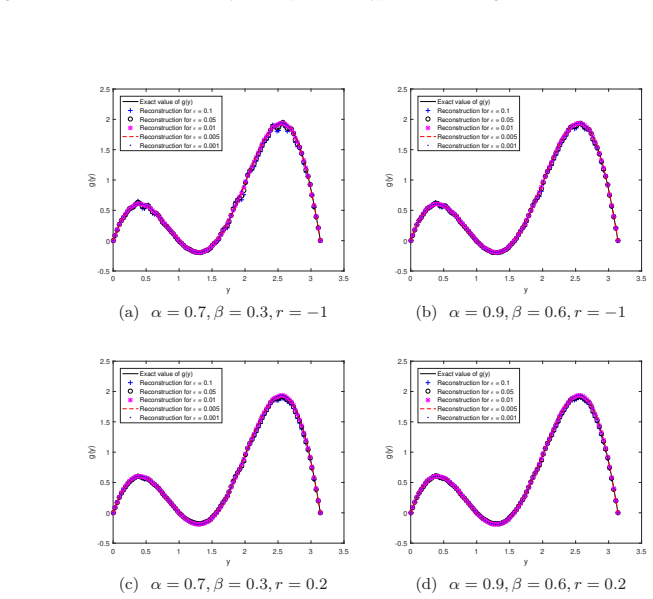
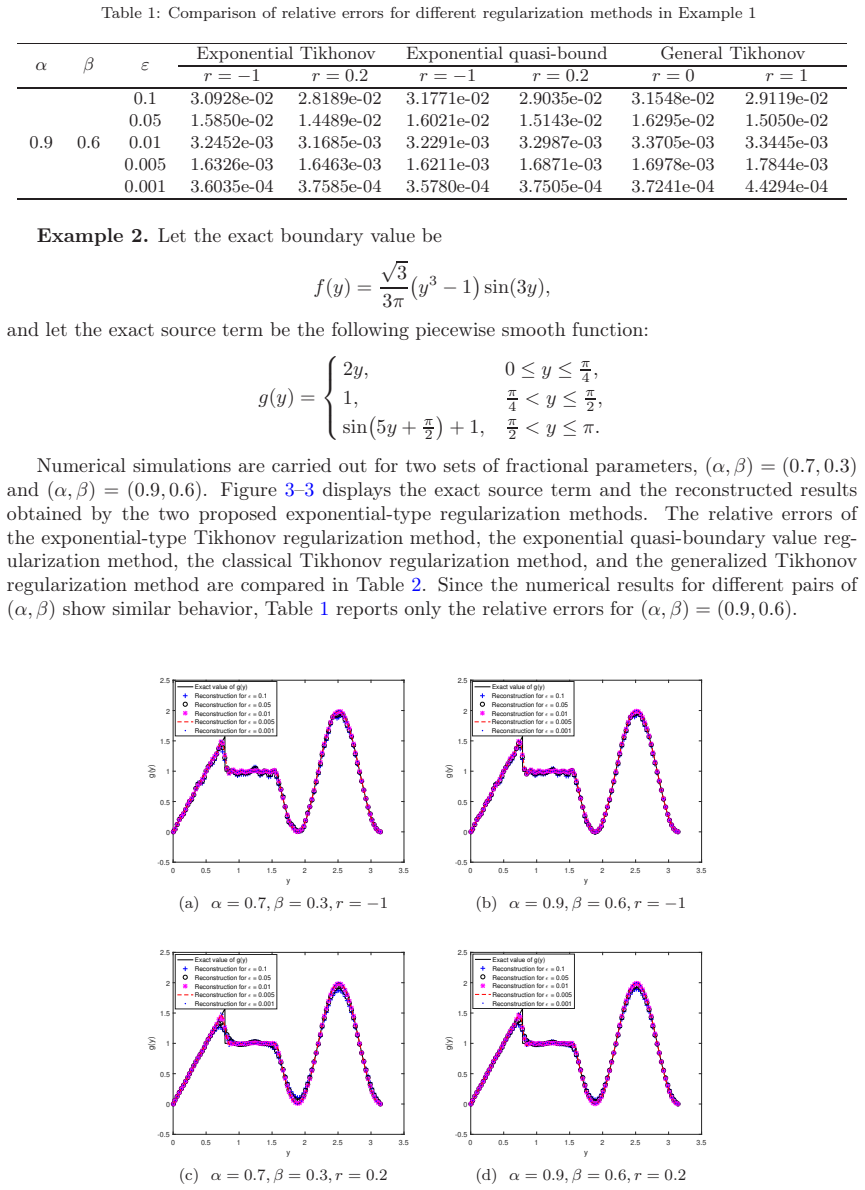
- Numerical experiments indicate stable and accurate recovery for both smooth and piecewise smooth sources even when the signal-to-noise ratio is low.
Where Pith is reading between the lines
- The same stability framework could be tested on time-fractional or space-time fractional variants of the equation.
- Comparison with classical Tikhonov regularization without the exponential scale would clarify the benefit of the new Hilbert scale.
- Extension to three-dimensional domains or more general singular coefficients would test the robustness of the well-posedness assumption for the direct problem.
Load-bearing premise
The direct problem admits a formal solution whose well-posedness can be established for the given class of fractional elliptic operators with singular coefficients.
What would settle it
Numerical computation showing that the regularized solutions fail to converge to the true source for a sequence of noisy data with noise level approaching zero, while the source satisfies the assumed bounds, would disprove the convergence claims.
Figures


read the original abstract
An inverse source problem for a class of fractional elliptic equations with singular coefficients is investigated in this paper. For the corresponding direct problem, a formal solution is derived and the well-posedness of the solution is established. For the inverse problem, a H\"older-type conditional stability estimate is obtained in a Hilbert scale associated with exponential operators. Based on this stability framework, two regularization methods are proposed for reconstructing the unknown source term: the exponential-type Tikhonov regularization method and the exponential quasi-boundary value regularization method. Convergence estimates for the regularized solutions are derived under both a priori and a posteriori choices of the regularization parameter. In addition, finite-dimensional spectral approximation results show that the proposed methods are also applicable to general square-integrable source terms, without requiring the exact source to satisfy an exponential-type source condition. Numerical experiments demonstrate that the proposed methods provide stable and accurate reconstructions for both smooth and piecewise smooth sources even under low signal-to-noise ratio conditions.
Editorial analysis
A structured set of objections, weighed in public.
Referee Report
Summary. The paper investigates an inverse source problem for a class of fractional elliptic equations with singular coefficients. For the direct problem, a formal solution is derived and well-posedness is established. For the inverse problem, a Hölder-type conditional stability estimate is obtained in a Hilbert scale associated with exponential operators. Two regularization methods are proposed: exponential-type Tikhonov regularization and exponential quasi-boundary value regularization, with convergence estimates derived under a priori and a posteriori parameter choices. Finite-dimensional spectral approximation results extend applicability to general square-integrable sources, and numerical experiments demonstrate stable reconstructions under noise.
Significance. If the foundational well-posedness holds, the work provides a stability framework and regularization schemes for inverse source problems in fractional elliptic equations with singular coefficients, using exponential Hilbert scales. The extension to general L2 sources without requiring exponential source conditions and the numerical validation for both smooth and piecewise smooth sources under low SNR are strengths that could support applications in models with anomalous diffusion or singular media.
major comments (1)
- [Abstract (direct problem paragraph)] Abstract (paragraph on direct problem): The well-posedness of the direct problem is load-bearing for the Hölder stability estimate and the convergence rates of both regularization methods. The abstract states only that a formal solution is derived and well-posedness established, without specifying the function space, the precise class of singular coefficients (e.g., whether in L^∞, weighted spaces, or weaker), or how the fractional power remains sectorial or admits a discrete spectrum suitable for the eigenfunction expansion after incorporating the singularity. This gap must be addressed explicitly to support the subsequent claims.
Simulated Author's Rebuttal
We thank the referee for the careful review and the recommendation for major revision. The single major comment concerns the level of detail in the abstract regarding the direct problem; we address it below and will revise accordingly.
read point-by-point responses
-
Referee: [Abstract (direct problem paragraph)] Abstract (paragraph on direct problem): The well-posedness of the direct problem is load-bearing for the Hölder stability estimate and the convergence rates of both regularization methods. The abstract states only that a formal solution is derived and well-posedness established, without specifying the function space, the precise class of singular coefficients (e.g., whether in L^∞, weighted spaces, or weaker), or how the fractional power remains sectorial or admits a discrete spectrum suitable for the eigenfunction expansion after incorporating the singularity. This gap must be addressed explicitly to support the subsequent claims.
Authors: We agree that the abstract would benefit from greater explicitness on these points to strengthen the presentation. In the revised manuscript we will expand the direct-problem sentence in the abstract to state that well-posedness is established in the space H¹₀(Ω) for coefficients belonging to L^∞(Ω) that satisfy a uniform positivity condition; under these assumptions the associated elliptic operator remains sectorial, generates a discrete spectrum, and permits the eigenfunction expansion used throughout the paper. The full technical details already appear in Section 2; the abstract revision will simply make this reference explicit. revision: yes
Circularity Check
No circularity: derivation chain is self-contained
full rationale
The paper first derives a formal solution and establishes well-posedness for the direct problem, then obtains a Hölder conditional stability estimate in an exponential Hilbert scale from that foundation, and finally derives convergence rates for the two regularization methods under a priori/a posteriori parameter choices. No quoted step reduces by construction to a fitted input renamed as prediction, a self-definitional loop, or a load-bearing self-citation chain. The central claims remain independent of the paper's own fitted quantities or prior self-references.
Axiom & Free-Parameter Ledger
axioms (2)
- domain assumption The fractional elliptic operator with singular coefficients admits a formal eigenfunction expansion whose coefficients yield a well-posed direct problem.
- domain assumption The solution space can be equipped with a Hilbert scale generated by exponential operators that produces a Hölder-type conditional stability estimate for the inverse source map.
Reference graph
Works this paper leans on
-
[1]
Fractional Differential Equations[M]
Podlubny, I. Fractional Differential Equations[M]. San Diego: Academic Press, 1999
1999
-
[2]
Theory and applic ations of fractional differential equations[M]
Kilbas A A, Srivastava H M, Trujillo J J. Theory and applic ations of fractional differential equations[M]. Amsterdam: elsevier, 2006
2006
-
[3]
Mathematical Aspects of Subsonic and Transonic Gas Dynamics[M]
Bers, L. Mathematical Aspects of Subsonic and Transonic Gas Dynamics[M]. New York: Dover Publications, 2016
2016
-
[4]
Nonexistence of global sol utions for generalized Tricomi equa- tions with combined nonlinearity[J]
Chen W, Lucente S, Palmieri A. Nonexistence of global sol utions for generalized Tricomi equa- tions with combined nonlinearity[J]. Nonlinear Analysis: Real World Applications, 2021(2), 61: 103354
2021
-
[5]
Current noise and K eldysh vertex function of an Anderson impurity in the Fermi-liquid regime[J]
Oguri A, Teratani Y, Tsutsumi K, et al. Current noise and K eldysh vertex function of an Anderson impurity in the Fermi-liquid regime[J]. Physical Review B, 2022, 105(11): 115409
2022
-
[6]
On second-order linear partial differential e quation of mixed type[J]
Tricomi F. On second-order linear partial differential e quation of mixed type[J]. Moscow:Leningrad, 1947. (In Russian) 34
1947
-
[7]
Sur un probleme aux limites pour une equa tion linearire aux derivees partielles du second ordre de type mixtes[D]
Gellerstedt, S. Sur un probleme aux limites pour une equa tion linearire aux derivees partielles du second ordre de type mixtes[D]. Uppsala University, 1935
1935
-
[8]
On some cases of degenerate elliptic equatio ns on the boundary of a domain[J]
Keldysh M V. On some cases of degenerate elliptic equatio ns on the boundary of a domain[J]. Doklady Akademii Nauk USSR, 1951, 77: 181-183
1951
-
[9]
Global existence for the n-dimensional semi linear Tricomi-type equations[J]
Yagdjian K. Global existence for the n-dimensional semi linear Tricomi-type equations[J]. Com- munications in Partial Differential Equations, 2006, 31(6) : 907-944
2006
-
[10]
Computational study of a local fractional Tricomi equation occurring in fractal transonic flow[J]
Dubey S, Dubey V P, Singh J, et al. Computational study of a local fractional Tricomi equation occurring in fractal transonic flow[J]. Journal of Computat ional and Nonlinear Dynamics, 2022, 17(8): 081006
2022
-
[11]
Exact solution to the Dirichlet problem for degenerating on the boundary elliptic equation of Tricomi-Keldysh type in the half-space[J]
Algazin O D. Exact solution to the Dirichlet problem for degenerating on the boundary elliptic equation of Tricomi-Keldysh type in the half-space[J]. Her ald of the Bauman Moscow State Technical University (Series Natural Sciences), 2016, 68( 5): 4-17
2016
-
[12]
Nonexistence of global weak solutions of nonli near Keldysh type equation with one derivative term[J]
Zhang K. Nonexistence of global weak solutions of nonli near Keldysh type equation with one derivative term[J]. Advances in Mathematical Physics, 201 8, 2018(1): 3931297
2018
-
[13]
Well-posedness of Tricomi–Gellerstedt–Keldysh- type fractional elliptic problems[J]
Ruzhansky M, Torebek B T, Turmetov B. Well-posedness of Tricomi–Gellerstedt–Keldysh- type fractional elliptic problems[J]. Journal of Integral Equations and Applications, 2022, 34(3): 373-387
2022
-
[14]
The conditional s tability and an iterative regular- ization method for a fractional inverse elliptic problem of Tricomi-Gellerstedt-Keldysh type[J]
Djemoui S, Meziani M S E, Boussetila N. The conditional s tability and an iterative regular- ization method for a fractional inverse elliptic problem of Tricomi-Gellerstedt-Keldysh type[J]. Mathematical Modelling and Analysis, 2024, 29(1): 23–45
2024
-
[15]
Generalized Tikhonov regularization method f or an inverse boundary value problem of the fractional elliptic equation[J]
Zhang X. Generalized Tikhonov regularization method f or an inverse boundary value problem of the fractional elliptic equation[J]. Boundary Value Pro blems, 2024, 2024(1): 80
2024
-
[16]
On solution of integral equations of Abel-Volterra type[J]
Kilbas A A, Saigo M. On solution of integral equations of Abel-Volterra type[J]. Differential Integral Equations, 1995, 8(5): 993–1011
1995
-
[17]
Exponential Tikhonov regulari zation method for solving an inverse source problem of time fractional diffusion equation[J]
Wang Z, Qiu S, Yu S, et al. Exponential Tikhonov regulari zation method for solving an inverse source problem of time fractional diffusion equation[J]. Jo urnal of Computational Mathematics, 2023, 41(2): 173-190
2023
-
[18]
Simultaneous inversion of the space -dependent source term and the initial value in a time-fractional diffusion equation[J ]
Yu S, Wang Z, Yang H. Simultaneous inversion of the space -dependent source term and the initial value in a time-fractional diffusion equation[J ]. Computational Methods in Applied Mathematics, 2023, 23(3): 767-782
2023
-
[19]
Stability results for backwa rd time-fractional parabolic equations[J]
Hào D N, Liu J, Duc N V, et al. Stability results for backwa rd time-fractional parabolic equations[J]. Inverse Problems, 2019, 35(12): 125006
2019
-
[20]
A generalized quasi-boundary value method for recovering a source in a frac- tional diffusion-wave equation[J]
Wei T, Luo Y. A generalized quasi-boundary value method for recovering a source in a frac- tional diffusion-wave equation[J]. Inverse Problems, 2022 , 38(4): 045001
2022
-
[21]
Uniqueness and numerical method for determ ining a spatial source term in a time-fractional diffusion wave equation[J]
Luo Y, Wei T. Uniqueness and numerical method for determ ining a spatial source term in a time-fractional diffusion wave equation[J]. Journal of Sci entific Computing, 2024, 99(2): 51
2024
-
[22]
Some properties of the Kilbas-Saig o function[J]
Boudabsa L, Simon T. Some properties of the Kilbas-Saig o function[J]. Mathematics, 2021, 9(3), 217
2021
-
[23]
New model function methods for determinin g regularization parameters in linear inverse problems[J]
Wang Z, Liu J. New model function methods for determinin g regularization parameters in linear inverse problems[J]. Applied Numerical Mathematic s, 2009, 59(10): 2489-2506. 35
2009
-
[24]
On the linear model function method for choo sing Tikhonov regularization parameters in linear ill-posed problems[J]
Wang Z, Xu D. On the linear model function method for choo sing Tikhonov regularization parameters in linear ill-posed problems[J]. Chinese Journ al of Engineering Mathematics, 2013, 30(3): 451-466
2013
-
[25]
Generalized Tikhonov met hods for an inverse source prob- lem of the time-fractional diffusion equation[J]
Ma Y K, Prakash P, Deiveegan A. Generalized Tikhonov met hods for an inverse source prob- lem of the time-fractional diffusion equation[J]. Chaos, So litons & Fractals, 2018, 108: 39-48
2018
-
[26]
Inverse source problem f or time fractional diffusion equation with Mittag-Leffler kernel[J]
Can N H, Luc N H, Baleanu D, et al. Inverse source problem f or time fractional diffusion equation with Mittag-Leffler kernel[J]. Advances in Differen ce Equations, 2020, 2020(1): 210. 36
2020
discussion (0)
Sign in with ORCID, Apple, or X to comment. Anyone can read and Pith papers without signing in.