Accelerated and Stable Convergence with Anchored Optimistic Method
Pith reviewed 2026-06-26 13:34 UTC · model grok-4.3
The pith
Anchored optimistic methods achieve optimal accelerated last-iterate rates for monotone variational inequalities.
A machine-rendered reading of the paper's core claim, the machinery that carries it, and where it could break.
Core claim
GOMA achieves the optimal accelerated last-iterate rate O(1/k²) on the squared gradient norm for monotone Lipschitz operators in the deterministic setting. A simplified single-call variant achieves a last-iterate convergence rate of O(1/√k) on the squared gradient norm in the stochastic setting with unbounded variance, marking the first such guarantee for stochastic monotone Lipschitz variational inequalities in the unconstrained setting without variance reduction or growing batches.
What carries the argument
Generalized Optimistic Methods with Anchoring (GOMA) that combine two-time-scale optimistic updates with an anchoring term inspired by Halpern iteration.
If this is right
- These methods use only one or two gradient evaluations per iteration, enabling use in stochastic and online settings.
- The convergence is measured on the last iterate rather than averages, which is more relevant for practical applications.
- The rates hold without additional assumptions like bounded variance or variance reduction techniques.
- The anchoring improves stability and acceleration compared to standard optimistic methods.
Where Pith is reading between the lines
- If the anchoring term can be generalized, it might apply to non-monotone operators as well.
- Practical implementations could test whether these rates translate to faster training in adversarial machine learning tasks.
- The single-call variant might reduce computational cost in high-dimensional problems.
Load-bearing premise
The variational inequality operator is assumed to be monotone and Lipschitz continuous.
What would settle it
A numerical experiment on a simple bilinear saddle-point problem showing that the squared gradient norm fails to decrease at the claimed rate under GOMA would falsify the result.
Figures


read the original abstract
We study first-order methods for solving monotone variational inequalities arising in min-max optimization. Classical approaches such as the extragradient method rely on two gradient queries per iteration, which limits their analysis and applicability in the online and stochastic settings. We propose a family of Generalized Optimistic Methods with Anchoring (GOMA), which combine two-time-scale optimistic updates with an anchoring term inspired by Halpern iteration. In the deterministic setting, GOMA achieves the optimal accelerated last-iterate rate $O(1/k^2)$ on the squared gradient norm for monotone Lipschitz operators. In the stochastic setting with unbounded variance, a simplified single-call variant of GOMA achieves a last-iterate convergence rate of $O(1/\sqrt{k})$ on the squared gradient norm. To the best of our knowledge, this is the first such guarantee for stochastic monotone Lipschitz variational inequalities in the unconstrained setting without variance reduction or growing batches.
Editorial analysis
A structured set of objections, weighed in public.
Referee Report
Summary. The manuscript introduces the Generalized Optimistic Methods with Anchoring (GOMA), a family of first-order methods that combine two-time-scale optimistic updates with an anchoring term for solving monotone variational inequalities. In the deterministic setting the method is claimed to attain the optimal accelerated last-iterate rate O(1/k²) on the squared gradient norm for monotone Lipschitz operators; in the stochastic setting with unbounded variance a single-call variant is claimed to attain last-iterate convergence O(1/√k) on the same quantity, asserted to be the first such guarantee in the unconstrained setting without variance reduction or growing batch sizes.
Significance. If the stated rates and assumptions are rigorously established, the work supplies the first last-iterate guarantees for stochastic monotone Lipschitz variational inequalities that match known deterministic lower bounds while remaining stable under unbounded variance. The anchoring construction and the single-call stochastic variant constitute a technically interesting synthesis of optimistic and Halpern-style ideas that could influence subsequent analyses of min-max and game-theoretic problems.
minor comments (3)
- [§3] §3, Algorithm 1: the two-time-scale parameters α_k and β_k are introduced without an explicit statement of the precise relation required between them for the O(1/k²) proof; a short remark clarifying the admissible range would improve readability.
- [Theorem 4.2] Theorem 4.2: the statement of the stochastic rate assumes the operator is monotone and L-Lipschitz but does not restate the precise moment condition on the noise that replaces bounded variance; adding one sentence would make the theorem self-contained.
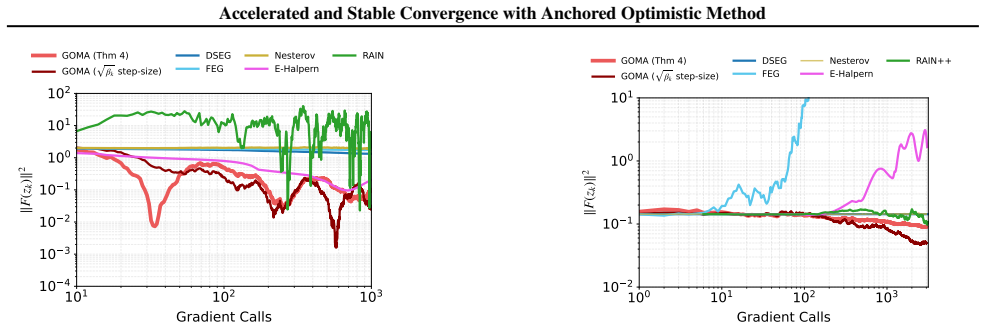
- [Figure 2] Figure 2: the y-axis label “squared gradient norm” is plotted on a log scale without indicating the base or the reference line for the claimed 1/k² slope; this makes visual verification of the rate harder.
Simulated Author's Rebuttal
We thank the referee for the positive summary, significance assessment, and recommendation of minor revision. No specific major comments were listed in the report.
Circularity Check
No significant circularity detected
full rationale
The provided abstract and novelty claim present convergence rates for GOMA as independent first-principles results under standard monotonicity and Lipschitz assumptions, with no equations, fitted parameters, self-citations, or ansatzes shown that reduce the claimed O(1/k²) or O(1/√k) rates to prior inputs by construction. The derivation chain cannot be inspected for circular steps because no technical sections, proofs, or load-bearing citations are available in the query; the abstract itself contains no self-referential reductions. This is the expected honest non-finding for an abstract-only view of a paper whose central claims are stated without visible self-definition or renaming of known results.
Axiom & Free-Parameter Ledger
axioms (2)
- domain assumption The operator is monotone
- domain assumption The operator is Lipschitz continuous
Reference graph
Works this paper leans on
-
[1]
(Cit. on p. 2) Cai, Y ., Oikonomou, A., and Zheng, W. Tight last-iterate convergence of the extragradient and the optimistic gradi- ent descent-ascent algorithm for constrained monotone variational inequalities.arXiv preprint arXiv:2204.09228, 2022b. (Cit. on p. 2) Chen, L. and Luo, L. Near-optimal algorithms for making the gradient small in stochastic mi...
-
[2]
(Cit. on p. 5, 7, 8, 9, 34) Defazio, A. and Bottou, L. On the ineffectiveness of vari- ance reduced optimization for deep learning. In Wallach, H., Larochelle, H., Beygelzimer, A., d'Alch´e-Buc, F., Fox, E., and Garnett, R. (eds.),Advances in Neural Informa- tion Processing Systems, volume 32. Curran Associates, Inc., 2019. (Cit. on p. 5) Diakonikolas, J....
2019
-
[3]
(Cit. on p. 3) Facchinei, F. and Pang, J.-S.Finite-dimensional variational inequalities and complementarity problems. Springer,
-
[4]
(Cit. on p. 1) Gidel, G., Askari, R., Pezeshki, M., LePriol, R., Huang, G., Lacoste-Julien, S., and Mitliagkas, I. Negative Momen- tum for Improved Game Dynamics. InAISTATS, 2019a. (Cit. on p. 6, 8) 10 Accelerated and Stable Convergence with Anchored Optimistic Method Gidel, G., Berard, H., Vignoud, G., Vincent, P., and Lacoste- Julien, S. A Variational I...
work page internal anchor Pith review Pith/arXiv arXiv doi:10.1214/10-ssy011 2020
-
[5]
(Cit. on p. 1, 2) Krogh, A. and Hertz, J. A simple weight decay can improve generalization. In Moody, J., Hanson, S., and Lippmann, R. (eds.),Advances in Neural Information Processing Systems, volume 4. Morgan-Kaufmann, 1991. (Cit. on p. 3) Lee, J. and Ryu, E. Accelerating value iteration with an- choring. In Oh, A., Naumann, T., Globerson, A., Saenko, K....
1991
-
[6]
(Cit. on p. 2, 3, 5, 7, 8, 35, 36) Lieder, F. On the convergence rate of the halpern-iteration. Optimization Letters, 15(2):405–418, 2020. ISSN 1862-
2020
-
[7]
(Cit. on p. 1) Loshchilov, I. and Hutter, F. Decoupled weight decay reg- ularization. InInternational Conference on Learning Representations, 2019. (Cit. on p. 3) Madry, A., Makelov, A., Schmidt, L., Tsipras, D., and Vladu, A. Towards deep learning models resistant to adversarial attacks.arXiv preprint arXiv:1706.06083,
Pith/arXiv arXiv 2019
-
[8]
(Cit. on p. 1) Mertikopoulos, P., Lecouat, B., Zenati, H., Foo, C.-S., Chan- drasekhar, V ., and Piliouras, G. Optimistic mirror descent in saddle-point problems: Going the extra(-gradient) mile. InInternational Conference on Learning Representations,
-
[9]
(Cit. on p. 1) Mokhtari, A., Ozdaglar, A., and Pattathil, S. A unified analysis of extra-gradient and optimistic gradient methods for saddle point problems: Proximal point approach. In Proceedings of the Twenty Third International Conference on Artificial Intelligence and Statistics, volume 108 of Proceedings of Machine Learning Research, pp. 1497–
-
[10]
PMLR, 26–28 Aug 2020. (Cit. on p. 3, 4) 11 Accelerated and Stable Convergence with Anchored Optimistic Method Nemirovski, A. Prox-method with rate of convergence O(1/t) for variational inequalities with lipschitz contin- uous monotone operators and smooth convex-concave saddle point problems.SIAM Journal on Optimization, 15(1):229–251, 2004. (Cit. on p. 2...
-
[11]
(Cit. on p. 3) Stooke, A., Achiam, J., and Abbeel, P. Responsive Safety in Reinforcement Learning by PID Lagrangian Methods. InICML, 2020. (Cit. on p. 3) Surina, A., Suggala, A., Tsoukalas, G., Kovsharov, A., Shi- robokov, S., Ruiz, F. J., Kohli, P., and Chaudhuri, S. An improved last-iterate convergence rate for anchored gra- dient descent ascent.arXiv p...
Pith/arXiv arXiv 2020
-
[12]
2M η2 k(1−β 2 k)−4M 2η4 k(1−β k)2 −M η 2 kβ2 k 1−2M η 2 k(1−β k)2 −M η 2 kβ2 k # = βk+1 2β k(1−β k)
(Cit. on p. 3) Tran-Dinh, Q. and Luo, Y . Halpern-type accelerated and splitting algorithms for monotone inclusions. 2021. (Cit. on p. 2, 3, 4, 5, 13) Yoon, T. and Ryu, E. K. Accelerated algorithms for smooth convex-concave minimax problems with O(1/k2) rate on squared gradient norm. InProceedings of the 38th International Conference on Machine Learning, ...
2021
-
[13]
This inequality is equivalent to 0≥ − 1 2 β2 + 3 2 β3 = 1 2 β2(−1 + 3β), which holds forβ≤ 1
Plugging int= 1 2, we get 4β−5β 2 2β− 3 2 β2 = 4−5β 2− 3 2 β ≥(2 +β)(1−β) = 2−β−β 2. This inequality is equivalent to 0≥ − 1 2 β2 + 3 2 β3 = 1 2 β2(−1 + 3β), which holds forβ≤ 1
-
[14]
Sinceβ k ≤ 1 3, condition (4) follows. 17 Accelerated and Stable Convergence with Anchored Optimistic Method Positivity of the potential function decrease.With ck+1 =a k+1, the residual coefficient derived in (29) iseck+1 = akθ 2M η2(1−βk)2 −a k+1, so Vk −V k+1 ≥L 2 akθ 2M η2 −a k+1 ∥xk+1 −y k∥2. Since (1−β k)2 ≤1 gives akθ 2M η2(1−βk)2 ≥ akθ 2M η2 , it s...
-
[15]
Thus condition (9) holds for allkwhenevert=M γ 2 ≤ 5 39
=− 140 81 , so t≤ 3 5 · 140 81 −1 2 5 − 1 9 = 1 27 13 45 = 5 39 . Thus condition (9) holds for allkwhenevert=M γ 2 ≤ 5 39. Positivity of the potential function decrease.We had Vk −V k+1 ≥L 2 akθ 2M γ2 k −a k+1 ∥xk+1 −y k∥2, Recalla k = bkηk 2βk ,b k+1 = bk 1−βk , andη k = (1−β k)γwith constantγ. Then ak+1 ak = bk+1 bk · ηk+1 ηk · βk βk+1 = βk(1−β k+1) βk+...
-
[16]
This proves (17) with 66 + 2(1 +e)2 ≤ 94. B.3. Proof of Lemma 4 (stochastic stability) Lemma 4.In the setting of Lemma 3, let bG satisfy Assumption 3, let (xk) be given by (14), and set ek :=x k −¯xk. Then for allN≥0, E∥e N ∥2 ≤ 1√ N+ 1 4σ 2 L2κ + 752κ∥x 0 −x ⋆∥2 .(18) Proof. Step 1: error recursion.Let nk := bG(yk, ξk)−G(y k), so E[nk | F k] = 0 and, by ...
-
[17]
It remains to check the determinant conditionS 11 k S22 k ≥(S 12 k )2, that is, ak ≥ (S12 k )2 S22 k = bkc 2√M β k · 1−β k 1−c 2βk
Since βk = 1 k+2 ≤ 1 2, this gives 1−c 2βk ≥1− 1 4 >0 , hence S22 k >0(andS 11 k =a k ≥0). It remains to check the determinant conditionS 11 k S22 k ≥(S 12 k )2, that is, ak ≥ (S12 k )2 S22 k = bkc 2√M β k · 1−β k 1−c 2βk . 31 Accelerated and Stable Convergence with Anchored Optimistic Method Usinga k = bk−1c 2 √ M βk−1(1−βk−1), cancelingc, M >0, and usin...
2020
-
[18]
We setn= 200
Therefore this is a 1-smooth saddle problem. We setn= 200. 35 Accelerated and Stable Convergence with Anchored Optimistic Method Methods.We compare the same set of methods as in the negative comonotone experiments. Hyperparameter selection. • EAG-C / EAG-V: Since this experiment is from (Yoon & Ryu, 2021), we use their reported parameters:α= 0.1265/L for ...
2021
discussion (0)
Sign in with ORCID, Apple, or X to comment. Anyone can read and Pith papers without signing in.