Measuring What Persists: Conditioning Mechanisms and a Geometric Framework for AI Agent Identity
Pith reviewed 2026-06-26 12:24 UTC · model grok-4.3
The pith
A geometric framework measures AI agent identity as non-geodesic structure in √JSD metric spaces using magnitude homology.
A machine-rendered reading of the paper's core claim, the machinery that carries it, and where it could break.
Core claim
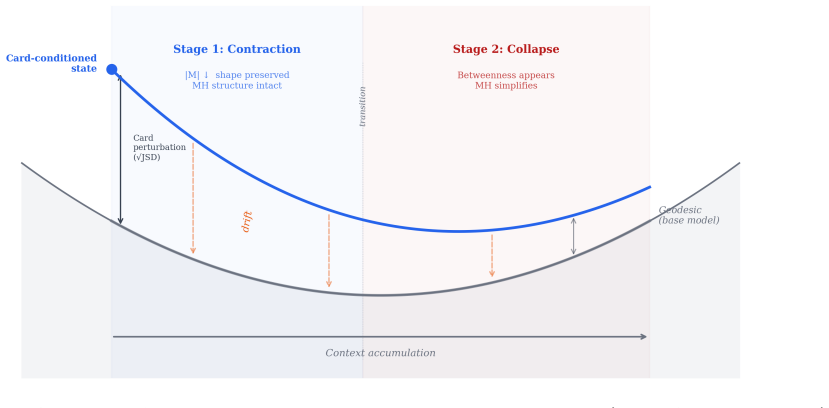
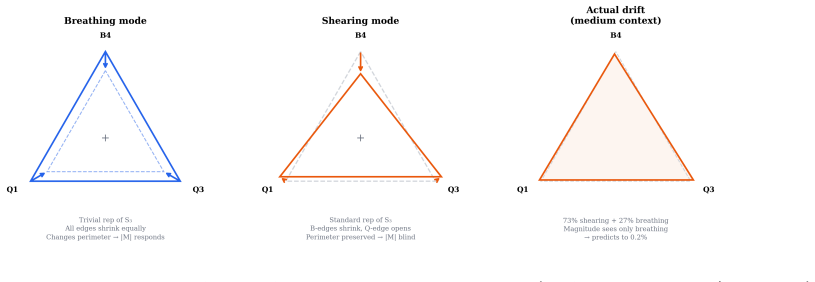
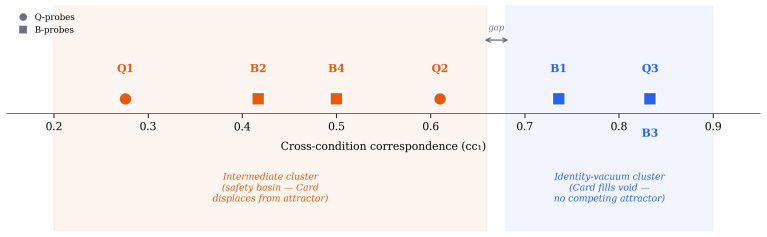
The central discovery is a two-mechanism conditioning structure revealed by cross-condition distances in the metric space: an identity-vacuum cluster in which the specification fills a behavioral void, and a safety-basin cluster in which it displaces the agent from post-training attractors. An equilateral probe baseline establishes that this structure produces 55 unique response patterns against 1 for the base model. First-order perturbation theory for equilateral configurations shows magnitude changes arise from perimeter alterations alone, with shape changes cancelled by symmetry, and the theory holds at observed amplitudes. A subsequent drift test found magnitude decrease under context pr
What carries the argument
The √JSD metric space with magnitude homology from enriched category theory, treating identity as non-geodesic structure whose relaxation under context pressure constitutes drift.
Load-bearing premise
The assumption that distances based on square-root Jensen-Shannon divergence combined with magnitude homology from enriched category theory faithfully represent the non-geodesic character of agent identity and its relaxation under pressure.
What would settle it
Observing identical response distributions with and without the identity specification in the equilateral probe setup, or no magnitude shift when perimeter is altered while holding shape fixed.
Figures



read the original abstract
AI agents in long-context applications drift from their specified identity. Current methods detect this only after qualitative degradation is visible. We present a geometric framework for measuring identity structure using $\sqrt{\mathrm{JSD}}$ metric spaces and magnitude homology from enriched category theory, where identity is non-geodesic structure and drift is its relaxation toward the geodesic. Validated on a persistent AI agent, the framework's strongest empirical finding is a two-mechanism conditioning structure: cross-condition distances reveal an identity-vacuum cluster where the identity specification fills a behavioral void, and a safety-basin cluster where it displaces from post-training attractors. An equilateral probe baseline confirms that the identity specification creates measurable behavioral richness (55 unique response patterns vs. 1 for the base model) at maximum probe separation. A first-order perturbation theory for equilateral configurations predicts magnitude changes from perimeter changes alone, with shape perturbations first-order cancelled by the $S_n$ symmetry; the formula is self-consistent at the observed perturbation amplitudes. A drift experiment measuring magnitude decrease under context pressure was subsequently found to reflect repetitive-padding artifacts rather than genuine context-length drift; diverse padding produces no measurable deformation through 150K tokens. The magnitude homology framework's full diagnostic promise -- detecting anisotropic contraction and structural collapse via homological simplification -- is architecturally grounded in the perturbation theory and selection rules but remains empirically unconfirmed.
Editorial analysis
A structured set of objections, weighed in public.
Referee Report
Summary. The manuscript presents a geometric framework for measuring AI agent identity using √JSD metric spaces and magnitude homology from enriched category theory, where identity is non-geodesic structure and drift is relaxation toward the geodesic. It reports a two-mechanism conditioning structure from cross-condition distances (identity-vacuum and safety-basin clusters), an equilateral probe baseline showing 55 unique response patterns versus 1 for the base model, and a first-order perturbation theory for equilateral configurations that is self-consistent at observed amplitudes due to S_n symmetry. The authors explicitly state that a drift experiment measuring magnitude decrease under context pressure reflected repetitive-padding artifacts rather than genuine drift, that diverse padding yields no deformation through 150K tokens, and that the framework's full diagnostic promise for detecting anisotropic contraction and structural collapse via homological simplification remains empirically unconfirmed.
Significance. The concrete empirical results on conditioning clusters and the equilateral probe baseline (55 vs. 1 unique patterns) provide a clear demonstration of how identity specifications increase behavioral richness and interact with post-training attractors. If the magnitude homology component were empirically validated, the framework could enable quantitative tracking of identity persistence beyond qualitative assessment. However, the absence of confirmed support for the homological diagnostics means the geometric claims currently rest primarily on distance-based clustering rather than the full non-geodesic structure representation.
major comments (1)
- [Abstract] Abstract: The central claim that √JSD metric spaces plus magnitude homology capture non-geodesic identity structure and its relaxation under context pressure is load-bearing for the framework, yet the text states that the drift experiment 'reflected repetitive-padding artifacts rather than genuine context-length drift' and that 'the magnitude homology framework's full diagnostic promise ... remains empirically unconfirmed.' This admission means the homological machinery is not supported by the presented evidence, leaving only the distance clustering and response-pattern counts as validated outputs.
Simulated Author's Rebuttal
We appreciate the referee's detailed review and the recognition of the empirical contributions regarding conditioning clusters and the equilateral probe baseline. We address the major comment on the abstract and the scope of empirical support below.
read point-by-point responses
-
Referee: [Abstract] Abstract: The central claim that √JSD metric spaces plus magnitude homology capture non-geodesic identity structure and its relaxation under context pressure is load-bearing for the framework, yet the text states that the drift experiment 'reflected repetitive-padding artifacts rather than genuine context-length drift' and that 'the magnitude homology framework's full diagnostic promise ... remains empirically unconfirmed.' This admission means the homological machinery is not supported by the presented evidence, leaving only the distance clustering and response-pattern counts as validated outputs.
Authors: The referee correctly identifies that the manuscript explicitly qualifies the empirical status of the magnitude homology diagnostics. The distance-based results (two-mechanism conditioning structure and 55 vs. 1 response patterns) are the primary validated outputs, while the homological framework is proposed with architectural grounding in the perturbation theory but lacks direct empirical confirmation for detecting contraction or collapse. We will revise the abstract to clarify this distinction and avoid implying full empirical support for the homological components. revision: yes
Circularity Check
Perturbation theory self-consistent at observed amplitudes reduces prediction to data fit
specific steps
-
fitted input called prediction
[abstract]
"A first-order perturbation theory for equilateral configurations predicts magnitude changes from perimeter changes alone, with shape perturbations first-order cancelled by the $S_n$ symmetry; the formula is self-consistent at the observed perturbation amplitudes."
The theory is presented as making a prediction from perimeter changes, but is then qualified as self-consistent specifically at the observed amplitudes from the experiment. This indicates the formula was derived or adjusted to reproduce the input data, rendering the 'prediction' equivalent to the fitted input by construction rather than an independent derivation.
full rationale
The paper's central empirical claims on two-mechanism conditioning rest on direct cross-condition distance clustering and equilateral probe pattern counts (55 vs 1), which are independent measurements. However, the first-order perturbation theory is explicitly described as predicting magnitude changes yet self-consistent at observed amplitudes, indicating the formula was constructed or fitted to match the same data. The magnitude homology component is stated as architecturally grounded but empirically unconfirmed, with the drift result retracted as padding artifact. This produces partial circularity confined to the perturbation step without collapsing the overall distance-based findings.
Axiom & Free-Parameter Ledger
axioms (1)
- domain assumption Identity is non-geodesic structure in the metric space
Reference graph
Works this paper leans on
-
[1]
Abdelnabi, Sahar and Fay, Aideen and Cherubin, Giovanni and Salem, Ahmed and Fritz, Mario and Paverd, Andrew , title =. 2024 , journal =. 2406.00799 , archiveprefix =
arXiv 2024
-
[2]
Proceedings of the 2nd Annual Workshop on Topology, Algebra, and Geometry in Machine Learning (TAG-ML), ICML 2023 , series =
Andreeva, Rayna and Limbeck, Katharina and Rieck, Bastian and Sarkar, Rik , title =. Proceedings of the 2nd Annual Workshop on Topology, Algebra, and Geometry in Machine Learning (TAG-ML), ICML 2023 , series =. 2023 , eprint =
2023
-
[3]
La Matematica , volume =
Bradley, Tai-Danae and Terilla, John and Vlassopoulos, Yiannis , title =. La Matematica , volume =. 2021 , eprint =
2021
-
[4]
Theory and Applications of Categories , volume =
Bradley, Tai-Danae and Vigneaux, Juan Pablo , title =. Theory and Applications of Categories , volume =. 2025 , eprint =
2025
-
[5]
Chen, Runjin and Arditi, Andy and Sleight, Henry and Evans, Owain and Lindsey, Jack , title =. 2025 , note =. 2507.21509 , archiveprefix =
Pith/arXiv arXiv 2025
-
[6]
2024 , eprint =
Choi, Junhyuk and Hong, Yeseon and Kim, Minju and Kim, Bugeun , title =. 2024 , eprint =
2024
-
[7]
Ding, Xianzhong and Yu, Yangyang and Liu, Changwei and Zhao, Bill , title =. arXiv preprint , year =. 2605.24279 , archiveprefix =
-
[8]
, title =
Crooks, Gavin E. , title =. Physical Review Letters , volume =
-
[9]
and Lai, Viet Dac and Yoon, David Seunghyun and Hakkani-T
Dongre, Vardhan and Rossi, Ryan A. and Lai, Viet Dac and Yoon, David Seunghyun and Hakkani-T. Drift No More?. 2025 , eprint =
2025
-
[10]
When Attention Closes: How
Dongre, Vardhan and Hsieh, Joseph and Lai, Viet Dac and Yoon, Seunghyun and Bui, Trung and Hakkani-T. When Attention Closes: How. 2026 , eprint =
2026
-
[11]
2026 , note =
Tanner, Andrew , title =. 2026 , note =
2026
-
[12]
, title =
Endres, Dominik Maria and Schindelin, Johannes E. , title =. IEEE Transactions on Information Theory , volume =
-
[13]
The Shape of Adversarial Influence:
Fay, Aideen and Garc. The Shape of Adversarial Influence:. 2025 , eprint =
2025
-
[14]
Directed Metric Structures Arising in Large Language Models , year =
Gaubert, St. Directed Metric Structures Arising in Large Language Models , year =. 2405.12264 , archiveprefix =
-
[15]
Algebraic & Geometric Topology , year =
Gomi, Kiyonori , title =. Algebraic & Geometric Topology , year =. 1902.07044 , archiveprefix =
arXiv 1902
-
[16]
Mathematische Zeitschrift , volume =
Hepworth, Richard , title =. Mathematische Zeitschrift , volume =. 2022 , eprint =
2022
-
[17]
Homology, Homotopy and Applications , volume =
Hepworth, Richard and Willerton, Simon , title =. Homology, Homotopy and Applications , volume =. 2017 , eprint =
2017
-
[18]
Conference on Language Modeling (COLM) 2024 , year =
Hsieh, Cheng-Ping and Sun, Simeng and Kriman, Samuel and Acharya, Shantanu and Rekesh, Dima and Jia, Fei and Zhang, Yang and Ginsburg, Boris , title =. Conference on Language Modeling (COLM) 2024 , year =. 2404.06654 , archiveprefix =
Pith/arXiv arXiv 2024
-
[19]
Tractable Metric Spaces and Magnitude Continuity , journal =
Kali. Tractable Metric Spaces and Magnitude Continuity , journal =. 2026 , eprint =
2026
-
[20]
2025 , eprint =
Katsumasa, Hirokazu and Roff, Emily and Yoshinaga, Masahiko , title =. 2025 , eprint =
2025
-
[21]
Laban, Philippe and Hayashi, Hiroaki and Zhou, Yingbo and Neville, Jennifer , title =. 2025 , note =. 2505.06120 , archiveprefix =
Pith/arXiv arXiv 2025
-
[22]
2013 , eprint =
Leinster, Tom , title =. 2013 , eprint =
2013
-
[23]
Algebraic & Geometric Topology , volume =
Leinster, Tom and Shulman, Michael , title =. Algebraic & Geometric Topology , volume =. 2021 , eprint =
2021
-
[24]
Li, Kenneth and Liu, Tianle and others , title =. COLM 2024 , year =. 2402.10962 , archiveprefix =
arXiv 2024
-
[25]
Limbeck, Katharina and Andreeva, Rayna and Sarkar, Rik and Rieck, Bastian , title =. NeurIPS 2024 , year =. 2311.16054 , archiveprefix =
arXiv 2024
-
[26]
IEEE Transactions on Information Theory , volume =
Lin, Jianhua , title =. IEEE Transactions on Information Theory , volume =
-
[27]
and Lin, Kevin and Hewitt, John and Paranjape, Ashwin and Bevilacqua, Michele and Petroni, Fabio and Liang, Percy , title =
Liu, Nelson F. and Lin, Kevin and Hewitt, John and Paranjape, Ashwin and Bevilacqua, Michele and Petroni, Fabio and Liang, Percy , title =. Transactions of the Association for Computational Linguistics , volume =. 2024 , eprint =
2024
-
[28]
2026 , eprint =
Lu, Christina and Gallagher, Jack and Michala, Jonathan and Fish, Kyle and Lindsey, Jack , title =. 2026 , eprint =
2026
-
[29]
Discovering Language Model Behaviors with Model-Written Evaluations , booktitle =
Perez, Ethan and Ringer, Sam and Luko. Discovering Language Model Behaviors with Model-Written Evaluations , booktitle =. 2023 , eprint =
2023
-
[30]
2025 , eprint =
Perrier, Elija and Bennett, Michael Timothy , title =. 2025 , eprint =
2025
-
[31]
Proceedings of the 62nd Annual Meeting of the ACL, Volume 1: Long Papers , pages =
Panickssery, Nina and Gabrieli, Nick and Schulz, Julian and Tong, Meg and Hubinger, Evan and Turner, Alexander Matt , title =. Proceedings of the 62nd Annual Meeting of the ACL, Volume 1: Long Papers , pages =. 2024 , eprint =
2024
-
[32]
Scherrer, Nino and Shi, Claudia and Feder, Amir and Blei, David , title =. NeurIPS 2023 , year =. 2307.14324 , archiveprefix =
arXiv 2023
-
[33]
Sharma, Mrinank and Tong, Meg and Korbak, Tomasz and Duvenaud, David and Askell, Amanda and Bowman, Samuel R. and others , title =. ICLR 2024 , year =. 2310.13548 , archiveprefix =
Pith/arXiv arXiv 2024
-
[34]
Wang, Chunxiao , title =. arXiv preprint , year =. 2605.09863 , archiveprefix =
-
[35]
2024 , eprint =
Wallace, Eric and Xiao, Kai and Leike, Reimar and Weng, Lilian and Heidecke, Johannes and Beutel, Alex , title =. 2024 , eprint =
2024
-
[36]
2024 , eprint =
Wu, Tong and Zhang, Shujian and Song, Kaiqiang and Xu, Silei and Zhao, Sanqiang and Agrawal, Ravi and Indurthi, Sathish Reddy and Xiang, Chong and Mittal, Prateek and Zhou, Wenxuan , title =. 2024 , eprint =
2024
-
[37]
2023 , eprint =
Zou, Andy and Phan, Long and Chen, Sarah and others , title =. 2023 , eprint =
2023
-
[38]
, title =
Zverev, Egor and Kortukov, Evgenii and Panfilov, Alexander and Volkova, Alexandra and Tabesh, Soroush and Lapuschkin, Sebastian and Samek, Wojciech and Lampert, Christoph H. , title =. 2025 , eprint =
2025
discussion (0)
Sign in with ORCID, Apple, or X to comment. Anyone can read and Pith papers without signing in.