Evolutionary Entropy Shapes Reproductive Lifespan in Age-Structured Populations
Pith reviewed 2026-06-26 11:02 UTC · model grok-4.3
The pith
Evolutionary entropy of the normalized post-maturity reproductive distribution shapes reproductive windows in age-structured populations
A machine-rendered reading of the paper's core claim, the machinery that carries it, and where it could break.
Core claim
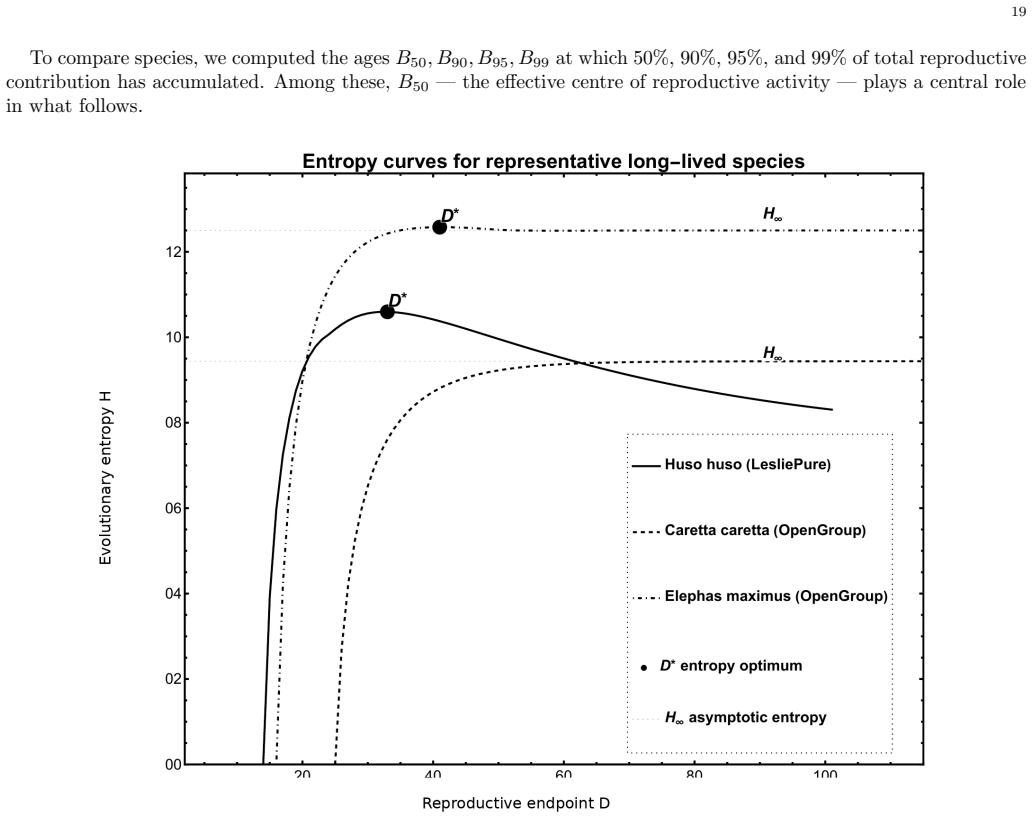
Our central result is a reduction principle: under Euler-Lotka normalization, evolutionary entropy and generation time are invariant under multiplicative rescaling of survivorship and fertility on the reproductive interval. The relevant entropy is determined not by absolute survivorship, fertility, or juvenile mortality, but by the normalized post-maturity reproductive distribution. We derive explicit entropy functionals for finite and open-group Leslie models, including geometric reproductive tails. For the geometric regime we prove a sharp critical threshold separating populations with a unique finite entropy-maximizing endpoint from those whose entropy increases toward an asymptotic value
What carries the argument
The reduction principle for evolutionary entropy under Euler-Lotka normalization, which isolates entropy to the shape of the normalized post-maturity reproductive distribution in Leslie matrices
If this is right
- Reproductive windows in iteroparous populations are frequently organized near the age classes that maximize entropy on the normalized post-maturity distribution.
- In the geometric reproductive tail regime, a critical threshold separates populations with a unique finite entropy-maximizing endpoint from those whose entropy increases asymptotically with endpoint age.
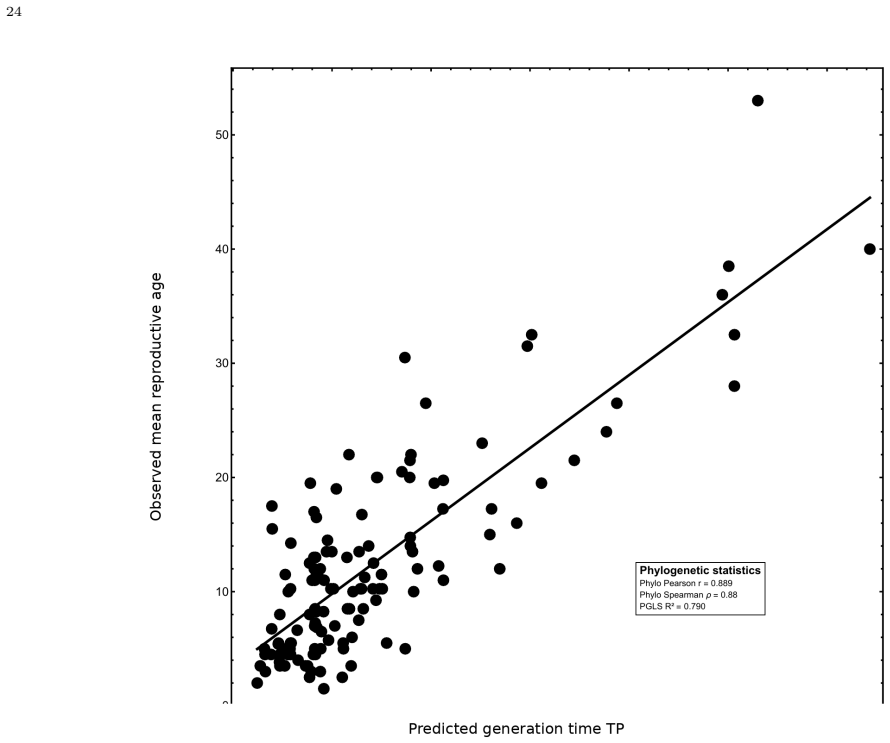
- Entropy-derived predictions from demographic matrices alone coincide exactly with observed reproductive medians in a majority of 130 tested species and fall within three classes for over 90 percent.
- The associations between predicted and observed values remain strong after phylogenetic correction.
Where Pith is reading between the lines
- The invariance result would allow reproductive lifespan predictions from partial demographic schedules without requiring full knowledge of juvenile survival rates.
- Populations whose observed reproductive windows lie far from entropy-maximizing ages may be subject to additional unmodeled pressures such as seasonal resource constraints or predation risk.
- The same normalization and reduction approach could be applied to stage-structured or size-structured models to test whether entropy continues to organize reproductive timing outside strict age-class Leslie frameworks.
Load-bearing premise
Iteroparous animal populations can be represented by Leslie-type demographic matrices whose post-maturity reproductive distributions are finite or geometric, and entropy maximization on these matrices selects observed reproductive windows without additional ecological or behavioral constraints.
What would settle it
Finding a substantial set of species in which entropy-maximizing ages computed from their Leslie matrices deviate by more than three reproductive classes from independently measured reproductive medians would falsify the central claim.
Figures





read the original abstract
Evolutionary entropy measures the temporal organization of reproductive contributions along the life cycle of an age-structured population. We develop a mathematical and empirical framework showing that, in iteroparous animal populations represented by Leslie-type demographic matrices, reproductive windows are frequently organized near the age classes selected by entropy maximization. Evolutionary entropy complements the classical net reproductive number and asymptotic growth rate: whereas these measure lifetime replacement and growth, entropy measures the temporal dispersion of the growth-adjusted reproductive distribution. Our central result is a reduction principle: under Euler--Lotka normalization, evolutionary entropy and generation time are invariant under multiplicative rescaling of survivorship and fertility on the reproductive interval. The relevant entropy is determined not by absolute survivorship, fertility, or juvenile mortality, but by the normalized post-maturity reproductive distribution. We derive explicit entropy functionals for finite and open-group Leslie models, including geometric reproductive tails. For the geometric regime, governed by we prove a sharp critical threshold separating populations with a unique finite entropy-maximizing endpoint from those whose entropy increases toward an asymptotic value in terms solely of the age at first reproduction. The theory is tested on 130 animal species. Entropy-derived predictions, computed from the demographic matrices alone, are compared with independent life-history variables. Predicted and observed reproductive medians coincide exactly for a majority of species, over 90% are predicted within three reproductive classes, and associations remain strong after phylogenetic correction. These results identify a quantitative regularity across taxa, with geometric reproductive distributions playing a central role.
Editorial analysis
A structured set of objections, weighed in public.
Referee Report
Summary. The paper claims that evolutionary entropy in iteroparous populations modeled by Leslie matrices is governed by a reduction principle: under Euler-Lotka normalization, entropy and generation time depend only on the normalized post-maturity reproductive distribution and are invariant under multiplicative rescaling of survivorship and fertility. It derives explicit entropy functionals for finite and geometric-tail cases (with a sharp threshold for the latter), and reports that entropy maximization on these matrices predicts observed reproductive medians exactly for a majority of 130 animal species and within three classes for over 90%, with associations persisting after phylogenetic correction.
Significance. If the reduction principle is correctly derived and the empirical matches prove robust to matrix construction details, the work supplies a parameter-free, falsifiable regularity for reproductive schedule organization that is independent of absolute rates and juvenile mortality, complementing classical metrics like r and R0. The geometric-tail threshold constitutes a clean mathematical contribution that could guide further tests.
major comments (2)
- [Empirical validation] Empirical validation section: the reported exact matches and >90% within-three-class accuracy for 130 species rest on Leslie matrices whose construction, exclusion rules, parameter error propagation, and independence from post-hoc selection of the entropy-maximizing age are not described; without these, it remains possible that the association simply recovers the shape of the input reproductive distributions rather than constituting an independent prediction from entropy maximization alone.
- [Discussion] Discussion: the central claim that entropy maximization on normalized Leslie matrices organizes observed reproductive windows without additional constraints is load-bearing for the interpretation, yet the 130-species comparison does not examine robustness when explicit trade-off functions or density-dependent terms are added to the underlying demographic model.
minor comments (2)
- [Abstract and methods] The abstract and methods should explicitly reference the prior literature on evolutionary entropy to clarify the precise novelty of the functionals derived here.
- [Figures] Figure captions for the species-level comparisons should report per-class sample sizes and the precise phylogenetic correction method employed.
Simulated Author's Rebuttal
We thank the referee for the constructive comments. Below we respond point-by-point to the major comments and indicate planned revisions.
read point-by-point responses
-
Referee: [Empirical validation] Empirical validation section: the reported exact matches and >90% within-three-class accuracy for 130 species rest on Leslie matrices whose construction, exclusion rules, parameter error propagation, and independence from post-hoc selection of the entropy-maximizing age are not described; without these, it remains possible that the association simply recovers the shape of the input reproductive distributions rather than constituting an independent prediction from entropy maximization alone.
Authors: We agree that the Methods section requires expansion for reproducibility. The revised manuscript will add a dedicated subsection detailing: (i) the published life-table sources for the 130 species, (ii) explicit exclusion criteria for incomplete tables, (iii) the exact procedure for assembling Leslie matrices from age-specific l_x and m_x values, and (iv) any handling of parameter uncertainty. Regarding independence, the entropy-maximizing age is obtained by optimizing the entropy functional solely over the normalized post-maturity distribution; the observed median is compared only after this optimization. We will add clarifying text to emphasize that the prediction does not use the observed median as input, thereby addressing the concern that the result merely recovers the input shape. revision: yes
-
Referee: [Discussion] Discussion: the central claim that entropy maximization on normalized Leslie matrices organizes observed reproductive windows without additional constraints is load-bearing for the interpretation, yet the 130-species comparison does not examine robustness when explicit trade-off functions or density-dependent terms are added to the underlying demographic model.
Authors: The reduction principle demonstrates invariance of entropy under multiplicative rescaling of rates on the reproductive interval, which holds regardless of the absolute values set by trade-offs. We nevertheless accept that explicit robustness checks under density dependence or functional trade-offs would strengthen the interpretation. The revised Discussion will include a new paragraph noting this invariance while acknowledging that full numerical examination of such extensions lies outside the scope of the present Leslie-matrix framework and is reserved for future work. revision: partial
Circularity Check
No significant circularity in derivation chain or empirical predictions
full rationale
The reduction principle is a direct mathematical consequence of applying the standard Euler-Lotka normalization to the definition of evolutionary entropy on the post-maturity reproductive distribution; this constitutes a valid invariance result rather than a self-definitional loop where an output is presupposed. Empirical claims derive entropy-maximizing endpoints from Leslie matrices constructed from demographic schedules and compare them to observed reproductive medians across 130 species, with explicit statements that predictions use matrices alone and associations hold after phylogenetic correction. No fitted parameters are relabeled as predictions, no load-bearing self-citations appear, and no ansatz or uniqueness result is imported from prior author work. The framework is self-contained against external species data benchmarks.
Axiom & Free-Parameter Ledger
axioms (2)
- domain assumption Populations are accurately described by Leslie-type age-structured matrices with either finite support or geometric reproductive tails.
- standard math The Euler-Lotka equation provides the correct normalization for growth-adjusted reproductive distributions.
invented entities (1)
-
Evolutionary entropy functional on Leslie matrices
no independent evidence
Reference graph
Works this paper leans on
-
[1]
J. F. Alves, A. Bravo, and H. Oliveira. Kneading determinants of infinite order linear recurrences.Linear Algebra and its Applications, (475):306–325, 2015
2015
-
[2]
J. F. Alves, A. Bravo, and H. Oliveira. Population dynamics with infinite Leslie matrices: finite time properties.Journal of Difference Equations and Applications, 20(9):1307–1318, 2015
2015
-
[3]
Animal diversity web, 2024
Animal Diversity Web. Animal diversity web, 2024
2024
-
[4]
Baudisch.Inevitable Aging?: Contributions to Evolutionary-Demographic Theory, volume 4 ofDemographic Research Monographs
A. Baudisch.Inevitable Aging?: Contributions to Evolutionary-Demographic Theory, volume 4 ofDemographic Research Monographs. Springer, Berlin and Heidelberg, 1 edition, 2008
2008
-
[5]
Bernard, C
C. Bernard, C. de Vries, O. R. Jones, and R. Salguero-G´ omez. Response to discretising and validating keyfitz’ entropy for any demographic classification.Methods in Ecology and Evolution, 15(8):1286–1289, 2024
2024
-
[6]
North american bird banding program, 2024
Bird Banding Laboratory. North american bird banding program, 2024
2024
-
[7]
Buescu, H
J. Buescu, H. M. Oliveira, and M. Sousa. Growth rate, evolutionary entropy and ageing across the tree of life.Journal of Biological Dynamics, 17(1):2256766, 2023
2023
-
[8]
J. R. Carey.Longevity: The Biology and Demography of Life Span. Princeton University Press, Princeton, NJ, 2003
2003
-
[9]
Caswell.Matrix Population Models: Construction, Analysis, and Interpretation
H. Caswell.Matrix Population Models: Construction, Analysis, and Interpretation. Sinauer and associates, 2001
2001
-
[10]
Charlesworth.Evolution in Age-Structured Populations, volume 2
B. Charlesworth.Evolution in Age-Structured Populations, volume 2. Cambridge University Press, Cambridge, 1994
1994
-
[11]
Colchero, R
F. Colchero, R. Rau, O. R. Jones, J. A. Barthold, D. A. Conde, A. Lenart, L. Nemeth, A. Scheuerlein, J. Schoeley, C. Torres, V. Zarulli, J. Altmann, D. K. Brockman, A. M. Bronikowski, L. M. Fedigan, A. E. Pusey, T. S. Stoinski, K. B. Strier, and A. Baudisch. The emergence of longevous populations.Proceedings of the National Academy of Sciences, 113(48):E7...
2016
-
[12]
R. M. Corless, G. H. Gonnet, D. E. G. Hare, D. J. Jeffrey, and D. E. Knuth. On the Lambert W Function.Advances in Computational Mathematics, 5(4):329–359, 1996
1996
-
[13]
T. M. Cover and J. A. Thomas.Elements of Information Theory. Wiley-Interscience, Hoboken, New Jersey, 2 edition, 2006
2006
-
[14]
J. M. Cushing.An Introduction to Structured Population Dynamics. SIAM, 1998
1998
-
[15]
J. P. de Magalh˜ aes. Anage: The animal ageing and longevity database.https://genomics.senescence.info/species/, 2026. Accessed 2026-06-08
2026
-
[16]
J. P. de Magalh˜ aes and J. Costa. A database of vertebrate longevity records and their relation to other life-history traits.Journal of Evolutionary Biology, 22(8):1770–1774, 2009
2009
-
[17]
de Vries, C
C. de Vries, C. Bernard, and R. Salguero-G´ omez. Discretising keyfitz’ entropy for studies of actuarial senescence and comparative demography.Methods in Ecology and Evolution, 14(5):1312–1322, 2023
2023
-
[18]
E. S. Deevey. Life tables for natural populations of animals.The Quarterly Review of Biology, 22(4):283–314, 1947
1947
-
[19]
Demetrius
L. Demetrius. On an infinite population matrix.Mathematical Biosciences, 13(1):133–137, 1972
1972
-
[20]
Demetrius
L. Demetrius. Multiplicative processes ii.Mathematical Biosciences, 20(3):345–357, 1974
1974
-
[21]
Demetrius
L. Demetrius. Natural selection and age-structured populations.Genetics, 79(3):535–544, 1975
1975
-
[22]
Demetrius
L. Demetrius. Adaptive value, entropy and survivorship curves.Nature, (275):213 – 214, 1978
1978
-
[23]
Demetrius
L. Demetrius. Statistical mechanics and population biology.Journal of Statistical Physics, 30(3):709–753, 1983
1983
-
[24]
Demetrius
L. Demetrius. Directionality principles in thermodynamics and evolution.Proceedings of the National Academy of Sciences, 94(8):3491– 3498, 1997
1997
-
[25]
Demetrius
L. Demetrius. Chronon and directional evolution.Physica A: Statistical Mechanics and its Applications, 340(1–3):1–11, September 2004
2004
-
[26]
Demetrius
L. Demetrius. Boltzmann, Darwin and directionality theory.Physics Reports, 530(1):1 – 85, 2013. Boltzmann, Darwin and Directionality Theory
2013
-
[27]
S. N. Elaydi and J. M. Cushing.Discrete Mathematical Models in Population Biology: Ecological, Epidemic, and Evolutionary Dynamics. Springer Undergraduate Texts in Mathematics and Technology. Springer Nature Switzerland, Cham, 2024
2024
-
[28]
Euring data bank and longevity records, 2024
EURING. Euring data bank and longevity records, 2024. European Union for Bird Ringing
2024
-
[29]
Felsenstein
J. Felsenstein. Phylogenies and the comparative method.American Naturalist, 125:1–15, 1985
1985
-
[30]
O. E. Fern´ andez and H. Beltr´ an-S´ anchez. The entropy of the life table: A reappraisal.Theoretical Population Biology, 104:26–45, 2015
2015
-
[31]
Finch.Longevity, Senescence, and the Genome
C. Finch.Longevity, Senescence, and the Genome. University of Chicago Press, Chicago, 1994
1994
-
[32]
R. P. Freckleton, P. H. Harvey, and M. Pagel. Phylogenetic analysis and comparative data.American Naturalist, 160:712–726, 2002
2002
-
[33]
Froese and D
R. Froese and D. Pauly. Fishbase, 2024. World Wide Web electronic publication
2024
-
[34]
S. Giaimo. Discretizing and validating keyfitz’ entropy for any demographic classification.Methods in Ecology and Evolution, 15, 2024
2024
-
[35]
Gompertz
B. Gompertz. On the nature of the function expressive of the law of human mortality, and on a new mode of determining the value of life contingencies.Philosophical Transactions of the Royal Society of London, 115:513–583, 1825
-
[36]
Gosselin and J.-D
F. Gosselin and J.-D. Lebreton. Asymptotic properties of infinite Leslie matrices.Journal of Theoretical Biology, 256(2):157 – 163, 2009
2009
-
[37]
A. Grafen. The phylogenetic regression.Philosophical Transactions of the Royal Society B, 326:119–157, 1989
1989
-
[38]
R. M. Gray.Entropy and Information Theory. Information Systems and Data Science. Springer, New York, 2 edition, 2011
2011
-
[39]
W. D. Hamilton. The moulding of senescence by natural selection.Journal of Theoretical Biology, 12(1):12–45, 1966
1966
-
[40]
P. H. Harvey and M. D. Pagel.The Comparative Method in Evolutionary Biology. Oxford University Press, 1991
1991
-
[41]
C. E. e. a. Hinchliff. Synthesis of phylogeny and taxonomy into a comprehensive tree of life.PNAS, 112:12764–12769, 2015
2015
-
[42]
H. F. Inman and E. L. J. Bradley. The overlapping coefficient as a measure of agreement between probability distributions and point estimation of the overlap of two normal densities.Communications in Statistics – Theory and Methods, 18(10):3851–3874, 1989
1989
-
[43]
E. T. Jaynes. Information theory and statistical mechanics.Physical Review, 106(4):620–630, 1957
1957
-
[44]
E. T. Jaynes. Information theory and statistical mechanics. ii.Physical Review, 108(2):171–190, 1957
1957
-
[45]
K. E. Jones, J. Bielby, M. Cardillo, S. A. Fritz, J. O’Dell, C. D. L. Orme, K. Safi, W. Sechrest, E. H. Boakes, C. Carbone, C. Connolly, M. J. Cutts, J. K. Foster, R. Grenyer, M. Habib, C. A. Plaster, S. A. Price, E. A. Rigby, J. Rist, A. Teacher, O. R. P. Bininda-Emonds, J. L. Gittleman, G. M. Mace, and A. Purvis. Pantheria: A species-level database of l...
2009
-
[46]
K. E. Jones et al. Pantheria: Species-level database of life history, ecology, and geography of mammals. https://esapubs.org/archive/ ecol/E090/184/, 2026. Accessed 2026-06-08
2026
-
[47]
O. R. Jones, A. Scheuerlein, R. Salguero-G´ omez, C. G. Camarda, R. Schaible, B. B. Casper, J. P. Dahlgren, J. Ehrl´ en, M. B. Garc´ ıa, E. S. Menges, P. F. Quintana-Ascencio, H. Caswell, A. Baudisch, and J. W. Vaupel. Diversity of ageing across the tree of life.Nature, 505(7482):169–173, 2014
2014
-
[48]
Keyfitz.Introduction to the Mathematics of Population
N. Keyfitz.Introduction to the Mathematics of Population. Addison-Wesley, Reading, Massachusetts, 1968
1968
-
[49]
T. B. L. Kirkwood. Evolution of ageing.Nature, 270(5635):301–304, 1977
1977
-
[50]
T. B. L. Kirkwood and S. N. Austad. Why do we age?Nature, 408(6809):233–238, 2000
2000
-
[51]
D. Lepage. Avibase – the world bird database, 2024. Accessed 2026-06-08. 32
2024
-
[52]
P. H. Leslie. On the use of matrices in certain population mathematics.Biometrika, 33(3):183–212, 1945
1945
-
[53]
P. B. Medawar.An Unsolved Problem of Biology: An Inaugural Lecture Delivered at University College, London, 6 December 1951. Published for University College London by H. K. Lewis and Company, London, 1952
1951
-
[54]
Open tree of life, 2025
Open Tree of Life Project. Open tree of life, 2025. https://tree.opentreeoflife.org, accessed Month Year
2025
-
[55]
M. Pagel. Inferring the historical patterns of biological evolution.Nature, 401:877–884, 1999
1999
-
[56]
Pastore and A
M. Pastore and A. Calcagn` ı. Measuring distribution similarities between samples: A distribution-free overlapping index.Frontiers in Psychology, 10:1089, 2019
2019
-
[57]
Pearl.The Rate of Living
R. Pearl.The Rate of Living. University of London Press, London, 1928
1928
-
[58]
Salguero-G´ omez et al
R. Salguero-G´ omez et al. Comadre animal matrix database.https://www.comadre-db.org, 2026. Accessed 2026-06-08
2026
-
[59]
Salguero-G´ omez et al
R. Salguero-G´ omez et al. Compadre plant matrix database.https://compadre-db.org, 2026. Accessed 2026-06-08
2026
-
[60]
Salguero-G´ omez, O
R. Salguero-G´ omez, O. R. Jones, C. R. Archer, C. Bein, H. de Buhr, C. Farack, F. Gottschalk, A. Hartmann, A. Henning, G. Hoppe, G. R¨ omer, J. Runge, T. Ruoff, V. Sommer, J. Wille, J. Voigt, D. Vieregg, Y. C. Buckley, J. Che-Castaldo, D. Hodgson, A. Scheuerlein, H. Caswell, J. W. Vaupel, and A. Baudisch. Comadre: A global data base of animal demography....
2016
-
[61]
Salguero-G´ omez, O
R. Salguero-G´ omez, O. R. Jones, C. R. Archer, Y. C. Buckley, J. Che-Castaldo, H. Caswell, D. Hodgson, A. Scheuerlein, D. A. Conde, E. Brinks, H. de Buhr, C. Farack, F. Gottschalk, A. Hartmann, A. Henning, G. Hoppe, G. R¨ omer, J. Runge, T. Ruoff, J. Wille, S. Zeh, D. Vieregg, A. Baudisch, and J. W. Vaupel. The compadre plant matrix database: An open onl...
2015
-
[62]
C. E. Shannon. A mathematical theory of communication.Bell System Technical Journal, 27:379–423, 623–656, 1948
1948
-
[63]
S. C. Stearns.The Evolution of Life Histories. Oxford University Press, Oxford and New York, 1 edition, 1992
1992
-
[64]
Tacutu, D
R. Tacutu, D. Thornton, E. Johnson, A. Budovsky, D. Barardo, T. Craig, E. Diana, G. Lehmann, D. Toren, J. Wang, V. E. Fraifeld, and J. P. de Magalh˜ aes. Human ageing genomic resources: New and updated databases.Nucleic Acids Research, 46(D1):D1083–D1090, January 2018
2018
-
[65]
J. W. Vaupel, A. Baudisch, M. D¨ olling, D. A. Roach, and J. Gampe. The case for negative senescence.Theoretical Population Biology, 65(4):339–351, 2004
2004
-
[66]
W. Weibull. A statistical distribution function of wide applicability.Journal of Applied Mechanics, 18(3):293–297, 1951
1951
-
[67]
G. C. Williams. Pleiotropy, natural selection, and the evolution of senescence.Evolution, 11(4):398–411, 1957. Email address:jsbuescu@ciencias.ulisboa.pt Email address:selaydi@trinity.edu Email address:henrique.m.oliveira@tecnico.ulisboa.pt
1957
discussion (0)
Sign in with ORCID, Apple, or X to comment. Anyone can read and Pith papers without signing in.