DreamUV: Unwrap Artist-like UV by End-to-End Flow Matching
Pith reviewed 2026-06-26 10:55 UTC · model grok-4.3
The pith
A flow matching model generates UV unwraps for 3D meshes that match professional artists' preferences for straight seams and axis-aligned islands.
A machine-rendered reading of the paper's core claim, the machinery that carries it, and where it could break.
Core claim
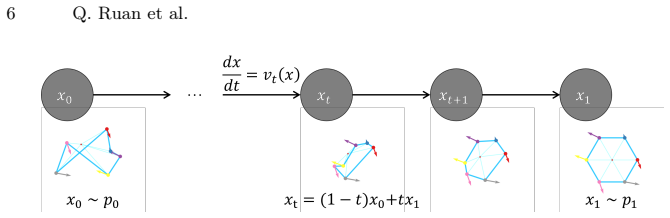
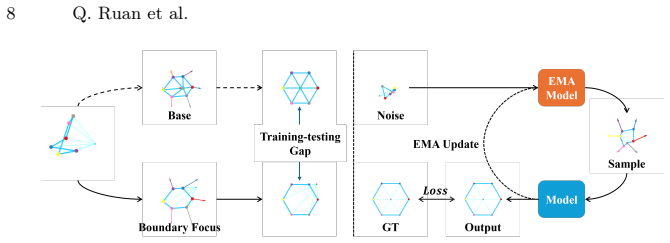
DreamUV formulates UV unwrapping as an end-to-end generative Flow Matching problem that learns a mesh-conditioned transport process mapping noise samples to a distribution of artist-like UV layouts. Boundary-aware training prioritizes seam geometry, and Model-in-the-Loop Finetuning stabilizes the dynamics under heterogeneous supervision by accounting for discretization errors. On a large-scale dataset of professionally authored UV layouts, the method yields significantly straighter boundaries and tighter axis-aligned islands than both classical and learning-based baselines while keeping distortion metrics competitive, with qualitative results and a professional user study confirming alignmen
What carries the argument
Mesh-conditioned flow matching transport process that maps noise to artist UV distributions, using boundary-aware training to focus on seams and Model-in-the-Loop Finetuning to handle sampling discretization.
If this is right
- UV generation can shift from pure energy minimization to sampling from a learned distribution that encodes observed artist conventions.
- Production workflows gain the ability to produce layouts with straightened seams and aligned islands without manual post-processing.
- Multiple valid UV options can be sampled for one mesh, allowing artists to choose among stylistically different but geometrically sound results.
- Distortion remains competitive, so the stylistic improvements do not trade away basic geometric validity.
- The same learned transport can be applied to new meshes once the model is trained, reducing the need for per-mesh hand-tuning.
Where Pith is reading between the lines
- The generative framing could be extended to condition the flow on additional signals such as target texture resolution or animation requirements.
- Integration into end-to-end 3D asset generators might produce meshes that already carry production-ready UVs rather than requiring a separate unwrapping stage.
- If the learned patterns prove stable across mesh categories, the approach could support consistent UVs for large batches of procedurally generated content.
Load-bearing premise
The collected dataset of professional UV layouts captures the stylistic patterns that matter in production, and the boundary-aware training plus finetuning reliably transfers those patterns to new meshes without producing invalid layouts.
What would settle it
On a held-out set of meshes, a blind user study with the same professional artists rates the generated UVs as less usable or more distorted than outputs from classical optimization methods.
Figures


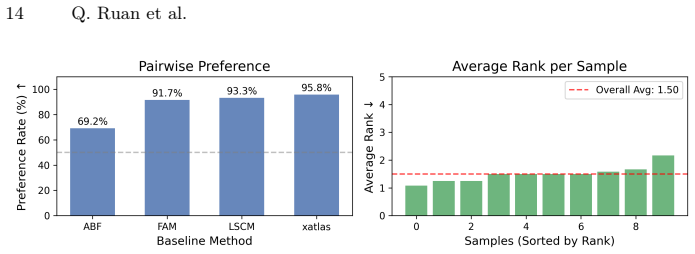
read the original abstract
UV parameterization is a fundamental step in 3D content creation, yet producing production-ready UV layouts remains challenging due to the gap between geometric distortion objectives and the stylistic preferences of professional artists. While classical methods optimize handcrafted energy functions, artist-authored UVs exhibit structural patterns such as straightened seams, axis-aligned islands, and flexible interior deformation, properties that are difficult to explicitly formulate. In this work, we present DreamUV, an end-to-end learning framework that formulates UV unwrapping as a generative Flow Matching problem. Rather than predicting a single optimal parameterization, DreamUV learns a mesh-conditioned transport process that maps noise samples to a distribution of artist-like UV layouts. To reflect real-world authoring practices, we introduce a boundary-aware training strategy that prioritizes seam geometry, and a Model-in-the-Loop Finetuning(MITL) scheme that explicitly accounts for discretization errors during sampling and stabilizes transport dynamics under heterogeneous supervision. We evaluate DreamUV on a large-scale dataset of professionally authored UV layouts. Experiments demonstrate that our method produces significantly straighter boundaries and tighter axis-aligned islands than both classical and learning-based baselines, while maintaining competitive distortion metrics. Qualitative results and a user study with professional artists further confirm that DreamUV generates UV layouts that are not only valid, but aligned with practical production requirements.
Editorial analysis
A structured set of objections, weighed in public.
Referee Report
Summary. The paper presents DreamUV, an end-to-end flow-matching framework that learns a mesh-conditioned generative transport from noise to distributions of artist-like UV layouts. It introduces a boundary-aware training strategy that prioritizes seam geometry and a Model-in-the-Loop Finetuning (MITL) procedure to handle discretization during sampling. Experiments on a large-scale dataset of professionally authored UVs report improved boundary straightness and axis-aligned islands relative to classical and learning-based baselines while preserving competitive distortion; a user study with artists is cited to support practical alignment.
Significance. If the validity and generalization claims hold, the work would provide a practical bridge between purely geometric UV optimization and the stylistic conventions used in production, potentially reducing manual cleanup time in 3D pipelines. The use of flow matching for unconditional sampling of UV distributions and the MITL stabilization under heterogeneous supervision are technically interesting contributions.
major comments (2)
- [Method and Experiments] The central claim that DreamUV outputs are 'not only valid, but aligned with practical production requirements' rests on the assertion that boundary-aware training plus MITL produce bijective, non-overlapping layouts. No injectivity loss, collision penalty, or post-sampling validity filter is described, and no quantitative table reports the fraction of invalid (overlapping or non-manifold) samples on held-out meshes; this directly affects whether the reported gains in boundary metrics are usable.
- [Experiments] The evaluation section reports 'significantly straighter boundaries and tighter axis-aligned islands' but provides no dataset statistics, ablation tables, or error bars on the quantitative metrics; without these it is impossible to assess whether the improvements are robust or driven by the specific test distribution.
minor comments (2)
- [Method] Notation for the flow-matching ODE and the conditioning mechanism on mesh features should be introduced with explicit equations rather than prose descriptions.
- [User Study] The user-study protocol (number of artists, number of meshes, exact rating criteria) is mentioned only qualitatively; a table summarizing participant responses would improve clarity.
Simulated Author's Rebuttal
We thank the referee for the constructive feedback on our manuscript. The comments highlight important aspects of validity quantification and experimental rigor that we will address. We respond to each major comment below.
read point-by-point responses
-
Referee: [Method and Experiments] The central claim that DreamUV outputs are 'not only valid, but aligned with practical production requirements' rests on the assertion that boundary-aware training plus MITL produce bijective, non-overlapping layouts. No injectivity loss, collision penalty, or post-sampling validity filter is described, and no quantitative table reports the fraction of invalid (overlapping or non-manifold) samples on held-out meshes; this directly affects whether the reported gains in boundary metrics are usable.
Authors: We agree that explicit evidence of bijectivity is necessary to substantiate the practical claims. The boundary-aware training and MITL are intended to promote valid outputs by aligning with the distribution of artist-authored layouts, but the manuscript does not describe an injectivity loss, collision penalty, or post-sampling filter, nor does it report validity rates. In the revised version we will add a quantitative table reporting the fraction of valid (non-overlapping, bijective) samples on held-out meshes and clarify the mechanisms that support validity during sampling. revision: yes
-
Referee: [Experiments] The evaluation section reports 'significantly straighter boundaries and tighter axis-aligned islands' but provides no dataset statistics, ablation tables, or error bars on the quantitative metrics; without these it is impossible to assess whether the improvements are robust or driven by the specific test distribution.
Authors: We concur that dataset statistics, ablations, and error bars are required for a complete assessment of robustness. The current evaluation focuses on comparative metrics but omits these supporting details. In the revision we will expand the experiments section to include key statistics of the professional UV dataset, ablation tables for the boundary-aware training and MITL components, and error bars or standard deviations on the reported metrics. revision: yes
Circularity Check
No circularity: data-driven flow matching trained on external artist UV dataset
full rationale
The paper formulates UV unwrapping as a mesh-conditioned flow matching generative process trained end-to-end on a large-scale external collection of professionally authored UV layouts. Boundary-aware reweighting and Model-in-the-Loop Finetuning are training heuristics applied to this external supervision; they do not redefine any target quantity in terms of the model's own outputs. Evaluation compares against separate classical and learning-based baselines on distortion, boundary straightness, and artist preference metrics, with no self-citation chain, fitted-parameter-as-prediction, or ansatz imported from prior author work serving as the load-bearing justification. The derivation chain is therefore self-contained against external data and benchmarks.
Axiom & Free-Parameter Ledger
axioms (2)
- domain assumption Artist-authored UV layouts exhibit consistent structural patterns that can be captured by a generative transport process
- ad hoc to paper The boundary-aware training strategy and Model-in-the-Loop Finetuning stabilize the learned transport under heterogeneous supervision
Reference graph
Works this paper leans on
-
[1]
Applied Sciences11(4), 1833 (2021)
Bazazian, D., Parés, M.E.: EDC-Net: Edge Detection Capsule Network for 3D Point Clouds. Applied Sciences11(4), 1833 (2021)
2021
-
[2]
Chen, R.T., Rubanova, Y., Bettencourt, J., Duvenaud, D.K.: Neural Ordinary Differential Equations. vol. 31 (2018)
2018
-
[3]
Chen, Y., Liu, X., Li, Y., Cheung, V., Chen, Z., Zhang, D., Guo, C.: ArtUV: Artist-style UV Unwrapping (2025),http://arxiv.org/abs/2509.20710
arXiv 2025
-
[4]
Advances in Multiresolution for Geometric Modelling pp
Floater, M.S., Hormann, K.: Surface Parameterization: a Tutorial and Survey. Advances in Multiresolution for Geometric Modelling pp. 157–186
-
[5]
In: CVPR
Groueix, T., Fisher, M., Kim, V.G., Russell, B.C., Aubry, M.: A Papier-Mâché Approach to Learning 3D Surface Generation. In: CVPR. pp. 216–224 (2018)
2018
-
[6]
ACM TOG41(1), 1–21 (2021)
Himeur, C.E., Lejemble, T., Pellegrini, T., Paulin, M., Barthe, L., Mellado, N.: PCEDNet: A Lightweight Neural Network for Fast and Interactive Edge Detection in 3D Point Clouds. ACM TOG41(1), 1–21 (2021)
2021
-
[7]
ACM TOG36(6), 1–9 (2017)
Jiang, Z., Schaefer, S., Panozzo, D.: Simplicial complex augmentation framework for bijective maps. ACM TOG36(6), 1–9 (2017)
2017
-
[8]
ACM TOG21(3), 10–p (2002)
Lévy, B., Petitjean, S., Ray, N., Maillot, J.: Least Squares Conformal Maps for Automatic Texture Atlas Generation. ACM TOG21(3), 10–p (2002)
2002
-
[9]
ACM TOG37(6), 1–13 (2018)
Li, M., Kaufman, D.M., Kim, V.G., Solomon, J., Sheffer, A.: OptCuts: Joint Op- timization of Surface Cuts and Parameterization. ACM TOG37(6), 1–13 (2018)
2018
-
[10]
Li, Y., Cheung, V., Liu, X., Chen, Y., Luo, Z., Lei, B., Weng, H., Zhao, Z., Huang, J., Chen, Z., et al.: Auto-regressive surface cutting (2025),http://arxiv.org/ abs/2506.18017
arXiv 2025
-
[11]
ACM TOG37(4), 153 (2018)
Limper, M., Vining, N., Sheffer, A.: Box cutter: Atlas refinement for efficient pack- ing via void elimination. ACM TOG37(4), 153 (2018)
2018
-
[12]
In: ICLR
Lipman, Y., Chen, R.T., Ben-Hamu, H., Nickel, M., Le, M.: Flow Matching for Generative Modeling. In: ICLR
-
[13]
ACM TOG38(4), 1–13 (2019)
Liu, H.Y., Fu, X.M., Ye, C., Chai, S., Liu, L.: Atlas Refinement with Bounded Packing Efficiency. ACM TOG38(4), 1–13 (2019)
2019
-
[14]
Olearo, L., Viganò, G., Baieri, D., Maggioli, F., Melzi, S.: FUSE: A Flow-based Mapping Between Shapes (2025),http://arxiv.org/abs/2511.13431
arXiv 2025
-
[15]
Poranne, R., Tarini, M., Huber, S., Panozzo, D., Sorkine-Hornung, O.: Autocuts: SimultaneousDistortionandCutOptimizationforUVMapping.ACMTOG36(6), 1–11 (2017)
2017
-
[16]
ACM TOG36(4), 1 (2017)
Rabinovich, M., Poranne, R., Panozzo, D., Sorkine-Hornung, O.: Scalable Locally Injective Mappings. ACM TOG36(4), 1 (2017)
2017
-
[17]
Shay, G., Solomon, J., Stein, O.: A Dataset and Benchmark for Mesh Parameteri- zation (2022),http://arxiv.org/abs/2208.01772
arXiv 2022
-
[18]
ACM TOG24(2), 311–330 (2005)
Sheffer, A., Lévy, B., Mogilnitsky, M., Bogomyakov, A.: ABF++: Fast and Robust Angle Based Flattening. ACM TOG24(2), 311–330 (2005)
2005
-
[19]
In: IEEE Visualization, 2002
Sorkine, O., Cohen-Or, D., Goldenthal, R., Lischinski, D.: Bounded-distortion Piecewise Mesh Parameterization. In: IEEE Visualization, 2002. VIS 2002. pp. 355–362. IEEE (2002)
2002
-
[20]
In: ECCV
Srinivasan, P.P., Garbin, S.J., Verbin, D., Barron, J.T., Mildenhall, B.: Nuvo: Neu- ral UV Mapping for Unruly 3D Representations. In: ECCV. pp. 18–34. Springer (2024)
2024
-
[21]
Team, S.D., Chen, X., Chu, F.J., Gleize, P., Liang, K.J., Sax, A., Tang, H., Wang, W., Guo, M., Hardin, T., Li, X., Lin, A., Liu, J., Ma, Z., Sagar, A., Song, B., Wang, X., Yang, J., Zhang, B., Dollár, P., Gkioxari, G., Feiszli, M., Malik, J.: SAM 3D: 3Dfy Anything in Images (2025),https://arxiv.org/abs/2511.16624 16 Q. Ruan et al
Pith/arXiv arXiv 2025
-
[22]
In: Computer Graphics Forum
Vining, N., Majercik, Z., Gu, F., Takikawa, T., Trusty, T., Lalonde, P., McGuire, M., Sheffer, A.: FastAtlas: Real-Time Compact Atlases for Texture Space Shading. In: Computer Graphics Forum. vol. 44, p. e70010. Wiley Online Library (2025)
2025
-
[23]
Wang, X., Xu, Y., Xu, K., Tagliasacchi, A., Zhou, B., Mahdavi-Amiri, A., Zhang, H.: PIE-NET: Parametric Inference of Point Cloud Edges. vol. 33, pp. 20167–20178 (2020)
2020
-
[24]
ACM TOG38(5), 1–12 (2019)
Wang, Y., Sun, Y., Liu, Z., Sarma, S.E., Bronstein, M.M., Solomon, J.M.: Dynamic Graph CNN for Learning on Point Clouds. ACM TOG38(5), 1–12 (2019)
2019
-
[25]
In: Proceedings of the SIGGRAPH Asia 2025 Conference Papers
Wang, Z., Wei, X., Shi, R., Zhang, X., Su, H., Liu, M.: PartUV: Part-Based UV Un- wrapping of 3D Meshes. In: Proceedings of the SIGGRAPH Asia 2025 Conference Papers. pp. 1–12 (2025)
2025
-
[26]
In: CVPR
Yang, Y., Feng, C., Shen, Y., Tian, D.: FoldingNet: Point Cloud Auto-encoder via Deep Grid Deformation. In: CVPR. pp. 206–215 (2018)
2018
-
[27]
ACM TOG42(6), 1–16 (2023)
Yang, Z., Pan, Z., Li, M., Wu, K., Gao, X.: Learning based 2D Irregular Shape Packing. ACM TOG42(6), 1–16 (2023)
2023
-
[28]
In: ECCV (September 2018)
Yu, L., Li, X., Fu, C.W., Cohen-Or, D., Heng, P.A.: EC-Net: an Edge-aware Point set Consolidation Network. In: ECCV (September 2018)
2018
-
[29]
Zhang, Q., Hou, J., He, Y.: ParaPoint: Learning Global Free-Boundary Surface Parameterization of 3D Point Clouds (2024),http://arxiv.org/abs/2403.10349
arXiv 2024
-
[30]
IJCV130(12), 3100– 3122 (2022)
Zhang, Q., Hou, J., Qian, Y., Chan, A.B., Zhang, J., He, Y.: RegGeoNet: Learning Regular Representations for Large-Scale 3D Point Clouds. IJCV130(12), 3100– 3122 (2022)
2022
-
[31]
IEEE TPAMI45(8), 9726–9742 (2023)
Zhang, Q., Hou, J., Qian, Y., Zeng, Y., Zhang, J., He, Y.: Flattening-Net: Deep Regular 2D Representation for 3D Point Cloud Analysis. IEEE TPAMI45(8), 9726–9742 (2023)
2023
-
[32]
Zhang, Q., Hou, J., Wang, W., He, Y.: Flatten Anything: Unsupervised Neural Surface Parameterization. vol. 37, pp. 2830–2850 (2024)
2024
-
[33]
IEEE TPAMI (2025)
Zhao, Y., Zhang, Q., Hou, J., Xia, J., Wang, W., He, Y.: Flexpara: Flexible neural surface parameterization. IEEE TPAMI (2025)
2025
discussion (0)
Sign in with ORCID, Apple, or X to comment. Anyone can read and Pith papers without signing in.