FAUST XXXI. Grain properties and variability of three sources in GSS 30
Pith reviewed 2026-06-26 09:53 UTC · model grok-4.3
The pith
ALMA imaging of GSS 30 finds tens-of-micron grains and 650-1510 Earth masses of dust in IRS3, free-free emission in IRS1, and 420-second brightness changes in IRS2.
A machine-rendered reading of the paper's core claim, the machinery that carries it, and where it could break.
Core claim
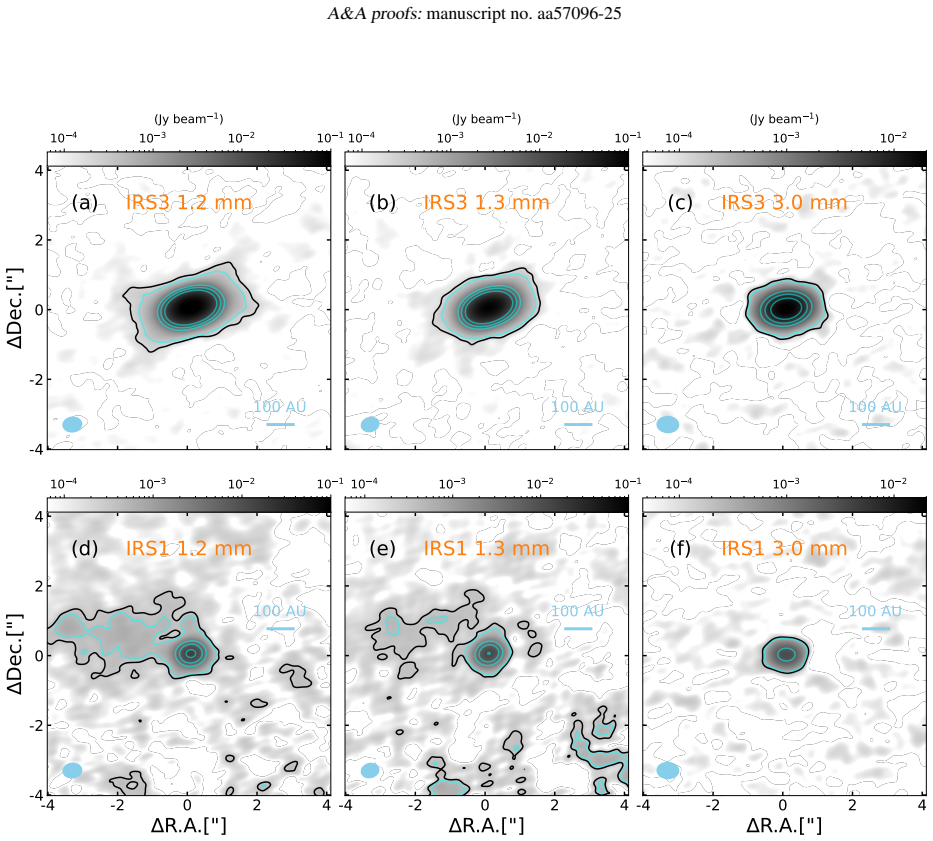
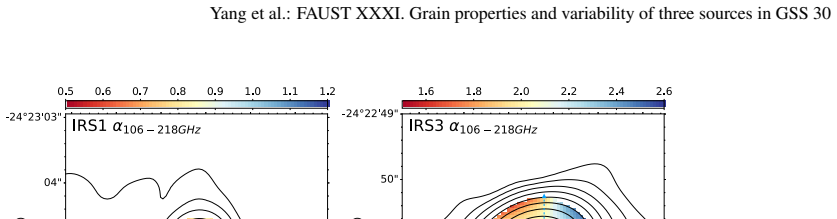
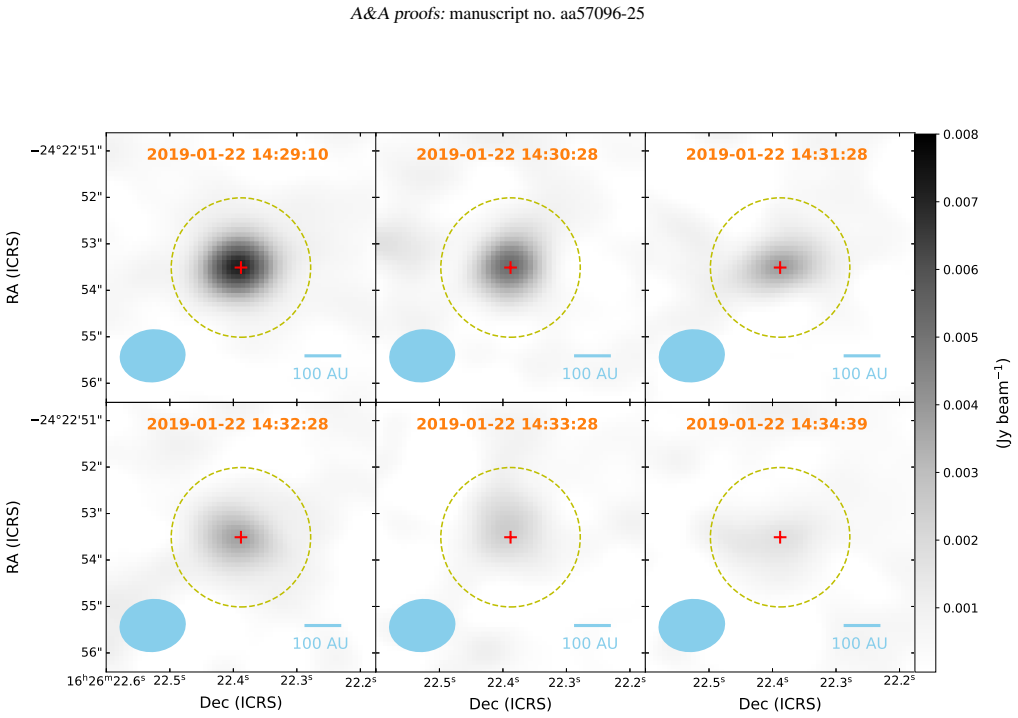
Spectral index rises radially from 2.0 to 2.5 in IRS3 but falls to 1.6-1.8 along the outflow; SED modeling yields maximum grain sizes of tens of microns and dust mass 650-1510 Earth masses. IRS1 exhibits alpha less than 0.8 at its center, matching marginally optically thick free-free emission. IRS2 shows brightness variations over 420 seconds that multi-epoch data indicate are flares lasting tens of minutes and likely produced by magnetic activity.
What carries the argument
Spectral-index mapping from multi-band continuum images combined with SED fitting to constrain maximum grain size and dust mass; multi-epoch brightness tracking to detect variability.
If this is right
- Grain growth to tens of microns and dust masses of hundreds of Earth masses can already be present inside class 0/I disks.
- Lower spectral indices along outflow directions can arise from cold envelope dust obscuring warmer inner material.
- Millimeter continuum can vary on minute timescales when magnetic activity occurs in the protostar.
- Extended structures around IRS1 may trace streamers or outflow-disk interactions that affect apparent disk properties.
Where Pith is reading between the lines
- If similar spectral-index gradients appear in other embedded sources, grain growth may be a common early-stage process rather than a later one.
- Repeated short-cadence observations could test whether the flares correlate with accretion-rate changes or X-ray bursts.
- Higher-resolution data might separate the contributions of envelope obscuration from true radial grain-size changes.
Load-bearing premise
The observed spectral indices are taken to reflect dust grain properties and optical depth without major contributions from calibration errors or other emission processes, and the brightness changes are taken to be intrinsic rather than artifacts.
What would settle it
A new set of 1.2-3 mm observations that recovers a flat or inverted spectral-index map for IRS3 or shows no brightness change in IRS2 on 420-second timescales would falsify the reported grain sizes and flare interpretation.
Figures



read the original abstract
To advance our understanding of dust properties in class 0/I young stellar objects, it is crucial to resolve their structures at multiple wavelengths and investigate how grain growth and environmental effects shape their spectral properties. We present 0.5 arcsec resolution ALMA observations of the GSS 30 complex at 1.2-3.0 mm from the FAUST large programme, achieving a linear resolution of 69 au. We analyse the dust continuum emission and perform modelling to constrain dust properties and disk structures. For IRS3, the spectral index increases radially from 2.0 at the centre to 2.5 at the disk edge, while decreasing to 1.6-1.8 along the outflow direction. The asymmetric low-alpha region towards the northeastern blueshifted lobe may result from cold outer envelope dust obscuring warmer inner regions. SED fitting suggests maximum grain sizes of tens of microns and a dust mass of 650-1510 M_earth. IRS1 is associated with an extended north-eastern structure, which may represent an outflow-disk complex, a trailing structure linked to a circumbinary disk, or a gas streamer accreting onto IRS1. The central IRS1 shows alpha < 0.8, consistent with marginally optically thick free-free emission. IRS2 displays brightness variations over 420 s, and multi-epoch comparison suggests a flare lasting tens of minutes, likely caused by magnetic activity in the protostar. Our results highlight the importance of environmental effects, including dust obscuration and streamer structures, in shaping the observed properties of young disks, and reveal millimetre variability associated with possible protostellar magnetic flares.
Editorial analysis
A structured set of objections, weighed in public.
Referee Report
Summary. The manuscript presents 0.5-arcsec ALMA observations at 1.2-3.0 mm of the GSS 30 complex from the FAUST program. It derives spectral indices for three embedded sources, reports a radial increase from 2.0 to 2.5 in IRS3 with SED fitting that yields a_max of tens of microns and dust mass 650-1510 M_earth, interprets IRS1's central alpha < 0.8 as marginally optically thick free-free emission, and attributes IRS2 brightness variations over 420 s to protostellar magnetic flares, while noting environmental effects such as outflow obscuration and possible streamers.
Significance. If the radiative-transfer modeling is shown to produce the required central optical depths, the work supplies useful multi-wavelength constraints on grain growth in Class 0/I disks and reports a rare mm-wavelength variability detection. The new high-resolution data and emphasis on environmental influences are positive contributions to the field.
major comments (1)
- [Abstract / SED fitting section] Abstract and modeling section: the central spectral index ~2.0 for IRS3 is reconciled with a_max of only tens of microns only if the fitted model produces tau ≳ 1 at the wavelengths used; the manuscript does not report the derived central optical-depth values or perform the necessary sensitivity tests on temperature/density structure, leaving the grain-size inference vulnerable to the alternative explanation of larger grains (beta ~ 0) in the optically thin limit.
minor comments (2)
- [Abstract] The abstract should state the exact frequency pairs or bands used to compute the reported spectral indices.
- [Modeling / results section] Clarify whether the quoted dust mass assumes a standard gas-to-dust ratio and list the opacity model (e.g., astronomical silicate) adopted in the SED fits.
Simulated Author's Rebuttal
We appreciate the referee's positive assessment of our work and their recommendation for major revision. We address the single major comment below by agreeing to include additional details from our modeling to support the grain growth interpretation.
read point-by-point responses
-
Referee: [Abstract / SED fitting section] Abstract and modeling section: the central spectral index ~2.0 for IRS3 is reconciled with a_max of only tens of microns only if the fitted model produces tau ≳ 1 at the wavelengths used; the manuscript does not report the derived central optical-depth values or perform the necessary sensitivity tests on temperature/density structure, leaving the grain-size inference vulnerable to the alternative explanation of larger grains (beta ~ 0) in the optically thin limit.
Authors: We thank the referee for highlighting this important point. Upon re-examination of our radiative transfer modeling, the best-fit models do indeed yield central optical depths τ ≳ 1 at both 1.2 mm and 3.0 mm for IRS3, which supports the interpretation that the observed spectral index of ~2.0 arises in the optically thick regime for maximum grain sizes of tens of microns rather than requiring β ≈ 0 in the thin limit. In the revised version of the manuscript, we will explicitly report these central optical depth values and include a brief discussion of the sensitivity of the results to assumptions about the temperature and density structure. This addition will strengthen the robustness of our grain-size conclusions. revision: yes
Circularity Check
No circularity: new observations and independent SED modeling
full rationale
The paper reports fresh ALMA continuum maps at 1.2-3 mm, directly measures radial spectral-index profiles from those maps, and then performs standard radiative-transfer SED fitting to the observed fluxes and indices to constrain a_max and dust mass. None of the load-bearing steps (spectral-index extraction, optical-depth inference, or grain-size fitting) reduce by construction to the paper's own inputs or to a self-citation chain; the modeling assumptions are stated explicitly and the results remain falsifiable against the raw visibilities. No self-definitional, fitted-input-renamed-as-prediction, or uniqueness-imported-from-authors patterns appear.
Axiom & Free-Parameter Ledger
free parameters (2)
- maximum grain size =
tens of microns
- dust mass =
650-1510 M_earth
axioms (2)
- domain assumption Dust opacity models link spectral index to grain size distribution
- domain assumption Brightness variations over short timescales indicate intrinsic source variability
Reference graph
Works this paper leans on
-
[1]
E., Sz˝ ucs, L., et al
Agurto-Gangas, C., Pineda, J. E., Sz˝ ucs, L., et al. 2019, A&A, 623, A147 ALMA Partnership, Brogan, C. L., Pérez, L. M., et al. 2015, ApJ, 808, L3
2019
-
[2]
O., Girart, J
Alves, F. O., Girart, J. M., Caselli, P., et al. 2017, A&A, 603, L3
2017
-
[3]
& Montmerle, T
Andre, P. & Montmerle, T. 1994, ApJ, 420, 837
1994
-
[4]
M., Huang, J., Pérez, L
Andrews, S. M., Huang, J., Pérez, L. M., et al. 2018, ApJ, 869, L41
2018
-
[5]
2023, in Astronomical Society of the Pacific Conference Series, V ol
Bae, J., Isella, A., Zhu, Z., et al. 2023, in Astronomical Society of the Pacific Conference Series, V ol. 534, Protostars and Planets VII, ed. S. Inutsuka, Y . Aikawa, T. Muto, K. Tomida, & M. Tamura, 423
2023
-
[6]
2016, ARA&A, 54, 491
Bally, J. 2016, ARA&A, 54, 491
2016
-
[7]
Beckwith, S. V . W. & Sargent, A. I. 1991, ApJ, 381, 250
1991
-
[8]
Beckwith, S. V . W., Sargent, A. I., Chini, R. S., & Guesten, R. 1990, AJ, 99, 924
1990
-
[9]
2015, A&A, 581, A119
Beuther, H., Henning, T., Linz, H., et al. 2015, A&A, 581, A119
2015
-
[10]
D., Linz, H., et al
Beuther, H., Soler, J. D., Linz, H., et al. 2020, ApJ, 904, 168
2020
-
[11]
P., Zhu, Z., et al
Birnstiel, T., Dullemond, C. P., Zhu, Z., et al. 2018, ApJ, 869, L45
2018
-
[12]
Bjerkeli, P., van der Wiel, M. H. D., Harsono, D., Ramsey, J. P., & Jørgensen, J. K. 2016, Nature, 540, 406
2016
-
[13]
A., et al
Bontemps, S., André, P., Kaas, A. A., et al. 2001, A&A, 372, 173
2001
-
[14]
2021, A&A, 653, A117
Bouvier, M., López-Sepulcre, A., Ceccarelli, C., et al. 2021, A&A, 653, A117
2021
-
[15]
2017, A&A, 604, A52
Bracco, A., Palmeirim, P., André, P., et al. 2017, A&A, 604, A52
2017
-
[16]
J., et al
Cacciapuoti, L., Macias, E., Maury, A. J., et al. 2023, A&A, 676, A4
2023
-
[17]
J., et al
Cacciapuoti, L., Testi, L., Maury, A. J., et al. 2025, A&A, 700, A188
2025
-
[18]
2024b, ApJ, 961, 90 CASA Team, Bean, B., Bhatnagar, S., et al
Cacciapuoti, L., Testi, L., Podio, L., et al. 2024b, ApJ, 961, 90 CASA Team, Bean, B., Bhatnagar, S., et al. 2022, PASP, 134, 114501
2022
-
[19]
C., Ladd, E
Chen, H., Myers, P. C., Ladd, E. F., & Wood, D. O. S. 1995, ApJ, 445, 377
1995
-
[20]
P., Launhardt, R., & Henning, T
Chen, X. P., Launhardt, R., & Henning, T. 2007, A&A, 475, 277
2007
-
[21]
2014, ApJ, 785, L12
Christiaens, V ., Casassus, S., Perez, S., van der Plas, G., & Ménard, F. 2014, ApJ, 785, L12
2014
-
[22]
M., Gurwell, M
Chung, C.-Y ., Andrews, S. M., Gurwell, M. A., et al. 2024, ApJS, 273, 29
2024
-
[23]
2021, Frontiers in Astronomy and Space Sciences, 8, 227
Codella, C., Ceccarelli, C., Chandler, C., et al. 2021, Frontiers in Astronomy and Space Sciences, 8, 227
2021
-
[24]
B., Jiménez-Serra, I., et al
Coutens, A., Liu, H. B., Jiménez-Serra, I., et al. 2019, A&A, 631, A58
2019
-
[25]
A., Teague, R., et al
Czekala, I., Loomis, R. A., Teague, R., et al. 2021, ApJS, 257, 2
2021
-
[26]
Dolidze, M. V . & Arakelyan, M. A. 1959, Soviet Ast., 3, 434
1959
-
[27]
B., Cuello, N., et al
Dong, R., Liu, H. B., Cuello, N., et al. 2022, Nature Astronomy, 6, 331
2022
-
[28]
Draine, B. T. 2006, ApJ, 636, 1114
2006
-
[29]
A., Loinard, L., Mioduszewski, A
Dzib, S. A., Loinard, L., Mioduszewski, A. J., et al. 2013, ApJ, 775, 63
2013
-
[30]
Elias, J. H. 1978, ApJ, 224, 453
1978
-
[31]
L., Evans, II, N
Enoch, M. L., Evans, II, N. J., Sargent, A. I., & Glenn, J. 2009, ApJ, 692, 973
2009
-
[32]
Friesen, R. K. & Jarvis, E. 2024, ApJ, 969, 70
2024
-
[33]
K., Pon, A., Bourke, T
Friesen, R. K., Pon, A., Bourke, T. L., et al. 2018, ApJ, 869, 158
2018
-
[34]
J., Valdivia, V ., et al
Galametz, M., Maury, A. J., Valdivia, V ., et al. 2019, A&A, 632, A5 Galván-Madrid, R., Liu, H. B., Izquierdo, A. F., et al. 2018, ApJ, 868, 39
2019
-
[35]
M., et al
Gieser, C., Caselli, P., Segura-Cox, D. M., et al. 2025, A&A, 701, A165
2025
-
[36]
L., Strom, K
Grasdalen, G. L., Strom, K. M., & Strom, S. E. 1973, ApJ, 184, L53
1973
-
[37]
D., Evans, II, N
Green, J. D., Evans, II, N. J., Jørgensen, J. K., et al. 2013, ApJ, 770, 123 Güdel, M. 2002, ARA&A, 40, 217
2013
-
[38]
V ., Ramos, A., et al
Harsono, D., Persson, M. V ., Ramos, A., et al. 2020, A&A, 636, A26
2020
-
[39]
J., Brown, J
Herczeg, G. J., Brown, J. M., van Dishoeck, E. F., & Pontoppidan, K. M. 2011, A&A, 533, A112
2011
-
[40]
Hildebrand, R. H. 1983, QJRAS, 24, 267
1983
-
[41]
Hull, C. L. H. & Zhang, Q. 2019, Frontiers in Astronomy and Space Sciences, 6, 3
2019
-
[42]
2003, PASJ, 55, 653
Imanishi, K., Nakajima, H., Tsujimoto, M., Koyama, K., & Tsuboi, Y . 2003, PASJ, 55, 653
2003
-
[43]
D., & Evans, II, N
Je, H., Lee, J.-E., Lee, S., Green, J. D., & Evans, II, N. J. 2015, ApJS, 217, 6 Jørgensen, J. K., Bourke, T. L., Myers, P. C., et al. 2007, ApJ, 659, 479 Jørgensen, J. K., van Dishoeck, E. F., Visser, R., et al. 2009, A&A, 507, 861
2015
-
[44]
& van Moorsel, G
Jorsater, S. & van Moorsel, G. A. 1995, AJ, 110, 2037
1995
-
[45]
M., Di Francesco, J., et al
Kirk, H., Dunham, M. M., Di Francesco, J., et al. 2017, ApJ, 838, 114
2017
-
[46]
B., Lai, S.-P., et al
Ko, C.-L., Liu, H. B., Lai, S.-P., et al. 2020, ApJ, 889, 172
2020
-
[47]
G., Maureira, M
Kong, S., Arce, H. G., Maureira, M. J., et al. 2019, ApJ, 874, 104
2019
-
[48]
M., Matzner, C
Kratter, K. M., Matzner, C. D., Krumholz, M. R., & Klein, R. I. 2010, ApJ, 708, 1585
2010
-
[49]
Lee, C.-F., Ho, P. T. P., Li, Z.-Y ., et al. 2017, Nature Astronomy, 1, 0152
2017
-
[50]
A., Feigelson, E
Leous, J. A., Feigelson, E. D., Andre, P., & Montmerle, T. 1991, ApJ, 379, 683
1991
-
[51]
I.-H., Liu, H
Li, J. I.-H., Liu, H. B., Hasegawa, Y ., & Hirano, N. 2017, ApJ, 840, 72
2017
-
[52]
W., et al
Li, S., Sanhueza, P., Lee, C. W., et al. 2022, ApJ, 926, 165
2022
-
[53]
2023, ApJ, 949, 109
Li, S., Sanhueza, P., Zhang, Q., et al. 2023, ApJ, 949, 109
2023
-
[54]
B., Li, D., et al
Lin, Y ., Liu, H. B., Li, D., et al. 2016, ApJ, 828, 32
2016
-
[55]
Liu, H. B. 2019, ApJ, 877, L22
2019
-
[56]
B., Dunham, M
Liu, H. B., Dunham, M. M., Pascucci, I., et al. 2018, A&A, 612, A54
2018
-
[57]
B., Galván-Madrid, R., Forbrich, J., et al
Liu, H. B., Galván-Madrid, R., Forbrich, J., et al. 2014, ApJ, 780, 155
2014
-
[58]
B., Mérand, A., Green, J
Liu, H. B., Mérand, A., Green, J. D., et al. 2019, ApJ, 884, 97
2019
-
[59]
B., Takami, M., Kudo, T., et al
Liu, H. B., Takami, M., Kudo, T., et al. 2016, Science Advances, 2, e1500875
2016
-
[60]
2022, Frontiers in Astronomy and Space Sciences, 9, 943556
Liu, J., Zhang, Q., & Qiu, K. 2022, Frontiers in Astronomy and Space Sciences, 9, 943556
2022
-
[61]
2022, Nature Astronomy, 6, 837
Lu, X., Li, G.-X., Zhang, Q., & Lin, Y . 2022, Nature Astronomy, 6, 837
2022
-
[62]
Machida, M. N. & Hosokawa, T. 2013, MNRAS, 431, 1719
2013
-
[63]
Mamajek, E. E. 2008, Astronomische Nachrichten, 329, 10
2008
-
[64]
M., et al
Massi, M., Forbrich, J., Menten, K. M., et al. 2006, A&A, 453, 959
2006
-
[65]
J., Pineda, J
Maureira, M. J., Pineda, J. E., Liu, H. B., et al. 2024, A&A, 689, L5
2024
-
[66]
2024, A&A, 686, A253
Mauxion, J., Lesur, G., & Maret, S. 2024, A&A, 686, A253
2024
-
[67]
Mezger, P. G. & Henderson, A. P. 1967, ApJ, 147, 471
1967
-
[68]
M., Pérez, L
Miley, J. M., Pérez, L. M., Agurto-Gangas, C., et al. 2025, ApJ, 989, 11
2025
-
[69]
2014, A&A, 567, A32
Miotello, A., Testi, L., Lodato, G., et al. 2014, A&A, 567, A32
2014
-
[70]
M., van Dishoeck, E
Murillo, N. M., van Dishoeck, E. F., Hacar, A., Harsono, D., & Jørgensen, J. K. 2022, A&A, 658, A53
2022
-
[71]
A., Hashimoto, J., et al
Muto, T., Grady, C. A., Hashimoto, J., et al. 2012, ApJ, 748, L22
2012
-
[72]
B., Ohashi, S., et al
Nakatani, R., Liu, H. B., Ohashi, S., et al. 2020, ApJ, 895, L2 Öberg, K. I., Guzmán, V . V ., Walsh, C., et al. 2021, ApJS, 257, 1
2020
-
[73]
J., Jørgensen, J
Ohashi, N., Tobin, J. J., Jørgensen, J. K., et al. 2023, ApJ, 951, 8 Ortiz-León, G. N., Loinard, L., Dzib, S. A., et al. 2018, ApJ, 869, L33 Ortiz-León, G. N., Loinard, L., Kounkel, M. A., et al. 2017, ApJ, 834, 141
2023
-
[74]
& Fissel, L
Pattle, K. & Fissel, L. 2019, Frontiers in Astronomy and Space Sciences, 6, 15
2019
-
[75]
E., Segura-Cox, D., Caselli, P., et al
Pineda, J. E., Segura-Cox, D., Caselli, P., et al. 2020, Nature Astronomy, 4, 1158 Planck Collaboration XIV, Ade, P. A. R., Aghanim, N., et al. 2014, A&A, 564, A45
2020
-
[76]
& Cornwell, T
Rau, U. & Cornwell, T. J. 2011, A&A, 532, A71
2011
-
[77]
Reynolds, S. P. 1986, ApJ, 304, 713
1986
-
[78]
J., et al
Sabatini, G., Bianchi, E., Chandler, C. J., et al. 2025, A&A, 698, L16
2025
-
[79]
2024, A&A, 684, L12
Sabatini, G., Podio, L., Codella, C., et al. 2024, A&A, 684, L12
2024
-
[80]
I., Stephens, I
Sadavoy, S. I., Stephens, I. W., Myers, P. C., et al. 2019, ApJS, 245, 2
2019
discussion (0)
Sign in with ORCID, Apple, or X to comment. Anyone can read and Pith papers without signing in.