Trajectory Forcing: Structure-First Generation with Controllable Semantic Trajectories
Pith reviewed 2026-06-26 10:31 UTC · model grok-4.3
The pith
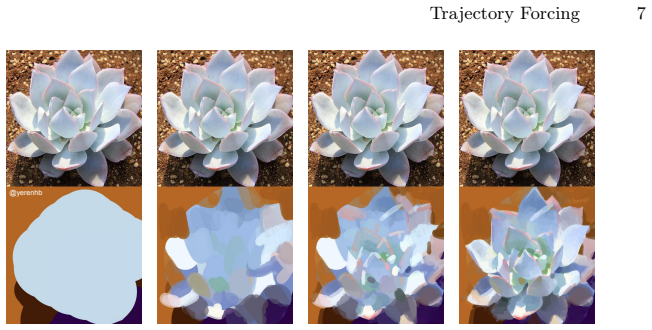
Trajectory Forcing turns image generation into a sequence of editable semantic stages from global layout to details.
A machine-rendered reading of the paper's core claim, the machinery that carries it, and where it could break.
Core claim
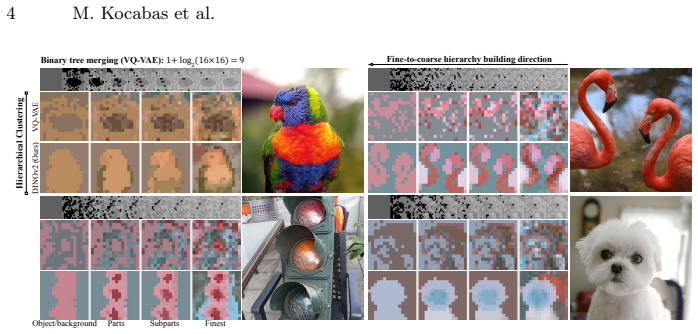
Trajectory Forcing organizes synthesis as a sequence of semantically structured stages, progressing from global layout to object-, part-, and detail-level representations. Each stage produces a decodable latent state that can be inspected, evaluated, and locally edited before the next stage begins. The framework derives coarse-to-fine teacher hierarchies by clustering pretrained visual representations such as DINOv2 and trains a hierarchy-conditioned one-step flow-matching model at each level, while introducing trajectory-aware metrics that go beyond endpoint measures like FID.
What carries the argument
Trajectory Forcing, a trajectory-centric framework that derives semantic hierarchies via clustering of pretrained representations and conditions one-step flow-matching models on those levels to produce editable intermediate states.
If this is right
- Generation produces inspectable and editable states at each semantic stage rather than only a final image.
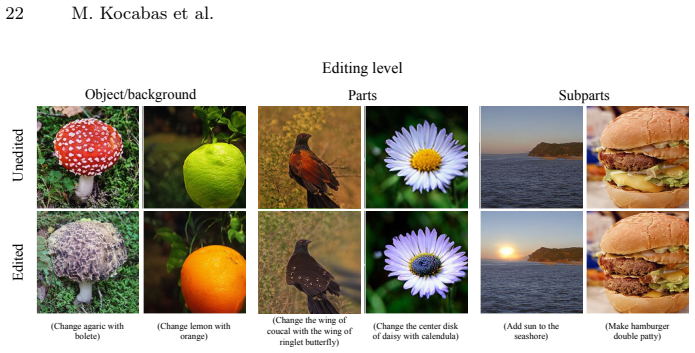
- Localized edits can be performed at global, object, part, or detail levels without restarting the full process.
- Trajectory-aware metrics quantify structural consistency and controllability in addition to standard image quality scores.
- The generative path itself becomes the primary object of interaction instead of remaining internal computation.
Where Pith is reading between the lines
- The same staged approach might transfer to video or 3D generation if comparable semantic hierarchies can be defined from pretrained models.
- Early-stage edits could enable efficient global recomposition that endpoint-only methods handle poorly.
- Success would imply that pretrained visual features already encode the natural decomposition of generative dynamics.
Load-bearing premise
Clustering pretrained visual representations such as DINOv2 produces teacher hierarchies whose semantic levels line up with the generative steps of the flow-matching model and permit meaningful local edits.
What would settle it
If an edit applied to an intermediate latent state at one semantic level fails to produce a corresponding localized change in the final output while preserving other levels, the claim that the states support controllable trajectory editing would not hold.
Figures





read the original abstract
Diffusion and flow-based generative models produce strong images, yet their controllability remains largely endpoint-centric: users specify conditions and receive final outputs, while the intermediate generative dynamics remain hidden. Recent methods have begun to exploit generation order and process decomposition to improve sample quality, but still treat intermediate states as internal computation rather than objects for interaction. We propose Trajectory Forcing (TF), a trajectory-centric framework that makes the generation path explicit, semantic, and editable. TF organizes synthesis as a sequence of semantically structured stages, progressing from global layout to object-, part-, and detail-level representations. Each stage produces a decodable latent state that can be inspected, evaluated, and locally edited before the next stage begins. To instantiate this path, we derive coarse-to-fine teacher hierarchies by clustering pretrained visual representations such as DINOv2, and train a hierarchy-conditioned one-step flow-matching model at each level. We further introduce trajectory-aware metrics that measure structural consistency and local controllability beyond endpoint quality metrics such as FID. Experiments show that TF achieves competitive sample quality while exposing coherent intermediate states and supporting localized edits across semantic levels. By shifting the focus from final images to the generative path itself, TF opens a route toward controllable, trajectory-aware image synthesis.
Editorial analysis
A structured set of objections, weighed in public.
Referee Report
Summary. The paper proposes Trajectory Forcing (TF), a trajectory-centric framework for diffusion/flow-based generative models that organizes image synthesis into a sequence of semantically structured stages (global layout to object-, part-, and detail-level) derived from coarse-to-fine teacher hierarchies obtained by clustering pretrained DINOv2 features. At each level a separate one-step flow-matching model is trained conditioned on the hierarchy, producing decodable latent states that can be inspected and locally edited. The work introduces trajectory-aware metrics for structural consistency and local controllability, and claims competitive sample quality (FID) together with support for localized edits across semantic levels.
Significance. If the claimed alignment between static DINOv2 clusters and the progressive dynamics of the flow-matching ODE holds, TF would provide a concrete route to inspectable, editable intermediate states that current endpoint-centric models lack. The introduction of trajectory-aware metrics beyond FID is a positive step toward evaluating controllability. However, the absence of any quantitative results, ablations, or alignment validation in the manuscript leaves the practical significance unestablished.
major comments (3)
- [Abstract, §3] Abstract and §3 (method): the central claim that clustered DINOv2 hierarchies induce semantic stages whose latent states are 'consistent with the progressive structure of the flow-matching ODE' and support 'localized edits' is load-bearing, yet no quantitative validation, alignment metric, or comparison of cluster-induced partitions against the actual ODE trajectory is reported. Without this, the controllability benefit does not follow from the construction.
- [§4] §4 (experiments): the statements 'achieves competitive sample quality' and 'supporting localized edits across semantic levels' are presented without FID scores, error bars, baseline comparisons, ablation tables, or any numerical results on the trajectory-aware metrics. This absence prevents assessment of whether the hierarchy-conditioned one-step models actually deliver the claimed performance.
- [§3.2] §3.2 (hierarchy construction): the procedure for deriving coarse-to-fine teacher hierarchies via DINOv2 clustering is described at a high level but supplies no details on the number of levels, clustering algorithm, feature aggregation across scales, or how the resulting partitions are mapped to conditioning signals for the flow-matching models.
minor comments (2)
- [§3] Notation for the hierarchy levels and the one-step flow-matching objective is introduced without an explicit equation or diagram showing the conditioning mechanism at each stage.
- [Abstract, §4] The abstract refers to 'trajectory-aware metrics' but the manuscript does not define their formulas or show how they differ from standard perceptual or structural metrics.
Simulated Author's Rebuttal
We thank the referee for the constructive feedback highlighting the need for quantitative validation, experimental results, and methodological details. We address each major comment below and will revise the manuscript to strengthen these aspects.
read point-by-point responses
-
Referee: [Abstract, §3] Abstract and §3 (method): the central claim that clustered DINOv2 hierarchies induce semantic stages whose latent states are 'consistent with the progressive structure of the flow-matching ODE' and support 'localized edits' is load-bearing, yet no quantitative validation, alignment metric, or comparison of cluster-induced partitions against the actual ODE trajectory is reported. Without this, the controllability benefit does not follow from the construction.
Authors: We agree that a quantitative alignment metric between the DINOv2-derived hierarchies and the flow-matching ODE trajectories is necessary to substantiate the central claim. The current version relies on the construction and qualitative inspection of latent states; we will add an explicit alignment score (e.g., measuring boundary correspondence along sampled ODE paths) and a comparison against random or non-hierarchical partitions in the revised §3 and experiments. revision: yes
-
Referee: [§4] §4 (experiments): the statements 'achieves competitive sample quality' and 'supporting localized edits across semantic levels' are presented without FID scores, error bars, baseline comparisons, ablation tables, or any numerical results on the trajectory-aware metrics. This absence prevents assessment of whether the hierarchy-conditioned one-step models actually deliver the claimed performance.
Authors: We acknowledge that the submitted manuscript lacks explicit numerical tables for FID, error bars, baselines, and the trajectory-aware metrics. We will add a dedicated results table in the revised §4 reporting these quantities with standard deviations across runs, direct baseline comparisons, and quantitative scores for structural consistency and local controllability. revision: yes
-
Referee: [§3.2] §3.2 (hierarchy construction): the procedure for deriving coarse-to-fine teacher hierarchies via DINOv2 clustering is described at a high level but supplies no details on the number of levels, clustering algorithm, feature aggregation across scales, or how the resulting partitions are mapped to conditioning signals for the flow-matching models.
Authors: We will expand §3.2 with the missing implementation details, including the number of hierarchy levels, the clustering algorithm employed, the method for multi-scale feature aggregation, and the precise mapping from cluster partitions to conditioning inputs for the one-step flow-matching models. revision: yes
Circularity Check
No significant circularity detected in derivation chain
full rationale
The abstract and provided context describe deriving coarse-to-fine hierarchies via clustering of external pretrained DINOv2 features, followed by training separate hierarchy-conditioned one-step flow-matching models and introducing new trajectory-aware metrics beyond FID. No equations, fitted parameters renamed as predictions, self-citations as load-bearing premises, or definitional equivalences are present. The construction relies on an empirical assumption about cluster alignment with generative dynamics rather than reducing any claimed result to its inputs by construction. The derivation chain remains self-contained against external benchmarks like pretrained representations and standard metrics.
Axiom & Free-Parameter Ledger
Reference graph
Works this paper leans on
-
[1]
In: Proc
Atanov, A., Allardice, J., Bachmann, R., Kar, O.F., Fu, P., Griffiths, D., Hjelm, D., Dehghan, A., Zamir, A.: VideoFlexTok: Flexible-length coarse-to-fine video tokenization. In: Proc. of the International Conf. on Machine learning (ICML) (2026)
2026
-
[2]
arXiv preprint arXiv:2602.11401 (2026)
Baade, A., Chan, E.R., Sargent, K., Chen, C., Johnson, J., Adeli, E., Fei-Fei, L.: Latentforcing:Reorderingthediffusiontrajectoryforpixel-spaceimagegeneration. arXiv preprint arXiv:2602.11401 (2026)
arXiv 2026
-
[3]
arXiv preprint arXiv:2511.16719 (2025)
Carion, N., Gustafson, L., Hu, Y.T., Debnath, S., Hu, R., Suris, D., Ryali, C., Alwala,K.V.,Khedr,H.,Huang,A.,etal.:Sam3:Segmentanythingwithconcepts. arXiv preprint arXiv:2511.16719 (2025)
Pith/arXiv arXiv 2025
-
[4]
arXiv preprint arXiv:2603.06507 (2026)
Chefer, H., Esser, P., Lorenz, D., Podell, D., Raja, V., Tong, V., Torralba, A., Rombach, R.: Self-supervised flow matching for scalable multi-modal synthesis. arXiv preprint arXiv:2603.06507 (2026)
arXiv 2026
-
[5]
In: Advances in Neural Information Processing Systems (NeurIPS) (2025)
Chen, B., Monsó, D.M., Du, Y., Simchowitz, M., Tedrake, R., Sitzmann, V.: Diffu- sion forcing: Next-token prediction meets full-sequence diffusion. In: Advances in Neural Information Processing Systems (NeurIPS) (2025)
2025
-
[6]
arXiv preprint arXiv:2504.07963 (2025)
Chen, S., Ge, C., Zhang, S., Sun, P., Luo, P.: Pixelflow: Pixel-space generative models with flow. arXiv preprint arXiv:2504.07963 (2025)
arXiv 2025
-
[7]
In: Proc
Chong, M.J., Forsyth, D.: Effectively unbiased fid and inception score and where to find them. In: Proc. IEEE Conf. on Computer Vision and Pattern Recognition (CVPR) (2020)
2020
-
[8]
In: Proc
Deng, Jia, Dong, Wei, Socher, Richard, Li, Li-Jia, Li, Kai, Fei-Fei, Li: Imagenet: A large-scale hierarchical image database. In: Proc. IEEE Conf. on Computer Vision and Pattern Recognition (CVPR) (2009)
2009
-
[9]
arXiv preprint arXiv:2602.04770 (2026)
Deng, M., Li, H., Li, T., Du, Y., He, K.: Generative modeling via drifting. arXiv preprint arXiv:2602.04770 (2026)
Pith/arXiv arXiv 2026
-
[10]
In: Proc
Esser, P., Rombach, R., Ommer, B.: Taming transformers for high-resolution image synthesis. In: Proc. IEEE Conf. on Computer Vision and Pattern Recognition (CVPR) (2021)
2021
-
[11]
In: Proc
Frans,K.,Hafner,D.,Levine,S.,Abbeel,P.:Onestepdiffusionviashortcutmodels. In: Proc. of the International Conf. on Learning Representations (ICLR) (2025)
2025
-
[12]
arXiv preprint arXiv:2110.01571 (2021)
Gao, G., Huang, H., Fu, C., He, R.: Causal representation learning for context- aware face transfer. arXiv preprint arXiv:2110.01571 (2021)
arXiv 2021
-
[13]
In: Proc
Gao, G., Liu, W., Chen, A., Geiger, A., Schölkopf, B.: Graphdreamer: Composi- tional 3d scene synthesis from scene graphs. In: Proc. IEEE Conf. on Computer Vision and Pattern Recognition (CVPR) (2024) 16 M. Kocabas et al
2024
-
[14]
arXiv preprint arXiv:2606.12316 (2026)
Gao, G., Schölkopf, B., Geiger, A.: Slots, transitions, loops: Learning composable world models for arc. arXiv preprint arXiv:2606.12316 (2026)
Pith/arXiv arXiv 2026
-
[15]
In: Advances in Neural Information Processing Systems (NeurIPS) (2025)
Geng, Z., Deng, M., Bai, X., Kolter, J.Z., He, K.: Mean flows for one-step genera- tive modeling. In: Advances in Neural Information Processing Systems (NeurIPS) (2025)
2025
-
[16]
arXiv preprint arXiv:2512.02012 (2025)
Geng, Z., Lu, Y., Wu, Z., Shechtman, E., Kolter, J.Z., He, K.: Improved mean flows: On the challenges of fastforward generative models. arXiv preprint arXiv:2512.02012 (2025)
Pith/arXiv arXiv 2025
-
[17]
In: Proc
Gupta, S., Jalal, A., Parulekar, A., Price, E., Xun, Z.: Diffusion posterior sampling is computationally intractable. In: Proc. of the International Conf. on Machine learning (ICML) (2024)
2024
-
[18]
In: Advances in Neural Information Processing Systems (NeurIPS) (2017)
Heusel,M.,Ramsauer,H.,Unterthiner,T.,Nessler,B.,Hochreiter,S.:Ganstrained by a two time-scale update rule converge to a local nash equilibrium. In: Advances in Neural Information Processing Systems (NeurIPS) (2017)
2017
-
[19]
arXiv preprint arXiv:2511.13019 (2025)
Hu, Z., Lai, C.H., Wu, G., Mitsufuji, Y., Ermon, S.: Meanflow transformers with representation autoencoders. arXiv preprint arXiv:2511.13019 (2025)
arXiv 2025
-
[20]
In: Proc
Jayasumana, S., Ramalingam, S., Veit, A., Glasner, D., Chakrabarti, A., Kumar, S.: Rethinking fid: Towards a better evaluation metric for image generation. In: Proc. IEEE Conf. on Computer Vision and Pattern Recognition (CVPR) (2024)
2024
-
[21]
Jordan,Keller,Jin,Yuchen,Boza,Vlado,Jiacheng,You,Cecista,Franz,Newhouse, Laker, Bernstein, Jeremy: Muon: An optimizer for hidden layers in neural networks (2024),https://kellerjordan.github.io/posts/muon
2024
-
[22]
In: Proc
Karras, T., Aittala, M., Lehtinen, J., Hellsten, J., Aila, T., Laine, S.: Analyzing and improving the training dynamics of diffusion models. In: Proc. IEEE Conf. on Computer Vision and Pattern Recognition (CVPR) (2024)
2024
-
[23]
In: Proc
Kim, D., Lai, C.H., Liao, W.H., Murata, N., Takida, Y., Uesaka, T., He, Y., Mitsu- fuji, Y., Ermon, S.: Consistency trajectory models: Learning probability flow ODE trajectory of diffusion. In: Proc. of the International Conf. on Learning Represen- tations (ICLR) (2024)
2024
-
[24]
In: Proc
Kynk"a"anniemi, T., Karras, T., Aittala, M., Aila, T., Lehtinen, J.: The role of imagenet classes in fréchet inception distance. In: Proc. of the International Conf. on Learning Representations (ICLR) (2023)
2023
-
[25]
In: Proc
Lei, J., Liu, K., Berner, J., HoiM, Y., Zheng, H., Wu, J., Chu, X.: There is no vae: Advancing end-to-end pixel-space generative modeling via self-supervised pre- training. In: Proc. of the International Conf. on Learning Representations (ICLR) (2026)
2026
-
[26]
arXiv preprint arXiv:2511.13720 (2026)
Li, T., He, K.: Back to basics: Let denoising generative models denoise. arXiv preprint arXiv:2511.13720 (2026)
Pith/arXiv arXiv 2026
-
[27]
In: Advances in Neural Information Processing Systems (NeurIPS) (2024)
Li, T., Tian, Y., Li, H., Deng, M., He, K.: Autoregressive image generation with- out vector quantization. In: Advances in Neural Information Processing Systems (NeurIPS) (2024)
2024
-
[28]
In: Proc
Li, Y., Bornschein, J., Chen, T.: Denoising autoregressive representation learning. In: Proc. of the International Conf. on Machine learning (ICML) (2024)
2024
-
[29]
arXiv preprint arXiv:2209.03003 (2022)
Liu, X., Gong, C., Liu, Q.: Flow straight and fast: Learning to generate and transfer data with rectified flow. arXiv preprint arXiv:2209.03003 (2022)
Pith/arXiv arXiv 2022
-
[30]
In: Proc
Lu, C., Song, Y.: Simplifying, stabilizing and scaling continuous-time consistency models. In: Proc. of the International Conf. on Learning Representations (ICLR) (2025)
2025
-
[31]
arXiv preprint arXiv:2601.22158 (2026) Trajectory Forcing 17
Lu, Y., Lu, S., Sun, Q., Zhao, H., Jiang, Z., Wang, X., Li, T., Geng, Z., He, K.: One-step latent-free image generation with pixel mean flows. arXiv preprint arXiv:2601.22158 (2026) Trajectory Forcing 17
Pith/arXiv arXiv 2026
-
[32]
In: European Conference on Computer Vision
Ma, N., Goldstein, M., Albergo, M.S., Boffi, N.M., Vanden-Eijnden, E., Xie, S.: Sit: Exploring flow and diffusion-based generative models with scalable interpolant transformers. In: European Conference on Computer Vision. pp. 23–40. Springer (2024)
2024
-
[33]
arXiv preprint arXiv:2511.19365 (2025)
Ma, Z., Wei, L., Wang, S., Zhang, S., Tian, Q.: Deco: Frequency-decoupled pixel diffusion for end-to-end image generation. arXiv preprint arXiv:2511.19365 (2025)
Pith/arXiv arXiv 2025
-
[34]
In: Proc
Meng, C., Rombach, R., Gao, R., Kingma, D.P., Ermon, S., Ho, J., Salimans, T.: On distillation of guided diffusion models. In: Proc. IEEE Conf. on Computer Vision and Pattern Recognition (CVPR) (2023)
2023
-
[35]
arXiv preprint arXiv:2304.07193 (2023)
Oquab, M., Darcet, T., Moutakanni, T., Vo, H.V., Szafraniec, M., Khalidov, V., Fernandez, P., Haziza, D., Massa, F., El-Nouby, A., et al.: Dinov2: Learning robust visual features without supervision. arXiv preprint arXiv:2304.07193 (2023)
Pith/arXiv arXiv 2023
-
[36]
In: Proc
Parmar, G., Zhang, R., Zhu, J.Y.: On aliased resizing and surprising subtleties in gan evaluation. In: Proc. IEEE Conf. on Computer Vision and Pattern Recognition (CVPR) (2022)
2022
-
[37]
In: Proc
Peebles, W., Xie, S.: Scalable diffusion models with transformers. In: Proc. of the IEEE International Conf. on Computer Vision (ICCV) (2023)
2023
-
[38]
arXiv preprint arXiv:2412.15205 (2024)
Ren, S., Yu, Q., He, J., Shen, X., Yuille, A., Chen, L.C.: Flowar: Scale-wise autore- gressive image generation meets flow matching. arXiv preprint arXiv:2412.15205 (2024)
arXiv 2024
-
[39]
In: Proc
Rombach, R., Blattmann, A., Lorenz, D., Esser, P., Ommer, B.: High-resolution image synthesis with latent diffusion models. In: Proc. IEEE Conf. on Computer Vision and Pattern Recognition (CVPR) (2022)
2022
-
[40]
In: Advances in Neural Information Processing Systems (NeurIPS) (2016)
Salimans, T., Goodfellow, I., Zaremba, W., Cheung, V., Radford, A., Chen, X.: Im- proved techniques for training gans. In: Advances in Neural Information Processing Systems (NeurIPS) (2016)
2016
-
[41]
In: Proc
Salimans, T., Ho, J.: Progressive distillation for fast sampling of diffusion models. In: Proc. of the International Conf. on Learning Representations (ICLR) (2022)
2022
-
[42]
In: Proc
Song, Y., Dhariwal, P.: Improved techniques for training consistency models. In: Proc. of the International Conf. on Learning Representations (ICLR) (2024)
2024
-
[43]
In: Proc
Song, Y., Dhariwal, P., Chen, M., Sutskever, I.: Consistency models. In: Proc. of the International Conf. on Machine learning (ICML) (2023)
2023
-
[44]
In: Proc
Szegedy, C., Vanhoucke, V., Ioffe, S., Shlens, J., Wojna, Z.: Rethinking the incep- tion architecture for computer vision. In: Proc. IEEE Conf. on Computer Vision and Pattern Recognition (CVPR) (2016)
2016
-
[45]
In: Advances in Neural Information Processing Systems (NeurIPS) (2024)
Tian, K., Jiang, Y., Yuan, Z., PENG, B., Wang, L.: Visual autoregressive mod- eling: Scalable image generation via next-scale prediction. In: Advances in Neural Information Processing Systems (NeurIPS) (2024)
2024
-
[46]
arXiv preprint arXiv:2507.14137 (2025)
Venkataramanan, S., Pariza, V., Salehi, M., Knobel, L., Gidaris, S., Ramzi, E., Bursuc, A., Asano, Y.M.: Franca: Nested matryoshka clustering for scalable visual representation learning. arXiv preprint arXiv:2507.14137 (2025)
Pith/arXiv arXiv 2025
-
[47]
In: Proc
Wang, S., Gao, Z., Zhu, C., Huang, W., Wang, L.: Pixnerd: Pixel neural field diffusion. In: Proc. of the International Conf. on Learning Representations (ICLR) (2026)
2026
-
[48]
In: Proc
Wang, Y., Wang, Z., Wu, Z., Tao, Q., Liao, K., Loy, C.C.: Next visual granular- ity generation. In: Proc. of the International Conf. on Learning Representations (ICLR) (2026)
2026
-
[49]
arXiv preprint arXiv:2509.04394 (2025) 18 M
Wang,Z.,Zhang,Y.,Yue,X.,Yue,X.,Li,Y.,Ouyang,W.,Bai,L.:Transitionmod- els: Rethinking the generative learning objective. arXiv preprint arXiv:2509.04394 (2025) 18 M. Kocabas et al
arXiv 2025
-
[50]
In: Proc
Wei, C., Mangalam, K., Huang, P.Y., Li, Y., Fan, H., Xu, H., Wang, H., Xie, C., Yuille, A., Feichtenhofer, C.: Diffusion models as masked autoencoders. In: Proc. of the IEEE International Conf. on Computer Vision (ICCV) (2023)
2023
-
[51]
arXiv preprint arXiv:2604.28190 (2026)
Yang, J., Geng, Z., Ju, X., Tian, Y., Wang, Y.: Representation fréchet loss for visual generation. arXiv preprint arXiv:2604.28190 (2026)
Pith/arXiv arXiv 2026
-
[52]
In: Proc
Yu, S., Kwak, S., Jang, H., Jeong, J., Huang, J., Shin, J., Xie, S.: Representation alignment for generation: Training diffusion transformers is easier than you think. In: Proc. of the International Conf. on Learning Representations (ICLR) (2025)
2025
-
[53]
arXiv preprint arXiv:2510.20771 (2025)
Zhang, H., Siarohin, A., Menapace, W., Vasilkovsky, M., Tulyakov, S., Qu, Q., Skorokhodov, I.: Alphaflow: Understanding and improving meanflow models. arXiv preprint arXiv:2510.20771 (2025)
arXiv 2025
-
[54]
In: Proc
Zheng, B., Ma, N., Tong, S., Xie, S.: Diffusion transformers with representation autoencoders. In: Proc. of the International Conf. on Learning Representations (ICLR) (2026)
2026
-
[55]
In: Proc
Zhou, L., Ermon, S., Song, J.: Inductive moment matching. In: Proc. of the Inter- national Conf. on Machine learning (ICML) (2025) Trajectory Forcing 19 Appendix Table of Contents A Experimental Settings....................................... 20 A.1 Additional Implementation Details .......................... 20 A.2 Hyperparameter Settings ..................
2025
discussion (0)
Sign in with ORCID, Apple, or X to comment. Anyone can read and Pith papers without signing in.