Data Evolution by Wittgenstein's Rule Following
Pith reviewed 2026-06-26 09:24 UTC · model grok-4.3
The pith
Datasets evolve by extrapolating trajectories of structural descriptors to follow an implicit rule.
A machine-rendered reading of the paper's core claim, the machinery that carries it, and where it could break.
Core claim
WRF represents each dataset by structural descriptors rather than pointwise correspondences. The method predicts a rule-following target by extrapolating descriptor trajectories and a family-resemblance target by averaging historical descriptors. Candidate datasets are then generated from the observed history through balanced or bounded mixture recombination, scored according to these targets, and optionally refined through differentiable optimization in descriptor space. The framework allows both sample size and feature dimension to vary over time and does not assume that the next dataset is a direct transformation of the last one.
What carries the argument
Wittgenstein's Rule Following data evolution, which extrapolates trajectories of structural descriptors to form a rule-following target and averages them to form a family-resemblance target for scoring generated candidates.
If this is right
- The next dataset can be produced without assuming it is obtained by a direct transformation of the previous one.
- Both unsupervised and supervised settings can yield meaningful continuations of an evolving sequence.
- Sample size and feature dimension are permitted to change across the datasets in the sequence.
- Simulations on synthetic data and image collections confirm that the generated datasets continue the observed pattern.
Where Pith is reading between the lines
- The same descriptor-extrapolation approach could be tested on real time-series data where distributions shift gradually, such as sensor readings or user behavior logs.
- It might supply synthetic examples for studying how models adapt when training data follows an ongoing rule rather than a stationary distribution.
- The method opens a route to generative handling of non-stationary problems by treating the sequence itself as the object to be continued.
Load-bearing premise
Structural descriptors can adequately capture the implicit rule expressed by a historical sequence of datasets so that extrapolation produces meaningful new data.
What would settle it
Apply the method to a sequence of synthetic datasets whose rule is known in advance, such as successive Gaussians whose means increase by a fixed step, and check whether the generated next dataset has a mean within a small tolerance of the expected value.
Figures

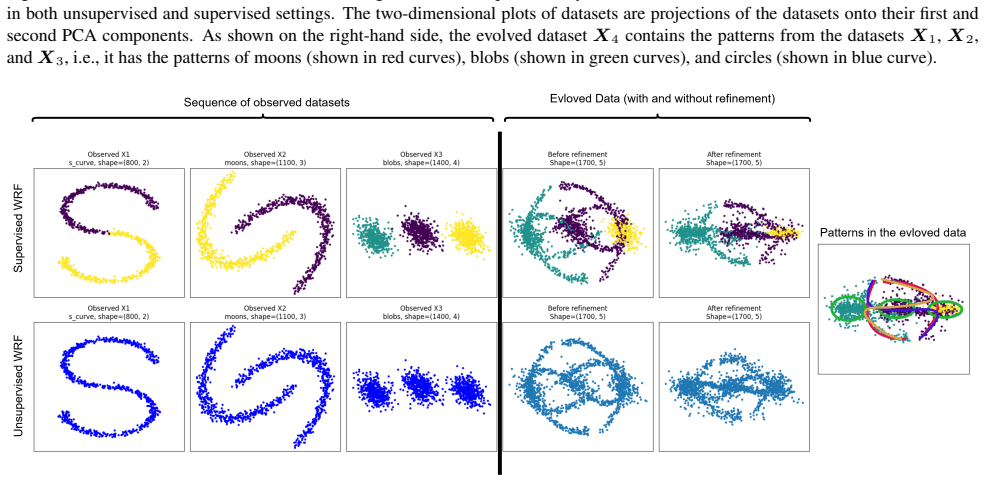


read the original abstract
This paper introduces Wittgenstein's Rule Following (WRF) data evolution, a framework in philomatics for evolving or generating a new dataset from a sequence of previously observed datasets. The method is inspired by Ludwig Wittgenstein's rule-following considerations and his notion of family resemblance in Philosophical Investigations. Unlike standard synthetic data generation, where the goal is usually to sample from or augment a fixed distribution, WRF aims to continue the implicit rule expressed by a historical sequence of datasets while preserving resemblance to the previous datasets. WRF represents each dataset by structural descriptors rather than pointwise correspondences. These descriptors summarize geometric, distributional, clustering, and, in the supervised case, label-based properties of the data. The method predicts a rule-following target by extrapolating descriptor trajectories and a family-resemblance target by averaging historical descriptors. Candidate datasets are then generated from the observed history through balanced or bounded mixture recombination, scored according to these targets, and optionally refined through differentiable optimization in descriptor space. The proposed framework allows both sample size and feature dimension to vary over time and does not assume that the next dataset is a direct transformation of the last one. Simulations on synthetic and image datasets show that WRF can generate meaningful continuations of evolving datasets in both unsupervised and supervised settings.
Editorial analysis
A structured set of objections, weighed in public.
Referee Report
Summary. The paper introduces Wittgenstein's Rule Following (WRF) data evolution, a framework for generating a new dataset from a historical sequence by representing each dataset via structural descriptors (geometric, distributional, clustering, and label-based), extrapolating descriptor trajectories to predict a rule-following target, averaging for a family-resemblance target, generating candidates via mixture recombination, scoring them, and optionally refining via optimization. It claims this continues an implicit rule while preserving resemblance, allows varying sample size and dimension, and is validated via simulations on synthetic and image datasets in unsupervised and supervised settings.
Significance. If the central claim holds, the framework would provide a novel, non-distributional approach to synthetic data generation that explicitly incorporates sequence history and philosophical notions of rule-following, with potential applications in dynamic or evolving data scenarios in machine learning. The allowance for changing dimensionality and the use of both extrapolation and averaging are distinctive strengths, though the absence of quantitative metrics, error analysis, or comparisons in the abstract limits evaluation of practical significance.
major comments (3)
- [Abstract] Abstract: The central claim that WRF produces 'meaningful continuations' of evolving datasets rests on the assumption that the author-selected structural descriptors adequately encode the implicit rule expressed by the sequence. No independent ground-truth rule (separate from the descriptor set) is described against which success can be measured, raising the risk that reported success is by construction on the chosen descriptors alone.
- [Abstract] Abstract: No equations, pseudocode, or formal definitions are provided for descriptor computation, trajectory extrapolation, family-resemblance averaging, candidate scoring, or the optimization step. This prevents assessment of whether the method is well-defined or reproducible, directly undermining evaluation of the simulation results.
- [Abstract] Abstract (simulations paragraph): The claim that simulations 'show that WRF can generate meaningful continuations' is stated without any reported metrics, baselines, error bars, dataset sizes, or quantitative comparisons. This absence makes it impossible to judge whether the results support the claim or merely illustrate the procedure.
minor comments (1)
- [Abstract] The abstract refers to 'philomatics' without definition or reference; a brief clarification or citation would improve accessibility.
Simulated Author's Rebuttal
We thank the referee for their constructive comments on the abstract and evaluation of our proposed WRF framework. We address each major comment below and outline revisions to improve the manuscript's clarity, formality, and empirical support.
read point-by-point responses
-
Referee: [Abstract] Abstract: The central claim that WRF produces 'meaningful continuations' of evolving datasets rests on the assumption that the author-selected structural descriptors adequately encode the implicit rule expressed by the sequence. No independent ground-truth rule (separate from the descriptor set) is described against which success can be measured, raising the risk that reported success is by construction on the chosen descriptors alone.
Authors: We acknowledge the validity of this observation: the framework defines continuation relative to the chosen structural descriptors (geometric, distributional, clustering, and label-based), which serve as the operationalization of the implicit rule and family resemblance. This is intentional, as the approach avoids assuming an external fixed distribution or ground-truth rule independent of the sequence history. The simulations illustrate continuation through preservation of properties across varying dimensions and sample sizes. We will revise to add an explicit discussion of descriptor selection rationale, the Wittgensteinian motivation for this choice, and limitations regarding potential circularity. revision: partial
-
Referee: [Abstract] Abstract: No equations, pseudocode, or formal definitions are provided for descriptor computation, trajectory extrapolation, family-resemblance averaging, candidate scoring, or the optimization step. This prevents assessment of whether the method is well-defined or reproducible, directly undermining evaluation of the simulation results.
Authors: The body of the manuscript contains algorithmic descriptions of each step, but we agree that the absence of formal notation or pseudocode in the abstract (and potentially summarized in the main text) hinders quick assessment of reproducibility. We will add a concise formal overview, including key equations for descriptor trajectories and scoring, along with pseudocode for the core pipeline, either in the abstract or as a new methods overview subsection. revision: yes
-
Referee: [Abstract] Abstract (simulations paragraph): The claim that simulations 'show that WRF can generate meaningful continuations' is stated without any reported metrics, baselines, error bars, dataset sizes, or quantitative comparisons. This absence makes it impossible to judge whether the results support the claim or merely illustrate the procedure.
Authors: The current simulations are primarily demonstrative, showing application to synthetic and image data in unsupervised and supervised settings with varying dimensions. We agree that stronger quantitative support is needed. In revision we will report specific metrics (e.g., distances to extrapolated and averaged targets), baseline comparisons (such as naive last-dataset replication), dataset sizes, and basic error analysis or variability measures to better substantiate the claims. revision: yes
Circularity Check
No circularity; framework is self-contained by construction as a proposed method
full rationale
The paper defines WRF explicitly as a procedure that selects structural descriptors, extrapolates their trajectories to form targets, generates candidates via recombination, and scores them against those same extrapolated targets. This is presented as the method itself rather than a derivation claiming to discover or predict an independent rule from first principles. No equations, self-citations, fitted parameters renamed as predictions, or uniqueness theorems appear in the provided text. The simulations validate the procedure on its own terms; the central claim does not reduce to an input by definition or external self-reference. This matches the most common honest finding of a self-contained proposal.
Axiom & Free-Parameter Ledger
axioms (2)
- domain assumption Structural descriptors can summarize geometric, distributional, clustering, and label-based properties of datasets to capture an implicit rule.
- ad hoc to paper Extrapolating descriptor trajectories and averaging historical descriptors produces a valid target for the next dataset.
invented entities (1)
-
Wittgenstein's Rule Following (WRF) data evolution framework
no independent evidence
Reference graph
Works this paper leans on
-
[1]
Elements of dimensionality reduction and manifold learning , pages=
Principal component analysis , author=. Elements of dimensionality reduction and manifold learning , pages=. 2023 , publisher=
2023
-
[2]
Adam: A Method for Stochastic Optimization
Adam: A method for stochastic optimization , author=. arXiv preprint arXiv:1412.6980 , year=
work page internal anchor Pith review Pith/arXiv arXiv
-
[3]
Elements of Deep Learning , pages=
Backpropagation and Optimization in Deep Neural Networks , author=. Elements of Deep Learning , pages=. 2026 , publisher=
2026
-
[4]
1953 , publisher=
Philosophical Investigations , author=. 1953 , publisher=
1953
-
[5]
1990 , publisher=
Ludwig Wittgenstein: The Duty of Genius , author=. 1990 , publisher=
1990
-
[6]
1921 , publisher=
Tractatus Logico-Philosophicus , author=. 1921 , publisher=
1921
-
[7]
1677 , note=
Ethics , author=. 1677 , note=
-
[8]
The Stanford Encyclopedia of Philosophy , editor =
Biletzki, Anat and Matar, Anat , title =. The Stanford Encyclopedia of Philosophy , editor =. 2023 , edition =
2023
-
[9]
arXiv preprint arXiv:2308.13738 , year=
On Philomatics and Psychomatics for Combining Philosophy and Psychology with Mathematics , author=. arXiv preprint arXiv:2308.13738 , year=
-
[10]
Advances in neural information processing systems , volume=
Generative adversarial nets , author=. Advances in neural information processing systems , volume=
-
[11]
Auto-Encoding Variational Bayes
Auto-encoding variational bayes , author=. arXiv preprint arXiv:1312.6114 , year=
work page internal anchor Pith review Pith/arXiv arXiv
-
[12]
arXiv preprint arXiv:2310.00277 , year=
A unified framework for generative data augmentation: A comprehensive survey , author=. arXiv preprint arXiv:2310.00277 , year=
-
[13]
Plos one , volume=
An empirical survey of data augmentation for time series classification with neural networks , author=. Plos one , volume=. 2021 , publisher=
2021
-
[14]
ACM computing surveys (CSUR) , volume=
A survey on concept drift adaptation , author=. ACM computing surveys (CSUR) , volume=. 2014 , publisher=
2014
-
[15]
IEEE transactions on knowledge and data engineering , volume=
Learning under concept drift: A review , author=. IEEE transactions on knowledge and data engineering , volume=. 2018 , publisher=
2018
-
[16]
1982 , publisher=
Wittgenstein on rules and private language: An elementary exposition , author=. 1982 , publisher=
1982
-
[17]
Synthese , volume=
Wittgenstein on following a rule , author=. Synthese , volume=. 1984 , publisher=
1984
-
[18]
1984 , publisher=
Scepticism, rules and language , author=. 1984 , publisher=
1984
-
[19]
2006 , publisher=
Pattern recognition and machine learning , author=. 2006 , publisher=
2006
-
[20]
2009 , publisher=
The Elements of Statistical Learning: Data Mining, Inference, and Prediction , author=. 2009 , publisher=
2009
-
[21]
2024 , publisher=
Multivariate analysis , author=. 2024 , publisher=
2024
-
[22]
Philosophical transactions
Principal component analysis: a review and recent developments , author=. Philosophical transactions. Series A, Mathematical, physical, and engineering sciences , volume=
-
[23]
Some methods of classification and analysis of multivariate observations , author=. Proc. of 5th Berkeley Symposium on Math. Stat. and Prob. , pages=
-
[24]
Least squares quantization in
Lloyd, Stuart , journal=. Least squares quantization in. 1982 , publisher=
1982
-
[25]
Journal of computational and applied mathematics , volume=
Silhouettes: a graphical aid to the interpretation and validation of cluster analysis , author=. Journal of computational and applied mathematics , volume=. 1987 , publisher=
1987
-
[26]
2012 , publisher=
Machine learning: a probabilistic perspective , author=. 2012 , publisher=
2012
-
[27]
Neural computation , volume=
Training with noise is equivalent to Tikhonov regularization , author=. Neural computation , volume=. 1995 , publisher=
1995
-
[28]
Journal of machine learning research , volume=
Automatic differentiation in machine learning: a survey , author=. Journal of machine learning research , volume=
-
[29]
Scikit-learn: Machine learning in
Pedregosa, Fabian and Varoquaux, Ga. Scikit-learn: Machine learning in. the Journal of machine Learning research , volume=. 2011 , publisher=
2011
-
[30]
Proceedings of the IEEE , volume=
Gradient-based learning applied to document recognition , author=. Proceedings of the IEEE , volume=. 1998 , publisher=
1998
-
[31]
arXiv preprint arXiv:2302.01570 , year=
Witgenstein's influence on artificial intelligence , author=. arXiv preprint arXiv:2302.01570 , year=
-
[32]
What Can Be Shown Cannot Be Said , pages=
Does Artificial Intelligence Use Private Language? , author=. What Can Be Shown Cannot Be Said , pages=
-
[33]
arXiv preprint arXiv:2601.01127 , year=
Wittgenstein's Family Resemblance Clustering Algorithm , author=. arXiv preprint arXiv:2601.01127 , year=
-
[34]
arXiv preprint arXiv:2208.13386 , year=
Affective Manifolds: Modeling Machine's Mind to Like, Dislike, Enjoy, Suffer, Worry, Fear, and Feel Like A Human , author=. arXiv preprint arXiv:2208.13386 , year=
discussion (0)
Sign in with ORCID, Apple, or X to comment. Anyone can read and Pith papers without signing in.