BipBipCache: Pipeline-Aware Integration of Low-Latency Tweakable Encryption in an Embedded Cache Controller
Pith reviewed 2026-06-26 07:30 UTC · model grok-4.3
The pith
A direct-mapped cache controller encrypts data and tags in real time with a tweakable block cipher while limiting the write penalty to three cycles through pipeline overlap.
A machine-rendered reading of the paper's core claim, the machinery that carries it, and where it could break.
Core claim
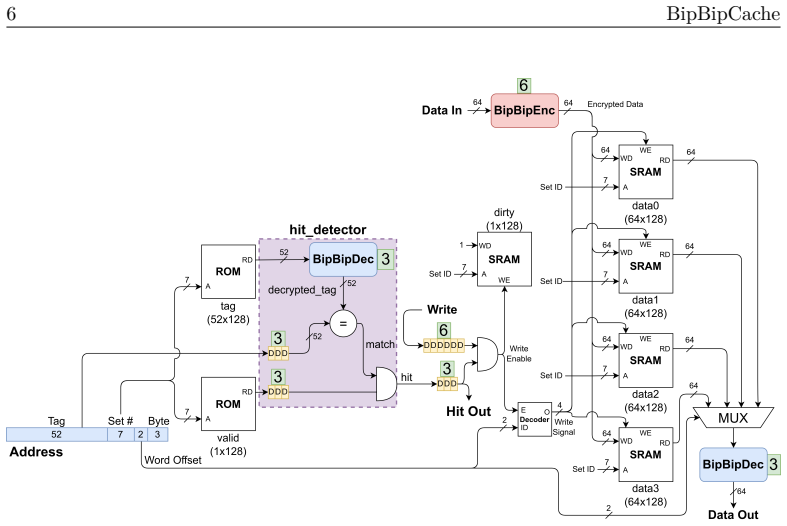
BipBipCache coordinates a reconstructed six-stage pipelined BipBip encryptor with a three-cycle decryptor inside the cache datapath so that the first three encryptor stages run in parallel with tag decryption and hit detection, producing an effective three-cycle write commitment after verification.
What carries the argument
The 3-cycle overlap between the first encryptor stages and tag decryption plus hit detection inside the direct-mapped controller datapath.
Load-bearing premise
The BipBip cipher description permits a correct, side-channel-free pipelined hardware encryptor to be built from the given decryptor-centric specification.
What would settle it
A hardware run in which the reconstructed encryptor produces outputs that fail to match the official BipBip C++ reference vectors, or in which a cold-boot or bus readout recovers plaintext from the encrypted SRAM array.
Figures

read the original abstract
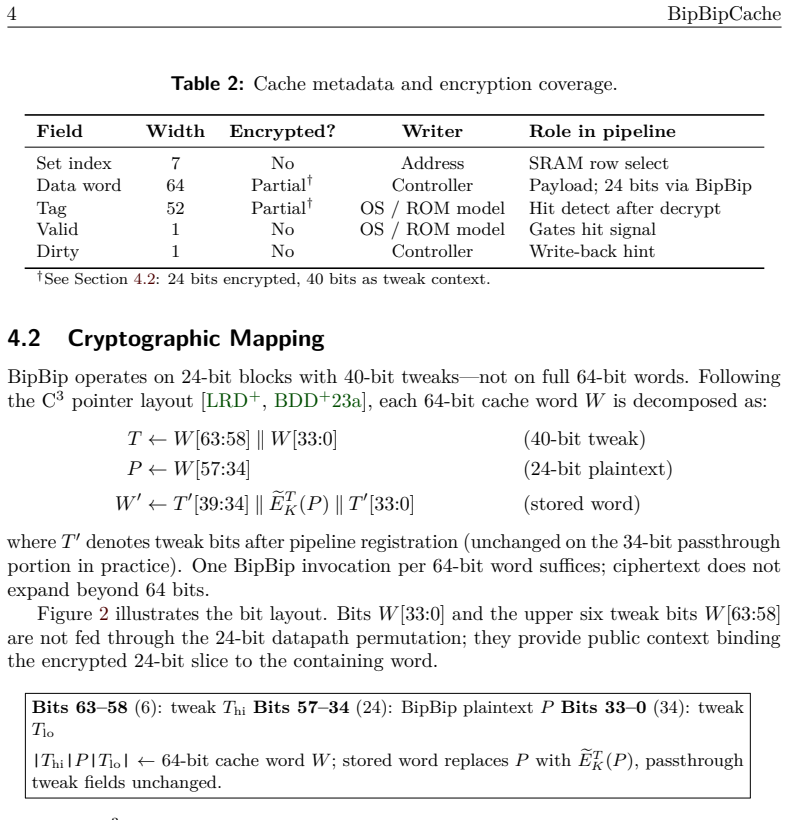
Consumer and embedded processors store sensitive data in on-chip SRAM caches that remain readable after power loss or physical probing unless ciphertext is maintained in the memory array itself. This paper presents BipBipCache, a direct-mapped cache controller that integrates the BipBip tweakable block cipher (TBC) to encrypt cache data and tags in real time using a C$^3$-style 24+40 bit decomposition of each 64-bit word. We reconstruct the first pipelined hardware BipBip encryptor from a decryptor-centric specification and coordinate it with a 3-cycle decryptor inside the cache datapath. Our threat model targets confidentiality of cache-resident contents against cold-boot, bus, and SRAM readout attacks. A key architectural result is that 6-cycle encryption latency does not fully translate into 6-cycle write penalty: the first three encryptor stages overlap with tag decryption and hit detection, leaving an effective 3-cycle write commitment after hit verification. We verify encryptor and decryptor correctness against the official BipBip C++ reference (five vectors each), report FPGA resource utilization on Xilinx Artix-7 (3,356 LUTs, 16.1% of device; crypto logic ~79% of LUTs), and confirm end-to-end operation on hardware.
Editorial analysis
A structured set of objections, weighed in public.
Referee Report
Summary. The paper presents BipBipCache, a direct-mapped cache controller integrating the BipBip tweakable block cipher (TBC) for real-time encryption of cache data and tags using a C³-style decomposition. It reconstructs the first pipelined hardware BipBip encryptor from a decryptor-centric specification, coordinates it with a 3-cycle decryptor, and claims that the first three encryptor stages overlap with tag decryption and hit detection, yielding an effective 3-cycle write commitment after hit verification rather than a full 6-cycle penalty. Correctness is verified against the official BipBip C++ reference with five vectors each, and FPGA utilization on Xilinx Artix-7 is reported (3,356 LUTs, 16.1% of device).
Significance. If the overlap claim holds, the work provides a concrete architectural technique for minimizing the performance impact of on-chip encryption in embedded systems while maintaining confidentiality against cold-boot, bus, and SRAM readout attacks. The reported hardware implementation and resource utilization offer practical evidence of feasibility for low-overhead integration of tweakable encryption in cache controllers.
major comments (1)
- [Abstract and Implementation Description] The central architectural claim—that the first three encryptor stages overlap with tag decryption and hit detection to achieve an effective 3-cycle write penalty—depends on the correctness of the reconstructed pipelined encryptor in the shared datapath. However, verification is limited to five test vectors against the C++ reference for both encryptor and decryptor, with no additional details on reconstruction method, timing analysis, or testing specific to the overlap region provided. This is load-bearing for the latency reduction result.
minor comments (2)
- The abstract mentions 'C³-style 24+40 bit decomposition' without defining C³ or providing a reference; a brief explanation or citation would improve clarity.
- FPGA results report total LUTs and percentage but do not break down the contribution of the crypto logic beyond the approximate 79%; a more detailed resource breakdown would aid reproducibility.
Simulated Author's Rebuttal
We thank the referee for the positive evaluation of BipBipCache's significance and for identifying the need for stronger evidence on the pipelined encryptor reconstruction and overlap claim. We address the major comment below and will revise the manuscript accordingly.
read point-by-point responses
-
Referee: [Abstract and Implementation Description] The central architectural claim—that the first three encryptor stages overlap with tag decryption and hit detection to achieve an effective 3-cycle write penalty—depends on the correctness of the reconstructed pipelined encryptor in the shared datapath. However, verification is limited to five test vectors against the C++ reference for both encryptor and decryptor, with no additional details on reconstruction method, timing analysis, or testing specific to the overlap region provided. This is load-bearing for the latency reduction result.
Authors: We agree that the current verification details are insufficient to fully substantiate the overlap claim. The encryptor was reconstructed by inverting the round structure and tweak schedule from the official BipBip decryptor-centric specification, producing a 6-stage pipeline whose first three stages share the datapath with the existing 3-cycle tag decryptor and hit logic. We will revise the manuscript to include: (1) an explicit stage-by-stage mapping table showing how the inverted encryptor rounds align with the decryptor pipeline, (2) a timing diagram of the shared datapath illustrating the three-cycle overlap, (3) static timing analysis results from the Artix-7 implementation confirming that the combined path meets the 3-cycle write commitment, and (4) additional test vectors (beyond the existing five) that specifically exercise the pipeline stages and overlap region, with end-to-end comparison against the C++ reference. These additions will be placed in a new subsection on implementation verification. revision: yes
Circularity Check
No significant circularity; hardware design verified against external reference
full rationale
The paper describes a cache controller integrating a reconstructed BipBip encryptor with a 3-cycle decryptor, claiming an effective 3-cycle write penalty via pipeline overlap. No equations, fitted parameters, or self-referential definitions appear. Verification uses an external official BipBip C++ reference (five vectors each for encryptor/decryptor) and reports FPGA utilization. The architectural result rests on the described datapath coordination and hardware implementation rather than any self-definition, fitted input renamed as prediction, or load-bearing self-citation chain. The cited BipBip specification is treated as an independent external artifact with functional checks outside the paper's own values.
Axiom & Free-Parameter Ledger
Reference graph
Works this paper leans on
-
[1]
Avanzi, Roberto and Dunkelman, Orr and Minematsu, Kazuhiko , date =
-
[2]
Avanzi, Roberto , date =. The. doi:10.46586/tosc.v2017.i1.4-44 , abstract =
-
[3]
Avanzi, Roberto and Banik, Subhadeep and Dunkelman, Orr and Eichlseder, Maria and Ghosh, Shibam and Nageler, Marcel and Regazzoni, Francesco , date =. The
-
[4]
Beierle, Christof and Jean, Jérémy and Kölbl, Stefan and Leander, Gregor and Moradi, Amir and Peyrin, Thomas and Sasaki, Yu and Sasdrich, Pascal and Sim, Siang Meng , editor =. The. Advances in. doi:10.1007/978-3-662-53008-5_5 , abstract =
-
[5]
doi:10.46586/tches.v2023.i1.326-368 , url =
Belkheyar, Yanis and Daemen, Joan and Dobraunig, Christoph and Ghosh, Santosh and Rasoolzadeh, Shahram , date =. doi:10.46586/tches.v2023.i1.326-368 , url =
-
[6]
Bellare, Mihir and Krovetz, Ted and Rogaway, Phillip , date =. Luby-. doi:10.1007/BFb0054132 , abstract =
-
[7]
Bertoni, Guido and Daemen, Joan and Peeters, Michael and Van Assche, Gilles , year =. The
-
[8]
Borghoff, Julia and Canteaut, Anne and Güneysu, Tim and Kavun, Elif Bilge and Knezevic, Miroslav and Knudsen, Lars R. and Leander, Gregor and Nikov, Ventzislav and Paar, Christof and Rechberger, Christian and Rombouts, Peter and Thomsen, Søren S. and Yalçın, Tolga , editor =. Advances in. doi:10.1007/978-3-642-34961-4_14 , abstract =
-
[9]
Chakraborty, Debrup and Sarkar, Palash , date =. A. doi:10.1109/TIT.2008.920247 , url =
-
[10]
Cipher and Hash Function Design Strategies Based on Linear and Differential Cryptanalysis , author =
-
[11]
Digital Design and Computer Architecture , author =
-
[12]
Jackson, Riley and Phillips, Maxwell and Hassan, Firas and Ammar, Ahmed , date =. High. 2023 30th. doi:10.1109/ICECS58634.2023.10382792 , url =
-
[13]
LeMay, Michael and Rakshit, Joydeep and Deutsch, Sergej and Durham, David M. and Ghosh, Santosh and Nori, Anant and Gaur, Jayesh and Weiler, Andrew and Sultana, Salmin and Grewal, Karanvir and Subramoney, Sreenivas , date =. Cryptographic. doi:10.1145/3466752.3480076 , url =
-
[14]
Liskov, Moses and Rivest, Ronald L. and Wagner, David , date =. Tweakable. doi:10.1007/s00145-010-9073-y , url =
-
[15]
Liu, Fukang and Sarkar, Santanu and Meier, Willi and Isobe, Takanori , date =. The
-
[16]
Generalizing the
McKanna, Eric , date =. Generalizing the
-
[17]
Phillips, Maxwell and Hassan, Firas and Ammar, Ahmed and Hagerdorn, Nathan , date =. Leveraging a. 2023. doi:10.1109/MWSCAS57524.2023.10405960 , url =
-
[18]
Rogaway, Phillip , editor =. Efficient. Advances in. doi:10.1007/978-3-540-30539-2_2 , abstract =
-
[19]
Sadeghi, Sadegh and Mohammadi, Tahereh and Bagheri, Nasour , date =. Cryptanalysis of. doi:10.13154/tosc.v2018.i3.124-162 , url =
-
[20]
Soleimany, Hadi and Blondeau, Céline and Yu, Xiaoli and Wu, Wenling and Nyberg, Kaisa and Zhang, Huiling and Zhang, Lei and Wang, Yanfeng , date =. Reflection. doi:10.1007/s00145-013-9175-4 , url =
-
[21]
Get in Researchers; We’re Measuring Reproducibility
Unterguggenberger, Martin and Schrammel, David and Lamster, Lukas and Nasahl, Pascal and Mangard, Stefan , date =. Cryptographically. Proceedings of the 2023. doi:10.1145/3576915.3623138 , url =
-
[22]
Wang, Jinliang and Boura, Christina and Derbez, Patrick and Hu, Kai and Li, Muzhou and Wang, Meiqin , date =. Cryptanalysis of. doi:10.46586/tosc.v2024.i2.68-84 , url =
-
[23]
2023 , howpublished =
BipBip Tweakable Block Cipher Reference Implementation , author =. 2023 , howpublished =
2023
-
[24]
Phillips, Maxwell , howpublished =
-
[25]
Lest We Remember: Cold-Boot Attacks on Encryption Keys , author =. 16th. 2008 , pages =
2008
-
[26]
2019 , pages =
Werner, Michael and Unterguggenberger, Martin and Mangard, Stefan , booktitle =. 2019 , pages =
2019
-
[27]
Canale, Federico and G. 32nd. 2023 , pages =
2023
-
[28]
The Offline Quantum Attack Against Modular Addition Variant of Even - Mansour Cipher
Fangzhou Liu and Xueqi Zhu and Ruozhou Xu and Danping Shi and Peng Wang. The Offline Quantum Attack Against Modular Addition Variant of Even-Mansour Cipher. doi:10.1007/978-981-97-5025-2_1
-
[29]
Known-Key Attack on GIFT -64 and GIFT -64 [g_0^c] Based on Correlation Matrices
Xiaomeng Sun and Wenying Zhang and Ren \'e Rodr \'i guez and Huimin Liu. Known-Key Attack on GIFT -64 and GIFT -64 [g_0^c] Based on Correlation Matrices. doi:10.1007/978-981-97-5025-2_2
-
[30]
Fanyang Zeng and Tian Tian. On the Security Bounds for Block Ciphers Without Whitening Key Addition Against Integral Distinguishers. doi:10.1007/978-981-97-5025-2_3
-
[31]
Tight Multi-user Security of Ascon and Its Large Key Extension
Bishwajit Chakraborty and Chandranan Dhar and Mridul Nandi. Tight Multi-user Security of Ascon and Its Large Key Extension. doi:10.1007/978-981-97-5025-2_4
-
[32]
Differential Distinguishing Attacks on SNOW - V , SNOW -Vi and KCipher -2
Rikuto Kurahara and Kosei Sakamoto and Yuto Nakano and Takanori Isobe. Differential Distinguishing Attacks on SNOW - V , SNOW -Vi and KCipher -2. doi:10.1007/978-981-97-5025-2_5
-
[33]
Efficient Search for Optimal Permutations of Refined Type- II Generalized Feistel Structures
Xiaodan Li and Wenling Wu and Yuhan Zhang and Ee Duan. Efficient Search for Optimal Permutations of Refined Type- II Generalized Feistel Structures. doi:10.1007/978-981-97-5025-2_6
-
[34]
Man Chen and Yuyue Chen and Rui Zong and ZengPeng Li and Zoe L. Jiang. F- FHEW : High-Precision Approximate Homomorphic Encryption with Batch Bootstrapping. doi:10.1007/978-981-97-5025-2_7
-
[35]
Robin Jadoul and Axel Mertens and Jeongeun Park and Hilder V. L. Pereira. NTRU -Based FHE for Larger Key and Message Space. doi:10.1007/978-981-97-5025-2_8
-
[36]
Jiang and Jun Zhou and Junbin Fang and Zhenfu Cao
Yi Huang and Junping Wan and Zoe L. Jiang and Jun Zhou and Junbin Fang and Zhenfu Cao. An Efficient Integer-Wise ReLU on TFHE. doi:10.1007/978-981-97-5025-2_9
-
[37]
HERatio : Homomorphic Encryption of Rationals Using Laurent Polynomials
Luke Harmon and Gaetan Delavignette and Hanes Oliveira. isplaystyle sfHERatio : Homomorphic Encryption of Rationals Using Laurent Polynomials. doi:10.1007/978-981-97-5025-2_10
-
[38]
TFHE Bootstrapping: Faster, Smaller and Time-Space Trade-Offs
Ruida Wang and Benqiang Wei and Zhihao Li and Xianhui Lu and Kunpeng Wang. TFHE Bootstrapping: Faster, Smaller and Time-Space Trade-Offs. doi:10.1007/978-981-97-5025-2_11
-
[39]
Approximate Methods for the Computation of Step Functions in Homomorphic Encryption
Tairong Huang and Shihe Ma and Anyu Wang and Xiaoyun Wang. Approximate Methods for the Computation of Step Functions in Homomorphic Encryption. doi:10.1007/978-981-97-5025-2_12
-
[40]
Key Cooperative Attribute-Based Encryption
Luqi Huang and Willy Susilo and Guomin Yang and Fuchun Guo. Key Cooperative Attribute-Based Encryption. doi:10.1007/978-981-97-5025-2_13
-
[41]
On the Feasibility of Identity-Based Encryption with Equality Test Against Insider Attacks
Keita Emura. On the Feasibility of Identity-Based Encryption with Equality Test Against Insider Attacks. doi:10.1007/978-981-97-5025-2_14
-
[42]
Non-interactive Publicly Verifiable Searchable Encryption with Forward and Backward Privacy
Zhilong Luo and Shifeng Sun and Zhedong Wang and Dawu Gu. Non-interactive Publicly Verifiable Searchable Encryption with Forward and Backward Privacy. doi:10.1007/978-981-97-5025-2_15
-
[43]
On the Implications from Updatable Encryption to Public-Key Cryptographic Primitives
Yuichi Tanishita and Ryuya Hayashi and Ryu Ishii and Takahiro Matsuda and Kanta Matsuura. On the Implications from Updatable Encryption to Public-Key Cryptographic Primitives. doi:10.1007/978-981-97-5025-2_16
-
[44]
Continuous Version of Non-malleable Codes from Authenticated Encryption
Anit Kumar Ghosal and Dipanwita Roychowdhury. Continuous Version of Non-malleable Codes from Authenticated Encryption. doi:10.1007/978-981-97-5025-2_17
-
[45]
Pairing-Free ID -Based Signatures as Secure as Discrete Logarithm in AGM
Jia-Chng Loh and Fuchun Guo and Willy Susilo. Pairing-Free ID -Based Signatures as Secure as Discrete Logarithm in AGM. doi:10.1007/978-981-97-5025-2_18
-
[46]
Threshold Ring Signatures with Accountability
Thanh Xuan Khuc and Willy Susilo and Dung Hoang Duong and Fuchun Guo and Kazuhide Fukushima and Shinsaku Kiyomoto. Threshold Ring Signatures with Accountability. doi:10.1007/978-981-97-5025-2_19
-
[47]
Threshold Signatures with Private Accountability via Secretly Designated Witnesses
Meng Li and Hanni Ding and Qing Wang and Zijian Zhang and Mauro Conti. Threshold Signatures with Private Accountability via Secretly Designated Witnesses. doi:10.1007/978-981-97-5025-2_20
-
[48]
A Novel Window NAF on Koblitz Curves
Xiuxiu Li and Wei Yu and Kunpeng Wang. A Novel Window NAF on Koblitz Curves. doi:10.1007/978-981-97-5025-2_21
-
[49]
Parallel Algorithms on Hyperelliptic Pairings Using Hyperelliptic Nets
Chao Chen and Fangguo Zhang. Parallel Algorithms on Hyperelliptic Pairings Using Hyperelliptic Nets. doi:10.1007/978-981-97-5025-2_22
-
[50]
AlgSAT - A SAT Method for Verification of Differential Trails from an Algebraic Perspective
Huina Li and Haochen Zhang and Kai Hu and Guozhen Liu and Weidong Qiu. AlgSAT - A SAT Method for Verification of Differential Trails from an Algebraic Perspective. doi:10.1007/978-981-97-5025-2_23
-
[51]
Hadamard Product Argument from Lagrange-Based Univariate Polynomials
Jie Xie and Yuncong Hu and Yu Yu. Hadamard Product Argument from Lagrange-Based Univariate Polynomials. doi:10.1007/978-981-97-5025-2_24
-
[52]
Improved Multimodal Private Signatures from Lattices
Nam Tran and Khoa Nguyen and Dongxi Liu and Josef Pieprzyk and Willy Susilo. Improved Multimodal Private Signatures from Lattices. doi:10.1007/978-981-97-5028-3_1
-
[53]
Automatic Quantum Multi-collision Distinguishers and Rebound Attacks with Triangulation Algorithm
Zhenzhen Bao and Jian Guo and Shun Li and Phuong Pham. Automatic Quantum Multi-collision Distinguishers and Rebound Attacks with Triangulation Algorithm. doi:10.1007/978-981-97-5028-3_2
-
[54]
Lattice-Based, More General Anti-leakage Model and Its Application in Decentralization
Xiaokang Dai and Jingwei Chen and Wenyuan Wu and Yong Feng. Lattice-Based, More General Anti-leakage Model and Its Application in Decentralization. doi:10.1007/978-981-97-5028-3_3
-
[55]
An Efficient Hardware Implementation of Crystal- Dilithium on FPGA
Zixuan Wu and Rongmao Chen and Yi Wang and Qiong Wang and Wei Peng. An Efficient Hardware Implementation of Crystal-Dilithium on FPGA. doi:10.1007/978-981-97-5028-3_4
-
[56]
Pushing the Limit of Vectorized Polynomial Multiplications for NTRU Prime
Vincent Hwang. Pushing the Limit of Vectorized Polynomial Multiplications for NTRU Prime. doi:10.1007/978-981-97-5028-3_5
-
[57]
Jumping for Bernstein-Yang Inversion
Li-Jie Jian and Ting-Yuan Wang and Bo-Yin Yang and Ming-Shing Chen. Jumping for Bernstein-Yang Inversion. doi:10.1007/978-981-97-5028-3_6
-
[58]
Xinyu Zhang and Ron Steinfeld and Joseph K. Liu and Muhammed F. Esgin and Dongxi Liu and Sushmita Ruj. DualRing - PRF : Post-quantum (Linkable) Ring Signatures from Legendre and Power Residue PRFs. doi:10.1007/978-981-97-5028-3_7
-
[59]
Faster Verifications and Smaller Signatures: Trade-Offs for ALTEQ Using Rejections
Arnaud Sipasseuth. Faster Verifications and Smaller Signatures: Trade-Offs for ALTEQ Using Rejections. doi:10.1007/978-981-97-5028-3_8
-
[60]
Revisiting the Security of Fiat - Shamir Signature Schemes Under Superposition Attacks
Quan Yuan and Chao Sun and Tsuyoshi Takagi. Revisiting the Security of Fiat-Shamir Signature Schemes Under Superposition Attacks. doi:10.1007/978-981-97-5028-3_9
-
[61]
Improved Lattice-Based Attack on Mersenne Low Hamming Ratio Search Problem
Mengce Zheng and Wei Yan. Improved Lattice-Based Attack on Mersenne Low Hamming Ratio Search Problem. doi:10.1007/978-981-97-5028-3_10
-
[62]
New Strategy for Evaluating Differential Clustering Effect of uBlock
Chen Wang and Jinliang Wang and Muzhou Li and Meiqin Wang. New Strategy for Evaluating Differential Clustering Effect of uBlock. doi:10.1007/978-981-97-5028-3_11
-
[63]
Algebraic Cryptanalysis of the HADES Design Strategy: Application to Poseidon and Poseidon2
Tomer Ashur and Thomas Buschman and Mohammad Mahzoun. Algebraic Cryptanalysis of the HADES Design Strategy: Application to Poseidon and Poseidon2. doi:10.1007/978-981-97-5028-3_12
-
[64]
Weiwei Cao. Revisiting Impossible Differential Cryptanalysis and Expanding the Application of MILP in Impossible Differential Attack. doi:10.1007/978-981-97-5028-3_13
-
[65]
A Fault-Tolerant Content Moderation Mechanism for Secure Messaging Systems
Tuong Ngoc Nguyen and Willy Susilo and Dung Hoang Duong and Fuchun Guo and Kazuhide Fukushima and Shinsaku Kiyomoto. A Fault-Tolerant Content Moderation Mechanism for Secure Messaging Systems. doi:10.1007/978-981-97-5028-3_14
-
[66]
Formal Verification of Challenge Flow in EMV 3- D Secure
Kakeru Watanabe and Kazuki Yoneyama. Formal Verification of Challenge Flow in EMV 3- D Secure. doi:10.1007/978-981-97-5028-3_15
-
[67]
Size-Hiding Computation in the Honest-But-Curious Model
Kazumasa Shinagawa. Size-Hiding Computation in the Honest-But-Curious Model. doi:10.1007/978-981-97-5028-3_16
-
[68]
o rre and Jeremias Mechler and J \
Saskia Bayreuther and Robin Berger and Felix D \"o rre and Jeremias Mechler and J \"o rn M \"u ller-Quade. Hidden -Fairness: A Novel Notion for Fair Secure Two-Party Computation. doi:10.1007/978-981-97-5028-3_17
-
[69]
ProfistMAC : A Protocol Finite State Machine Classifier via Graph Representation
Yali Yuan and Yichao Wang and Guang Cheng. ProfistMAC : A Protocol Finite State Machine Classifier via Graph Representation. doi:10.1007/978-981-97-5028-3_18
-
[70]
Subverting Cryptographic Protocols from a Fine-Grained Perspective- A Case Study on 2-Party ECDSA
Jialiu Cheng and Yi Wang and Rongmao Chen and Xinyi Huang. Subverting Cryptographic Protocols from a Fine-Grained Perspective- A Case Study on 2-Party ECDSA. doi:10.1007/978-981-97-5028-3_19
-
[71]
Deep Dive on Relationship Between Personality and Password Creation
Madeline Moran and Arrianna Szymczak and Anna Hart and Shelia Kennison and Eric Chan-Tin. Deep Dive on Relationship Between Personality and Password Creation. doi:10.1007/978-981-97-5028-3_20
-
[72]
Unveiling the Unseen: Video Recognition Attacks on Social Software
Hangyu Zhao and Hua Wu and Xuqiong Bian and Songtao Liu and Guang Cheng and Xiaoyan Hu and Zhiyi Tian. Unveiling the Unseen: Video Recognition Attacks on Social Software. doi:10.1007/978-981-97-5028-3_21
-
[73]
An Account Matching Method Based on Hyper Graph
Zhiwei Tang and Xuemeng Zhai and Gaolei Fei and Junyi Gao and Jianwei Ding and Keren Wang and Qiang Li and Guangmin Hu. An Account Matching Method Based on Hyper Graph. doi:10.1007/978-981-97-5028-3_22
-
[74]
Enhancing Permissioned Blockchains with Controlled Data Authorization
Qichang Liu and Xufeng Zhang and Sisi Duan and Haibin Zhang. Enhancing Permissioned Blockchains with Controlled Data Authorization. doi:10.1007/978-981-97-5101-3_1
-
[75]
FXChain : A Multi-consortium Permissioned Blockchain with Flexible Privacy-Preserving Strategies
Zenan Lou and Na Ruan and Yuxiang Cai. FXChain : A Multi-consortium Permissioned Blockchain with Flexible Privacy-Preserving Strategies. doi:10.1007/978-981-97-5101-3_2
-
[76]
Efficient Vulnerability Detection for Smart Contracts Using Gated Graph Neural Network
Yiwen Zhai and Jia Yang and Mingwu Zhang. Efficient Vulnerability Detection for Smart Contracts Using Gated Graph Neural Network. doi:10.1007/978-981-97-5101-3_3
-
[77]
Lightweight Instance Batch Schemes Towards Prover-Efficient Decentralized Private Computation
Ziyu Meng and Zibo Zhou and Zongyang Zhang and Yu Jin. Lightweight Instance Batch Schemes Towards Prover-Efficient Decentralized Private Computation. doi:10.1007/978-981-97-5101-3_4
-
[78]
CrossAAD : Cross-Chain Abnormal Account Detection
Yong Lin and Peng Jiang and Fuchun Guo and Liehuang Zhu. CrossAAD : Cross-Chain Abnormal Account Detection. doi:10.1007/978-981-97-5101-3_5
-
[79]
Jun Zhao and Jiangshan Yu and Xingliang Yuan and Joseph K. Liu. AegisDB : Scalable Blockchain Database with Secure Decentralised Load Balancing. doi:10.1007/978-981-97-5101-3_6
-
[80]
Zuobin Ying and Qingao Ding and Wenqi Li and Shengmin Xu and Jinbo Xiong. Towards Scalable and Secure IoTs Transactions: A New Bi-directional Payment Channel Without Third-Party Monitoring. doi:10.1007/978-981-97-5101-3_7
discussion (0)
Sign in with ORCID, Apple, or X to comment. Anyone can read and Pith papers without signing in.