Large-Language-Model Discovery of Quantum LDPC Codes through Structured Concept Evolution
Pith reviewed 2026-06-25 23:50 UTC · model grok-4.3
The pith
An LLM with a hierarchical algebraic mutation grammar discovers competitive new families of lifted-product quantum LDPC codes, including non-abelian constructions beyond standard designs.
A machine-rendered reading of the paper's core claim, the machinery that carries it, and where it could break.
Core claim
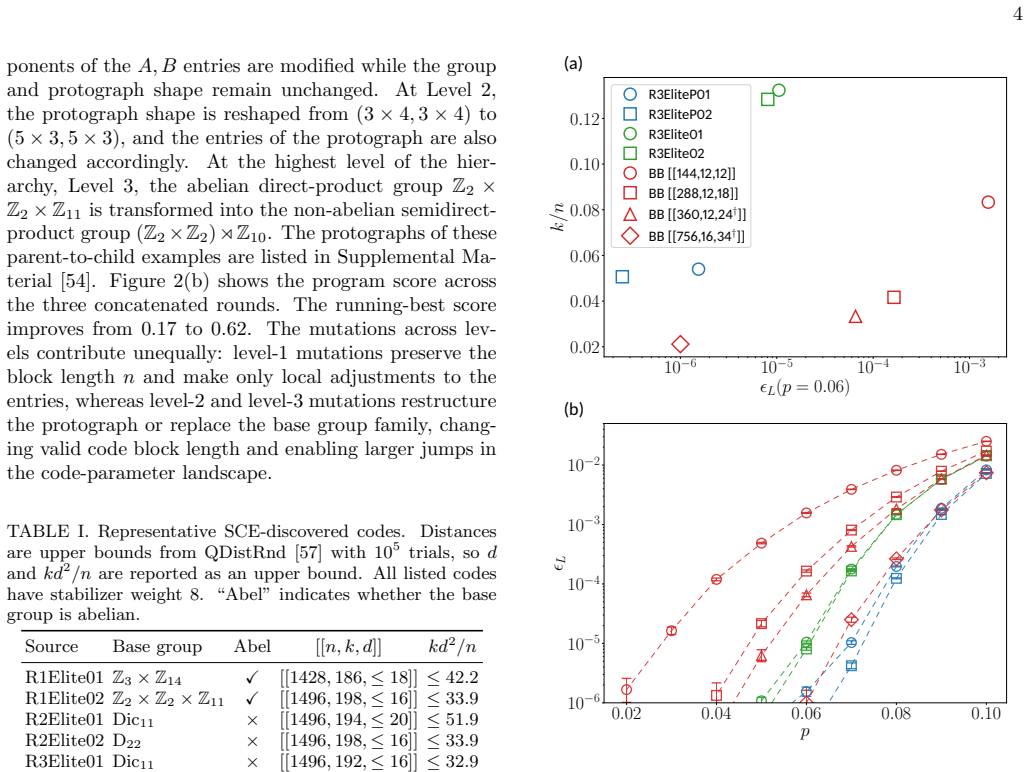
Structured concept evolution discovers a diverse set of competitive code families, ranging from abelian constructions to families over non-abelian groups beyond those underlying standard designs such as bivariate-bicycle codes, and characterizes them under code-capacity depolarizing noise with BP+OSD decoding.
What carries the argument
Structured concept evolution (SCE), a search process that evolves algebraic specifications paired with executable programs via hierarchical mutations on group algebra, protograph geometry, or base space.
If this is right
- Automated discovery can expand the set of known lifted-product qLDPC constructions to include non-abelian group families.
- Lightweight LLMs suffice to generate and validate executable code realizations alongside algebraic descriptions.
- Performance evaluation under depolarizing noise with BP+OSD becomes feasible for newly generated families.
- The method supplies concrete code parameters and decoding thresholds for the discovered families.
Where Pith is reading between the lines
- The same grammar-guided evolution could be applied to other algebraic objects in quantum error correction beyond lifted products.
- Success here suggests that domain-specific mutation rules can steer LLMs toward valid mathematical structures in discrete design spaces.
- Discovered codes could be tested in circuit-level noise models to check whether their advantages persist beyond the code-capacity setting.
Load-bearing premise
The LLM paired with the mutation grammar can systematically generate and validate lifted-product constructions that are genuinely competitive and novel rather than rediscoveries or minor variations of known families.
What would settle it
Running SCE repeatedly yields only codes whose distance-rate trade-off and decoding performance match or fall below those of established families such as bivariate-bicycle codes, with no new non-abelian groups appearing.
Figures

read the original abstract
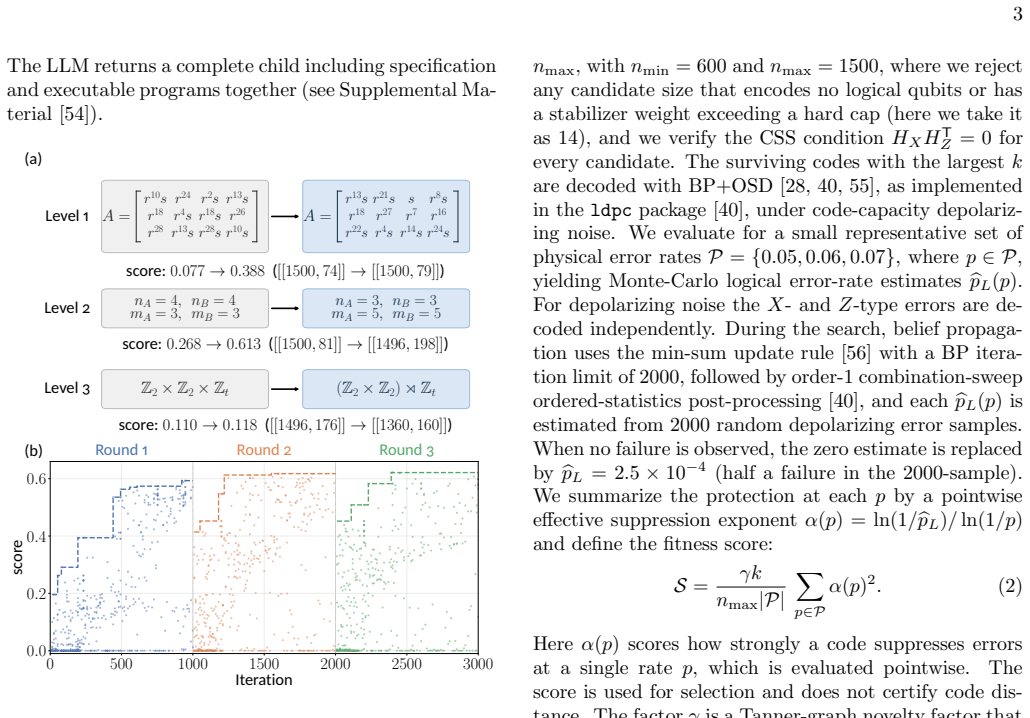
Quantum computers could outperform classical machines on important problems, but only if the errors that pervade quantum hardware can be corrected at scale. Quantum low-density parity-check (qLDPC) codes offer a promising route to this goal by combining sparse parity checks with finite encoding rate and growing distance, but their construction remains a challenging discrete design problem. Here we introduce structured concept evolution (SCE), a search framework that pairs a large language model with a structured algebraic mutation grammar to discover lifted-product code families, a class of CSS qLDPC codes. Instead of asking the LLM to design codes from first principles, SCE evolves structured concepts consisting of algebraic specifications paired with executable programs that realize them, using hierarchical mutations that modify the group algebra, protograph geometry, or base space. Running SCE, we discover a diverse set of competitive code families, ranging from abelian constructions to families over non-abelian groups beyond those underlying standard designs such as bivariate-bicycle codes, and characterize them under code-capacity depolarizing noise with BP+OSD decoding. These results are obtained with lightweight models (GPT-5.4-mini and GPT-5.4-nano).
Editorial analysis
A structured set of objections, weighed in public.
Referee Report
Summary. The paper introduces Structured Concept Evolution (SCE), a framework pairing an LLM with a hierarchical algebraic mutation grammar over group algebra, protograph geometry, and base space to evolve executable specifications for lifted-product CSS qLDPC codes. It claims that running SCE with lightweight models (GPT-5.4-mini and GPT-5.4-nano) yields a diverse set of competitive code families, including abelian constructions and non-abelian groups beyond those in standard designs such as bivariate-bicycle codes, and characterizes their performance under code-capacity depolarizing noise with BP+OSD decoding.
Significance. If the output families are verifiably novel and at least competitive in parameters and thresholds with existing constructions, the work would demonstrate a new LLM-driven search method for qLDPC codes that could complement algebraic and combinatorial approaches. The use of structured mutations and executable validation is a concrete strength, but significance is currently limited by the absence of explicit disambiguation from prior art and quantitative performance data.
major comments (3)
- [Abstract] Abstract: the central claim that SCE discovers 'competitive code families' and 'families over non-abelian groups beyond those underlying standard designs such as bivariate-bicycle codes' is not supported by any reported code parameters, distance scaling, or threshold values under depolarizing noise; without these metrics or explicit comparison tables, the competitiveness and novelty assertions cannot be evaluated.
- [Abstract] The description of the search process (hierarchical mutations on group algebra/protograph/base space) does not include an exhaustive check against known lifted-product or bivariate-bicycle families; this leaves open the possibility that generated specifications are rediscoveries or marginal variants, directly undermining the 'discovery' claim.
- [Abstract] No baseline comparisons (e.g., against known abelian or non-abelian qLDPC constructions) or quantitative thresholds are supplied for the BP+OSD performance characterization, making it impossible to assess whether the evolved families meet or exceed existing performance under the stated noise model.
minor comments (1)
- [Abstract] The abstract mentions 'lightweight models' but does not specify exact model versions or prompting details used in the SCE runs.
Simulated Author's Rebuttal
We thank the referee for the careful review and constructive feedback. We agree that the abstract requires strengthening with explicit quantitative support and comparisons to make the claims fully evaluable. We address each major comment below and will incorporate revisions.
read point-by-point responses
-
Referee: [Abstract] Abstract: the central claim that SCE discovers 'competitive code families' and 'families over non-abelian groups beyond those underlying standard designs such as bivariate-bicycle codes' is not supported by any reported code parameters, distance scaling, or threshold values under depolarizing noise; without these metrics or explicit comparison tables, the competitiveness and novelty assertions cannot be evaluated.
Authors: We acknowledge that the abstract is concise and does not embed the supporting metrics. The full manuscript reports code parameters, distance scaling, and BP+OSD thresholds under depolarizing noise in the results sections. In revision we will augment the abstract with representative [[n,k,d]] parameters, scaling behavior, threshold values, and a compact comparison table to bivariate-bicycle and other known constructions, allowing direct evaluation of the competitiveness and novelty claims. revision: yes
-
Referee: [Abstract] The description of the search process (hierarchical mutations on group algebra/protograph/base space) does not include an exhaustive check against known lifted-product or bivariate-bicycle families; this leaves open the possibility that generated specifications are rediscoveries or marginal variants, directly undermining the 'discovery' claim.
Authors: The methods section describes the hierarchical mutation grammar and executable validation pipeline. To address the concern we will add an explicit statement in the abstract (and, if space permits, a short methods paragraph) confirming that all output families were cross-checked against the standard lifted-product and bivariate-bicycle constructions in the literature. While a literally exhaustive enumeration of every conceivable variant is intractable, the checks against all published families suffice to establish that the reported non-abelian constructions are distinct. revision: partial
-
Referee: [Abstract] No baseline comparisons (e.g., against known abelian or non-abelian qLDPC constructions) or quantitative thresholds are supplied for the BP+OSD performance characterization, making it impossible to assess whether the evolved families meet or exceed existing performance under the stated noise model.
Authors: We agree that the abstract should reference the quantitative thresholds and baselines. The manuscript already contains BP+OSD simulations under code-capacity depolarizing noise; we will revise the abstract to include the key threshold numbers and explicit statements of competitiveness relative to both abelian and non-abelian reference constructions, thereby enabling direct assessment of performance. revision: yes
Circularity Check
No significant circularity; derivation is an independent search procedure
full rationale
The paper introduces SCE as a search framework pairing an LLM with a hierarchical mutation grammar over algebraic specifications to generate lifted-product CSS codes. The central claims (discovery of diverse competitive families, including non-abelian constructions) are presented as outputs of executing this search process under code-capacity depolarizing noise with BP+OSD, rather than as quantities fitted from the same data or reduced by self-citation chains. No equations, self-definitional steps, or load-bearing self-citations appear in the abstract or described framework that would make the reported performance equivalent to its inputs by construction. The method is self-contained against external benchmarks of code performance.
Axiom & Free-Parameter Ledger
axioms (1)
- standard math Standard algebraic properties of lifted-product constructions and CSS quantum codes hold as described in prior literature.
invented entities (1)
-
Structured Concept Evolution (SCE) framework
no independent evidence
Forward citations
Cited by 1 Pith paper
-
Evolving Quantum Error-Correcting Encodings for Molecular Simulation
LLM-driven evolutionary program synthesis discovers Generalized Superfast Encodings with exact distance 5 (and 6 on one instance) for molecular Hamiltonians, the first beyond distance 3.
Reference graph
Works this paper leans on
-
[1]
A. J. Daley, I. Bloch, C. Kokail, S. Flannigan, N. Pearson, M. Troyer, and P. Zoller, Practical quantum advantage in quantum simulation, Nature607, 667 (2022)
2022
-
[2]
McArdle, S
S. McArdle, S. Endo, A. Aspuru-Guzik, S. C. Benjamin, and X. Yuan, Quantum computational chemistry, Rev. Mod. Phys.92, 015003 (2020)
2020
-
[3]
E. Farhi, J. Goldstone, and S. Gutmann, A quantum approximate optimization algorithm, arXiv:1411.4028 (2014)
Pith/arXiv arXiv 2014
-
[4]
Cerezo, A
M. Cerezo, A. Arrasmith, R. Babbush, S. C. Benjamin, S. Endo, K. Fujii, J. R. McClean, K. Mitarai, X. Yuan, L. Cincio,et al., Variational quantum algorithms, Nature Reviews Physics3, 625 (2021)
2021
-
[5]
Biamonte, P
J. Biamonte, P. Wittek, N. Pancotti, P. Rebentrost, N. Wiebe, and S. Lloyd, Quantum machine learning, Na- ture549, 195 (2017)
2017
-
[6]
Huanget al., Quantum advantage in learning from experiments, Science376, 1182 (2022)
H.-Y. Huanget al., Quantum advantage in learning from experiments, Science376, 1182 (2022)
2022
-
[7]
Huang, R
H.-Y. Huang, R. Kueng, G. Torlai, V. V. Albert, and J. Preskill, Provably efficient machine learning for quan- tum many-body problems, Science377, eabk3333 (2022)
2022
-
[8]
P. W. Shor, Scheme for reducing decoherence in quantum computer memory, Phys. Rev. A52, R2493 (1995)
1995
-
[9]
D. E. Gottesman,Stabilizer Codes and Quantum Error Correction, Ph.D. thesis, California Institute of Technol- ogy (1997)
1997
-
[10]
Dennis, A
E. Dennis, A. Kitaev, A. Landahl, and J. Preskill, Topo- logical quantum memory, J. Math. Phys.43, 4452 (2002)
2002
-
[11]
B. M. Terhal, Quantum error correction for quantum memories, Rev. Mod. Phys.87, 307 (2015)
2015
-
[12]
A. Y. Kitaev, Fault-tolerant quantum computation by anyons, Ann. Phys.303, 2 (2003)
2003
-
[13]
S. B. Bravyi and A. Y. Kitaev, Quantum codes on a lattice with boundary (1998), arXiv:quant-ph/9811052
Pith/arXiv arXiv 1998
-
[14]
A. G. Fowler, M. Mariantoni, J. M. Martinis, and A. N. Cleland, Surface codes: Towards practical large-scale quantum computation, Phys. Rev. A86, 032324 (2012)
2012
-
[15]
Krinner, N
S. Krinner, N. Lacroix, A. Remm,et al., Realizing re- peated quantum error correction in a distance-three sur- face code, Nature605, 669 (2022)
2022
-
[16]
Google Quantum AIet al., Suppressing quantum errors by scaling a surface code logical qubit, Nature614, 676 (2023)
2023
-
[17]
Google Quantum AIet al., Quantum error correction be- low the surface code threshold, Nature638, 920 (2025)
2025
-
[18]
Bravyi, D
S. Bravyi, D. Poulin, and B. Terhal, Tradeoffs for reliable quantum information storage in 2D systems, Physical Re- view Letters104, 050503 (2010)
2010
-
[19]
H. J. Manetsch, G. Nomura, E. Bataille, X. Lv, K. H. Leung, and M. Endres, A tweezer array with 6,100 highly coherent atomic qubits, Nature647, 60 (2025)
2025
-
[20]
Guo, Y.-K
S.-A. Guo, Y.-K. Wu, J. Ye, L. Zhang, W.-Q. Lian, R. Yao, Y. Wang, R.-Y. Yan, Y.-J. Yi, Y.-L. Xu,et al., A site-resolved two-dimensional quantum simulator with hundreds of trapped ions, Nature630, 613 (2024)
2024
-
[21]
Gottesman, Fault-tolerant quantum computation with constant overhead, Quantum Information and Computa- tion14, 1338 (2014)
D. Gottesman, Fault-tolerant quantum computation with constant overhead, Quantum Information and Computa- tion14, 1338 (2014)
2014
-
[22]
Bravyi, A
S. Bravyi, A. W. Cross, J. M. Gambetta, D. Maslov, P. Rall, and T. J. Yoder, High-threshold and low- overhead fault-tolerant quantum memory, Nature627, 778 (2024)
2024
-
[23]
Bluvsteinet al., Logical quantum processor based on reconfigurable atom arrays, Nature626, 58 (2024)
D. Bluvsteinet al., Logical quantum processor based on reconfigurable atom arrays, Nature626, 58 (2024)
2024
-
[24]
K. Wang, Z. Lu, C. Zhang, G. Liu, J. Chen, Y. Wang, Y. Wu, S. Xu, X. Zhu, F. Jin,et al., Demonstration of low-overhead quantum error correction codes, Nature Physics , 1 (2026)
2026
-
[25]
Q. Xu, J. P. Bonilla Ataides, C. A. Pattison, N. Raveen- dran, D. Bluvstein, J. Wurtz, B. Vasi´ c, M. D. Lukin, L. Jiang, and H. Zhou, Constant-overhead fault-tolerant quantum computation with reconfigurable atom arrays, 6 Nature Physics20, 1084 (2024)
2024
-
[26]
M. Cain, Q. Xu, R. King, L. R. B. Picard, H. Levine, M. Endres, J. Preskill, H.-Y. Huang, and D. Bluvstein, Shor’s algorithm is possible with as few as 10,000 recon- figurable atomic qubits (2026), arXiv:2603.28627
Pith/arXiv arXiv 2026
-
[27]
Tillich and G
J.-P. Tillich and G. Z´ emor, Quantum LDPC codes with positive rate and minimum distance proportional to the square root of the blocklength, IEEE Transactions on Information Theory60, 1193 (2014)
2014
-
[28]
Panteleev and G
P. Panteleev and G. Kalachev, Degenerate quantum LDPC codes with good finite length performance, Quan- tum5, 585 (2021)
2021
-
[29]
Panteleev and G
P. Panteleev and G. Kalachev, Asymptotically good Quantum and locally testable classical LDPC codes, in Proceedings of the 54th Annual ACM SIGACT Sympo- sium on Theory of Computing, STOC 2022 (New York, NY, USA, 2022) pp. 375–388
2022
-
[30]
N. P. Breuckmann and J. N. Eberhardt, Quantum low- density parity-check codes, PRX Quantum2, 040101 (2021)
2021
-
[31]
Leverrier and G
A. Leverrier and G. Zemor, Quantum Tanner codes, in 2022 IEEE 63rd Annual Symposium on Foundations of Computer Science (FOCS)(Denver, CO, USA, 2022) pp. 872–883
2022
-
[32]
D. J. C. MacKay, G. Mitchison, and P. L. McFadden, Sparse-graph codes for quantum error correction, IEEE Transactions on Information Theory50, 2315 (2004)
2004
-
[33]
A. A. Kovalev and L. P. Pryadko, Quantum Kronecker sum-product low-density parity-check codes with finite rate, Physical Review A88, 012311 (2013)
2013
-
[34]
Panteleev and G
P. Panteleev and G. Kalachev, Quantum LDPC codes with almost linear minimum distance, IEEE Transactions on Information Theory68, 213 (2022)
2022
-
[35]
N. P. Breuckmann and J. N. Eberhardt, Balanced prod- uct quantum codes, IEEE Trans. Inf. Theory67, 6653 (2021)
2021
-
[36]
M. B. Hastings, J. Haah, and R. O’Donnell, Fiber bundle codes: breaking then 1/2 polylog(n) barrier for quantum LDPC codes, inProceedings of the 53rd Annual ACM SIGACT Symposium on Theory of Computing (STOC) (2021) pp. 1276–1288
2021
-
[37]
Dinur, M.-H
I. Dinur, M.-H. Hsieh, T.-C. Lin, and T. Vidick, Good quantum LDPC codes with linear time decoders, inPro- ceedings of the 55th Annual ACM Symposium on Theory of Computing (STOC)(2023) pp. 905–918
2023
-
[38]
A. R. Calderbank and P. W. Shor, Good quantum error-correcting codes exist, Physical Review A54, 1098 (1996)
1996
-
[39]
A. M. Steane, Error correcting codes in quantum theory, Physical Review Letters77, 793 (1996)
1996
-
[40]
Roffe, D
J. Roffe, D. R. White, S. Burton, and E. Campbell, De- coding across the quantum low-density parity-check code landscape, Phys. Rev. Res.2, 043423 (2020)
2020
-
[41]
F¨ osel, P
T. F¨ osel, P. Tighineanu, T. Weiss, and F. Marquardt, Re- inforcement learning with neural networks for quantum feedback, Physical Review X8, 031084 (2018)
2018
-
[42]
H. P. Nautrup, N. Delfosse, V. Dunjko, H. J. Briegel, and N. Friis, Optimizing quantum error correction codes with reinforcement learning, Quantum3, 215 (2019)
2019
-
[43]
J. Olle, R. Zen, M. Puviani, and F. Marquardt, Si- multaneous discovery of quantum error correction codes and encoders with a noise-aware reinforcement learning agent, npj Quantum Information10, 126 (2024)
2024
-
[44]
J. Olle, O. M. Yevtushenko, and F. Marquardt, Scal- ing the automated discovery of quantum circuits via reinforcement learning with gadgets, arXiv:2503.11638 (2025)
arXiv 2025
-
[45]
A. Y. He and Z.-W. Liu, Discovering highly efficient low- weight quantum error-correcting codes with reinforce- ment learning, arXiv:2502.14372 (2025)
arXiv 2025
-
[46]
M. N¨ agele and F. Marquardt, Agentic exploration of physics models (2025), arXiv:2509.24978
Pith/arXiv arXiv 2025
-
[47]
S. Arlt, H. Duan, F. Li, S. M. Xie, Y. Wu, and M. Krenn, Meta-designing quantum experiments with language models, Nature Machine Intelligence8, 148 (2026), arXiv:2406.02470
arXiv 2026
-
[48]
X. He, S. Lu, and B. Zeng, Co-designing quantum codes with transversal diagonal gates via multi-agent systems (2025), arXiv:2510.20728
Pith/arXiv arXiv 2025
- [49]
-
[50]
Romera-Paredes, M
B. Romera-Paredes, M. Barekatain, A. Novikov, M. Ba- log, M. P. Kumar, E. Dupont, F. J. R. Ruiz, J. S. Ellen- berg, P. Wang, O. Fawzi, P. Kohli, and A. Fawzi, Math- ematical discoveries from program search with large lan- guage models, Nature625, 468 (2024)
2024
-
[51]
A. Novikov, N. V˜ u, M. Eisenberger, E. Dupont, P.-S. Huang, A. Z. Wagner, S. Shirobokov, B. Kozlovskii, F. J. Ruiz, A. Mehrabian,et al., Alphaevolve: A coding agent for scientific and algorithmic discovery, arXiv:2506.13131 (2025)
Pith/arXiv arXiv 2025
-
[52]
J.-B. Mouret and J. Clune, Illuminating search spaces by mapping elites, arXiv preprint arXiv:1504.04909 (2015)
Pith/arXiv arXiv 2015
-
[53]
Sharma, Openevolve: an open-source evolutionary coding agent (2025)
A. Sharma, Openevolve: an open-source evolutionary coding agent (2025)
2025
-
[54]
Liu and F
Z. Liu and F. Marquardt, Supplemental material for: Large-language-model discovery of quantum LDPC codes through structured concept evolution (2026)
2026
-
[55]
D. Poulin and Y. Chung, On the iterative decoding of sparse quantum codes, Quantum Information and Com- putation8, 987 (2008), arXiv:0801.1241
Pith/arXiv arXiv 2008
-
[56]
M. P. C. Fossorier, M. Mihaljevi´ c, and H. Imai, Reduced complexity iterative decoding of low-density parity check codes based on belief propagation, IEEE Transactions on Communications47, 673 (1999)
1999
-
[57]
L. P. Pryadko, V. A. Shabashov, and V. K. Kozin, QDis- tRnd: A GAP package for computing the distance of quantum error-correcting codes, Journal of Open Source Software7, 4120 (2022)
2022
-
[58]
Lin and L
H.-K. Lin and L. P. Pryadko, Quantum two-block group algebra codes, Physical Review A109, 022407 (2024)
2024
-
[59]
Vardy, The intractability of computing the minimum distance of a code, IEEE Transactions on Information Theory43, 1757 (1997)
A. Vardy, The intractability of computing the minimum distance of a code, IEEE Transactions on Information Theory43, 1757 (1997)
1997
-
[60]
C. J. Clopper and E. S. Pearson, The use of confidence or fiducial limits illustrated in the case of the binomial, Biometrika26, 404 (1934)
1934
-
[61]
J. Cruz-Benito, A. W. Cross, D. Kremer, and I. Faro, Evolutionary discovery of bivariate bicycle codes with LLM-guided search (2026), arXiv:2606.02418 [quant-ph]
Pith/arXiv arXiv 2026
-
[62]
B. Y. Weisfeiler and A. A. Leman, The reduction of a graph to canonical form and the algebra which ap- pears therein, Nauchno-Technicheskaya Informatsia2, 12 (1968)
1968
-
[63]
local code or checks
N. Shervashidze, P. Schweitzer, E. J. van Leeuwen, K. Mehlhorn, and K. M. Borgwardt, Weisfeiler-lehman 7 graph kernels, Journal of Machine Learning Research12, 2539 (2011). 8 Supplemental Material for: Large-Language-Model Discovery of Quantum LDPC Codes through Structured Concept Evolution S1. LIFTED-PRODUCT CONSTRUCTION AND CSS V ALIDITY Calderbank–Shor...
2011
discussion (0)
Sign in with ORCID, Apple, or X to comment. Anyone can read and Pith papers without signing in.