Competitive satellite placement and the geography of orbital risk: evidence from the geostationary arc
Pith reviewed 2026-06-25 20:18 UTC · model grok-4.3
The pith
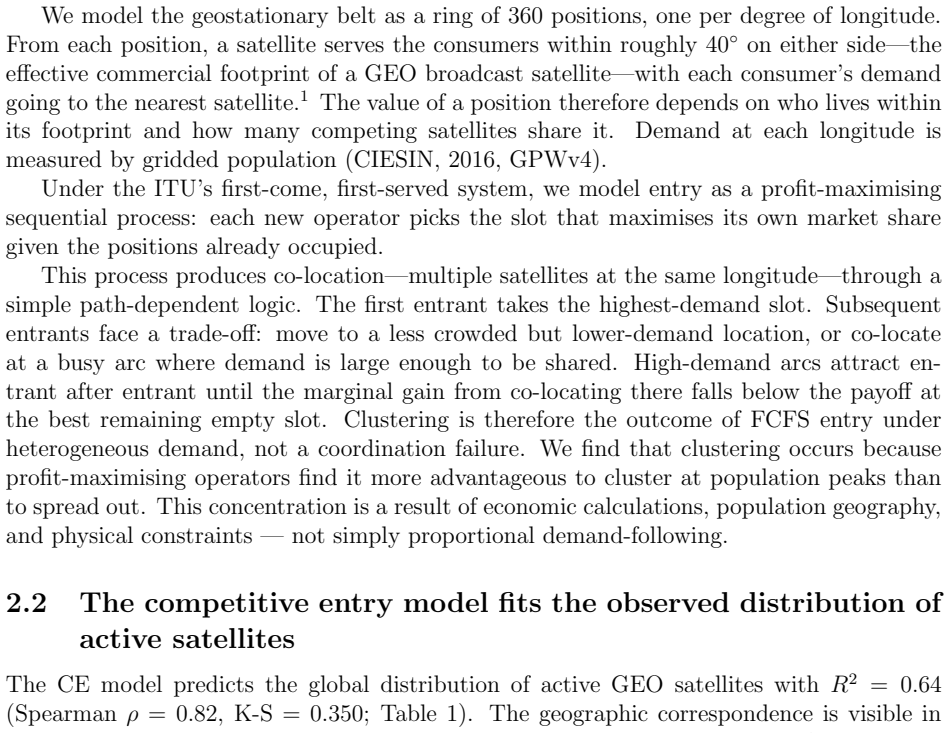
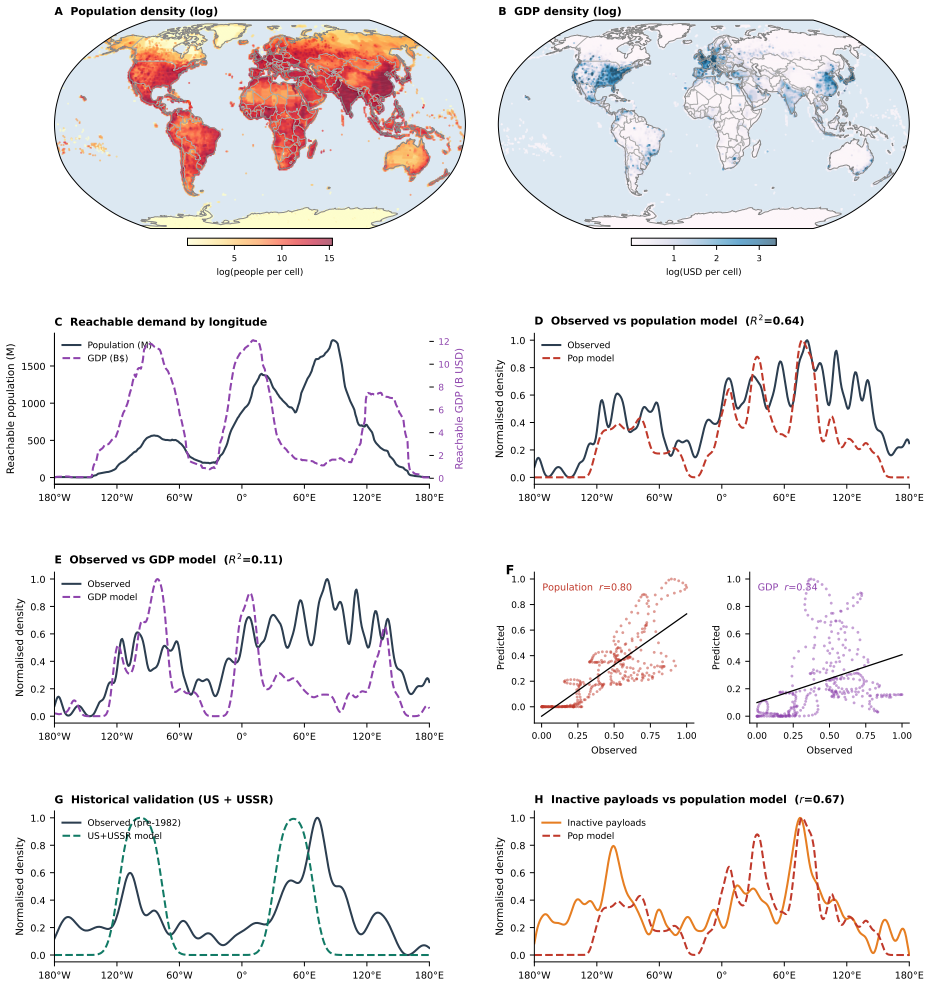
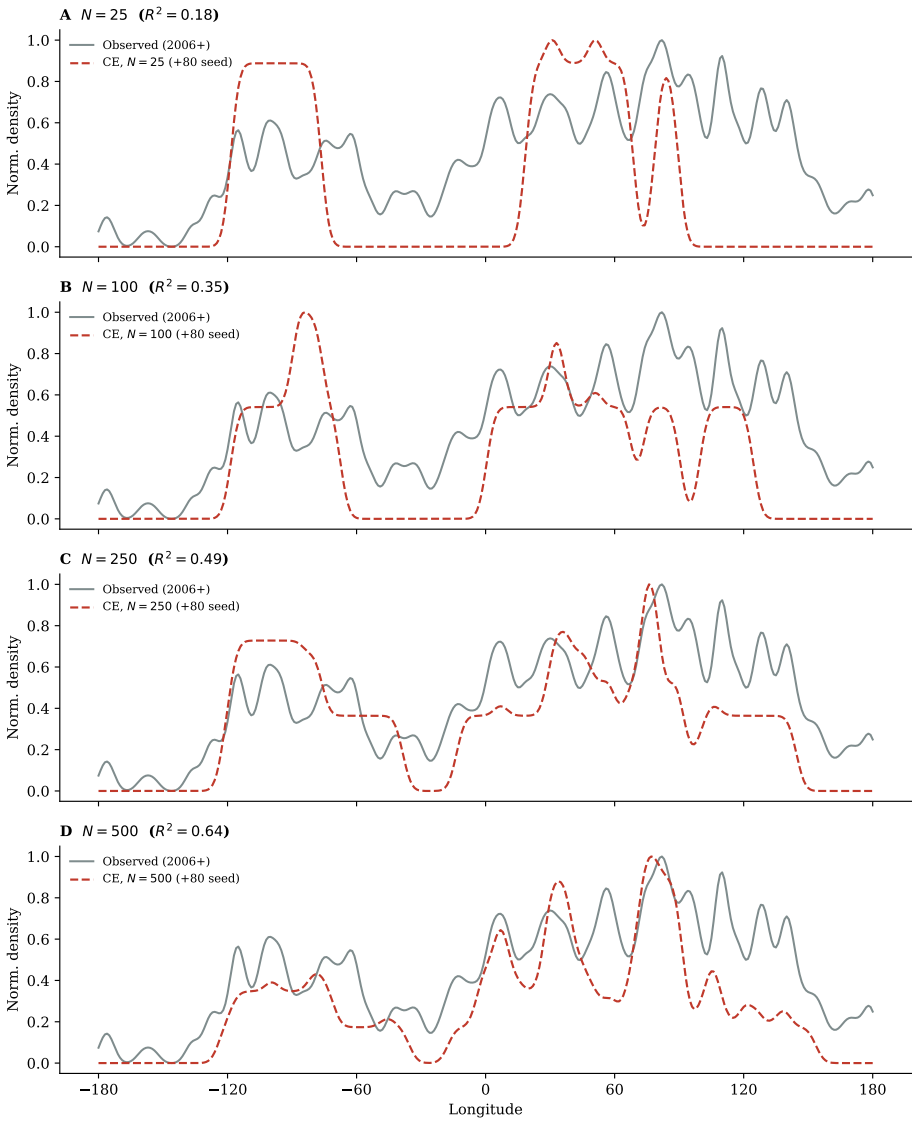
A competitive entry model predicts the distribution of satellites along the geostationary arc with R² of 0.64.
A machine-rendered reading of the paper's core claim, the machinery that carries it, and where it could break.
Core claim
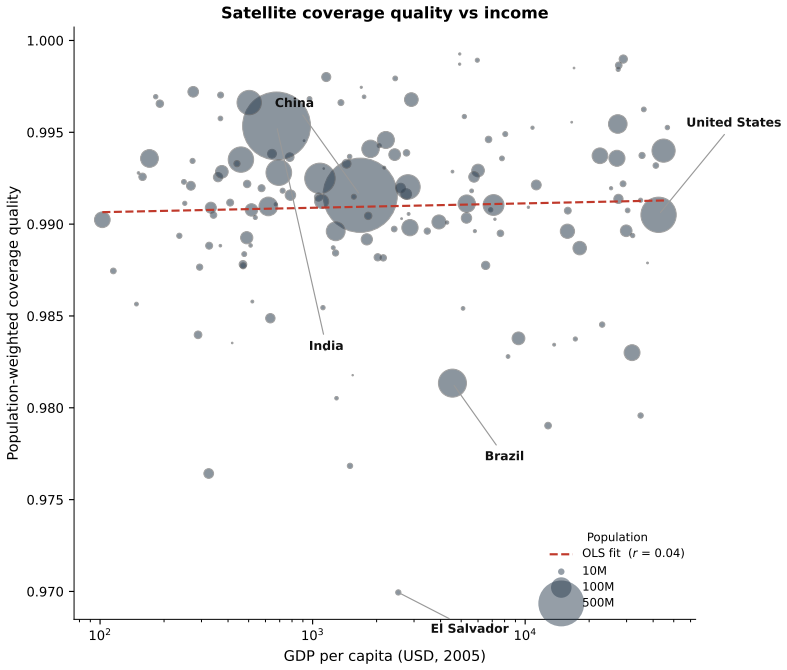
Using the complete ITU registry and a simple competitive entry model, the authors predict the observed distribution of active GEO satellites with R² = 0.64. In walk-forward tests the structural model also predicts individual slot choices out of sample better than a fitted conditional-logit discrete-choice model. The same model predicts the distribution of inactive payloads in GEO with R² = 0.44. The current satellite distribution is relatively fair, driven by population rather than income, and places satellites in economically efficient locations, but this holds only for mature slots.
What carries the argument
A competitive entry model in which satellite operators select GEO slots to maximize expected profits under first-come first-served allocation.
If this is right
- The geography of debris risk from inactive satellites can be predicted directly from launch patterns.
- Satellite placement in GEO is driven by population size and is relatively fair across countries.
- Placement is economically efficient in mature slots but not necessarily in newer ones.
- A structural competitive model outperforms reduced-form discrete choice models for out-of-sample slot prediction.
Where Pith is reading between the lines
- Similar entry models could be applied to other orbital regimes once data on operator profits become available.
- Regulators could use the model to forecast where risk concentrations will emerge before launches occur.
- If profit expectations shift with new technology, the model predicts corresponding changes in the distribution of both active and inactive satellites.
Load-bearing premise
Satellite operators' slot choices are driven mainly by expected profits under first-come first-served rules without dominant unmodeled factors such as regulatory capture or geopolitical constraints.
What would settle it
A walk-forward test in which the profit-maximizing slot predicted by the model is chosen by fewer operators than a null model that ignores profit differences would falsify the central claim.
Figures




read the original abstract
Some orbital locations are crowded while others remain unoccupied. We explain why using the geostationary orbit as a near-ideal laboratory: a mature, one-dimensional orbit in which satellite operators compete for position under first-come first-served allocation rules. Using the complete ITU registry and a simple competitive entry model, we predict the observed distribution of active GEO satellites with $R^2 = 0.64$. In walk-forward tests, the structural model also predicts individual slot choices out of sample better than a fitted conditional-logit discrete-choice model. Our model also predicts the distribution of inactive payloads in GEO with $R^2 = 0.44$, showing that the geography of debris risk can be predicted when it is a function of satellite launches. Surprisingly, we find that the current satellite distribution in GEO is relatively fair: driven by population rather than income and placing satellites in economically efficient locations. However, our model shows that this is only the case for mature slots.
Editorial analysis
A structured set of objections, weighed in public.
Referee Report
Summary. The paper claims that a simple competitive entry model, calibrated to expected profits under first-come-first-served rules and applied to the complete ITU registry, predicts the observed spatial distribution of active GEO satellites with R² = 0.64. Walk-forward out-of-sample tests show this structural model outperforms a fitted conditional-logit discrete-choice model in predicting individual slot choices. The same model predicts the distribution of inactive payloads with R² = 0.44. The authors conclude that the current GEO distribution is relatively fair (driven by population rather than income) and places satellites in economically efficient locations, at least for mature slots.
Significance. If the structural interpretation holds, the work supplies a rare empirical test of competitive entry in a one-dimensional, mature resource with observable entry order, and demonstrates that the geography of orbital debris risk can be recovered from launch decisions alone. The walk-forward validation and direct comparison to a reduced-form discrete-choice benchmark are genuine strengths that raise the evidentiary bar above in-sample fit alone.
major comments (1)
- [Abstract and model section] The central claim that the R² = 0.64 fit and out-of-sample superiority reflect a valid structural representation of profit-driven slot choice is load-bearing on the assumption that unmodeled factors (regulatory capture, geopolitical constraints, technological lock-in) are not first-order. The abstract and model description supply no direct test of this premise—no country fixed effects, no geopolitical covariates, and no comparison of predicted versus actual entry around known regulatory events—leaving open the possibility that the reported performance reflects omitted-variable bias rather than the competitive-entry mechanism.
minor comments (1)
- [Abstract] The abstract supplies no information on model specification, parameter estimation, robustness checks, or selection into the ITU registry, which reduces the ability of readers to evaluate the reported R² values and walk-forward results at a glance.
Simulated Author's Rebuttal
We thank the referee for the constructive report and positive assessment of the paper's empirical contributions. Below we respond directly to the major comment.
read point-by-point responses
-
Referee: [Abstract and model section] The central claim that the R² = 0.64 fit and out-of-sample superiority reflect a valid structural representation of profit-driven slot choice is load-bearing on the assumption that unmodeled factors (regulatory capture, geopolitical constraints, technological lock-in) are not first-order. The abstract and model description supply no direct test of this premise—no country fixed effects, no geopolitical covariates, and no comparison of predicted versus actual entry around known regulatory events—leaving open the possibility that the reported performance reflects omitted-variable bias rather than the competitive-entry mechanism.
Authors: We agree that the structural interpretation depends on unmodeled factors not being first-order and that the current draft provides no direct test of this premise. The walk-forward out-of-sample superiority over the conditional logit offers indirect evidence, because any dominant omitted factors would likely be absorbed by the reduced-form benchmark, yet the structural model still outperforms. Nevertheless, this does not substitute for explicit checks. In revision we will add country fixed effects to the entry model, introduce a limited set of geopolitical covariates where data permit, and expand the model section to discuss the identifying assumption and its limitations. Direct event-study comparisons around regulatory changes are feasible only for a small number of well-documented ITU rule shifts and will be reported as supplementary analysis rather than a full test. revision: partial
Circularity Check
No significant circularity detected
full rationale
The paper presents a structural competitive entry model derived from first-come-first-served profit maximization that is used to generate predictions of satellite slot distributions. These predictions are evaluated both in-sample (R²=0.64) and via explicit walk-forward out-of-sample tests that outperform a separately fitted conditional logit benchmark. No quoted equations or sections reduce the central result to a parameter fit by construction, a self-citation chain, or a renamed empirical pattern. The model contains independent theoretical content (expected-profit entry under FCFS) that is tested against external data rather than being tautological with its inputs.
Axiom & Free-Parameter Ledger
axioms (1)
- domain assumption Satellite operators compete for GEO positions under first-come first-served allocation rules
Reference graph
Works this paper leans on
-
[1]
Journal of Geophysical Research: Space Physics , volume=
Collision frequency of artificial satellites: The creation of a debris belt , author=. Journal of Geophysical Research: Space Physics , volume=. 1978 , publisher=
1978
-
[2]
Science , volume=
Risks in space from orbiting debris , author=. Science , volume=. 2006 , publisher=
2006
-
[3]
Acta Astronautica , volume=
Sensitivity analysis of launch activities in Low Earth Orbit , author=. Acta Astronautica , volume=. 2019 , publisher=
2019
-
[4]
Environmental and Resource Economics , volume=
A Physico-Economic Model of Low Earth Orbit Management , author=. Environmental and Resource Economics , volume=. 2020 , publisher=
2020
-
[5]
Working paper
Cost in Space: Debris and Collision Risk in the Orbital Commons , author=. Working paper. Latest draft available at
-
[6]
Environmental and Resource Economics , volume=
An economic analysis of earth orbit pollution , author=. Environmental and Resource Economics , volume=. 2015 , publisher=
2015
-
[7]
Proceedings of the National Academy of Sciences , volume=
Orbital-use fees could more than quadruple the value of the space industry , author=. Proceedings of the National Academy of Sciences , volume=. 2020 , publisher=
2020
-
[8]
Journal of Environmental Economics and Management , volume=
Climate treaties and approaching catastrophes , author=. Journal of Environmental Economics and Management , volume=. 2013 , publisher=
2013
-
[9]
Journal of Space Safety Engineering , volume=
Understanding long-term orbital debris population dynamics , author=. Journal of Space Safety Engineering , volume=. 2020 , publisher=
2020
-
[10]
Available at SSRN 3900257 , year=
Understanding the Economics of Orbital Pollution Through the Lens of Terrestrial Climate Change , author=. Available at SSRN 3900257 , year=
-
[11]
Environmental federalism: a survey of the empirical literature , author=. Case W. Res. L. Rev. , volume=. 2013 , publisher=
2013
-
[12]
Utilization of the Geostationary Orbit--A Need for Orbital Allocation , author=. Colum. J. Transnat'l L. , volume=. 1974 , publisher=
1974
-
[13]
American Journal of International Law , volume=
The geostationary orbit: issues of law and policy , author=. American Journal of International Law , volume=. 1979 , publisher=
1979
-
[14]
Proceedings of the National Academy of Sciences , volume=
Oligopoly competition between satellite constellations will reduce economic welfare from orbit use , author=. Proceedings of the National Academy of Sciences , volume=. 2023 , publisher=
2023
-
[15]
The American Economic Review , volume=
Out of space? Regulation and technical change in communications satellites , author=. The American Economic Review , volume=. 1986 , publisher=
1986
-
[16]
The Journal of Law and Economics , volume=
Allocation of Orbit and Spectrum resources for Regional Communications: What's at stake? , author=. The Journal of Law and Economics , volume=. 1998 , publisher=
1998
-
[17]
Acta Astronautica , volume=
Local debris congestion in the geosynchronous environment with population augmentation , author=. Acta Astronautica , volume=. 2014 , publisher=
2014
-
[18]
Acta Astronautica , volume=
Cost and risk assessment for spacecraft operation decisions caused by the space debris environment , author=. Acta Astronautica , volume=. 2015 , publisher=
2015
-
[19]
Acta Astronautica , volume=
A comprehensive assessment of collision likelihood in Geosynchronous Earth Orbit , author=. Acta Astronautica , volume=. 2018 , publisher=
2018
-
[20]
Nature , volume=
Four steps to global management of space traffic , author=. Nature , volume=. 2019 , publisher=
2019
-
[21]
Science , volume=
Protect Earth’s orbit: Avoid high seas mistakes , author=. Science , volume=. 2023 , publisher=
2023
-
[22]
Nature , volume=
The quest to conquer the space junk problem , author=. Nature , volume=. 2018 , publisher=
2018
-
[23]
Investigaciones Regionales-Journal of Regional Research , volume=
Change and Continuity in Quality of Government: Trends in subnational quality of government in EU member states , author=. Investigaciones Regionales-Journal of Regional Research , volume=. 2022 , publisher=
2022
-
[24]
Econometrica: Journal of the Econometric Society , pages=
Equilibrium in Hotelling's model of spatial competition , author=. Econometrica: Journal of the Econometric Society , pages=. 1987 , publisher=
1987
-
[25]
NASA Socioeconomic Data and Applications Center (SEDAC) , year=
Global gridded geographically based economic data (G-econ), version 4 , author=. NASA Socioeconomic Data and Applications Center (SEDAC) , year=
-
[26]
Journal of Regional Science , volume=
Hotelling games with three, four, and more players , author=. Journal of Regional Science , volume=. 2005 , publisher=
2005
-
[27]
Advances in Space Research , volume=
Space debris mitigation in geosynchronous orbit , author=. Advances in Space Research , volume=. 2008 , publisher=
2008
-
[28]
Acta astronautica , volume=
Optimal transfer schemes between space debris objects in geostationary orbit , author=. Acta astronautica , volume=. 2020 , publisher=
2020
-
[29]
Journal of Spacecraft and Rockets , volume=
TugSat: removing space debris from geostationary orbits using solar sails , author=. Journal of Spacecraft and Rockets , volume=. 2018 , publisher=
2018
-
[30]
Acta Astronautica , volume=
An optimized analytical solution for geostationary debris removal using solar sails , author=. Acta Astronautica , volume=. 2019 , publisher=
2019
-
[31]
Acta Astronautica , volume=
A method for assessing satellite operators’ compliance with geosynchronous orbital assignments , author=. Acta Astronautica , volume=. 2024 , publisher=
2024
-
[32]
The Economic Journal , volume=
Stability in competition , author=. The Economic Journal , volume=. 1929 , publisher=
1929
-
[33]
d'Aspremont, Claude and Gabszewicz, Jean Jaskold and Thisse, Jacques-Fran. On. Econometrica , volume=. 1979 , publisher=
1979
-
[34]
Proceedings of the National Academy of Sciences , volume=
Geography and macroeconomics: New data and new findings , author=. Proceedings of the National Academy of Sciences , volume=. 2006 , publisher=
2006
-
[35]
The Bell Journal of Economics , volume=
Monopolistic competition with outside goods , author=. The Bell Journal of Economics , volume=. 1979 , publisher=
1979
-
[36]
and Vasile, M
Wilson, C. and Vasile, M. and Feng, J. and McNally, K. and Maric, N. and Horstmann, A. , title =. Advances in Space Research , year =
-
[37]
and Bastida Virgili, B
Letizia, F. and Bastida Virgili, B. and Lemmens, S. , title =. Advances in Space Research , volume =
-
[38]
2016 , publisher =
Gridded Population of the World, Version 4 (. 2016 , publisher =
2016
discussion (0)
Sign in with ORCID, Apple, or X to comment. Anyone can read and Pith papers without signing in.