The Cosmic Ray Life Cycle in Galaxy Clusters
Pith reviewed 2026-06-25 19:45 UTC · model grok-4.3
The pith
SKA-Mid and SKA-Low can map magnetic fields and low-energy cosmic rays throughout galaxy clusters via their radio emissions.
A machine-rendered reading of the paper's core claim, the machinery that carries it, and where it could break.
Core claim
Within the cosmic web, gravitational energy tied to cluster formation and AGN activity is converted to heat via turbulence and shock waves; this amplifies magnetic fields and accelerates cosmic ray electrons that emit synchrotron radiation on the scale of entire clusters, appearing as radio halos, radio relics, and related sources. SKA-Mid (Bands 1 and 2) and SKA-Low are ideally suited to probe the resulting magnetic field structures and the large reservoir of low-energy cosmic rays because of their sensitivity to polarized and low-frequency emission.
What carries the argument
Synchrotron emission from cosmic ray electrons, which directly traces the amplified magnetic fields and the population of accelerated particles produced by turbulence and shocks.
If this is right
- Deep SKA observations of selected nearby clusters will yield a comprehensive view of cosmic ray acceleration processes.
- Wide-area SKA surveys will capture the long-term interactions of these sources over gigayear timescales.
- The high sensitivity to low-frequency emission will reveal acceleration mechanisms for low-energy cosmic rays that remain unexplored.
- Polarized emission data will map magnetic field structures across entire clusters.
Where Pith is reading between the lines
- The same SKA capabilities could be applied to map cosmic ray populations in other large-scale structures such as filaments of the cosmic web.
- If the low-energy cosmic ray reservoir is detected, it would constrain the efficiency of microphysical acceleration processes beyond standard shock and turbulence models.
- Repeated observations over years could test whether AGN activity or gravitational processes dominate the energy budget in different cluster environments.
Load-bearing premise
Turbulence and shock waves are the dominant mechanisms that convert gravitational energy into cosmic rays and magnetic field amplification inside galaxy clusters.
What would settle it
SKA observations of a sample of nearby clusters that detect no polarized low-frequency emission from expected radio halos or relics, or that show no signatures of the predicted low-energy cosmic ray reservoir.
Figures
read the original abstract
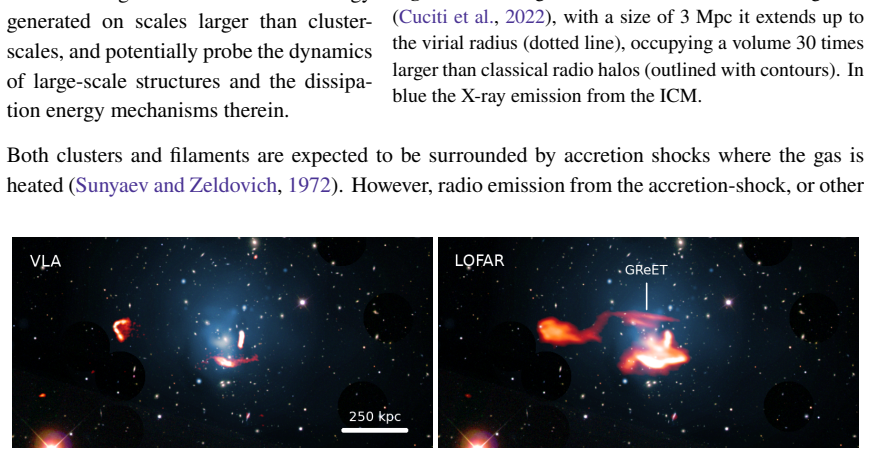
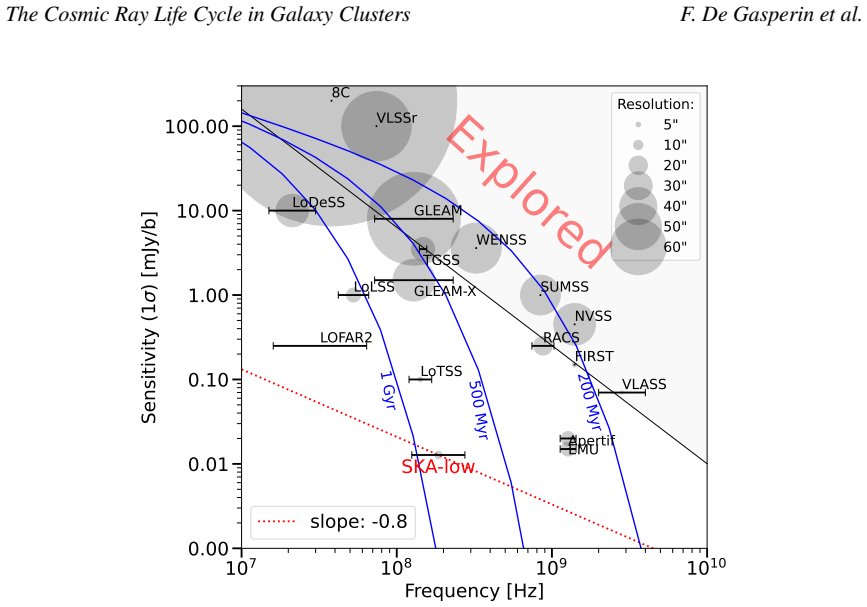
Within the cosmic web, gravitational energy, linked to the formation and growth of the Universe's largest structures and the activity of active galactic nuclei (AGN), is converted to heat through processes such as turbulence and shock waves. These processes have a fundamental impact on the evolution of galaxy clusters. For example, they lead to the amplification of magnetic fields and the production of cosmic ray (CR) electrons that emit continuum radio waves via synchrotron emission. This produces sources on scales of the entire hosting clusters. These large radio sources in galaxy clusters are often classified based on their morphological appearance as radio halos, cluster radio shocks (radio relics), and other types. To understand the CR acceleration processes in galaxy clusters (and beyond), and to gain a comprehensive view of these sources, including their long-term interactions, SKA telescope should conduct both deep observations of a carefully selected sample of nearby clusters as well as shallower wide-area surveys. Thanks to their capabilities - in particular the sensitivity to polarised and low-frequency emission - SKA-Mid (Bands 1 and 2) and SKA-Low are ideally suited to probing magnetic field structures in galaxy clusters, as well as the large reservoir of low-energy CRs that may be accelerated by yet-unexplored microphysical mechanisms. The high sensitivity to low-frequency emission will also be fundamental to detect the long term actions and interactions of these phenomena over gigayear timescales.
Editorial analysis
A structured set of objections, weighed in public.
Referee Report
Summary. The manuscript reviews how turbulence and shock waves convert gravitational energy into heat, magnetic field amplification, and cosmic-ray electron acceleration within galaxy clusters, producing large-scale synchrotron sources classified as radio halos and cluster radio shocks. It recommends that SKA-Mid (Bands 1 and 2) and SKA-Low perform both deep targeted observations of nearby clusters and shallower wide-area surveys to study magnetic-field structures and the low-energy CR population, citing the telescopes' sensitivity to polarized and low-frequency emission as key advantages.
Significance. The review synthesizes established cluster astrophysics and translates it into concrete SKA observing strategies. If the underlying processes are as described in the prior literature, the recommendations could usefully inform SKA early-science planning and help prioritize observations that probe CR acceleration and B-field evolution on gigayear timescales.
minor comments (2)
- [Abstract] Abstract, first paragraph: the clause 'SKA telescope should conduct' is grammatically imprecise; rephrasing to 'the SKA should conduct' would improve readability.
- [Introduction (inferred from abstract)] The manuscript would benefit from explicit citations to the key review papers on turbulence-driven CR acceleration and relic formation when stating the dominance of these mechanisms.
Simulated Author's Rebuttal
We thank the referee for their positive review, accurate summary of the manuscript, and recommendation to accept. No major comments were raised in the report.
Circularity Check
No significant circularity; descriptive review with no derivations
full rationale
This is a review/white-paper summarizing established cluster physics (turbulence/shocks amplifying B-fields and accelerating CR electrons) and recommending SKA observing strategies. No new quantitative model, derivation, or falsifiable prediction is advanced; the central claim is an observational recommendation whose validity rests on the prior literature rather than on any internal step that could be internally inconsistent or under-supported within the paper itself. No equations, fitted parameters, or self-referential predictions appear in the provided text, so no load-bearing step reduces to the paper's own inputs by construction.
Axiom & Free-Parameter Ledger
Reference graph
Works this paper leans on
-
[1]
A search for intercluster filaments with LOFAR and eROSITA. , keywords =. doi:10.1093/mnras/stad1702 , archivePrefix =. 2306.03904 , primaryClass =
-
[2]
Mapping the Perseus Galaxy Cluster with XRISM: Gas Kinematic Features and their Implications for Turbulence. arXiv e-prints , keywords =. doi:10.48550/arXiv.2510.12782 , archivePrefix =. 2510.12782 , primaryClass =
-
[3]
XRISM observation of the Ophiuchus galaxy cluster: Quiescent velocity structure in the dynamically disturbed core. , keywords =. doi:10.1093/pasj/psaf089 , archivePrefix =. 2507.00126 , primaryClass =
-
[4]
The Seeding of Cosmic Ray Electrons by Cluster Radio Galaxies: A Review. Galaxies , keywords =. doi:10.3390/galaxies12020019 , archivePrefix =. 2403.16068 , primaryClass =
-
[5]
2026 ,publisher =
Alessandro Ignesti and author2 and author3 and author4 and author5 ,title =. 2026 ,publisher =
2026
-
[6]
2026 ,publisher =
Virginia Cuciti and author2 and author3 and author4 and author5 ,title =. 2026 ,publisher =
2026
-
[7]
2026 ,publisher =
Rossella Cassano and author2 and author3 and author4 and author5 ,title =. 2026 ,publisher =
2026
-
[8]
Dyer, K. K. and Cornwell, T. J. and Maddalena, R. J. , number =. 2009 , journal =. doi:10.1088/0004-6256/137/2/2956 , issn =
-
[9]
Condon, J. J. and Cotton, W. D. and Greisen, E. W. and Yin, Q. F. and Perley, Richard A. and Taylor, G. B. and Broderick, J. J. , number =. 1998 , journal =. doi:10.1086/300337 , issn =
-
[10]
Lynch, C. R. R. and Lenc, E. and Kaplan, D. L. L. and Murphy, Tara and Anderson, G. E. E. , number =. 2017 , journal =. doi:10.3847/2041-8213/aa5ffd , issn =
-
[11]
1989 , journal =
Gavazzi, Giuseppe , month =. 1989 , journal =
1989
-
[12]
Viner, M. R. and Erickson, W. C. , month =. 1975 , journal =. doi:10.1086/111827 , issn =
-
[13]
Sirothia, S. K. and Dennefeld, M and Saikia, D. J. and Dole, H and Ricquebourg, F and Roland, J , number =. 2009 , journal =. doi:10.1111/j.1365-2966.2009.14317.x , issn =
-
[14]
Cotton, W. D. and Mason, B. S. and Dicker, S. R. and Korngut, P. M. and Devlin, M. J. and Aquirre, J. and Benford, D. J. and Moseley, S. H. and Staguhn, J. G. and Irwin, K. D. and Ade, P. , number =. 2009 , journal =. doi:10.1088/0004-637X/701/2/1872 , issn =
-
[15]
Riseley, C. J. and Bonafede, A. and Bruno, L. and Botteon, A. and Rossetti, M. and Biava, N. and Bonnassieux, E. and Loi, F. and Vernstrom, T. and Balboni, M. , month =. 2024 , journal =. doi:10.1051/0004-6361/202348944 , issn =
-
[16]
Blandford, R. D. and Rees, M. J. , pages =. 1974 , journal =
1974
-
[17]
Ledlow, Michael J. and Owen, Frazer N. , month =. 1996 , journal =. doi:10.1086/117985 , issn =
-
[18]
Condon, J. J. and Broderick, J. J. and Seielstad, G. A. and Douglas, K. and Gregory, P. C. , month =. 1994 , journal =. doi:10.1086/116992 , issn =
-
[19]
Scaife, Anna M. M. and Heald, George H. , number =. 2012 , journal =. doi:10.1111/j.1745-3933.2012.01251.x , issn =
-
[20]
White, Richard L. and Becker, Robert H. and Helfand, David J. and Gregg, Michael D. , number =. 1997 , journal =. doi:10.1086/303564 , issn =
-
[21]
Abell, George O. and Corwin, Harold G., Jr. and Olowin, Ronald P. , month =. 1989 , journal =. doi:10.1086/191333 , issn =
-
[22]
Green, D. A. , month =. 2014 , journal =
2014
-
[23]
V. 2006 , journal =. doi:10.1051/0004-6361:20065177 , issn =
-
[24]
Mills, BY and Slee, OB and Hill, ER , number =. 1961 , journal =. doi:10.1071/ph610497 , issn =
-
[25]
Macquart, J. P. and Prochaska, J. X. and McQuinn, M. and Bannister, K. W. and Bhandari, S. and Day, C. K. and Deller, A. T. and Ekers, R. D. and James, C. W. and Marnoch, L. and Os. 2020 , journal =. doi:10.1038/s41586-020-2300-2 , issn =
-
[26]
Soria, Roberto and Kolehmainen, Mari and Graham, Alister W. and Swartz, Douglas A. and Yukita, Mihoko and Motch, Christian and Jarrett, Thomas H. and Miller-Jones, James C.A. and Plotkin, Richard M. and MacCarone, Thomas J. and Ferrarese, Laura and Guest, Alexander and Lan. 2022 , journal =. doi:10.1093/mnras/stac148 , issn =
-
[27]
Smith, David A. and Wilson, Andrew S. and Arnaud, Keith A. and Terashima, Yuichi and Young, Andrew J. , number =. 2002 , journal =. doi:10.1086/324539 , issn =
-
[28]
Hill, Gary J. and Lilly, Simon J. , month =. 1991 , journal =. doi:10.1086/169597 , issn =
-
[29]
Roettiger, Kurt and Burns, Jack O. and Stone, James M. , number =. 1999 , journal =. doi:10.1086/307327 , issn =
-
[30]
Govoni, F. and En. 2001 , journal =. doi:10.1051/0004-6361:20010115 , issn =
-
[31]
Struble, Mitchell F. and Rood, Herbert J. , number =. 1999 , journal =. doi:10.1086/313274 , issn =
-
[32]
1990 , journal =
Rees, Nick , month =. 1990 , journal =
1990
-
[33]
Hodges-Kluck, Edmund J. and Reynolds, Christopher S. and Miller, M. Coleman and Cheung, Chi C. , number =. 2010 , journal =. doi:10.1088/2041-8205/717/1/L37 , issn =
-
[34]
and van Weeren, R
Bagchi, J. and van Weeren, R. J. and Raychaudhury, S. and Rottgering, H. J. A. and Intema, H. T. and Miniati, F. and Ensslin, T. A. and Markevitch, M. and Erben, T. , pages =. 2011 , journal =
2011
-
[35]
Cohen, A. S. and Rottgering, H. J. A. and Jarvis, M. J. and Kassim, N. E. and Lazio, T. J. W. , number =. 2003 , journal =. doi:10.1086/380783 , issn =
-
[36]
Batcheldor, D. and Robinson, A. and Axon, D. J. and Perlman, E. S. and Merritt, D. , number =. 2010 , journal =. doi:10.1088/2041-8205/717/1/L6 , issn =
-
[37]
van Weeren, R. J. and Hoeft, M. and R. 2011 , journal =. doi:10.1051/0004-6361/201016185 , issn =
-
[38]
2003 , journal =
Merloni, Andrea and Heinz, Sebastian and Matteo, Tiziana Di and Matteo, Di , number =. 2003 , journal =
2003
-
[39]
A Fundamental Relation Between Supermassive Black Holes and Their Host Galaxies
Ferrarese, Laura and Merritt, David , number =. 2000 , journal =. doi:10.1086/312838 , issn =
work page internal anchor Pith review doi:10.1086/312838 2000
-
[40]
Botteon, A and Van Weeren, R. J. and Brunetti, G and De Gasperin, F. and Intema, H T and Osinga, E and Di Gennaro, G. and Shimwell, T W and Bonafede, A and Br. 2020 , journal =. doi:10.1093/mnrasl/slaa142 , issn =
-
[41]
Giovannini, G. and Feretti, L. and Girardi, M. and Govoni, F. and Murgia, M. and Vacca, V. and Bagchi, J. , month =. 2011 , journal =. doi:10.1051/0004-6361/201116930 , issn =
-
[42]
Hao, Jiangang and McKay, Timothy A. T. A. and Koester, B. P. Benjamin P. and Rykoff, Eli S. E. S. and Rozo, Eduardo and Annis, James and Wechsler, Risa H. R. H. and Evrard, August and Siegel, Seth R. S. R. and Becker, Matthew and Busha, Michael and Gerdes, David and Johnston, David E. D. E. and Sheldon, Erin , number =. 2010 , journal =. doi:10.1088/0067-...
-
[43]
and Karastergiou, A
Armour, W. and Karastergiou, A. and Giles, M. and Williams, C. and Magro, A. and Zagkouris, K. and Roberts, S. and Salvini, S. and Dulwich, F. and Mort, B. , month =. 2012 , booktitle =
2012
-
[44]
Large, M. I. and Mathewson, D. S. and Haslam, C. G. T. , number =. 1959 , journal =. doi:10.1038/1831663a0 , issn =
-
[45]
Kumari, Shobha and Pal, Sabyasachi , pages =. 2024 , journal =. doi:10.1051/0004-6361/202347816 , issn =
-
[46]
Plotkin, Richard M. and Anderson, Scott F. and Hall, Patrick B. and Margon, Bruce and Voges, Wolfgang and Schneider, Donald P. and Stinson, Gregory and York, Donald G. , number =. 2008 , journal =. doi:10.1088/0004-6256/135/6/2453 , issn =
-
[47]
Bilous, A. V. and Kondratiev, V. I. and Kramer, M and Keane, E. F. and Hessels, J. W. T. and Stappers, B. W. and Malofeev, V. M. and Sobey, C and Breton, R. P. and Cooper, S and Falcke, H and Karastergiou, A and Michilli, D and Os. 2016 , journal =. doi:10.1051/0004-6361/201527702 , issn =
-
[48]
Offringa, A. R. and De Bruyn, A. G. and Zaroubi, S. and Biehl, M. , pages =. 2010 , booktitle =
2010
-
[49]
Mahatma, V. H. and Basu, A. and Hardcastle, M. J. and Morabito, L. K. and van Weeren, R. J. , number =. 2023 , journal =. doi:10.1093/mnras/stad395 , arxivId =
-
[50]
Brunetti, G. and Giacintucci, S. and Cassano, R. and Lane, W. and Dallacasa, D. and Venturi, T. and Kassim, N. and Setti, G. and Cotton, W. D. and Markevitch, M. , number =. 2008 , journal =. doi:10.1038/nature07379 , issn =
-
[51]
and Nandi, S
Pirya, a. and Nandi, S. and Saikia, D. J. and Singh, M. , number =. 2011 , journal =
2011
-
[52]
Arias, M. and Vink, J. and Iacobelli, M. and Dom. 2019 , booktitle =. doi:10.1051/0004-6361/201833865 , issn =
-
[53]
and Cram, L
Large, M. and Cram, L. and Burgess, A. , pages =. 1991 , journal =
1991
-
[54]
Riseley, C. J. and Biava, N. and Lusetti, G. and Bonafede, A. and Bonnassieux, E. and Botteon, A. and Loi, F. and Brunetti, G. and Cassano, R. and Osinga, E. and Rajpurohit, K. and R. 2023 , journal =. doi:10.1093/mnras/stad2218 , issn =
-
[55]
Riseley, C. J. and Rajpurohit, K. and Loi, F. and Botteon, A. and Timmerman, R. and Biava, N. and Bonafede, A. and Bonnassieux, E. and Brunetti, G. and En. 2022 , journal =. doi:10.1093/mnras/stac672 , issn =
-
[56]
Riseley, C. J. and Rajpurohit, K. and Loi, F. and Botteon, A. and Timmerman, R. and Biava, N. and Bonafede, A. and Bonnassieux, E. and Brunetti, G. and En. 2021 , journal =
2021
-
[57]
Russell, H. R. and van Weeren, R. J. and Edge, A. C. and Mcnamara, B. R. and Sanders, J. S. and Fabian, A. C. and Baum, S. A. and Canning, R. E. A. and Donahue, M. and O'Dea, C. P. , number =. 2011 , journal =. doi:10.1111/j.1745-3933.2011.01098.x , issn =
-
[58]
Vollmer, B. and Davoust, E. and Dubois, P. and Genova, F. and Ochsenbein, F. and van Driel, W. , number =. 2005 , journal =. doi:10.1051/0004-6361:20040562 , issn =
-
[59]
2010 , journal =
Massardi, Marcella and Bonaldi, Anna and Negrello, Mattia and Ricciardi, Sara and Raccanelli, Alvise and De Zotti, Gianfranco , number =. 2010 , journal =
2010
-
[60]
Polderman, I. M. and Haverkorn, M. and Jaffe, T. R. , month =. 2020 , journal =. doi:10.1051/0004-6361/201937042 , issn =
-
[61]
Offringa, A. R. and van de Gronde, J. J. and Roerdink, J. B. T. M. , month =. 2012 , journal =. doi:10.1051/0004-6361/201118497 , issn =
-
[62]
Vikhlinin, A. and Markevitch, M. and Murray, S. S. , number =. 2001 , journal =. doi:10.1086/320078 , issn =
-
[63]
Murgia, M and Parma, P and Ruiter, H R De and Bondi, M and Ekers, R D and Fanti, R and Fomalont, E B , pages =. 2001 , journal =. doi:10.1051/0004-6361 , keywords =
-
[64]
, archivePrefix = "arXiv", eprint =
Rau, U. and Cornwell, T. J. , month =. 2011 , journal =. doi:10.1051/0004-6361/201117104 , issn =
-
[65]
2007, MNRAS, 376, 1145, doi: 10.1111/j.1365-2966.2007.11495.x
Jamrozy, M. and Konar, C. and Machalski, J. and Saikia, D. J. , number =. 2008 , journal =. doi:10.1111/j.1365-2966.2007.12772.x , issn =
-
[66]
Janz, J. and Laurikainen, E. and Lisker, T. and Salo, H. and Peletier, R. F. and Niemi, S. -M. and Toloba, E. and Hensler, G. and Falc. 2014 , journal =. doi:10.1088/0004-637X/786/2/105 , issn =
-
[67]
Barnbaum, Cecilia and Bradley, Richard F. , number =. 1998 , journal =. doi:10.1086/300604 , issn =
-
[68]
1997 , journal =
Niklas, S and Beck, R , number =. 1997 , journal =
1997
-
[69]
Jones, R. Clark , number =. 1941 , journal =. doi:10.1364/JOSA.31.000488 , issn =
-
[70]
and van Weeren, R
De Gasperin, F. and van Weeren, R. J. and Bruggen, M. and Vazza, F. and Bonafede, A. and Intema, H. T. , number =. 2014 , journal =
2014
-
[71]
Ryle, M. and Smith, F. G. , number =. 1948 , journal =. doi:10.1038/162462a0 , issn =
-
[72]
and Bhattacharya, Dipen , number =
Case, Gary L. and Bhattacharya, Dipen , number =. 1998 , journal =. doi:10.1086/306089 , issn =
-
[73]
Vaidya, Bhargav and Mignone, Andrea and Bodo, Gianluigi and Rossi, Paola and Massaglia, Silvano , number =. 2018 , journal =. doi:10.3847/1538-4357/aadd17 , issn =
-
[74]
Shimwell, T. W. and Luckin, J. and Br. 2016 , journal =. doi:10.1093/mnras/stw661 , issn =
-
[75]
Cavagnolo, K. W. and McNamara, B. R. and Wise, M. W. and Nulsen, P. E. J. and Br. 2011 , journal =. doi:10.1088/0004-637X/732/2/71 , issn =
-
[76]
De Gasperin, F. and Intema, H. T. and van Weeren, R. J. and Dawson, W. A. and Golovich, N. and Wittman, D. and Bonafede, A. and Br. 2015 , journal =. doi:10.1093/mnras/stv1873 , issn =
-
[77]
Liang, H. and Hunstead, R. W. and Birkinshaw, M. and Andreani, P. , number =. 2000 , journal =. doi:10.1086/317223 , issn =
-
[78]
Albert, J. G. and Oei, M. S. S. L. and van Weeren, R. J. and Intema, H. T. and R. 2020 , journal =. doi:10.1051/0004-6361/201935668 , issn =
-
[79]
Govoni, F. and Orr. 2019 , journal =. doi:10.1126/science.aat7500 , issn =
-
[80]
De Gasperin, F. and Intema, H. T. and Frail, D. A. , number =. 2018 , journal =. doi:10.1093/mnras/stx3125 , issn =
discussion (0)
Sign in with ORCID, Apple, or X to comment. Anyone can read and Pith papers without signing in.