Privacy Vulnerabilities of Attention Layers in Tabular Foundation Models and Protection of High-Risk Queries
Pith reviewed 2026-06-25 19:34 UTC · model grok-4.3
The pith
Attention patterns in tabular foundation models leak enough information for effective membership inference attacks on context examples.
A machine-rendered reading of the paper's core claim, the machinery that carries it, and where it could break.
Core claim
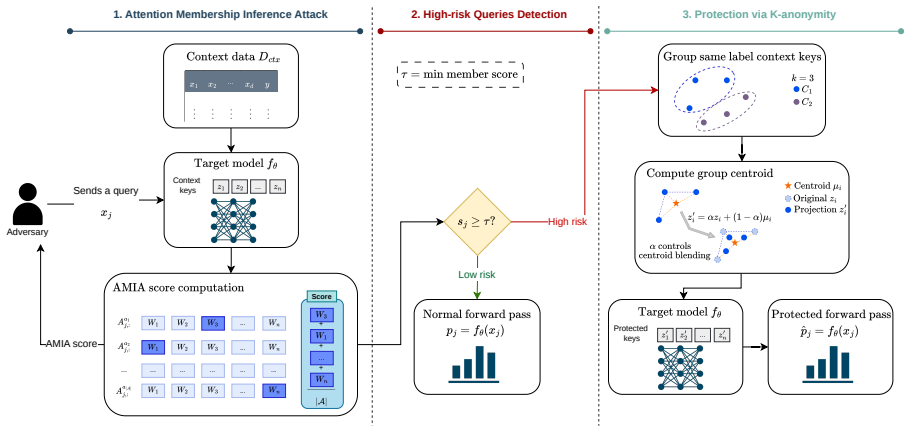
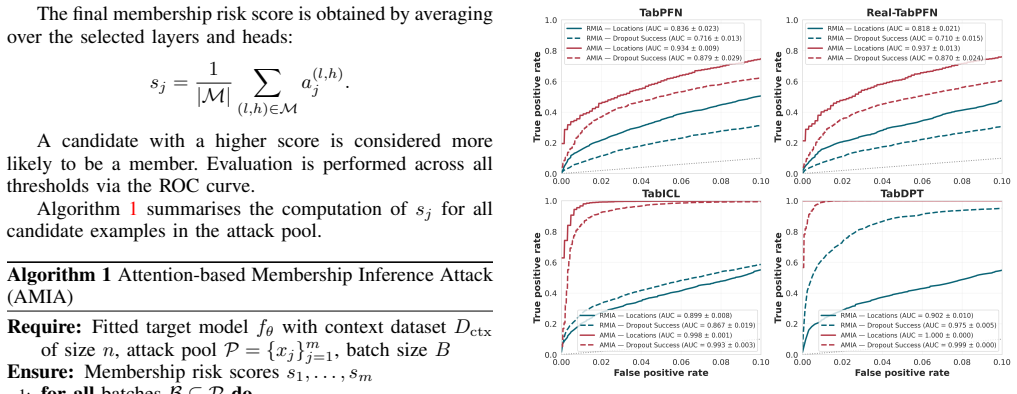
Predictions generated via the attention mechanism in tabular foundation models leak sufficient information to enable effective Membership Inference Attacks. AMIA exploits the concentration of transformer attention patterns to achieve an average gain of 7.7 percent over classical confidence-based attacks, particularly in low false-positive regimes. An inference-time defense inspired by k-anonymity principles, applied only to high-risk queries identified by AMIA scores, reduces membership leakage by an average of 50 percent against the new attack and 25 percent against confidence-based attacks while preserving predictive utility with only 3.9 percent degradation. Fine-tuning introduces an addi
What carries the argument
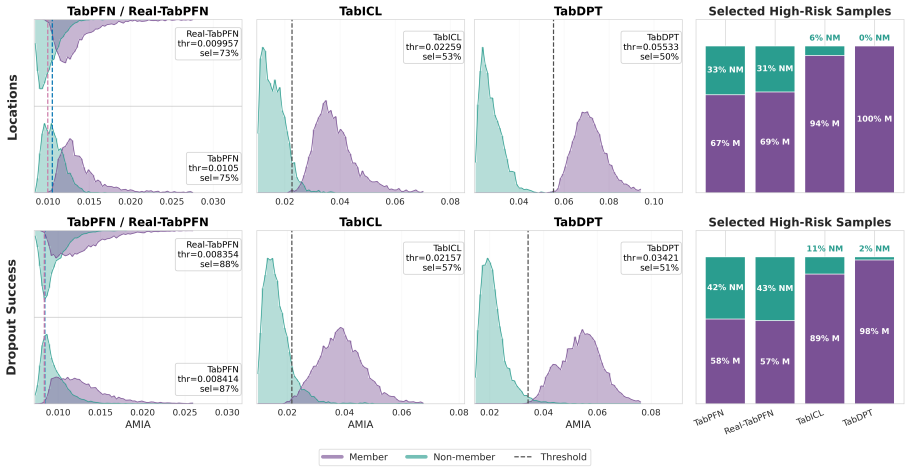
AMIA scores derived from the concentration of attention patterns on context-key representations, used both to mount the attack and to select queries for the k-anonymity-style defense.
If this is right
- Attention-based attacks outperform confidence-based ones by 7.7 percent on average and are strongest in low false-positive regimes.
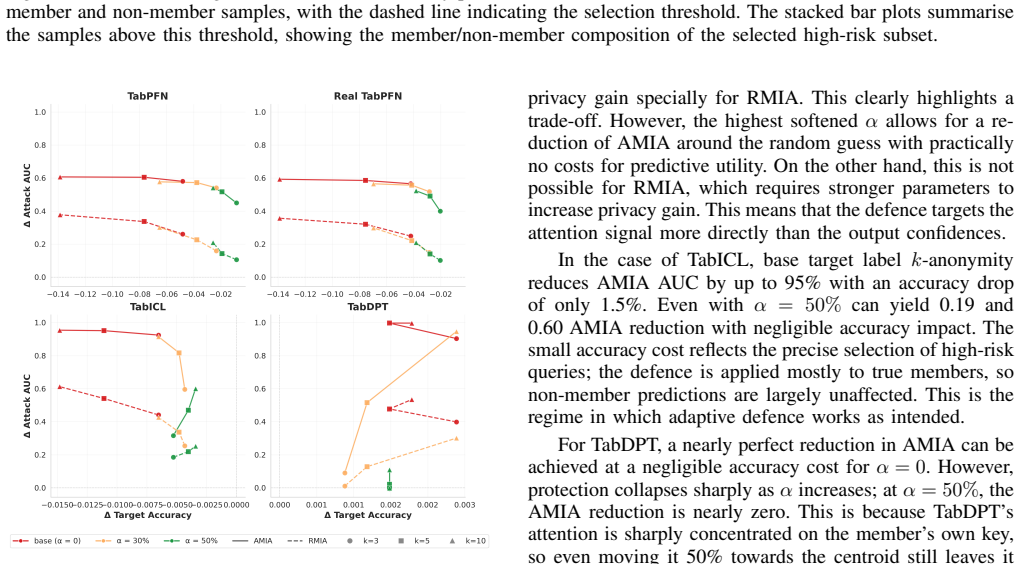
- Targeting only high-risk queries with an inference-time k-anonymity defense cuts leakage from AMIA by 50 percent and from confidence attacks by 25 percent.
- The defense preserves predictive utility with only 3.9 percent average degradation and requires no retraining or noise injection.
- Fine-tuning amplifies memorization, making samples with increased post-fine-tuning confidence more vulnerable to membership inference.
- Context examples supplied at inference time constitute a distinct privacy surface beyond the pre-training data.
Where Pith is reading between the lines
- The same attention leakage could appear in other transformer-based in-context learners outside tabular data if context keys are similarly exposed.
- A defense that only protects high-risk queries may leave an attacker who can force many queries into the system with a residual attack surface.
- If attention concentration is the dominant signal, then architectures that dilute or regularize attention over context might reduce the need for query-level defenses.
Load-bearing premise
Attention patterns concentrate in ways that reliably encode membership signals for context examples even when other model factors vary.
What would settle it
Measure whether randomizing or masking attention weights on context examples drops AMIA success rate to the level of random guessing on the same queries.
Figures
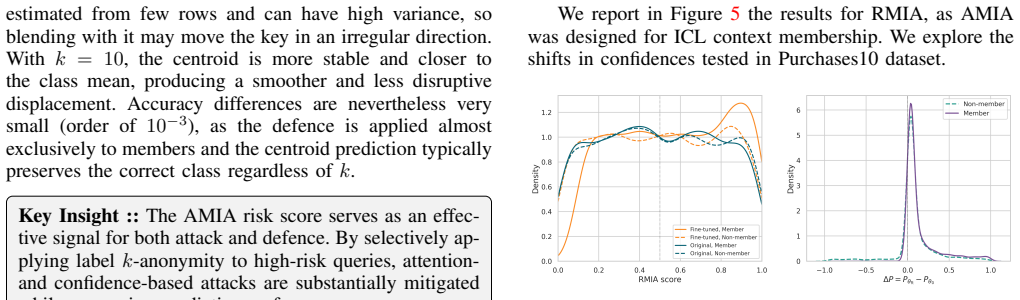
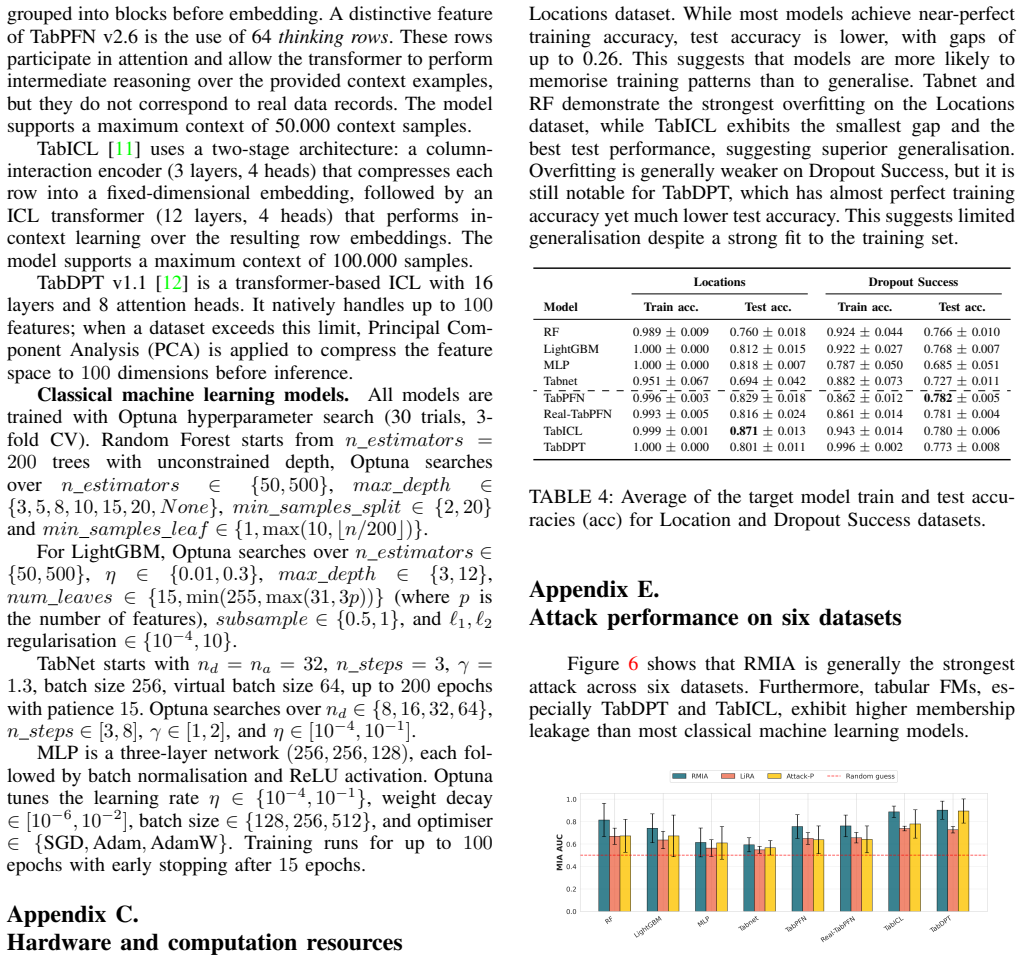


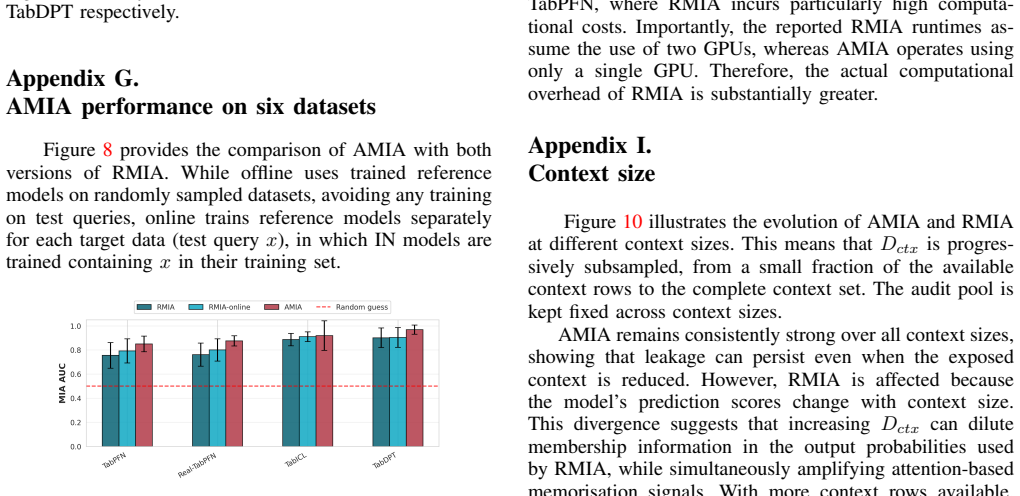
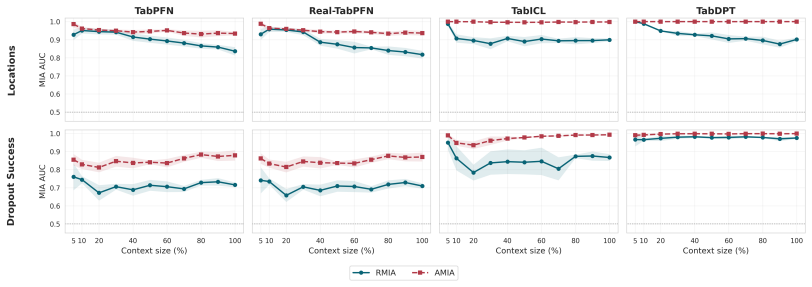
read the original abstract
Tabular foundation models are commonly assumed to present limited privacy concerns as they are often pre-trained on large collections of synthetic data. However, these models leverage in-context learning, where sensitive records may be provided directly at inference time as labelled context examples. In this paper, we demonstrate that predictions generated via the attention mechanism leak sufficient information to enable effective Membership Inference Attacks (MIAs). To highlight this vulnerability, we propose AMIA (Attention-based Membership Inference Attack), a shadow-model-free attack that exploits the concentration of transformer attention patterns. Our results show that attention mechanisms reveal strong membership signals, which exceed classical confidence-based attacks, achieving an average gain of 7.7\%, specially in low false-positive regimes. To mitigate this risk, we introduce an inference-time defence inspired by $k$-anonymity principles. This approach reduces the uniqueness of context-key representations without introducing random noise or retraining the model. By targeting only high-risk queries identified through AMIA scores, the defence substantially reduces membership leakage of this attack by an average of 50\% and 25\% against confidence-based attacks, while preserving predictive utility with only 3.9\% performance degradation. Beyond showing that context examples are vulnerable, we further demonstrate that fine-tuning introduces an additional source of privacy risk. In particular, samples whose prediction confidence increases after fine-tuning become more susceptible to MIAs, indicating that fine-tuning can amplify memorisation and expose sensitive training information through confidence shifts.
Editorial analysis
A structured set of objections, weighed in public.
Referee Report
Summary. The paper claims that attention patterns in tabular foundation models enable effective shadow-model-free membership inference attacks (AMIA) via concentration signals, yielding a 7.7% average gain over confidence-based attacks (especially at low FPR). It further claims that an inference-time k-anonymity-style defense, applied only to high-risk queries identified by AMIA scores, reduces leakage by 50% (vs. AMIA) and 25% (vs. confidence attacks) at a cost of 3.9% predictive utility, and that fine-tuning amplifies memorization as measured by post-fine-tuning confidence increases.
Significance. If the attention-based signal proves independent of query-context similarity and other confounders, the work would identify a previously under-appreciated privacy vector in in-context tabular models and supply a lightweight, model-agnostic mitigation; the shadow-model-free nature and targeted defense would be notable strengths.
major comments (3)
- [§4] §4 (AMIA construction): the claim that attention concentration encodes membership independently of other factors is load-bearing for the 7.7% gain result, yet no ablation is described that matches context examples to queries on cosine similarity (or label balance); if the gain vanishes under such matching, the reported leakage would be an artifact of sampling rather than an inherent attention vulnerability.
- [Abstract, §5] Abstract and §5 (defense evaluation): the 50% and 25% leakage reductions and 3.9% utility degradation are reported without error bars, number of runs, or statistical tests; because the defense is applied selectively via AMIA scores, any confounding in the AMIA signal directly undermines the defense efficacy claims.
- [fine-tuning paragraph] Fine-tuning experiment (final paragraph): the claim that samples with increased post-fine-tuning confidence become more susceptible to MIAs requires explicit controls for overall model calibration shift; without them the observed confidence change could be a global effect rather than evidence of amplified memorization.
minor comments (2)
- Notation for attention scores and AMIA threshold should be defined once in a dedicated subsection rather than introduced piecemeal.
- Table or figure captions for the quantitative results should explicitly list the datasets, model sizes, and number of trials used to obtain the reported percentages.
Simulated Author's Rebuttal
We thank the referee for the constructive feedback. We address each major comment below and outline revisions where the manuscript requires strengthening.
read point-by-point responses
-
Referee: [§4] §4 (AMIA construction): the claim that attention concentration encodes membership independently of other factors is load-bearing for the 7.7% gain result, yet no ablation is described that matches context examples to queries on cosine similarity (or label balance); if the gain vanishes under such matching, the reported leakage would be an artifact of sampling rather than an inherent attention vulnerability.
Authors: We agree that an explicit ablation controlling for cosine similarity between queries and context examples, as well as label balance, is necessary to substantiate that the attention concentration signal operates independently of these factors. The current experiments rely on random sampling, which leaves open the possibility of confounding. We will add this ablation in the revised manuscript by constructing matched query-context pairs and re-evaluating AMIA performance; if the gain persists, it will be reported with the original results for comparison. revision: yes
-
Referee: [Abstract, §5] Abstract and §5 (defense evaluation): the 50% and 25% leakage reductions and 3.9% utility degradation are reported without error bars, number of runs, or statistical tests; because the defense is applied selectively via AMIA scores, any confounding in the AMIA signal directly undermines the defense efficacy claims.
Authors: The referee correctly notes the absence of error bars, run counts, and statistical tests in the defense results. Because the defense is conditioned on AMIA scores, robustness of those scores is critical. We will rerun all defense experiments across multiple random seeds (minimum five runs), report means with standard deviations, and include statistical comparisons (e.g., paired t-tests) between defended and undefended settings in the revised §5 and abstract. revision: yes
-
Referee: [fine-tuning paragraph] Fine-tuning experiment (final paragraph): the claim that samples with increased post-fine-tuning confidence become more susceptible to MIAs requires explicit controls for overall model calibration shift; without them the observed confidence change could be a global effect rather than evidence of amplified memorization.
Authors: We acknowledge that without controls for global calibration shifts, the observed post-fine-tuning confidence increases could reflect a model-wide effect rather than targeted memorization. We will add explicit controls in the revision, such as comparing confidence changes on a held-out non-fine-tuned set and normalizing per-sample confidence deltas against the overall distribution shift, before correlating with MIA success rates. revision: yes
Circularity Check
No circularity in derivation chain
full rationale
The paper presents an empirical attack (AMIA) and defense without any mathematical derivations, equations, or parameter fittings that reduce to inputs by construction. The attack is explicitly shadow-model-free and relies on observed attention concentration patterns as an independent signal. No self-citations, uniqueness theorems, or ansatzes are invoked to justify core claims in the abstract or description. The central results are presented as experimental measurements rather than derived predictions, making the work self-contained against external benchmarks.
Axiom & Free-Parameter Ledger
Reference graph
Works this paper leans on
-
[1]
Sur- vey on privacy-preserving techniques for microdata publication,
T. Carvalho, N. Moniz, P. Faria, and L. Antunes, “Sur- vey on privacy-preserving techniques for microdata publication,”ACM Computing Surveys, vol. 55, no. 14s, pp. 1–42, 2023
2023
-
[2]
Membership inference attacks on machine learning: A survey,
H. Hu, Z. Salcic, L. Sun, G. Dobbie, P. S. Yu, and X. Zhang, “Membership inference attacks on machine learning: A survey,”ACM Computing Surveys (CSUR), vol. 54, no. 11s, pp. 1–37, 2022
2022
-
[3]
Tabarena: A liv- ing benchmark for machine learning on tabular data,
N. Erickson, L. Purucker, A. Tschalzev, D. Holzm ¨uller, P. Desai, D. Salinas, and F. Hutter, “Tabarena: A liv- ing benchmark for machine learning on tabular data,” Advances in Neural Information Processing Systems, vol. 38, 2026
2026
-
[4]
Language models are few-shot learners,
T. Brown, B. Mann, N. Ryder, M. Subbiah, J. D. Ka- plan, P. Dhariwal, A. Neelakantan, P. Shyam, G. Sas- try, A. Askellet al., “Language models are few-shot learners,”Advances in neural information processing systems, vol. 33, pp. 1877–1901, 2020
1901
-
[5]
What can transformers learn in-context? a case study of sim- ple function classes,
S. Garg, D. Tsipras, P. S. Liang, and G. Valiant, “What can transformers learn in-context? a case study of sim- ple function classes,”Advances in neural information processing systems, vol. 35, pp. 30 583–30 598, 2022
2022
-
[6]
Understanding emergent in-context learning from a kernel regression perspective,
C. Han, Z. Wang, H. Zhao, and H. Ji, “Understanding emergent in-context learning from a kernel regression perspective,”Transactions on Machine Learning Re- search, 2025
2025
-
[7]
The mechanistic basis of data dependence and abrupt learning in an in-context classification task,
G. Reddy, “The mechanistic basis of data dependence and abrupt learning in an in-context classification task,” arXiv preprint arXiv:2312.03002, 2023
-
[8]
In-context learning for extreme multi-label classification,
K. D’Oosterlinck, O. Khattab, F. Remy, T. De- meester, C. Develder, and C. Potts, “In-context learning for extreme multi-label classification,”arXiv preprint arXiv:2401.12178, 2024
-
[9]
TabPFN: A Transformer That Solves Small Tabular Classification Problems in a Second
N. Hollmann, S. M ¨uller, K. Eggensperger, and F. Hut- ter, “TabPFN: A Transformer That Solves Small Tab- ular Classification Problems in a Second,” Sep. 2023, arXiv:2207.01848 [cs]
work page internal anchor Pith review Pith/arXiv arXiv 2023
-
[10]
TabPFN: Accurate predictions on small data with a tabular foundation model,
N. Hollmann, S. M ¨uller, L. Purucker, A. Krishnaku- mar, M. K ¨orfer, S. B. Hoo, R. T. Schirrmeister, and F. Hutter, “TabPFN: Accurate predictions on small data with a tabular foundation model,”Nature, vol. 637, no. 8045, pp. 319–326, Jan. 2025
2025
-
[11]
TabICL: A Tabular Foundation Model for In-Context Learning on Large Data
J. Qu, D. Holzm ¨uller, G. Varoquaux, and M. L. Morvan, “TabICL: A Tabular Foundation Model for In-Context Learning on Large Data,” Feb. 2025, arXiv:2502.05564 [cs]
work page internal anchor Pith review Pith/arXiv arXiv 2025
-
[12]
Tabdpt: Scaling tabular foundation mod- els on real data,
J. Ma, V . Thomas, R. Hosseinzadeh, A. Labach, J. Cresswell, K. Golestan, G. Yu, A. L. Caterini, and M. V olkovs, “Tabdpt: Scaling tabular foundation mod- els on real data,”Advances in Neural Information Pro- cessing Systems, vol. 38, pp. 172 692–172 722, 2026
2026
-
[13]
Tabstar: A tabular foundation model for tabular data with text fields,
A. Arazi, E. Shapira, and R. Reichart, “Tabstar: A tabular foundation model for tabular data with text fields,”Advances in Neural Information Processing Systems, vol. 38, pp. 172 108–172 161, 2026
2026
-
[14]
Mitra: Mixed synthetic priors for enhancing tabular foundation models,
X. Zhang, D. Maddix Robinson, J. Yin, N. Erickson, A. F. Ansari, B. Han, S. Zhang, L. Akoglu, C. Falout- sos, M. Mahoneyet al., “Mitra: Mixed synthetic priors for enhancing tabular foundation models,”Advances in neural information processing systems, vol. 38, pp. 15 795–15 840, 2026
2026
-
[15]
Tabflex: Scaling tabular learning to millions with lin- ear attention,
Y . Zeng, T. Dinh, W. Kang, and A. C. Mueller, “Tabflex: Scaling tabular learning to millions with lin- ear attention,”arXiv preprint arXiv:2506.05584, 2025
-
[16]
Defenses to membership in- ference attacks: A survey,
L. Hu, A. Yan, H. Yan, J. Li, T. Huang, Y . Zhang, C. Dong, and C. Yang, “Defenses to membership in- ference attacks: A survey,”ACM Computing Surveys, vol. 56, no. 4, pp. 1–34, 2023
2023
-
[17]
Membership inference attacks from first principles,
N. Carlini, S. Chien, M. Nasr, S. Song, A. Terzis, and F. Tramer, “Membership inference attacks from first principles,” in2022 IEEE symposium on security and privacy (SP). IEEE, 2022, pp. 1897–1914
2022
-
[18]
Low-cost high- power membership inference attacks,
S. Zarifzadeh, P. Liu, and R. Shokri, “Low-cost high- power membership inference attacks,”arXiv preprint arXiv:2312.03262, 2023
-
[19]
Enhanced membership inference at- tacks against machine learning models,
J. Ye, A. Maddi, S. K. Murakonda, V . Bindschaedler, and R. Shokri, “Enhanced membership inference at- tacks against machine learning models,” inProceed- ings of the 2022 ACM SIGSAC conference on computer and communications security, 2022, pp. 3093–3106
2022
-
[20]
Membership inference attacks against machine learn- ing models,
R. Shokri, M. Stronati, C. Song, and V . Shmatikov, “Membership inference attacks against machine learn- ing models,” in2017 IEEE symposium on security and privacy (SP). IEEE, 2017, pp. 3–18
2017
-
[21]
On the privacy risk of in-context learn- ing,
H. Duan, A. Dziedzic, M. Yaghini, N. Papernot, and F. Boenisch, “On the privacy risk of in-context learn- ing,”arXiv preprint arXiv:2411.10512, 2024
-
[22]
Membership Inference Attacks Against In-Context Learning,
R. Wen, Z. Li, M. Backes, and Y . Zhang, “Membership Inference Attacks Against In-Context Learning,” in Proceedings of the 2024 on ACM SIGSAC Conference on Computer and Communications Security. Salt Lake City UT USA: ACM, Dec. 2024, pp. 3481–3495
2024
-
[23]
Context-aware membership inference attacks against pre-trained large language models,
H. Chang, A. S. Shamsabadi, K. Katevas, H. Haddadi, and R. Shokri, “Context-aware membership inference attacks against pre-trained large language models,” in Proceedings of the 2025 Conference on Empirical Methods in Natural Language Processing, 2025, pp. 7299–7321
2025
-
[24]
Lora-leak: Membership inference at- tacks against lora fine-tuned language models,
D. Ran, X. He, T. Cong, A. Wang, Q. Li, and X. Wang, “Lora-leak: Membership inference at- tacks against lora fine-tuned language models,”arXiv preprint arXiv:2507.18302, 2025
-
[25]
ContextLeak: Auditing Leakage in Private In-Context Learning Methods
J. Choi, S. Cao, X. Dong, A. Banayeeanzade, W. B. Zhu, R. Jia, and S. P. Karimireddy, “Contextleak: Au- diting leakage in private in-context learning methods,” arXiv preprint arXiv:2512.16059, 2025
work page internal anchor Pith review Pith/arXiv arXiv 2025
-
[26]
Tab-mia: A benchmark dataset for mem- bership inference attacks on tabular data in llms,
E. German, S. Antebi, D. Samira, A. Shabtai, and Y . Elovici, “Tab-mia: A benchmark dataset for mem- bership inference attacks on tabular data in llms,” ArXiv, vol. abs/2507.17259, 2025
-
[27]
Differential privacy,
C. Dwork, “Differential privacy,” inEncyclopedia of Cryptography, Security and Privacy. Springer, 2025, pp. 649–652
2025
-
[28]
Privacy- preserving in-context learning for large language mod- els,
T. Wu, A. Panda, J. T. Wang, and P. Mittal, “Privacy- preserving in-context learning for large language mod- els,” inInternational Conference on Learning Repre- sentations, vol. 2024, 2024, pp. 20 005–20 040
2024
-
[29]
Locally differentially pri- vate in-context learning,
C. Zheng, K. Sun, W. Zhao, H. Zhou, L. Jiang, S. Song, and C. Zhou, “Locally differentially pri- vate in-context learning,” inProceedings of the 2024 Joint International Conference on Computational Lin- guistics, Language Resources and Evaluation (LREC- COLING 2024), 2024, pp. 10 686–10 697
2024
-
[30]
Pri- vate prediction for large-scale synthetic text genera- tion,
K. Amin, A. Bie, W. Kong, A. Kurakin, N. Pono- mareva, U. Syed, A. Terzis, and S. Vassilvitskii, “Pri- vate prediction for large-scale synthetic text genera- tion,” inFindings of the Association for Computational Linguistics: EMNLP 2024, 2024, pp. 7244–7262
2024
-
[31]
Privacy preserving in-context-learning framework for large lan- guage models,
B. Bhusal, M. Acharya, R. Kaur, C. Samplawski, A. Roy, A. D. Cobb, R. Chadha, and S. Jha, “Privacy preserving in-context-learning framework for large lan- guage models,” inProceedings of the AAAI Conference on Artificial Intelligence, vol. 40, no. 42, 2026, pp. 35 303–35 312
2026
-
[32]
Privacy- preserving in-context learning with differentially pri- vate few-shot generation,
X. Tang, R. Shin, H. Inan, A. Manoel, N. Mireshghal- lah, Z. Lin, S. Gopi, J. Kulkarni, and R. Sim, “Privacy- preserving in-context learning with differentially pri- vate few-shot generation,” inInternational confer- ence on learning representations, vol. 2024, 2024, pp. 33 058–33 077
2024
-
[33]
Differen- tially private in-context learning with nearest neighbor search,
A. Koskela, T. D. Kulkarni, and L. Zumot, “Differen- tially private in-context learning with nearest neighbor search,”ArXiv, vol. abs/2511.04332, 2025
-
[34]
Flocks of stochastic parrots: Differentially private prompt learning for large language models,
H. Duan, A. Dziedzic, N. Papernot, and F. Boenisch, “Flocks of stochastic parrots: Differentially private prompt learning for large language models,”Advances in Neural Information Processing Systems, vol. 36, pp. 76 852–76 871, 2023
2023
-
[35]
Dp- tabicl: In-context learning with differentially private tabular data,
A. N. Carey, K. Bhaila, K. Edemacu, and X. Wu, “Dp- tabicl: In-context learning with differentially private tabular data,” in2024 IEEE International Conference on Big Data (BigData). IEEE, 2024, pp. 1552–1557
2024
-
[36]
When Tables Leak: Attacking String Memorization in LLM-Based Tabular Data Generation
J. Ward, B. Gu, C.-H. Wang, and G. Cheng, “When tables leak: Attacking string memorization in llm-based tabular data generation,”arXiv preprint arXiv:2512.08875, 2025
work page internal anchor Pith review Pith/arXiv arXiv 2025
-
[37]
J. Byun, X. Lin, J. Ward, and G. Cheng, “Risk in context: Benchmarking privacy leakage of foundation models in synthetic tabular data generation,”arXiv preprint arXiv:2507.17066, 2025
-
[38]
Attenmia: Llm membership infer- ence attack through attention signals,
P. Zaree, M. A. A. Mamun, Y . Dong, I. Alouani, and N. Abu-Ghazaleh, “Attenmia: Llm membership infer- ence attack through attention signals,”arXiv preprint arXiv:2601.18110, 2026
-
[39]
Tabnet: Attentive inter- pretable tabular learning,
S. ¨O. Arik and T. Pfister, “Tabnet: Attentive inter- pretable tabular learning,” inProceedings of the AAAI conference on artificial intelligence, vol. 35, no. 8, 2021, pp. 6679–6687
2021
-
[40]
Sok: Challenges in tabular membership inference attacks,
C. P ˆera, T. Carvalho, M. Cordy, and L. Antunes, “Sok: Challenges in tabular membership inference attacks,” arXiv preprint arXiv:2601.15874, 2026
-
[41]
Attention is all you need,
A. Vaswani, N. Shazeer, N. Parmar, J. Uszkoreit, L. Jones, A. N. Gomez, Ł. Kaiser, and I. Polosukhin, “Attention is all you need,”Advances in neural infor- mation processing systems, vol. 30, 2017
2017
-
[42]
Z. Chen and K. Pattabiraman, “Overconfidence is a dangerous thing: Mitigating membership inference at- tacks by enforcing less confident prediction,”arXiv preprint arXiv:2307.01610, 2023
-
[43]
Demystifying membership inference attacks in ma- chine learning as a service,
S. Truex, L. Liu, M. E. Gursoy, L. Yu, and W. Wei, “Demystifying membership inference attacks in ma- chine learning as a service,”IEEE transactions on services computing, vol. 14, no. 6, pp. 2073–2089, 2019
2073
-
[44]
k-anonymity: A model for protecting privacy,
L. Sweeney, “k-anonymity: A model for protecting privacy,”Int. J. Uncertain. Fuzziness Knowl. Based Syst., vol. 10, pp. 557–570, 2002
2002
-
[45]
Practical data-oriented microaggregation for statistical disclo- sure control,
J. Domingo-Ferrer and J. M. Mateo-Sanz, “Practical data-oriented microaggregation for statistical disclo- sure control,”IEEE Trans. Knowl. Data Eng., vol. 14, pp. 189–201, 2002
2002
-
[46]
Purucker, “Mic,” OpenML, id=46943; Accessed May 2026
L. Purucker, “Mic,” OpenML, id=46943; Accessed May 2026
2026
-
[47]
Foursquare global-scale check-in dataset with user social networks,
D. Y ANG, “Foursquare global-scale check-in dataset with user social networks,” accessed Jan 2026
2026
-
[48]
Tabular- bench: Benchmarking adversarial robustness for tab- ular deep learning in real-world use-cases,
T. Simonetto, S. Ghamizi, and M. Cordy, “Tabular- bench: Benchmarking adversarial robustness for tab- ular deep learning in real-world use-cases,”Advances in Neural Information Processing Systems, vol. 37, pp. 78 394–78 430, 2024
2024
-
[49]
Predict Students’ Dropout and Academic Suc- cess,
V . Realinho, M. V . Martins, J. Machado, and L. Bap- tista, “Predict Students’ Dropout and Academic Suc- cess,” UCI Machine Learning Repository, 2021, ac- cessed Jan 2026
2021
-
[50]
Financial indicators us stocks,
Y . Li, “Financial indicators us stocks,” OpenML, id=46567; Accessed May 2026
2026
-
[51]
Acquire valued shoppers challenge,
W. Cukierski, “Acquire valued shoppers challenge,” Kaggle, accessed Jan 2026. Appendix A. Datasets The characteristics of all datasets used to evaluate the MIAs are presented in Table 3. We use datasets that span a range of sample sizes, features, and class labels. The domains include healthcare, finance, education, locations and purchases. Datasetnsample...
2026
discussion (0)
Sign in with ORCID, Apple, or X to comment. Anyone can read and Pith papers without signing in.