Probing the Nature of Lyman Continuum Emitting and Low-metallicity Galaxies Using the SKA
Pith reviewed 2026-06-26 01:14 UTC · model grok-4.3
The pith
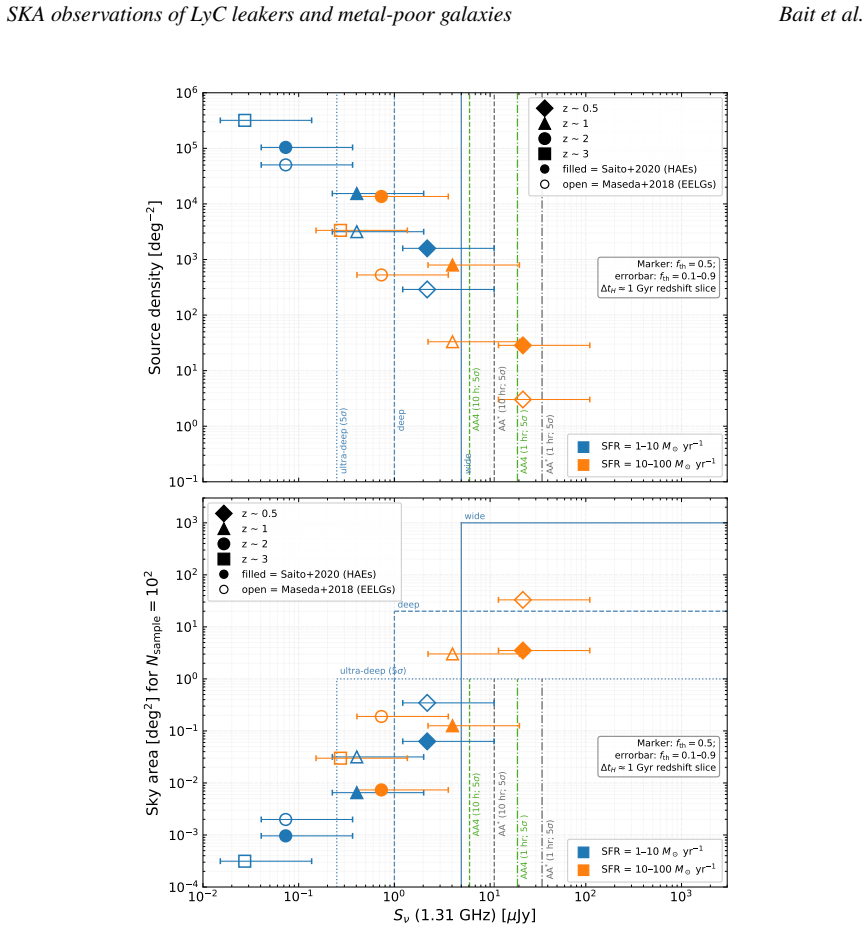
SKA-Mid surveys can assemble samples of 10-100 Lyman continuum emitter candidates per square degree at redshifts 1-3.
A machine-rendered reading of the paper's core claim, the machinery that carries it, and where it could break.
Core claim
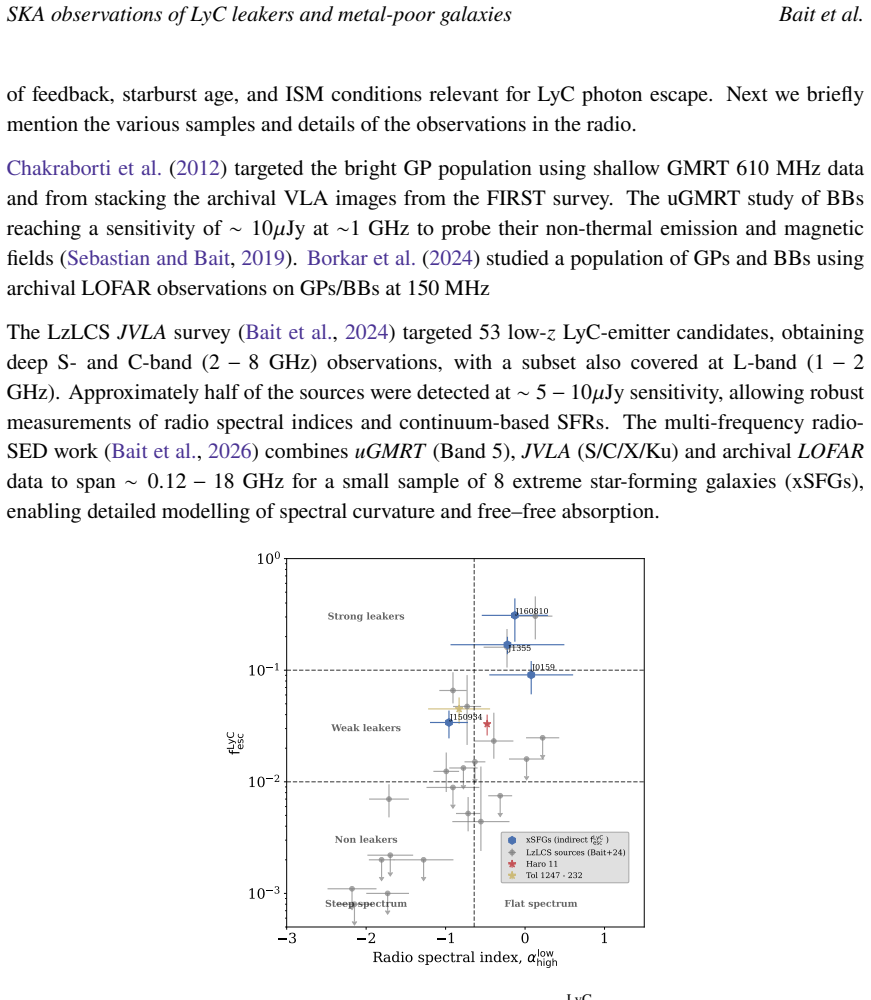
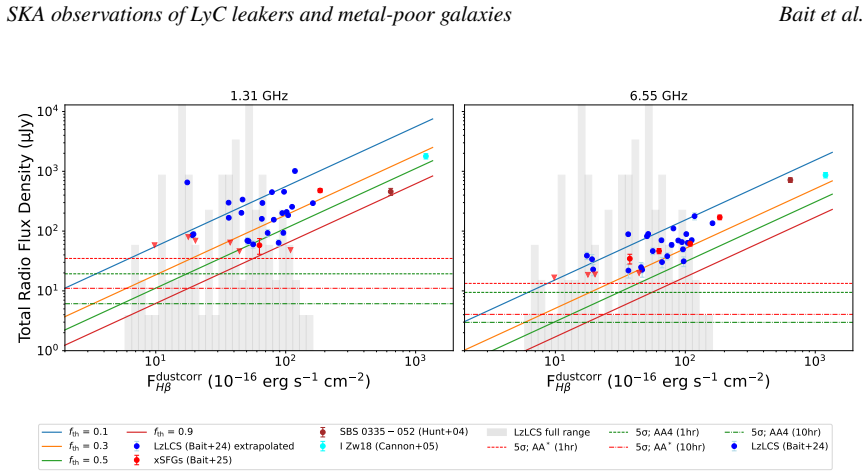
Targeted mid-frequency observations with SKA precursors have revealed connections between radio continuum spectral index, LyC escape fraction, ionization conditions, metallicity, and SFR surface density in low-redshift LCEs, along with deviations from the standard radio-SFR relation. The higher sensitivity of SKA Array Assemblies in Bands 1-5 will allow systematic studies of fainter LCEs and low-mass metal-poor galaxies at higher redshifts. Number density predictions show SKA-Mid surveys can yield samples of roughly 10-100 candidates per square degree over SFR 1-100 solar masses per year at z~1-3, making a dedicated SKA Large Programme feasible. With the full SKA in synergy with JWST, multi-
What carries the argument
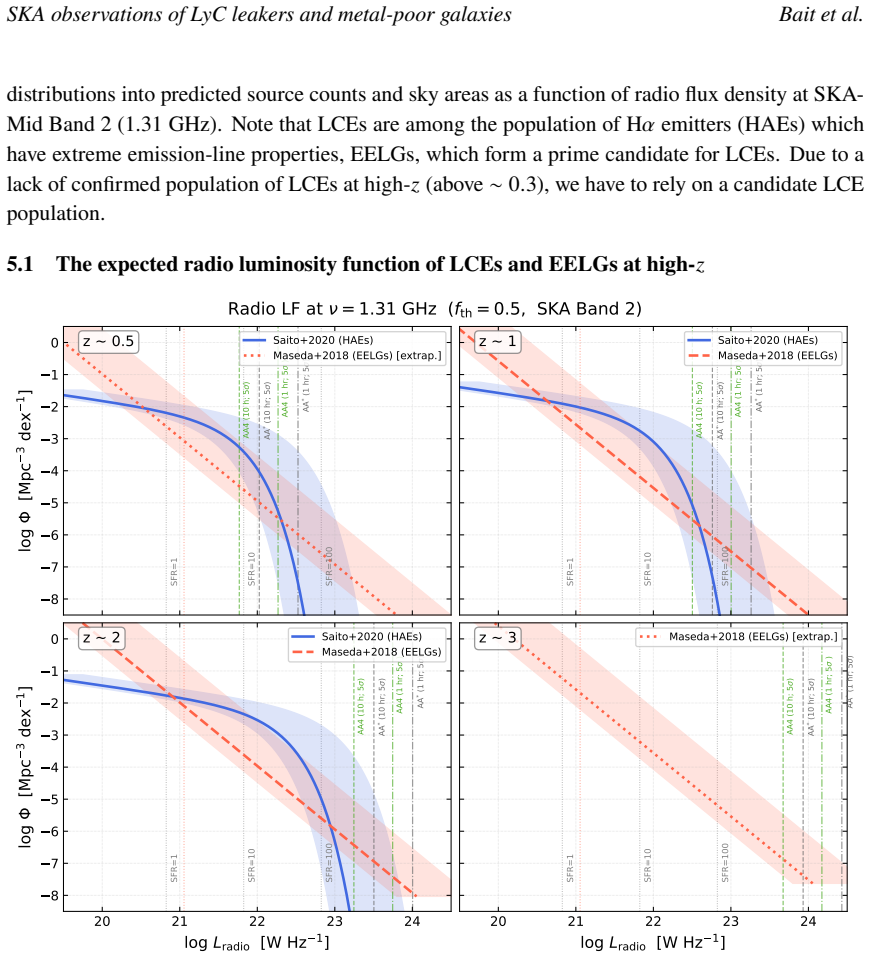
Number density predictions for LCE candidates at z~1-3 derived by extrapolating radio continuum spectral index and escape fraction relations observed in low-redshift systems.
If this is right
- SKA-Mid can target LCE candidates over a star-formation rate range of 1-100 solar masses per year at z~1-3.
- A dedicated SKA Large Programme becomes scientifically feasible with samples of 10-100 candidates per square degree.
- Full SKA observations combined with JWST data can separate thermal and non-thermal radio components in these galaxies.
- Constraints on cosmic-ray energy spectra will inform feedback processes that control LyC photon escape.
Where Pith is reading between the lines
- If the predictions hold, radio observations could help identify which low-mass galaxies contributed most to cosmic reionization.
- The approach opens a path to test whether extreme ionization conditions in metal-poor systems are tied to specific radio signatures across cosmic time.
- Actual SKA detections would provide a direct check on whether the low-redshift scaling relations extend to the faint end of the luminosity function.
Load-bearing premise
The observed links between radio continuum properties and LyC escape in nearby galaxies also apply to fainter systems at redshifts 1 to 3.
What would settle it
SKA-Mid observations of candidate LCEs at z~1-3 that find either far fewer than 10 per square degree or no correlation between radio spectral index and LyC escape fraction would falsify the prediction.
Figures
read the original abstract
The sources responsible for cosmic reionization remain a key open question in observational cosmology. Recent JWST results increasingly suggest that low-mass star-forming galaxies (e.g., compact starbursts and strong emission-line systems) dominated the ionizing photon budget. The physical mechanisms driving Lyman continuum (LyC) photon escape, including supernova, radiative, and cosmic-ray feedback, and the origin of extreme ionization conditions, remain poorly understood. Radio continuum (RC) emission, a well-established star-formation tracer in normal galaxies, is not yet well characterized in such extreme systems, which exhibit high star-formation rate densities, young stellar populations, low metallicity, and hard ionizing spectra. Targeted mid-frequency ($1-15$,GHz) observations with SKA precursors have begun probing low-redshift LyC emitters (LCEs), revealing links between RC spectral index, LyC escape fraction, ionization conditions, metallicity, and SFR surface density, alongwith deviations from the canonical RC$-$SFR relation. The higher sensitivity of the SKA Array Assemblies across Bands $\sim 1-5$ will enable systematic studies of fainter LCEs and low-mass, metal-poor galaxies. We present number density predictions for LCE candidates at $z \sim 1$-$3$, showing that SKA-Mid surveys can assemble samples of $\sim10-100$ candidates per square degree over a star-formation rate range of $1-100$,$M_{\odot}$yr$^{-1}$, making a dedicated SKA Large Programme scientifically feasible. With the full SKA, in synergy with JWST and next generation telescopes, multi-wavelength analyses will robustly constrain the thermal and non-thermal RC components and cosmic-ray energy spectra, providing critical insights into the feedback processes governing LyC escape and star formation in the early universe.
Editorial analysis
A structured set of objections, weighed in public.
Referee Report
Summary. The manuscript claims that correlations between radio continuum spectral index, LyC escape fraction, ionization conditions, metallicity, and SFR surface density observed in low-redshift LCEs with SKA precursors can be used to predict number densities of LCE candidates at z∼1-3. It concludes that SKA-Mid surveys can assemble samples of ∼10-100 candidates per square degree over SFR 1-100 M⊙ yr⁻¹, rendering a dedicated SKA Large Programme feasible, with further synergies possible using the full SKA and JWST to constrain thermal/non-thermal RC components and cosmic-ray spectra.
Significance. If the low-z correlations prove redshift-invariant and applicable to fainter high-z systems, the number-density forecasts would provide a practical justification for allocating SKA time to study feedback mechanisms governing LyC escape in the reionization-era galaxy population, complementing JWST observations. The work identifies a potentially high-impact use case for SKA-Mid Bands 1-5 but does not supply independent validation of the extrapolation.
major comments (2)
- [Abstract] Abstract: The central number-density prediction (∼10-100 candidates deg⁻²) is stated without any derivation, scaling relations, input assumptions, model equations, or error analysis, so it is impossible to determine whether the quoted range is supported by the underlying low-z data or extrapolations.
- [Abstract] Abstract: The feasibility conclusion rests on the untested assumption that the RC-LyC, RC-metallicity, and RC-Σ_SFR relations observed at low redshift remain valid for the fainter, higher-redshift (z∼1-3) population; no high-z calibration data, simulation suite, or redshift-invariance test is presented to support this extrapolation.
minor comments (2)
- Text contains typographical issues including 'alongwith' (should be 'along with'), '1-15,GHz' (comma instead of space or en-dash), and '1-100,M⊙yr−1' (inconsistent spacing and punctuation around units).
- [Abstract] The abstract refers to 'SKA Array Assemblies across Bands ∼1-5' without defining the exact frequency coverage or array configuration assumed for the sensitivity calculations.
Simulated Author's Rebuttal
We thank the referee for their constructive comments. We address the two major comments on the abstract below and indicate where revisions will be made to improve clarity without altering the core content of the work.
read point-by-point responses
-
Referee: [Abstract] Abstract: The central number-density prediction (∼10-100 candidates deg⁻²) is stated without any derivation, scaling relations, input assumptions, model equations, or error analysis, so it is impossible to determine whether the quoted range is supported by the underlying low-z data or extrapolations.
Authors: The number-density forecast is derived in the main text from the low-z RC-LyC, RC-metallicity and RC-Σ_SFR correlations measured with SKA precursors, combined with the observed SFR function at z∼1-3 and standard assumptions on spectral index and luminosity. To address the concern that this is not evident from the abstract alone, we will revise the abstract to include a concise clause referencing the extrapolation method (e.g., “based on low-z SKA-precursor correlations extrapolated via the SFR density evolution”). This change will make the supporting data and assumptions traceable from the abstract. revision: yes
-
Referee: [Abstract] Abstract: The feasibility conclusion rests on the untested assumption that the RC-LyC, RC-metallicity, and RC-Σ_SFR relations observed at low redshift remain valid for the fainter, higher-redshift (z∼1-3) population; no high-z calibration data, simulation suite, or redshift-invariance test is presented to support this extrapolation.
Authors: We agree that the relations are extrapolated from low-redshift observations and that the manuscript contains no independent high-z calibration or simulation test of redshift invariance; such data are not yet available at the necessary sensitivities. The paper frames the result explicitly as a prediction intended to motivate future SKA observations that can test the assumption. We will revise the abstract to state the extrapolation assumption more explicitly, thereby clarifying the basis and limitations of the feasibility claim. revision: partial
Circularity Check
No significant circularity detected
full rationale
The paper's central claim consists of number density forecasts for LCE candidates at z~1-3 derived from observed correlations (RC spectral index vs. LyC escape, metallicity, Σ_SFR) reported in prior SKA-precursor work at low redshift. No equations, self-citations, or derivations are exhibited in the provided text that reduce these forecasts to the input relations by construction, rename a fitted parameter as a prediction, or import uniqueness via author-overlapping citations. The forecasts are presented as extrapolations that remain externally falsifiable with SKA-Mid data, rendering the derivation chain self-contained against independent benchmarks.
Axiom & Free-Parameter Ledger
free parameters (1)
- Scaling factors for RC-SFR relations in extreme galaxies
axioms (1)
- domain assumption Radio continuum emission remains a usable star-formation tracer in low-metallicity, high star-formation-density systems despite known deviations from canonical relations.
Reference graph
Works this paper leans on
-
[2]
Physical properties of extreme emission-line galaxies at z 4─9 from the JWST CEERS survey. , keywords =. doi:10.1051/0004-6361/202449904 , archivePrefix =. 2403.05362 , primaryClass =
-
[5]
Spectroscopy from Photometry: A Population of Extreme Emission Line Galaxies at 1.7 z 6.7 Selected with JWST Medium Band Filters. , keywords =. doi:10.3847/2041-8213/ad01c0 , archivePrefix =. 2304.11181 , primaryClass =
-
[6]
The High Latitude Spectroscopic Survey on the Nancy Grace Roman Space Telescope. , keywords =. doi:10.3847/1538-4357/ac4973 , archivePrefix =. 2110.01829 , primaryClass =
-
[7]
Science with the Ultraviolet Explorer (UVEX). arXiv e-prints , keywords =. doi:10.48550/arXiv.2111.15608 , archivePrefix =. 2111.15608 , primaryClass =
-
[8]
The AstroSat UV Deep Field South. II. A Diverse Set of Lyman-continuum Leakers at z 1. , keywords =. doi:10.3847/1538-4357/adc10e , archivePrefix =. 2410.09515 , primaryClass =
-
[9]
AstroSat detection of Lyman continuum emission from a z = 1.42 galaxy. Nature Astronomy , keywords =. doi:10.1038/s41550-020-1173-5 , archivePrefix =. 2008.11394 , primaryClass =
-
[10]
Diverse properties of Ly emission in low-redshift compact star-forming galaxies with extremely high [O III]/[O II] ratios. , keywords =. doi:10.1093/mnras/stz3041 , archivePrefix =. 1910.12773 , primaryClass =
-
[11]
2026 ,publisher =
Isabella Prandoni and author2 and author3 and author4 and author5 ,title =. 2026 ,publisher =
2026
-
[12]
The Number Density Evolution of Extreme Emission Line Galaxies in 3D-HST: Results from a Novel Automated Line Search Technique for Slitless Spectroscopy. , keywords =. doi:10.3847/1538-4357/aaa76e , archivePrefix =. 1608.01674 , primaryClass =
work page internal anchor Pith review Pith/arXiv arXiv doi:10.3847/1538-4357/aaa76e
-
[13]
The synthetic Emission Line COSMOS catalogue: H and [O II] galaxy luminosity functions and counts at 0.3 < z < 2.5. , keywords =. doi:10.1093/mnras/staa727 , archivePrefix =. 2003.06394 , primaryClass =
-
[17]
Emission-line Wings Driven by Lyman Continuum in the Green Pea Analog Mrk 71. , keywords =. doi:10.3847/2041-8213/ac2c09 , archivePrefix =. 2109.14691 , primaryClass =
-
[19]
Extreme Feedback and the Epoch of Reionization: Clues in the Local Universe
Extreme Feedback and the Epoch of Reionization: Clues in the Local Universe. , keywords =. doi:10.1088/0004-637X/730/1/5 , archivePrefix =. 1101.4219 , primaryClass =
work page internal anchor Pith review Pith/arXiv arXiv doi:10.1088/0004-637x/730/1/5
-
[20]
Advancing Astrophysics with the Square Kilometre Array (AASKA14) , year = 2015, month = apr, eid =
The Cosmic Dawn and Epoch of Reionisation with SKA. Advancing Astrophysics with the Square Kilometre Array (AASKA14) , year = 2015, month = apr, eid =. doi:10.22323/1.215.0001 , archivePrefix =. 1505.07568 , primaryClass =
-
[21]
Green Pea Galaxies and Cohorts: Luminous Compact Emission-line Galaxies in the Sloan Digital Sky Survey. , keywords =. doi:10.1088/0004-637X/728/2/161 , archivePrefix =. 1012.5639 , primaryClass =
work page internal anchor Pith review Pith/arXiv arXiv doi:10.1088/0004-637x/728/2/161
-
[23]
SBS 0335-052E+W: deep VLT/FORS+UVES spectroscopy of the pair of the lowest-metallicity blue compact dwarf galaxies. , keywords =. doi:10.1051/0004-6361/200911965 , archivePrefix =. 0907.2116 , primaryClass =
work page internal anchor Pith review Pith/arXiv arXiv doi:10.1051/0004-6361/200911965
-
[24]
, keywords =
H I observations and star formation in the blue compact galaxy I ZW 18. , keywords =
-
[26]
New candidates for extremely metal-poor emission-line galaxies in the SDSS/BOSS DR10
New candidates for extremely metal-poor emission-line galaxies in the SDSS/BOSS DR10. , keywords =. doi:10.1051/0004-6361/201525697 , archivePrefix =. 1505.03701 , primaryClass =
work page internal anchor Pith review Pith/arXiv arXiv doi:10.1051/0004-6361/201525697
-
[27]
Study of galaxies in the Lynx-Cancer void. II. Element abundances. Astrophysical Bulletin , keywords =. doi:10.1134/S1990341311030011 , archivePrefix =. 1108.4850 , primaryClass =
work page internal anchor Pith review Pith/arXiv arXiv doi:10.1134/s1990341311030011
-
[28]
Hunting for extremely metal-poor emission-line galaxies in the Sloan Digital Sky Survey: MMT and 3.5 m APO observations. , keywords =. doi:10.1051/0004-6361/201219733 , archivePrefix =. 1207.5971 , primaryClass =
work page internal anchor Pith review Pith/arXiv arXiv doi:10.1051/0004-6361/201219733
-
[29]
MMT observations of new extremely metal-poor emission-line galaxies in the Sloan Digital Sky Survey
MMT Observations of New Extremely Metal-poor Emission-Line Galaxies in the Sloan Digital Sky Survey. , keywords =. doi:10.1086/519922 , archivePrefix =. 0704.3842 , primaryClass =
work page internal anchor Pith review Pith/arXiv arXiv doi:10.1086/519922
-
[31]
The Physics of the Far-infrared-Radio Correlation. I. Calorimetry, Conspiracy, and Implications. , keywords =. doi:10.1088/0004-637X/717/1/1 , archivePrefix =. 0907.4161 , primaryClass =
work page internal anchor Pith review Pith/arXiv arXiv doi:10.1088/0004-637x/717/1/1
-
[32]
Magnetic Fields in Starburst Galaxies and The Origin of the FIR-Radio Correlation
Magnetic Fields in Starburst Galaxies and the Origin of the FIR-Radio Correlation. , keywords =. doi:10.1086/504035 , archivePrefix =. astro-ph/0601626 , primaryClass =
work page internal anchor Pith review Pith/arXiv arXiv doi:10.1086/504035
-
[33]
The Radio Spectral Energy Distribution and Star Formation Calibration in MIGHTEE-COSMOS Highly Star-Forming Galaxies at 1.5 < z < 3.5. arXiv e-prints , keywords =. doi:10.48550/arXiv.2506.16275 , archivePrefix =. 2506.16275 , primaryClass =
-
[34]
Mr-Moose: An advanced SED-fitting tool for heterogeneous multi-wavelength datasets
MR-MOOSE: an advanced SED-fitting tool for heterogeneous multi-wavelength data sets. , keywords =. doi:10.1093/mnras/sty831 , archivePrefix =. 1804.01748 , primaryClass =
work page internal anchor Pith review Pith/arXiv arXiv doi:10.1093/mnras/sty831
-
[35]
emcee: The MCMC Hammer. , keywords =. doi:10.1086/670067 , archivePrefix =. 1202.3665 , primaryClass =
work page internal anchor Pith review Pith/arXiv arXiv doi:10.1086/670067
-
[36]
SEDfit: Software for Spectral Energy Distribution Fitting of Photometric Data
SEDfit: Software for Spectral Energy Distribution Fitting of Photometric Data. , keywords =. doi:10.1086/668636 , archivePrefix =. 1210.0285 , primaryClass =
work page internal anchor Pith review Pith/arXiv arXiv doi:10.1086/668636
-
[37]
CIGALE: a python Code Investigating GALaxy Emission
CIGALE: a python Code Investigating GALaxy Emission. , keywords =. doi:10.1051/0004-6361/201834156 , archivePrefix =. 1811.03094 , primaryClass =
work page internal anchor Pith review Pith/arXiv arXiv doi:10.1051/0004-6361/201834156
-
[38]
The Far-Infrared-Radio Correlation at High Redshifts: Physical Considerations and Prospects for the Square Kilometer Array. , keywords =. doi:10.1088/0004-637X/706/1/482 , archivePrefix =. 0910.0011 , primaryClass =
work page internal anchor Pith review Pith/arXiv arXiv doi:10.1088/0004-637x/706/1/482
-
[39]
Blueberry galaxies up to 200 Mpc and their optical and infrared properties. , keywords =. doi:10.1051/0004-6361/202449766 , archivePrefix =. 2405.03391 , primaryClass =
-
[40]
Star Formation in Galaxies Along the Hubble Sequence
Star Formation in Galaxies Along the Hubble Sequence. , keywords =. doi:10.1146/annurev.astro.36.1.189 , archivePrefix =. astro-ph/9807187 , primaryClass =
work page internal anchor Pith review Pith/arXiv arXiv doi:10.1146/annurev.astro.36.1.189
-
[42]
LBT observations of compact star-forming galaxies with extremely high [O III]/[O II] flux ratios: He I emission-line ratios as diagnostics of Lyman continuum leakage. , keywords =. doi:10.1093/mnras/stx1629 , archivePrefix =. 1706.08769 , primaryClass =
-
[43]
Essential Radio Astronomy
-
[44]
The Low-Redshift Lyman Continuum Survey: The Roles of Stellar Feedback and ISM Geometry in LyC Escape. arXiv e-prints , keywords =. doi:10.48550/arXiv.2409.12118 , archivePrefix =. 2409.12118 , primaryClass =
-
[45]
Low-Frequency Turnover Star Forming Galaxies I: Radio Continuum Observations and Global Properties. arXiv e-prints , keywords =. doi:10.48550/arXiv.2412.03143 , archivePrefix =. 2412.03143 , primaryClass =
-
[46]
, keywords =
The metal-poor HII galaxy SBS 0335-052 and the primordial helium abundance. , keywords =
-
[47]
The Relationship between Infrared, Optical, and Ultraviolet Extinction. , keywords =. doi:10.1086/167900 , adsurl =
-
[48]
The efficiency of ionizing photon production and the radiation energy balance in compact star-forming galaxies. , keywords =. doi:10.1093/mnras/stx347 , archivePrefix =. 1702.02420 , primaryClass =
-
[49]
Rejuvenating Star Formation Activity in an Early-type Dwarf Galaxy, LEDA 1915372, with Accreted H I Gas. , keywords =. doi:10.3847/2041-8213/acdef1 , archivePrefix =. 2306.14456 , primaryClass =
-
[50]
PyBDSF: Python Blob Detection and Source Finder
-
[51]
The LOFAR Two-metre Sky Survey. I. Survey description and preliminary data release. , keywords =. doi:10.1051/0004-6361/201629313 , archivePrefix =. 1611.02700 , primaryClass =
work page internal anchor Pith review Pith/arXiv arXiv doi:10.1051/0004-6361/201629313
-
[52]
The LOFAR Two-metre Sky Survey. V. Second data release. , keywords =. doi:10.1051/0004-6361/202142484 , archivePrefix =. 2202.11733 , primaryClass =
-
[53]
Using Lyman-alpha to detect galaxies that leak Lyman continuum
Using Lyman- to detect galaxies that leak Lyman continuum. , keywords =. doi:10.1051/0004-6361/201423978 , archivePrefix =. 1404.2958 , primaryClass =
work page internal anchor Pith review Pith/arXiv arXiv doi:10.1051/0004-6361/201423978
-
[54]
The Mass-Metallicity Relation at z ≃ 8: Direct-method Metallicity Constraints and Near-future Prospects. , keywords =. doi:10.3847/1538-4357/abb943 , archivePrefix =. 2006.02447 , primaryClass =
-
[56]
JADES: The production and escape of ionizing photons from faint Lyman-alpha emitters in the epoch of reionization. , keywords =. doi:10.1051/0004-6361/202347132 , archivePrefix =. 2306.04536 , primaryClass =
-
[57]
Ionising properties of galaxies in JADES for a stellar mass complete sample: resolving the cosmic ionising photon budget crisis at the Epoch of Reionisation. arXiv e-prints , keywords =. doi:10.48550/arXiv.2409.01286 , archivePrefix =. 2409.01286 , primaryClass =
-
[58]
The ionizing photon production efficiency at z 6 for Lyman-alpha emitters using JEMS and MUSE. , keywords =. doi:10.1093/mnras/stad1749 , archivePrefix =. 2303.07931 , primaryClass =
-
[59]
Evolution of the Mass-Metallicity Relation from Redshift z 8 to the Local Universe. , keywords =. doi:10.3847/1538-4357/acdbc1 , archivePrefix =. 2212.02491 , primaryClass =
-
[60]
Metal-poor star formation at z > 6 with JWST: new insight into hard radiation fields and nitrogen enrichment on 20 pc scales. , keywords =. doi:10.1093/mnras/stae682 , archivePrefix =. 2401.08764 , primaryClass =
-
[61]
CEERS Spectroscopic Confirmation of NIRCam-selected z 8 Galaxy Candidates with JWST/NIRSpec: Initial Characterization of Their Properties. , keywords =. doi:10.3847/2041-8213/acd2d9 , archivePrefix =. 2301.09482 , primaryClass =
-
[62]
A JWST/NIRCam study of key contributors to reionization: the star-forming and ionizing properties of UV-faint z 7-8 galaxies. , keywords =. doi:10.1093/mnras/stad1919 , archivePrefix =. 2208.14999 , primaryClass =
-
[63]
A magnified compact galaxy at redshift 9.51 with strong nebular emission lines. Science , keywords =. doi:10.1126/science.adf5307 , archivePrefix =. 2210.15699 , primaryClass =
-
[64]
New insight on the nature of cosmic reionizers from the CEERS survey. , keywords =. doi:10.1051/0004-6361/202347884 , archivePrefix =. 2309.02219 , primaryClass =
-
[65]
JWST/NIRSpec spectroscopy of z = 7-9 star-forming galaxies with CEERS: new insight into bright Ly emitters in ionized bubbles. , keywords =. doi:10.1093/mnras/stad2763 , archivePrefix =. 2301.07072 , primaryClass =
-
[66]
Are Ultra-faint Galaxies at z = 6-8 Responsible for Cosmic Reionization? Combined Constraints from the Hubble Frontier Fields Clusters and Parallels. , keywords =. doi:10.1088/0004-637X/814/1/69 , archivePrefix =. 1509.06764 , primaryClass =
work page internal anchor Pith review Pith/arXiv arXiv doi:10.1088/0004-637x/814/1/69
-
[67]
Cosmic Reionization and Early Star-forming Galaxies: A Joint Analysis of New Constraints from Planck and the Hubble Space Telescope. , keywords =. doi:10.1088/2041-8205/802/2/L19 , archivePrefix =. 1502.02024 , primaryClass =
work page internal anchor Pith review Pith/arXiv arXiv doi:10.1088/2041-8205/802/2/l19 2041
-
[68]
Radio-only and Radio-to-far-ultraviolet Spectral Energy Distribution Modeling of 14 ULIRGs: Insights into the Global Properties of Infrared Bright Galaxies. , keywords =. doi:10.3847/1538-4357/ad2c93 , archivePrefix =. 2402.10786 , primaryClass =
-
[69]
Signatures of the Youngest Starbursts: Optically Thick Thermal Bremsstrahlung Radio Sources in Henize 2-10. , keywords =. doi:10.1086/308075 , archivePrefix =. astro-ph/9907233 , primaryClass =
work page internal anchor Pith review Pith/arXiv arXiv doi:10.1086/308075
-
[70]
The Spectral Energy Distributions of Infant Super Star Clusters in Henize 2-10 from 7mm to 6cm
The Spectral Energy Distributions of Infant Super-Star Clusters in Henize 2-10 from 7 Millimeters to 6 Centimeters. , keywords =. doi:10.1086/378585 , archivePrefix =. astro-ph/0308303 , primaryClass =
work page internal anchor Pith review Pith/arXiv arXiv doi:10.1086/378585
-
[71]
H I content of selected mid-infrared bright, starburst blue compact dwarf galaxies. , keywords =. doi:10.1093/mnras/stad3018 , archivePrefix =. 2310.02202 , primaryClass =
-
[72]
FAST H I 21 cm study of blueberry galaxies. arXiv e-prints , keywords =. doi:10.48550/arXiv.2411.13527 , archivePrefix =. 2411.13527 , primaryClass =
-
[73]
A radio continuum survey of Shapley-Ames galaxies at 2.8cm. II. Separation of thermal and non-thermal radio emission. , keywords =
-
[74]
The Interstellar Medium of Dwarf Galaxies. Galaxies , keywords =. doi:10.3390/galaxies10010011 , archivePrefix =. 2202.08231 , primaryClass =
-
[75]
The Effect of Radiation and Supernovae Feedback on LyC Escape in Local Star-forming Galaxies. arXiv e-prints , keywords =. doi:10.48550/arXiv.2409.05180 , archivePrefix =. 2409.05180 , primaryClass =
-
[76]
Primordial Rotating Disk Composed of 15 Dense Star-Forming Clumps at Cosmic Dawn. arXiv e-prints , keywords =. doi:10.48550/arXiv.2402.18543 , archivePrefix =. 2402.18543 , primaryClass =
-
[77]
Anatomy of a z=6 Lyman-\ \ emitter down to parsec scales: extreme UV slopes, metal-poor regions and possibly leaking star clusters. arXiv e-prints , keywords =. doi:10.48550/arXiv.2407.20331 , archivePrefix =. 2407.20331 , primaryClass =
-
[78]
Bound star clusters observed in a lensed galaxy 460 Myr after the Big Bang. , keywords =. doi:10.1038/s41586-024-07703-7 , archivePrefix =. 2401.03224 , primaryClass =
-
[79]
JWST/NIRCam Probes Young Star Clusters in the Reionization Era Sunrise Arc. , keywords =. doi:10.3847/1538-4357/acb59a , archivePrefix =. 2211.09839 , primaryClass =
-
[80]
The Atomic Gas Mass of Green Pea Galaxies. , keywords =. doi:10.3847/2041-8213/abfb76 , archivePrefix =. 2105.12756 , primaryClass =
-
[81]
Stellar Feedback in Molecular Clouds and its Influence on the Mass Function of Young Star Clusters
Stellar Feedback in Molecular Clouds and its Influence on the Mass Function of Young Star Clusters. , keywords =. doi:10.1088/2041-8205/710/2/L142 , archivePrefix =. 0910.2238 , primaryClass =
work page internal anchor Pith review Pith/arXiv arXiv doi:10.1088/2041-8205/710/2/l142 2041
-
[82]
The Morphologies and Physical Properties of Ultracompact H II Regions. , keywords =. doi:10.1086/191329 , adsurl =
-
[83]
A population of hypercompact H II regions identified from young H II regions. , keywords =. doi:10.1051/0004-6361/202038608 , archivePrefix =. 2011.07620 , primaryClass =
-
[84]
SCOTCH - search for clandestine optically thick compact H II regions: II. , keywords =. doi:10.1093/mnras/stae1910 , archivePrefix =. 2408.07273 , primaryClass =
-
[85]
Bursts of star formation and radiation-driven outflows produce efficient LyC leakage from dense compact star clusters. arXiv e-prints , keywords =. doi:10.48550/arXiv.2408.14591 , archivePrefix =. 2408.14591 , primaryClass =
-
[86]
Witnessing an extreme, highly efficient galaxy formation mode with resolved Ly and LyC emission. arXiv e-prints , keywords =. doi:10.48550/arXiv.2407.18804 , archivePrefix =. 2407.18804 , primaryClass =
-
[87]
Observational signatures of forming young massive clusters: continuum emission from dense H II regions. , keywords =. doi:10.1093/mnras/stad3297 , archivePrefix =. 2305.19432 , primaryClass =
-
[88]
On the Lack of Correlation Between [OIII]/[OII] and Lyman-Continuum Escape Fraction
On the lack of correlation between [O III]/[O II] and Lyman continuum escape fraction. , keywords =. doi:10.1093/mnras/sty3320 , archivePrefix =. 1812.04129 , primaryClass =
work page internal anchor Pith review Pith/arXiv arXiv doi:10.1093/mnras/sty3320
-
[89]
New methods for identifying Lyman continuum leakers and reionization-epoch analogues. , keywords =. doi:10.1093/mnras/staa2355 , archivePrefix =. 2005.01734 , primaryClass =
-
[90]
The Origin and Optical Depth of Ionizing Radiation in the "Green Pea" Galaxies
The Origin and Optical Depth of Ionizing Radiation in the ``Green Pea'' Galaxies. , keywords =. doi:10.1088/0004-637X/766/2/91 , archivePrefix =. 1301.0530 , primaryClass =
work page internal anchor Pith review Pith/arXiv arXiv doi:10.1088/0004-637x/766/2/91
-
[91]
Gas-to-Dust mass ratios in local galaxies over a 2 dex metallicity range
Gas-to-dust mass ratios in local galaxies over a 2 dex metallicity range. , keywords =. doi:10.1051/0004-6361/201322803 , archivePrefix =. 1312.3442 , primaryClass =
work page internal anchor Pith review Pith/arXiv arXiv doi:10.1051/0004-6361/201322803
-
[92]
The dust content of the most metal-poor star-forming galaxies
The dust content of the most metal-poor star-forming galaxies. , keywords =. doi:10.1093/mnras/stw114 , archivePrefix =. 1601.01686 , primaryClass =
work page internal anchor Pith review Pith/arXiv arXiv doi:10.1093/mnras/stw114
discussion (0)
Sign in with ORCID, Apple, or X to comment. Anyone can read and Pith papers without signing in.