SpaceRipple: Lightweight Semantic Delivery for Mission-Oriented LEO Earth Observation Satellite Networks
Pith reviewed 2026-06-26 05:18 UTC · model grok-4.3
The pith
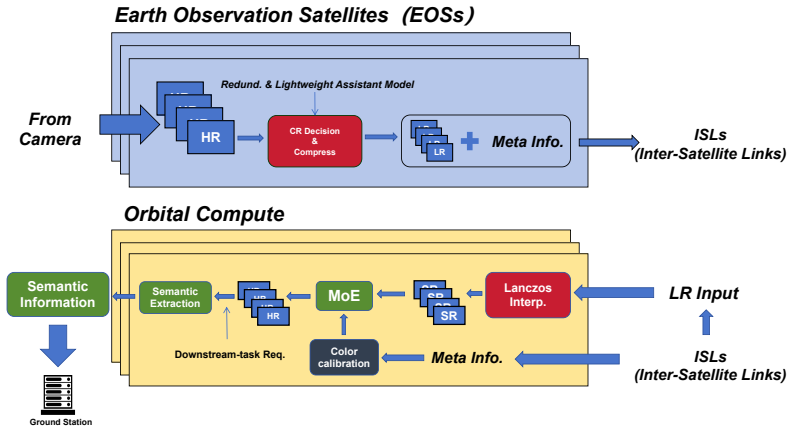
SpaceRipple coordinates compression on sensing satellites with on-board restoration and semantic extraction on edge satellites to deliver task-relevant information instead of full raw images.
A machine-rendered reading of the paper's core claim, the machinery that carries it, and where it could break.
Core claim
SpaceRipple coordinates compression, forwarding, restoration, and semantic inference within a collaborative pipeline, enabling semantic-oriented delivery instead of pixel-level image delivery. A compression-aware MoE enhancement module improves robustness under degraded visual inputs. Experimental results show favorable reconstruction quality, improved semantic detection performance, and substantial bandwidth savings.
What carries the argument
The collaborative pipeline that coordinates adaptive compression and metadata generation on the sensing satellite with restoration and task-relevant semantic extraction on the edge computing satellite, augmented by a compression-aware MoE enhancement module.
If this is right
- Missions can request semantic information directly rather than waiting for full raw-image downlinks.
- Inter-satellite traffic decreases because only compressed representations and metadata are forwarded.
- The MoE module maintains detection accuracy when input quality drops after compression.
- Overall system bandwidth usage drops while task performance holds or improves.
Where Pith is reading between the lines
- Constellations could allocate fewer downlink slots to each sensing satellite by shifting semantic processing to edge nodes.
- Time-sensitive applications such as disaster monitoring might complete analysis cycles faster by avoiding full-image transfers.
- The same pipeline structure could be tested on other constrained networks where raw data volume exceeds link capacity.
Load-bearing premise
On-board restoration and semantic extraction will reliably produce task-relevant information from the compressed representations even under degraded visual inputs.
What would settle it
A test in which semantic detection performance fails to improve or bandwidth savings do not materialize when the pipeline is run on actual LEO satellite hardware with real mission imagery.
Figures


read the original abstract
Earth observation satellite networks generate massive volumes of high-resolution imagery, whereas inter-satellite and downlink resources remain limited. In many time-sensitive missions, ground users require mission-relevant semantic information rather than a full raw-image downlink. This paper proposes SpaceRipple, a lightweight framework for mission-oriented semantic delivery and on-board processing in Earth observation satellite networks. A sensing satellite performs adaptive compression and metadata generation to reduce inter-satellite traffic, while an edge computing satellite restores the received representation and extracts task-relevant semantic information. Unlike fidelity-driven image transmission, SpaceRipple coordinates compression, forwarding, restoration, and semantic inference within a collaborative pipeline, enabling semantic-oriented delivery instead of pixel-level image delivery. A compression-aware MoE enhancement module is further introduced to improve robustness under degraded visual inputs. Experimental results show that SpaceRipple achieves favorable reconstruction quality, improved semantic detection performance, and substantial bandwidth savings, demonstrating its potential for efficient and reliable Earth observation under constrained satellite-network resources.
Editorial analysis
A structured set of objections, weighed in public.
Referee Report
Summary. The manuscript proposes SpaceRipple, a lightweight framework for mission-oriented semantic delivery in LEO Earth observation satellite networks. A sensing satellite performs adaptive compression and metadata generation to reduce inter-satellite traffic, while an edge computing satellite restores the received representation and extracts task-relevant semantic information. The approach coordinates compression, forwarding, restoration, and semantic inference in a collaborative pipeline, augmented by a compression-aware MoE enhancement module for robustness under degraded inputs, with claimed benefits in reconstruction quality, semantic detection performance, and bandwidth savings over pixel-level delivery.
Significance. If the experimental claims hold under detailed validation, the work could enable more efficient use of constrained satellite resources by prioritizing semantic information over raw imagery for time-sensitive missions.
major comments (1)
- [Abstract] Abstract: the abstract asserts positive experimental outcomes on reconstruction, detection, and bandwidth but supplies no quantitative metrics, baselines, datasets, or method details, so it is not possible to determine whether the data or derivations support the claims as stated.
Simulated Author's Rebuttal
We thank the referee for their review. The single major comment concerns the abstract's lack of quantitative detail. We address it directly below.
read point-by-point responses
-
Referee: [Abstract] Abstract: the abstract asserts positive experimental outcomes on reconstruction, detection, and bandwidth but supplies no quantitative metrics, baselines, datasets, or method details, so it is not possible to determine whether the data or derivations support the claims as stated.
Authors: We agree the abstract would be strengthened by including concrete metrics. The full manuscript reports specific results (e.g., reconstruction PSNR/SSIM, semantic detection mAP, and bandwidth reduction percentages) against explicit baselines on standard Earth-observation datasets; these appear in the experimental section. In the revised version we will condense the key quantitative outcomes, baselines, and dataset references into the abstract while preserving its length constraints. revision: yes
Circularity Check
No derivation chain or equations present; no circularity
full rationale
The paper is a system/framework description for semantic delivery in satellite networks. The abstract and available text contain no equations, derivations, fitted parameters, predictions, or mathematical claims that could reduce to inputs by construction. No self-citations, ansatzes, or uniqueness theorems are invoked in a load-bearing way. The central claims rest on experimental results and pipeline coordination rather than any self-referential reduction, making the work self-contained against the circularity criteria.
Axiom & Free-Parameter Ledger
Reference graph
Works this paper leans on
-
[1]
DeepREM: Deep-learning- based radio environment map estimation from sparse measurements,
G. Wang, G. Wan, Z. Su, Y . Wang, Y . Jia, G. Li, and S. Liang, “High- performance on-orbit intelligent computing and real-time services for remote sensing satellites based on large-scale computing power in space,”IEEE Access, vol. 13, pp. 92114–92133, 2025, doi: 10.1109/AC- CESS.2025.3573932
work page doi:10.1109/ac- 2025
-
[2]
J.-H. Chen, W.-C. Kuo, and W. Liao, “SpaceEdge: Optimizing service latency and sustainability for space-centric task offloading in LEO satel- lite networks,”IEEE Transactions on Wireless Communications, vol. 23, no. 10, pp. 15435–15446, 2024, doi: 10.1109/TWC.2024.3429510
-
[3]
M. Wang, S. Xiang, and J. Xiao, “Task-oriented intelligent compression method for high resolution optical satellite remote sensing image,” Geomatics and Information Science of Wuhan University, vol. 47, no. 8, pp. 1213–1219, 2022, doi: 10.13203/j.whugis20220153
-
[4]
Semantic communication: A survey of its theoretical development,
G. Xin, P. Fan, and K. B. Letaief, “Semantic communication: A survey of its theoretical development,”Entropy, vol. 26, no. 2, Art. no. 102, 2024, doi: 10.3390/e26020102
-
[5]
A knowledge base driven task-oriented image semantic communication scheme,
C. Guo, J. Xi, Z. He, J. Liu, and J. Yang, “A knowledge base driven task-oriented image semantic communication scheme,”Remote Sensing, vol. 16, no. 21, Art. no. 4044, 2024, doi: 10.3390/rs16214044
-
[6]
A low-bit-rate image semantic commu- nication system based on semantic graph,
J. Dong, T. Yan, and W. Sun, “A low-bit-rate image semantic commu- nication system based on semantic graph,”Electronics, vol. 13, no. 12, Art. no. 2366, 2024, doi: 10.3390/electronics13122366
-
[7]
DeepSpace: Super resolution powered efficient and reliable satellite image data acquisition,
C. Sun, Y . Zhang, B. Tao, D. Vasisht, and M. K. Marina, “DeepSpace: Super resolution powered efficient and reliable satellite image data acquisition,” inProc. ACM SIGCOMM Conf. (SIGCOMM), Coimbra, Portugal, Sept. 2025, pp. 311–328, doi: 10.1145/3718958.3750523
-
[8]
Scaling vision with sparse mixture of experts,
C. Riquelme, J. Puigcerver, B. Mustafa, M. Neumann, R. Jenatton, A. Susano Pinto, D. Keysers, and N. Houlsby, “Scaling vision with sparse mixture of experts,” inAdvances in Neural Information Process- ing Systems, vol. 34, 2021
2021
-
[9]
In: 2018 IEEE/CVF Con- ference on Computer Vision and Pattern Recognition
R. Zhang, P. Isola, A. A. Efros, E. Shechtman, and O. Wang, “The unreasonable effectiveness of deep features as a perceptual metric,” inProc. IEEE/CVF Conf. Computer Vision and Pattern Recognition (CVPR), 2018, pp. 586–595, doi: 10.1109/CVPR.2018.00068
discussion (0)
Sign in with ORCID, Apple, or X to comment. Anyone can read and Pith papers without signing in.