TGHE: Template-based Graph Homomorphic Encryption for Privacy-Preserving GNN Inference in Edge-Cloud Systems
Pith reviewed 2026-06-26 04:43 UTC · model grok-4.3
The pith
Template packing of convergent local tree shapes into shared ciphertexts enables encrypted GNN inference on million-node graphs.
A machine-rendered reading of the paper's core claim, the machinery that carries it, and where it could break.
Core claim
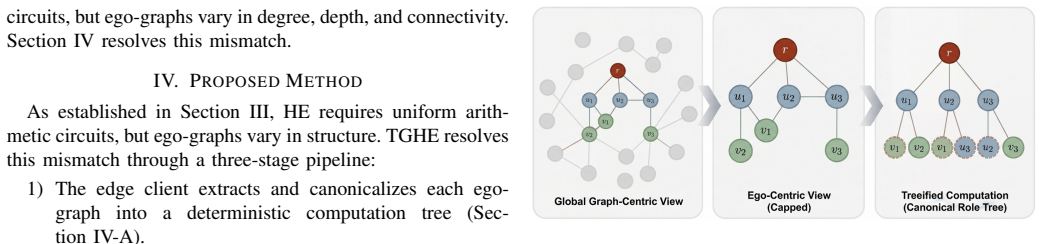
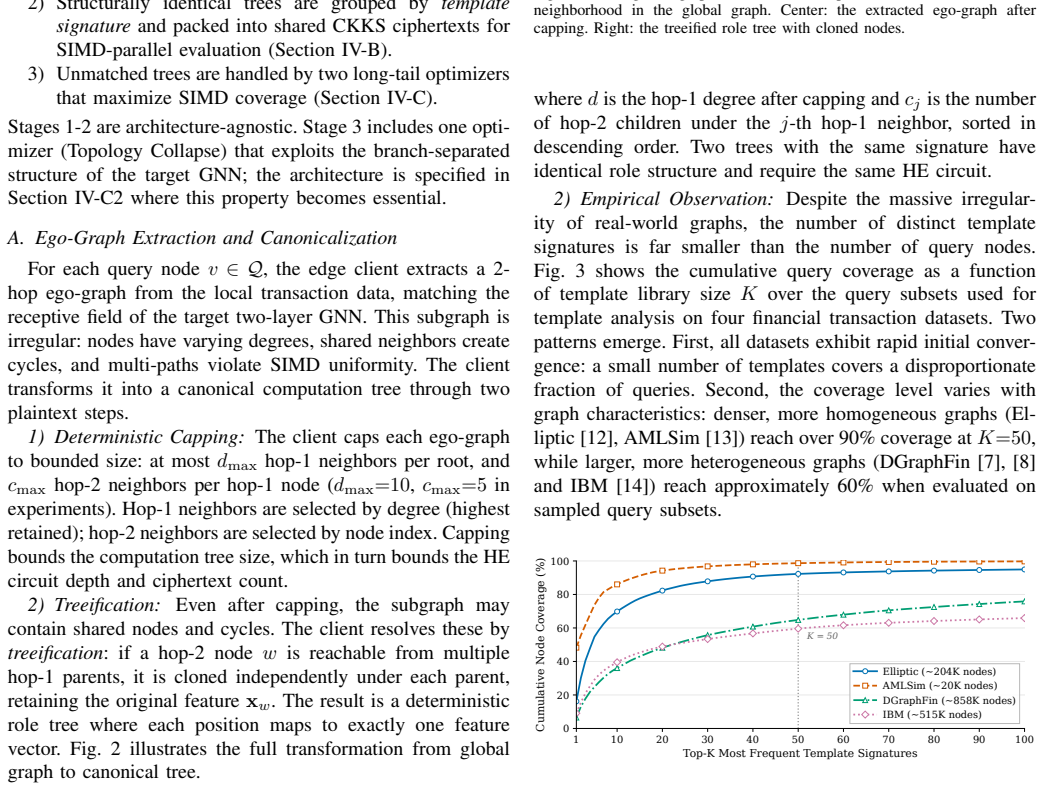
TGHE resolves the scalability barrier of graph-centric HE-GNN systems by exploiting the template phenomenon in transaction graphs, where local computation trees converge into a small set of structural shapes, allowing canonicalization of ego-graphs and packing of structurally identical trees into shared CKKS ciphertexts for SIMD-parallel encrypted inference, with Approximate Template Fitting and Topology Collapse providing full SIMD coverage.
What carries the argument
The template phenomenon, where local computation trees converge to few shapes, combined with Approximate Template Fitting and Topology Collapse to pack identical trees into shared CKKS ciphertexts for SIMD execution.
Load-bearing premise
Local computation trees in transaction graphs converge into a small set of structural shapes that Approximate Template Fitting and Topology Collapse can exploit for full SIMD coverage without meaningful accuracy degradation.
What would settle it
Run the method on a synthetic transaction graph dataset constructed with high structural diversity in local computation trees and measure whether speedup falls below 10x or AUC loss exceeds 0.01.
Figures

read the original abstract
Existing homomorphic encryption (HE)-based GNN systems adopt a graph-centric paradigm that couples per-query cost to global graph size, limiting evaluations to at most ~20k nodes and making them incompatible with dynamic, large-scale financial graphs. We propose TGHE (Template-based Graph Homomorphic Encryption), an ego-centric framework that resolves this by exploiting a template phenomenon: local computation trees in transaction graphs converge into a small set of structural shapes. TGHE canonicalizes ego-graphs at the edge and packs structurally identical trees into shared CKKS ciphertexts for SIMD-parallel encrypted inference, with two long-tail optimizers (Approximate Template Fitting and Topology Collapse) ensuring full SIMD coverage. On DGraphFin (3.7M nodes, 4.3M edges), TGHE-Collapse achieves a 66.9x speedup over the sequential encrypted baseline with less than 0.002 AUC loss.
Editorial analysis
A structured set of objections, weighed in public.
Referee Report
Summary. The manuscript proposes TGHE, an ego-centric framework for homomorphic encryption (HE)-based GNN inference that exploits an observed 'template phenomenon' in transaction graphs: local computation trees converge into a small set of structural shapes. It canonicalizes ego-graphs at the edge, packs identical trees into shared CKKS ciphertexts for SIMD-parallel encrypted inference, and applies two optimizers (Approximate Template Fitting and Topology Collapse) for full SIMD coverage. The central empirical claim, stated in the abstract, is that TGHE-Collapse achieves a 66.9x speedup over the sequential encrypted baseline on DGraphFin (3.7M nodes, 4.3M edges) with less than 0.002 AUC loss.
Significance. If the empirical result and underlying template assumption hold under scrutiny, the work would meaningfully extend the practical reach of privacy-preserving GNN inference to large-scale financial graphs, addressing the ~20k-node scalability limit of prior graph-centric HE approaches. The ego-centric design and concrete, falsifiable performance numbers on a public large dataset constitute a clear strength; the approach could enable edge-cloud deployments where per-query cost is decoupled from global graph size.
major comments (2)
- [Abstract / Experimental Results] Abstract and Experimental Results: The headline claim of 66.9x speedup with <0.002 AUC loss on DGraphFin is presented without implementation details, error analysis, verification of the template convergence phenomenon, description of the sequential encrypted baseline, or any reproducibility artifacts; this directly undermines assessment of the central performance contribution.
- [Method] Method section (description of Approximate Template Fitting and Topology Collapse): The core assumption that local computation trees converge to a small set of shapes enabling full SIMD coverage is stated but lacks formal characterization, bounds on approximation error, or empirical validation of the convergence rate; this assumption is load-bearing for both the speedup and the negligible accuracy loss.
Simulated Author's Rebuttal
We thank the referee for the constructive feedback and for recognizing the potential of the ego-centric approach for scaling privacy-preserving GNN inference. We address each major comment below with concrete plans for revision.
read point-by-point responses
-
Referee: [Abstract / Experimental Results] Abstract and Experimental Results: The headline claim of 66.9x speedup with <0.002 AUC loss on DGraphFin is presented without implementation details, error analysis, verification of the template convergence phenomenon, description of the sequential encrypted baseline, or any reproducibility artifacts; this directly undermines assessment of the central performance contribution.
Authors: We agree that the manuscript would benefit from expanded experimental documentation. In revision we will add a dedicated 'Experimental Setup' subsection detailing: CKKS parameters (N=2^14, scale=2^40, etc.), hardware (single NVIDIA A100), the sequential baseline (per-ego-graph encryption with no packing or template sharing), and the exact AUC computation protocol. We will include an error breakdown table attributing the <0.002 AUC loss to fitting tolerance and collapse operations, plus a new figure showing template convergence (unique templates vs. sampled ego-graphs on DGraphFin, saturating at ~87 templates). A reproducibility artifact link (anonymized GitHub with preprocessing scripts and parameter files) will be added. These changes directly support the headline numbers. revision: yes
-
Referee: [Method] Method section (description of Approximate Template Fitting and Topology Collapse): The core assumption that local computation trees converge to a small set of shapes enabling full SIMD coverage is stated but lacks formal characterization, bounds on approximation error, or empirical validation of the convergence rate; this assumption is load-bearing for both the speedup and the negligible accuracy loss.
Authors: The template phenomenon is presented as an empirical property of transaction graphs rather than a universal theorem. In revision we will add: (i) a formal definition of a template as an isomorphism class of depth-d rooted trees, (ii) empirical convergence plots and rate statistics on DGraphFin demonstrating saturation, and (iii) an explicit error bound for Approximate Template Fitting expressed in terms of the chosen tolerance parameter (maximum structural edit distance). No closed-form theoretical bound on convergence rate across arbitrary graphs will be claimed, as the phenomenon is distribution-dependent; the negligible accuracy loss remains supported by the end-to-end experiments on the target dataset. revision: partial
Circularity Check
No significant circularity
full rationale
The paper's central claim is an empirical performance result (66.9x speedup, <0.002 AUC loss on DGraphFin) measured against an external sequential baseline on a public dataset. The method description relies on an observable structural property of transaction graphs (convergence of local computation trees) that is presented as an input premise for the template-based packing and optimizers, not derived from or equivalent to the measured outcome. No equations, fitted parameters renamed as predictions, or self-citation chains reduce the reported result to a tautology by construction. The derivation is therefore self-contained against external benchmarks.
Axiom & Free-Parameter Ledger
axioms (1)
- domain assumption Local computation trees in transaction graphs converge into a small set of structural shapes.
Reference graph
Works this paper leans on
-
[1]
Graph neural networks,
G. Corso, H. Stark, S. Jegelka, T. Jaakkola, and R. Barzilay, “Graph neural networks,”Nature Reviews Methods Primers, vol. 4, no. 1, p. 17, 2024
2024
-
[2]
A survey on homomorphic encryption schemes: Theory and implementation,
A. Acar, H. Aksu, A. S. Uluagac, and M. Conti, “A survey on homomorphic encryption schemes: Theory and implementation,”ACM Computing Surveys, vol. 51, no. 4, pp. 1–35, 2018
2018
-
[3]
CryptoGCN: Fast and scalable homomorphically encrypted graph convolutional network inference,
R. Ran, N. Xu, W. Wang, G. Quan, J. Yin, and W. Wen, “CryptoGCN: Fast and scalable homomorphically encrypted graph convolutional network inference,” inAdvances in Neural Information Processing Systems (NeurIPS), vol. 35, 2022. [Online]. Available: https://openreview.net/forum?id=VeQBBm1MmTZ
2022
-
[4]
LinGCN: Structural linearized graph convolutional network for homomorphically encrypted inference,
H. Peng, R. Ran, Y . Luo, J. Zhao, S. Huang, K. Thorat, T. Geng, C. Wang, X. Xu, W. Wen, and C. Ding, “LinGCN: Structural linearized graph convolutional network for homomorphically encrypted inference,” inAdvances in Neural Information Processing Systems (NeurIPS),
-
[5]
Available: https://openreview.net/forum?id=5loV5tVzsY
[Online]. Available: https://openreview.net/forum?id=5loV5tVzsY
-
[6]
Penguin: Parallel-packed homomorphic encryption for fast graph convolutional network inference,
R. Ran, N. Xu, T. Liu, W. Wang, G. Quan, and W. Wen, “Penguin: Parallel-packed homomorphic encryption for fast graph convolutional network inference,” inAdvances in Neural Information Processing Systems (NeurIPS), 2023. [Online]. Available: https://proceedings.neurips.cc/paper files/paper/2023/hash/ 3cc685788a311fa35d8d41df93e288ca-Abstract-Conference.html
2023
-
[7]
FicGCN: Unveiling the homomorphic encryption efficiency from irregular graph convolutional networks,
Z. Kan, H. Han, S. Shi, T. Hua, H. Lu, X. Li, J. Mu, and X. Hu, “FicGCN: Unveiling the homomorphic encryption efficiency from irregular graph convolutional networks,” inProceedings of the 42nd International Conference on Machine Learning (ICML), ser. Proceedings of Machine Learning Research, vol. 267. PMLR, 2025, pp. 28 832–28 848. [Online]. Available: ht...
2025
-
[8]
torch geometric.datasets.DGraphFin docu- mentation,
PyTorch Geometric Team, “torch geometric.datasets.DGraphFin docu- mentation,” 2025, accessed via PyG documentation; includes dataset statistics. [Online]. Available: https://pytorch-geometric.readthedocs.io/ en/2.7.0/generated/torch geometric.datasets.DGraphFin.html
2025
-
[9]
DGraph: A large-scale financial dataset for graph anomaly detection,
X. Huang, Y . Yang, Y . Wang, C. Wang, Z. Zhang, J. Xu, L. Chen, and M. Vazirgiannis, “DGraph: A large-scale financial dataset for graph anomaly detection,” inAdvances in Neural Information Processing Systems (NeurIPS), Datasets and Benchmarks Track, 2022. [Online]. Available: https://proceedings.neurips.cc/paper files/paper/ 2022/hash/8f1918f71972789db39...
2022
-
[10]
J. H. Cheon, A. Kim, M. Kim, and Y . Song, “Homomorphic encryption for arithmetic of approximate numbers,” inAdvances in Cryptology – ASIACRYPT 2017, ser. Lecture Notes in Computer Science, vol. 10624. Springer, 2017, pp. 409–437. [Online]. Available: https://link.springer.com/chapter/10.1007/978-3-319-70694-8 15
-
[11]
Stealing links from graph neural networks,
X. He, J. Jia, M. Backes, N. Z. Gong, and Y . Zhang, “Stealing links from graph neural networks,” in30th USENIX Security Symposium (USENIX Security 21), 2021, pp. 2669–2686. [Online]. Available: https://www.usenix.org/system/files/sec21summer he.pdf
2021
-
[12]
Safeguarding graph neural networks against topology inference attacks,
J. Fu, Y . Hong, Z. Chen, and W. H. Wang, “Safeguarding graph neural networks against topology inference attacks,” inProceedings of the 32nd ACM Conference on Computer and Communications Security (ACM CCS), 2025, also available as arXiv:2509.05429. [Online]. Available: https://arxiv.org/abs/2509.05429
arXiv 2025
-
[13]
M. Weber, G. Domeniconi, J. Chen, D. K. I. Weidele, C. Bellei, T. Robinson, and C. E. Leiserson, “Anti-money laundering in bitcoin: Experimenting with graph convolutional networks for financial foren- sics,” inKDD Workshop on Anomaly Detection in Finance, 2019, arXiv:1908.02591
arXiv 2019
-
[14]
AMLSim: A multi-agent simulator of anti-money laundering,
T. Suzumura and H. Kanezashi, “AMLSim: A multi-agent simulator of anti-money laundering,” https://github.com/IBM/AMLSim, 2021
2021
-
[15]
Realistic synthetic financial transactions for anti-money laundering models,
E. Altman, J. Blanu ˇsa, L. von Niederh ¨ausern, B. Egressy, A. Anghel, and K. Atasu, “Realistic synthetic financial transactions for anti-money laundering models,” inAdvances in Neural Information Processing Systems (NeurIPS), Datasets and Benchmarks Track, 2023
2023
-
[16]
Faster homomorphic linear transformations in HElib,
S. Halevi and V . Shoup, “Faster homomorphic linear transformations in HElib,” inAdvances in Cryptology – CRYPTO 2018, ser. Lecture Notes in Computer Science, vol. 10991. Springer, 2018, pp. 93–120
2018
-
[17]
GEARSage: Graph edge-aware GraphSAGE for DGraphFin,
J. Li, Z. Yu, W. Sun, X. Jin, Q. Wang, and L. Chen, “GEARSage: Graph edge-aware GraphSAGE for DGraphFin,” 7th Finvolution Data Science Competition, technical report, 2022, Sun Yat-sen University, SYSU-GEAR team. [Online]. Available: https://github.com/ storyandwine/GEARSage-DGraphFin
2022
-
[18]
Microsoft SEAL (release 4.1),
Microsoft Research, “Microsoft SEAL (release 4.1),” 2024, homomorphic encryption library. [Online]. Available: https: //github.com/microsoft/SEAL
2024
-
[19]
Graph transformer networks,
S. Yun, M. Jeong, R. Kim, J. Kang, and H. J. Kim, “Graph transformer networks,” inAdvances in Neural Information Processing Systems (NeurIPS), vol. 32, 2019
2019
-
[20]
SIGN: Scalable inception graph neural networks,
F. Frasca, E. Rossi, D. Eynard, B. Chamberlain, M. Bronstein, and F. Monti, “SIGN: Scalable inception graph neural networks,”arXiv preprint arXiv:2004.11198, 2020
arXiv 2004
-
[21]
Inductive representation learning on large graphs,
W. Hamilton, Z. Ying, and J. Leskovec, “Inductive representation learning on large graphs,” inAdvances in Neural Information Processing Systems (NeurIPS), vol. 30, 2017
2017
-
[22]
Graph attention networks,
P. Veli ˇckovi´c, G. Cucurull, A. Casanova, A. Romero, P. Li`o, and Y . Ben- gio, “Graph attention networks,” inProc. International Conference on Learning Representations (ICLR), 2018
2018
-
[23]
Semi-supervised classification with graph convolutional networks,
T. N. Kipf and M. Welling, “Semi-supervised classification with graph convolutional networks,” inProc. International Conference on Learning Representations (ICLR), 2017
2017
discussion (0)
Sign in with ORCID, Apple, or X to comment. Anyone can read and Pith papers without signing in.