The Emerging Population of High-energy Emitting Radio Galaxies
Pith reviewed 2026-06-26 04:21 UTC · model grok-4.3
The pith
Gamma-ray detections from misaligned radio galaxies indicate efficient particle acceleration occurs throughout the radio-loud AGN population.
A machine-rendered reading of the paper's core claim, the machinery that carries it, and where it could break.
Core claim
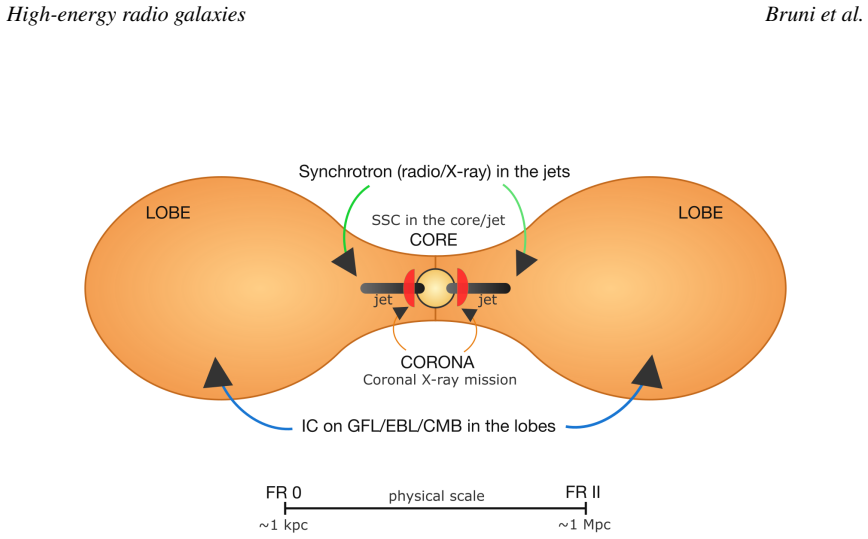
The recent detection of gamma-ray emission from misaligned radio galaxies, including Compact Symmetric Objects, FR0, FRI/II, and Giant Radio Galaxies, demonstrates that efficient particle acceleration is not limited to blazars but occurs throughout the full radio-loud AGN population. This finding supports a unifying framework where leptonic synchrotron, synchrotron self-Compton, and external inverse-Compton processes coexist across multiple spatial scales, from the inner jet and corona to the extended lobes, possibly with a hadronic contribution in dense environments.
What carries the argument
The unifying framework in which leptonic synchrotron, synchrotron self-Compton, and external inverse-Compton processes coexist across multiple spatial scales from the inner jet to extended lobes.
If this is right
- Particle acceleration operates in compact symmetric objects, FR0, FRI/II, and giant radio galaxies as well as blazars.
- Leptonic processes dominate across inner jet, corona, and lobes, with possible hadronic input in dense regions.
- Multi-scale mapping can connect central engine activity to large-scale energy release and host galaxy feedback.
Where Pith is reading between the lines
- If the associations hold, similar acceleration physics would apply regardless of jet orientation to the line of sight.
- The framework could be tested by checking whether gamma-ray variability correlates with changes in compact radio cores.
- This view suggests radio galaxy lobes carry a larger share of the total AGN energy output than previously modeled.
Load-bearing premise
The gamma-ray sources must be correctly identified with the listed radio galaxies rather than chance alignments, background objects, or misclassifications.
What would settle it
A survey that finds the gamma-ray positions do not match the radio galaxy locations or reveals unrelated origins for the emissions would disprove the claimed population and associations.
Figures

read the original abstract
High-energy emission from radio galaxies provides a unique laboratory to study the connection between accretion, jet formation, and particle acceleration in active galactic nuclei (AGN). The recent detection of $\gamma$-ray emission from misaligned radio galaxies - including Compact Symmetric Objects (CSOs), FR0, FRI/II, and even Giant Radio Galaxies (GRGs) - has shown that efficient particle acceleration is not limited to blazars, but occurs throughout the full radio-loud AGN population. This finding supports a unifying framework where leptonic synchrotron, synchrotron self-Compton (SSC), and external inverse-Compton (EIC) processes coexist across multiple spatial scales, from the inner jet and corona to the extended lobes, possibly with a hadronic contribution in dense environments. The Square Kilometre Array (SKA) will be pivotal in advancing this field. SKA1-Low will detect and characterize diffuse, low-surface-brightness emission tracing aged plasma and jet duty cycles. SKA1-Mid will enable high-resolution spectral and polarimetric studies of compact jets and nuclear regions, while SKA-VLBI will connect parsec- to kiloparsec-scale structures, identifying the exact sites of high-energy dissipation. In synergy with forthcoming high-energy missions such as NewAthena and CTAO, SKA will provide the first spatially resolved, multi-scale view of particle acceleration and energy release in misaligned AGN, unveiling the physical link between the central engine and its large-scale feedback on the host galaxy evolution.
Editorial analysis
A structured set of objections, weighed in public.
Referee Report
Summary. The manuscript claims that recent γ-ray detections from misaligned radio galaxies (CSOs, FR0, FRI/II, and GRGs) demonstrate efficient particle acceleration throughout the radio-loud AGN population, supporting a unifying multi-scale framework with coexisting leptonic (synchrotron, SSC, EIC) and possible hadronic processes. It positions the SKA (with SKA1-Low, SKA1-Mid, and SKA-VLBI) as key for future spatially resolved studies in synergy with NewAthena and CTAO.
Significance. If the source associations hold, the synthesis correctly highlights the extension of high-energy emission studies to the full radio-loud AGN population and the multi-scale nature of the emission sites. It appropriately flags SKA's capabilities for tracing aged plasma, jet duty cycles, and parsec-to-kiloparsec connections. As a descriptive perspective without new data, derivations, or modeling, its value lies in framing observational prospects rather than advancing quantitative predictions.
major comments (1)
- [Abstract] Abstract: The central claim of an 'emerging population' supporting a 'unifying framework' is load-bearing on the physical association of the cited γ-ray sources with the listed radio galaxy classes. The text states the detections as established facts and proceeds directly to the framework without referencing or presenting angular separation statistics, cross-match radii, or Monte-Carlo false-association probabilities needed to rule out chance alignments, background blazars, or misclassifications.
Simulated Author's Rebuttal
We thank the referee for the constructive comment on source associations. We address it directly below and will revise the manuscript to strengthen this foundation while preserving the perspective nature of the work.
read point-by-point responses
-
Referee: [Abstract] Abstract: The central claim of an 'emerging population' supporting a 'unifying framework' is load-bearing on the physical association of the cited γ-ray sources with the listed radio galaxy classes. The text states the detections as established facts and proceeds directly to the framework without referencing or presenting angular separation statistics, cross-match radii, or Monte-Carlo false-association probabilities needed to rule out chance alignments, background blazars, or misclassifications.
Authors: We agree that robust justification of the associations is essential for the central claim. The detections referenced are drawn from published discovery papers on CSOs, FR0s, FRI/II, and GRGs, each of which performed dedicated cross-matching with Fermi-LAT catalogs and assessed false-association rates via Monte Carlo or angular separation methods. In the revised manuscript we will add a short paragraph (or expanded footnote) explicitly citing these statistical validations from the original works, thereby grounding the 'emerging population' statement without introducing new analysis. revision: yes
Circularity Check
No circularity; purely descriptive review with no derivations or fitted predictions
full rationale
The manuscript is a review-style discussion of an emerging observational population. It states the existence of gamma-ray detections from misaligned radio galaxies as an established fact and proceeds to describe implications for unification and future SKA observations. No equations, parameters, predictions, or fitted quantities appear in the supplied text. No self-citations are invoked as load-bearing uniqueness theorems or ansatzes. The central premise rests on external observational claims rather than reducing by construction to any input defined within the paper itself. This is the normal case of a self-contained descriptive paper with no derivation chain to inspect for circularity.
Axiom & Free-Parameter Ledger
Reference graph
Works this paper leans on
-
[1]
A. A. Abdo et al. The Astrophysical Journal, 720: 0 912--922, 2010. doi:10.1088/0004-637X/720/1/912
-
[2]
M. Ajello et al. , 892 0 (2): 0 105, Apr. 2020. doi:10.3847/1538-4357/ab791e
-
[3]
R. D. Baldi . The Astronomy and Astrophysics Review, 31: 0 3, 2023. doi:10.1007/s00159-023-00148-3
-
[4]
R. D. Baldi and A. Capetti . , 508 0 (2): 0 603--614, Dec. 2009. doi:10.1051/0004-6361/200913021
-
[5]
R. D. Baldi , A. Capetti , and F. Massaro . Astronomy & Astrophysics, 609: 0 A1, 2018. doi:10.1051/0004-6361/201731333
-
[6]
R. D. Baldi , A. Capetti , and G. Giovannini . , 482 0 (2): 0 2294--2304, Jan. 2019 a . doi:10.1093/mnras/sty2703
-
[7]
R. D. Baldi , A. Capetti , and G. Giovannini . Monthly Notices of the Royal Astronomical Society, 482: 0 2294--2305, 2019 b . doi:10.1093/mnras/sty2848
-
[8]
R. D. Baldi et al. Galaxies, 7 0 (3): 0 76, 2019 c . doi:10.3390/galaxies7030076
-
[9]
R. D. Baldi et al. In Advancing Astrophysics with the SKA -- II (AASKAII). 2026. arXiv search: Report number AASKAII/Baldi01
2026
-
[10]
Barcons et al
X. Barcons et al. Astronomy & Astrophysics, 608: 0 A1, 2017
2017
-
[11]
R. H. Becker , R. L. White , and D. J. Helfand . , 450: 0 559, Sept. 1995. doi:10.1086/176166
-
[12]
P. N. Best and T. M. Heckman . Monthly Notices of the Royal Astronomical Society, 421: 0 1569--1582, 2012. doi:10.1111/j.1365-2966.2012.20414.x
-
[13]
M. Boughelilba and A. Reimer . , 955 0 (2): 0 L41, Oct. 2023. doi:10.3847/2041-8213/acf83c
-
[14]
E. Bronzini , P. Grandi , E. Torresi , and S. Buson . , 977 0 (1): 0 L16, Dec. 2024. doi:10.3847/2041-8213/ad93cf
-
[15]
Morphological evidence of restarted radio activity
G. Bruni , F. Panessa , L. Bassani , et al. Monthly Notices of the Royal Astronomical Society, 494: 0 902--914, 2020. doi:10.1093/mnras/staa735
-
[16]
G. Bruni , F. Panessa , L. Bassani , et al. Monthly Notices of the Royal Astronomical Society, 513: 0 886--899, 2022. doi:10.1093/mnras/stac865
-
[17]
Z. Cao et al. , 971 0 (2): 0 L45, Aug. 2024. doi:10.3847/2041-8213/ad5e6d
-
[18]
C. Casadio et al. , 808 0 (2): 0 162, Aug. 2015. doi:10.1088/0004-637X/808/2/162
-
[19]
J. J. Condon et al. , 115 0 (5): 0 1693--1716, May 1998. doi:10.1086/300337
-
[20]
M. Cruise , M. Guainazzi , J. Aird , et al. Nature Astronomy, 9: 0 36--44, 2025. doi:10.1038/s41550-024-02416-3. arXiv:2501.03100
-
[21]
P. Dabhade , M. Mahato , J. Bagchi , et al. Astronomy & Astrophysics, 642: 0 A153, 2020. doi:10.1051/0004-6361/202037049
-
[22]
P. Dewdney et al. Ska1 design baseline description, Jan. 2022. URL https://doi.org/10.5281/zenodo.16895574
-
[23]
B. Fanaroff et al. , 505: 0 6003--6016, 2021. doi:10.1093/mnras/stab1540
-
[24]
B. L. Fanaroff and J. M. Riley . Monthly Notices of the Royal Astronomical Society, 167: 0 31P--36P, 1974. doi:10.1093/mnras/167.1.31P
-
[25]
Ghisellini
G. Ghisellini . Memorie della Societ \`a Astronomica Italiana , 82: 0 104--113, 2011
2011
-
[26]
G. Ghisellini, F. Tavecchio, and M. Chiaberge. A&A, 432: 0 401--410, 2005. doi:10.1051/0004-6361:20041404
-
[27]
P. Grandi , A. Capetti , and R. D. Baldi . Monthly Notices of the Royal Astronomical Society, 457: 0 2--12, 2016. doi:10.1093/mnras/stv2894
-
[28]
M. J. Hardcastle and J. H. Croston . , 415 0 (1): 0 133--142, July 2011. doi:10.1111/j.1365-2966.2011.18678.x
-
[29]
M. J. Hardcastle et al. , 622: 0 A12, Feb. 2019. doi:10.1051/0004-6361/201833893
-
[30]
M. J. Hardcastle et al. In Advancing Astrophysics with the SKA -- II (AASKAII). 2026. arXiv search: Report number AASKAII/Hardcastle01
2026
-
[31]
W. Hofmann , R. Zanin , and CTA Consortium . arXiv e-prints, art. arXiv:2305.12888, 2023
arXiv 2023
-
[32]
IceCube-Gen2 Collaboration . J. Phys. G, 48 0 (6): 0 060501, 2021. doi:10.1088/1361-6471/abbd48
-
[33]
N. S. Khatiya et al. , 971 0 (1): 0 84, Aug. 2024. doi:10.3847/1538-4357/ad534c
-
[34]
M. Kino and K. Asano . Monthly Notices of the Royal Astronomical Society: Letters, 412: 0 L20--L24, 2011. doi:10.1111/j.1745-3933.2010.00999.x
-
[35]
M. Kino , H. Ito , N. Kawakatu , and H. Nagai . , 395 0 (1): 0 L43--L47, May 2009. doi:10.1111/j.1745-3933.2009.00638.x
-
[36]
KM3NeT Collaboration . J. Phys. G, 43 0 (8): 0 084001, 2016. doi:10.1088/0954-3899/43/8/084001
-
[37]
D. V. Lal . , 915 0 (2): 0 126, 2021. doi:10.3847/1538-4357/ac042d
-
[38]
D. V. Lal and A. P. Rao . , 420: 0 491--499, 2004. doi:10.1051/0004-6361:20035777
-
[39]
D. V. Lal , M. J. Hardcastle , and R. P. Kraft . , 390 0 (3): 0 1105--1116, 2008. doi:10.1111/j.1365-2966.2008.13810.x
-
[40]
D. V. Lal et al. , 722: 0 1735--1743, Oct. 2010. doi:10.1088/0004-637X/722/2/1735
-
[41]
D. V. Lal et al. , 764: 0 83, 2013. doi:10.1088/0004-637X/764/1/83
-
[42]
D. V. Lal et al. Galaxies, 9: 0 87, 2021. doi:10.3390/galaxies9040087
-
[43]
M. L. Lister et al. The Astrophysical Journal, 899: 0 141, 2020. doi:10.3847/1538-4357/aba18d
-
[44]
D. McConnell et al. , 37: 0 e048, Nov. 2020. doi:10.1017/pasa.2020.41
-
[45]
G. Migliori et al. The Astrophysical Journal, 780: 0 165, 2014. doi:10.1088/0004-637X/780/2/165
-
[46]
G. Migliori et al. The Astrophysical Journal Letters, 821: 0 L31, 2016. doi:10.3847/2041-8205/821/2/L31
-
[47]
B. Mingo et al. , 488 0 (2): 0 2701--2721, Sept. 2019. doi:10.1093/mnras/stz1901
-
[48]
B. Mingo et al. , 511 0 (3): 0 3250--3271, Apr. 2022. doi:10.1093/mnras/stac140
-
[49]
Nandra et al
K. Nandra et al. Athena mission proposal, 2013
2013
-
[50]
C. P. O'Dea . Publications of the Astronomical Society of the Pacific, 110: 0 493--532, 1998. doi:10.1086/316162
-
[51]
L. Ostorero et al. , 715 0 (2): 0 1071--1093, June 2010. doi:10.1088/0004-637X/715/2/1071
-
[52]
V. S. Paliya . The Astrophysical Journal Letters, 918: 0 L39, 2021. doi:10.3847/2041-8213/ac1f0d
-
[53]
V. S. Paliya et al. The Astrophysical Journal, 976: 0 120, 2024. doi:10.3847/1538-4357/ad85e2
-
[54]
V. S. Paliya et al. The Astrophysical Journal, 989: 0 36, 2025
2025
-
[55]
M. Pannikkote , V. S. Paliya , and D. J. Saikia . The Astrophysical Journal, 957: 0 73, 2023. doi:10.3847/1538-4357/acf6aa
-
[56]
T. J. Pearson and A. C. S. Readhead . , 328: 0 114, May 1988. doi:10.1086/166274
-
[57]
M. Persic and Y. Rephaeli . Monthly Notices of the Royal Astronomical Society, 485: 0 2001--2009, 2019 a . doi:10.1093/mnras/stz511
-
[58]
M. Persic and Y. Rephaeli . Monthly Notices of the Royal Astronomical Society, 490: 0 1489--1502, 2019 b . doi:10.1093/mnras/stz2680
-
[59]
M. Persic and Y. Rephaeli . Monthly Notices of the Royal Astronomical Society, 491: 0 5740--5757, 2020. doi:10.1093/mnras/stz3659
-
[60]
G. Principe et al. Astronomy & Astrophysics, 635: 0 A185, 2020. doi:10.1051/0004-6361/201937049
-
[61]
A. C. S. Readhead et al. The Astrophysical Journal, 460: 0 612--627, 1996. doi:10.1086/176996
-
[62]
T. W. Shimwell et al. , 598: 0 A104, Feb. 2017. doi:10.1051/0004-6361/201629313
-
[63]
, 680 0 (2): 0 911--925, June 2008
Stawarz et al. , 680 0 (2): 0 911--925, June 2008. doi:10.1086/587781
-
[64]
Swain , V
S. Swain , V. S. Paliya , D. J. Saikia , and C. S. Stalin . The Astrophysical Journal, 979: 0 97, 2025
2025
-
[65]
F. Tavecchio and G. Ghisellini. MNRAS Letters, 385: 0 L98--L102, 2008. doi:10.1111/j.1745-3933.2008.00441.x
-
[66]
F. Tavecchio et al. Monthly Notices of the Royal Astronomical Society, 475: 0 5529--5534, 2018. doi:10.1093/mnras/sty251
-
[67]
E. Torresi et al. Monthly Notices of the Royal Astronomical Society, 476: 0 5535--5547, 2018. doi:10.1093/mnras/sty520
-
[68]
F. Ubertosi et al. , 961 0 (1): 0 134, Jan. 2024. doi:10.3847/1538-4357/ad11d8
-
[69]
F. Ubertosi et al. , 693: 0 A171, Jan. 2025. doi:10.1051/0004-6361/202452430
-
[70]
P. N. Wilkinson et al. The Astrophysical Journal Letters, 432: 0 L87--L90, 1994. doi:10.1086/187516
-
[71]
X.-H. Ye et al. , 708: 0 A56, Mar. 2026. doi:10.1051/0004-6361/202556939
discussion (0)
Sign in with ORCID, Apple, or X to comment. Anyone can read and Pith papers without signing in.