Hyperiax and Phylogenetic Inference from Shape Data
Pith reviewed 2026-06-26 01:48 UTC · model grok-4.3
The pith
Hyperiax library enables BFFG-based inference of parameters and ancestral states from shape landmarks on phylogenetic trees with hundreds of nodes.
A machine-rendered reading of the paper's core claim, the machinery that carries it, and where it could break.
Core claim
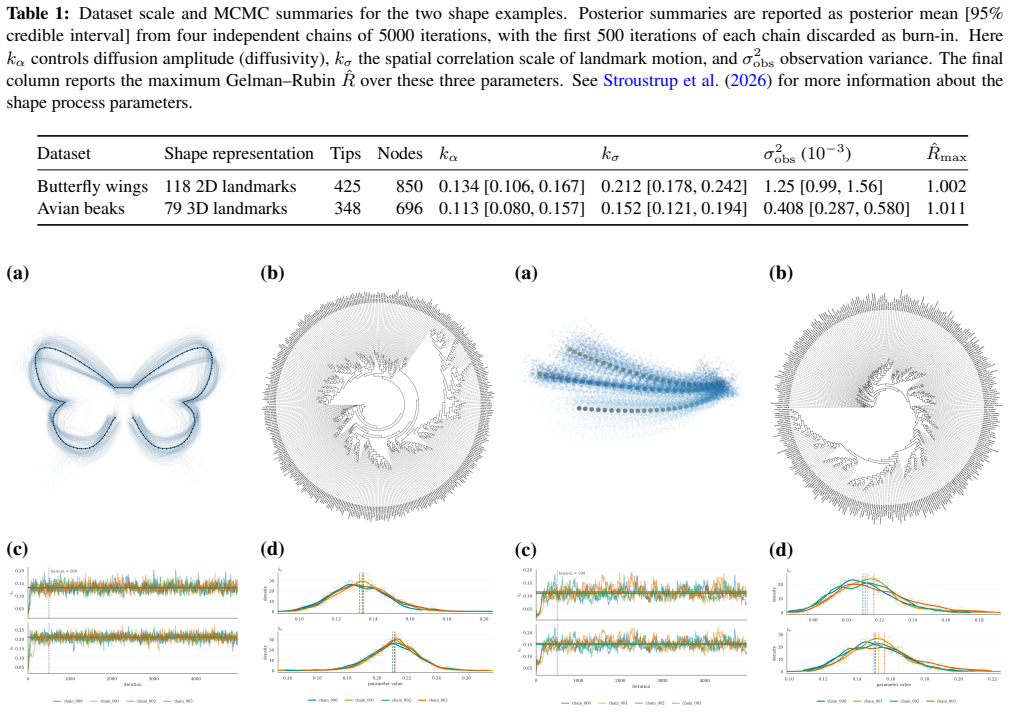
Hyperiax is an open-source library that implements tree traversal algorithms and message passing using JAX to support the Backward Filtering Forward Guiding (BFFG) framework. The framework supplies smoothing for nonlinear stochastic processes on trees and thereby enables inference of parameters and ancestral states. The library is shown to perform efficient inference in both discrete-time and stochastic differential equation models on two substantially larger phylogenetic trees than previously feasible, using butterfly wing shapes represented by 118 two-dimensional landmarks on an 850-node tree and avian beak shapes represented by 79 three-dimensional landmarks on a 696-node tree.
What carries the argument
The Backward Filtering Forward Guiding (BFFG) framework, which supplies smoothing for nonlinear stochastic processes on trees to enable parameter inference and ancestral-state reconstruction.
If this is right
- Parameter inference and ancestral reconstruction become feasible for 2D butterfly wing shapes on an 850-node tree with 118 landmarks.
- Analyses of 3D avian beak shapes become feasible on a 696-node tree with 79 landmarks.
- The same operations apply to both discrete-time models and stochastic differential equation models.
- Higher-resolution shape data can be handled on larger trees than in prior work.
Where Pith is reading between the lines
- The same JAX-based tree operations could support other nonlinear diffusion models on phylogenies beyond the two demonstrated cases.
- Scaling the library to trees with several thousand nodes would require only additional memory and parallel hardware rather than new algorithmic ideas.
- The message-passing design makes it straightforward to replace the landmark representation with other shape descriptors such as outline curves or surface meshes.
Load-bearing premise
The Backward Filtering Forward Guiding framework correctly supplies smoothing for nonlinear stochastic processes on trees and thereby enables reliable inference of parameters and ancestral states.
What would settle it
Re-running the butterfly-wing and avian-beak analyses with Hyperiax and checking whether the resulting parameter estimates and ancestral reconstructions match those obtained from an independent implementation of BFFG or from simulated data generated under the same model.
Figures

read the original abstract
Phylogenetic inference on high-dimensional morphological traits requires algorithms that account for both the nonlinear geometry of the shape data and the phylogenetic tree structure. The Backward Filtering Forward Guiding (BFFG) framework provides smoothing for nonlinear stochastic processes on trees and enables inference of parameters and ancestral states. As practical adoption has been limited by a lack of efficient implementations, we present Hyperiax, an open-source library for tree traversal algorithms and message passing using JAX, designed particularly to support operations needed for BFFG. Hyperiax enables efficient execution of operations on trees with large numbers of nodes and, coupled with the BFFG-specific operations, this allows efficient inference in both discrete-time and stochastic differential equation models. Concretely, we demonstrate that Hyperiax enables parameter inference and ancestral reconstruction for butterfly wing shapes represented by landmarks in two dimensions, and analyses of avian beaks from landmarks in three dimensions. Both cases demonstrate application of BFFG on two substantially larger phylogenetic trees with 850 and 696 nodes with higher resolution shape data (118 two-dimensional landmarks and 79 three-dimensional landmarks, specifically) than previously possible.
Editorial analysis
A structured set of objections, weighed in public.
Referee Report
Summary. The manuscript presents Hyperiax, an open-source JAX library implementing tree traversal and message-passing operations to support the Backward Filtering Forward Guiding (BFFG) framework for smoothing nonlinear stochastic processes on phylogenetic trees. It claims this enables parameter inference and ancestral reconstruction for high-dimensional shape data, demonstrated on butterfly wing landmarks (118 2D points) and avian beak landmarks (79 3D points) using trees of 850 and 696 nodes.
Significance. If the efficiency and correctness claims hold, the library would allow scaling of BFFG-based morphological inference to larger phylogenies and denser landmark configurations than previously reported, with the open-source JAX implementation providing a reproducible foundation for further work in phylogenetic shape analysis.
major comments (1)
- [Abstract] Abstract: the central claim that Hyperiax 'enables ... analyses ... on two substantially larger phylogenetic trees with 850 and 696 nodes with higher resolution shape data ... than previously possible' is unsupported by any quantitative metrics, runtime benchmarks, error analysis, or explicit comparison to prior implementations or baselines.
minor comments (2)
- The manuscript should include explicit statements of the BFFG update equations implemented in Hyperiax (with section or equation numbers) to allow readers to verify that the library faithfully realizes the cited framework.
- No information is given on numerical stability, convergence criteria, or handling of missing landmarks; adding a short methods subsection on these implementation choices would improve clarity.
Simulated Author's Rebuttal
We thank the referee for the review and the specific comment on the abstract. We address it directly below.
read point-by-point responses
-
Referee: [Abstract] Abstract: the central claim that Hyperiax 'enables ... analyses ... on two substantially larger phylogenetic trees with 850 and 696 nodes with higher resolution shape data ... than previously possible' is unsupported by any quantitative metrics, runtime benchmarks, error analysis, or explicit comparison to prior implementations or baselines.
Authors: We agree that the comparative phrasing in the abstract is not backed by explicit quantitative metrics, runtime benchmarks, error analysis, or side-by-side comparisons to earlier BFFG implementations. The manuscript demonstrates successful application of the library on the stated tree sizes and landmark counts, but does not quantify improvement relative to prior work. We will revise the abstract to remove or qualify the unsupported claim of being 'substantially larger ... than previously possible.' In the revised manuscript we will also add a results subsection with available runtime figures and any error metrics from the reported experiments. revision: yes
Circularity Check
No significant circularity
full rationale
The paper introduces the Hyperiax library as an implementation of the existing BFFG framework for tree-based smoothing and inference on shape landmarks. No derivation, equation, or parameter fit is presented that reduces by construction to its own inputs; the work consists of software demonstrations on external phylogenetic datasets (850- and 696-node trees) rather than any self-referential prediction or ansatz. BFFG is treated as a prior framework whose correctness is not re-derived here. No self-citation chain, uniqueness theorem, or renaming of known results is load-bearing for the central claim. The contribution is therefore self-contained as an engineering artifact whose value is measured by external applicability.
Axiom & Free-Parameter Ledger
Reference graph
Works this paper leans on
-
[2]
2018 , url =
Bradbury, James and Frostig, Roy and Hawkins, Peter and Johnson, Matthew James and Leary, Chris and Maclaurin, Dougal and Necula, George and Paszke, Adam and VanderPlas, Jake and. 2018 , url =
2018
-
[7]
Journal of Machine Learning Research , author =
Backward filtering forward guiding , volume =. Journal of Machine Learning Research , author =. 2025 , pages =
2025
-
[9]
Stochastic
Severinsen, Michael Lind , year =. Stochastic. PhD thesis , school =
-
[10]
Duchêne, David A. and Chowdhury, Al-Aabid and Yang, Jingyi and Iglesias-Carrasco, Maider and Stiller, Josefin and Feng, Shaohong and Bhatt, Samir and Gilbert, M. Thomas P. and Zhang, Guojie and Tobias, Joseph A. and Ho, Simon Y. W. , month = may, year =. Drivers of avian genomic change revealed by evolutionary rate decomposition , volume =. Nature , publi...
-
[11]
Nature , volume=
Mega-evolutionary dynamics of the adaptive radiation of birds , author=. Nature , volume=. 2017 , publisher=
2017
-
[12]
Nature , volume=
Complexity of avian evolution revealed by family-level genomes , author=. Nature , volume=. 2024 , publisher=
2024
-
[13]
JAX : Composable transformations of Python + NumPy programs, 2018
James Bradbury, Roy Frostig, Peter Hawkins, Matthew James Johnson, Chris Leary, Dougal Maclaurin, George Necula, Adam Paszke, Jake VanderPlas, Skye Wanderman-Milne , and Qiao Zhang. JAX : Composable transformations of Python + NumPy programs, 2018. URL http://github.com/jax-ml/jax
2018
-
[14]
Mega-evolutionary dynamics of the adaptive radiation of birds
Christopher R Cooney, Jen A Bright, Elliot JR Capp, Angela M Chira, Emma C Hughes, Christopher JA Moody, Lara O Nouri, Zo \"e K Varley, and Gavin H Thomas. Mega-evolutionary dynamics of the adaptive radiation of birds. Nature, 542 0 (7641): 0 344--347, 2017
2017
-
[15]
Phylogenies and the Comparative Method
Joseph Felsenstein. Phylogenies and the Comparative Method . The American Naturalist, 125 0 (1): 0 1--15, January 1985. ISSN 0003-0147. doi:10.1086/284325
-
[16]
Landmark matching via large deformation diffeomorphisms
Sarang Joshi and Michael Miller. Landmark matching via large deformation diffeomorphisms. IEEE Transactions on Image Processing, 9 0 (8): 0 1357--1370, 2000. doi:10.1109/83.855431
-
[17]
David G. Kendall. Shape Manifolds , Procrustean Metrics , and Complex Projective Spaces . Bull. London Math. Soc., 16 0 (2): 0 81--121, March 1984. doi:10.1112/blms/16.2.81
-
[18]
Stochastic Morphometry : Applying stochastic processes to model infinite dimensional shape evolution
Michael Lind Severinsen. Stochastic Morphometry : Applying stochastic processes to model infinite dimensional shape evolution . PhD thesis, University of Copenhagen, 2026
2026
-
[19]
Diffeomorphic Independent Contrasts for Ancestral Reconstruction of Shapes
Michael Lind Severinsen, Morten Akhøj, Rasmus Nielsen, Stefan Sommer, and Christy Anna Hipsley. Diffeomorphic Independent Contrasts for Ancestral Reconstruction of Shapes . Systematic Biology, page syag019, February 2026. ISSN 1063-5157. doi:10.1093/sysbio/syag019. URL https://doi.org/10.1093/sysbio/syag019
-
[20]
Stochastics of shapes and Kunita flows
Stefan Sommer, Gefan Yang, and Elizabeth Louise Baker. Stochastics of shapes and Kunita flows. Harvard Data Science Review, 2026. doi:10.48550/arXiv.2512.11676. URL http://arxiv.org/abs/2512.11676. arXiv:2512.11676
work page internal anchor Pith review Pith/arXiv arXiv doi:10.48550/arxiv.2512.11676 2026
-
[21]
Complexity of avian evolution revealed by family-level genomes
Josefin Stiller, Shaohong Feng, Al-Aabid Chowdhury, Iker Rivas-Gonz \'a lez, David A Duch \^e ne, Qi Fang, Yuan Deng, Alexey Kozlov, Alexandros Stamatakis, Santiago Claramunt, et al. Complexity of avian evolution revealed by family-level genomes. Nature, 629 0 (8013): 0 851--860, 2024
2024
-
[22]
Stochastic Phylogenetic Models of Shape
Sofia Stroustrup, Morten Akhøj Pedersen, Frank van der Meulen , Stefan Sommer, and Rasmus Nielsen. Stochastic Phylogenetic Models of Shape . Systematic Biology, in press, 2026. doi:10.1101/2025.04.03.646616. URL https://www.biorxiv.org/content/10.1101/2025.04.03.646616v1
-
[23]
van der Meulen and S
Frank H. van der Meulen and S. Sommer. Backward filtering forward guiding. Journal of Machine Learning Research, 26 0 (281): 0 1--51, 2025. URL http://jmlr.org/papers/v26/25-1130.html
2025
discussion (0)
Sign in with ORCID, Apple, or X to comment. Anyone can read and Pith papers without signing in.