Behind the Mask: A Taxonomic Analysis of Activities in Online Social Networks
Pith reviewed 2026-06-26 02:14 UTC · model grok-4.3
The pith
A taxonomy distinguishes malicious actors in online social networks by their characteristics, activities, and strategies for spreading disinformation.
A machine-rendered reading of the paper's core claim, the machinery that carries it, and where it could break.
Core claim
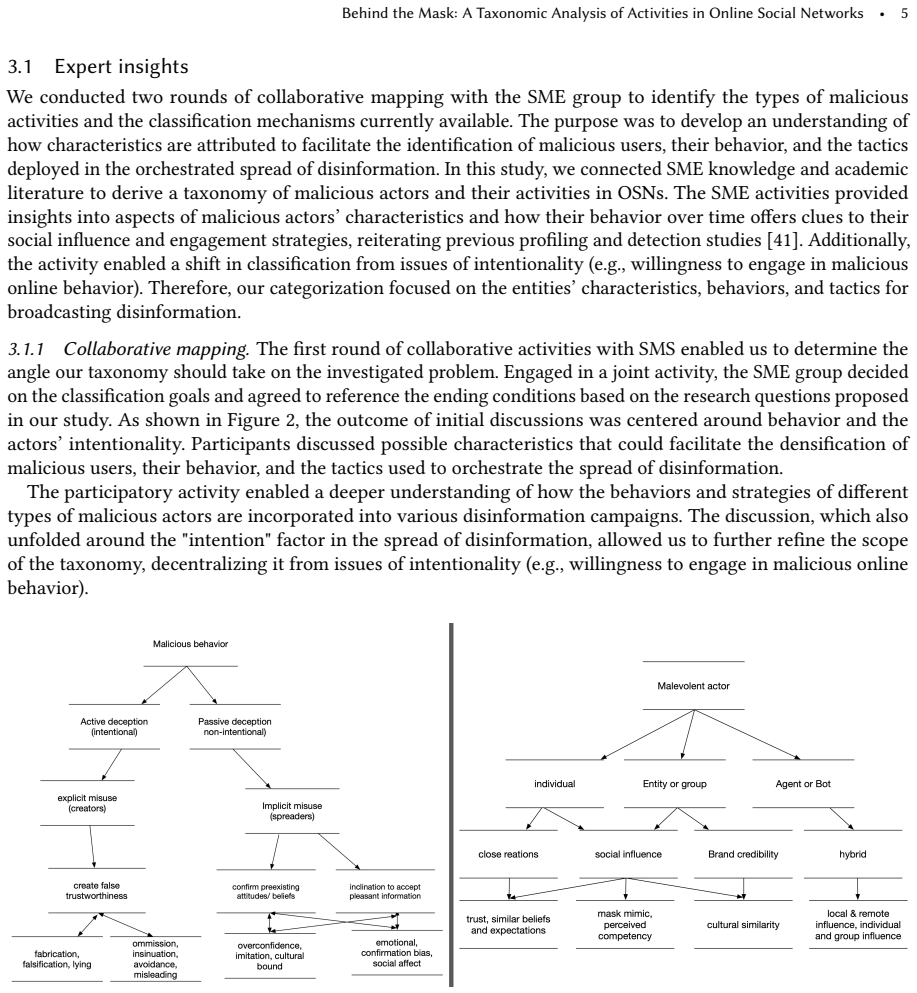
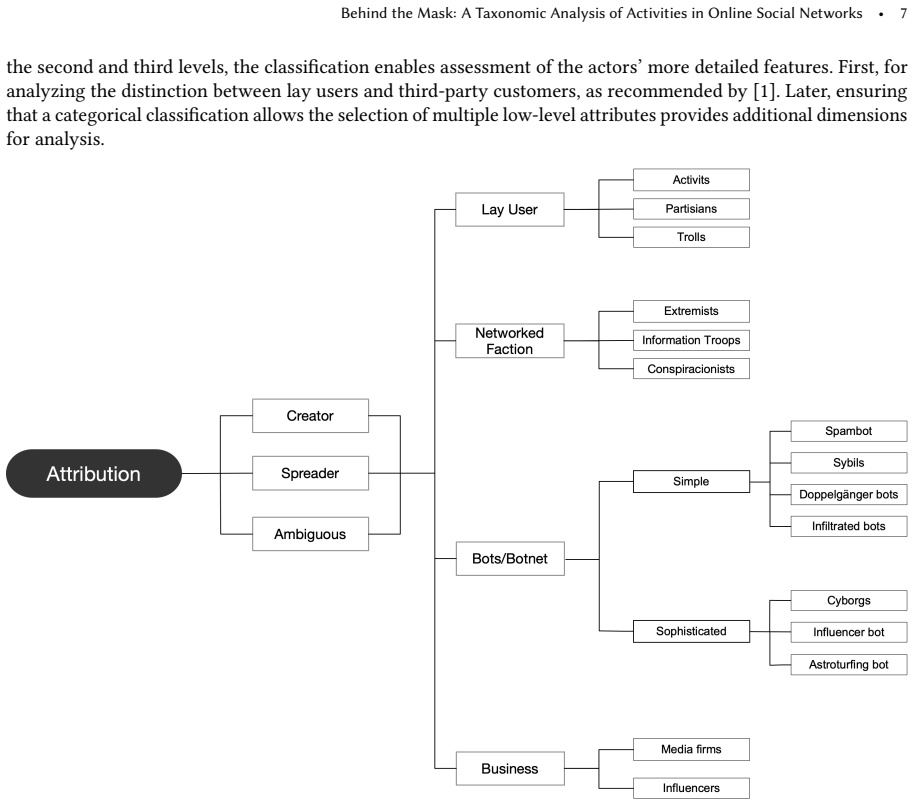
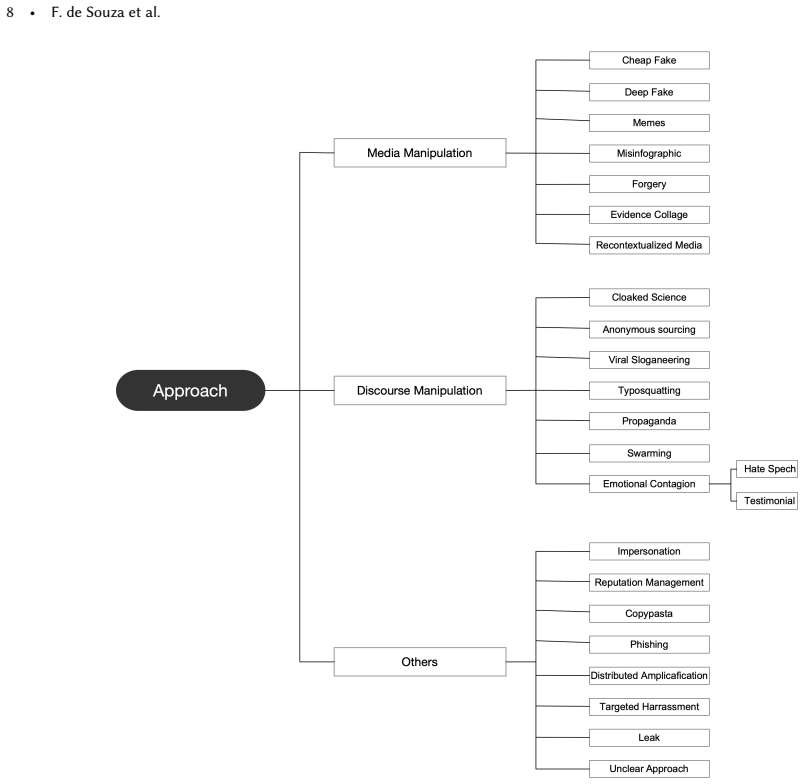
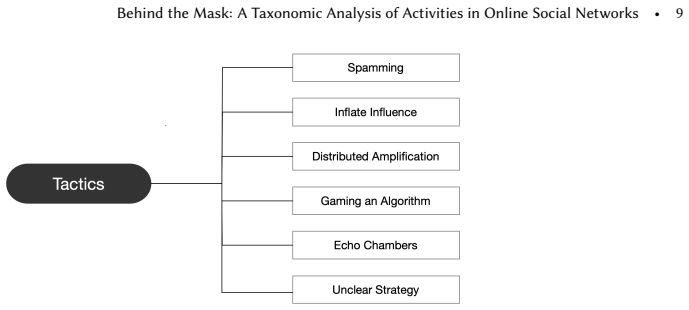
The authors present a taxonomy informed by collaboration with subject matter experts and a review of the academic literature that classifies the characteristics, activities, and strategies of malicious actors on OSNs and examines their contribution to the spread of disinformation, as shown through its application to anti-migration discourse in social media channels.
What carries the argument
A taxonomy of malicious actor activities in online social networks, developed through expert consultation and literature review, that organizes characteristics and strategies to distinguish actors.
Load-bearing premise
The taxonomy accurately captures and distinguishes the characteristics, activities, and strategies of malicious actors on OSNs based on subject matter expert input and literature without specified validation against independent data.
What would settle it
Independent researchers applying the taxonomy to the same collection of OSN accounts and achieving low agreement on actor classifications would indicate the taxonomy does not reliably distinguish actors.
Figures

read the original abstract
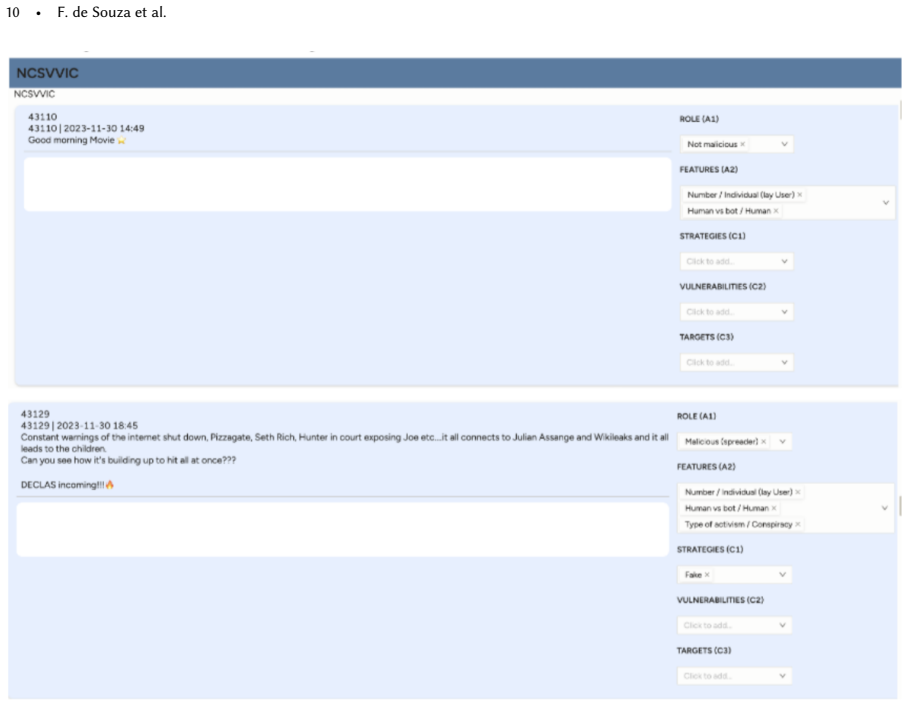
The broadcast of disinformation in online social networks (OSN) is a growing concern examined across several disciplines, including human-computer interaction (HCI). The pervasive issue has been prompting novel approaches to identify the malicious actors behind the dissemination of deceptive and fabricated content. Analyzing the characteristics and activities of these actors, we designed a taxonomy informed by collaboration with subject matter experts (SMEs) and a review of the academic literature. Our study explores how to distinguish the characteristics, activities, and strategies of malicious actors on OSN and examines how they contribute to the spread of disinformation. We describe the design process and the application of the taxonomy in a case study analyzing anti-migration discourse in social media channels, and reflect on its potential to aid researchers and practitioners in the responsible design of network systems.
Editorial analysis
A structured set of objections, weighed in public.
Referee Report
Summary. The paper claims to have designed a taxonomy for distinguishing the characteristics, activities, and strategies of malicious actors on online social networks (OSNs) involved in disinformation dissemination. The taxonomy is developed via collaboration with subject matter experts (SMEs) and a review of academic literature; the manuscript describes the design process and applies the taxonomy in a case study of anti-migration discourse on social media channels, reflecting on its utility for researchers and practitioners in responsible network system design.
Significance. If validated for reproducibility, the taxonomy would supply a structured framework for HCI analysis of OSN malicious actors, building on SME input and literature synthesis with a concrete case-study demonstration. The approach credits external expertise and applies the result to anti-migration discourse, but the absence of reliability or external validation metrics limits immediate significance for detection or mitigation work.
major comments (2)
- [Design Process] Design process (as described in the abstract and methods): the taxonomy is presented as distinguishing malicious actors' characteristics, activities, and strategies, yet no inter-rater reliability statistics, pilot-coding agreement measures, or external validation against independent datasets are supplied; this directly undermines the central claim that the categories are reproducible rather than reflective of the consulted SMEs' views.
- [Case Study] Case study application (anti-migration discourse): the single case study is offered as demonstration but does not address completeness or accuracy testing of the taxonomy, leaving the claim that it captures strategies load-bearing without supporting evidence such as agreement metrics or comparison to alternative taxonomies.
minor comments (1)
- The abstract could specify the number of SMEs consulted and the exact scope or search terms of the literature review to allow readers to assess the synthesis process.
Simulated Author's Rebuttal
We thank the referee for their thoughtful and constructive comments on our manuscript. We address each major comment point by point below, providing clarifications on our methodological choices while remaining faithful to the scope and claims of the work.
read point-by-point responses
-
Referee: [Design Process] Design process (as described in the abstract and methods): the taxonomy is presented as distinguishing malicious actors' characteristics, activities, and strategies, yet no inter-rater reliability statistics, pilot-coding agreement measures, or external validation against independent datasets are supplied; this directly undermines the central claim that the categories are reproducible rather than reflective of the consulted SMEs' views.
Authors: The taxonomy was developed as a synthesis of subject-matter expert input and a review of the academic literature, following an iterative design process rather than a quantitative coding study. No multiple independent raters applied categories to a shared dataset, so inter-rater reliability or pilot-coding agreement metrics are not applicable and would misrepresent the methodology. Reproducibility is instead supported by the transparent documentation of the expert collaboration and literature synthesis steps, which other researchers can follow or adapt. We did not claim statistical reproducibility or external dataset validation, as these were outside the stated scope of constructing an initial conceptual taxonomy. We will add a brief clarifying sentence in the methods section to distinguish this approach from empirical coding studies. revision: partial
-
Referee: [Case Study] Case study application (anti-migration discourse): the single case study is offered as demonstration but does not address completeness or accuracy testing of the taxonomy, leaving the claim that it captures strategies load-bearing without supporting evidence such as agreement metrics or comparison to alternative taxonomies.
Authors: The case study is explicitly framed as an illustrative application to demonstrate how the taxonomy can be used in practice on anti-migration discourse, not as a validation, completeness test, or comparative evaluation. The manuscript makes no claim that the taxonomy has been shown to capture all strategies with quantitative evidence. We agree that future work could usefully include agreement metrics or comparisons, but such extensions lie beyond the current paper's focus on taxonomy development and initial demonstration. We will revise the discussion to state the illustrative purpose more explicitly and note the lack of formal validation metrics as a limitation. revision: yes
Circularity Check
No circularity: taxonomy derived from external SME input and literature review
full rationale
The paper's central process is the construction of a taxonomy informed by collaboration with subject matter experts and a review of the academic literature, as stated in the abstract. No equations, fitted parameters, self-referential predictions, or load-bearing self-citations are present that would reduce any claim to its own inputs by construction. The derivation chain relies on external sources and is therefore self-contained with no reduction to internal definitions or prior author work.
Axiom & Free-Parameter Ledger
axioms (1)
- domain assumption A taxonomy derived from subject matter experts and academic literature can effectively distinguish characteristics, activities, and strategies of malicious actors in OSNs
Reference graph
Works this paper leans on
-
[1]
Amelia Acker and Joan Donovan. 2019. Data craft: a theory/methods package for critical internet studies.Information, Communication & Society22, 11 (2019), 1590–1609. doi:10.1080/1369118x.2019.1645194
-
[2]
Abdullah Al Hasib. 2009. Threats of online social networks.IJCSNS International Journal of Computer Science and Network Security9, 11 (2009), 288–93
2009
-
[3]
Firoj Alam, Stefano Cresci, Tanmoy Chakraborty, Fabrizio Silvestri, Dimiter Dimitrov, Giovanni Da San Martino, Shaden Shaar, Hamed Firooz, and Preslav Nakov. 2021. A Survey on Multimodal Disinformation Detection.arXiv(2021). arXiv:2103.12541 doi:10.48550/arxiv. 2103.12541
work page internal anchor Pith review doi:10.48550/arxiv 2021
-
[4]
Zulfikar Alom, Barbara Carminati, and Elena Ferrari. 2018. Detecting Spam Accounts on Twitter. In2018 IEEE/ACM International Conference on Advances in Social Networks Analysis and Mining (ASONAM). IEEE, 1191–1198. doi:10.1109/asonam.2018.8508495
-
[5]
Samuel Anderson and Hapsari Dwiningtyas Sulistyani. 2020. Detecting and combating fake news on web 2.0 technology in the 2019 political season Indonesia.Journal of Social Studies (JSS)15, 2 (Sept. 2020), 103–116. doi:10.21831/jss.v15i2.25233
-
[6]
Zach Bastick. 2021. Would you notice if fake news changed your behavior? An experiment on the unconscious effects of disinformation. Computers in Human Behavior116 (March 2021), 106633. doi:10.1016/j.chb.2020.106633
-
[7]
Mauro Conti, Daniele Lain, Riccardo Lazzeretti, Giulio Lovisotto, and Walter Quattrociocchi. 2017. It’s always April fools’ day!: On the difficulty of social network misinformation classification via propagation features. In2017 IEEE Workshop on Information Forensics and Security (WIFS). IEEE, 1–6
2017
-
[8]
Carlos Diaz Ruiz and Tomas Nilsson. 2022. Disinformation and Echo Chambers: How Disinformation Circulates on Social Media Through Identity-Driven Controversies.Journal of Public Policy & Marketing42, 1 (Aug. 2022), 18–35. doi:10.1177/07439156221103852
-
[9]
Tatiana Dourado. 2023. Who Posts Fake News? Authentic and Inauthentic Spreaders of Fabricated News on Facebook and Twitter. Journalism Practice17, 10 (Feb. 2023), 2103–2122. doi:10.1080/17512786.2023.2176352 Behind the Mask: A Taxonomic Analysis of Activities in Online Social Networks•15
-
[10]
Marc Dupuis and Andrew Williams. 2020. Information Warfare: Memes and their Attack on the Most Valued Critical Infrastructure—the Democratic Institution Itself.Systemics, Cybernetics and Informatics18, 2 (2020), 44–54
2020
-
[11]
Emilio Ferrara, Onur Varol, Clayton Davis, Filippo Menczer, and Alessandro Flammini. 2016. The rise of social bots.Commun. ACM59, 7 (2016), 96–104
2016
-
[12]
Michael Fire, Roy Goldschmidt, and Yuval Elovici. 2014. Online social networks: threats and solutions.IEEE Communications Surveys & Tutorials16, 4 (2014), 2019–2036
2014
-
[13]
Lily Jamali. 2024. Telegram will now provide some user data to authorities. https://www.bbc.com/news/articles/cvglp0xny3eo
2024
-
[14]
Mansooreh Karami, Tahora H. Nazer, and Huan Liu. 2021. Profiling Fake News Spreaders on Social Media through Psychological and Motivational Factors. InProceedings of the 32st ACM Conference on Hypertext and Social Media (HT ’21). ACM, 225–230. doi:10.1145/ 3465336.3475097
arXiv 2021
-
[15]
Natascha A Karlova and Karen E Fisher. 2013. A social diffusion model of misinformation and disinformation for understanding human information behaviour.Information Research(2013)
2013
-
[16]
Dennis Kundisch, Jan Muntermann, Anna Maria Oberländer, Daniel Rau, Maximilian Röglinger, Thorsten Schoormann, and Daniel Szopinski. 2021. An Update for Taxonomy Designers: Methodological Guidance from Information Systems Research.Business & Information Systems Engineering64, 4 (Oct. 2021), 421–439. doi:10.1007/s12599-021-00723-x
-
[17]
Majd Latah. 2020. Detection of malicious social bots: A survey and a refined taxonomy.Expert Systems with Applications151 (2020), 113383
2020
-
[18]
David MJ Lazer, Matthew A Baum, Yochai Benkler, Adam J Berinsky, Kelly M Greenhill, Filippo Menczer, Miriam J Metzger, Brendan Nyhan, Gordon Pennycook, David Rothschild, et al. 2018. The science of fake news.Science359, 6380 (2018), 1094–1096
2018
-
[19]
2022.Disentangling untruths online: Creators, spreaders and how to stop them
Molly Lesher, Hanna Pawelec, and Arpitha Desai. 2022.Disentangling untruths online: Creators, spreaders and how to stop them. Technical Report. OECD Publishing
2022
-
[20]
Hana Matatov, Mor Naaman, and Ofra Amir. 2022. Stop the [Image] Steal: The Role and Dynamics of Visual Content in the 2020 U.S. Election Misinformation Campaign.Proceedings of the ACM on Human-Computer Interaction6, CSCW2 (Nov. 2022), 1–24. doi:10.1145/ 3555599
2022
-
[21]
Innocent Mbona and Jan HP Eloff. 2023. Classifying social media bots as malicious or benign using semi-supervised machine learning. Journal of Cybersecurity9, 1 (2023), tyac015
2023
-
[22]
Filippo Menczer and Thomas Hills. 2020. Information overload helps fake news spread, and social media knows it.Scientific American 323, 6 (2020), 54–61
2020
-
[23]
Christian Montag, Haibo Yang, and Jon D Elhai. 2021. On the psychology of TikTok use: A first glimpse from empirical findings. Frontiers in public health9 (2021), 641673
2021
-
[24]
Rachel R. Mourão and Craig T. Robertson. 2019. Fake News as Discursive Integration: An Analysis of Sites That Publish False, Misleading, Hyperpartisan and Sensational Information.Journalism Studies20, 14 (2019), 2077–2095. doi:10.1080/1461670x.2019.1566871
-
[25]
Nic Newman, Richard Fletcher, Kirsten Eddy, Craig T Robinson, and Rasmus Kleis Nielsen. 2023. Reuters Institute digital news report
2023
-
[26]
doi:10.60625/RISJ-P6ES-HB13
-
[27]
Robert C Nickerson, Upkar Varshney, and Jan Muntermann. 2013. A method for taxonomy development and its application in information systems.European Journal of Information Systems22, 3 (2013), 336–359
2013
-
[28]
Ruipérez- Valiente, Gregorio Martínez Pérez, and Félix Gómez Mármol
Javier Pastor-Galindo, Mattia Zago, Pantaleone Nespoli, Sergio López Bernal, Alberto Huertas Celdrán, Manuel Gil Pérez, José A. Ruipérez- Valiente, Gregorio Martínez Pérez, and Félix Gómez Mármol. 2020. Spotting Political Social Bots in Twitter: A Use Case of the 2019 Spanish General Election.IEEE Transactions on Network and Service Management17, 4 (Dec. ...
-
[29]
Shama Patel and Ioanna Constantiou. 2020. Human agency in the propagation of false information-a conceptual framework. InECIS 2020 Research-in-Progress Papers
2020
-
[30]
Meet Rajdev and Kyumin Lee. 2015. Fake and Spam Messages: Detecting Misinformation During Natural Disasters on Social Media. In2015 IEEE/WIC/ACM International Conference on Web Intelligence and Intelligent Agent Technology (WI-IAT). IEEE. doi:10.1109/wi-iat.2015.102
-
[31]
Shubhangi Rastogi and Divya Bansal. 2022. Disinformation detection on social media: An integrated approach.Multimedia Tools and Applications81, 28 (May 2022), 40675–40707. doi:10.1007/s11042-022-13129-y
-
[32]
Richard Rogers. 2020. Deplatforming: Following extreme Internet celebrities to Telegram and alternative social media.European Journal of Communication35, 3 (2020), 213–229. arXiv:https://doi.org/10.1177/0267323120922066 doi:10.1177/0267323120922066
-
[33]
Wajiha Shahid, Yiran Li, Dakota Staples, Gulshan Amin, Saqib Hakak, and Ali Ghorbani. 2022. Are You a Cyborg, Bot or Human?—A Survey on Detecting Fake News Spreaders.IEEE Access10 (2022), 27069–27083. doi:10.1109/access.2022.3157724
-
[34]
Chengcheng Shao, Pik-Mai Hui, Lei Wang, Xinwen Jiang, Alessandro Flammini, Filippo Menczer, and Giovanni Luca Ciampaglia. 2018. Anatomy of an online misinformation network.PLOS ONE13, 4 (April 2018), e0196087. doi:10.1371/journal.pone.0196087
-
[35]
Kai Shu, Amrita Bhattacharjee, Faisal Alatawi, Tahora H Nazer, Kaize Ding, Mansooreh Karami, and Huan Liu. 2020. Combating disinformation in a social media age.Wiley Interdisciplinary Reviews: Data Mining and Knowledge Discovery10, 6 (2020), e1385
2020
-
[36]
Kai Shu, Suhang Wang, and Huan Liu. 2018. Understanding user profiles on social media for fake news detection. In2018 IEEE conference on multimedia information processing and retrieval (MIPR). IEEE, 430–435. 16•F. de Souza et al
2018
-
[37]
Edson C Tandoc, Darren Lim, and Rich Ling. 2020. Diffusion of disinformation: How social media users respond to fake news and why. Journalism21, 3 (2020), 381–398. doi:10.1177/1464884919868325
-
[38]
2025.AI Influencers Like Lil’ Miquela and Mia Zelu Are Redefining Fame
The New York Times. 2025.AI Influencers Like Lil’ Miquela and Mia Zelu Are Redefining Fame. https://www.nytimes.com/2025/09/03/ style/ai-influencers-lil-miquela-mia-zelu.html
2025
-
[39]
2018.Fake news: National security in the post-truth era
Norman Vasu, Benjamin Ang, Terri-Anne Teo, Shashi Jayakumar, Muhammad Raizal, and Juhi Ahuja. 2018.Fake news: National security in the post-truth era. S. Rajaratnam School of International Studies
2018
-
[40]
Maike Vollstedt and Sebastian Rezat. 2019. Compendium for Early Career Researchers in Mathematics Education.ICME-13 Monographs (2019), 81–100. doi:10.1007/978-3-030-15636-7_4
-
[41]
and Ferrara, Emilio and Flammini, Alessandro and Menczer, Filippo , title =
Kai-Cheng Yang, Onur Varol, Clayton A. Davis, Emilio Ferrara, Alessandro Flammini, and Filippo Menczer. 2019. Arming the public with artificial intelligence to counter social bots.Human Behavior and Emerging Technologies1, 1 (Jan. 2019), 48–61. doi:10.1002/hbe2.115
-
[42]
Xinyi Zhou and Reza Zafarani. 2020. A survey of fake news: Fundamental theories, detection methods, and opportunities.ACM Computing Surveys (CSUR)53, 5 (2020), 1–40
2020
-
[43]
Xinyi Zhou, Reza Zafarani, Kai Shu, and Huan Liu. 2019. Fake news: Fundamental theories, detection strategies and challenges. In Proceedings of the twelfth ACM international conference on web search and data mining. 836–837
2019
discussion (0)
Sign in with ORCID, Apple, or X to comment. Anyone can read and Pith papers without signing in.