Chemical Complexity in the Early Stages of Star Formation in the SKAO Era
Pith reviewed 2026-06-26 03:23 UTC · model grok-4.3
The pith
The SKAO will detect prebiotic molecules hidden by dust in the earliest stages of star formation.
A machine-rendered reading of the paper's core claim, the machinery that carries it, and where it could break.
Core claim
The Square Kilometre Array Observatory will provide an unprecedented combination of sensitivity and angular resolution at radio wavelengths. This will allow detection of prebiotic species such as formamide, glycolaldehyde, urea, and hydroxylamine, which remain inaccessible today, and will deliver new insights into the chemical pathways that shape emerging planetary systems.
What carries the argument
SKAO radio-wavelength sensitivity and angular resolution with Band 5 receivers, which target lower-frequency transitions of large molecules in regions where dust opacity blocks shorter wavelengths.
If this is right
- Prebiotic molecules currently blocked by dust opacity will become detectable in dense protostellar regions.
- Chemical diversity present from the earliest stages of star formation will be mapped in detail.
- The initial chemical inventory passed to planetary systems will be traced through specific molecular pathways.
- Both high-mass and solar-type star-forming regions will yield comparable data on these processes.
Where Pith is reading between the lines
- If the detections succeed, they could guide searches for the same molecules in disks around young stars to test inheritance.
- The data might connect early interstellar chemistry to the organic content observed in comets or meteorites.
Load-bearing premise
The final SKA-Mid Band 5 receivers will reach the needed sensitivity and frequency coverage, and the targeted prebiotic molecules will exist at detectable abundances and excitation conditions in the dense regions.
What would settle it
SKAO observations of protostellar regions that achieve the expected sensitivity but still fail to detect the predicted prebiotic species at any abundance would falsify the central claim.
Figures



read the original abstract
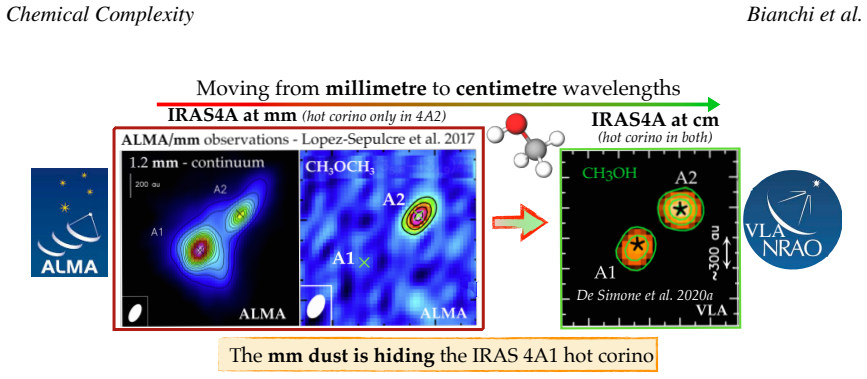
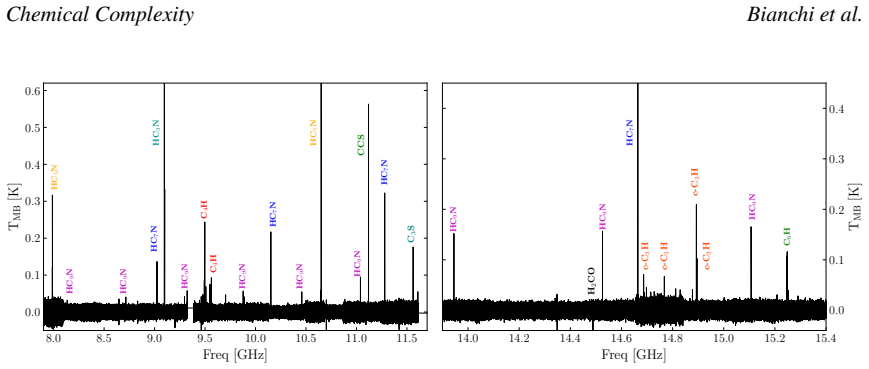
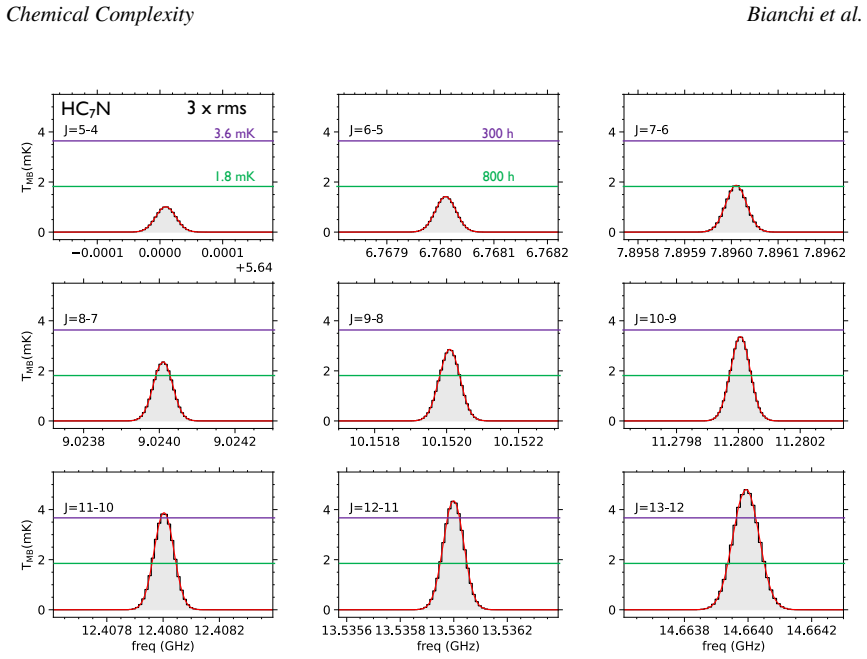
About 350 molecules have been identified in the interstellar medium (ISM), including complex molecules relevant to prebiotic chemistry. A remarkable level of molecular diversity has been observed from the earliest stages of star formation, providing the initial chemical inventory inherited by planetary systems. Radio observations have played a pivotal role in these discoveries, starting with the identification of the first polyatomic molecule, $\text{NH}_3$ (Cheung et al. 1968). (Sub-)millimeter observations have revealed complex organic molecules of prebiotic relevance, including formamide ($\text{NH}_2\text{CHO}$), glycolaldehyde ($\text{CH}_2\text{OHCHO}$), and even urea ($(\text{NH}_2)_2\text{CO}$), and hydroxylamine ($\text{NH}_2\text{OH}$), which are possible precursors of RNA nucleotides (Ceccarelli et al. 2023; Jim\'enez-Serra et al. 2020). However, in dense protostellar regions, dust opacity hampers the detection of molecular emission. Additionally, large molecules and those containing heavy atoms, which have rotational transitions at lower frequencies, often remain inaccessible to current instruments. The Square Kilometre Array Observatory (SKAO) will provide an unprecedented combination of sensitivity and angular resolution at radio wavelengths. This will allow for the detection of prebiotic species and offer new insights into the chemical pathways that shape emerging planetary systems (Jim\'enez-Serra et al. 2022). This chapter details the scientific questions and advancements that the SKAO, and more specifically, SKA-Mid equipped with the Band 5 receivers, will pursue in the field of astrochemistry, focusing on the chemical complexity in both high-mass and solar-type star-forming regions.
Editorial analysis
A structured set of objections, weighed in public.
Referee Report
Summary. The manuscript reviews the detection of ~350 molecules in the ISM, including prebiotic species such as formamide, glycolaldehyde, urea, and hydroxylamine, and argues that current limitations from dust opacity in dense protostellar regions and limited access to low-frequency transitions of large/heavy molecules will be overcome by the SKAO, particularly SKA-Mid Band 5, enabling new detections and insights into chemical pathways inherited by planetary systems.
Significance. If the projected SKA-Mid Band 5 performance is realized, the paper usefully synthesizes existing literature on astrochemistry and identifies specific open questions in high-mass and solar-type star formation that could be addressed with the new instrument's sensitivity and resolution at radio wavelengths.
major comments (2)
- [Abstract] Abstract: the claim that SKA-Mid Band 5 'will allow for the detection of prebiotic species' is load-bearing for the central argument but rests on the unverified assumptions that final receiver sensitivity/frequency coverage will be achieved and that target molecules will be present at detectable column densities/excitation temperatures in dust-obscured regions; no quantitative sensitivity calculations or abundance estimates are provided or derived in the manuscript to support this.
- [SKAO capabilities discussion] The section on SKAO capabilities: the assertion that SKAO overcomes dust opacity and accesses low-frequency transitions of species such as (NH2)2CO and NH2OH is presented without a direct comparison to existing instrument performance metrics or cited SKAO technical specifications that would demonstrate the improvement is sufficient for the cited molecules.
minor comments (1)
- The manuscript refers to itself as 'this chapter'; clarify whether it is intended as a standalone article or book chapter for the target journal.
Simulated Author's Rebuttal
We thank the referee for their constructive comments. We address the two major comments point-by-point below and will revise the manuscript to incorporate quantitative context and comparisons as outlined.
read point-by-point responses
-
Referee: [Abstract] Abstract: the claim that SKA-Mid Band 5 'will allow for the detection of prebiotic species' is load-bearing for the central argument but rests on the unverified assumptions that final receiver sensitivity/frequency coverage will be achieved and that target molecules will be present at detectable column densities/excitation temperatures in dust-obscured regions; no quantitative sensitivity calculations or abundance estimates are provided or derived in the manuscript to support this.
Authors: We agree that the abstract claim would be strengthened by additional quantitative support. The manuscript is a review chapter synthesizing existing literature rather than presenting new calculations; however, we will revise both the abstract and the main text to include order-of-magnitude sensitivity estimates and references to published SKAO performance studies and typical molecular abundances in high-mass and solar-type protostellar regions (e.g., from Ceccarelli et al. 2023 and related works). We will also qualify the language to note that detections assume design goals are met. revision: yes
-
Referee: [SKAO capabilities discussion] The section on SKAO capabilities: the assertion that SKAO overcomes dust opacity and accesses low-frequency transitions of species such as (NH2)2CO and NH2OH is presented without a direct comparison to existing instrument performance metrics or cited SKAO technical specifications that would demonstrate the improvement is sufficient for the cited molecules.
Authors: We accept this point. The current text relies on cited references for SKAO capabilities, but a direct comparison will improve clarity. We will revise the SKAO capabilities section to add explicit comparisons of sensitivity, frequency coverage, and resolution between SKA-Mid Band 5 and facilities such as ALMA and the VLA, citing official SKAO technical specifications and performance documents to show the advantages for low-frequency transitions of species like urea and hydroxylamine. revision: yes
Circularity Check
No significant circularity; paper is a review without derivations or self-referential predictions.
full rationale
The manuscript contains no equations, quantitative predictions, or derivation chains. Central claims about SKAO/SKA-Mid Band 5 capabilities rest on external citations (e.g., Jiménez-Serra et al. 2022) for instrument projections and prior detections, rather than reducing to self-defined inputs or fitted parameters renamed as predictions. Overlap in authorship with cited works exists but does not create load-bearing circularity, as the argument is forward-looking and externally falsifiable via instrument performance data. This is a standard non-finding for perspective/review papers.
Axiom & Free-Parameter Ledger
Reference graph
Works this paper leans on
-
[1]
2026 ,publisher =
Giovanni Sabatini and author2 and author3 and author4 and author5 ,title =. 2026 ,publisher =
2026
-
[2]
2026 ,publisher =
Linda Podio and author2 and author3 and author4 and author5 ,title =. 2026 ,publisher =
2026
-
[3]
2026 ,publisher =
Antonio Garufi and author2 and author3 and author4 and author5 ,title =. 2026 ,publisher =
2026
-
[4]
2026 ,publisher =
Yinhao Wu and author2 and author3 and author4 and author5 ,title =. 2026 ,publisher =
2026
-
[5]
Probing highly obscured, self-absorbed galaxy nuclei with vibrationally excited HCN
Probing highly obscured, self-absorbed galaxy nuclei with vibrationally excited HCN. , keywords =. doi:10.1051/0004-6361/201526410 , archivePrefix =. 1504.06824 , primaryClass =
work page internal anchor Pith review Pith/arXiv arXiv doi:10.1051/0004-6361/201526410
-
[6]
Aromatic cycles are widespread in cold clouds. , keywords =. doi:10.1051/0004-6361/202347524 , archivePrefix =. 2308.15951 , primaryClass =
-
[7]
Chemical Variation among Protostellar Cores: Dependence on Prestellar Core Conditions. , keywords =. doi:10.3847/1538-4357/ab994a , archivePrefix =. 2006.11696 , primaryClass =
-
[8]
Photochemical and thermal evolution of interstellar/precometary ice analogs. , keywords =. doi:10.1016/0019-1035(88)90070-X , adsurl =
-
[9]
Cometary Chemistry and the Origin of Icy Solar System Bodies: The View After Rosetta. , keywords =. doi:10.1146/annurev-astro-091918-104409 , archivePrefix =. 1908.04046 , primaryClass =
-
[10]
Long Carbon Chains in the Warm Carbon-chain-chemistry Source L1527: First Detection of C _ 7 H in Molecular Clouds. , keywords =. doi:10.3847/1538-4357/aa8637 , adsurl =
-
[11]
Hot Corinos Chemical Diversity: Myth or Reality?. , keywords =. doi:10.3847/2041-8213/ab8d41 , archivePrefix =. 2006.04484 , primaryClass =
-
[12]
Shock Chemistry in the Young Bipolar Outflow L1157. , keywords =. doi:10.1086/310877 , adsurl =
-
[13]
Chemically active outflow L 1157. , keywords =. doi:10.1051/0004-6361:20010519 , adsurl =
-
[14]
The Degree of CO Depletion in Pre-stellar Cores
The degree of CO depletion in pre-stellar cores. , keywords =. doi:10.1051/0004-6361:20020652 , archivePrefix =. astro-ph/0205154 , primaryClass =
work page internal anchor Pith review Pith/arXiv arXiv doi:10.1051/0004-6361:20020652
-
[15]
Rethinking Habitability Using Biogenic Precursors: Formaldehyde in Millimeter Molecular Clouds of the Inner Galaxy. , keywords =. doi:10.3847/1538-4357/add691 , archivePrefix =. 2505.15027 , primaryClass =
-
[16]
Formation of complex organic molecules in cold objects: the role of gas phase reactions
Formation of complex organic molecules in cold objects: the role of gas-phase reactions. , keywords =. doi:10.1093/mnrasl/slv009 , archivePrefix =. 1501.03668 , primaryClass =
work page internal anchor Pith review Pith/arXiv arXiv doi:10.1093/mnrasl/slv009
-
[17]
, year = 2024, month = jun, volume =
The binding energy distribution of H _ 2 S: why it is not the major sulphur reservoir of the interstellar ices. , year = 2024, month = jun, volume =. doi:10.1093/mnras/stae1210 , adsurl =
-
[18]
, year = 2025, month = may, volume =
Gaseous methanol in cold environments: is thermal desorption from low binding energy sites the explanation?. , year = 2025, month = may, volume =. doi:10.1093/mnras/staf476 , adsurl =
-
[19]
Gas phase Elemental abundances in Molecular cloudS (GEMS). X. Observational effects of turbulence on the chemistry of molecular clouds. , keywords =. doi:10.1051/0004-6361/202346955 , archivePrefix =. 2410.04226 , primaryClass =
-
[20]
Exploring molecular complexity with ALMA (EMoCA): Deuterated complex organic molecules in Sagittarius B2(N2). , keywords =. doi:10.1051/0004-6361/201527268 , archivePrefix =. 1511.05721 , primaryClass =
work page internal anchor Pith review Pith/arXiv arXiv doi:10.1051/0004-6361/201527268
-
[21]
Questioning the spatial origin of complex organic molecules in young protostars with the CALYPSO survey. , keywords =. doi:10.1051/0004-6361/201937352 , archivePrefix =. 2002.00592 , primaryClass =
-
[22]
The clumpy structure of the chemically active L1157 outflow. , keywords =. doi:10.1111/j.1365-2966.2007.12300.x , archivePrefix =. 0708.0133 , primaryClass =
-
[23]
, keywords =. doi:10.1086/429119 , adsurl =
-
[24]
Methanol at the Edge of the Galaxy: New Observations to Constrain the Galactic Habitable Zone. , keywords =. doi:10.3847/1538-4357/ac27a6 , adsurl =
-
[25]
The Spitzer-IRS spectrum of SMP LMC 11
The Spitzer IRS spectrum of SMP LMC 11. , keywords =. doi:10.1086/509777 , archivePrefix =. astro-ph/0609299 , primaryClass =
work page internal anchor Pith review Pith/arXiv arXiv doi:10.1086/509777
-
[26]
Star Formation from Low to High Mass: A Comparative View. , keywords =. doi:10.1146/annurev-astro-013125-122023 , archivePrefix =. 2501.16866 , primaryClass =
-
[27]
The census of interstellar complex organic molecules in the Class I hot corino of SVS13-A
The census of interstellar complex organic molecules in the Class I hot corino of SVS13-A. , keywords =. doi:10.1093/mnras/sty2915 , archivePrefix =. 1810.11411 , primaryClass =
work page internal anchor Pith review Pith/arXiv arXiv doi:10.1093/mnras/sty2915
-
[28]
Cyanopolyyne Chemistry in the L1544 Prestellar Core: New Insights from GBT Observations. , keywords =. doi:10.3847/1538-4357/acb5e8 , archivePrefix =. 2301.10106 , primaryClass =
-
[29]
Faraday Discussions , year = 2014, month = jan, volume =
Low-energy electron-induced chemistry of condensed methanol: implications for the interstellar synthesis of prebiotic molecules. Faraday Discussions , year = 2014, month = jan, volume =. doi:10.1039/C3FD00158J , adsurl =
-
[30]
Accretion in stellar clusters and the collisional formation of massive stars. , keywords =. doi:10.1046/j.1365-8711.2002.05794.x , adsurl =
-
[31]
Complex molecules in the hot core of the low mass protostar NGC1333-IRAS4A
Complex Molecules in the Hot Core of the Low-Mass Protostar NGC 1333 IRAS 4A. , keywords =. doi:10.1086/423952 , archivePrefix =. astro-ph/0407154 , primaryClass =
work page internal anchor Pith review Pith/arXiv arXiv doi:10.1086/423952
-
[32]
Hot corinos in NGC1333-IRAS4B and IRAS2A
Hot corinos in NGC 1333-IRAS4B and IRAS2A. , keywords =. doi:10.1051/0004-6361:20065139 , archivePrefix =. astro-ph/0611480 , primaryClass =
work page internal anchor Pith review Pith/arXiv arXiv doi:10.1051/0004-6361:20065139
-
[33]
and Vogt-Geisse, Stefan and Bovino, Stefano and Grassi, Tommaso , year=
Binding Energy Evaluation Platform: A Database of Quantum Chemical Binding Energy Distributions for the Astrochemical Community. , keywords =. doi:10.3847/1538-4365/ac7f31 , archivePrefix =. 2207.13095 , primaryClass =
-
[34]
An inherited complex organic molecule reservoir in a warm planet-hosting disk. Nature Astronomy , keywords =. doi:10.1038/s41550-021-01352-w , archivePrefix =. 2104.08348 , primaryClass =
-
[35]
2015 , publisher=
Advancing Astrophysics with the Square Kilometre Array (AASKA14) , author=. 2015 , publisher=
2015
-
[36]
ORion Alma New GEneration Survey (ORANGES). I. Dust continuum and free-free emission of OMC-2/3 filament protostars. , keywords =. doi:10.1051/0004-6361/202141157 , archivePrefix =. 2107.10743 , primaryClass =
-
[37]
The Chemical Nature of Orion Protostars: Are ORANGES Different from PEACHES? ORANGES II. , keywords =. doi:10.3847/1538-4357/ac5904 , archivePrefix =. 2202.13835 , primaryClass =
-
[38]
Complex organic molecules towards the central molecular zone of NGC 253. , keywords =. doi:10.1051/0004-6361/202554420 , archivePrefix =. 2504.19631 , primaryClass =
-
[39]
2019 , eprint=
Anticipated Performance of the Square Kilometre Array -- Phase 1 (SKA1) , author=. 2019 , eprint=
2019
-
[40]
Ubiquitous aromatic carbon chemistry at the earliest stages of star formation. Nature Astronomy , keywords =. doi:10.1038/s41550-020-01253-4 , archivePrefix =. 2009.13548 , primaryClass =
-
[41]
Discovery of propenethial (CH _ 2 CHCHS) in TMC-1: The sulphur analogue of acrolein. , keywords =. doi:10.1051/0004-6361/202554670 , adsurl =
-
[42]
The ALMA-PILS survey: Complex nitriles towards IRAS 16293--2422
The ALMA-PILS survey: complex nitriles towards IRAS 16293-2422. , keywords =. doi:10.1051/0004-6361/201732289 , archivePrefix =. 1804.09210 , primaryClass =
work page internal anchor Pith review Pith/arXiv arXiv doi:10.1051/0004-6361/201732289
-
[43]
Probing the dynamics of polyatomic multichannel elementary reactions by crossed molecular beam experiments with soft electron-ionization mass spectrometric detection. Physical Chemistry Chemical Physics (Incorporating Faraday Transactions) , year = 2009, month = jan, volume =. doi:10.1039/B814709D , adsurl =
-
[44]
Our astrochemical heritage. , keywords =. doi:10.1007/s00159-012-0056-x , archivePrefix =. 1210.6368 , primaryClass =
work page internal anchor Pith review Pith/arXiv arXiv doi:10.1007/s00159-012-0056-x
-
[45]
The Central 1000 au of a Prestellar Core Revealed with ALMA. II. Almost Complete Freeze-out. , keywords =. doi:10.3847/1538-4357/ac5913 , archivePrefix =. 2202.13374 , primaryClass =
-
[46]
TIMASSS: the IRAS 16293-2422 millimeter and submillimeter spectral survey. I. Observations, calibration, and analysis of the line kinematics. , keywords =. doi:10.1051/0004-6361/201015399 , archivePrefix =. 1103.5347 , primaryClass =
work page internal anchor Pith review Pith/arXiv arXiv doi:10.1051/0004-6361/201015399
-
[47]
The Hot Core around the Low-mass Protostar IRAS 16293-2422: Scoundrels Rule!. , keywords =. doi:10.1086/378038 , adsurl =
-
[48]
Star Formation in the Interstellar Medium: In Honor of David Hollenbach , year = 2004, editor =
The Hot Corinos of Solar Type Protostars. Star Formation in the Interstellar Medium: In Honor of David Hollenbach , year = 2004, editor =
2004
-
[49]
Extreme Deuteration and Hot Corinos: the Earliest Chemical Signatures of Low-Mass Star Formation
Extreme Deuteration and Hot Corinos: The Earliest Chemical Signatures of Low-Mass Star Formation. Protostars and Planets V , year = 2007, editor =. doi:10.48550/arXiv.astro-ph/0603018 , archivePrefix =. astro-ph/0603018 , primaryClass =
work page internal anchor Pith review Pith/arXiv arXiv doi:10.48550/arxiv.astro-ph/0603018 2007
-
[50]
Overview of the 555-636 GHz range
Herschel spectral surveys of star-forming regions. Overview of the 555-636 GHz range. , keywords =. doi:10.1051/0004-6361/201015081 , adsurl =
-
[51]
Seeds Of Life In Space (SOLIS): The Organic Composition Diversity at 300-1000 au Scale in Solar-type Star-forming Regions. , keywords =. doi:10.3847/1538-4357/aa961d , archivePrefix =. 1710.10437 , primaryClass =
work page internal anchor Pith review Pith/arXiv arXiv doi:10.3847/1538-4357/aa961d
-
[52]
Protostars and Planets VII , year = 2023, editor =
Organic Chemistry in the First Phases of Solar-Type Protostars. Protostars and Planets VII , year = 2023, editor =
2023
-
[53]
Discovery of benzyne, o-C _ 6 H _ 4 , in TMC-1 with the QUIJOTE line survey. , keywords =. doi:10.1051/0004-6361/202141660 , archivePrefix =. 2108.02308 , primaryClass =
-
[54]
Discovery of two isomers of ethynyl cyclopentadiene in TMC-1: Abundances of CCH and CN derivatives of hydrocarbon cycles. , keywords =. doi:10.1051/0004-6361/202142226 , archivePrefix =. 2110.09105 , primaryClass =
-
[55]
European Physical Journal Web of Conferences , year = 2022, series =
The QUIJOTE1</xref> line survey of TMC-1. European Physical Journal Web of Conferences , year = 2022, series =. doi:10.1051/epjconf/202226500041 , adsurl =
-
[56]
The spatial distribution of an aromatic molecule, C _ 6 H _ 5 CN, in the cold dark cloud TMC-1. , keywords =. doi:10.1051/0004-6361/202346722 , archivePrefix =. 2305.15315 , primaryClass =
-
[57]
OMC-2 FIR 4 under the microscope: Shocks, filaments, and a highly collimated jet at 100 au scales. , keywords =. doi:10.1051/0004-6361/202243799 , archivePrefix =. 2209.03696 , primaryClass =
-
[58]
Selected oxygen-bearing species
CoCCoA: Complex Chemistry in hot Cores with ALMA. Selected oxygen-bearing species. , keywords =. doi:10.1051/0004-6361/202346491 , archivePrefix =. 2308.02688 , primaryClass =
-
[59]
, year = 1968, month = dec, volume =
Detection of NH _ 3 Molecules in the Interstellar Medium by Their Microwave Emission. , year = 1968, month = dec, volume =. doi:10.1103/PhysRevLett.21.1701 , adsurl =
-
[60]
, year = 1969, month = feb, volume =
Detection of Water in Interstellar Regions by its Microwave Radiation. , year = 1969, month = feb, volume =. doi:10.1038/221626a0 , adsurl =
-
[61]
Dust Filaments and Star Formation in OMC-2 and OMC-3. , keywords =. doi:10.1086/310436 , adsurl =
-
[62]
The CHESS spectral survey of star forming regions: Peering into the protostellar shock L1157-B1. I. Shock chemical complexity. , keywords =. doi:10.1051/0004-6361/201014582 , archivePrefix =. 1006.1864 , primaryClass =
work page internal anchor Pith review Pith/arXiv arXiv doi:10.1051/0004-6361/201014582
-
[63]
Complex organic molecules in protostellar environments in the SKA era
Complex organic molecules in protostellar environments in the SKA era. Advancing Astrophysics with the Square Kilometre Array (AASKA14) , year = 2015, month = apr, eid =. doi:10.22323/1.215.0123 , archivePrefix =. 1412.8611 , primaryClass =
work page internal anchor Pith review Pith/arXiv arXiv doi:10.22323/1.215.0123 2015
-
[64]
Water and acetaldehyde in HH212: The first hot corino in Orion
Water and acetaldehyde in HH212: The first hot corino in Orion. , keywords =. doi:10.1051/0004-6361/201527424 , archivePrefix =. 1601.00539 , primaryClass =
work page internal anchor Pith review Pith/arXiv arXiv doi:10.1051/0004-6361/201527424
-
[65]
Seeds of Life in Space (SOLIS). II. Formamide in protostellar shocks: Evidence for gas-phase formation. , keywords =. doi:10.1051/0004-6361/201731249 , archivePrefix =. 1708.04663 , primaryClass =
work page internal anchor Pith review Pith/arXiv arXiv doi:10.1051/0004-6361/201731249
-
[66]
Frontiers in Astronomy and Space Sciences , keywords =
Enlightening the chemistry of infalling envelopes and accretion disks around Sun-like protostars: the ALMA FAUST project. Frontiers in Astronomy and Space Sciences , keywords =. doi:10.3389/fspas.2021.782006 , archivePrefix =. 2111.14121 , primaryClass =
-
[67]
Accretion streamers and jets in the VLA 1623-2417 protocluster
FAUST XII. Accretion streamers and jets in the VLA 1623-2417 protocluster. , keywords =. doi:10.1093/mnras/stae472 , archivePrefix =. 2402.10258 , primaryClass =
-
[68]
Integral and differential cross sections of reactions relevant to astrochemistry. Physical Chemistry Chemical Physics (Incorporating Faraday Transactions) , year = 2010, month = jan, volume =. doi:10.1039/c003656k , adsurl =
-
[69]
A pathfinder for Square Kilometre Array studies
VLA cm-wave survey of young stellar objects in the Oph A cluster: constraining extreme UV- and X-ray-driven disk photoevaporation. A pathfinder for Square Kilometre Array studies. , keywords =. doi:10.1051/0004-6361/201935340 , archivePrefix =. 1909.03515 , primaryClass =
-
[70]
Observing the gas temperature drop in the high-density nucleus of L 1544
Observing the gas temperature drop in the high-density nucleus of L 1544. , keywords =. doi:10.1051/0004-6361:20077613 , archivePrefix =. 0705.0471 , primaryClass =
work page internal anchor Pith review Pith/arXiv arXiv doi:10.1051/0004-6361:20077613
-
[71]
Experimental investigation of aminoacetonitrile formation through the Strecker synthesis in astrophysical-like conditions: reactivity of methanimine (CH _ 2 NH), ammonia (NH _ 3 ), and hydrogen cyanide (HCN). , keywords =. doi:10.1051/0004-6361/201117602 , adsurl =
-
[72]
An Approach to Estimate the Binding energy of Interstellar Species
An Approach to Estimate the Binding Energy of Interstellar Species. , keywords =. doi:10.3847/1538-4365/aac886 , archivePrefix =. 1805.08075 , primaryClass =
work page internal anchor Pith review Pith/arXiv arXiv doi:10.3847/1538-4365/aac886
-
[73]
Glycolaldehyde in Perseus young solar analogs
Glycolaldehyde in Perseus young solar analogs. , keywords =. doi:10.1051/0004-6361/201630049 , archivePrefix =. 1701.00724 , primaryClass =
work page internal anchor Pith review Pith/arXiv arXiv doi:10.1051/0004-6361/201630049
-
[74]
Tracking the Ice Mantle History in the Solar-type Protostars of NGC 1333 IRAS 4. , keywords =. doi:10.3847/2041-8213/ac85af , archivePrefix =. 2208.00247 , primaryClass =
-
[75]
Protostars and Planets VII , year = 2023, editor =
Planet Formation Theory in the Era of ALMA and Kepler: from Pebbles to Exoplanets. Protostars and Planets VII , year = 2023, editor =. doi:10.48550/arXiv.2203.09759 , archivePrefix =. 2203.09759 , primaryClass =
-
[76]
Methanol Along the Path from Envelope to Protoplanetary Disc
Methanol along the path from envelope to protoplanetary disc. , keywords =. doi:10.1093/mnras/stu1789 , archivePrefix =. 1409.2473 , primaryClass =
work page internal anchor Pith review Pith/arXiv arXiv doi:10.1093/mnras/stu1789
-
[77]
Efficient formation route of the prebiotic molecule formamide on interstellar dust grains. , keywords =. doi:10.1093/mnrasl/slz013 , adsurl =
-
[78]
A 2-3 mm high-resolution molecular line survey towards the centre of the nearby spiral galaxy NGC 6946. , keywords =. doi:10.1051/0004-6361/202142624 , archivePrefix =. 2201.02209 , primaryClass =
-
[79]
The 360 catalogue of clump physical properties
The Hi-GAL compact source catalogue - II. The 360 catalogue of clump physical properties. , keywords =. doi:10.1093/mnras/stab1038 , archivePrefix =. 2104.04807 , primaryClass =
-
[80]
Quantum Mechanical Simulations of the Radical-Radical Chemistry on Icy Surfaces. , keywords =. doi:10.3847/1538-4365/ac480e , archivePrefix =. 2201.10864 , primaryClass =
discussion (0)
Sign in with ORCID, Apple, or X to comment. Anyone can read and Pith papers without signing in.