Finite temperature precursors of Mottness in the Fermi Hubbard model
Pith reviewed 2026-06-26 02:13 UTC · model grok-4.3
The pith
Mottness in the Hubbard model first appears through suppressed charge fluctuations in an anomalous metallic regime before single-particle gaps form.
A machine-rendered reading of the paper's core claim, the machinery that carries it, and where it could break.
Core claim
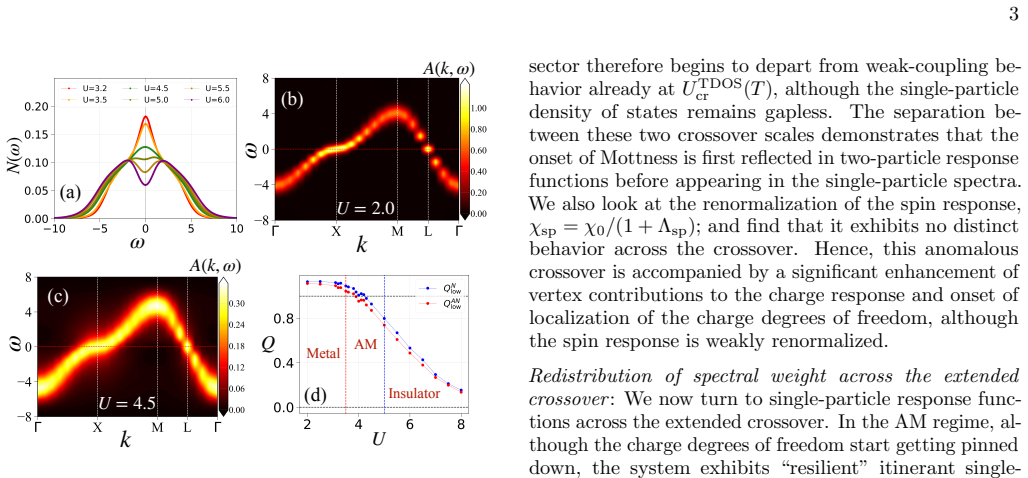
In the repulsive Hubbard model above the spin-ordering temperature, the finite-temperature crossover is accompanied by a pronounced suppression of charge fluctuations despite gapless single-particle spectra. Mottness first emerges via two-particle response in an anomalous metallic regime. Gap formation in the density of states occurs through momentum-resolved redistribution of spectral weight across the Brillouin zone that begins at the onset of the anomalous metallic regime. Upon doping, the anomalous-metallic regime generates transport and spectroscopic signatures characteristic of doped Mott insulators, showing that these anomalies originate from the strong charge-response renormalization
What carries the argument
The anomalous metallic regime, defined by suppression of charge fluctuations while single-particle spectra stay gapless, acts as the precursor stage where Mottness develops through two-particle charge response and momentum-resolved spectral weight redistribution.
If this is right
- Transport anomalies upon doping arise from the precursor regime at half-filling rather than a complete Mott gap.
- Spectroscopic anomalies in doped systems trace to spectral-weight redistribution that starts in the anomalous metallic phase.
- Gap formation in the density of states proceeds via momentum-resolved redistribution across the Brillouin zone instead of local gaps at individual momenta.
- Doped Mott insulator signatures can appear without a fully formed Mott insulator at half-filling.
Where Pith is reading between the lines
- Experiments could detect Mottness precursors by measuring charge fluctuations at temperatures higher than those where single-particle gaps appear.
- The same precursor mechanism may operate in other lattice models of strong correlations where two-particle responses renormalize first.
- Numerical studies of doped systems should incorporate the finite-temperature crossover at half-filling as the source of anomalies rather than assuming a zero-temperature Mott insulator.
- The momentum-resolved redistribution implies that zone-boundary and zone-center responses evolve differently, offering a testable distinction in momentum-resolved spectroscopies.
Load-bearing premise
Determinant quantum Monte Carlo simulations accurately capture the two-particle charge response and the momentum-resolved spectral weight redistribution without significant finite-size effects, Trotter errors, or ambiguities in defining the boundaries of the anomalous metallic regime.
What would settle it
Finding unsuppressed charge fluctuations persisting through the temperature window where single-particle spectra remain gapless would show that Mottness does not emerge first via two-particle response.
Figures



read the original abstract
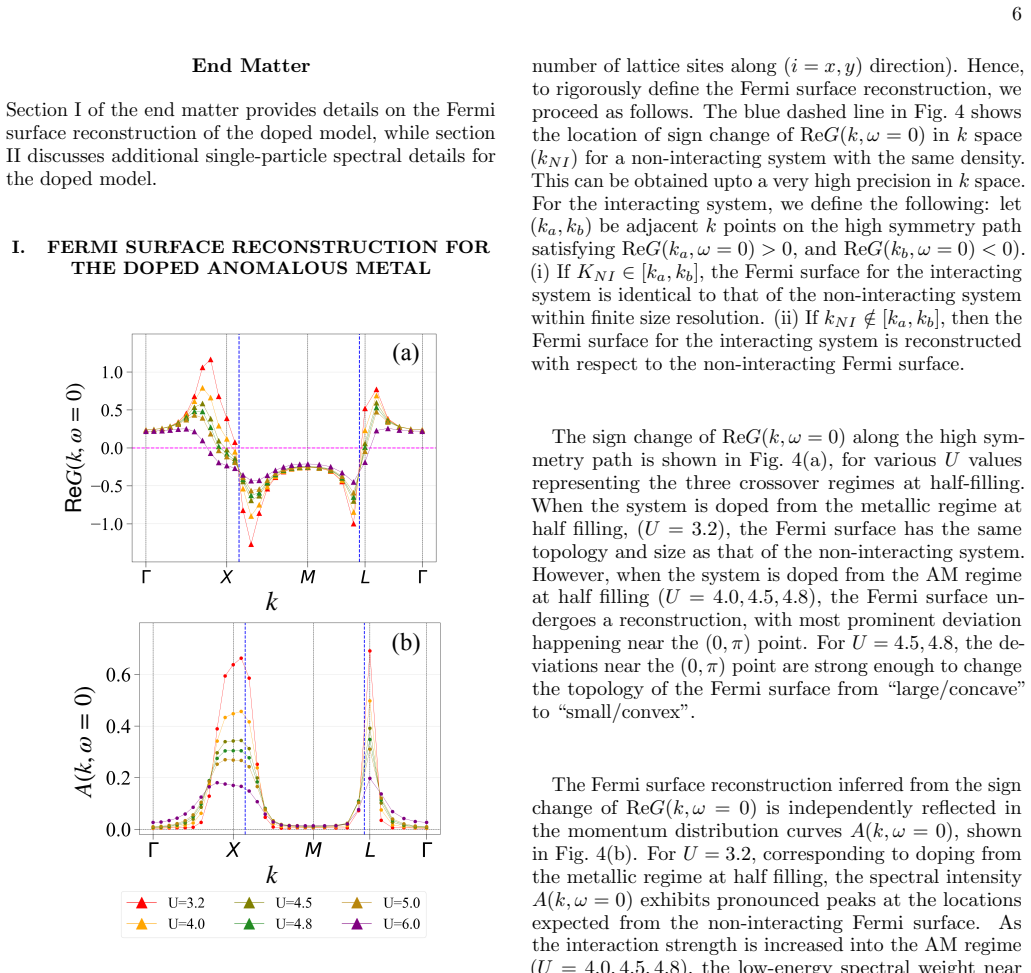
We investigate finite-temperature precursors of Mottness in the repulsive Hubbard model above the spin-ordering temperature, using numerically exact determinant quantum Monte Carlo. We show that the finite-temperature crossover is accompanied by a pronounced suppression of charge fluctuations, despite the presence of a gapless single-particle spectra, demonstrating that Mottness first emerges via two-particle response in an anomalous metallic regime, before appearing in single-particle spectral functions. We further show that a gap formation in the density of states occurs through momentum-resolved redistribution of spectral weight across the Brillouin zone, that begins at the onset of anomalous metallic regime, rather than through gap formation in single-particle spectral functions at individual momenta. Upon doping, the anomalous-metallic regime generates transport and spectroscopic signatures characteristic of doped Mott insulators. This shows that the transport and spectroscopic anomalies of the doped Hubbard model do not require the presence of a fully formed Mott insulator at half-filling, but instead originate from the strong charge-response renormalization and spectral-weight redistribution that develop within the precursor anomalous metallic regime at half-filling.
Editorial analysis
A structured set of objections, weighed in public.
Referee Report
Summary. The manuscript uses determinant quantum Monte Carlo (DQMC) to examine finite-temperature crossovers in the repulsive Hubbard model above the spin-ordering temperature. It reports that charge fluctuations are suppressed in a regime that remains gapless in single-particle spectra, arguing that Mottness precursors first appear via two-particle response in an anomalous metallic regime; spectral-weight redistribution across the Brillouin zone then produces a density-of-states gap, and doping this regime reproduces transport and spectroscopic anomalies of doped Mott insulators without requiring a fully formed Mott insulator at half filling.
Significance. If the reported ordering between two-particle and single-particle signatures is robust, the work supplies a concrete numerical mechanism linking half-filling precursors to the anomalies observed upon doping. The reliance on numerically exact DQMC rather than approximate methods is a clear strength; the absence of fitted parameters or invented entities further strengthens the claim that the observed sequence is a direct consequence of the Hubbard Hamiltonian.
major comments (3)
- [§4] §4 (results on charge response and spectral functions): the central claim that charge-fluctuation suppression precedes single-particle gap formation rests on the boundaries of the anomalous metallic regime, yet the manuscript provides neither explicit finite-size scaling nor Trotter-error estimates for the two-particle correlator and the analytically continued spectra; without these controls the reported precedence cannot be verified at the level required for the load-bearing conclusion.
- [§4.2] §4.2 (momentum-resolved spectral functions): analytic continuation of the imaginary-time Green’s function is used to extract the onset of spectral-weight redistribution and the density-of-states gap; no systematic tests (different default models, regularization strengths, or comparison with direct real-frequency estimators) are reported, leaving open the possibility that continuation resolution limits shift the apparent single-particle onset relative to the directly computed charge response.
- [Figure 2] Figure 2 and associated text: the definition of the anomalous metallic regime is stated in terms of simultaneous suppression of charge fluctuations and persistence of gapless spectra, but the quantitative thresholds (e.g., percentage suppression or gap-size cutoff) and their statistical uncertainties are not supplied, rendering the regime boundaries—and therefore the claimed temporal ordering—difficult to reproduce or falsify.
minor comments (2)
- The abstract and introduction use the phrase “anomalous metallic regime” without an immediate, self-contained definition; a one-sentence operational definition at first use would improve readability.
- Several panels lack axis labels or units on the color bars; adding these would aid quick assessment of the plotted quantities.
Simulated Author's Rebuttal
We thank the referee for the careful reading and constructive comments. We agree that additional numerical controls are needed to strengthen the central claims regarding the ordering of two-particle and single-particle signatures. We will revise the manuscript to incorporate finite-size scaling, Trotter-error estimates, systematic analytic-continuation tests, and quantitative regime definitions. Point-by-point responses follow.
read point-by-point responses
-
Referee: §4 (results on charge response and spectral functions): the central claim that charge-fluctuation suppression precedes single-particle gap formation rests on the boundaries of the anomalous metallic regime, yet the manuscript provides neither explicit finite-size scaling nor Trotter-error estimates for the two-particle correlator and the analytically continued spectra; without these controls the reported precedence cannot be verified at the level required for the load-bearing conclusion.
Authors: We agree that explicit controls are required. In the revised manuscript we will add finite-size scaling of the charge compressibility and susceptibility across system sizes up to L=16 to confirm the suppression is not a finite-size effect. We will also report Trotter-error estimates obtained by comparing results at Δτ = 0.1 and Δτ = 0.05 for both the charge response functions and the imaginary-time Green’s functions used for continuation. These additions will allow direct verification of the reported ordering between charge-fluctuation suppression and single-particle gap formation. revision: yes
-
Referee: §4.2 (momentum-resolved spectral functions): analytic continuation of the imaginary-time Green’s function is used to extract the onset of spectral-weight redistribution and the density-of-states gap; no systematic tests (different default models, regularization strengths, or comparison with direct real-frequency estimators) are reported, leaving open the possibility that continuation resolution limits shift the apparent single-particle onset relative to the directly computed charge response.
Authors: We acknowledge the absence of systematic continuation tests. The revised version will include maximum-entropy continuation results for multiple default models (flat, Gaussian, and model-independent) and a range of regularization strengths. We will also compare the continued spectra against direct estimators such as the imaginary-time decay rate and first two moments of the spectral function to demonstrate that the reported onset of the density-of-states gap is robust and not shifted by continuation artifacts relative to the charge response. revision: yes
-
Referee: Figure 2 and associated text: the definition of the anomalous metallic regime is stated in terms of simultaneous suppression of charge fluctuations and persistence of gapless spectra, but the quantitative thresholds (e.g., percentage suppression or gap-size cutoff) and their statistical uncertainties are not supplied, rendering the regime boundaries—and therefore the claimed temporal ordering—difficult to reproduce or falsify.
Authors: We agree that explicit quantitative thresholds are needed. In the revision we will define the anomalous metallic regime using concrete criteria: charge fluctuations suppressed by more than 25 % relative to the non-interacting value (with Monte Carlo statistical uncertainty reported) together with a density-of-states gap smaller than 0.08t. These thresholds and their uncertainties will be stated in the text and figure caption, making the regime boundaries reproducible and allowing unambiguous assessment of the temporal ordering. revision: yes
Circularity Check
No circularity; central claims rest on direct DQMC numerics of the Hubbard model
full rationale
The paper computes charge response, single-particle spectra, and spectral-weight redistribution directly from determinant quantum Monte Carlo simulations of the repulsive Hubbard Hamiltonian. No quantities are defined in terms of each other (no self-definitional loops), no fitted parameters are relabeled as predictions, and no load-bearing uniqueness theorems or ansatzes are imported via self-citation. The ordering of two-particle versus single-particle Mottness precursors follows from the raw simulation outputs without reduction to the inputs by construction.
Axiom & Free-Parameter Ledger
free parameters (2)
- U/t
- T/t
axioms (2)
- domain assumption The single-band repulsive Hubbard model captures the essential physics of the systems under study.
- domain assumption Determinant quantum Monte Carlo yields numerically exact results for the observables considered when the sign problem is absent.
Reference graph
Works this paper leans on
-
[1]
P. W. Anderson, New approach to the theory of superex- change interactions, Physical Review115, 2 (1959)
1959
-
[2]
N. F. Mott, The transition to the metallic state, Philo- 8 sophical Magazine6, 287 (1961)
1961
-
[3]
Hubbard, Electron correlations in narrow energy bands, Proceedings of the Royal Society of London
J. Hubbard, Electron correlations in narrow energy bands, Proceedings of the Royal Society of London. Series A. Mathematical and Physical Sciences276, 238 (1963)
1963
-
[4]
Slater, Magnetic effects and the hartree-fock equation, Physical Review82, 538 (1951)
J. Slater, Magnetic effects and the hartree-fock equation, Physical Review82, 538 (1951)
1951
-
[5]
Schrieffer, X
J. Schrieffer, X. Wen, and S. Zhang, Dynamic spin fluctua- tions and the bag mechanism of high-t c superconductivity, Physical Review B39, 11663 (1989)
1989
-
[6]
Imada, A
M. Imada, A. Fujimori, and Y. Tokura, Metal-insulator transitions, Reviews of modern physics70, 1039 (1998)
1998
-
[7]
A. H. MacDonald, S. Girvin, and D. t. Yoshioka, t u expansion for the hubbard model, Physical Review B37, 9753 (1988)
1988
-
[8]
Sch¨ afer, N
T. Sch¨ afer, N. Wentzell, F.ˇSimkovic IV, Y.-Y. He, C. Hille, M. Klett, C. J. Eckhardt, B. Arzhang, V. Harkov, F.- M. Le R´ egent,et al., Tracking the footprints of spin fluctuations: A multimethod, multimessenger study of the two-dimensional hubbard model, Physical Review X 11, 011058 (2021)
2021
-
[9]
A. J. Kim, F. Simkovic IV, and E. Kozik, Spin and charge correlations across the metal-to-insulator crossover in the half-filled 2d hubbard model, Physical Review Letters 124, 117602 (2020)
2020
-
[10]
Lenihan, A
C. Lenihan, A. J. Kim, F. ˇSimkovic IV, and E. Kozik, Entropy in the non-fermi-liquid regime of the doped 2 d hubbard model, Physical Review Letters126, 105701 (2021)
2021
-
[11]
ˇSimkovic IV, J
F. ˇSimkovic IV, J. LeBlanc, A. J. Kim, Y. Deng, N. Prokof’ev, B. Svistunov, and E. Kozik, Extended crossover from a fermi liquid to a quasiantiferromagnet in the half-filled 2d hubbard model, Physical Review Letters 124, 017003 (2020)
2020
-
[12]
Paiva, R
T. Paiva, R. Scalettar, M. Randeria, and N. Trivedi, Fermions in 2d optical lattices: temperature and entropy scales for observing antiferromagnetism and superfluidity, Physical Review Letters104, 066406 (2010)
2010
-
[13]
Bloch, Ultracold quantum gases in optical lattices, Na- ture physics1, 23 (2005)
I. Bloch, Ultracold quantum gases in optical lattices, Na- ture physics1, 23 (2005)
2005
-
[14]
Bloch, J
I. Bloch, J. Dalibard, and S. Nascimbene, Quantum sim- ulations with ultracold quantum gases, Nature Physics8, 267 (2012)
2012
-
[15]
W. S. Bakr, J. I. Gillen, A. Peng, S. F¨ olling, and M. Greiner, A quantum gas microscope for detecting single atoms in a hubbard-regime optical lattice, Nature 462, 74 (2009)
2009
-
[16]
M. Aidelsburger, M. Atala, M. Lohse, J. T. Barreiro, B. Paredes, and I. Bloch, Realization of the hofstadter hamiltonian with ultracold atoms in optical lattices, arXiv preprint arXiv:1308.0321 (2013)
Pith/arXiv arXiv 2013
-
[17]
Gross and I
C. Gross and I. Bloch, Quantum simulations with ultra- cold atoms in optical lattices, Science357, 995 (2017)
2017
-
[18]
Koepsell, J
J. Koepsell, J. Vijayan, P. Sompet, F. Grusdt, T. A. Hilker, E. Demler, G. Salomon, I. Bloch, and C. Gross, Imaging magnetic polarons in the doped fermi–hubbard model, Nature572, 358 (2019)
2019
-
[19]
Koepsell, S
J. Koepsell, S. Hirthe, D. Bourgund, P. Sompet, J. Vi- jayan, G. Salomon, C. Gross, and I. Bloch, Robust bilayer charge pumping for spin-and density-resolved quantum gas microscopy, Physical Review Letters125, 010403 (2020)
2020
-
[20]
Hirthe, T
S. Hirthe, T. Chalopin, D. Bourgund, P. Bojovi´ c, A. Bohrdt, E. Demler, F. Grusdt, I. Bloch, and T. A. Hilker, Magnetically mediated hole pairing in fermionic ladders of ultracold atoms, Nature613, 463 (2023)
2023
-
[21]
Salomon, J
G. Salomon, J. Koepsell, J. Vijayan, T. A. Hilker, J. Ne- spolo, L. Pollet, I. Bloch, and C. Gross, Direct observation of incommensurate magnetism in hubbard chains, Nature 565, 56 (2019)
2019
-
[22]
Vijayan, P
J. Vijayan, P. Sompet, G. Salomon, J. Koepsell, S. Hirthe, A. Bohrdt, F. Grusdt, I. Bloch, and C. Gross, Time- resolved observation of spin-charge deconfinement in fermionic hubbard chains, Science367, 186 (2020)
2020
-
[23]
Koepsell, D
J. Koepsell, D. Bourgund, P. Sompet, S. Hirthe, A. Bohrdt, Y. Wang, F. Grusdt, E. Demler, G. Salomon, C. Gross,et al., Microscopic evolution of doped mott insulators from polaronic metal to fermi liquid, Science 374, 82 (2021)
2021
-
[24]
Sompet, S
P. Sompet, S. Hirthe, D. Bourgund, T. Chalopin, J. Bibo, J. Koepsell, P. Bojovi´ c, R. Verresen, F. Pollmann, G. Sa- lomon,et al., Realizing the symmetry-protected haldane phase in fermi–hubbard ladders, Nature606, 484 (2022)
2022
-
[25]
C. S. Chiu, G. Ji, A. Mazurenko, D. Greif, and M. Greiner, Quantum state engineering of a hubbard system with ultracold fermions, Physical review letters120, 243201 (2018)
2018
-
[26]
C. S. Chiu, G. Ji, A. Bohrdt, M. Xu, M. Knap, E. Demler, F. Grusdt, M. Greiner, and D. Greif, String patterns in the doped hubbard model, Science365, 251 (2019)
2019
-
[27]
S. Roy, S. Pervaiz, T. Paiva, and N. Trivedi, Metal to insulator crossover in the repulsive fermi-hubbard model probed by static correlations, Physical Review B112, 165144 (2025)
2025
-
[28]
Sch¨ afer, G
T. Sch¨ afer, G. Rohringer, O. Gunnarsson, S. Ciuchi, G. Sangiovanni, and A. Toschi, Divergent precursors of the mott-hubbard transition at the two-particle level, Physical Review Letters110, 246405 (2013)
2013
-
[29]
M. Pelz, S. Adler, M. Reitner, and A. Toschi, Highly nonperturbative nature of the mott metal-insulator tran- sition: Two-particle vertex divergences in the coexistence region, Physical Review B108, 155101 (2023)
2023
-
[30]
Lu, Y.-F
M. Lu, Y.-F. Song, Y. Deng, and Y.-Y. He, Quantum monte carlo study of the metal-insulator crossover in the square-lattice hubbard model, Physical Review B113, 195154 (2026)
2026
-
[31]
M. Lu, Y.-F. Song, Y. Deng, and Y.-Y. He, Thermal sig- natures of the slater-mott crossover in the hubbard model: From double occupancy to antiferromagnetic correlation length, arXiv preprint arXiv:2606.10976 (2026)
Pith/arXiv arXiv 2026
-
[32]
Y. Eom, I. S. Tupitsyn, N. V. Prokof’ev, B. Svistunov, E. Kozik, and A. J. Kim, Strange diffusivity of incoherent metal in half-filled two-dimensional hubbard model, arXiv preprint arXiv:2509.00281 (2025)
arXiv 2025
-
[33]
Comanac, L
A. Comanac, L. de’Medici, M. Capone, and A. Mil- lis, Optical conductivity and the correlation strength of high-temperature copper-oxide superconductors, Nature Physics4, 287 (2008)
2008
-
[34]
B. S. Shastry, Thermopower in correlated systems, inNew Materials for Thermoelectric Applications: Theory and Experiment(Springer, 2013) pp. 25–29
2013
-
[35]
M. R. Peterson and B. S. Shastry, Kelvin formula for thermopower, Physical Review B82, 195105 (2010)
2010
-
[36]
Blankenbecler, D
R. Blankenbecler, D. Scalapino, and R. Sugar, Monte carlo calculations of coupled boson-fermion systems. i, Physical Review D24, 2278 (1981)
1981
-
[37]
J. E. Hirsch, Two-dimensional hubbard model: Numerical simulation study, Physical Review B31, 4403 (1985)
1985
-
[38]
R. Levy, J. LeBlanc, and E. Gull, Implementation of 9 the maximum entropy method for analytic continuation, Computer Physics Communications215, 149 (2017)
2017
-
[39]
S. R. White, Spectral weight function for the two- dimensional hubbard model, Physical Review B44, 4670 (1991)
1991
-
[40]
Swanson, Y
M. Swanson, Y. L. Loh, M. Randeria, and N. Trivedi, Dynamical conductivity across the disorder-tuned superconductor-insulator transition, Physical Review X 4, 021007 (2014)
2014
-
[41]
See Supplemental Material and End matter at [URL will be inserted by publisher] for details on vertex corrections to compressibility, momentum-resolved spectral functions, entropy evolution across the crossover, and additional finite-doping spectral data
-
[42]
Dagotto, A
E. Dagotto, A. Moreo, F. Ortolani, J. Riera, and D. Scalapino, Density of states of doped hubbard clusters, Physical review letters67, 1918 (1991)
1918
-
[43]
Osborne, T
I. Osborne, T. Paiva, and N. Trivedi, Broken luttinger theorem in the two-dimensional fermi-hubbard model, Physical Review B104, 235122 (2021)
2021
-
[44]
X. Deng, J. Mravlje, R. ˇZitko, M. Ferrero, G. Kotliar, and A. Georges, How bad metals turn good: Spectroscopic sig- natures of resilient quasiparticles, Physical review letters 110, 086401 (2013)
2013
-
[45]
W. O. Wang, J. K. Ding, E. W. Huang, B. Moritz, and T. P. Devereaux, Quantitative assessment of the universal thermopower in the hubbard model, Nature Communica- tions14, 7064 (2023)
2023
-
[46]
Mravlje and A
J. Mravlje and A. Georges, Thermopower and entropy: lessons from sr 2 ruo 4, Physical review letters117, 036401 (2016)
2016
-
[47]
Gourgout, G
A. Gourgout, G. Grissonnanche, F. Lalibert´ e, A. Ataei, L. Chen, S. Verret, J.-S. Zhou, J. Mravlje, A. Georges, N. Doiron-Leyraud,et al., Seebeck coefficient in a cuprate superconductor: particle-hole asymmetry in the strange metal phase and fermi surface transformation in the pseu- dogap phase, Physical Review X12, 011037 (2022)
2022
-
[48]
Cyr-Choini` ere, S
O. Cyr-Choini` ere, S. Badoux, G. Grissonnanche, B. Mi- chon, S. Afshar, S. Fortier, D. LeBoeuf, D. Graf, J. Day, D. Bonn,et al., Anisotropy of the seebeck coefficient in the cuprate superconductor yba 2 cu 3 o y: Fermi-surface reconstruction by bidirectional charge order, Physical Re- view X7, 031042 (2017)
2017
-
[49]
Mandal, T
P. Mandal, T. Sarkar, and R. L. Greene, Anomalous quantum criticality in the electron-doped cuprates, Pro- ceedings of the National Academy of Sciences116, 5991 (2019)
2019
-
[50]
Doiron-Leyraud, S
N. Doiron-Leyraud, S. Lepault, O. Cyr-Choiniere, B. Vig- nolle, G. Grissonnanche, F. Lalibert´ e, J. Chang, N. Bariˇ si´ c, M. Chan, L. Ji,et al., Hall, seebeck, and nernst coeffi- cients of underdoped hgba 2 cuo 4+ δ: Fermi-surface reconstruction in an archetypal cuprate superconductor, Physical Review X3, 021019 (2013)
2013
-
[51]
S. Roy, M. Randeria, and N. Trivedi, in preparation
-
[52]
Zhang, J.-W
C. Zhang, J.-W. Li, D. Nikolaidou, and J. von Delft, Frustration-induced superconductivity in the t-t’ hubbard model, Physical Review Letters134, 116502 (2025)
2025
-
[53]
Georges, G
A. Georges, G. Kotliar, W. Krauth, and M. J. Rozen- berg, Dynamical mean-field theory of strongly correlated fermion systems and the limit of infinite dimensions, Re- views of modern physics68, 13 (1996)
1996
-
[54]
isobestic
T. Sch¨ afer, S. Ciuchi, M. Wallerberger, P. Thunstr¨ om, O. Gunnarsson, G. Sangiovanni, G. Rohringer, and A. Toschi, Nonperturbative landscape of the mott- hubbard transition: Multiple divergence lines around the critical endpoint, Physical Review B94, 235108 (2016). 10 Supplemental Material: Finite temperature precursors of Mottness in the Fermi Hubbard...
2016
discussion (0)
Sign in with ORCID, Apple, or X to comment. Anyone can read and Pith papers without signing in.