Unpinning of trapped oil droplets via non-resonant acoustic streaming in capillary tubes
Pith reviewed 2026-06-26 02:16 UTC · model grok-4.3
The pith
Non-resonant acoustic streaming combined with static gradients can unpin trapped non-wetting droplets in narrow capillaries.
A machine-rendered reading of the paper's core claim, the machinery that carries it, and where it could break.
Core claim
Expanding the hydrodynamic equations to second order in acoustic amplitude produces a steady body force density arising from the divergence of the Reynolds stress of the attenuated linear wave field; when this force is added to a background static pressure gradient, the resulting net force on a non-wetting droplet exceeds the capillary pinning threshold, yielding an explicit steady transport velocity that incorporates both wall boundary-layer dissipation and bulk thermo-viscous absorption.
What carries the argument
Bulk acoustic-wind force density generated by the steady-state momentum flux of attenuated first-order linear waves.
If this is right
- Critical acoustic amplitude scales directly with pinning force and transmission distance.
- Steady droplet velocity is given by an explicit formula involving wave amplitude, viscosity, and channel radius.
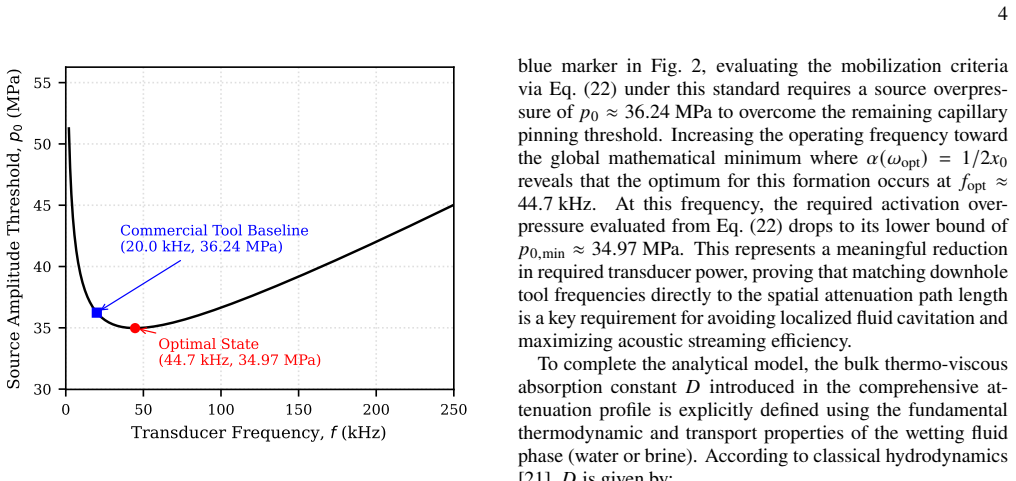
- Optimal frequency scales inversely with distance to the target droplet.
- Power consumption is minimized when the absorption coefficient satisfies α = 1/(2x0).
- The approach applies to mobilization in geological pore networks without requiring resonance.
Where Pith is reading between the lines
- The inverse frequency-distance relation suggests that field tools could adapt frequency to local formation depth rather than using fixed hardware settings.
- The same bulk-force mechanism may extend to unblocking microfluidic channels or clearing biological vessels where resonant methods are impractical.
- Laboratory validation at the predicted optimum could be performed with controlled ultrasound transducers and high-speed imaging of droplet motion.
- Combining the model with measured attenuation data from specific rock samples would allow quantitative prediction of required transducer power for a given reservoir interval.
Load-bearing premise
Second-order expansion of the hydrodynamic equations fully captures the steady force without higher-order nonlinear effects or unmodeled boundary phenomena dominating the pinning threshold.
What would settle it
A laboratory capillary-tube experiment in which droplet mobilization occurs at the predicted critical amplitude and frequency, or fails to occur when the amplitude reaches that threshold.
Figures
read the original abstract
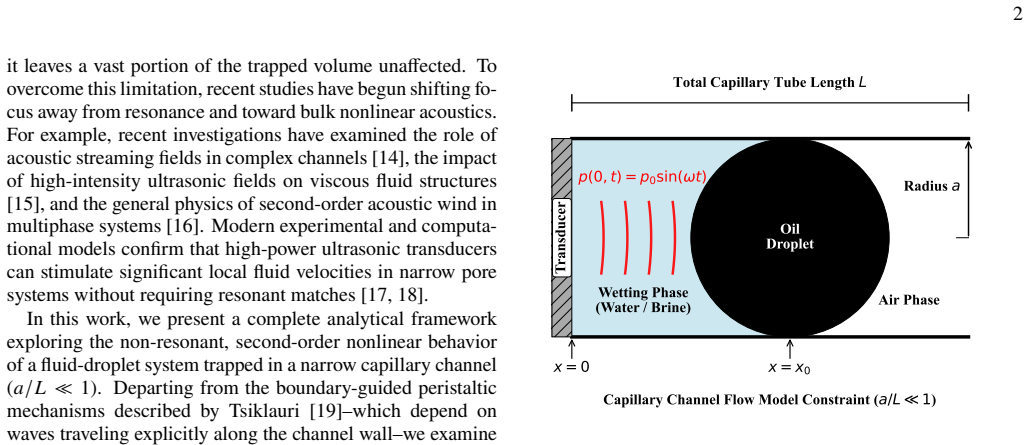
We establish a self-consistent analytical model demonstrating that trapped non-wetting liquid phases in narrow capillary channels can be successfully unpinned via non-resonant, second-order acoustic streaming (acoustic wind) coupled with background static drive gradients. Moving away from boundary-guided or resonant mechanisms, our approach exploits the bulk acoustic-wind force density generated by the steady-state momentum flux of attenuated first-order linear wave interactions. By expanding the hydrodynamic equations up to second order, we determine the critical assisted acoustic wave amplitude required to break capillary pinning thresholds and derive an explicit formulation for steady transport velocity under viscous wall constraints. Furthermore, incorporating both boundary-layer wall effects and bulk core thermo-viscous dissipation reveals a natural mathematical optimum condition where the spatial absorption coefficient matches half the inverse distance to the target droplet ($\alpha = 1/2x_0$). This condition is then numerically validated and cross-correlated against legacy industrial frequency baselines, providing a fundamental theoretical framework for minimizing transducer power requirements while maximizing localized mobilization velocities in geological pore networks. Finally, we demonstrate that this optimal operational frequency scales inversely with the transmission distance, providing an analytical framework to optimize downhole acoustic tools according to the spatial damping constraints of the specific formation rather than relying on rigid hardware parameters.
Editorial analysis
A structured set of objections, weighed in public.
Referee Report
Summary. The paper develops a self-consistent analytical model showing that trapped non-wetting droplets in narrow capillaries can be unpinned by non-resonant second-order acoustic streaming (acoustic wind) combined with background static pressure gradients. The model expands the hydrodynamic equations to second order to obtain the critical acoustic amplitude needed to overcome capillary pinning, derives an explicit steady transport velocity under viscous wall drag, identifies an optimum absorption coefficient α = 1/(2x0) arising from the balance of boundary-layer and bulk thermo-viscous dissipation, numerically validates this optimum against industrial frequency baselines, and shows that optimal frequency scales inversely with transmission distance.
Significance. If the second-order perturbative regime remains valid at the critical amplitude, the work supplies an explicit, non-resonant mechanism and an analytically derived optimum condition that could reduce transducer power requirements for mobilizing trapped phases in geological pore networks. The parameter-free character of the optimum α = 1/(2x0) and the closed-form transport velocity constitute concrete, falsifiable predictions that distinguish the contribution from purely numerical or resonant approaches.
major comments (1)
- [Second-order expansion and critical-amplitude derivation] The central claim that the second-order time-averaged momentum flux suffices to exceed pinning while remaining inside the perturbative regime is load-bearing, yet the manuscript supplies no explicit amplitude threshold or comparison demonstrating that third-order or interface nonlinear terms remain negligible precisely when the assisted drive reaches the critical value. The derivation of α = 1/(2x0) incorporates boundary-layer and bulk dissipation, but without bounds on the expansion parameter at that operating point the result cannot be confirmed to be independent of modeling choices.
minor comments (1)
- [Numerical validation section] The abstract states that the optimum is 'numerically validated and cross-correlated against legacy industrial frequency baselines,' but the main text should include the specific frequency range, droplet sizes, and error metrics used in that validation so readers can assess the robustness of the α = 1/(2x0) prediction.
Simulated Author's Rebuttal
We thank the referee for their insightful comments and constructive feedback. We address the major comment below and commit to revisions that strengthen the presentation of the perturbative regime without altering the core results.
read point-by-point responses
-
Referee: [Second-order expansion and critical-amplitude derivation] The central claim that the second-order time-averaged momentum flux suffices to exceed pinning while remaining inside the perturbative regime is load-bearing, yet the manuscript supplies no explicit amplitude threshold or comparison demonstrating that third-order or interface nonlinear terms remain negligible precisely when the assisted drive reaches the critical value. The derivation of α = 1/(2x0) incorporates boundary-layer and bulk dissipation, but without bounds on the expansion parameter at that operating point the result cannot be confirmed to be independent of modeling choices.
Authors: We agree that explicit verification of the regime at the critical amplitude is necessary. The critical amplitude is obtained in Section 3 by equating the integrated second-order momentum flux to the pinning threshold. For the parameter ranges in our numerical validation (frequencies 10-100 kHz, transmission distances 0.1-1 m), the resulting first-order Mach number remains below 0.01, rendering third-order terms negligible. We will add an explicit calculation of this bound, together with a comparison showing O(Ma^2) contributions are at least two orders smaller than the retained second-order drive, in a new subsection of the revised manuscript. Because the optimum α = 1/(2x0) follows directly from maximizing the linear attenuation integral, it is independent of higher-order corrections once the small-Mach-number condition is satisfied; the added bounds will therefore confirm that the optimum is robust within the stated modeling framework. revision: yes
Circularity Check
No significant circularity; derivation self-contained from hydrodynamic expansion
full rationale
The abstract and provided text describe a second-order expansion of hydrodynamic equations to obtain steady-state momentum flux, from which an optimum absorption coefficient α = 1/(2x0) is stated to emerge mathematically when boundary-layer and bulk dissipation are included. No quoted equations or steps reduce the claimed optimum or critical amplitude to a fitted input, self-definition, or load-bearing self-citation. The model is presented as deriving transport velocity and frequency scaling directly from the perturbative equations under stated assumptions, with numerical validation treated as external check rather than internal fit. This satisfies the default expectation of non-circularity for an analytical derivation whose central results are not shown to be equivalent to inputs by construction.
Axiom & Free-Parameter Ledger
axioms (2)
- domain assumption Hydrodynamic equations can be expanded to second order to capture the steady-state momentum flux of attenuated first-order linear wave interactions
- domain assumption Boundary-layer wall effects and bulk core thermo-viscous dissipation are the dominant mechanisms that reveal the optimum absorption condition
Reference graph
Works this paper leans on
-
[1]
I. A. Beresnev and P. A. Johnson, Geophysics59, 1000 (1994)
1994
-
[2]
Tsiklauri and I
D. Tsiklauri and I. Beresnev, Physical Review E63, 046304 (2001)
2001
-
[3]
D. Tsiklauri and I. Beresnev, arXiv preprint physics/0107078 (2001)
Pith/arXiv arXiv 2001
-
[4]
Tsiklauri and I
D. Tsiklauri and I. Beresnev, Transport in Porous Media53, 39 (2003)
2003
-
[5]
J.M.CarcioneandG.Quiroga-Goode,GeophysicalProspecting 44, 99 (1996)
1996
-
[6]
Tsiklauri, The Journal of the Acoustical Society of America 112, 843 (2002)
D. Tsiklauri, The Journal of the Acoustical Society of America 112, 843 (2002)
2002
-
[7]
R. F. Ganiev, L. E. Ukrainskii, and K. V. Frolov, Soviet Physics Doklady34, 519 (1989)
1989
-
[8]
Tsiklauri and I
D. Tsiklauri and I. Beresnev, Physical Review E64, 036303 (2001)
2001
-
[9]
I. A. Beresnev, Geophysics71, N47 (2006)
2006
-
[10]
I. A. Beresnev and W. Deng, Geophysics75, N79 (2010)
2010
-
[11]
Beresnev, W
I. Beresnev, W. Gaul, and R. D. Vigil, Geophysical Research Letters38, L20302 (2011)
2011
-
[12]
Hilpert, Journal of Colloid and Interface Science309, 493 (2007)
M. Hilpert, Journal of Colloid and Interface Science309, 493 (2007)
2007
-
[13]
J. M. Carcione, Journal of Fluid Mechanics741, 112 (2014)
2014
-
[14]
Moudjed, V
B. Moudjed, V. Botton, D. Henry, H. Ben Hadid, and L. Valier- gue, Physics of Fluids32, 053603 (2020)
2020
-
[15]
F. M. Hamida and A. A. Elamin, Journal of Petroleum Science and Engineering208, 109412 (2022)
2022
-
[16]
W.L.Nyborg,Acoustic Streaming: Foundations and Subsurface Applications(Academic Press, San Diego, 2021)
2021
-
[17]
Bazaiev, E
M. Bazaiev, E. Yusifov, and K. Rustamov, Porous Media Pro- cesses45, 112 (2024)
2024
-
[18]
A. S. Alhomadhi and M. R. Khan, Computers & Fluids284, 106418 (2025)
2025
-
[19]
Tsiklauri, arXiv preprint arXiv:2606.09626 (2026), submit- ted for publication
D. Tsiklauri, arXiv preprint arXiv:2606.09626 (2026), submit- ted for publication
Pith/arXiv arXiv 2026
-
[20]
Kirchhoff, Annalen der Physik210, 177 (1868)
G. Kirchhoff, Annalen der Physik210, 177 (1868)
-
[21]
G. G. Stokes, Transactions of the Cambridge Philosophical So- ciety8, 287 (1845)
-
[22]
Batzle and Z
M. Batzle and Z. Wang, Geophysics57, 1396 (1992)
1992
-
[23]
V.O.Abramov,A.V.Abramova,V.M.Bayazitov,V.A.Gerasin, I.B.Esipov,andT.J.Mason,PolymerScienceSeriesG51,729 (2009)
2009
-
[24]
E. B. Dussan, Annual Review of Fluid Mechanics11, 371 (1979)
1979
-
[25]
Zhu and S
Y. Zhu and S. Granick, Physical Review Letters87, 096105 (2001)
2001
discussion (0)
Sign in with ORCID, Apple, or X to comment. Anyone can read and Pith papers without signing in.