Analysis of Nonlinear Random Polarization in Dispersive Dielectrics
Pith reviewed 2026-06-29 01:19 UTC · model grok-4.3
The pith
Polynomial chaos expansions turn random nonlinear Debye polarization into a deterministic coupled system solved by a second-order Yee scheme.
A machine-rendered reading of the paper's core claim, the machinery that carries it, and where it could break.
Core claim
The paper claims that random perturbations in a nonlinear Debye polarization model can be represented by a polynomial chaos expansion whose resulting deterministic system admits a second-order-accurate Yee discretization; numerical verification establishes convergence, and the same framework reveals that nonlinear properties become markedly more sensitive to parameter uncertainty at large input amplitudes, thereby supporting simulation-based identification of realizable materials whose desired effects survive fabrication variations.
What carries the argument
The polynomial chaos expansion of the random nonlinear Debye polarization, which produces an enlarged deterministic system to which the Yee finite-difference time-domain discretization extends while preserving second-order spatial accuracy.
If this is right
- The extended Yee scheme solves the transformed deterministic system to second-order accuracy in space.
- Numerical experiments confirm the expected convergence rates for the coupled system.
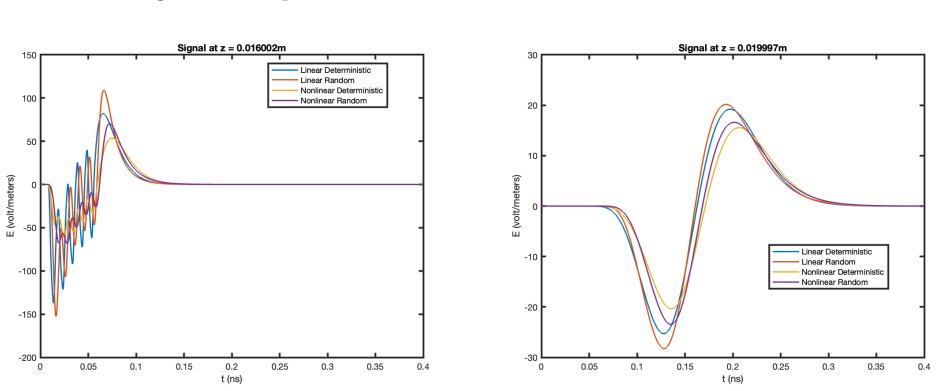
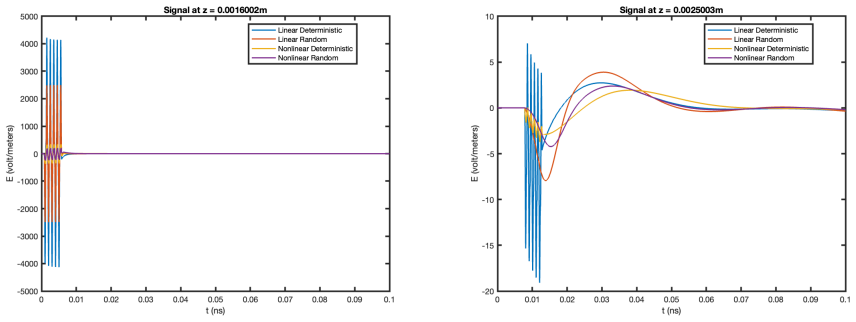
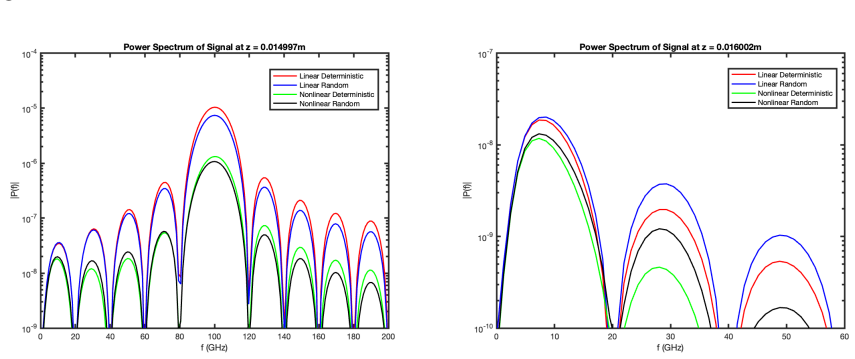
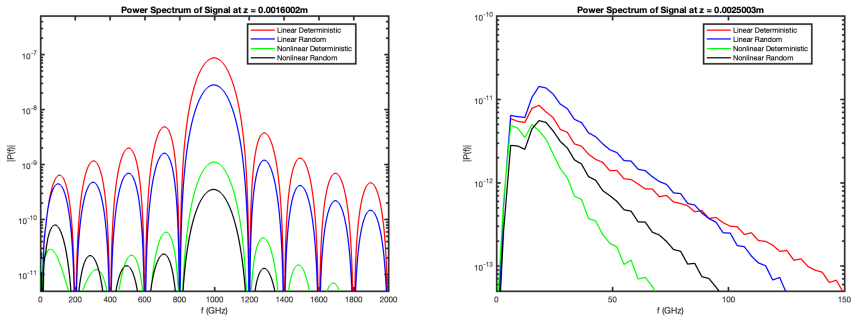
- Nonlinear response properties exhibit greater sensitivity to uncertainty at large input signal amplitudes.
- The framework supports model-based selection of material parameters that remain effective despite random manufacturing variations.
Where Pith is reading between the lines
- The same expansion-plus-Yee approach could be tested on other dispersive nonlinear models such as Kerr or Raman media to check whether second-order accuracy persists.
- Large-amplitude regimes may require adaptive choice of chaos expansion order to keep truncation error from contaminating sensitivity estimates.
- The method supplies a concrete route to quantify how tight manufacturing tolerances must be to preserve a target nonlinear optical effect.
- Extension to three-dimensional domains or to inverse design problems would follow directly from the deterministic coupled system already derived.
Load-bearing premise
The truncation error of the polynomial chaos expansion remains small enough that it does not degrade the second-order spatial accuracy of the extended Yee scheme.
What would settle it
A convergence study in which the observed order of accuracy falls below two when the polynomial chaos truncation order is deliberately lowered or when the input amplitude is increased to the regime where nonlinear sensitivity is reported to be highest.
Figures


read the original abstract
We present a study on the time-domain propagation of electromagnetic waves in dielectric materials modeled by a nonlinear Debye medium with random perturbations. Polynomial Chaos Expansions are employed to transform the random nonlinear Debye polarization model into a deterministic framework. We extend the Yee discretization to the resulting coupled system, establish second order accuracy, and verify convergence numerically. We investigate the sensitivity of nonlinear properties to uncertainty, particularly when the amplitude of the input signal is large. Given the challenges in manufacturing where uncertainties can cause optimal parameters to vary and potentially disrupt nonlinear effects, our approach incorporates these uncertainties within the simulation. This can enable the model-based design identification of realizable materials that maintain their desired effects despite variations. The findings from this study contribute to a deeper understanding of wave propagation in complex media, with potential implications for applications in optical communications, material science, and electromagnetic wave control.
Editorial analysis
A structured set of objections, weighed in public.
Referee Report
Summary. The paper claims to study time-domain EM wave propagation in nonlinear Debye dielectrics subject to random perturbations by applying Polynomial Chaos Expansions to obtain a deterministic coupled system, extending the Yee discretization to this system while establishing and numerically verifying second-order accuracy, and examining the sensitivity of nonlinear properties to uncertainty (especially at large input amplitudes) for applications in robust material design.
Significance. If the claimed second-order accuracy of the extended Yee scheme is rigorously supported and not degraded by PCE truncation in the nonlinear setting, the work would supply a practical framework for uncertainty quantification in dispersive nonlinear optics, enabling model-based identification of realizable materials whose desired effects persist under manufacturing variations.
major comments (2)
- [Abstract] Abstract: the claim that second-order accuracy is established and verified numerically is not supported by any a-priori error analysis or explicit bounds relating the PCE truncation remainder to the spatial discretization error; in the nonlinear polarization equations the remainder enters as a forcing term whose magnitude is not shown to remain O(h²).
- [Numerical results / convergence verification] Convergence verification (implied in the numerical results section): without details on how the nonlinear Debye polarization couples to the random expansion, it is unclear whether the observed convergence rate reaches 2 or saturates at the level set by the chosen PCE truncation order.
minor comments (2)
- Specify the exact PCE truncation order and the distributions chosen for the random material parameters in all reported experiments.
- Clarify the precise form of the extended Yee update equations for the coupled deterministic system obtained after PCE transformation.
Simulated Author's Rebuttal
We thank the referee for the careful review and constructive comments. We address each major comment below and will revise the manuscript accordingly to improve clarity on the error analysis and numerical coupling details.
read point-by-point responses
-
Referee: [Abstract] Abstract: the claim that second-order accuracy is established and verified numerically is not supported by any a-priori error analysis or explicit bounds relating the PCE truncation remainder to the spatial discretization error; in the nonlinear polarization equations the remainder enters as a forcing term whose magnitude is not shown to remain O(h²).
Authors: We acknowledge that the manuscript does not contain a complete a-priori error analysis with explicit bounds on the PCE truncation remainder. The second-order accuracy follows from extending the standard Yee-scheme analysis to the deterministic augmented system; the additional polarization-coefficient equations are discretized with the same centered differences. For a fixed PCE truncation order the remainder appears as a smooth, h-independent forcing term whose contribution does not alter the O(h²) spatial rate. In the revision we will add a short paragraph in the methods section making this argument explicit and will rephrase the abstract to state that second-order accuracy is verified numerically for the spatial discretization once the PCE order is chosen sufficiently high. revision: yes
-
Referee: [Numerical results / convergence verification] Convergence verification (implied in the numerical results section): without details on how the nonlinear Debye polarization couples to the random expansion, it is unclear whether the observed convergence rate reaches 2 or saturates at the level set by the chosen PCE truncation order.
Authors: We agree that the coupling mechanism and its effect on observed rates require more explicit description. The nonlinear term (product of field and polarization) is projected onto the PCE basis, producing a closed deterministic system whose nonlinear interactions are handled by the triple-product coefficients of the orthogonal polynomials. In the reported experiments a PCE order of 4 was used after verifying that order 5 produced changes below the discretization error. The revision will add a dedicated subsection describing this projection and will include supplementary convergence tables for two different PCE orders, confirming that the measured rate reaches 2 when the truncation error lies below the spatial error. revision: yes
Circularity Check
No significant circularity detected
full rationale
The derivation applies standard Polynomial Chaos Expansion to convert the random nonlinear Debye polarization into a deterministic coupled system, then extends the classical Yee finite-difference scheme to that system. Second-order accuracy is asserted via discretization analysis of the extended scheme and confirmed by numerical convergence tests; neither step reduces by construction to a fitted parameter, self-defined quantity, or self-citation chain internal to the paper. The central claims rest on external, independently verifiable numerical methods rather than on any renaming, ansatz smuggling, or uniqueness theorem imported from the authors' prior work.
Axiom & Free-Parameter Ledger
free parameters (2)
- PCE truncation order
- Random variable distributions for material parameters
axioms (2)
- domain assumption Polynomial Chaos Expansion converges in L2 for the nonlinear Debye polarization operator
- domain assumption Extended Yee scheme retains second-order accuracy on the PCE-augmented system
Reference graph
Works this paper leans on
-
[1]
Albanese, J
R. Albanese, J. Penn, and R. Medina. Ultrashort pulse response in nonlinear dispersive media. In H. Bertoni, L. Carin, and L. Felsen, editors,Ultra-Wideband, Short-Pulse Electromagnetics, pages 259–264. Plenum Press, 1993
1993
-
[2]
Electromagnetic inverse problems involving distributions of dielectric mechanisms and parameters.Quarterly of Applied Mathematics, 64(4):749–795, 2006
H Banks and N Gibson. Electromagnetic inverse problems involving distributions of dielectric mechanisms and parameters.Quarterly of Applied Mathematics, 64(4):749–795, 2006
2006
-
[3]
Banks and Gabriella A
H.T. Banks and Gabriella A. Pinter. High frequency pulse propagation in nonlinear dielectric materials. Nonlinear analysis: real world applications, Elsevier, 2003
2003
-
[4]
Ross Macdonald, editors.Impedance Spectroscopy: Theory, Experiment, and Applications
Evgenij Barsoukov and J. Ross Macdonald, editors.Impedance Spectroscopy: Theory, Experiment, and Applications. Wiley-Interscience, Hoboken, NJ, 2 edition, 2005
2005
-
[5]
Generalized polynomial chaos and dispersive dielectric media.REU Program at Oregon State University Proceedings, 2010
ERIN Bela, ERIK Hortsch, and NL Gibson. Generalized polynomial chaos and dispersive dielectric media.REU Program at Oregon State University Proceedings, 2010
2010
-
[6]
C. J. F. Böttcher, O. C. Van Belle, P. Bordewijk, A. Rip, and D. D. Yue. Theory of electric polarization. Journal of The Electrochemical Society, 121:211C, 1974
1974
-
[7]
Boyd.Nonlinear Optics
Robert W. Boyd.Nonlinear Optics. Academic Press, 3 edition, 2008
2008
-
[8]
Cole and Robert H
Kenneth S. Cole and Robert H. Cole. Dispersion and absorption in dielectrics i. alternating current characteristics.The Journal of Chemical Physics, 9(4):341–351, 1941
1941
-
[9]
Cole and Robert H
Kenneth S. Cole and Robert H. Cole. Dispersion and absorption in dielectrics ii. direct current characteristics.The Journal of Chemical Physics, 10(2):98–105, 1942. 19
1942
-
[10]
The dielectric properties of biological tissues: III
Christoph Gabriel, Stuart Gabriel, and Elaine Corthout. The dielectric properties of biological tissues: III. parametric models for the dielectric spectrum of tissues.Physics in Medicine & Biology, 41(11):2271– 2293, 1996
1996
-
[11]
Ghanem and S
R. Ghanem and S. Dham. Stochastic finite element analysis for multiphase flow in heterogeneous porous media.Porous Media, 32:239–262, 1998
1998
-
[12]
Nathan L. Gibson. A polynomial chaos method for dispersive electromagnetics.Journal of Computational Physics, 270:105–125, 2014
2014
-
[13]
Calculation of gauss quadrature rules.Mathematics of computation, 23(106):221–230, 1969
Gene H Golub and John H Welsch. Calculation of gauss quadrature rules.Mathematics of computation, 23(106):221–230, 1969
1969
-
[14]
Multiterm debye dispersion relations for permittivity of muscle.IEEE Transactions on Biomedical Engineering, (1):60–64, 2007
William D Hurt. Multiterm debye dispersion relations for permittivity of muscle.IEEE Transactions on Biomedical Engineering, (1):60–64, 2007
2007
-
[15]
John Wiley & Sons, New York, 3rd edition, 1998
John David Jackson.Classical Electrodynamics. John Wiley & Sons, New York, 3rd edition, 1998
1998
-
[16]
Springer, Berlin, Heidelberg, 2002
Friedrich Kremer and Andreas Schönhals, editors.Broadband Dielectric Spectroscopy. Springer, Berlin, Heidelberg, 2002
2002
-
[17]
L. D. Landau and E. M. Lifshitz.Electrodynamics of Continuous Media. Pergamon Press, Oxford, 2nd edition, 1984
1984
-
[18]
A nonlinear wave equation associated with a nonlinear integral equation
Nguyen Thanh Long. A nonlinear wave equation associated with a nonlinear integral equation. 2011
2011
-
[19]
Generalized polynomial chaos and random oscillators
Didier Lucor, C-H Su, and George Em Karniadakis. Generalized polynomial chaos and random oscillators. International Journal for Numerical Methods in Engineering, 60(3):571–596, 2004
2004
-
[20]
Oguadimma
Emmanuel E. Oguadimma. Analysis of nonlinear random polarization in dispersive dielectrics. Master’s thesis, Oregon State University, Corvallis, OR, 2025
2025
-
[21]
Oughstun and G
Kurt E. Oughstun and G. C. Sherman.Electromagnetic Pulse Propagation in Causal Dielectrics. Springer-Verlag, 1994
1994
-
[22]
Pleshko and I
P. Pleshko and I. Palocz. Experimental observation of sommerfeld and brillouin precursors in the microwave domain.Physical Review Letters, 22:1201–1204, 1969
1969
-
[23]
SIAM, 2024
Ralph C Smith.Uncertainty quantification: theory, implementation, and applications. SIAM, 2024
2024
-
[24]
Hagness.Computational Electrodynamics: The Finite-Difference Time- Domain Method
Allen Taflove and Susan C. Hagness.Computational Electrodynamics: The Finite-Difference Time- Domain Method. Artech House, 3 edition, 2005
2005
-
[25]
The homogeneous chaos.American Journal of Mathematics, 60(4):897–936, 1938
Norbert Wiener. The homogeneous chaos.American Journal of Mathematics, 60(4):897–936, 1938
1938
-
[26]
W. H. Hunter Woodward. Broadband dielectric spectroscopy—a practical guide. InBroadband Dielectric Spectroscopy: A Modern Analytical Technique, volume 1375 ofACS Symposium Series, pages 3–59. American Chemical Society, Washington, DC, 2021
2021
-
[27]
Princeton university press, 2010
Dongbin Xiu.Numerical methods for stochastic computations: a spectral method approach. Princeton university press, 2010
2010
-
[28]
The Wiener–Askey polynomial chaos for stochastic differential equations.SIAM journal on scientific computing, 24(2):619–644, 2002
Dongbin Xiu and George Em Karniadakis. The Wiener–Askey polynomial chaos for stochastic differential equations.SIAM journal on scientific computing, 24(2):619–644, 2002
2002
-
[29]
Mathematical analysis of high frequency pulse propagation in nonlinear dielectric materials.Nonlinear Analysis: Real World Applications, 11(5):3453–3462, 2010
Younis Zaidan. Mathematical analysis of high frequency pulse propagation in nonlinear dielectric materials.Nonlinear Analysis: Real World Applications, 11(5):3453–3462, 2010. 20
2010
discussion (0)
Sign in with ORCID, Apple, or X to comment. Anyone can read and Pith papers without signing in.