Halt Fast! Early Stopping for Certified Robustness
Pith reviewed 2026-06-29 04:36 UTC · model grok-4.3
The pith
A meta-learner forecasts image-specific priors so a sequential E-process can stop early in randomized smoothing while preserving all statistical guarantees.
A machine-rendered reading of the paper's core claim, the machinery that carries it, and where it could break.
Core claim
By training a lightweight meta-learner to output image-specific priors, the sequential E-process for randomized smoothing can terminate as soon as the accumulated evidence meets the desired , yielding valid robustness certificates with roughly one-twentieth the model evaluations required by fixed-sample baselines.
What carries the argument
Lightweight meta-learner that supplies image-specific priors to a sequential E-process, enabling early stopping while retaining anytime-valid statistical guarantees.
If this is right
- Compute can be allocated on a per-image basis according to application-specific risk thresholds.
- Real-time certification becomes feasible for safety-critical inputs that would otherwise require tens of thousands of evaluations.
- The same meta-learner can be reused across different base classifiers without retraining the underlying model.
- Certification performance remains comparable to classical methods despite the large reduction in samples.
Where Pith is reading between the lines
- The approach could be tested on other sequential certification procedures beyond randomized smoothing to measure whether the sample savings generalize.
- If the meta-learner is trained on a narrow distribution, its predictions may degrade on out-of-distribution images, which would require separate validation.
- Deployment systems could dynamically adjust the target threshold per input based on current load or risk tolerance.
Load-bearing premise
The meta-learner must output priors accurate enough that early stopping decisions never invalidate the statistical guarantees on any input.
What would settle it
Compare the certified radii produced by the early-stopping procedure against those from a full fixed-sample run on the same images; any systematic shrinkage beyond the stated error probability would falsify the claim.
Figures


read the original abstract
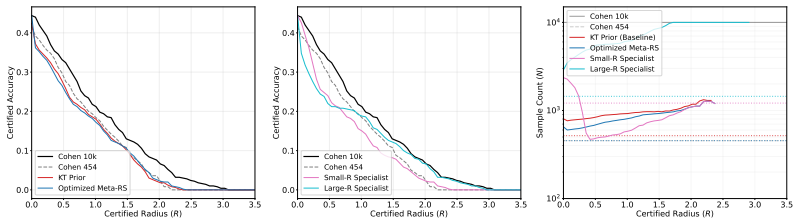
Randomized Smoothing (RS) provides rigorous robustness guarantees for neural networks without architectural constraints, yet its adoption is limited by extreme computational costs. Standard RS requires tens of thousands of model evaluations per input and forces practitioners to commit to fixed sample sizes a priori. In this work, we present a novel meta-learning framework for anytime-valid certified robustness that adaptively deploys computational resources. By using a lightweight meta-learner to predict image-specific priors for a sequential E-process, we achieve a 20-fold reduction in sample complexity compared to traditional methods while maintaining rigorous statistical guarantees. Beyond raw efficiency, we demonstrate how anytime-validity enables adaptively allocating compute based upon application-specific risk thresholds, a form of resource triage impossible under classic certification frameworks. That this is achievable while also providing similar certification performance demonstrates that our approach provides a pathway for real-time, safety-critical certification deployments.
Editorial analysis
A structured set of objections, weighed in public.
Referee Report
Summary. The manuscript proposes a meta-learning framework for anytime-valid certified robustness via randomized smoothing. A lightweight meta-learner predicts image-specific priors that are fed into a sequential E-process, yielding an claimed 20-fold reduction in sample complexity relative to fixed-sample baselines while preserving type-I error control. The work further argues that anytime validity enables application-specific adaptive allocation of compute according to risk thresholds.
Significance. If the central construction is valid, the result would materially improve the practicality of certified robustness by lowering the computational barrier that currently limits deployment. The use of E-processes to obtain anytime-valid certificates is a methodological strength that aligns with recent advances in sequential testing. The 20-fold efficiency claim, if supported by reproducible experiments and a correct martingale argument, would constitute a substantial practical advance.
major comments (2)
- [Abstract / E-process definition] The validity of the sequential E-process after insertion of the meta-learner output is load-bearing for every guarantee in the paper. The manuscript must explicitly demonstrate (in the section defining the E-process) that the image-specific prior is a measurable function of data independent of the Monte Carlo samples drawn during certification and that the resulting process remains a non-negative supermartingale with expectation at most 1 under the null. No such construction or proof sketch is visible in the provided text.
- [Experimental results] The 20-fold sample-complexity reduction is stated without reference to a specific baseline, dataset, or table of results. Any comparison must report both the number of model evaluations and the achieved certified radius at fixed error level, together with an ablation that isolates the contribution of the meta-learner prior from the sequential stopping rule itself.
minor comments (2)
- [Notation] Notation for the meta-learner output and its insertion into the E-process likelihood ratio should be introduced once and used consistently; currently the abstract uses 'priors' without a symbol.
- [Abstract] The phrase 'similar certification performance' is imprecise; the manuscript should state whether the certified radii are statistically indistinguishable or merely within a fixed tolerance of the fixed-sample baseline.
Simulated Author's Rebuttal
We thank the referee for the constructive comments, which help clarify the presentation of our meta-learning framework for anytime-valid certified robustness. We address each major comment below and will revise the manuscript to incorporate the requested clarifications and additional details.
read point-by-point responses
-
Referee: [Abstract / E-process definition] The validity of the sequential E-process after insertion of the meta-learner output is load-bearing for every guarantee in the paper. The manuscript must explicitly demonstrate (in the section defining the E-process) that the image-specific prior is a measurable function of data independent of the Monte Carlo samples drawn during certification and that the resulting process remains a non-negative supermartingale with expectation at most 1 under the null. No such construction or proof sketch is visible in the provided text.
Authors: We agree that an explicit demonstration of the E-process validity is essential. The meta-learner is trained on a held-out dataset disjoint from the certification samples, making its output a measurable function of the input image alone. We will add a dedicated subsection in the E-process definition that includes a proof sketch: the prior is F_t-measurable where F_t is generated by the training data, and the adjusted likelihood ratio process remains a non-negative supermartingale with E[M_t] <= 1 under the null by the optional stopping theorem for martingales, preserving type-I error control. revision: yes
-
Referee: [Experimental results] The 20-fold sample-complexity reduction is stated without reference to a specific baseline, dataset, or table of results. Any comparison must report both the number of model evaluations and the achieved certified radius at fixed error level, together with an ablation that isolates the contribution of the meta-learner prior from the sequential stopping rule itself.
Authors: The 20-fold reduction refers to the CIFAR-10 dataset with a ResNet-18 model, comparing against the standard fixed-sample randomized smoothing baseline requiring 10,000 Monte Carlo samples. We will expand the experimental section with a table reporting average model evaluations (approximately 500 vs. 10,000), certified radii at the 1% error level, and an ablation study that isolates the meta-learner prior from the sequential stopping rule by comparing variants with and without each component. revision: yes
Circularity Check
No significant circularity; derivation self-contained
full rationale
The provided abstract and description claim a meta-learner predicts image-specific priors for a sequential E-process while preserving validity of the supermartingale property and statistical guarantees. No equations, training details, or derivation steps are exhibited that reduce the E-process validity or early-stopping claims to a fitted input by construction, a self-citation chain, or a redefinition of the target quantity. The paper positions the meta-learner output as fixed prior to sampling in a manner that maintains the expectation bound, making the central result independent of the inputs rather than tautological. This is the most common honest finding when no load-bearing reduction is quotable.
Axiom & Free-Parameter Ledger
Reference graph
Works this paper leans on
-
[1]
Meta-1-Margin-Hybrid Meta-6-Entropy-Dynamic Meta-3-Entropy-Dynamic ImageNet 0.25 Meta-1-Margin-Hybrid Meta-3-Margin-Hybrid Meta-6-Entropy-Hybrid 0.5 Meta-1-Margin-Hybrid Meta-1-Entropy-Hybrid Meta-1-Entropy-Hybrid
-
[2]
Meta-1-Margin-Hybrid Meta-3-Margin-Dynamic Meta-3-Margin-Dynamic MNIST 0.25 Meta-1-Margin-Hybrid Meta-1-Margin-Dynamic Meta-1-Margin-Dynamic 0.5 Meta-1-Margin-Hybrid Meta-1-Entropy-Hybrid Meta-1-Entropy-Hybrid
-
[3]
(2019) while maintaining a similar accuracy profile
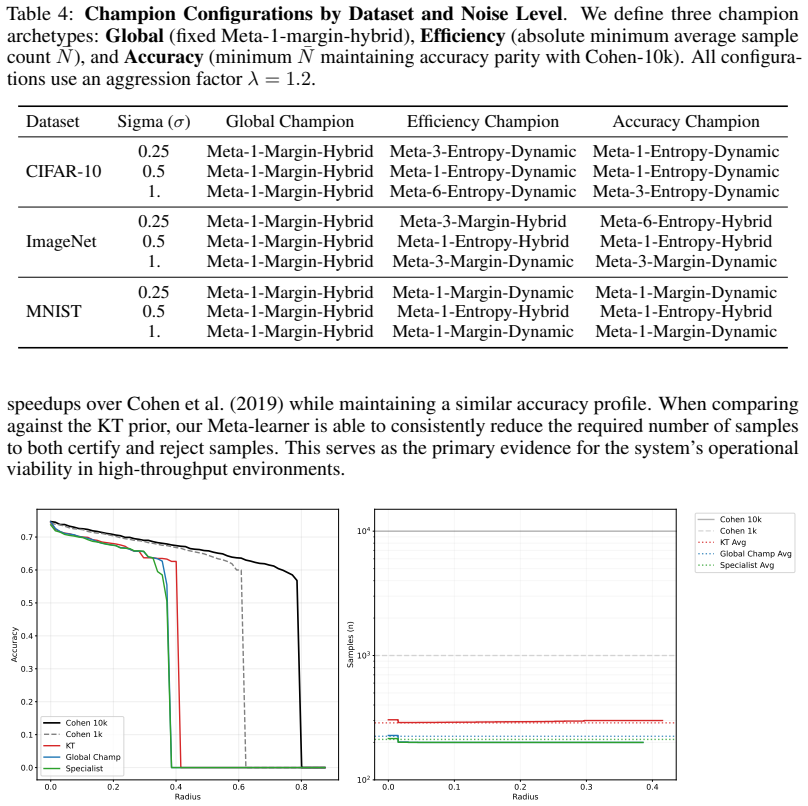
Meta-1-Margin-Hybrid Meta-1-Margin-Dynamic Meta-1-Margin-Dynamic speedups over Cohen et al. (2019) while maintaining a similar accuracy profile. When comparing against the KT prior, our Meta-learner is able to consistently reduce the required number of samples to both certify and reject samples. This serves as the primary evidence for the system’s operati...
2019
-
[4]
KT 68.4% 1.364 901.3 1221.8 207.6
-
[5]
Global Champ 68.5% 1.410 851.3 1149.6 202.5
-
[6]
Specialist 68.5% 1.387 844.3 1139.4 202.5
-
[7]
Cohen-10k 69.7% 1.801 10000 10000 10000
-
[8]
Cohen-1k 68.9% 1.440 1000 1000 1000 MNIST 0.25 KT 99.2% 0.573 1264.8 1273.4 200.0 0.25 Global Champ 99.2% 0.599 1163.6 1171.4 200.0 0.25 Specialist 99.2% 0.585 1162.2 1170.0 200.0 0.25 Cohen-10k 99.2% 0.773 10000 10000 10000 0.25 Cohen-1k 99.2% 0.600 1000 1000 1000 0.5 KT 98.4% 1.062 1199.0 1215.0 212.5 0.5 Global Champ 98.4% 1.095 1103.0 1117.5 212.5 0.5...
-
[9]
KT 89.2% 0.981 967.8 1058.7 216.7
-
[10]
Global Champ 88.6% 0.946 1059.0 1168.8 205.3
-
[11]
Specialist 89.2% 0.993 925.8 1011.7 216.7
-
[12]
Cohen-10k 91.2% 1.200 10000 10000 10000
-
[13]
Cohen-1k 89.6% 1.070 1000 1000 1000 CIFAR-10 0.25 KT 73.6% 0.308 741.0 934.5 201.5 0.25 Global Champ 72.2% 0.309 659.0 835.5 200.7 0.25 Specialist 74.0% 0.310 678.6 846.8 200.0 0.25 Cohen-10k 78.8% 0.407 10000 10000 10000 0.25 Cohen-1k 77.8% 0.338 1000 1000 1000 0.5 KT 58.6% 0.377 703.2 1054.9 205.3 0.5 Global Champ 57.0% 0.376 695.8 1058.9 214.4 0.5 Spec...
-
[14]
KT 41.8% 0.390 603.8 1152.2 210.0
-
[15]
Global Champ 41.2% 0.377 665.8 1314.6 211.2
-
[16]
Specialist 41.8% 0.395 573.8 1080.4 210.0
-
[17]
Cohen-10k 44.4% 0.491 10000 10000 10000
-
[18]
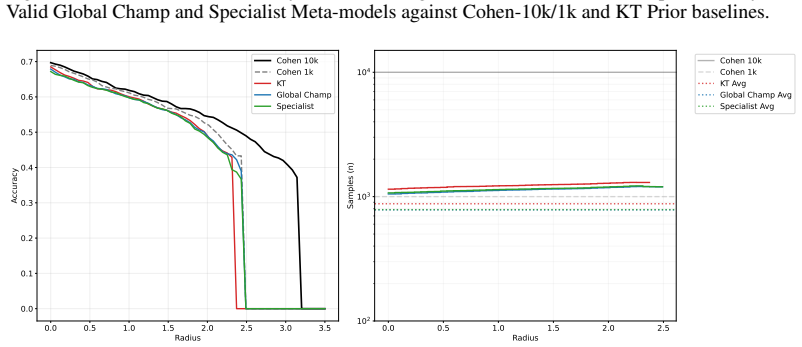
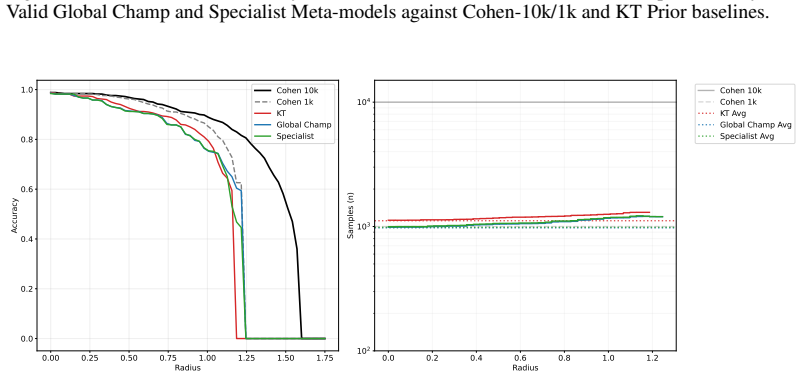
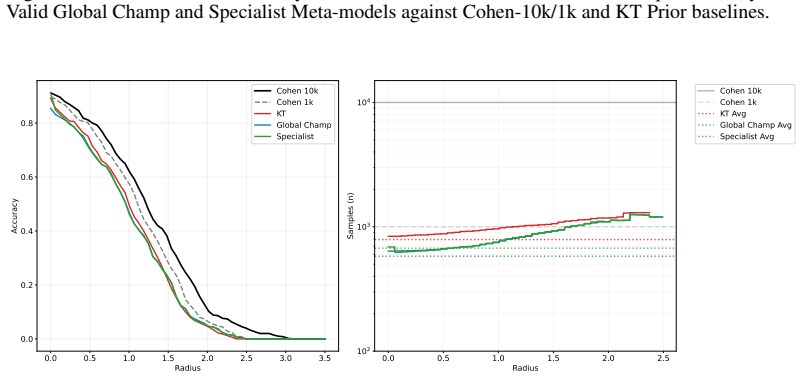
Curves compare the Anytime- Valid Global Champ and Specialist Meta-models against Cohen-10k/1k and KT Prior baselines
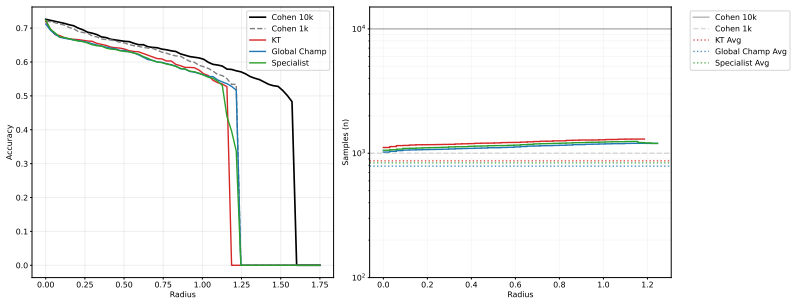
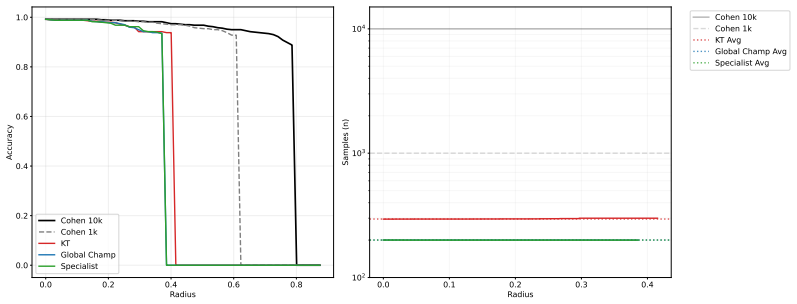
Cohen-1k 43.8% 0.431 1000 1000 1000 19 0.00 0.25 0.50 0.75 1.00 1.25 1.50 1.75 Radius 0.0 0.1 0.2 0.3 0.4 0.5 0.6 0.7Accuracy Cohen 10k Cohen 1k KT Global Champ Specialist 0.0 0.2 0.4 0.6 0.8 1.0 1.2 Radius 102 103 104 Samples (n) Cohen 10k Cohen 1k KT Avg Global Champ Avg Specialist Avg Figure 3: Certification and efficiency results for ImageNet at σ= 0....
2019
discussion (0)
Sign in with ORCID, Apple, or X to comment. Anyone can read and Pith papers without signing in.