An Embedded Real-Time License Plate Recognition System for Complex Traffic Scenes
Pith reviewed 2026-06-29 05:11 UTC · model grok-4.3
The pith
Lightweight CNNs with quantization and FPGA acceleration deliver real-time license plate recognition at 11.5 FPS on embedded hardware for complex traffic.
A machine-rendered reading of the paper's core claim, the machinery that carries it, and where it could break.
Core claim
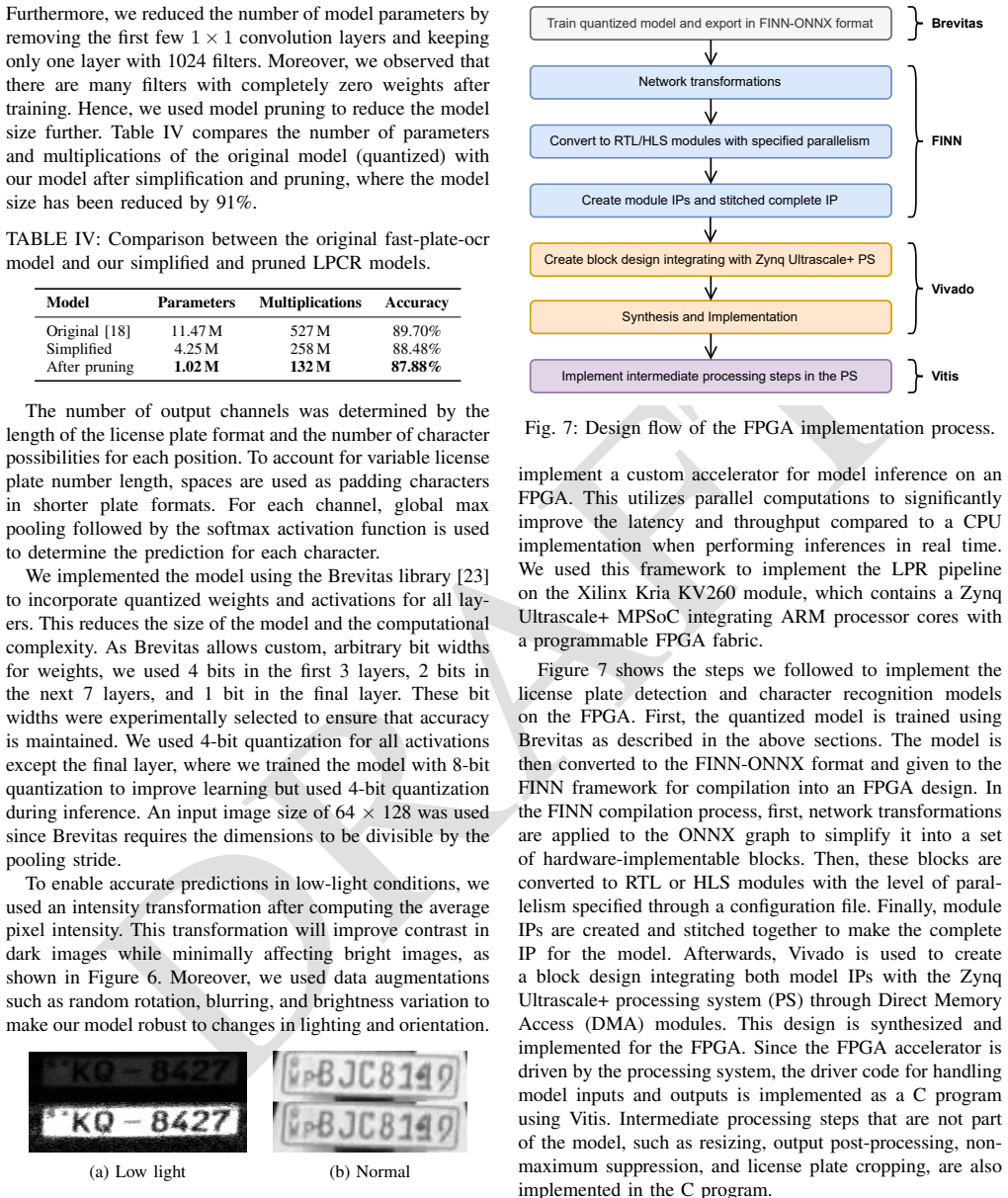
The authors show that license plate detection followed by character recognition can be performed in real time on resource-constrained embedded hardware by replacing large models with lightweight CNNs, applying low-bitwidth quantization, and mapping the computation onto an FPGA using the FINN framework, yielding 11.5 FPS end-to-end performance on the SL-LPR dataset while remaining competitive with bigger networks on public benchmarks.
What carries the argument
Lightweight convolutional neural networks quantized with Brevitas and accelerated on FPGA with the FINN framework
If this is right
- Low-cost embedded platforms become viable for intelligent transportation systems in developing countries.
- The pipeline processes multi-vehicle images containing diverse vehicle types and irregular traffic patterns.
- Quantized models remain competitive with larger networks on existing public license-plate datasets.
- The SL-LPR dataset supplies a benchmark for evaluating recognition methods under unstructured conditions.
Where Pith is reading between the lines
- The same quantization-plus-FPGA workflow could be tested on other real-time vision tasks such as traffic sign detection.
- Collecting additional datasets from different regions would test whether the current accuracy generalizes beyond Sri Lankan roads.
- The approach points toward practical deployment of computer vision in settings where power, cost, and compute are tightly limited.
Load-bearing premise
The accuracy measured on the collected dataset will persist when the same models run on live, unseen traffic scenes outside the training distribution.
What would settle it
Deploy the finished system on a large collection of new live traffic videos from varied locations and compare its outputs against human-annotated ground truth to check whether the reported mAP and accuracy figures hold.
Figures


read the original abstract
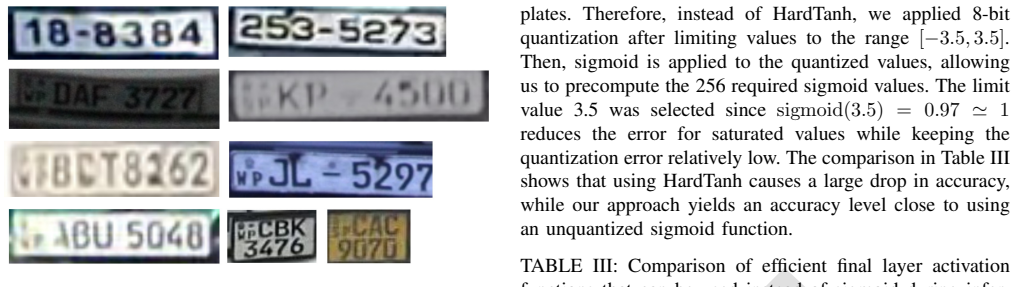
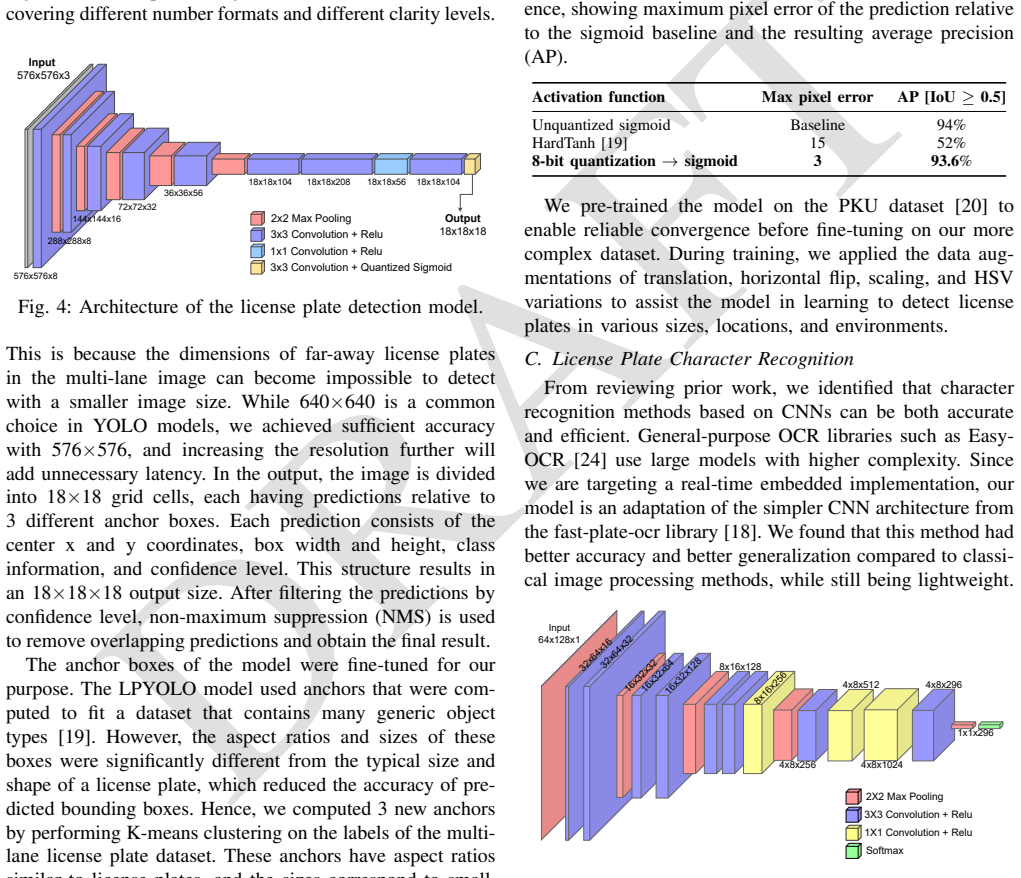
Vehicle license plate recognition is an integral component of intelligent transportation systems. In this work, we present an embedded real-time license plate recognition system customized for developing countries. We address the challenge of handling complex, unstructured traffic scenes with diverse vehicle types while implementing the system on an embedded platform for low-cost deployment. Our method consists of license plate detection on a multi-vehicle image, followed by character recognition on the detected license plates. Both steps use lightweight convolutional neural networks to balance accuracy and efficiency. We also introduce the SL-LPR dataset of Sri Lankan road images, which contains a variety of vehicle types and traffic conditions typically seen in developing countries. On this dataset, the license plate detection and character recognition models achieved 93.6% mAP and 87.88% accuracy, respectively, and were competitive against larger models on several public datasets. To achieve real-time performance in a resource-constrained embedded environment, we applied low-bitwidth quantization using the Brevitas library and implemented FPGA acceleration for the models using the FINN framework. The end-to-end system can operate at 11.5~FPS when implemented on the Xilinx Kria KV260 platform. These results demonstrate that our system is effective for real-time license plate recognition on an embedded device, even in complex traffic scenarios. The SL-LPR dataset is available for research use at: https://github.com/sl-lpr-uom/SL-LPR.git.
Editorial analysis
A structured set of objections, weighed in public.
Referee Report
Summary. The paper presents an embedded real-time license plate recognition system for complex, unstructured traffic scenes typical of developing countries. It employs lightweight CNNs for multi-vehicle license plate detection followed by character recognition, introduces the SL-LPR dataset of Sri Lankan road images, reports 93.6% mAP and 87.88% accuracy on this dataset (competitive with larger models on public benchmarks), applies Brevitas low-bitwidth quantization and FINN FPGA acceleration, and achieves 11.5 FPS end-to-end on the Xilinx Kria KV260 platform.
Significance. If the central performance claims hold after quantization, the work offers a practical low-cost embedded LPR solution tailored to resource-constrained environments and diverse vehicle/traffic conditions underrepresented in existing datasets. The public release of the SL-LPR dataset is a clear strength for reproducibility and future benchmarking in this domain.
major comments (2)
- [Abstract] Abstract: The 93.6% mAP (detection) and 87.88% accuracy (recognition) are stated for 'the license plate detection and character recognition models' immediately before describing the separate quantization step and resulting 11.5 FPS. No numerical post-quantization results on the SL-LPR test set are provided, so it is unclear whether the quoted metrics reflect the deployed quantized models that underpin the embedded-system claim.
- [Abstract] Abstract: The central claim that the end-to-end system 'is effective for real-time license plate recognition on an embedded device, even in complex traffic scenarios' rests on the unverified assumption that Brevitas quantization + FINN acceleration preserves the reported accuracy levels on SL-LPR; an ablation or direct comparison of pre- vs. post-quantization performance on this dataset is required to substantiate the deployment result.
Simulated Author's Rebuttal
We thank the referee for the constructive comments on the abstract. The points raised correctly identify ambiguity in how pre- and post-quantization results are presented, and we will revise the manuscript to resolve this.
read point-by-point responses
-
Referee: [Abstract] Abstract: The 93.6% mAP (detection) and 87.88% accuracy (recognition) are stated for 'the license plate detection and character recognition models' immediately before describing the separate quantization step and resulting 11.5 FPS. No numerical post-quantization results on the SL-LPR test set are provided, so it is unclear whether the quoted metrics reflect the deployed quantized models that underpin the embedded-system claim.
Authors: We agree the abstract is ambiguous on this point. The reported 93.6% mAP and 87.88% accuracy refer to the floating-point lightweight CNN models; quantization is applied afterward for deployment. We will revise the abstract to explicitly state that these metrics are for the pre-quantization models and add a clarifying sentence on post-quantization performance on SL-LPR (drawing from the experiments section) to support the embedded claim. revision: yes
-
Referee: [Abstract] Abstract: The central claim that the end-to-end system 'is effective for real-time license plate recognition on an embedded device, even in complex traffic scenarios' rests on the unverified assumption that Brevitas quantization + FINN acceleration preserves the reported accuracy levels on SL-LPR; an ablation or direct comparison of pre- vs. post-quantization performance on this dataset is required to substantiate the deployment result.
Authors: The referee correctly notes that an explicit pre-/post-quantization comparison on SL-LPR would strengthen the claim. We will revise the abstract to reference the preservation of accuracy after quantization and ensure the experiments section includes or highlights a direct comparison/ablation on the SL-LPR test set to substantiate the end-to-end embedded results. revision: yes
Circularity Check
No circularity; empirical measurements on new dataset with independent implementation steps
full rationale
The paper reports direct empirical results: 93.6% mAP and 87.88% accuracy measured on the newly introduced SL-LPR dataset for the detection and recognition models, plus a separate measured 11.5 FPS after Brevitas quantization and FINN acceleration on KV260. No equations, self-definitions, fitted parameters renamed as predictions, or load-bearing self-citations appear in the provided text. All central claims are falsifiable external measurements rather than reductions to inputs by construction.
Axiom & Free-Parameter Ledger
axioms (1)
- domain assumption Standard CNN training and optimization assumptions hold for the lightweight models on the described dataset.
Reference graph
Works this paper leans on
-
[1]
Towards end-to-end license plate detection and recognition: A large dataset and baseline,
Z. Xu, W. Yang, A. Meng, N. Lu, and H. Huang, “Towards end-to-end license plate detection and recognition: A large dataset and baseline,” inProc. of the Eur . Conf. on Computer Vision, 2018, pp. 255–271
2018
-
[2]
Deep-learning based license plate detection method using vehicle region extraction,
S. G. Kim, H. Jeon, and H. I. Koo, “Deep-learning based license plate detection method using vehicle region extraction,”Electronics Letters, vol. 53, 06 2017
2017
-
[3]
Automatic number plate recognition system on an ARM-DSP and FPGA heterogeneous SoC platforms,
Z. Jeffrey, X. Zhai, F. Bensaali, R. Sotudeh, and A. Ariyaeeinia, “Automatic number plate recognition system on an ARM-DSP and FPGA heterogeneous SoC platforms,” in2013 IEEE Hot Chips 25 Symposium (HCS), Aug. 2013, pp. 1–9
2013
-
[4]
Real-time vision system for license plate detection and recognition on FPGA,
F. Rosli, A. Elhossini, and B. Juurlink, “Real-time vision system for license plate detection and recognition on FPGA,”J. of Parallel Algorithms and Comput. Struct., vol. 32, no. 1, pp. 69–79, 2015
2015
-
[5]
Real-time license plate recognition on an embedded DSP-platform,
C. Arth, F. Limberger, and H. Bischof, “Real-time license plate recognition on an embedded DSP-platform,” in2007 IEEE Conf. on Computer Vision and Pattern Recognition, Jun. 2007, pp. 1–8
2007
-
[6]
A multi-stage deep-learning-based vehicle and license plate recognition system with real-time edge inference,
A. Ammar, A. Koubaa, W. Boulila, B. Benjdira, and Y . Alhabashi, “A multi-stage deep-learning-based vehicle and license plate recognition system with real-time edge inference,”Sensors, vol. 23, no. 4, p. 2120, Feb. 2023
2023
-
[7]
Edge-AI-based real-time automated license plate recognition system,
C.-J. Lin, C.-C. Chuang, and H.-Y . Lin, “Edge-AI-based real-time automated license plate recognition system,”Applied Sciences, vol. 12, no. 3, p. 1445, Jan. 2022
2022
-
[8]
An all-in-one vehicle type and license plate recognition system using YOLOv4,
S.-H. Park, S.-B. Yu, J.-A. Kim, and H. Yoon, “An all-in-one vehicle type and license plate recognition system using YOLOv4,”Sensors, vol. 22, no. 3, p. 921, Jan. 2022
2022
-
[9]
An efficient license plate recognition system using convolution neural networks,
C.-H. Lin, Y .-S. Lin, and W.-C. Liu, “An efficient license plate recognition system using convolution neural networks,” in2018 IEEE Int. Conf. on Applied System Invention, Apr. 2018, pp. 224–227
2018
-
[10]
Performance enhancement method for multiple license plate recognition in challenging environments,
K. Khan, A. Imran, H. Z. U. Rehman, A. Fazil, M. Zakwan, and Z. Mahmood, “Performance enhancement method for multiple license plate recognition in challenging environments,”EURASIP J. on Image and Video Processing, vol. 2021, no. 1, p. 30, Sep. 2021
2021
-
[11]
A robust real-time automatic license plate recognition based on the YOLO detector,
R. Larocaet al., “A robust real-time automatic license plate recognition based on the YOLO detector,” in2018 Int. Joint Conf. on Neural Networks (IJCNN), Jul. 2018, pp. 1–10
2018
-
[12]
A mixed-precision transformer accelerator with vector tiling systolic array for license plate recognition in unconstrained scenarios,
J. Li, D. Yan, F. He, Z. Dong, and M. Jiang, “A mixed-precision transformer accelerator with vector tiling systolic array for license plate recognition in unconstrained scenarios,”IEEE Trans. on Intell. Transp. Syst., vol. 25, no. 12, pp. 20 280–20 294, 2024
2024
-
[13]
License plate recognition using neural archi- tecture search for edge devices,
J. Shashiranganaet al., “License plate recognition using neural archi- tecture search for edge devices,”Int. J. of Intelligent Systems, vol. 37, no. 12, pp. 10 211–10 248, Dec. 2022
2022
-
[14]
Low- power license plate detection and recognition on a RISC-V multi-core MCU-based vision system,
L. Lamberti, M. Rusci, M. Fariselli, F. Paci, and L. Benini, “Low- power license plate detection and recognition on a RISC-V multi-core MCU-based vision system,” in2021 IEEE Int. Symp. on Circuits and Systems (ISCAS), May 2021, pp. 1–5
2021
-
[15]
Multi-object detection of Chinese license plate in complex scenes,
D. Liu, Y . Wu, Y . He, L. Qin, and B. Zheng, “Multi-object detection of Chinese license plate in complex scenes,”Computer Systems Science and Engineering, vol. 36, no. 1, pp. 145–156, 2021
2021
-
[16]
Vehicle and license plate recognition with novel dataset for toll collection,
M. Usama, H. Anwar, and S. Anwar, “Vehicle and license plate recognition with novel dataset for toll collection,”Pattern Analysis and Applications, vol. 28, no. 2, p. 57, Jun. 2025
2025
-
[17]
LPRNet: License Plate Recognition via Deep Neural Networks
S. Zherzdev and A. Gruzdev, “LPRNet: License plate recognition via deep neural networks,”arXiv preprint arXiv:1806.10447, 2018
work page internal anchor Pith review Pith/arXiv arXiv 2018
-
[18]
fast-plate-ocr: Fast & lightweight license plate OCR,
ankandrew, “fast-plate-ocr: Fast & lightweight license plate OCR,” https://github.com/ankandrew/fast-plate-ocr, 2024, accessed: 2024-08
2024
-
[19]
LPYOLO: low precision YOLO for face detection on FPGA,
B. G ¨unay, S. B. Okcu, and H. S ¸. Bilge, “LPYOLO: low precision YOLO for face detection on FPGA,”arXiv preprint arXiv:2207.10482, 2022
-
[20]
A robust and efficient approach to license plate detection,
Y . Yuan, W. Zou, Y . Zhao, X. Wang, X. Hu, and N. Komodakis, “A robust and efficient approach to license plate detection,”IEEE Trans. on Image Processing, vol. 26, no. 3, pp. 1102–1114, 2017
2017
-
[21]
Application-oriented license plate recognition,
G.-S. Hsu, J.-C. Chen, and Y .-Z. Chung, “Application-oriented license plate recognition,”IEEE Trans. on V ehicular Technol., 2012
2012
-
[22]
Multiple Chinese vehicle license plate localization in complex scenes,
Y . Luo, Y . Li, S. Huang, and F. Han, “Multiple Chinese vehicle license plate localization in complex scenes,” in2018 IEEE 3rd Int. Conf. on Image, Vision and Computing (ICIVC), 2018, pp. 745–749
2018
-
[23]
A. Pappalardo, “Xilinx/brevitas,” 2023. [Online]. Available: https: //doi.org/10.5281/zenodo.3333552
-
[24]
EasyOCR,
JaidedAI, “EasyOCR,” https://github.com/JaidedAI/EasyOCR, 2022, accessed: 2025-02-27
2022
-
[25]
FINN: A framework for fast, scalable binarized neural network inference,
Y . Umurogluet al., “FINN: A framework for fast, scalable binarized neural network inference,” inProc. of the 2017 ACM/SIGDA Int. Symp. on Field-Programmable Gate Arrays, ser. FPGA ’17, 2017, pp. 65–74
2017
-
[26]
A new CNN-based method for multi-directional car license plate detection,
L. Xie, T. Ahmad, L. Jin, Y . Liu, and S. Zhang, “A new CNN-based method for multi-directional car license plate detection,”IEEE Trans. on Intell. Transp. Syst., vol. 19, no. 2, pp. 507–517, 2018
2018
-
[27]
A robust attentional framework for license plate recognition in the wild,
L. Zhang, P. Wang, H. Li, Z. Li, C. Shen, and Y . Zhang, “A robust attentional framework for license plate recognition in the wild,”IEEE Trans. on Intell. Transp. Syst., vol. 22, no. 11, pp. 6967–6976, 2020
2020
discussion (0)
Sign in with ORCID, Apple, or X to comment. Anyone can read and Pith papers without signing in.