Habitual lifestyle timing explains circadian timing, but daily lifestyle changes do not, in free-living humans across 2000 days
Pith reviewed 2026-06-29 01:40 UTC · model grok-4.3
The pith
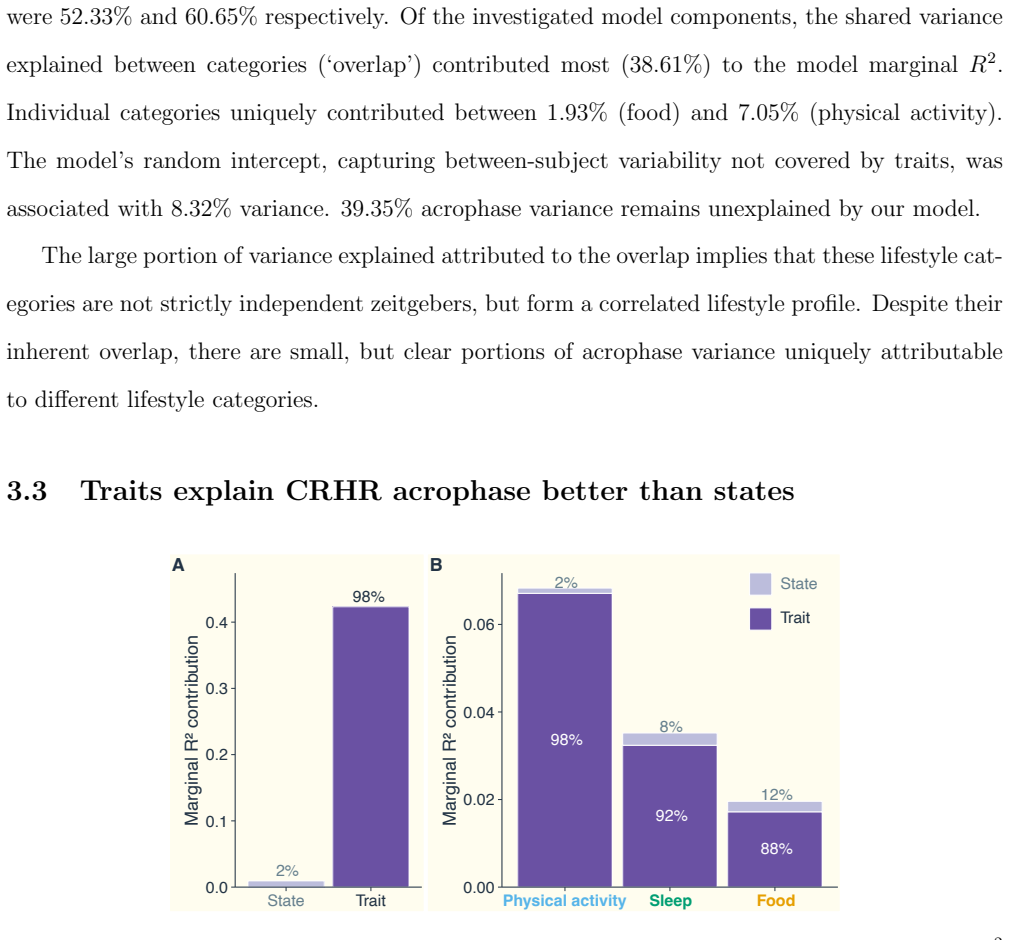
Habitual lifestyle timing explains most variation in circadian heart rate timing while daily changes explain almost none.
A machine-rendered reading of the paper's core claim, the machinery that carries it, and where it could break.
Core claim
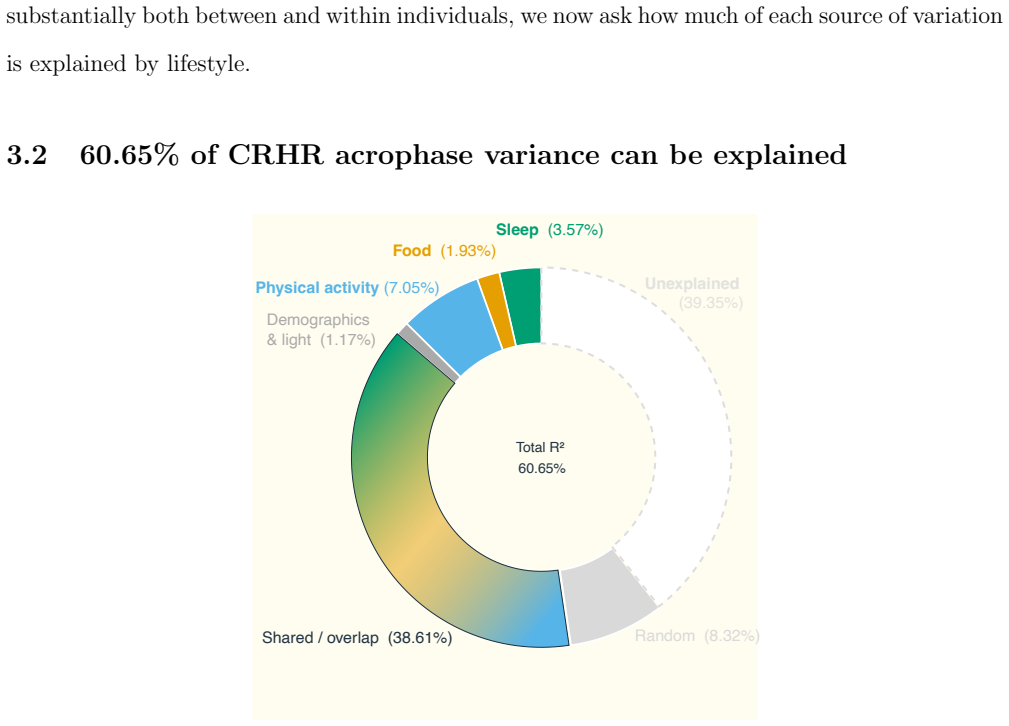
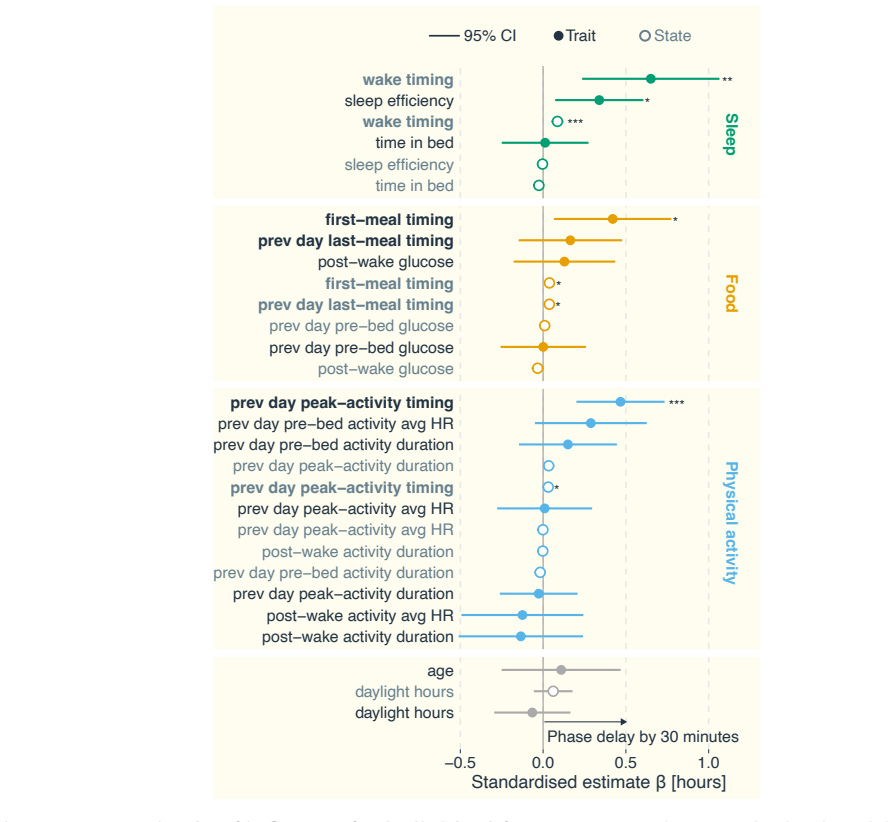
Traits were substantially more influential than states, explaining 42.3% versus 0.9% of total acrophase variance. Accordingly, traits explained 86.5% of between-subject variance, whereas states explained only 1.8% of within-subject variance. Sleep, food and physical activity factors contributed both jointly and uniquely, and lifestyle timing mattered most.
What carries the argument
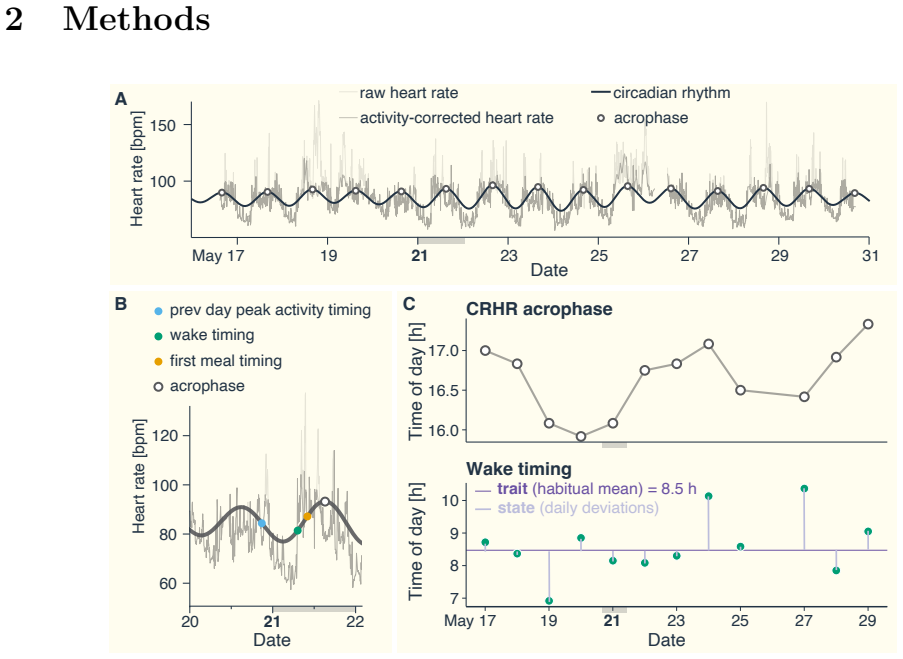
Linear mixed-effects model that partitions variance in acrophase (peak time of activity-adjusted heart rate rhythm) into between-subject trait and within-subject state components from lifestyle factors.
If this is right
- Between-subject lifestyle traits explain acrophase better than within-subject lifestyle states.
- Sustained, holistic, timing-focused lifestyle adjustments are supported as chronotherapy targets.
- Sleep, food, and physical activity factors contribute both jointly and uniquely to acrophase.
- Lifestyle timing matters most among the lifestyle factors studied.
Where Pith is reading between the lines
- Efforts to shift circadian timing should prioritize establishing new habitual patterns over temporary daily changes.
- This asymmetry may explain why short-term interventions often fail to produce lasting shifts in circadian phase.
- Future studies could test whether altering traits through sustained intervention produces larger acrophase changes than state manipulations.
- The overlap between factors suggests that integrated lifestyle approaches may be more effective than targeting single behaviors.
Load-bearing premise
The linear mixed-effects model correctly partitions acrophase variance into between-subject trait and within-subject state components without residual confounding from unmeasured variables or from deriving traits and states from the same lifestyle factors.
What would settle it
An experiment that imposes controlled daily changes in lifestyle timing while holding traits fixed, then checks whether acrophase shifts substantially within individuals.
Figures
read the original abstract
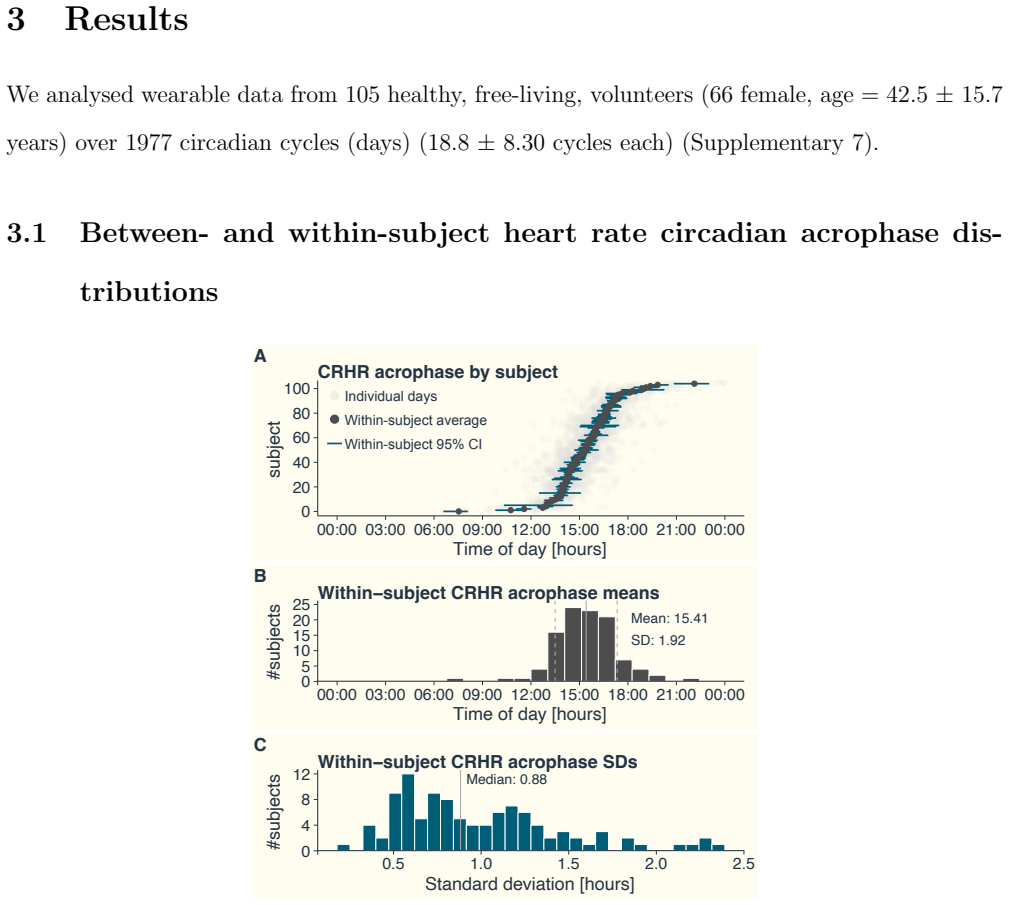
Background: Both between- and within-subject variations in circadian timing matter for health. If lifestyle changes could be used to regulate circadian timing, they would offer accessible and scalable routes to chronotherapy, but this link remains unclear under real-life conditions. Here, we explore how lifestyle 'traits' (such as typical wake time) and 'states' (day-to-day deviations from traits, such as waking up later than typical) explain between- and within-subject variation in acrophase (peak time) of the circadian rhythm of heart rate (CRHR). Methods: We collected free-living wearable data (smartwatch, continuous glucose monitor) from healthy volunteers for up to 4 weeks. The CRHR was derived from activity-adjusted heart rate, and acrophase was defined as time-of-day at daily CRHR peak. Sleep, food, and physical activity 'factors' were calculated and split into traits and states. Using a linear mixed-effects model, we tested how traits and states associate with between- and within-subject acrophase variance. Findings: Data from 105 healthy volunteers (66 female, age = 42.5 $\pm$ 15.7 years) spanning ~2000 days (18.8 $\pm$ 8.30 days each) were analysed. Traits were substantially more influential than states, explaining 42.3% versus 0.9% of total acrophase variance. Accordingly, traits explained 86.5% of between-subject variance, whereas states explained only 1.8% of within-subject variance. Sleep, food and physical activity factors contributed both jointly and uniquely, and lifestyle timing mattered most. Interpretation: Between-subject lifestyle traits explained acrophase better than within-subject lifestyle states. This asymmetry, alongside the considerable overlap between factors, supports sustained, holistic, timing-focused lifestyle adjustments as chronotherapy targets, testable through future interventional studies.
Editorial analysis
A structured set of objections, weighed in public.
Referee Report
Summary. The paper analyzes wearable data from 105 healthy volunteers (~2000 person-days) to decompose variance in heart-rate acrophase into between-subject (trait) and within-subject (state) components using linear mixed-effects models. Lifestyle factors (sleep, food, activity) are split into person-means (traits) and daily deviations (states); the central finding is that traits explain 42.3% of total acrophase variance and 86.5% of between-subject variance, while states explain only 0.9% and 1.8% of within-subject variance, respectively.
Significance. If the variance partition is robust, the result indicates that habitual lifestyle timing is far more predictive of circadian phase than day-to-day fluctuations, supporting sustained rather than acute lifestyle interventions as chronotherapy targets. The use of multi-week free-living wearable data (smartwatch + CGM) across 105 subjects is a clear strength, providing ecological validity that laboratory studies lack.
major comments (3)
- [Methods] Methods (LME specification): the abstract reports variance percentages (42.3% traits vs 0.9% states) but supplies no model equation, random-effects structure, fixed-effect coding of traits/states, missing-data handling, or sensitivity checks; without these the reported decomposition cannot be evaluated and is load-bearing for the trait-vs-state claim.
- [Statistical analysis] Statistical analysis (trait estimation): traits are defined as person-means of lifestyle factors over an average of only 18.8 days per subject; the LME treats these means as error-free fixed predictors, yet sampling variability in short series can attenuate trait coefficients, inflate residual variance, or bias the between/within split, directly undermining the 86.5% vs 1.8% attribution.
- [Results] Results (variance decomposition): the claim that traits explain 86.5% of between-subject acrophase variance rests on the assumption that unmeasured confounders and the derivation of traits/states from the same factors do not induce residual confounding; no diagnostic (e.g., variance inflation, simulation of measurement error) is described to support this.
minor comments (2)
- [Abstract] Abstract: the phrase 'up to 4 weeks' should be replaced by the exact range and mean number of days per subject for precision.
- [Methods] Notation: 'factors' and 'traits/states' are used without an explicit equation showing how the split is performed (e.g., trait = mean over days, state = day – trait); a small methods equation would clarify.
Simulated Author's Rebuttal
We thank the referee for their constructive comments on our manuscript. We have revised the paper to provide greater methodological transparency and added sensitivity analyses to address concerns about trait estimation and variance decomposition. Below we respond point-by-point to each major comment.
read point-by-point responses
-
Referee: [Methods] Methods (LME specification): the abstract reports variance percentages (42.3% traits vs 0.9% states) but supplies no model equation, random-effects structure, fixed-effect coding of traits/states, missing-data handling, or sensitivity checks; without these the reported decomposition cannot be evaluated and is load-bearing for the trait-vs-state claim.
Authors: We agree that the original Methods section lacked sufficient detail on the LME. In the revised manuscript we now include the explicit model equation (acrophase_ij = β0 + β_traits * trait_i + β_states * state_ij + u_i + ε_ij), specify random intercepts per subject only, describe fixed-effect coding (person-mean centering for traits, daily deviations for states), note that missing data were handled by complete-case analysis after requiring ≥7 days per participant, and report sensitivity checks (varying minimum days threshold and bootstrap resampling of the variance partition). These additions make the decomposition fully evaluable. revision: yes
-
Referee: [Statistical analysis] Statistical analysis (trait estimation): traits are defined as person-means of lifestyle factors over an average of only 18.8 days per subject; the LME treats these means as error-free fixed predictors, yet sampling variability in short series can attenuate trait coefficients, inflate residual variance, or bias the between/within split, directly undermining the 86.5% vs 1.8% attribution.
Authors: We acknowledge the measurement-error concern with person-means based on ~19 days. We have added a dedicated sensitivity subsection restricting the sample to the 62 participants with ≥25 days; the trait contribution to total variance remained 39.8% (vs 42.3% in full sample) and the between-subject attribution stayed above 80%. We also discuss this as a limitation and note that the within-subject state estimates are unaffected by the same issue. Longer per-subject series would be desirable but are outside the scope of the existing dataset. revision: partial
-
Referee: [Results] Results (variance decomposition): the claim that traits explain 86.5% of between-subject acrophase variance rests on the assumption that unmeasured confounders and the derivation of traits/states from the same factors do not induce residual confounding; no diagnostic (e.g., variance inflation, simulation of measurement error) is described to support this.
Authors: We agree that explicit diagnostics strengthen the claim. The revision now reports variance inflation factors (all <3.2) for the trait and state predictors and includes a brief Monte Carlo simulation that injects realistic sampling error into the person-means; the resulting trait-state variance split remained stable (traits 40–45% of total variance). While observational data cannot eliminate all unmeasured confounding, these checks support the reported partition. revision: yes
Circularity Check
No significant circularity; variance partition is direct model output
full rationale
The paper fits a standard linear mixed-effects model to observed acrophase and lifestyle data, defines traits as subject means and states as within-subject deviations, then reports the resulting variance-explained percentages (42.3 % vs 0.9 %, 86.5 % vs 1.8 %) as direct outputs of that fit. No equation reduces these quantities to quantities defined by the same fitted parameters, no self-citation chain is load-bearing, and no ansatz or uniqueness claim is smuggled in. The derivation chain is therefore self-contained against the empirical data; any sampling-error concern in short per-subject series is a statistical bias issue, not a circularity reduction.
Axiom & Free-Parameter Ledger
axioms (2)
- domain assumption Linear mixed-effects model accurately separates between-subject trait effects from within-subject state effects in acrophase data
- domain assumption Acrophase of activity-adjusted heart rate rhythm is a valid marker of circadian timing
Reference graph
Works this paper leans on
-
[1]
Cell Reports Methods , author =
A method for characterizing daily physiology from widely used wearables , volume =. Cell Reports Methods , author =. 2021 , keywords =. doi:10.1016/j.crmeth.2021.100058 , abstract =
-
[2]
Frontiers in Network Physiology , author =
Circadian. Frontiers in Network Physiology , author =. 2021 , keywords =. doi:10.3389/fnetp.2021.732243 , abstract =
-
[3]
More variable circadian rhythms in epilepsy captured by long-term heart rate recordings from wearable sensors , volume =. Epilepsia , author =. 2025 , note =. doi:10.1111/epi.18424 , abstract =
-
[4]
Circadian rhythms and disorders of the timing of sleep , volume =. The Lancet , author =. 2022 , keywords =. doi:10.1016/S0140-6736(22)00877-7 , abstract =
-
[5]
Predicting circadian misalignment with wearable technology: validation of wrist-worn actigraphy and photometry in night shift workers , volume =. Sleep , author =. 2021 , keywords =. doi:10.1093/sleep/zsaa180 , abstract =
-
[6]
Mammalian circadian networks mediated by the suprachiasmatic nucleus , volume =. The FEBS Journal , author =. 2021 , keywords =. doi:10.1111/febs.16233 , abstract =
-
[7]
Pellizzari, Elisa and Prendin, Francesco and Cappon, Giacomo and Idi, Elena and Del Favero, Simone and Herzig, David and Bally, Lia and Facchinetti, Andrea , month = mar, year =. Automatic identification of unreported meals from continuous glucose monitoring data in individuals after bariatric surgery using a template matching algorithm , volume =. Scient...
-
[8]
Meal. Current Biology , author =. 2017 , pages =. doi:10.1016/j.cub.2017.04.059 , abstract =
-
[9]
Song, Yun Min and Jeong, Jaegwon and Reyes, Aurelio A. de los and Lim, Dongju and Cho, Chul-Hyun and Yeom, Ji Won and Lee, Taek and Lee, Jung-Been and Lee, Heon-Jeong and Kim, Jae Kyoung , month = may, year =. Causal dynamics of sleep, circadian rhythm, and mood symptoms in patients with major depression and bipolar disorder: insights from longitudinal we...
-
[10]
The Journal of Physiology , author =
Human circadian phase-response curves for exercise , volume =. The Journal of Physiology , author =. 2019 , keywords =. doi:10.1113/JP276943 , abstract =
-
[11]
and von Schantz, Malcolm , month = aug, year =
Zeitgebers and their association with rest-activity patterns , volume =. Chronobiology international , author =. 2019 , pages =. doi:10.1080/07420528.2018.1527347 , abstract =
-
[12]
Aligning. Current Biology , author =. 2015 , pages =. doi:10.1016/j.cub.2015.01.064 , abstract =
-
[13]
and Vincenzi, Simon and Redman, Jennifer R
Sletten, Tracey L. and Vincenzi, Simon and Redman, Jennifer R. and Lockley, Steven W. and Rajaratnam, Shantha M. , month = nov, year =. Timing of. Frontiers in Neurology , publisher =. doi:10.3389/fneur.2010.00137 , abstract =
-
[14]
The Journal of Physiology , author =
Heart rate phase is an indicator of chronotype-relevant circadian shifts associated with human disease: an. The Journal of Physiology , author =. 2026 , note =. doi:10.1113/JP290337 , abstract =
-
[15]
Lim, Dongju and Jeong, Jaegwon and Song, Yun Min and Cho, Chul-Hyun and Yeom, Ji Won and Lee, Taek and Lee, Jung-Been and Lee, Heon-Jeong and Kim, Jae Kyoung , month = nov, year =. Accurately predicting mood episodes in mood disorder patients using wearable sleep and circadian rhythm features , volume =. npj Digital Medicine , publisher =. doi:10.1038/s41...
-
[16]
Tang, Tianyou and Zhou, YuDong and Zhai, Xuan , month = dec, year =. Circadian rhythm and epilepsy: a nationally representative cross-sectional study based on actigraphy data , volume =. Frontiers in Neurology , publisher =. doi:10.3389/fneur.2024.1496507 , abstract =
-
[17]
Esaki, Yuichi and Obayashi, Kenji and Saeki, Keigo and Fujita, Kiyoshi and Iwata, Nakao and Kitajima, Tsuyoshi , month = oct, year =. Association between circadian activity rhythms and mood episode relapse in bipolar disorder: a 12-month prospective cohort study , volume =. Translational Psychiatry , publisher =. doi:10.1038/s41398-021-01652-9 , abstract =
-
[18]
Lunsford-Avery, Jessica R. and Engelhard, Matthew M. and Navar, Ann Marie and Kollins, Scott H. , month = sep, year =. Validation of the. Scientific Reports , publisher =. doi:10.1038/s41598-018-32402-5 , abstract =
-
[19]
Physiology & Behavior , author =
Influence of dietary behavior on the circadian rhythm of the autonomic nervous system as assessed by heart rate variability , volume =. Physiology & Behavior , author =. 2013 , keywords =. doi:10.1016/j.physbeh.2013.05.010 , abstract =
-
[20]
Thomas, J. Matthew and Kern, Philip A. and Bush, Heather M. and McQuerry, Kristen J. and Black, W. Scott and Clasey, Jody L. and Pendergast, Julie S. , month = feb, year =. Circadian rhythm phase shifts caused by timed exercise vary with chronotype , volume =. JCI Insight , publisher =. doi:10.1172/jci.insight.134270 , language =
-
[21]
Actigraphic assessment of circadian activity and sleep patterns in bipolar disorder , volume =. Bipolar Disorders , author =. 2005 , note =. doi:10.1111/j.1399-5618.2005.00187.x , abstract =
-
[22]
Morris, Christopher J. and Yang, Jessica N. and Garcia, Joanna I. and Myers, Samantha and Bozzi, Isadora and Wang, Wei and Buxton, Orfeu M. and Shea, Steven A. and Scheer, Frank A. J. L. , month = apr, year =. Endogenous circadian system and circadian misalignment impact glucose tolerance via separate mechanisms in humans , volume =. Proceedings of the Na...
-
[23]
Mundlak, Yair , year =. On the. Econometrica , publisher =. doi:10.2307/1913646 , abstract =
-
[24]
Circadian rhythm of heart rate and activity:
Natarajan, Aravind and Gleichauf, Karla and Khalid, Maryam and Heneghan, Conor and Schneider, Logan Douglas , month = jan, year =. Circadian rhythm of heart rate and activity:. Chronobiology International , publisher =. doi:10.1080/07420528.2024.2446622 , abstract =
-
[25]
and Zerbini, Giulia and Winnebeck, Eva C
Roenneberg, Till and Pilz, Luísa K. and Zerbini, Giulia and Winnebeck, Eva C. , month = sep, year =. Chronotype and. Biology , publisher =. doi:10.3390/biology8030054 , abstract =
-
[26]
Journal of Biological Rhythms , author =
Alteration of internal circadian phase relationships after morning versus evening carbohydrate-rich meals in humans , volume =. Journal of Biological Rhythms , author =. 2002 , keywords =. doi:10.1177/074873002129002663 , abstract =
-
[27]
Biological Psychiatry , author =
Alterations in the circadian rest-activity rhythm in aging and. Biological Psychiatry , author =. 1990 , pages =. doi:10.1016/0006-3223(90)90523-5 , abstract =
-
[28]
Political Science Research and Methods , author =
Explaining. Political Science Research and Methods , author =. 2015 , pages =. doi:10.1017/psrm.2014.7 , abstract =
-
[29]
Journal of pineal research , author =
Robust stability of melatonin circadian phase, sleep metrics, and chronotype across months in young adults living in real-world settings , volume =. Journal of pineal research , author =. 2021 , pages =. doi:10.1111/jpi.12720 , abstract =
-
[30]
Progress in Neuro-Psychopharmacology and Biological Psychiatry , author =
Alterations in circadian rhythms following alcohol use:. Progress in Neuro-Psychopharmacology and Biological Psychiatry , author =. 2020 , keywords =. doi:10.1016/j.pnpbp.2019.109831 , abstract =
-
[31]
Burke, Tina M. and Markwald, Rachel R. and McHill, Andrew W. and Chinoy, Evan D. and Snider, Jesse A. and Bessman, Sara C. and Jung, Christopher M. and O’Neill, John S. and Wright, Kenneth P. , month = sep, year =. Effects of caffeine on the human circadian clock in vivo and in vitro , volume =. Science Translational Medicine , publisher =. doi:10.1126/sc...
-
[32]
Journal of Open Source Software , author =
performance:. Journal of Open Source Software , author =. 2021 , pages =. doi:10.21105/joss.03139 , abstract =
-
[33]
Multilevel
Snijders, Tom and Bosker, Roel , year =. Multilevel
-
[34]
Methods in Ecology and Evolution , author =
A general and simple method for obtaining. Methods in Ecology and Evolution , author =. 2013 , note =. doi:10.1111/j.2041-210x.2012.00261.x , abstract =
-
[35]
PeerJ , author =. 2021 , pages =. doi:10.7717/peerj.11414 , abstract =
-
[36]
Steinach, Mathias and Gunga, Hanns-Christian , editor =. Circadian. Stress. 2020 , pages =. doi:10.1007/978-3-030-16996-1_9 , abstract =
-
[37]
ACNR, Advances in Clinical Neuroscience and Rehabilitation , author =
Consumer wearable devices for sleep measurement: ready for use in sleep research and medicine? , shorttitle =. ACNR, Advances in Clinical Neuroscience and Rehabilitation , author =. 2025 , file =
2025
-
[38]
Schmitt, Manfred and Blum, Gabriela S. , year =. State/. Encyclopedia of. doi:10.1007/978-3-319-24612-3_1922 , pages =
-
[39]
PLOS digital health , author =
Unraveling the interplay of circadian rhythm and sleep deprivation on mood:. PLOS digital health , author =. 2024 , pages =. doi:10.1371/journal.pdig.0000439 , abstract =
-
[40]
and Kim, Dae Wook and Fang, Yu and Kim, Ruby and Bohnert, Amy S
Lee, Minki P. and Kim, Dae Wook and Fang, Yu and Kim, Ruby and Bohnert, Amy S. B. and Sen, Srijan and Forger, Daniel B. , month = dec, year =. The real-world association between digital markers of circadian disruption and mental health risks , volume =. npj Digital Medicine , publisher =. doi:10.1038/s41746-024-01348-6 , abstract =
-
[41]
and von Schantz, Malcolm , month = aug, year =
Knutson, Kristen L. and von Schantz, Malcolm , month = aug, year =. Associations between chronotype, morbidity and mortality in the. Chronobiology International , publisher =. doi:10.1080/07420528.2018.1454458 , abstract =
-
[42]
Hastings, Michael H. and Reddy, Akhilesh B. and Maywood, Elizabeth S. , month = aug, year =. A clockwork web: circadian timing in brain and periphery, in health and disease , volume =. Nature Reviews Neuroscience , publisher =. doi:10.1038/nrn1177 , abstract =
-
[43]
External temporal organization in biological rhythms , volume =
Menna-Barreto, Luiz and Díez-Noguera, Antoni , month = feb, year =. External temporal organization in biological rhythms , volume =. Biological Rhythm Research , publisher =. doi:10.1080/09291016.2011.638111 , abstract =
-
[44]
Mistlberger, Ralph E. and Skene, Debra J. , month = aug, year =. Nonphotic. Journal of Biological Rhythms , publisher =. doi:10.1177/0748730405277982 , abstract =
-
[45]
Aschoff, Jürgen , month = jan, year =. Exogenous and. Cold Spring Harbor Symposia on Quantitative Biology , publisher =. doi:10.1101/SQB.1960.025.01.004 , abstract =
-
[46]
Physiology & Behavior , author =
Calories. Physiology & Behavior , author =. 1997 , keywords =. doi:10.1016/S0031-9384(97)00204-7 , abstract =
-
[47]
Korobeynikov, Anton and Shlemov, Alex and Usevich, Konstantin and Golyandina, Nina , month = sep, year =. Rssa:
-
[48]
Vitale, Jacopo A. and Roveda, Eliana and Montaruli, Angela and Galasso, Letizia and Weydahl, Andi and Caumo, Andrea and Carandente, Franca , month = mar, year =. Chronotype influences activity circadian rhythm and sleep:. Chronobiology International , publisher =. doi:10.3109/07420528.2014.986273 , abstract =
-
[49]
R Core Team , year =. R:
-
[50]
Roenneberg, Till and Daan, Serge and Merrow, Martha , month = jun, year =. The. Journal of Biological Rhythms , publisher =. doi:10.1177/0748730403018003001 , abstract =
-
[51]
Social influences on mammalian circadian rhythms: animal and human studies , volume =. Biological Reviews , author =. 2004 , note =. doi:10.1017/S1464793103006353 , abstract =
-
[52]
and Pansara, Zeel and Christopher, Thornton and Csaba, Kozma and Peter N., Taylor and Wang, Yujiang , year =
Molefi, Emmanuel and Smith, Billy C. and Pansara, Zeel and Christopher, Thornton and Csaba, Kozma and Peter N., Taylor and Wang, Yujiang , year =
-
[53]
Pinheiro, José and Bates, Douglas and DebRoy, Saikat and Sarkar, Deepyan and authors, EISPACK and Heisterkamp, Siem and Van Willigen, Bert and Ranke, Johannes and Core Team, R , month = mar, year =. nlme:
-
[54]
Bartoń, Kamil , month = mar, year =
-
[55]
Diabetes Research and Clinical Practice , author =
Time-in-range for monitoring glucose control:. Diabetes Research and Clinical Practice , author =. 2021 , keywords =. doi:10.1016/j.diabres.2021.108917 , abstract =
-
[56]
The Journal of Clinical Endocrinology & Metabolism , author =
Continuous. The Journal of Clinical Endocrinology & Metabolism , author =. 2019 , pages =. doi:10.1210/jc.2018-02763 , abstract =
-
[57]
Validation of. Diabetes Care , author =. 2018 , pages =. doi:10.2337/dc18-1444 , abstract =
-
[58]
St-Onge, Marie-Pierre and Aggarwal, Brooke and Fernandez-Mendoza, Julio and Johnson, Dayna and Kline, Christopher E. and Knutson, Kristen L. and Redeker, Nancy and Grandner, Michael A. and. Multidimensional. Circulation: Cardiovascular Quality and Outcomes , publisher =. 2025 , pages =. doi:10.1161/HCQ.0000000000000139 , abstract =
-
[59]
Sleep regularity is a stronger predictor of mortality risk than sleep duration:. Sleep , author =. 2024 , pages =. doi:10.1093/sleep/zsad253 , abstract =
-
[60]
Frontiers in Digital Health , author =
Distinct. Frontiers in Digital Health , author =. 2021 , keywords =. doi:10.3389/fdgth.2021.727504 , abstract =
discussion (0)
Sign in with ORCID, Apple, or X to comment. Anyone can read and Pith papers without signing in.