Rapid and robust parameter estimation for electrochemical battery models via BOLT: A batch-optimized local-to-global technique
Pith reviewed 2026-06-30 01:24 UTC · model grok-4.3
The pith
BOLT estimates electrochemical battery model parameters to 12 mV accuracy using roughly 20,000 evaluations in under 9 seconds per run.
A machine-rendered reading of the paper's core claim, the machinery that carries it, and where it could break.
Core claim
BOLT achieves a favorable trade-off among voltage-response accuracy, computational efficiency, and repeated-run stability by combining diversified candidate initialization, batch-parallel trust-region reflective local refinement, JIT-accelerated model evaluation, and multi-condition consistency screening within a single calibration workflow.
What carries the argument
BOLT (Batch-Optimized Local-to-Global Technique), which launches parallel local trust-region refinements on a diversified set of initial guesses and then screens survivors for voltage consistency across operating conditions.
If this is right
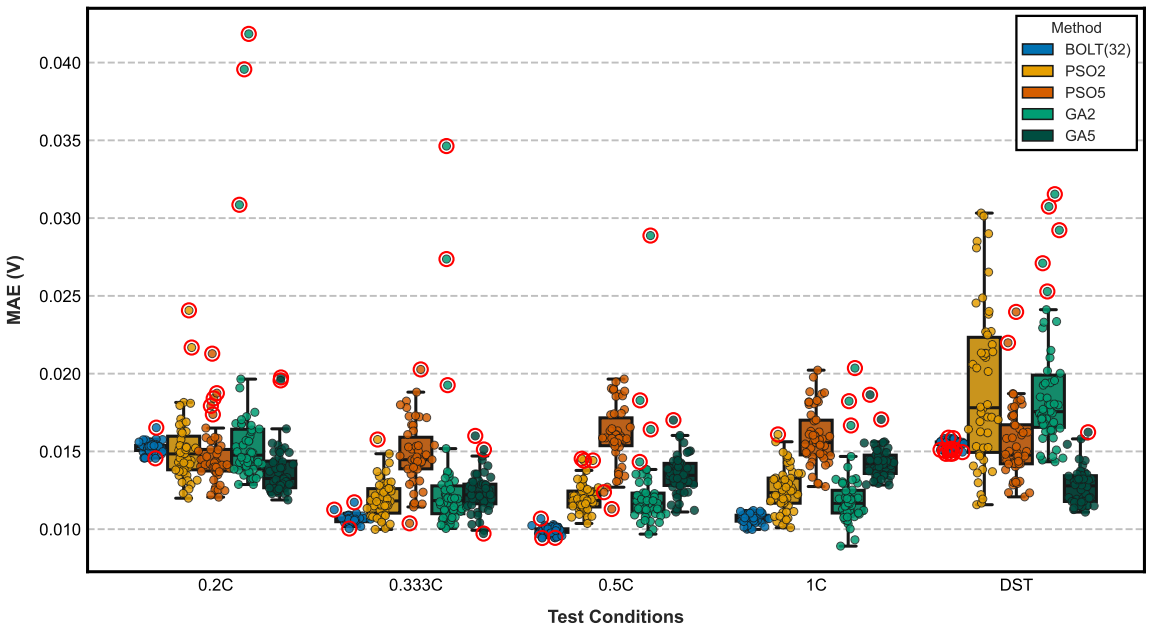
- BOLT(32) produces 12.4 mV average MAE over five operating conditions while using only 20,636 model calls and 8.97 seconds per run.
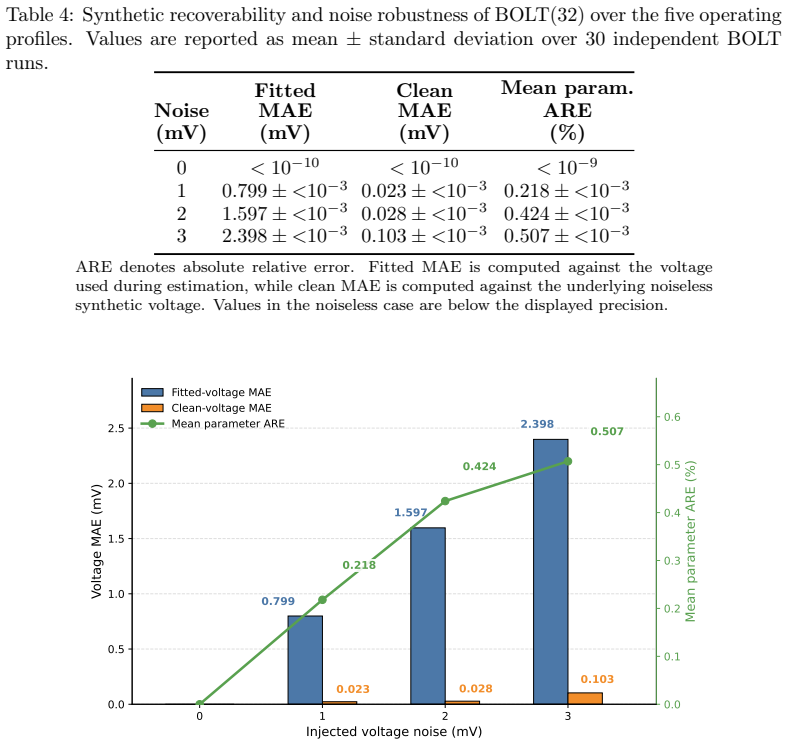
- The method recovers a known reference parameter vector with mean absolute relative error below 0.6 percent in synthetic data.
- Performance remains stable under 1–3 mV voltage noise perturbations.
- The workflow is intended for BMS parameter updating, control-oriented digital twins, and second-life battery screening.
Where Pith is reading between the lines
- If the consistency screen generalizes, BOLT could be applied to full-order electrochemical models without changing the outer workflow.
- The batch structure suggests the same pattern could accelerate parameter fitting for other expensive physics simulators that lack analytic gradients.
- Frequent on-device recalibration becomes feasible once the per-run cost drops below ten seconds.
Load-bearing premise
The grouped single-particle model together with the five chosen operating conditions and noise levels are representative enough that consistency screening will accept good parameter vectors and reject poor ones for other cells or chemistries.
What would settle it
Running BOLT on a different lithium-ion chemistry or on a higher-fidelity electrochemical model and measuring whether the selected parameters still reproduce measured voltages to within 12 mV under previously unseen current profiles.
Figures




read the original abstract
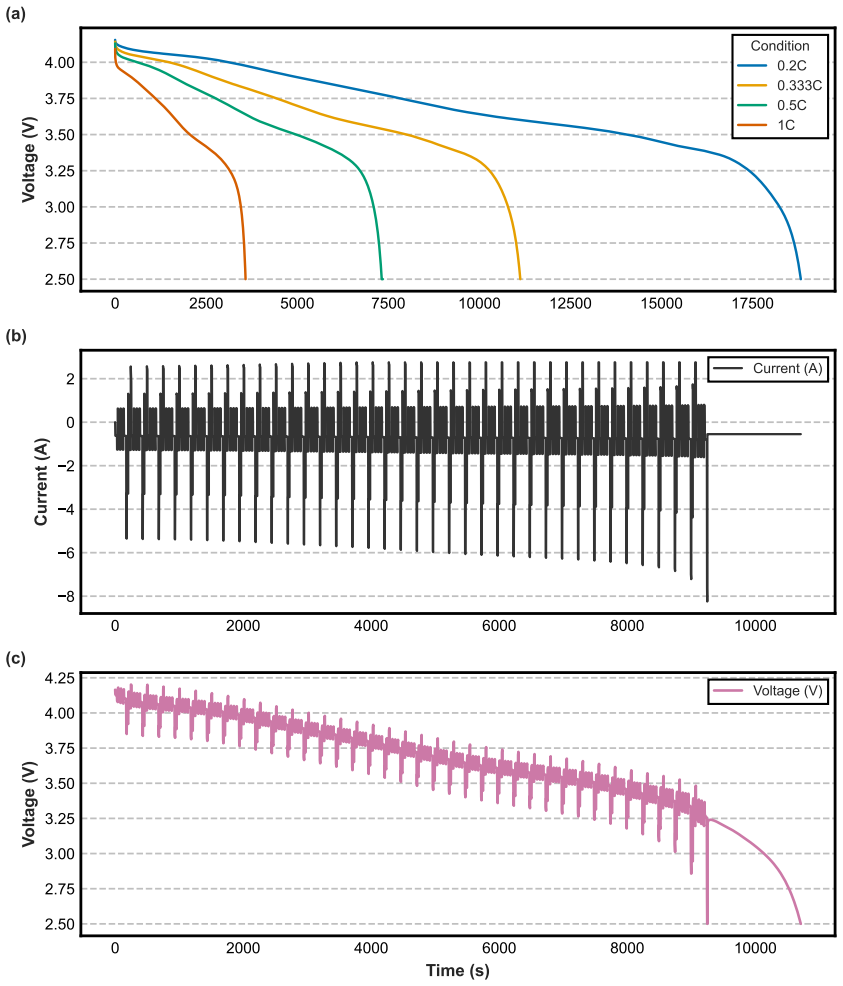
Accurate and efficient parameter estimation is essential for applying electrochemical battery models in simulation, state estimation, control, and repeated model updating. However, conventional optimization methods, such as particle swarm optimization (PSO) and genetic algorithms (GA), often require many model evaluations and show considerable run-to-run variability, limiting their use in time-sensitive calibration scenarios. This study proposes a Batch-Optimized Local-to-Global Technique (BOLT) for rapid and robust parameter estimation of electrochemical battery models. BOLT combines diversified candidate initialization, batch-parallel trust-region reflective (TRF) local refinement, JIT-accelerated model evaluation, and multi-condition consistency screening within a unified calibration workflow. Comparative experiments based on a grouped single-particle model and measured data from a commercial 18650 NMC lithium-ion cell show that BOLT achieves a favorable trade-off among voltage-response accuracy, computational efficiency, and repeated-run stability. BOLT(32) achieves an average mean absolute error of \(12.4 \pm 0.1\) mV over five operating conditions, requiring only \(20636 \pm 3081\) model calls and \(8.97 \pm 1.20\) s per run. Synthetic-data validation with a known parameter vector in the grouped SPM formulation further shows that BOLT recovers the reference parameter vector under model-consistent conditions and remains robust under 1--3 mV voltage-noise perturbations, with the mean parameter absolute relative error below \(0.6\%\). These results indicate that BOLT provides a practical calibration framework for BMS parameter updating, control-oriented battery digital twins, and second-life battery screening.
Editorial analysis
A structured set of objections, weighed in public.
Referee Report
Summary. The manuscript proposes BOLT, a Batch-Optimized Local-to-Global Technique for rapid parameter estimation of electrochemical battery models. It integrates diversified candidate initialization, batch-parallel trust-region reflective (TRF) local optimization, JIT-accelerated evaluations, and multi-condition consistency screening. On a grouped single-particle model fitted to voltage data from a commercial 18650 NMC cell, BOLT(32) reports an average MAE of 12.4 ± 0.1 mV across five operating conditions, using 20636 ± 3081 model calls and 8.97 ± 1.20 s per run, with lower run-to-run variability than PSO and GA baselines. Synthetic-data recovery tests recover a known parameter vector with mean absolute relative error below 0.6% under 1–3 mV noise.
Significance. If the reported performance holds, BOLT supplies a practical, low-variability calibration workflow suitable for repeated BMS updates and control-oriented digital twins. The quantitative reporting of means and standard deviations over five runs, together with explicit synthetic recovery metrics, strengthens the efficiency and stability claims relative to standard global optimizers.
major comments (1)
- [Abstract] Abstract and the description of the multi-condition consistency screening: the central robustness claim rests on this screening step, yet its reliability is demonstrated only under the grouped SPM with the five chosen operating conditions and 1–3 mV noise. The synthetic recovery validates the workflow under model-consistent conditions but does not test whether the screening discards valid vectors or retains poor ones when the underlying model omits electrolyte dynamics, temperature effects, or when applied to different cells/chemistries.
minor comments (1)
- [Abstract] Abstract: the notation BOLT(32) appears without an immediate definition of the batch size or other parameter; this should be stated explicitly on first use.
Simulated Author's Rebuttal
We thank the referee for the constructive comment on the validation scope of the multi-condition consistency screening. We agree that the reported robustness is demonstrated specifically within the grouped SPM and the chosen conditions/noise levels, and we will revise the manuscript to clarify these boundaries.
read point-by-point responses
-
Referee: [Abstract] Abstract and the description of the multi-condition consistency screening: the central robustness claim rests on this screening step, yet its reliability is demonstrated only under the grouped SPM with the five chosen operating conditions and 1–3 mV noise. The synthetic recovery validates the workflow under model-consistent conditions but does not test whether the screening discards valid vectors or retains poor ones when the underlying model omits electrolyte dynamics, temperature effects, or when applied to different cells/chemistries.
Authors: We agree that the robustness claims for the multi-condition consistency screening are validated only under the grouped SPM formulation, the five operating conditions, and 1–3 mV synthetic noise. The synthetic recovery experiments confirm recovery of a known parameter vector under model-consistent conditions but do not address model mismatch (e.g., omitted electrolyte dynamics or temperature dependence) or transfer to other cell chemistries. In the revised manuscript we will (i) temper the abstract wording to specify that the reported stability and accuracy apply to the grouped SPM on the tested NMC data, and (ii) add an explicit limitations paragraph that states the current validation scope and identifies broader model classes and cell types as future work. No new experiments are required for this clarification. revision: yes
Circularity Check
No circularity: performance metrics are direct experimental measurements
full rationale
The paper's central results (MAE of 12.4 mV, model call counts, run times, and synthetic recovery errors) are obtained by running BOLT on measured cell data and synthetic trajectories generated from the grouped SPM. These quantities are not algebraically forced by the fitted parameters or by any self-citation chain; they are counted or averaged from the optimization runs themselves. The multi-condition consistency screening is a procedural filter whose correctness depends on modeling assumptions, but the reported numbers do not reduce to those assumptions by definition. No self-definitional loops, fitted-input predictions, or load-bearing self-citations appear in the derivation of the performance claims.
Axiom & Free-Parameter Ledger
free parameters (1)
- batch size =
32
invented entities (1)
-
BOLT workflow
no independent evidence
Reference graph
Works this paper leans on
-
[1]
Xiong, W
R. Xiong, W. Sun, Q. Yu, F. Sun, Research progress, challenges and prospects of fault diagnosis on battery system of electric vehicles, Ap- plied Energy 279 (2020) 115855
2020
-
[2]
Y. Wang, X. Zhang, K. Liu, Z. Wei, X. Hu, X. Tang, Z. Chen, System identification and state estimation of a reduced-order electrochemical model for lithium-ion batteries, Etransportation 18 (2023) 100295
2023
-
[3]
Y. Li, X. Gao, X. Feng, X. Han, J. Du, L. Lu, M. Ouyang, Parameter- independent error correction for potential measurements by reference electrode in lithium-ion batteries, Journal of Energy Chemistry 67 (2022) 34–45. 37
2022
-
[4]
Z.P.Cano, D.Banham, S.Ye, A.Hintennach, J.Lu, M.Fowler, Z.Chen, Batteries and fuel cells for emerging electric vehicle markets, Nature energy 3 (4) (2018) 279–289
2018
-
[5]
Haghverdi, D
K. Haghverdi, D. L. Danilov, G. Mulder, L. D. Couto, F. Guo, R.-A. Eichel, Review of the safe operating area (soa) for batteries: Evolv- ing concepts and structured frameworks, Journal of Power Sources 652 (2025) 237483
2025
-
[6]
Q. Qi, W. Liu, Z. Deng, J. Li, Z. Song, X. Hu, Battery pack capacity estimation for electric vehicles based on enhanced machine learning and field data, Journal of Energy Chemistry 92 (2024) 605–618
2024
-
[7]
Z. M. Konz, B. M. Wirtz, A. Verma, T.-Y. Huang, H. K. Bergstrom, M. J. Crafton, D. E. Brown, E. J. McShane, A. M. Colclasure, B. D. McCloskey, High-throughput li plating quantification for fast-charging battery design, Nature Energy 8 (5) (2023) 450–461
2023
-
[8]
X. Hu, L. Xu, X. Lin, M. Pecht, Battery lifetime prognostics, Joule 4 (2) (2020) 310–346
2020
-
[9]
Y.Gao, C.Liu, S.Chen, X.Zhang, G.Fan, C.Zhu, Developmentandpa- rameterization of a control-oriented electrochemical model of lithium-ion batteries for battery-management-systems applications, Applied Energy 309 (2022) 118521
2022
-
[10]
Dubarry, D
M. Dubarry, D. Howey, B. Wu, Enabling battery digital twins at the industrial scale, Joule 7 (6) (2023) 1134–1144
2023
-
[11]
Naseri, S
F. Naseri, S. Gil, C. Barbu, E. Cetkin, G. Yarimca, A. Jensen, P. G. Larsen, C. Gomes, Digital twin of electric vehicle battery systems: Com- prehensive review of the use cases, requirements, and platforms, Renew- able and Sustainable Energy Reviews 179 (2023) 113280
2023
-
[12]
J. Song, R. C. Ihuaenyi, J. Lim, Z. Wang, W. Li, R. Fang, A. K. Ghamsari, H. Xu, Y. M. Lee, J. Zhu, A microstructural electrochemo- mechanical model of high-nickel composite electrodes towards digital twins to bridge the particle and electrode-level characterizations, En- ergy & Environmental Science 18 (7) (2025) 3129–3147. 38
2025
-
[13]
Hafner, J
D. Hafner, J. Pasukonis, J. Ba, T. Lillicrap, Mastering diverse control tasks through world models, Nature (2025) 1–7
2025
-
[14]
C. Zhu, J. Han, G. Fan, K. Li, B. Guo, X. Zhang, K. Liu, Reduced- order multi-particle model of lithium-ion batteries capturing electro- chemical heterogeneity at subzero temperatures, Applied Energy 410 (2026) 127488
2026
-
[15]
H. A. A. Ali, L. H. Raijmakers, K. Chayambuka, D. L. Danilov, P. H. Notten, R.-A. Eichel, A comparison between physics-based li-ion battery models, Electrochimica Acta 493 (2024) 144360
2024
-
[16]
M. Mama, E. Solai, T. Capurso, A. Danlos, S. Khelladi, Comprehen- sive review of multi-scale lithium-ion batteries modeling: From electro- chemical dynamics up to heat transfer in battery thermal management system, Energy Conversion and Management 325 (2025) 119223
2025
-
[17]
Miguel, G
E. Miguel, G. L. Plett, M. S. Trimboli, L. Oca, U. Iraola, E. Bekaert, Re- view of computational parameter estimation methods for electrochemi- cal models, Journal of Energy Storage 44 (2021) 103388
2021
-
[18]
Y. Li, G. Liu, W. Deng, Z. Li, Comparative study on parameter identi- fication of an electrochemical model for lithium-ion batteries via meta- heuristic methods, Applied Energy 367 (2024) 123437
2024
-
[19]
S. Ding, Y. Li, H. Dai, L. Wang, X. He, Accurate model parameter identification to boost precise aging prediction of lithium-ion batteries: A review, Advanced Energy Materials 13 (39) (2023) 2301452
2023
-
[20]
X. Cai, C. Zhang, Z. Chen, L. Zhang, D. U. Sauer, W. Li, Characteri- zation and quantification of multi-field coupling in lithium-ion batteries under mechanical constraints, Journal of Energy Chemistry 95 (2024) 364–379
2024
-
[21]
T. F. Fuller, M. Doyle, J. Newman, Simulation and optimization of the dual lithium ion insertion cell, Journal of the electrochemical society 141 (1) (1994) 1
1994
-
[22]
S. G. Marquis, V. Sulzer, R. Timms, C. P. Please, S. J. Chapman, An asymptotic derivation of a single particle model with electrolyte, Journal of The Electrochemical Society 166 (15) (2019) A3693. 39
2019
-
[23]
B. S. Haran, B. N. Popov, R. E. White, Determination of the hydro- gen diffusion coefficient in metal hydrides by impedance spectroscopy, Journal of Power Sources 75 (1) (1998) 56–63
1998
-
[24]
F. Guo, L. D. Couto, G. Mulder, K. Trad, G. Hu, O. Capron, K. Haghverdi, A systematic review of electrochemical model-based lithium-ion battery state estimation in battery management systems, Journal of Energy Storage 101 (2024) 113850
2024
-
[25]
Ecker, T
M. Ecker, T. K. D. Tran, P. Dechent, S. Käbitz, A. Warnecke, D. U. Sauer, Parameterization of a physico-chemical model of a lithium-ion battery: I. determination of parameters, Journal of The Electrochemical Society 162 (9) (2015) A1836
2015
-
[26]
J. Lu, T. Wu, K. Amine, State-of-the-art characterization techniques for advanced lithium-ion batteries, Nature Energy 2 (3) (2017) 1–13
2017
-
[27]
Wang, J.-N
Q.-K. Wang, J.-N. Shen, Z.-F. Ma, Y.-J. He, Decoupling parameter estimation strategy based electrochemical-thermal coupled modeling method for large format lithium-ion batteries with internal tempera- ture experimental validation, Chemical Engineering Journal 424 (2021) 130308
2021
-
[28]
Rojas, L
C. Rojas, L. Oca, I. Lopetegi, U. Iraola, J. Carrasco, A critical look at efficient parameter estimation methodologies of electrochemical models for lithium-ion cells, Journal of Energy Storage 80 (2024) 110384
2024
-
[29]
Z. Deng, H. Deng, L. Yang, Y. Cai, X. Zhao, Implementation of reduced- order physics-based model and multi-parameters identification strategy for lithium-ion battery, Energy 138 (2017) 509–519
2017
-
[30]
M. A. Rahman, S. Anwar, A. Izadian, Electrochemical model parameter identification of a lithium-ion battery using particle swarm optimization method, Journal of Power Sources 307 (2016) 86–97
2016
-
[31]
Xiong, L
R. Xiong, L. Li, Z. Li, Q. Yu, H. Mu, An electrochemical model based degradation state identification method of lithium-ion battery for all- climate electric vehicles application, Applied energy 219 (2018) 264–275
2018
-
[32]
F. Guo, L. D. Couto, G. Thenaisie, Efficiency and optimality in electro- chemical battery model parameter identification: A comparative study 40 of estimation techniques, in: 2024 10th International Conference on Op- timization and Applications (ICOA), IEEE, 2024, pp. 1–6
2024
-
[33]
A. Tian, K. Dong, X.-G. Yang, Y. Wang, L. He, Y. Gao, J. Jiang, Physics-based parameter identification of an electrochemical model for lithium-ion batteries with two-population optimization method, Applied Energy 378 (2025) 124748
2025
-
[34]
Huang, N
S. Huang, N. Lin, Z. Wang, Z. Zhang, S. Wen, Y. Zhao, Q. Li, A novel data-driven method for online parameter identification of an electro- chemical model based on cuckoo search and particle swarm optimization algorithm, Journal of Power Sources 601 (2024) 234261
2024
-
[35]
M. Kim, H. Chun, J. Kim, K. Kim, J. Yu, T. Kim, S. Han, Data- efficient parameter identification of electrochemical lithium-ion battery model using deep bayesian harmony search, Applied Energy 254 (2019) 113644
2019
-
[36]
Wang, Y.-B
B.-C. Wang, Y.-B. He, J. Liu, B. Luo, Fast parameter identification of lithium-ion batteries via classification model-assisted bayesian optimiza- tion, Energy 288 (2024) 129667
2024
-
[37]
Zhang, Y
W. Zhang, Y. Xie, H. He, Z. Long, L. Zhuang, J. Zhou, Multi-physics coupling model parameter identification of lithium-ion battery based on data driven method and genetic algorithm, Energy 314 (2025) 134120
2025
-
[38]
F. Guo, L. D. Couto, Comparative performance analysis of numerical discretization methods for electrochemical model of lithium-ion batter- ies, Journal of Power Sources 650 (2025) 237365
2025
-
[39]
F. Guo, L. D. Couto, A control-oriented simplified single particle model with grouped parameter and sensitivity analysis for lithium-ion batter- ies, Journal of Power Sources 649 (2025) 237309
2025
-
[40]
F. Guo, L. D. Couto, Cpg-spmt: Control-oriented parameter-grouped single particle model with thermal effects for lithium-ion batteries, Com- puter Physics Communications (2026) 110075
2026
-
[41]
M. A. Branch, T. F. Coleman, Y. Li, A subspace, interior, and con- jugate gradient method for large-scale bound-constrained minimization problems, SIAM Journal on Scientific Computing 21 (1) (1999) 1–23. 41
1999
-
[42]
F. Guo, L. D. Couto, K. Trad, G. Mulder, K. Haghverdi, G. Thenaisie, Optimizing parameter estimation for electrochemical battery model: A comparative analysis of operating profiles on computational efficiency and accuracy, Journal of Power Sources 665 (2026) 239044. 42
2026
discussion (0)
Sign in with ORCID, Apple, or X to comment. Anyone can read and Pith papers without signing in.