JWST observations of SN 2024abup: First Detection of CO in a broad-lined Type Ic Supernova and Constraints on r-process Nucleosynthesis
Pith reviewed 2026-06-30 00:51 UTC · model grok-4.3
The pith
JWST spectra reveal carbon monoxide in broad-lined Type Ic supernova SN 2024abup
A machine-rendered reading of the paper's core claim, the machinery that carries it, and where it could break.
Core claim
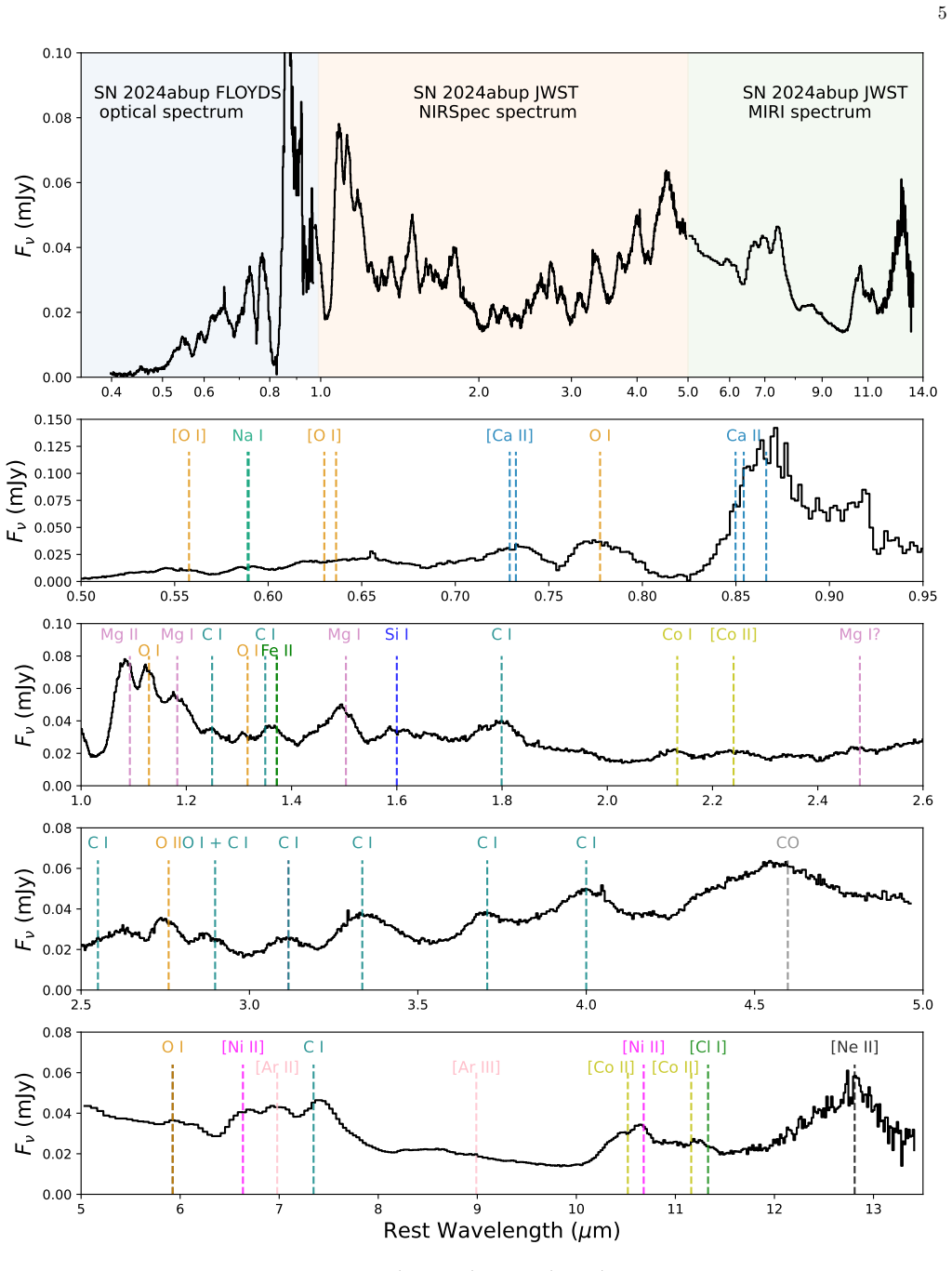
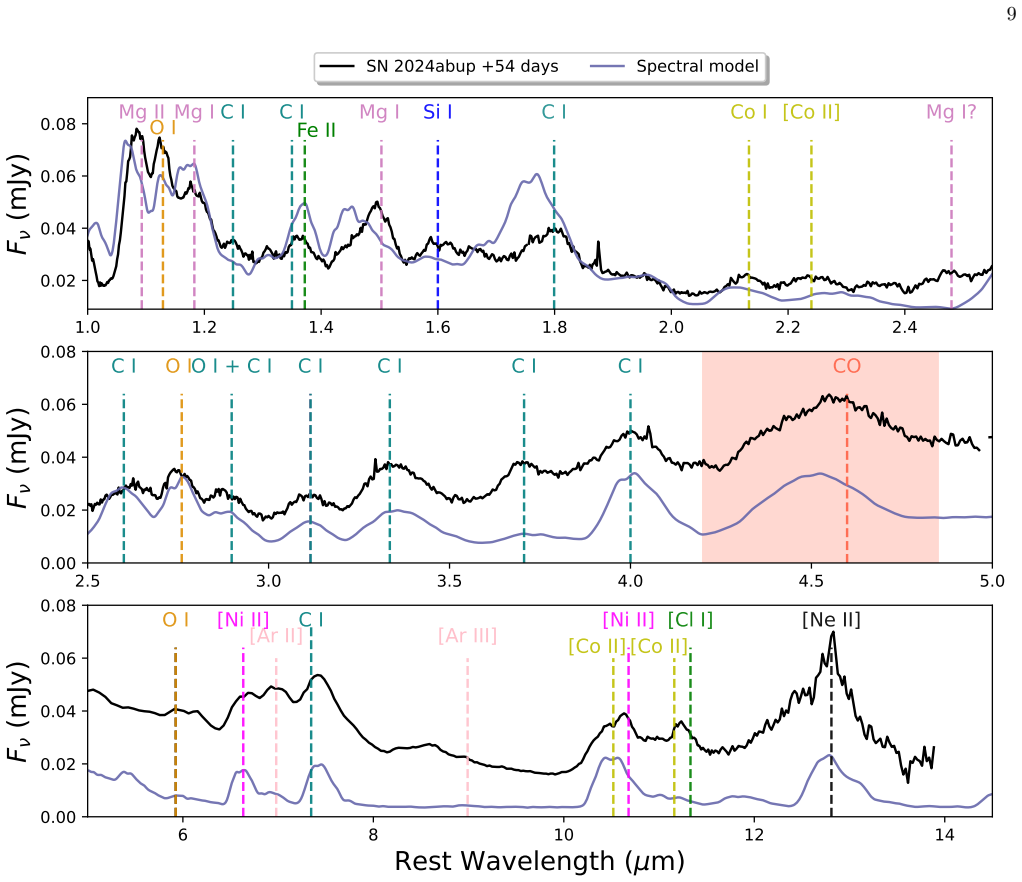
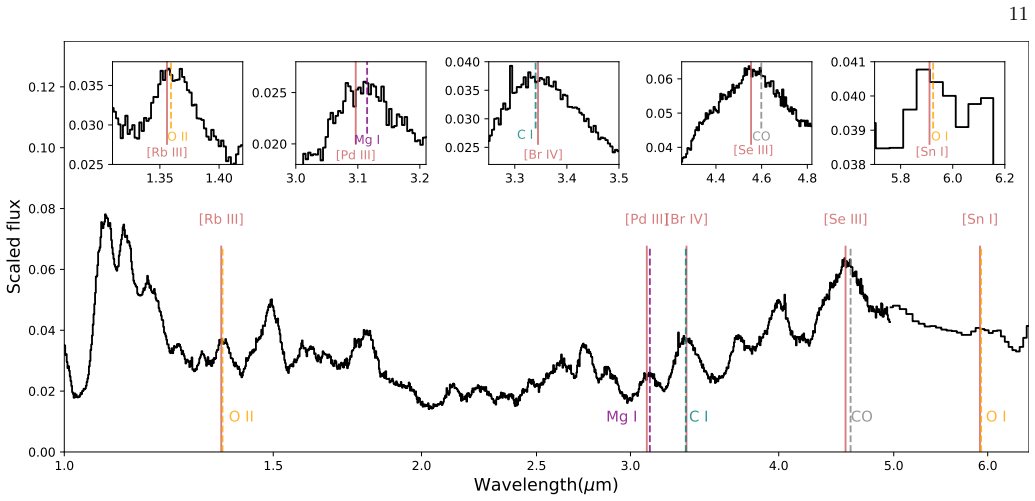
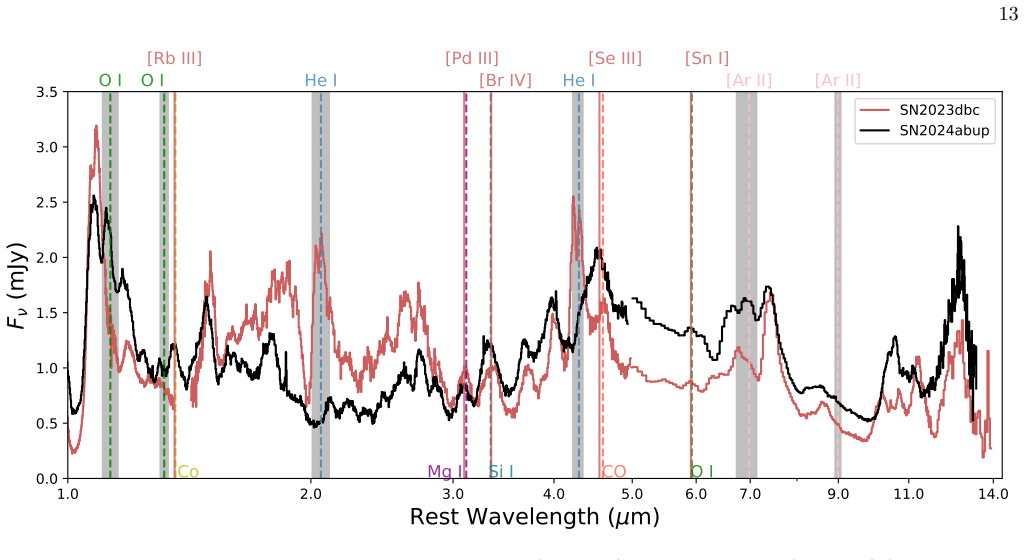
Using the spectral synthesis code SUMO on JWST NIR+MIR data of SN 2024abup, the authors identify significant contributions from C, O, Mg, and CO in the broad IR line features, marking the earliest detection of molecules in a core-collapse supernova. No compelling infrared signatures of r-process elements are found due to blending with non-r-process features. The continuum at wavelengths greater than 1.5 micron could arise from dust.
What carries the argument
The spectral synthesis code SUMO, which models the contributions of elements and molecules to the observed broad infrared spectrum to identify specific species.
If this is right
- SNe Ic-bl could be a contributor to early-universe dust production.
- If r-process elements are produced, revealing their presence from spectra requires very high-quality data and models to disentangle blends.
- Molecules such as CO can form in the ejecta of core-collapse supernovae as early as 54 days after explosion.
Where Pith is reading between the lines
- Additional JWST observations of other SNe Ic-bl at similar epochs could test whether CO and dust features are common in this class.
- Later-time or multi-epoch mid-IR data might separate potential r-process signals from the current blends.
- The dust continuum opens questions about whether preexisting or newly formed dust dominates, testable with longer-wavelength follow-up.
Load-bearing premise
The spectral synthesis code SUMO correctly attributes the observed broad infrared features to C, O, Mg, and CO without significant contamination or misidentification from unmodeled lines or incorrect opacity assumptions.
What would settle it
Higher-resolution spectra or an independent model that cannot reproduce the features using C, O, Mg, and CO, or that instead matches r-process elements more closely, would challenge the identification.
Figures



read the original abstract
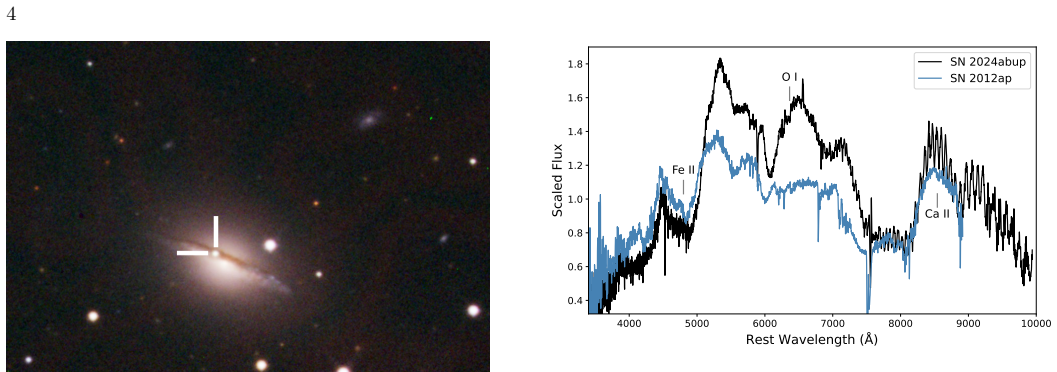
SN 2024abup is a nearby broad-lined Type Ic supernova (SN Ic-bl) in NGC 0681 at a distance of 23.3 \pm 1.6 Mpc. As energetic explosions of massive stars, SNe Ic-bl are considered a plausible site for rapid-neutron capture nucleosynthesis (r-process) and chemical enrichment from short-lived progenitors. They may also contribute to dust production in the early Universe. We present JWST near- to mid-infrared (NIR+MIR) observations (1-14 micron) of SN Ic-bl 2024abup at +41 days after the V band maximum (+54 days after explosion), the first-ever JWST+MIR observation of a SN Ic-bl along with radio and optical data. Using the spectral synthesis code SUMO, we identify the observed broad IR line features in SN 2024abup and find significant contributions from C, O, Mg, and carbon monoxide (CO) -- the earliest detection of molecules in a core-collapse SN so far. The spectrum shows continuum emission at wavelengths greater than 1.5 micron, which could be explained by dust -- preexisting, newly formed, or a combination-heated by the SN. We do not find compelling evidence for infrared signatures of r-process elements, though our search is hampered by the presence of many broad and blended features from the non-r-process elements. These new observations indicate that SNe Ic-bl could be a contributor to early-universe dust production, and suggest that if r-process elements are produced, revealing their presence from spectra requires very high-quality data and models to disentangle blends.
Editorial analysis
A structured set of objections, weighed in public.
Referee Report
Summary. The manuscript reports JWST NIR+MIR (1-14 micron) observations of the nearby broad-lined Type Ic supernova SN 2024abup at +41 days after V-band maximum (+54 days post-explosion), supplemented by radio and optical data. Using the spectral synthesis code SUMO, the authors attribute the observed broad IR features to significant contributions from C, O, Mg, and CO—the earliest claimed molecular detection in a core-collapse SN. They note possible dust continuum emission at >1.5 micron and find no compelling IR signatures of r-process elements, attributing this partly to blending with non-r-process lines. The work suggests SNe Ic-bl as potential contributors to early-universe dust production.
Significance. The new JWST data on an SN Ic-bl represent a valuable observational advance, providing the first mid-IR coverage for this class and enabling searches for molecules and dust. If the CO identification is robust, the result would carry significance for chemical enrichment timelines and dust formation in energetic core-collapse events. The paper explicitly notes limitations from blending when discussing the non-detection of r-process signatures.
major comments (1)
- [Spectral modeling and feature identification] Modeling and line identification (description of SUMO application): The central claim of CO detection rests on SUMO attribution of blended 1-14 micron features without reported quantitative fit statistics (e.g., chi-squared or likelihood metrics), error bars on derived line strengths or abundances, or explicit sensitivity tests (e.g., fits excluding CO while retaining C/O/Mg). This directly affects the robustness of the 'earliest detection' assertion and the interpretation of the spectrum.
minor comments (1)
- [Abstract] The abstract states that SUMO 'identifies' contributions but provides no example wavelengths or specific feature assignments for CO, which would aid immediate assessment of the claim.
Simulated Author's Rebuttal
We thank the referee for their constructive review and for recognizing the value of the first JWST mid-IR observations of an SN Ic-bl. We address the single major comment on spectral modeling below.
read point-by-point responses
-
Referee: The central claim of CO detection rests on SUMO attribution of blended 1-14 micron features without reported quantitative fit statistics (e.g., chi-squared or likelihood metrics), error bars on derived line strengths or abundances, or explicit sensitivity tests (e.g., fits excluding CO while retaining C/O/Mg). This directly affects the robustness of the 'earliest detection' assertion and the interpretation of the spectrum.
Authors: We acknowledge that the original manuscript does not include formal goodness-of-fit statistics or explicit sensitivity tests. SUMO is a spectral synthesis code that generates model spectra from specified abundances, temperature, and density profiles rather than performing automated statistical fitting; line identifications are therefore based on the requirement that specific features (particularly the broad 4.5-5 micron complex) cannot be reproduced without CO while retaining the observed C, O, and Mg contributions. To address the referee's concern, the revised manuscript will add (i) direct model comparisons with and without CO, (ii) a discussion of the parameter ranges that still provide acceptable visual matches, and (iii) approximate uncertainties on the CO and elemental abundances derived from those ranges. These additions will be presented in a new subsection on modeling robustness. revision: yes
Circularity Check
No significant circularity: observational attribution via external code on new data
full rationale
The paper's central claim rests on applying the pre-existing spectral synthesis code SUMO to new JWST NIR+MIR observations of SN 2024abup at +41 days. No equations, fitted parameters, or derivations are presented that reduce the reported line identifications (C, O, Mg, CO) to quantities defined from the same spectrum or to self-citations whose validity depends on the present result. The analysis is an interpretation step on external data using an independent tool; the reader's score of 2.0 reflects only routine code citation, not load-bearing circularity. No self-definitional, fitted-input, or uniqueness-imported patterns appear in the provided text.
Axiom & Free-Parameter Ledger
axioms (1)
- domain assumption Standard assumptions in supernova spectral modeling regarding atomic and molecular opacities and level populations
Reference graph
Works this paper leans on
-
[1]
Near-infrared spectroscopy and detection of carbon monoxide in the Type II supernova SN 2023ixf. , keywords =. doi:10.1051/0004-6361/202555244 , archivePrefix =. 2507.11877 , primaryClass =
-
[2]
NIR+MIR Spectroscopy of the Nearby Broad Line Type Ic SN 2024abup: r-process, Dust and Explosion Physics
-
[3]
Near-infrared and Optical Observations of Type Ic SN 2020oi and Broad-lined Type Ic SN 2020bvc: Carbon Monoxide, Dust, and High-velocity Supernova Ejecta. , keywords =. doi:10.3847/1538-4357/abd850 , archivePrefix =. 2010.00662 , primaryClass =
-
[4]
JWST Observations of SN 2024ggi. II. NIRSpec Spectroscopy and CO Modeling at +285─385 Days past the Explosion. , keywords =. doi:10.3847/1538-4357/ae317e , archivePrefix =. 2510.09600 , primaryClass =
-
[5]
Collapse of Rotating Massive Stars Leading to Black Hole Formation and Energetic Supernovae. , keywords =. doi:10.3847/1538-4357/acf5e5 , archivePrefix =. 2212.03958 , primaryClass =
-
[6]
r-process Viable Outflows are Suppressed in Global Alpha-viscosity Models of Collapsar Disks. , keywords =. doi:10.3847/2041-8213/ac83a1 , archivePrefix =. 2205.14158 , primaryClass =
-
[7]
Infrared Spectroscopy in Astronomy , year = 1989, editor =
Carbon monoxide in Supernova 1987a. Infrared Spectroscopy in Astronomy , year = 1989, editor =
1989
-
[8]
arXiv e-prints , keywords =
SN 2023dbc in M108: Optical and Near-Infrared Observations of a Highly-Obscured, Moderately Energetic Stripped-Envelope Supernova. arXiv e-prints , keywords =
-
[9]
Full Transport General Relativistic Radiation Magnetohydrodynamics for Nucleosynthesis in Collapsars. , keywords =. doi:10.3847/1538-4357/abb4e3 , archivePrefix =. 1912.03378 , primaryClass =
-
[10]
JWST Observations of SN 2023ixf. II. The Panchromatic Evolution between 250 and 720 Days after the Explosion. , keywords =. doi:10.3847/1538-4357/ae0736 , archivePrefix =. 2507.19727 , primaryClass =
-
[11]
Origins of Carbon Dust in a JWST-observed Primeval Galaxy at z 6.7. , keywords =. doi:10.3847/2041-8213/ade2e5 , archivePrefix =. 2505.10701 , primaryClass =
-
[12]
Delayed Shock-induced Dust Formation in the Dense Circumstellar Shell Surrounding the Type IIn Supernova SN 2010jl. , keywords =. doi:10.3847/1538-4357/aabfc3 , archivePrefix =. 1804.06878 , primaryClass =
work page internal anchor Pith review Pith/arXiv arXiv doi:10.3847/1538-4357/aabfc3
-
[13]
Carbon monoxide cooling in radiative transfer modelling of supernovae. , keywords =. doi:10.1093/mnras/stae1513 , archivePrefix =. 2406.10132 , primaryClass =
-
[14]
The molecular chemistry of Type Ibc supernovae and diagnostic potential with the James Webb Space Telescope. , keywords =. doi:10.1051/0004-6361/202243491 , archivePrefix =. 2203.07021 , primaryClass =
-
[15]
Dust from AGBs: relevant factors and modelling uncertainties
Dust from asymptotic giant branch stars: relevant factors and modelling uncertainties. , keywords =. doi:10.1093/mnras/stu028 , archivePrefix =. 1401.1332 , primaryClass =
work page internal anchor Pith review Pith/arXiv arXiv doi:10.1093/mnras/stu028
-
[16]
Evolved stars in the Local Group galaxies - II. AGB, RSG stars and dust production in IC10
Evolved stars in the Local Group galaxies - II. AGB, RSG stars, and dust production in IC10. , keywords =. doi:10.1093/mnras/sty1614 , archivePrefix =. 1806.04160 , primaryClass =
work page internal anchor Pith review Pith/arXiv arXiv doi:10.1093/mnras/sty1614
-
[17]
Interstellar Dust , year = 1989, editor =
Sources of Stardust in the Galaxy. Interstellar Dust , year = 1989, editor =
1989
-
[18]
Discovery of a Relativistic Stripped-envelope Type Ic-BL Supernova at z = 2.83 with JWST. , keywords =. doi:10.3847/2041-8213/ad6c32 , archivePrefix =. 2406.05076 , primaryClass =
-
[19]
Reviews of Modern Physics , keywords =
The evolution and explosion of massive stars. Reviews of Modern Physics , keywords =. doi:10.1103/RevModPhys.74.1015 , adsurl =
-
[20]
Radio Observations of a Sample of Broad-line Type IC Supernovae Discovered by PTF/IPTF: A Search for Relativistic Explosions. , keywords =. doi:10.3847/0004-637X/830/1/42 , archivePrefix =. 1512.01303 , primaryClass =
work page internal anchor Pith review Pith/arXiv arXiv doi:10.3847/0004-637x/830/1/42
-
[21]
GRB 230307A Formed No Dust or Was Not a Binary Neutron Star Merger. arXiv e-prints , keywords =. doi:10.48550/arXiv.2510.16121 , archivePrefix =. 2510.16121 , primaryClass =
-
[22]
EP 250108a/SN 2025kg: Observations of the Most Nearby Broad-line Type Ic Supernova Following an Einstein Probe Fast X-Ray Transient. , keywords =. doi:10.3847/2041-8213/ade7f9 , archivePrefix =. 2504.08889 , primaryClass =
-
[23]
Quantifying the Observational Effort Required for the Radial Velocity Characterization of TESS Planets. , keywords =. 2018. doi:10.3847/1538-3881/aacea9 , archivePrefix =. 1807.01263 , primaryClass =
work page internal anchor Pith review Pith/arXiv arXiv doi:10.3847/1538-3881/aacea9 2018
-
[24]
X-Ray Scattering Echoes and Ghost Halos from the Intergalactic Medium: Relation to the Nature of AGN Variability. , keywords =. 2015. doi:10.1088/0004-637X/805/1/23 , archivePrefix =. 1503.01475 , primaryClass =
work page internal anchor Pith review Pith/arXiv arXiv doi:10.1088/0004-637x/805/1/23 2015
-
[25]
Transient Name Server Classification Report , keywords =
Transient Classification Report for 2024-11-26. Transient Name Server Classification Report , keywords =
2024
-
[26]
Transient Name Server Discovery Report , keywords =
ATLAS Transient Discovery Report for 2024-11-22. Transient Name Server Discovery Report , keywords =
2024
-
[27]
1989", month =
T _ E X and LAT _ E X Macro Definition Files for Astronomical Publications. , year = "1989", month = "Mar", pages =
1989
-
[28]
LaTeX: A Document Preparation System. 1994
1994
-
[29]
Transient Name Server Classification Report , keywords =
Transient Classification Report for 2024-11-27. Transient Name Server Classification Report , keywords =
2024
-
[30]
Quasi-periodic Fast Propagating Magnetoacoustic Waves during the Magnetic Reconnection Between Solar Coronal Loops. , keywords =. 2018. doi:10.3847/2041-8213/aaf167 , archivePrefix =. 1811.08553 , primaryClass =
work page internal anchor Pith review Pith/arXiv arXiv doi:10.3847/2041-8213/aaf167 2018
-
[31]
Nominal values for selected solar and planetary quantities: IAU 2015 Resolution B3
Nominal Values for Selected Solar and Planetary Quantities: IAU 2015 Resolution B3. , keywords =. 2016. doi:10.3847/0004-6256/152/2/41 , archivePrefix =. 1605.09788 , primaryClass =
work page internal anchor Pith review Pith/arXiv arXiv doi:10.3847/0004-6256/152/2/41 2015
-
[32]
Swift X-Ray Observations of Classical Novae. II. The Super Soft Source Sample. , keywords =. 2011. doi:10.1088/0067-0049/197/2/31 , archivePrefix =. 1110.6224 , primaryClass =
work page internal anchor Pith review Pith/arXiv arXiv doi:10.1088/0067-0049/197/2/31 2011
-
[33]
Galaxy emission line classification using 3D line ratio diagrams
Galaxy Emission Line Classification Using Three-dimensional Line Ratio Diagrams. , keywords =. 2014. doi:10.1088/0004-637X/793/2/127 , archivePrefix =. 1406.5186 , primaryClass =
work page internal anchor Pith review Pith/arXiv arXiv doi:10.1088/0004-637x/793/2/127 2014
-
[34]
An analytic model of deviations from blackbody emission
Shock cooling emission from explosions of red supergiants: II. An analytic model of deviations from blackbody emission. , keywords =. doi:10.1093/mnras/stae374 , archivePrefix =. 2307.05598 , primaryClass =
-
[35]
The Early Ultraviolet Light-Curves of Type II Supernovae and the Radii of Their Progenitor Stars. arXiv e-prints , keywords =. doi:10.48550/arXiv.2310.16885 , archivePrefix =. 2310.16885 , primaryClass =
-
[36]
Errors When Constraining Hot Blackbody Parameters with Optical Photometry. , keywords =. doi:10.3847/1538-4357/ac90c0 , archivePrefix =. 2208.13674 , primaryClass =
-
[37]
Bright, Months-long Stellar Outbursts Announce the Explosion of Interaction-powered Supernovae. , keywords =. doi:10.3847/1538-4357/abd032 , archivePrefix =. 2010.11196 , primaryClass =
-
[38]
Precursors Prior to Type IIn Supernova Explosions are Common: Precursor Rates, Properties, and Correlations. , keywords =. doi:10.1088/0004-637X/789/2/104 , archivePrefix =. 1401.5468 , primaryClass =
work page internal anchor Pith review Pith/arXiv arXiv doi:10.1088/0004-637x/789/2/104
-
[39]
Final Moments II: Observational Properties and Physical Modeling of CSM-Interacting Type II Supernovae. arXiv e-prints , keywords =. doi:10.48550/arXiv.2403.02382 , archivePrefix =. 2403.02382 , primaryClass =
-
[40]
SALT spectroscopy of evolved massive stars
SALT Spectroscopy of Evolved Massive Stars. Stars: From Collapse to Collapse , year = 2017, editor =. doi:10.48550/arXiv.1612.00292 , archivePrefix =. 1612.00292 , primaryClass =
work page internal anchor Pith review Pith/arXiv arXiv doi:10.48550/arxiv.1612.00292 2017
-
[41]
MN48: a new Galactic bona fide luminous blue variable revealed by Spitzer and SALT
MN48: a new Galactic bona fide luminous blue variable revealed by Spitzer and SALT. , keywords =. doi:10.1093/mnras/stw889 , archivePrefix =. 1604.03942 , primaryClass =
work page internal anchor Pith review Pith/arXiv arXiv doi:10.1093/mnras/stw889
-
[42]
Research in Astronomy and Astrophysics , keywords =
Lijiang 2.4-meter Telescope and its instruments. Research in Astronomy and Astrophysics , keywords =. doi:10.1088/1674-4527/19/10/149 , archivePrefix =. 1905.05915 , primaryClass =
-
[43]
ATClean: A Novel Method for Detecting Low-Luminosity Transients and Application to Pre-explosion Counterparts from SN 2023ixf. arXiv e-prints , keywords =. doi:10.48550/arXiv.2405.03747 , archivePrefix =. 2405.03747 , primaryClass =
-
[44]
The Swift Ultra-Violet/Optical Telescope
The Swift Ultra-Violet/Optical Telescope. , keywords =. doi:10.1007/s11214-005-5095-4 , archivePrefix =. astro-ph/0507413 , primaryClass =
work page internal anchor Pith review Pith/arXiv arXiv doi:10.1007/s11214-005-5095-4
-
[45]
The Red Supergiant Progenitor of Type II Supernova 2024ggi. , keywords =. doi:10.3847/2041-8213/ad54b3 , archivePrefix =. 2405.07699 , primaryClass =
-
[46]
Early phase simultaneous multi-band observations of Type II supernova SN 2024ggi with Mephisto. arXiv e-prints , keywords =. doi:10.48550/arXiv.2405.07964 , archivePrefix =. 2405.07964 , primaryClass =
-
[47]
, year = 1956, month = mar, volume =
The Circumstellar Envelope of Alpha Herculis. , year = 1956, month = mar, volume =. doi:10.1086/146152 , adsurl =
-
[48]
Early-time spectra of supernovae and their precursor winds. The luminous blue variable/yellow hypergiant progenitor of SN 2013cu. , keywords =. doi:10.1051/0004-6361/201424852 , archivePrefix =. 1408.5397 , primaryClass =
work page internal anchor Pith review Pith/arXiv arXiv doi:10.1051/0004-6361/201424852
-
[49]
Light-travel-time diagnostics in early supernova spectra: substantial mass-loss of the IIb progenitor of SN 2013cu through a superwind. , keywords =. doi:10.1093/mnras/stv2283 , archivePrefix =. 1510.00013 , primaryClass =
work page internal anchor Pith review Pith/arXiv arXiv doi:10.1093/mnras/stv2283
-
[50]
PTF11iqb: Cool supergiant mass loss that bridges the gap between Type IIn and normal supernovae
PTF11iqb: cool supergiant mass-loss that bridges the gap between Type IIn and normal supernovae. , keywords =. doi:10.1093/mnras/stv354 , archivePrefix =. 1501.02820 , primaryClass =
work page internal anchor Pith review Pith/arXiv arXiv doi:10.1093/mnras/stv354
-
[51]
Transient
Itagaki, Koichi , year =. Transient. TNSTR , volume =
-
[52]
A., Jiang, Y.-F., & Bildsten, L
Shock Breakout in Three-dimensional Red Supergiant Envelopes. , keywords =. doi:10.3847/1538-4357/ac75e3 , archivePrefix =. 2206.04134 , primaryClass =
-
[53]
Supernova PTF 09uj: A possible shock breakout from a dense circumstellar wind
Supernova PTF 09UJ: A Possible Shock Breakout from a Dense Circumstellar Wind. , keywords =. doi:10.1088/0004-637X/724/2/1396 , archivePrefix =. 1009.5378 , primaryClass =
work page internal anchor Pith review Pith/arXiv arXiv doi:10.1088/0004-637x/724/2/1396
-
[54]
Handbook of Supernovae , year = 2017, editor =
Shock Breakout Theory. Handbook of Supernovae , year = 2017, editor =. doi:10.1007/978-3-319-21846-5_33 , adsurl =
-
[55]
and Moodley, Kavilan and Skordis, Constantinos
The Type IIn supernova 1994W: evidence for the explosive ejection of a circumstellar envelope. , keywords =. doi:10.1111/j.1365-2966.2004.08011.x , archivePrefix =. astro-ph/0405369 , primaryClass =
-
[56]
Explosion of red-supergiant stars: Influence of the atmospheric structure on shock breakout and early-time supernova radiation. , keywords =. doi:10.1051/0004-6361/201730942 , archivePrefix =. 1704.01697 , primaryClass =
work page internal anchor Pith review Pith/arXiv arXiv doi:10.1051/0004-6361/201730942
-
[57]
Shock Breakout in Dense Circumstellar Material with Application to PS1-13arp. , keywords =. doi:10.3847/1538-4357/abe938 , archivePrefix =. 2011.01937 , primaryClass =
-
[58]
Shell-shocked diffusion model for the light curve of SN2006gy
Shell-shocked Diffusion Model for the Light Curve of SN 2006gy. , keywords =. doi:10.1086/524681 , archivePrefix =. 0710.3428 , primaryClass =
work page internal anchor Pith review Pith/arXiv arXiv doi:10.1086/524681
-
[59]
Probing the Shock Breakout Signal of SN 2024ggi from the Transformation of Early Flash Spectroscopy. , keywords =. doi:10.3847/2041-8213/ad5da4 , archivePrefix =. 2406.07806 , primaryClass =
-
[60]
The compact circumstellar material of SN 2024ggi: Another supernova with a pre-explosion effervescent zone and jet-driven explosion. arXiv e-prints , keywords =. doi:10.48550/arXiv.2406.17751 , archivePrefix =. 2406.17751 , primaryClass =
-
[61]
Transient Name Server AstroNote , keywords =
ATLAS24fsk (AT2024ggi): discovery of a nearby candidate SN in NGC 3621 at 7 Mpc with a possible progenitor detection. Transient Name Server AstroNote , keywords =
-
[62]
Circumstellar material ejected violently by a massive star immediately before its death. Science Bulletin , keywords =. doi:10.1016/j.scib.2023.09.015 , archivePrefix =. 2309.01998 , primaryClass =
-
[63]
A shock flash breaking out of a dusty red supergiant. , keywords =. doi:10.1038/s41586-023-06843-6 , archivePrefix =. 2311.14409 , primaryClass =
-
[64]
Cepheid Distances to SNe Ia Host Galaxies Based on a Revised Photometric Zero Point of the HST WFPC2 and New PL Relations and Metallicity Corrections. , keywords =. doi:10.1086/503800 , archivePrefix =. astro-ph/0602572 , primaryClass =
work page internal anchor Pith review Pith/arXiv arXiv doi:10.1086/503800
-
[65]
Ground-based and Airborne Instrumentation for Astronomy V , year = 2014, editor =
Performance of the Southern African Large Telescope (SALT) High Resolution Spectrograph (HRS). Ground-based and Airborne Instrumentation for Astronomy V , year = 2014, editor =. doi:10.1117/12.2055635 , adsurl =
-
[66]
, keywords =
Mass loss rates in the Hertzsprung-Russell diagram. , keywords =
-
[67]
The delay of shock breakout due to circumstellar material seen in most Type II Supernovae
The delay of shock breakout due to circumstellar material evident in most type II supernovae. Nature Astronomy , keywords =. doi:10.1038/s41550-018-0563-4 , archivePrefix =. 1809.06379 , primaryClass =
work page internal anchor Pith review Pith/arXiv arXiv doi:10.1038/s41550-018-0563-4
-
[68]
The Astronomer's Telegram , keywords =
SRG/ART-XC detects SN2024ggi in X-rays. The Astronomer's Telegram , keywords =
-
[69]
The Astronomer's Telegram , keywords =
NuSTAR detection of SN2024ggi at 2 days post discovery. The Astronomer's Telegram , keywords =
-
[70]
The Astronomer's Telegram , keywords =
SN 2024ggi: detection of X-ray emission by EP-FXT. The Astronomer's Telegram , keywords =
-
[71]
The Astronomer's Telegram , keywords =
Radio detection of SN 2024ggi. The Astronomer's Telegram , keywords =
-
[72]
Transient Name Server Discovery Report , keywords =
ATLAS Transient Discovery Report for 2024-04-11. Transient Name Server Discovery Report , keywords =
2024
-
[73]
The complex circumstellar environment of supernova 2023ixf. , keywords =. doi:10.1038/s41586-024-07116-6 , archivePrefix =. 2310.10727 , primaryClass =
-
[74]
SN 2024ggi in NGC 3621: Rising Ionization in a Nearby, CSM-Interacting Type II Supernova. arXiv e-prints , keywords =. doi:10.48550/arXiv.2404.19006 , archivePrefix =. 2404.19006 , primaryClass =
-
[75]
High-resolution Spectroscopy of SN 2023ixf's First Week: Engulfing the Asymmetric Circumstellar Material. , keywords =. doi:10.3847/1538-4357/acf366 , archivePrefix =. 2306.07964 , primaryClass =
-
[76]
Early Emission from the Type IIn Supernova 1998S at High Resolution
Early Emission from the Type IIn Supernova 1998S at High Resolution. , keywords =. doi:10.1088/0004-637X/806/2/213 , archivePrefix =. 1408.1404 , primaryClass =
work page internal anchor Pith review Pith/arXiv arXiv doi:10.1088/0004-637x/806/2/213
-
[77]
Early flash-ionization lines in SN 2024ggi revealed by high-resolution spectroscopy. arXiv e-prints , keywords =. doi:10.48550/arXiv.2405.02274 , archivePrefix =. 2405.02274 , primaryClass =
-
[78]
Optimal Techniques in Two-dimensional Spectroscopy: Background Subtraction for the 21st Century
Optimal Techniques in Two-dimensional Spectroscopy: Background Subtraction for the 21st Century. , keywords =. doi:10.1086/375502 , archivePrefix =. astro-ph/0303507 , primaryClass =
work page internal anchor Pith review Pith/arXiv arXiv doi:10.1086/375502
-
[79]
The Evolution of Early-Type Galaxies in Distant Clusters. II. Internal Kinematics of 55 Galaxies in the z=0.33 Cluster CL 1358+62. , keywords =. doi:10.1086/308445 , archivePrefix =. astro-ph/9908257 , primaryClass =
work page internal anchor Pith review Pith/arXiv arXiv doi:10.1086/308445
-
[80]
Society of Photo-Optical Instrumentation Engineers (SPIE) Conference Series , year = 2006, editor =
The prime focus imaging spectrograph for the Southern African Large Telescope: structural and mechanical design and commissioning. Society of Photo-Optical Instrumentation Engineers (SPIE) Conference Series , year = 2006, editor =. doi:10.1117/12.672415 , adsurl =
discussion (0)
Sign in with ORCID, Apple, or X to comment. Anyone can read and Pith papers without signing in.