Logarithmic convergence of finite projective planes
Pith reviewed 2026-06-30 09:31 UTC · model grok-4.3
The pith
Incidence graphs of projective planes over finite fields log-converge to the same limit as a specific random graph model.
A machine-rendered reading of the paper's core claim, the machinery that carries it, and where it could break.
Core claim
The sequence of incidence graphs of projective planes over finite fields log-converges, and the limit coincides with that of a particular random graph model.
What carries the argument
Log-convergence of graph sequences, applied to the incidence graphs of projective planes over finite fields.
If this is right
- Szegedy's Question 4 receives an affirmative answer.
- The incidence graphs of these planes achieve the same limiting object as the chosen random model.
- Deterministic constructions from finite geometry can realize the limiting behavior previously associated only with random models.
- The log-convergence framework treats these geometric graphs and the random model as equivalent at the limit level.
Where Pith is reading between the lines
- Other families of algebraic graphs, such as those from higher-dimensional geometries, might be checked for the same log-convergence property.
- Explicit small-field examples could be used to numerically approximate the rate at which the sequence approaches the limit.
- The matching limit suggests the random model may capture some averaged or asymptotic property shared by all such planes.
Load-bearing premise
The log-convergence definition applies directly to these incidence graphs without needing extra regularity conditions.
What would settle it
A computation or limit calculation in which the projective-plane incidence graphs and the random model produce different values under the log-convergence measure.
Figures

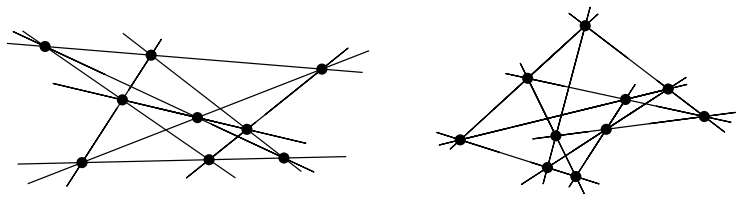
read the original abstract
In this paper, we study the so-called log-convergence of graphs defined by Bal\'azs Szegedy (arXiv:1504.00858). We answer his Question 4 affirmatively: the sequence of incidence graphs of projective planes over finite fields log-converges, and the limit coincides with that of a particular random graph model.
Editorial analysis
A structured set of objections, weighed in public.
Referee Report
Summary. The paper studies log-convergence of graphs in the sense of Szegedy (arXiv:1504.00858) and affirmatively answers Question 4: the sequence of incidence graphs of projective planes over finite fields log-converges, and the limit object coincides with that arising from a specified random graph model.
Significance. If the central claim holds, the result supplies a concrete affirmative resolution to an open question in the Szegedy framework, furnishing a deterministic sequence from finite geometry whose log-limit matches a random-graph limit. This supplies an explicit, non-random example in the theory and may facilitate further comparisons between algebraic/combinatorial constructions and probabilistic models under log-convergence.
minor comments (2)
- The abstract states the main result but supplies no proof outline, key definitions, or verification steps; a one-paragraph sketch of the argument (e.g., how the Szegedy definition is applied to the incidence graphs and how the limit is identified) would improve readability without altering the technical content.
- Notation for the random graph model whose limit is claimed to coincide should be introduced explicitly in the introduction or §2, together with a precise reference to the model in Szegedy's paper.
Simulated Author's Rebuttal
We thank the referee for the positive assessment of our work and the recommendation of minor revision. The report provides no specific major comments to address.
Circularity Check
No significant circularity
full rationale
The paper invokes Szegedy's external definition of log-convergence (arXiv:1504.00858, different author) to establish that incidence graphs of finite-field projective planes converge to the same limit object as a specified random-graph model, thereby answering an open question. No self-citations appear in the load-bearing steps, no parameter is fitted and then relabeled as a prediction, and no uniqueness theorem or ansatz is imported from the authors' own prior work. The central claim therefore rests on independent application of the cited framework rather than on any definitional reduction or self-referential loop.
Axiom & Free-Parameter Ledger
Reference graph
Works this paper leans on
-
[1]
David J. Aldous. Representations for partially exchangeable arrays of random variables.Journal of Multivariate Analysis, 11(4):581–598, 1981
1981
-
[2]
Action convergence of operators and graphs.Canadian Journal of Mathematics, 74(1):72–121, 2022
´Agnes Backhausz and Bal´ azs Szegedy. Action convergence of operators and graphs.Canadian Journal of Mathematics, 74(1):72–121, 2022
2022
-
[3]
Recurrence of distributional limits of finite planar graphs
Itai Benjamini and Oded Schramm. Recurrence of distributional limits of finite planar graphs. Electronic Journal of Probability, 6:Paper no. 23, 1–13, 2001
2001
-
[4]
Quotient-convergence of submodular setfunctions.Combinatorica, 46, 2026
Krist´ of B´ erczi, M´ arton Borb´ enyi, L´ aszl´ o Lov´ asz, and L´ aszl´ o M´ arton T´ oth. Quotient-convergence of submodular setfunctions.Combinatorica, 46, 2026
2026
-
[5]
Sparse graphs: Metrics and random models.Random Structures & Algorithms, 39(1):1–38, 2011
B´ ela Bollob´ as and Oliver Riordan. Sparse graphs: Metrics and random models.Random Structures & Algorithms, 39(1):1–38, 2011
2011
-
[6]
Left and right convergence of graphs with bounded degree.Random Structures & Algorithms, 42(1):1–28, 2013
Christian Borgs, Jennifer Chayes, Jeff Kahn, and L´ aszl´ o Lov´ asz. Left and right convergence of graphs with bounded degree.Random Structures & Algorithms, 42(1):1–28, 2013
2013
-
[7]
Chayes, Henry Cohn, and Nina Holden
Christian Borgs, Jennifer T. Chayes, Henry Cohn, and Nina Holden. Sparse exchangeable graphs and their limits via graphon processes.Journal of Machine Learning Research, 18:1–71, 2018. 18
2018
-
[8]
Chayes, Henry Cohn, and Yufei Zhao
Christian Borgs, Jennifer T. Chayes, Henry Cohn, and Yufei Zhao. AnL p theory of sparse graph convergence I: Limits, sparse random graph models, and power law distributions.Transactions of the American Mathematical Society, 372(5):3019–3062, 2019
2019
-
[9]
Chayes, L´ aszl´ o Lov´ asz, Vera T
Christian Borgs, Jennifer T. Chayes, L´ aszl´ o Lov´ asz, Vera T. S´ os, and Katalin Vesztergombi. Con- vergent graph sequences I: Subgraph frequencies, metric properties and testing.Advances in Mathe- matics, 219(6):1801–1851, 2008
2008
-
[10]
Criticallyn-connected graphs.Proceedings of the American Mathematical Society, 32(1):63–68, 1972
Gary Chartrand, Agnis Kaugars, and Don R Lick. Criticallyn-connected graphs.Proceedings of the American Mathematical Society, 32(1):63–68, 1972
1972
-
[11]
Fan R. K. Chung, Ronald L. Graham, and Richard M. Wilson. Quasi-random graphs.Combinatorica, 9(4):345–362, 1989
1989
-
[12]
Graph limits and exchangeable random graphs.Rendiconti di Matematica e delle sue Applicazioni
Persi Diaconis and Svante Janson. Graph limits and exchangeable random graphs.Rendiconti di Matematica e delle sue Applicazioni. Serie VII, 28:33–61, 2008
2008
-
[13]
A measure-theoretic approach to the theory of dense hypergraphs
G´ abor Elek and Bal´ azs Szegedy. A measure-theoretic approach to the theory of dense hypergraphs. Advances in Mathematics, 231(3–4):1731–1772, 2012
2012
-
[14]
Addison-Wesley Publishing Company, 1969
Frank Harary.Graph Theory. Addison-Wesley Publishing Company, 1969
1969
-
[15]
Limits of locally–globally convergent graph sequences.Geometric and Functional Analysis, 24:269–296, 2014
Hamed Hatami, L´ aszl´ o Lov´ asz, and Bal´ azs Szegedy. Limits of locally–globally convergent graph sequences.Geometric and Functional Analysis, 24:269–296, 2014
2014
-
[16]
Limits of permutation sequences.Journal of Combinatorial Theory, Series B, 103(1):93– 113, 2013
Carlos Hoppen, Yoshiharu Kohayakawa, Carlos Gustavo Moreira, Bal´ azs R´ ath, and Rudini Menezes Sampaio. Limits of permutation sequences.Journal of Combinatorial Theory, Series B, 103(1):93– 113, 2013
2013
-
[17]
Poset limits and exchangeable random posets.Combinatorica, 31:529–563, 2011
Svante Janson. Poset limits and exchangeable random posets.Combinatorica, 31:529–563, 2011
2011
-
[18]
Limits of dense graph sequences.Journal of Combinatorial Theory, Series B, 96(6):933–957, 2006
L´ aszl´ o Lov´ asz and Bal´ azs Szegedy. Limits of dense graph sequences.Journal of Combinatorial Theory, Series B, 96(6):933–957, 2006
2006
-
[19]
A correlation inequality for bipartite graphs.Graphs and Combinatorics, 9:201–204, 06 1993
Alexander Sidorenko. A correlation inequality for bipartite graphs.Graphs and Combinatorics, 9:201–204, 06 1993
1993
-
[20]
Sparse graph limits, entropy maximization and transitive graphs
Bal´ azs Szegedy. Sparse graph limits, entropy maximization and transitive graphs.arXiv: Combina- torics 1504.00858, 2015. 19
work page internal anchor Pith review Pith/arXiv arXiv 2015
discussion (0)
Sign in with ORCID, Apple, or X to comment. Anyone can read and Pith papers without signing in.