Modelling the delayed shock-breakout emission following jet-launching binary neutron star mergers via relativistic MHD simulations
Pith reviewed 2026-06-30 02:01 UTC · model grok-4.3
The pith
A substantially choked jet model best matches the observed delay and luminosity of the electromagnetic signal in GRB 170817A.
A machine-rendered reading of the paper's core claim, the machinery that carries it, and where it could break.
Core claim
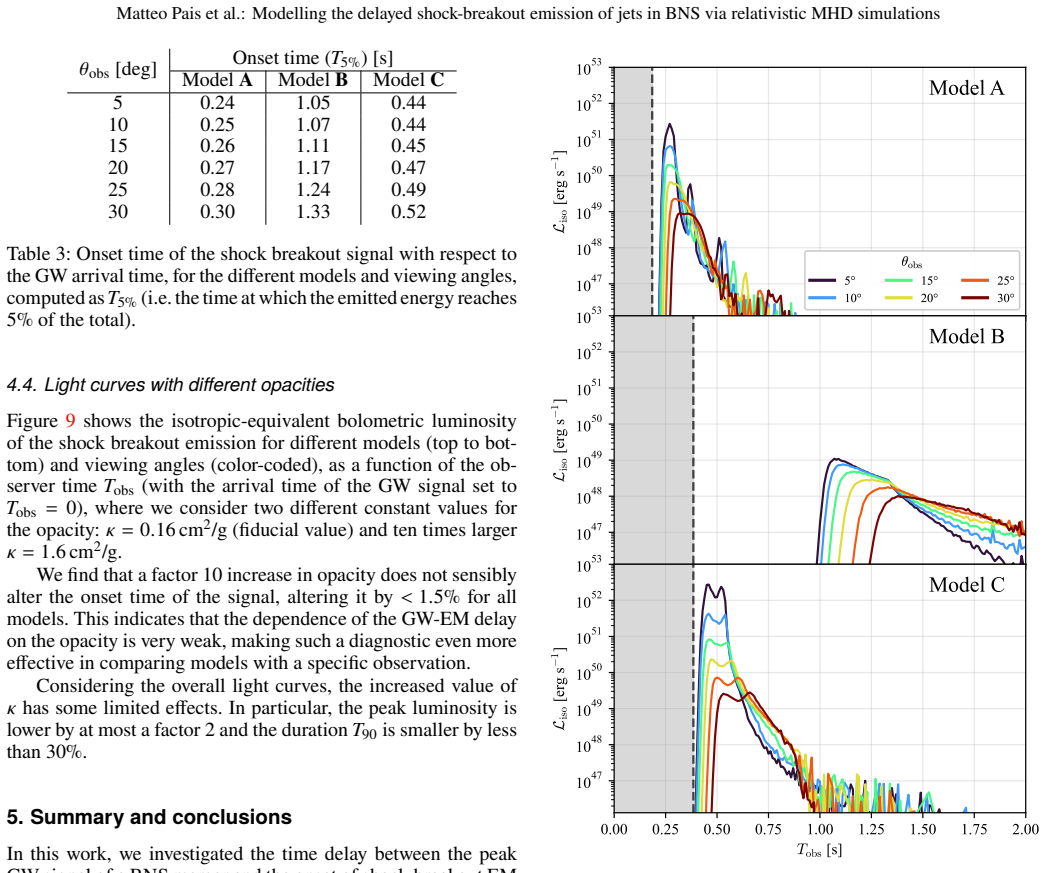
Simulations with varied jet launch times and luminosities produce three regimes from early breakout to extended choking. The forward shock is tracked to the photosphere and the breakout luminosity is computed under full thermal-to-radiation conversion. The substantially choked jet supplies the most plausible peak bolometric luminosity and the closest match to the observed gravitational-wave to electromagnetic delay and signal duration of GRB 170817A.
What carries the argument
Relativistic MHD simulations of jet propagation in imported post-merger ejecta, with early dynamical ejecta reconstruction, used to follow the jet-driven forward shock to the photosphere and compute viewing-angle-dependent bolometric luminosity.
If this is right
- The gravitational-wave to electromagnetic delay remains a robust diagnostic of jet-launch conditions because it varies little with viewing angle or ejecta opacity.
- Substantially choked jets are favored over early-breakout models for reproducing the properties of GRB 170817A.
- Early-breakout models yield higher luminosities inconsistent with the observed event.
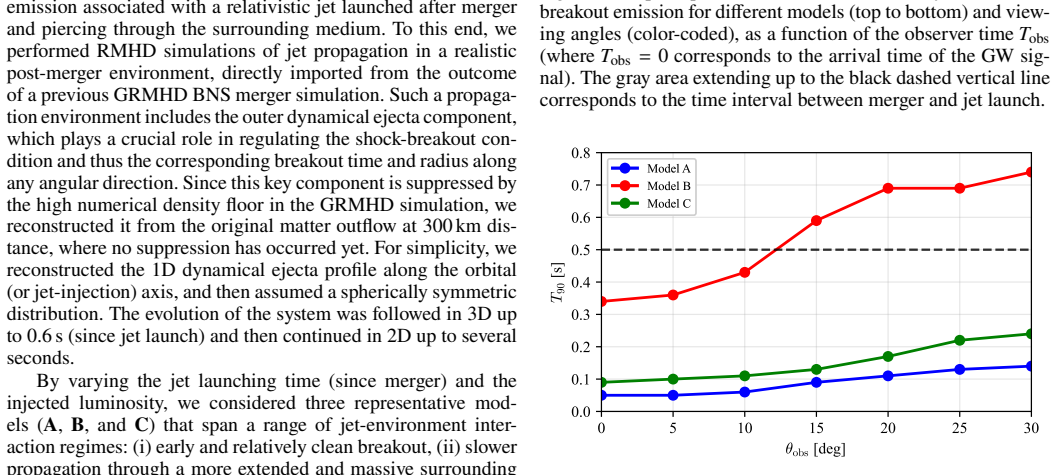
- Signal duration also favors the choked-jet regime over less choked cases.
Where Pith is reading between the lines
- If choked jets are typical, many binary neutron star mergers may fail to produce bright gamma-ray bursts, reducing expected multi-messenger detection rates.
- The weak dependence on opacity suggests the delay diagnostic could remain useful even when ejecta composition is uncertain.
- Future detections could use the same simulation pipeline to map observed delays back to jet luminosity distributions.
Load-bearing premise
Full conversion of thermal energy in the shocked material into radiation, together with the imported post-merger ejecta structure and the reconstruction of early dynamical ejecta.
What would settle it
An observed binary neutron star merger whose gravitational-wave to electromagnetic delay or shock-breakout luminosity deviates markedly from the choked-jet predictions, such as a significantly brighter or earlier signal.
Figures



read the original abstract
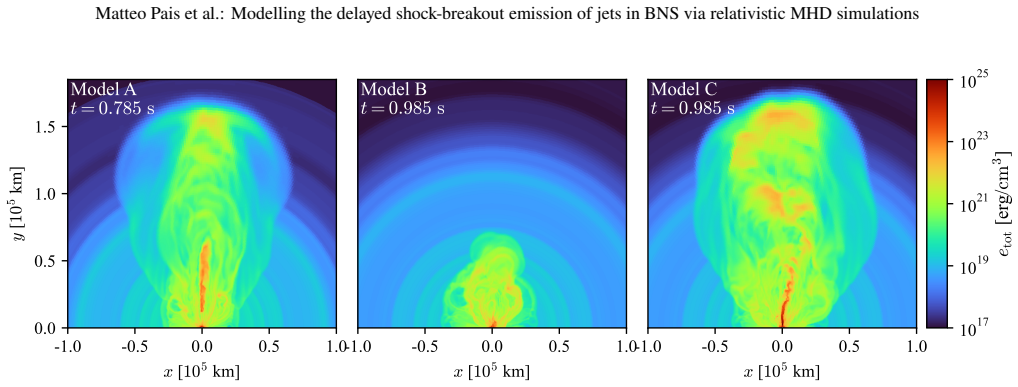
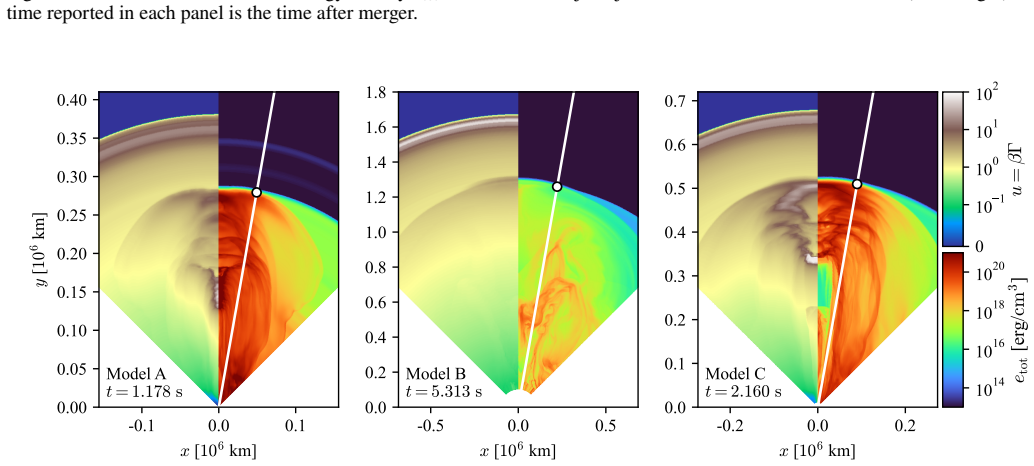
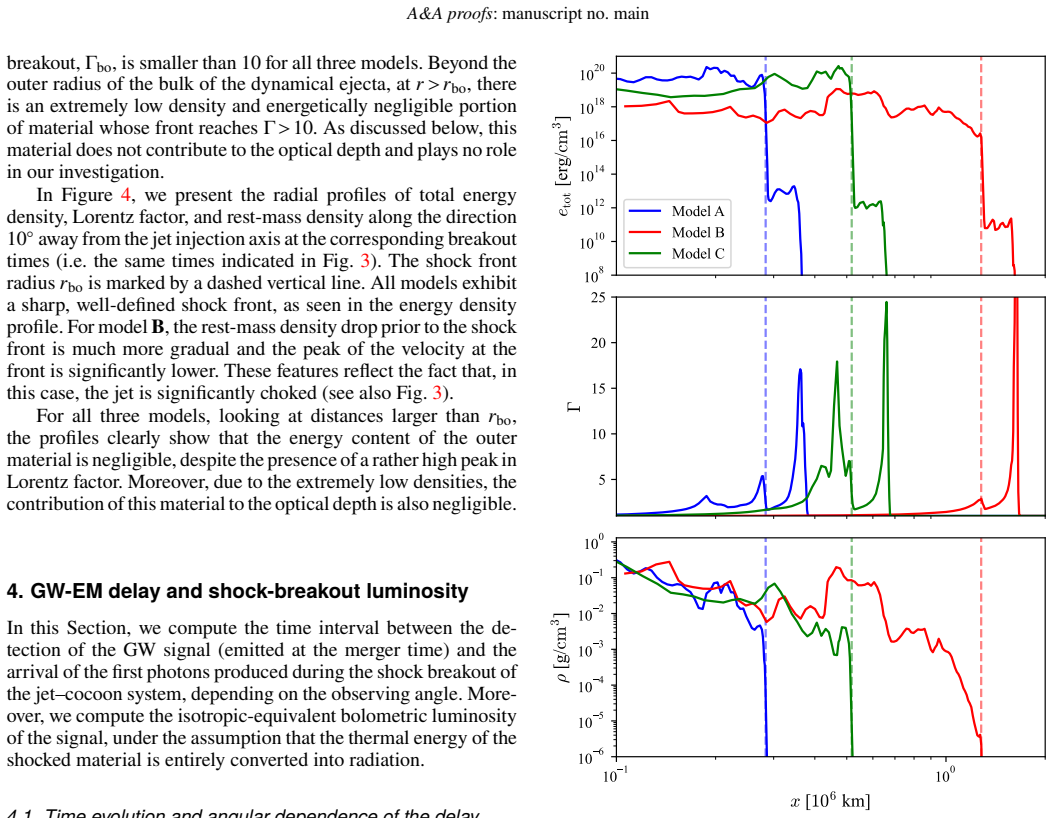
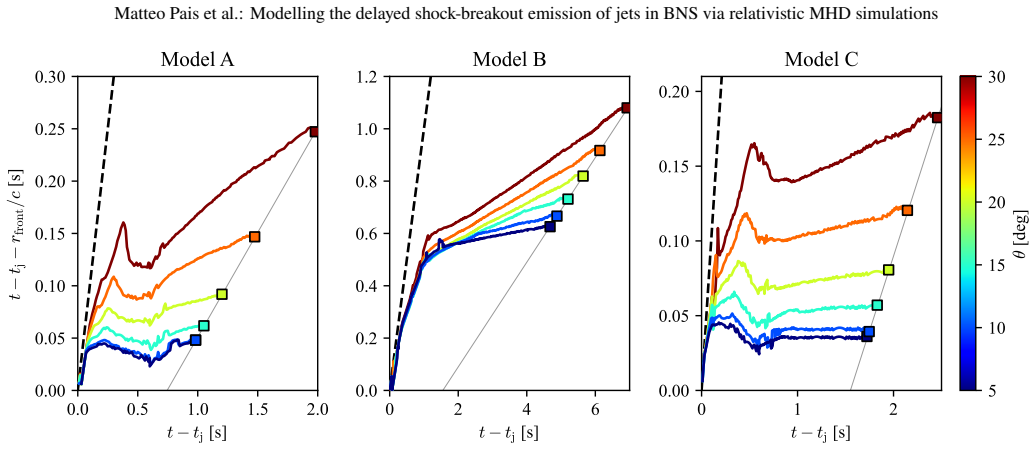
In binary neutron star (BNS) mergers launching a relativistic jet, an electromagnetic (EM) signal is produced when the jet-driven shock breaks out of the merger ejecta. The observed time delay of this shock-breakout (SBO) emission with respect to the gravitational-wave (GW) signal from the merger provides a powerful probe of the physical conditions governing jet launching and early-time jet propagation. Considering different models of jet propagation in realistic post-merger environments, we investigate the SBO emission and corresponding GW-EM delay that would be observed depending on the viewing angle and the assumed ejecta opacity. We perform relativistic MHD simulations of jets propagating through a post-merger environment directly imported from the outcome of a previous BNS merger simulation. We also introduce a specific procedure to faithfully reconstruct the early dynamical ejecta up to their natural front. The evolution is followed in 3D up to 0.6 s and then continued imposing axisymmetry and higher resolution. Varying jet launching time and luminosity, we identify three representative models spanning regimes from early breakout to extended jet choking. For each case, we track the jet-driven forward shock up to the photosphere and compute the angle-dependent bolometric SBO luminosity, assuming full conversion of the thermal energy within the shocked material into radiation, and taking into account non-radial photon propagation, relativistic Doppler shifts, and light-travel-time effects. We consider two opacity values spanning a factor of 10. We find that the GW-EM delay depends weakly on both viewing angle and ejecta opacity, making it a robust diagnostic for constraining models. Comparing with GRB 170817A, the model resulting in a substantially choked jet provides the most plausible peak bolometric luminosity and the closest match to the observed GW-EM delay and signal duration.
Editorial analysis
A structured set of objections, weighed in public.
Referee Report
Summary. The paper performs relativistic MHD simulations of relativistic jets propagating through post-merger ejecta imported from a prior BNS merger simulation, with a reconstruction procedure for early dynamical ejecta. Three representative models are evolved (spanning early breakout to substantially choked jets) by varying jet launch time and luminosity; angle-dependent bolometric SBO luminosities are computed assuming full thermal-to-radiative conversion, including non-radial propagation, Doppler shifts, and light-travel times. Two opacity values are considered. The GW-EM delay is reported as weakly dependent on viewing angle and opacity, and comparison to GRB 170817A identifies the choked-jet case as providing the closest match to observed peak luminosity, delay, and duration.
Significance. If the central results hold, the work supplies a forward-modeling framework that links jet parameters in realistic post-merger environments to observable SBO signatures, highlighting the GW-EM delay as a relatively robust diagnostic. The direct import of post-merger structure, the 3D-to-axisymmetric evolution, and the explicit treatment of viewing-angle and opacity effects constitute concrete strengths for multi-messenger interpretation.
major comments (2)
- [Abstract and luminosity computation] Abstract (and the luminosity computation procedure): the ranking of models against GRB 170817A rests on bolometric luminosities computed under the explicit assumption of full conversion of thermal energy in the shocked material into radiation. No sensitivity study or justification is provided for this assumption; if the radiated fraction is appreciably below unity, the choked-jet luminosities decrease and the identification of the best-matching model can change.
- [Simulation methodology and results] Simulation methodology and results sections: no quantitative convergence tests, resolution studies, or error budgets are reported on the extracted luminosities, delays, or durations. The switch from 3D to imposed axisymmetry at 0.6 s and the imported ejecta structure make such tests load-bearing for the quantitative observational comparisons.
minor comments (2)
- [Methods] The description of the early dynamical ejecta reconstruction procedure would benefit from an additional figure showing the density and velocity profiles at the hand-off time.
- [Results] Notation for the two opacity values and the precise definition of 'substantially choked' should be stated explicitly in the text rather than only in figure captions.
Simulated Author's Rebuttal
We thank the referee for their constructive and detailed report. We address the two major comments point by point below, indicating the revisions we will incorporate.
read point-by-point responses
-
Referee: [Abstract and luminosity computation] Abstract (and the luminosity computation procedure): the ranking of models against GRB 170817A rests on bolometric luminosities computed under the explicit assumption of full conversion of thermal energy in the shocked material into radiation. No sensitivity study or justification is provided for this assumption; if the radiated fraction is appreciably below unity, the choked-jet luminosities decrease and the identification of the best-matching model can change.
Authors: We agree that the full-conversion assumption is a simplification whose impact on model ranking merits explicit discussion. In the revised manuscript we will add a justification in Section 3.3 based on the high optical depth of the post-shock layer (where radiation pressure dominates and photons remain trapped until breakout) and will include a sensitivity study in which the computed luminosities are scaled by conversion efficiencies of 0.1, 0.5 and 1.0. We will show that while absolute luminosities shift, the relative ordering of the three jet models and the weak dependence of the GW-EM delay on viewing angle remain unchanged; the choked-jet case continues to provide the closest match to the observed delay and duration of GRB 170817A. These additions will be placed in the methods and results sections. revision: yes
-
Referee: [Simulation methodology and results] Simulation methodology and results sections: no quantitative convergence tests, resolution studies, or error budgets are reported on the extracted luminosities, delays, or durations. The switch from 3D to imposed axisymmetry at 0.6 s and the imported ejecta structure make such tests load-bearing for the quantitative observational comparisons.
Authors: We acknowledge that quantitative convergence information strengthens the reliability of the reported luminosities, delays and durations. In the revised version we will add a dedicated subsection (new Section 2.4) presenting resolution studies for at least one representative model, comparing shock position, energy distribution and extracted SBO quantities at the fiducial and doubled grid resolutions. We will also report an estimated numerical uncertainty (typically <20 % on luminosities and <10 % on delays) derived from these tests. For the 3D-to-axisymmetric transition we will include a short analysis demonstrating that, by t = 0.6 s, non-axisymmetric velocities have decayed below 5 % of the radial component, justifying the switch; any residual uncertainty will be folded into the error budget. These elements will be added without altering the central conclusions. revision: yes
Circularity Check
No significant circularity; forward modeling compared to external observation
full rationale
The paper runs relativistic MHD simulations of jets in imported post-merger ejecta, reconstructs early dynamical ejecta, follows the forward shock to the photosphere, and computes angle-dependent bolometric luminosities under the explicit assumption of full thermal-to-radiative conversion (plus Doppler and light-travel effects). These outputs are then compared to the independent external benchmark of GRB 170817A. No equation, fit, or self-citation reduces the reported delays or luminosities to quantities derived from the GRB data itself; the chain remains self-contained against external data.
Axiom & Free-Parameter Ledger
free parameters (3)
- jet launching time
- jet luminosity
- ejecta opacity
axioms (1)
- domain assumption full conversion of thermal energy in shocked material into radiation
Reference graph
Works this paper leans on
-
[1]
P., et al., 2017a, @doi [Physical Review Letters] 10.1103/PhysRevLett.119.161101 , 119, 161101
GW170817: Observation of Gravitational Waves from a Binary Neutron Star Inspiral. Physical Review Letters , archivePrefix = "arXiv", eprint =. doi:10.1103/PhysRevLett.119.161101 , adsurl =
-
[2]
, archivePrefix = "arXiv", eprint =
Multi-messenger Observations of a Binary Neutron Star Merger. , archivePrefix = "arXiv", eprint =. doi:10.3847/2041-8213/aa91c9 , adsurl =
-
[3]
, archivePrefix = "arXiv", eprint =
Gravitational Waves and Gamma-Rays from a Binary Neutron Star Merger: GW170817 and GRB 170817A. , archivePrefix = "arXiv", eprint =. doi:10.3847/2041-8213/aa920c , adsurl =
-
[4]
Living Reviews in Relativity , keywords =
Kilonovae. Living Reviews in Relativity , keywords =. doi:10.1007/s41114-019-0024-0 , archivePrefix =. 1910.01617 , primaryClass =
-
[5]
Compact radio emission indicates a structured jet was produced by a binary neutron star merger
Compact radio emission indicates a structured jet was produced by a binary neutron star merger. Science , keywords =. 2019. doi:10.1126/science.aau8815 , archivePrefix =. 1808.00469 , primaryClass =
work page internal anchor Pith review Pith/arXiv arXiv doi:10.1126/science.aau8815 2019
-
[6]
P., et al., 2018, @doi [Nature] 10.1038/s41586-018-0486-3 , 561, 355
Superluminal motion of a relativistic jet in the neutron-star merger. Nature , author =. 2018 , note =. doi:10.1038/s41586-018-0486-3 , language =
-
[7]
Kasliwal, M. M. and Nakar, E. and Singer, L. P. and Kaplan, D. L. and Cook, D. O. and Van Sistine, A. and Lau, R. M. and Fremling, C. and Gottlieb, O. and Jencson, J. E. and Adams, S. M. and Feindt, U. and Hotokezaka, K. and Ghosh, S. and Perley, D. A. and Yu, P.-C. and Piran, T. and Allison, J. R. and Anupama, G. C. and Balasubramanian, A. and Bannister,...
-
[8]
Monthly Notices of the Royal Astronomical Society , author =
A cocoon shock breakout as the origin of the γ -ray emission in. Monthly Notices of the Royal Astronomical Society , author =. 2018 , note =. doi:10.1093/mnras/sty1462 , abstract =
-
[9]
The electromagnetic counterparts of compact binary mergers , volume =. Physics Reports , author =. 2020 , keywords =. doi:10.1016/j.physrep.2020.08.008 , abstract =
-
[10]
The Astrophysical Journal , author =
The appearance of highly relativistic, spherically symmetric stellar winds , volume =. The Astrophysical Journal , author =. 1991 , pages =. doi:10.1086/169748 , abstract =
-
[11]
Living Reviews in Computational Astrophysics , author =
Neutrino transport in general relativistic neutron star merger simulations , volume =. Living Reviews in Computational Astrophysics , author =. 2023 , keywords =. doi:10.1007/s41115-023-00016-y , abstract =
-
[12]
Monthly Notices of the Royal Astronomical Society , author =
Role of injection parameters in jet propagation through realistic binary neutron star merger environments , volume =. Monthly Notices of the Royal Astronomical Society , author =. 2025 , pages =. doi:10.1093/mnras/staf795 , abstract =
-
[13]
The Astrophysical Journal , author =. 2013 , pages =. doi:10.1088/0004-637X/773/1/78 , abstract =
-
[14]
Physical Review D , author =
Mass ejection from the merger of binary neutron stars , language =. Physical Review D , author =. 2013 , pages =
2013
-
[15]
Radice, David and Perego, Albino and Hotokezaka, Kenta and Bernuzzi, Sebastiano and Fromm, Steven A. and Roberts, Luke F. , month = dec, year =. Viscous-dynamical. The Astrophysical Journal Letters , publisher =. doi:10.3847/2041-8213/aaf053 , abstract =
-
[16]
Cocoon shock breakout emission from binary neutron star mergers. , keywords =. doi:10.1103/PhysRevD.111.063031 , archivePrefix =. 2408.15973 , primaryClass =
-
[17]
Jet─Environment Interaction after Delayed Collapse in Binary Neutron Star Mergers. , keywords =. doi:10.3847/2041-8213/ae402a , archivePrefix =. 2505.09426 , primaryClass =
-
[18]
Monthly Notices of the Royal Astronomical Society: Letters , author =
Collimated outflows from long-lived binary neutron star merger remnants , volume =. Monthly Notices of the Royal Astronomical Society: Letters , author =. 2020 , pages =. doi:10.1093/mnrasl/slaa062 , abstract =
-
[19]
Mignone, A. and Bodo, G. and Massaglia, S. and Matsakos, T. and Tesileanu, O. and Zanni, C. and Ferrari, A. , month = may, year =. The Astrophysical Journal Supplement Series , publisher =. doi:10.1086/513316 , language =
-
[20]
Monthly Notices of the Royal Astronomical Society , author =
Short gamma-ray burst jet propagation in binary neutron star merger environments , volume =. Monthly Notices of the Royal Astronomical Society , author =. 2021 , pages =. doi:10.1093/mnras/stab1810 , abstract =
-
[21]
Monthly Notices of the Royal Astronomical Society , author =
Jet-environment interplay in magnetized binary neutron star mergers , volume =. Monthly Notices of the Royal Astronomical Society , author =. 2023 , pages =. doi:10.1093/mnras/stad1809 , abstract =
-
[22]
Mignone, A. and Zanni, C. and Tzeferacos, P. and van Straalen, B. and Colella, P. and Bodo, G. , month = dec, year =. The Astrophysical Journal Supplement Series , publisher =. doi:10.1088/0067-0049/198/1/7 , abstract =
-
[23]
arXiv , author =
Non-uniqueness of cosmic ray two-fluid equations at shocks and possible remedies , volume =. arXiv , author =. 2019 , note =
2019
-
[24]
Gupta, Siddhartha and Sharma, Prateek and Mignone, Andrea , year =. A numerical approach to the non-uniqueness problem of cosmic ray two-fluid equations at shocks , volume =. Monthly Notices of the Royal Astronomical Society , publisher =. doi:10.1093/mnras/stab142 , abstract =
-
[25]
and Anderson, Jay and Lu, Wenbin , month = oct, year =
Mooley, Kunal P. and Anderson, Jay and Lu, Wenbin , month = oct, year =. Optical superluminal motion measurement in the neutron-star merger. Nature , publisher =. doi:10.1038/s41586-022-05145-7 , abstract =
-
[26]
Equation of state in relativistic magnetohydrodynamics: variable versus constant adiabatic index , volume =. Monthly Notices of the Royal Astronomical Society , author =. 2007 , pages =. doi:10.1111/j.1365-2966.2007.11849.x , abstract =
-
[27]
and Lightman, Alan P
Rybicki, George B. and Lightman, Alan P. , month = jan, year =. Radiative processes in astrophysics , url =
-
[28]
Monthly Notices of the Royal Astronomical Society , author =
The structure of steady, relativistic, magnetized jets with rotation , volume =. Monthly Notices of the Royal Astronomical Society , author =. 2015 , pages =. doi:10.1093/mnras/stv1524 , abstract =
-
[29]
The Astrophysical Journal , author =
Propagation of a. The Astrophysical Journal , author =. 2019 , pages =. doi:10.3847/2041-8213/ab224b , abstract =
-
[30]
Journal of Computational Physics , author =. 2006 , keywords =. doi:10.1016/j.jcp.2005.12.012 , abstract =
-
[31]
Journal of Computational Physics , author =
High-order conservative reconstruction schemes for finite volume methods in cylindrical and spherical coordinates , volume =. Journal of Computational Physics , author =. 2014 , keywords =. doi:10.1016/j.jcp.2014.04.001 , abstract =
-
[32]
Monthly Notices of the Royal Astronomical Society , author =
A comparison of approximate non-linear. Monthly Notices of the Royal Astronomical Society , author =. 2021 , pages =. doi:10.1093/mnras/stab3373 , abstract =
-
[33]
Journal of Computational Physics , author =
Hyperbolic. Journal of Computational Physics , author =. 2002 , pages =. doi:10.1006/jcph.2001.6961 , language =
-
[34]
doi:10.1086/192237 , abstract =
Astrophysical Journal Supplement , author =. doi:10.1086/192237 , abstract =
-
[35]
Monthly Notices of the Royal Astronomical Society , author =
Jet propagation in expanding medium for gamma-ray bursts , volume =. Monthly Notices of the Royal Astronomical Society , author =. 2021 , pages =. doi:10.1093/mnras/staa3276 , abstract =
-
[36]
Goldstein, A. and Veres, P. and Burns, E. and Briggs, M. S. and Hamburg, R. and Kocevski, D. and Wilson-Hodge, C. A. and Preece, R. D. and Poolakkil, S. and Roberts, O. J. and Hui, C. M. and Connaughton, V. and Racusin, J. and Kienlin, A. von and Canton, T. Dal and Christensen, N. and Littenberg, T. and Siellez, K. and Blackburn, L. and Broida, J. and Bis...
-
[37]
Zhang, B.-B. and Zhang, B. and Sun, H. and Lei, W.-H. and Gao, H. and Li, Y. and Shao, L. and Zhao, Y. and Hu, Y.-D. and Lü, H.-J. and Wu, X.-F. and Fan, X.-L. and Wang, G. and Castro-Tirado, A. J. and Zhang, S. and Yu, B.-Y. and Cao, Y.-Y. and Liang, E.-W. , month = jan, year =. A peculiar low-luminosity short gamma-ray burst from a double neutron star m...
-
[38]
Kumar, Pawan , month = aug, year =. Gamma-. The Astrophysical Journal , publisher =. doi:10.1086/312265 , abstract =
-
[39]
Astronomy and Astrophysics , author =
Thick. Astronomy and Astrophysics , author =. 1980 , note =
1980
discussion (0)
Sign in with ORCID, Apple, or X to comment. Anyone can read and Pith papers without signing in.