Convergence of the PML method for scattering problems in poroelastic media
Pith reviewed 2026-06-30 04:56 UTC · model grok-4.3
The pith
Under assumptions on poroelastic and PML parameters, the PML truncation of three-dimensional time-harmonic poroelastic scattering problems admits unique solutions and converges exponentially with layer thickness.
A machine-rendered reading of the paper's core claim, the machinery that carries it, and where it could break.
Core claim
The paper proves existence and uniqueness of solutions to the PML problems both in the truncated domain and layer. Moreover, the exponential convergence of the PML method is established in terms of the thickness and parameters of the PML layer. The proof is based on the PML extension and the exponential decay properties of the stretched fundamental solution after the u-p transformation of the original system.
What carries the argument
The u-p transformation of the poroelastic system together with the spherical-coordinate PML extension, whose error is controlled by the exponential decay of the stretched fundamental solution.
If this is right
- The truncated PML problem can be solved by standard finite-element or finite-difference codes without introducing spurious reflections at the artificial boundary.
- The error committed by replacing the unbounded exterior by a finite PML layer is bounded by a quantity that decreases exponentially in the layer thickness.
- Existence and uniqueness hold simultaneously for the interior truncated problem and for the auxiliary problem posed inside the PML layer itself.
- The same truncation technique supplies a convergent numerical method for any scattering configuration whose radiating solution is represented by the derived fundamental solution.
Where Pith is reading between the lines
- The same u-p reduction and stretched-fundamental-solution argument could be tested on scattering problems in other Biot-type media once an analogous transformation yielding positive complex wave numbers is available.
- Error estimates derived here give explicit a-priori guidance for choosing layer thickness in existing poroelastic PML codes, something that was previously chosen by trial and error.
- If the positivity of the complex wave numbers can be verified for frequency-dependent poroelastic coefficients, the convergence result would immediately extend to dispersive media.
Load-bearing premise
The stretched fundamental solution decays exponentially inside the PML layer and the complex wave numbers remain positive once the u-p transformation is applied, and these properties continue to hold under the paper's chosen ranges for the poroelastic coefficients and PML parameters.
What would settle it
A direct numerical check that the difference between the PML solution on a sequence of thicker layers and a reference solution computed on a much larger domain fails to decrease exponentially with layer thickness while the poroelastic and PML parameters are held inside the assumed ranges.
Figures
read the original abstract
This paper is concerned with the time-harmonic wave scattering problems in three dimensional poroelastic media. By introducing an intermediate variable $p$, the original $\mathbf{u}-\mathbf{w}$ system is equivalently transformed into a $\mathbf{u}-p$ system with fewer degrees of freedom, which facilitates the derivation of the fundamental solution, Green's identity and positivity of the complex wave numbers. A perfectly matched layer (PML) method is then introduced in the spherical coordinates to truncate the unbounded scattering problem. Under certain assumptions on the poroelastic and PML parameters, we prove the existence and uniqueness of solutions to the PML problems both in the truncated domain and layer. Moreover, the exponential convergence of the PML method is established in terms of the thickness and parameters of the PML layer. The proof is based on the PML extension and the exponential decay properties of the stretched fundamental solution. As far as we know, this is the first convergence result of the PML method for poroelastic scattering problems.
Editorial analysis
A structured set of objections, weighed in public.
Referee Report
Summary. The manuscript addresses time-harmonic scattering in three-dimensional poroelastic media. It transforms the original u-w system into an equivalent u-p system via an intermediate pressure variable p, derives the associated fundamental solution and Green's identity, and establishes positivity of the complex wave numbers. A PML truncation is introduced in spherical coordinates. Under stated assumptions on the poroelastic and PML parameters, the authors prove existence and uniqueness for the PML problems in the truncated domain and the layer, and establish exponential convergence of the method with respect to PML thickness and parameters. The argument relies on the PML extension together with exponential decay of the stretched fundamental solution.
Significance. If the proofs hold under the stated parameter restrictions, this supplies the first rigorous convergence result for PML truncation of poroelastic scattering problems. The u-p reduction and the explicit control via the stretched fundamental solution are technically useful steps that could support reliable numerical implementations in applications such as seismic modeling.
major comments (2)
- [§3] §3 (PML extension and decay estimates): the exponential decay of the stretched fundamental solution is invoked to bound the layer error, but the precise dependence on the complex stretching function and the positivity of the wave numbers after the u-p transformation is not quantified with explicit constants; without these constants it is unclear whether the convergence rate remains uniform for all admissible poroelastic parameters.
- [Theorem 4.2] Theorem 4.2 (existence/uniqueness in the truncated domain): the proof uses a Fredholm alternative on the PML-truncated variational formulation, yet the coercivity constant is asserted to be positive only under the paper's parameter assumptions; an explicit lower bound in terms of the PML absorption coefficient and the frequency would strengthen the claim that the assumptions are not overly restrictive.
minor comments (3)
- [§2.2] The notation for the complex wave numbers k_p and k_s after the u-p transformation should be introduced with a dedicated display equation in §2.2 rather than inline.
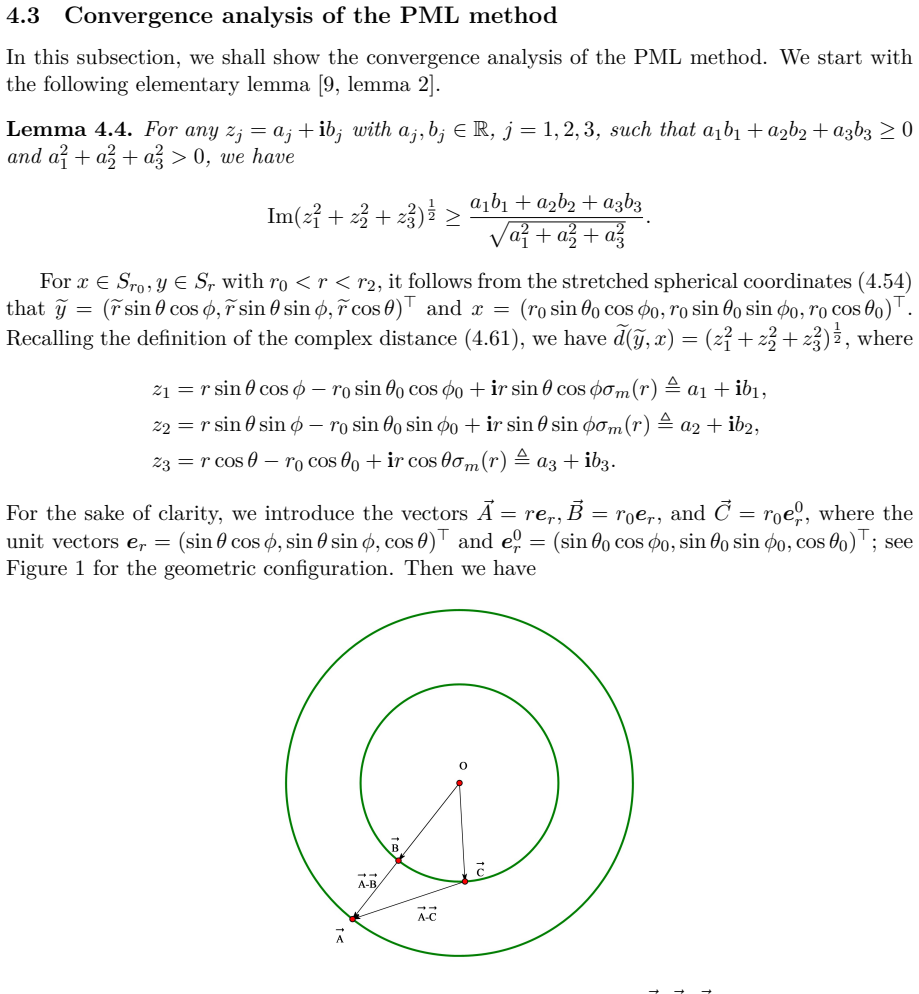
- [Figure 1] Figure 1 (schematic of the PML layer) lacks labels for the spherical radii R and R+δ; adding these would clarify the geometric setting used in the convergence statement.
- [Introduction] The abstract states that the result is the first convergence proof for poroelastic PML; a brief comparison paragraph in the introduction with existing PML analyses for elastic or acoustic media would help readers assess novelty.
Simulated Author's Rebuttal
We thank the referee for the careful reading and constructive comments. The suggestions will help clarify the uniformity of the convergence estimates. We address each point below.
read point-by-point responses
-
Referee: [§3] §3 (PML extension and decay estimates): the exponential decay of the stretched fundamental solution is invoked to bound the layer error, but the precise dependence on the complex stretching function and the positivity of the wave numbers after the u-p transformation is not quantified with explicit constants; without these constants it is unclear whether the convergence rate remains uniform for all admissible poroelastic parameters.
Authors: We agree that explicit constants would make the uniformity clearer. In the revised manuscript we will add explicit expressions for the decay rate of the stretched fundamental solution, showing its dependence on the stretching function and the positivity of the complex wave numbers, and verify uniformity under the stated parameter assumptions. revision: yes
-
Referee: [Theorem 4.2] Theorem 4.2 (existence/uniqueness in the truncated domain): the proof uses a Fredholm alternative on the PML-truncated variational formulation, yet the coercivity constant is asserted to be positive only under the paper's parameter assumptions; an explicit lower bound in terms of the PML absorption coefficient and the frequency would strengthen the claim that the assumptions are not overly restrictive.
Authors: We will strengthen the proof of Theorem 4.2 by deriving an explicit lower bound for the coercivity constant expressed in terms of the PML absorption coefficient and frequency, confirming that the assumptions remain reasonable for the applications of interest. revision: yes
Circularity Check
No significant circularity; derivation is self-contained
full rationale
The paper establishes existence/uniqueness and exponential convergence for the PML-truncated u-p system via direct analysis: the u-w to u-p transformation yields the fundamental solution and complex wave number positivity, after which PML extension in spherical coordinates plus decay of the stretched fundamental solution (under the stated parameter assumptions) controls the layer error. No equation reduces to a fitted input renamed as prediction, no self-definition of quantities, and no load-bearing step collapses to an unverified self-citation chain. The architecture is the standard one for PML convergence proofs and remains independent of the paper's own fitted values or prior results by the same authors.
Axiom & Free-Parameter Ledger
Reference graph
Works this paper leans on
-
[1]
Bao and H
G. Bao and H. Wu, Convergence analysis of the perfectly matched layer problems for time- harmonic Maxwell’s equations, SIAM J. Numer. Anal. 43 (2005), 2121-2143
2005
-
[2]
Bérenger, A perfectly matched layer for the absorption of electromagnetic waves, J
J.P. Bérenger, A perfectly matched layer for the absorption of electromagnetic waves, J. Comput. Phys. 114 (1994), 185-200
1994
-
[3]
Biot, Theory of propagation of elastic waves in a fluid-saturated porous solid
M.A. Biot, Theory of propagation of elastic waves in a fluid-saturated porous solid. I. low-frequency range, J. Acoust. Soc. Am. 28 (1956), 168-178
1956
-
[4]
Biot, Theory of propagation of elastic waves in a fluid-saturated porous solid
M.A. Biot, Theory of propagation of elastic waves in a fluid-saturated porous solid. II. higher frequency range, J. Acoust. Soc. Am. 28 (1956), 179-191. 32
1956
-
[5]
Bramble and J.E
J.H. Bramble and J.E. Pasciak, Analysis of a finite PML approximation for the three dimensional time-harmonic Maxwell and acoustic scattering problems, Math. Comp. 76 (2007), 597-614
2007
-
[6]
Bramble and J.E
J.H. Bramble and J.E. Pasciak, Analysis of a Cartesian PML approximation to acoustic scattering problems in R2 and R3, J. Comput. Appl. Math. 247 (2013), 209-230
2013
-
[7]
Bramble, J.E
J.H. Bramble, J.E. Pasciak, A note on the existence and uniqueness of solutions of frequency domain elastic wave problems: A priori estimates in H 1, J. Math. Anal. Appl. 345 (2008), 396-404
2008
-
[8]
Bramble, J.E
J.H. Bramble, J.E. Pasciak and D. Trenev, Analysis of a finite PML approximation to the three dimensional elastic wave scattering problem, Math. Comp. 79 (2010), 2079-2101
2010
-
[9]
Z. Chen, T. Cui and L. Zhang, An adaptive anisotropic perfectly matched layer method for 3-D time harmonic electromagnetic scattering problems, Numer. Math. 125 (2013), 639-677
2013
-
[10]
Chen and X
Z. Chen and X. Liu, An adaptive perfectly matched layer technique for time-harmonic scattering problems, SIAM J. Numer. Anal. 43 (2005), 645-671
2005
-
[11]
Z. Chen, X. Xiang and X. Zhang, Convergence of the PML method for elastic wave scat- tering problems, Math. Comp. 85 (2016), 2687-2714
2016
-
[12]
Teixeira and W
F. Teixeira and W. Chew, Systematic derivation of anisotropic PML absorbing media in cylindrical and spherical coordinates, IEEE Microw. Guided Wave Lett. 7 (1997), 371–373
1997
-
[13]
de Boer, Theory of porous media: highlights in historical development and current state , Springer Science & Business Media, 2012
R. de Boer, Theory of porous media: highlights in historical development and current state , Springer Science & Business Media, 2012
2012
-
[14]
Lassas and E
M. Lassas and E. Somersalo, On the existence and convergence of the solution of PML equations, Computing 60 (1998), 229-241
1998
-
[15]
Han and X
H. Han and X. Wu, Artificial Boundary Method, Springer , Berlin, 2013
2013
-
[16]
Jiang, and P
X. Jiang, and P. Li, An adaptive finite element PML method for the acoustic-elastic inter- action in three dimensions, Commun. Comput. Phys. 22 (2017), 1486-1507
2017
-
[17]
Jiang, P
X. Jiang, P. Li, J. Lv, and W. Zheng, An adaptive finite element PML method for the elastic wave scattering problem in periodic structures, ESAIM: Math. Model. Numer. Anal. 51 (2017), 2017-2047
2017
-
[18]
Jiang, P
X. Jiang, P. Li, J. Lv, and W. Zheng, Convergence of the PML solution for elastic wave scattering by biperiodic structures, Commun. Math. Sci. 16 (2018), 987-1016
2018
-
[19]
Kupradze, T.G
V.D. Kupradze, T.G. Gegelia, M.O. Basheleishvili and T.V. Burchuladze, Three- dimensional Problems of the Mathematical Theory of Elasticity and Thermoelasticity , North-Holland, Amsterdam, 1979
1979
-
[20]
McLean, Strongly Elliptic Systems and Boundary Integral Equations , Cambridge Uni- versity Press, Cambridge, 2000
W. McLean, Strongly Elliptic Systems and Boundary Integral Equations , Cambridge Uni- versity Press, Cambridge, 2000. 33
2000
-
[21]
Philippacopoulos, Spectral Green’s dyadic for point sources in poroelastic media, J
A.J. Philippacopoulos, Spectral Green’s dyadic for point sources in poroelastic media, J. Eng. Mech. 124 (1998): 24-31
1998
-
[22]
Schanz, Poroelastodynamics: linear models, analytical solutions, and numerical meth- ods, Appl
M. Schanz, Poroelastodynamics: linear models, analytical solutions, and numerical meth- ods, Appl. Mech. Rev. 62 (2009), 030803 (15 pages)
2009
-
[23]
Schanz, and S
M. Schanz, and S. Diebels, A comparative study of biot’s theory and the linear theory of porous media for wave propagation problems, Acta Mech. 161 (2003), 213-235
2003
-
[24]
C. Wei, J. Yang and B. Zhang, Convergence analysis of the PML method for time-domain electromagnetic scattering problems, SIAM J. Numer. Anal. 58 (2020), 1918-1940
2020
-
[25]
C. Wei, J. Yang and B. Zhang, Convergence of the uniaxial PML method for time-domain electromagnetic scattering problems, ESAIM: Math. Model. Numer. Anal. 55 (2021), 2421- 2443
2021
- [26]
-
[27]
Yamamoto, and M
K. Yamamoto, and M. Kitahara, A numerical method for wave scattering in poroelastic media, Structural Engineering/Earthquake Engineering 21 (2004), 143-157
2004
-
[28]
Zhang, L
L. Zhang, L. Xu, and T. Yin, An accurate hypersingular boundary integral equation method for dynamic poroelasticity in two dimensions, SIAM J. Sci. Comput. 43 (2021), B784-B810
2021
-
[29]
Zhang, L
L. Zhang, L. Xu and T. Yin, Regularized hyper-singular boundary integral equation meth- ods for three-dimensional poroelastic problems, J. Comput. Phys. 468 (2022), 111492
2022
-
[30]
Zhang, Stability analysis for wave simulation in 3D poroelastic media with the staggered- grid method, Commun Comput Phys
W. Zhang, Stability analysis for wave simulation in 3D poroelastic media with the staggered- grid method, Commun Comput Phys. 28 (2025), 743-767
2025
-
[31]
T. Zhu, C. Wei, and J. Yang, The time‐harmonic electromagnetic wave scattering by a biperiodic elastic body, Math. Meth. Appl. Sci. 47 (2024), 6354-6381. 34
2024
discussion (0)
Sign in with ORCID, Apple, or X to comment. Anyone can read and Pith papers without signing in.