From Search to Synthesis: Training LLMs as Zero-Shot Workflow Generators
Pith reviewed 2026-07-01 07:07 UTC · model grok-4.3
The pith
MetaFlow trains LLMs to generate reusable task-level workflows that generalize zero-shot to new tasks and operator sets.
A machine-rendered reading of the paper's core claim, the machinery that carries it, and where it could break.
Core claim
MetaFlow casts workflow generation as a meta-learning problem: given a task and an operator set, the model learns to compose solution strategies. It trains in two stages—supervised fine-tuning on synthetic workflow data, followed by reinforcement learning with verifiable rewards (RLVR) that uses execution feedback across problem instances in the task to improve end-to-end success. The resulting model produces effective workflows for trained tasks and exhibits strong generalization to untrained tasks and novel operator sets. Across benchmarks in question answering, code generation, and mathematical reasoning, MetaFlow achieves performance comparable to state-of-the-art baselines on in-domain
What carries the argument
MetaFlow, the two-stage procedure of supervised fine-tuning on synthetic workflows followed by reinforcement learning with verifiable rewards from execution feedback across task instances, which treats workflow generation as meta-learning to compose reusable strategies.
If this is right
- Workflows supply robustness across instance variations within a task because they encode recurring patterns rather than per-example fixes.
- Single-inference generation produces performance on trained tasks that matches state-of-the-art baselines in question answering, code generation, and mathematical reasoning.
- The same trained model transfers to entirely new tasks and previously unseen operator sets without additional fine-tuning.
- Explicit workflow traces improve interpretability and debugging compared with opaque instance-by-instance outputs.
- Automatic workflow synthesis removes the need for manual expert design of reusable strategies.
Where Pith is reading between the lines
- The separation of task strategy from instance execution could be tested by measuring how often the generated workflow reuses the same high-level structure on problems that differ in surface details.
- If execution feedback during RLVR is the main driver of generalization, replacing it with other verifiable signals such as partial credit or intermediate checks should produce similar transfer.
- The method opens the possibility of maintaining a library of learned workflows that can be composed or adapted when new operators become available.
- Because the model learns from execution outcomes across instances, it may discover strategies that remain stable even when the underlying operators are swapped for functionally equivalent ones.
Load-bearing premise
That training on synthetic workflow data and then reinforcing workflows by their success rate across many instances of the same task will cause the model to learn general task-level patterns instead of memorizing solutions to individual examples.
What would settle it
Measuring whether workflows generated for tasks and operator sets held out from training achieve success rates close to those on the original training distribution, or whether performance collapses to levels no better than prompting an untuned model to solve each instance separately.
Figures

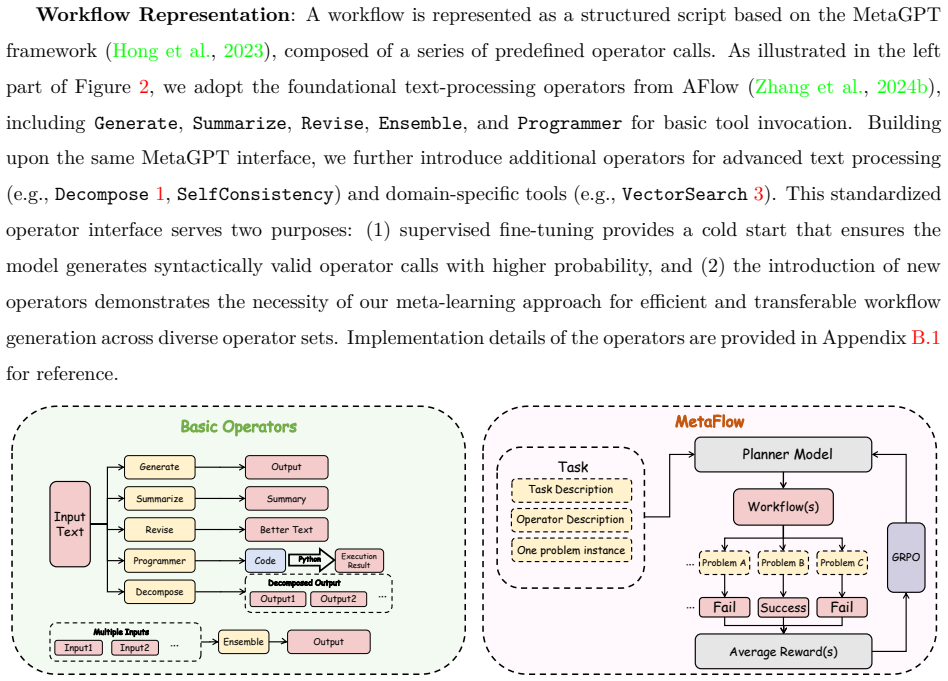


read the original abstract
Large language models (LLMs) excel across a wide range of tasks, yet their instance-specific solutions often lack the structural consistency needed for reliable deployment. Workflows that encode recurring algorithmic patterns at the task level provide a principled framework, offering robustness across instance variations, interpretable traces for debugging, and reusability across problem instances. However, manually designing such workflows requires significant expertise and effort, limiting their broader application. While automatic workflow generation could address this bottleneck, existing methods either produce instance-specific solutions without learning task-level patterns, or cannot generalize beyond their training configurations. We present MetaFlow, which casts workflow generation as a meta-learning problem: given a task and an operator set, the model learns to compose solution strategies. MetaFlow trains in two stages: supervised fine-tuning on synthetic workflow data, followed by reinforcement learning with verifiable rewards (RLVR) that uses execution feedback across problem instances in the task to improve end-to-end success. The resulting model produces effective workflows for trained tasks and exhibits strong generalization to untrained tasks and novel operator sets. Across benchmarks in question answering, code generation, and mathematical reasoning, MetaFlow achieves performance comparable to state-of-the-art baselines on in-domain tasks with single inference, while demonstrating remarkable zero-shot generalization capabilities on out-of-domain tasks and operator sets.
Editorial analysis
A structured set of objections, weighed in public.
Referee Report
Summary. The paper introduces MetaFlow, a two-stage training approach (supervised fine-tuning on synthetic workflows followed by reinforcement learning with verifiable rewards, RLVR) that casts LLM workflow generation as a meta-learning problem. Given a task and operator set, the model learns to compose reusable, task-level solution strategies rather than instance-specific outputs. The central empirical claim is that the resulting model matches SOTA baselines on in-domain tasks (question answering, code generation, mathematical reasoning) using single inference while exhibiting strong zero-shot generalization to out-of-domain tasks and novel operator sets.
Significance. If the reported generalization results hold under rigorous evaluation, the work would be significant for shifting LLM usage from brittle per-instance solutions toward robust, interpretable, and reusable workflows. The RLVR stage, which uses cross-instance execution feedback, offers a concrete mechanism for encouraging task-level abstraction; successful validation would provide a scalable alternative to manual workflow engineering.
major comments (2)
- [Abstract and §3] Abstract and §3 (method): the claim that RLVR produces task-level patterns rather than instance-specific solutions rests on the weakest assumption identified in the reader's note. No derivation, pseudocode, or ablation is referenced showing how the reward signal across instances forces abstraction; without this, the generalization results cannot be attributed to the proposed mechanism.
- [§4] §4 (experiments): the abstract asserts 'performance comparable to state-of-the-art baselines' and 'remarkable zero-shot generalization' yet supplies no numerical results, baseline names, or dataset splits. Load-bearing claims require the specific tables or figures reporting these metrics to be evaluated for statistical significance and controls.
minor comments (2)
- [Abstract] Notation: 'MetaFlow' is used before being defined; introduce the name explicitly on first appearance.
- The abstract does not mention limitations, failure modes, or the scope of operator sets tested; adding a brief limitations paragraph would improve completeness.
Simulated Author's Rebuttal
We thank the referee for the constructive feedback on MetaFlow. We address each major comment below, providing clarifications and indicating where revisions will be made to strengthen the manuscript.
read point-by-point responses
-
Referee: [Abstract and §3] Abstract and §3 (method): the claim that RLVR produces task-level patterns rather than instance-specific solutions rests on the weakest assumption identified in the reader's note. No derivation, pseudocode, or ablation is referenced showing how the reward signal across instances forces abstraction; without this, the generalization results cannot be attributed to the proposed mechanism.
Authors: The RLVR objective computes a verifiable reward based on end-to-end execution success across multiple instances of the same task. Because a workflow that succeeds on one instance but fails on others receives a lower aggregate reward, the optimization pressure favors compositions that capture task-level structure rather than instance-specific shortcuts. Section 3 describes this cross-instance feedback mechanism, but we agree that an explicit derivation, pseudocode, and supporting ablation would make the attribution clearer. We will add a short formal argument and pseudocode to §3 in the revision and include a targeted ablation comparing cross-instance versus per-instance rewards. revision: partial
-
Referee: [§4] §4 (experiments): the abstract asserts 'performance comparable to state-of-the-art baselines' and 'remarkable zero-shot generalization' yet supplies no numerical results, baseline names, or dataset splits. Load-bearing claims require the specific tables or figures reporting these metrics to be evaluated for statistical significance and controls.
Authors: Abstracts are conventionally limited to high-level claims to preserve brevity; the concrete numerical results, baseline names, dataset splits, and statistical controls appear in §4 with the associated tables and figures. The claims in the abstract are directly supported by those results. No change to the abstract is required, though we can add a parenthetical reference to the relevant tables if the editor prefers. revision: no
Circularity Check
No significant circularity
full rationale
The paper presents an empirical two-stage training procedure (SFT on synthetic workflows followed by RLVR using execution feedback) and reports benchmark results on in-domain and out-of-domain tasks. No equations, fitted parameters renamed as predictions, or self-citation chains appear in the provided text that would reduce any claimed result to its inputs by construction. Generalization claims rest on held-out evaluation rather than definitional equivalence.
Axiom & Free-Parameter Ledger
axioms (1)
- domain assumption Workflows that encode recurring algorithmic patterns at the task level provide robustness across instance variations, interpretable traces, and reusability.
invented entities (1)
-
MetaFlow
no independent evidence
Reference graph
Works this paper leans on
-
[5]
"" I m p l e m e n t the core problem - solving logic here
Return final n u m e r i c a l answer only # ### Input F o r m a t ‘‘‘ --- ** QU ES TIO N :** [ Com pl ete word problem text ] --- ‘‘‘ Mu lt ipl e p rob le ms follow the same s t r u c t u r e if pr ov ide d . Listing 4: CompleteTask Type Descriptionof GSM8K including domain overview, key requirements and the format of problem instance. (2)Operator Descri...
-
[6]
Extract all n u m e r i c a l values and their context
-
[7]
I de nti fy what the q ues ti on asks for
-
[8]
Build step - by - step c a l c u l a t i o n chain
-
[9]
Show i n t e r m e d i a t e results e x p l i c i t l y
-
[10]
"" I m p l e m e n t the core problem - solving logic here
Return final n u m e r i c a l answer only # ## 2. A v a i l a b l e O p e r a t o r s & B u i l d i n g B l o c k s All o p e r a t o r s follow a c o n s i s t e n t i n t e r f a c e pattern and are i n i t i a l i z e d with the problem text . # ### ** Core O p e r a t o r s ** ** Ge ne rat e : CREATE new i n f o r m a t i o n ** - ** S i g n a t u r ...
-
[11]
** Problem E x t r a c t i o n ** - Uses ‘ generate ‘ to parse the problem , e x t r a c t i n g all n u m e r i c a l values , the goal , and r e l a t i o n s h i p s between q u a n t i t i e s
-
[12]
** Pa ral le l So lu tio n G e n e r a t i o n ** - G e n e r a t e s three i n d e p e n d e n t s o l u t i o n s using d i f f e r e n t a p p r o a c h e s : - S ta nda rd step - by - step forward c a l c u l a t i o n - A l t e r n a t i v e v e r i f i c a t i o n method - Working b a c k w a r d s from the goal
-
[13]
** So lut io n Re vi sio n ** - Each so lut io n is revised to catch a r i t h m e t i c errors , v e r i f y i n g each c a l c u l a t i o n step
-
[14]
** En sem bl e De ci sio n ** - C om par es all three v er ifi ed s o l u t i o n s to d e t e r m i n e the correct answer through ma jo ri ty vote or error a nal ys is
-
[15]
" " I m p l e m e n t the core problem - solving logic here
** Answer E x t r a c t i o n ** - Uses ‘ summarize ‘ to extract just the final n u m e r i c a l value ** Key Fe at ur es :** - Uses ‘ asyncio . gather ‘ for par al lel e x e c u t i o n ( g e n e r a t i n g and r evi si ng s o l u t i o n s s i m u l t a n e o u s l y ) - M ult ip le i n d e p e n d e n t s o l u t i o n s reduce the chance of s y s t ...
2022
discussion (0)
Sign in with ORCID, Apple, or X to comment. Anyone can read and Pith papers without signing in.