Diffusing Blame: Task-Dependent Credit Assignment in Biologically Plausible Dual-Stream Networks
Pith reviewed 2026-07-01 06:03 UTC · model grok-4.3
The pith
Dual-stream excitatory-inhibitory networks with modulo error routing achieve representation learning under Dale's principle.
A machine-rendered reading of the paper's core claim, the machinery that carries it, and where it could break.
Core claim
By introducing modulo error routing, Error Diffusion can be applied to classification beyond binary tasks and to reinforcement learning in a dual-stream excitatory/inhibitory network. This yields 96.7% on MNIST and 61.7% on CIFAR-10, showing that representation learning is possible when strictly enforcing Dale's principle. For classification, layer-specific sigmoid widths, batch-centered class error signals, and asymmetric initialization are used, with their importance varying by task.
What carries the argument
Modulo error routing, which routes global error signals to all layers in the dual-stream excitatory/inhibitory architecture without transporting transposed weights.
If this is right
- Representation learning is possible in networks that strictly enforce Dale's principle.
- Ablation analysis shows that the relative importance of the three innovations reverses between MNIST and CIFAR-10.
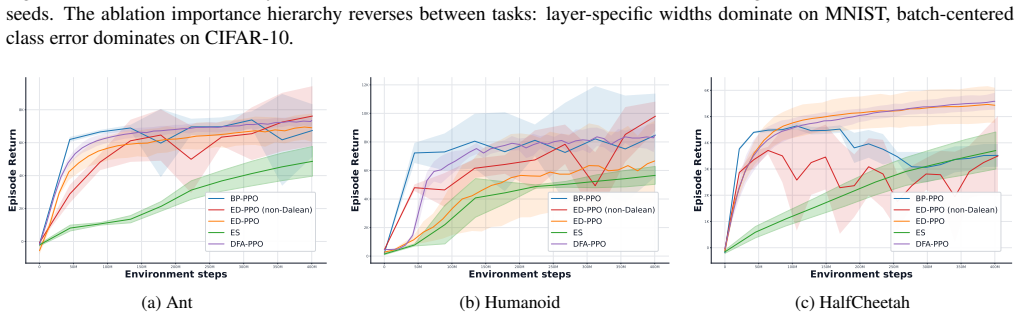
- ED integrated with PPO achieves competitive performance on continuous-control tasks and open-ended exploration.
- Credit assignment bottlenecks are task-dependent and invisible to single-benchmark evaluation.
Where Pith is reading between the lines
- The approach suggests that biological neural circuits could use dual-stream mechanisms for credit assignment.
- Future work could test the method on larger datasets or more complex RL environments to see scalability.
- Task-dependent bottlenecks imply that bio-plausible methods may need adaptive components depending on the problem domain.
Load-bearing premise
The reported performance stems primarily from the modulo error routing mechanism rather than from the three domain-specific innovations of layer-specific sigmoid widths, batch-centered error signals, and asymmetric initialization.
What would settle it
Training the dual-stream architecture on MNIST using standard supervised learning or another bio-plausible rule without the modulo error routing and observing whether accuracy falls significantly below 96.7%.
Figures




read the original abstract
Biological neural circuits obey Dale's principle: each neuron's synapses are uniformly excitatory or inhibitory. Artificial networks that respect this constraint must coordinate separate excitatory and inhibitory populations, fundamentally changing how credit is assigned during learning. Several biologically plausible learning rules avoid backpropagation's weight transport requirement, but it has been difficult to achieve strong performance under Dale's principle beyond MNIST. Error Diffusion (ED) was originally proposed in a dual-stream excitatory/inhibitory architecture, where learning is driven by routing global error signals to all layers without transporting transposed forward weights or relying on random feedback matrices. Whether such a rule can scale under Dale's principle across both supervised classification and reinforcement learning remains unknown. Here, we introduce modulo error routing to extend Error Diffusion beyond binary classification, and show that a dual-stream excitatory/inhibitory architecture trained with this method achieves 96.7% on MNIST and establishes a 61.7% baseline on CIFAR-10, demonstrating that representation learning is possible even when strictly enforcing Dale's principle. For the classification setting, we introduce three domain-specific innovations: layer-specific sigmoid widths, batch-centered class error signals, and asymmetric initialization, and ablation analysis reveals that their relative importance reverses between MNIST and CIFAR-10, exposing task-dependent credit-assignment bottlenecks invisible to single-benchmark evaluation. In reinforcement learning, we integrate ED with Proximal Policy Optimization (PPO) and evaluate it on continuous-control tasks in Google Brax and on Craftax, an open-ended exploration task. We show that ED-PPO achieves competitive performance relative to Direct Feedback Alignment, a backpropagation-free baseline.
Editorial analysis
A structured set of objections, weighed in public.
Referee Report
Summary. The manuscript presents modulo error routing as an extension of Error Diffusion for multi-class settings in dual-stream excitatory/inhibitory networks that enforce Dale's principle. It demonstrates performance of 96.7% on MNIST and 61.7% on CIFAR-10 by incorporating three domain-specific innovations, with ablations highlighting their task-dependent effects, and shows integration with PPO for competitive results on Brax continuous control and Craftax exploration tasks.
Significance. Should the results prove robust and the contribution of the error routing rule be isolated from the additional innovations, this would be a notable contribution to the field of biologically plausible machine learning. It would establish that representation learning is feasible in strictly Dale-compliant networks on standard vision benchmarks and extend to RL, addressing a key limitation of prior work that struggled beyond MNIST. The task-dependent nature of the innovations also offers insight into credit assignment bottlenecks.
major comments (3)
- [Abstract] The performance figures (96.7% MNIST, 61.7% CIFAR-10) are given without error bars or training curves, and there is no statement confirming that the three innovations were determined prior to test evaluation, which is necessary to substantiate the soundness of the reported accuracies.
- [Abstract (classification setting)] The three domain-specific innovations (layer-specific sigmoid widths, batch-centered class error signals, asymmetric initialization) are presented as necessary for classification, with ablations showing reversed relative importance across MNIST and CIFAR-10; this raises the possibility that these changes, rather than the modulo error routing itself, are responsible for enabling the performance under Dale's principle, requiring additional controls to isolate the core method's contribution.
- [Reinforcement learning section] The integration of ED with PPO lacks an ablation study comparable to the classification experiments to isolate the effect of the error diffusion mechanism from the PPO algorithm or the Direct Feedback Alignment baseline.
minor comments (3)
- [Abstract] Clarify what 'establishes a 61.7% baseline' means in terms of comparison to other methods.
- Define acronyms such as ED and PPO at their first occurrence in the text.
- [Methods] Provide the explicit mathematical formulation of 'modulo error routing' to allow reproducibility.
Simulated Author's Rebuttal
We thank the referee for their constructive comments, which identify key areas for strengthening the presentation and isolating contributions. We address each point below and will revise the manuscript to incorporate the suggested improvements.
read point-by-point responses
-
Referee: [Abstract] The performance figures (96.7% MNIST, 61.7% CIFAR-10) are given without error bars or training curves, and there is no statement confirming that the three innovations were determined prior to test evaluation, which is necessary to substantiate the soundness of the reported accuracies.
Authors: We agree that error bars, training curves, and an explicit statement on the protocol for determining innovations are essential for rigor. We will add multiple-run statistics with standard deviations, representative training curves, and a methods note confirming that innovations were finalized on validation data prior to test evaluation. revision: yes
-
Referee: [Abstract (classification setting)] The three domain-specific innovations (layer-specific sigmoid widths, batch-centered class error signals, asymmetric initialization) are presented as necessary for classification, with ablations showing reversed relative importance across MNIST and CIFAR-10; this raises the possibility that these changes, rather than the modulo error routing itself, are responsible for enabling the performance under Dale's principle, requiring additional controls to isolate the core method's contribution.
Authors: This concern is well-founded. The existing ablations highlight task dependence but do not fully isolate modulo error routing. We will add controls in the revision, including attempts to apply the core routing rule without the three innovations, to better separate their effects from the routing mechanism. revision: yes
-
Referee: [Reinforcement learning section] The integration of ED with PPO lacks an ablation study comparable to the classification experiments to isolate the effect of the error diffusion mechanism from the PPO algorithm or the Direct Feedback Alignment baseline.
Authors: We agree that RL ablations are needed for consistency. We will conduct and include additional experiments comparing ED-PPO to PPO alone and to DFA-augmented variants, to isolate the contribution of the error diffusion rule. revision: yes
Circularity Check
No significant circularity; empirical results on external benchmarks
full rationale
The paper reports measured performance on standard external benchmarks (MNIST at 96.7%, CIFAR-10 at 61.7%, Brax and Craftax RL tasks) rather than any derivation or prediction that reduces to its own inputs by construction. The modulo error routing extension and three domain-specific innovations are presented as engineering choices whose effects are quantified via ablation on held-out data; no self-definitional loop, fitted-input-as-prediction, or load-bearing self-citation chain appears in the abstract or described structure. The work is self-contained against external benchmarks and receives the default non-circularity finding.
Axiom & Free-Parameter Ledger
free parameters (3)
- layer-specific sigmoid widths
- batch-centered class error signals
- asymmetric initialization
axioms (1)
- domain assumption Dale's principle must be strictly enforced (each neuron is uniformly excitatory or inhibitory)
Reference graph
Works this paper leans on
-
[1]
E., and Lillicrap, T
Bartunov, S., Santoro, A., Richards, B., Marris, L., Hinton, G. E., and Lillicrap, T. (2018). Assessing the scalability of biologically-motivated deep learning algorithms and architectures. Advances in neural information processing systems , 31
2018
-
[2]
Bengio, Y., Lee, D.-H., Bornschein, J., Mesnard, T., and Lin, Z. (2015). Towards biologically plausible deep learning. arXiv preprint arXiv:1502.04156
work page internal anchor Pith review Pith/arXiv arXiv 2015
-
[3]
M., and Richards, B
Cornford, J., Kalajdzievski, D., Leite, M., Lamarquette, A., Kullmann, D. M., and Richards, B. A. (2021). Learning to live with dale's principle: \ ANN \ s with separate excitatory and inhibitory units. In International Conference on Learning Representations
2021
-
[4]
Crick, F. (1989). The recent excitement about neural networks. Nature , 337(6203):129--132
1989
-
[5]
Dale, H. (1935). Pharmacology and nerve-endings
1935
-
[6]
Ding, B., Qian, H., and Zhou, J. (2018). Activation functions and their characteristics in deep neural networks. In 2018 Chinese Control And Decision Conference (CCDC) , pages 1836--1841
2018
-
[7]
Eccles, J. C. (1976). From electrical to chemical transmission in the central nervous system: the closing address of the sir henry dale centennial symposium cambridge, 19 september 1975. Notes and records of the Royal Society of London , 30(2):219--230
1976
-
[8]
J., Guo, Z., Al-Qadasi, M., Marquez, B
Filipovich, M. J., Guo, Z., Al-Qadasi, M., Marquez, B. A., Morison, H. D., Sorger, V. J., Prucnal, P. R., Shekhar, S., and Shastri, B. J. (2022). Silicon photonic architecture for training deep neural networks with direct feedback alignment. Optica , 9(12):1323--1332
2022
-
[9]
Brax–a differentiable physics engine for large scale rigid body simulation,
Freeman, C. D., Frey, E., Raichuk, A., Girgin, S., Mordatch, I., and Bachem, O. (2021). Brax--a differentiable physics engine for large scale rigid body simulation. arXiv preprint arXiv:2106.13281
-
[10]
Fujita, K. (2026). A diagnostic evaluation of neural networks trained with the error diffusion learning algorithm. Discover Artificial Intelligence
2026
-
[11]
Grossberg, S. (1987). Competitive learning: From interactive activation to adaptive resonance. Cognitive science , 11(1):23--63
1987
- [12]
-
[13]
Izhikevich, E. M. (2007). Solving the distal reward problem through linkage of stdp and dopamine signaling. Cerebral cortex , 17(10):2443--2452
2007
- [14]
-
[15]
Launay, J., Poli, I., Boniface, F., and Krzakala, F. (2020). Direct feedback alignment scales to modern deep learning tasks and architectures. In Proceedings of the 34th International Conference on Neural Information Processing Systems , NIPS '20, Red Hook, NY, USA. Curran Associates Inc
2020
-
[16]
Launay, J., Poli, I., and Krzakala, F. (2019). Principled training of neural networks with direct feedback alignment
2019
-
[17]
Lee, D.-H., Zhang, S., Fischer, A., and Bengio, Y. (2015). Difference target propagation. In Appice, A., Rodrigues, P. P., Santos Costa, V., Soares, C., Gama, J., and Jorge, A., editors, Machine Learning and Knowledge Discovery in Databases , pages 498--515, Cham. Springer International Publishing
2015
-
[18]
Liao, Q., Leibo, J., and Poggio, T. (2016). How important is weight symmetry in backpropagation? In Proceedings of the AAAI Conference on Artificial Intelligence , volume 30
2016
-
[19]
P., Cownden, D., Tweed, D
Lillicrap, T. P., Cownden, D., Tweed, D. B., and Akerman, C. J. (2016). Random synaptic feedback weights support error backpropagation for deep learning. Nature communications , 7(1):13276
2016
-
[20]
Markram, H., Toledo-Rodriguez, M., Wang, Y., Gupta, A., Silberberg, G., and Wu, C. (2004). Interneurons of the neocortical inhibitory system. Nature reviews neuroscience , 5(10):793--807
2004
- [21]
-
[22]
N kland, A. (2016). Direct feedback alignment provides learning in deep neural networks. Advances in neural information processing systems , 29
2016
-
[23]
J., and Maass, W
Pfeiffer, M., Nessler, B., Douglas, R. J., and Maass, W. (2010). Reward-modulated hebbian learning of decision making. Neural computation , 22(6):1399--1444
2010
-
[24]
A., Lillicrap, T
Richards, B. A., Lillicrap, T. P., Beaudoin, P., Bengio, Y., Bogacz, R., Christensen, A., Clopath, C., Costa, R. P., de Berker, A., Ganguli, S., et al. (2019). A deep learning framework for neuroscience. Nature neuroscience , 22(11):1761--1770
2019
-
[25]
Roodschild, M., Gotay Sardi\ n as, J., and Will, A. (2020). A new approach for the vanishing gradient problem on sigmoid activation. Progress in Artificial Intelligence , 9(4):351–360
2020
-
[26]
Sacramento, J., Ponte Costa, R., Bengio, Y., and Senn, W. (2018). Dendritic cortical microcircuits approximate the backpropagation algorithm. Advances in neural information processing systems , 31
2018
-
[27]
Salimans, T., Ho, J., Chen, X., Sidor, S., and Sutskever, I. (2017). Evolution strategies as a scalable alternative to reinforcement learning. arXiv preprint arXiv:1703.03864
work page internal anchor Pith review Pith/arXiv arXiv 2017
-
[28]
Schulman, J., Wolski, F., Dhariwal, P., Radford, A., and Klimov, O. (2017). Proximal policy optimization algorithms. arXiv preprint arXiv:1707.06347
work page internal anchor Pith review Pith/arXiv arXiv 2017
-
[29]
F., Yang, G
Song, H. F., Yang, G. R., and Wang, X.-J. (2016). Training excitatory-inhibitory recurrent neural networks for cognitive tasks: a simple and flexible framework. PLoS computational biology , 12(2):e1004792
2016
-
[30]
and Harvey, R
Strata, P. and Harvey, R. (1999). Dale’s principle. Brain research bulletin , 50(5-6):349--350
1999
-
[31]
Szanda a, T. (2020). Review and comparison of commonly used activation functions for deep neural networks. In Bio-inspired neurocomputing , pages 203--224. Springer
2020
-
[32]
Turrigiano, G. (2011). Too many cooks? intrinsic and synaptic homeostatic mechanisms in cortical circuit refinement. Annual review of neuroscience , 34(1):89--103
2011
-
[33]
Whittington, J. C. and Bogacz, R. (2017). An approximation of the error backpropagation algorithm in a predictive coding network with local hebbian synaptic plasticity. Neural computation , 29(5):1229--1262
2017
discussion (0)
Sign in with ORCID, Apple, or X to comment. Anyone can read and Pith papers without signing in.