Stellar masses and ages in Gaia Data Release 4 from the Final Luminosity Age Mass Estimator algorithm
Pith reviewed 2026-07-02 16:52 UTC · model grok-4.3
The pith
FLAME pipeline derives stellar luminosities, radii, masses and ages from Gaia parameters using analytical steps followed by model inference.
A machine-rendered reading of the paper's core claim, the machinery that carries it, and where it could break.
Core claim
FLAME performs luminosity and radius estimation analytically from Gaia inputs and then infers mass, age and stage via model fitting; tests confirm the outputs match literature results without large systematic offsets.
What carries the argument
Two-component FLAME process: analytical calculation of luminosity and radius from atmospheric, astrometric and photometric data, followed by minimization or Bayesian model inference for mass and age.
If this is right
- Approximately 500 million Gaia sources will receive luminosity, radius, mass and age estimates in Data Release 4.
- New parameters become available for high-velocity stars, stars with low-mass companions, and stars in the Plato field of view.
- The two-step design allows photometric inputs prone to systematics to be handled with flexibility.
Where Pith is reading between the lines
- Large-scale application could tighten constraints on the age distribution of nearby stellar populations.
- Reliable masses for exoplanet host stars would improve planet radius and density estimates derived from transit data.
- If the pipeline runs on future Gaia releases, it could track evolutionary changes across the same stars over time.
Load-bearing premise
The atmospheric, astrometric and photometric parameters delivered by upstream Gaia pipelines are accurate enough that the derived masses and ages carry no large systematic errors.
What would settle it
A large sample of stars with independent mass and age measurements from asteroseismology or eclipsing binaries that shows systematic offsets larger than the quoted uncertainties would falsify the performance claim.
Figures
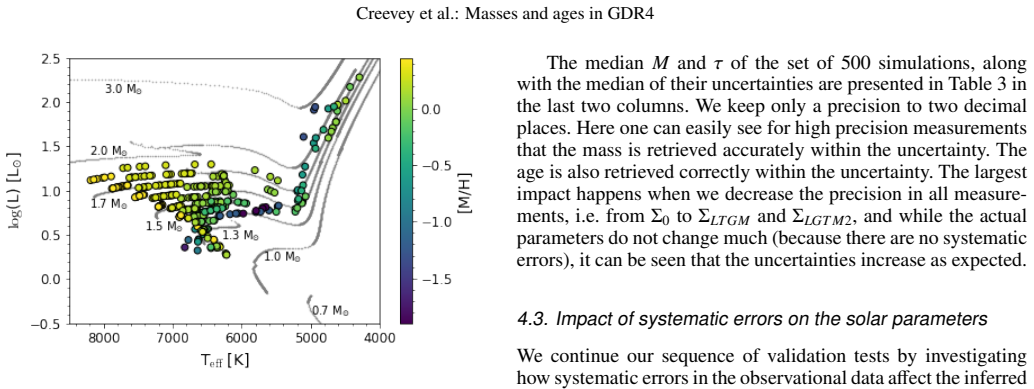
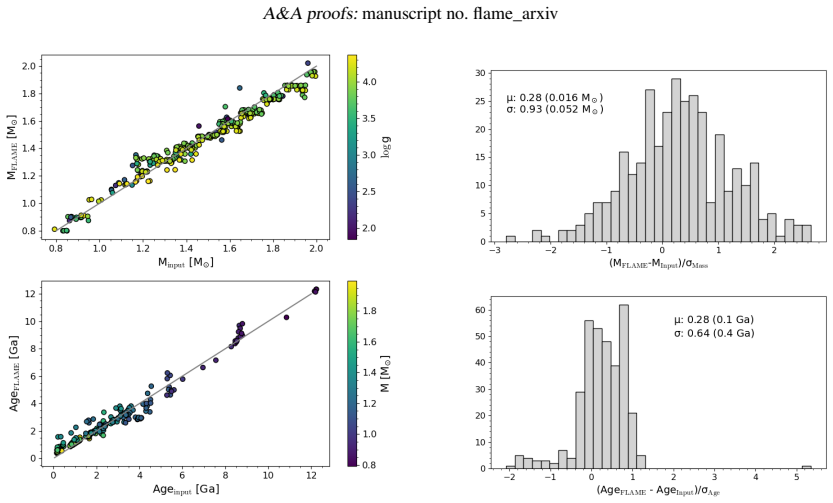
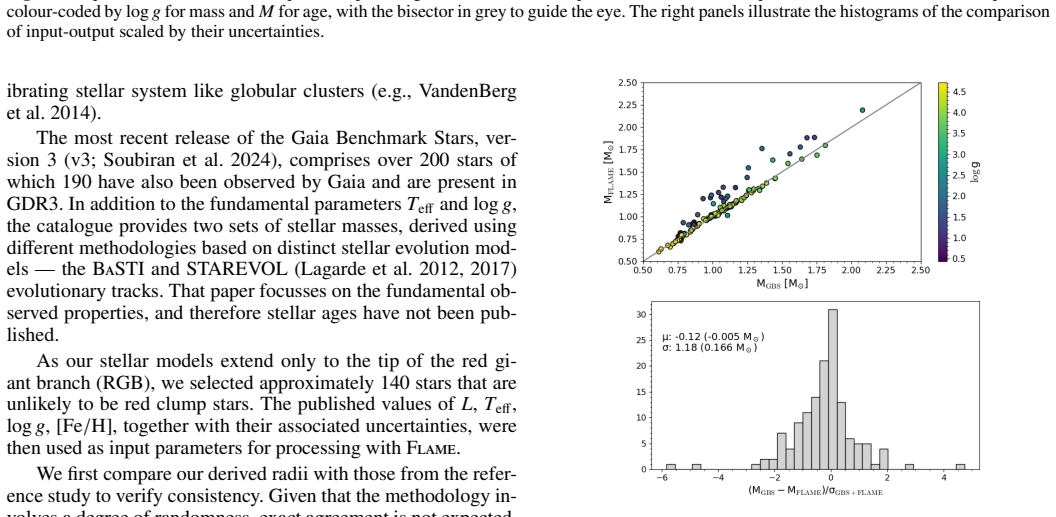
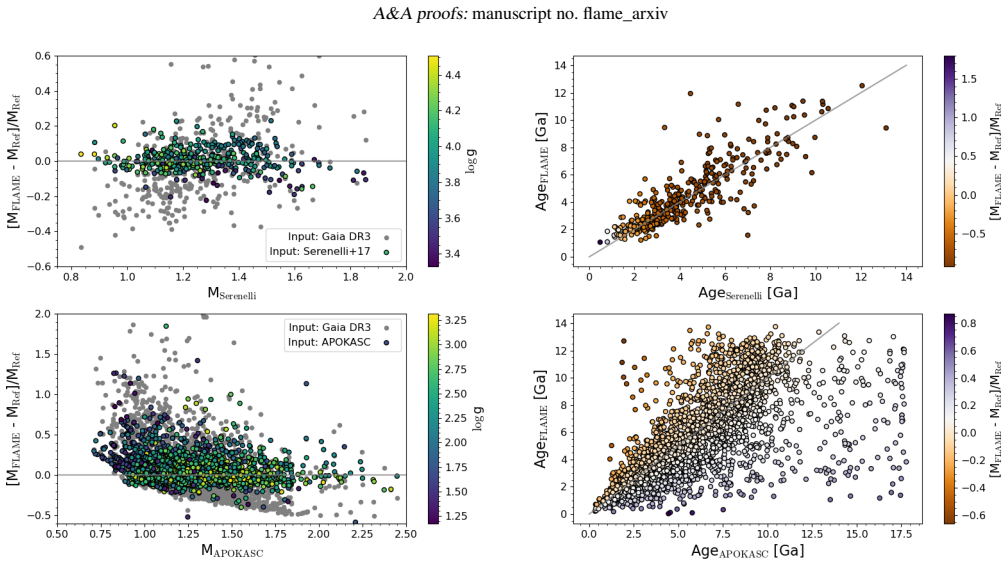
read the original abstract
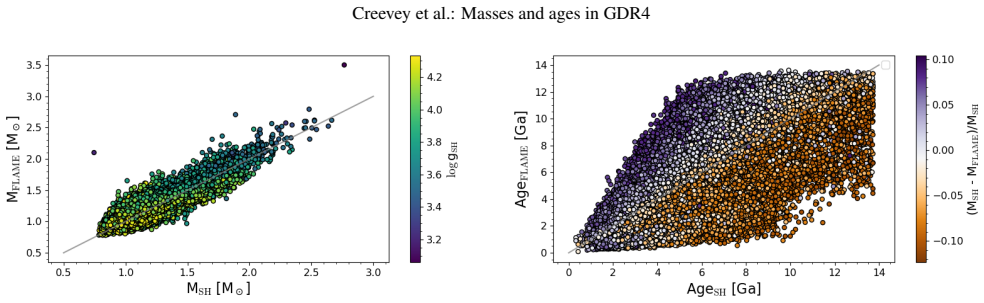
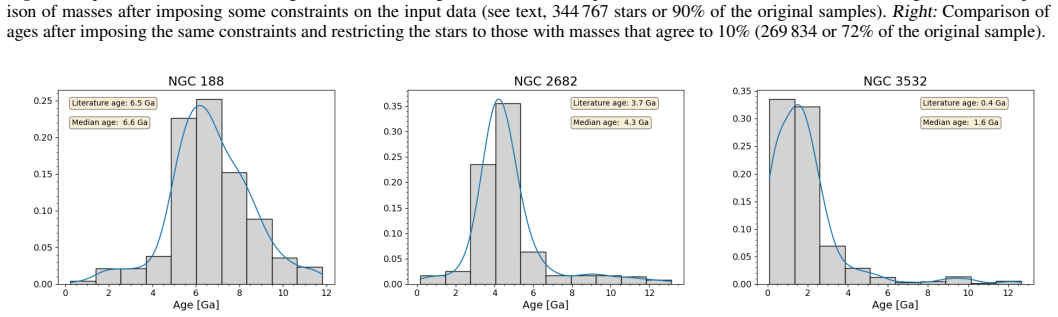
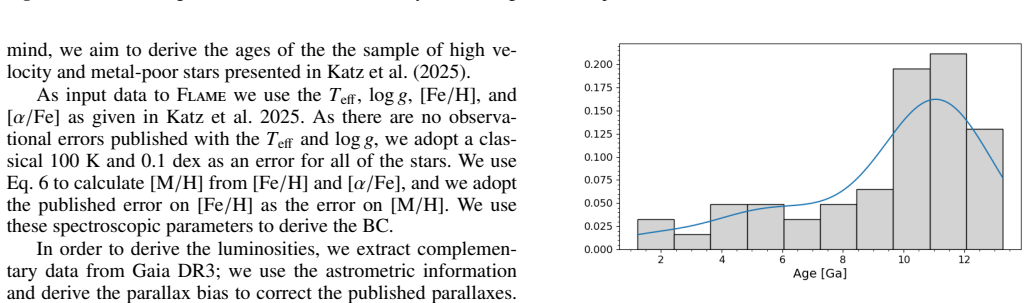
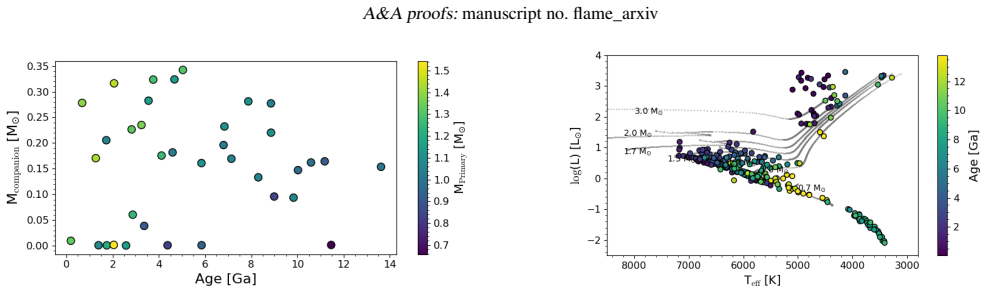
The masses and ages of stars are key quantities for understanding exoplanetary, stellar, and galactic evolution. In the context of Gaia, these parameters provide insights into the stellar populations, helping to trace the formation and history of the Galaxy. As part of the Gaia Data Processing and Analysis Consortium (DPAC), the Final Luminosity Age Mass Estimator (FLAME) pipeline processes Gaia data to derive stellar parameters comprising luminosities, radii, masses and ages. This paper discusses the methods and data used in FLAME for Gaia Data releases and the expected performances of FLAME for the 4th Gaia Data Release. FLAME comprises two main components: the first one, which is analytical, is used to estimate luminosity, radius, and radial velocity correction due to gravitational redshift by exploiting the atmospheric, astrometric, and photometric parameters produced within Gaia. The second is a model inference based on two main approaches: a classical minimization approach, and a Bayesian framework. It aims to derive mass, age, and evolutionary stage. The two step implementation offers flexibility in handling photometric properties that are prone to systematic errors. Tests with simulated data, the Sun, and well characterised samples of stars show that the methods in FLAME perform as expected, producing results in statistical agreement with the literature. We provide new stellar fundamental parameters for some high velocity stars, stars with very low mass companions, and a selection of stars in the Plato Field of View. In Gaia Data Release 4 approximately 500 million sources will have results from the pipeline. [abridged]
Editorial analysis
A structured set of objections, weighed in public.
Referee Report
Summary. The manuscript describes the Final Luminosity Age Mass Estimator (FLAME) pipeline for Gaia DR4, which derives stellar luminosities, radii, masses, and ages. An analytical first stage computes luminosity, radius, and gravitational-redshift corrections from Gaia atmospheric, astrometric, and photometric parameters; a second stage applies classical minimization or Bayesian inference against stellar models to obtain mass, age, and evolutionary stage. The authors state that tests on simulated data, the Sun, and well-characterised samples produce results in statistical agreement with the literature, and that the pipeline will deliver parameters for approximately 500 million sources, with additional results shown for high-velocity stars, low-mass-companion hosts, and PLATO-field stars.
Significance. If the pipeline outputs prove reliable, the work would deliver a homogeneous catalog of fundamental stellar parameters for hundreds of millions of stars, enabling large-scale studies of stellar evolution, galactic populations, and exoplanet hosts. The two-stage design that isolates photometric systematics is a practical strength for Gaia-scale processing.
major comments (2)
- [Abstract] Abstract: the claim that 'tests with simulated data, the Sun, and well characterised samples of stars show that the methods in FLAME perform as expected, producing results in statistical agreement with the literature' supplies no quantitative metrics, bias/scatter values, error budgets, or details on the model grids and priors, preventing assessment of whether the central reliability claim is supported.
- [Abstract / validation section] Validation tests (Abstract and methods description): all reported tests employ the identical atmospheric, astrometric, and photometric inputs supplied by other Gaia pipelines. This design cannot detect or quantify propagation of systematic offsets in those inputs (e.g., Teff, log g, parallax) through the analytical luminosity/radius stage and the subsequent mass/age inference steps.
Simulated Author's Rebuttal
We thank the referee for their constructive review and recommendation. We address each major comment below and will revise the manuscript to strengthen the presentation of validation results.
read point-by-point responses
-
Referee: [Abstract] Abstract: the claim that 'tests with simulated data, the Sun, and well characterised samples of stars show that the methods in FLAME perform as expected, producing results in statistical agreement with the literature' supplies no quantitative metrics, bias/scatter values, error budgets, or details on the model grids and priors, preventing assessment of whether the central reliability claim is supported.
Authors: We agree the abstract is too concise and omits key quantitative details. The full manuscript contains these metrics (bias, scatter, error budgets, grids, and priors) in the validation sections. In revision we will expand the abstract to include representative performance numbers and direct references to the relevant sections and tables. revision: yes
-
Referee: [Abstract / validation section] Validation tests (Abstract and methods description): all reported tests employ the identical atmospheric, astrometric, and photometric inputs supplied by other Gaia pipelines. This design cannot detect or quantify propagation of systematic offsets in those inputs (e.g., Teff, log g, parallax) through the analytical luminosity/radius stage and the subsequent mass/age inference steps.
Authors: The referee correctly notes a limitation of the current validation design. Our tests evaluate FLAME given the delivered Gaia inputs, which are themselves validated by upstream pipelines. To address propagation explicitly we will add a dedicated subsection with sensitivity tests (Monte Carlo perturbations of input parameters) and a discussion of how systematic offsets propagate to mass and age. This addition will be included in the revised manuscript. revision: yes
Circularity Check
No circularity: FLAME uses external models and Gaia inputs with independent validation
full rationale
The paper describes a two-stage pipeline (analytical luminosity/radius computation followed by classical/Bayesian inference on external stellar models) that ingests upstream Gaia atmospheric, astrometric and photometric parameters. Validation consists of comparisons against simulated data, the Sun and literature samples, none of which are shown to be fitted or redefined within the pipeline itself. No equations, fitted parameters or self-citations are presented that would make any output equivalent to an input by construction. The derivation chain therefore remains self-contained against external benchmarks and does not exhibit any of the enumerated circularity patterns.
Axiom & Free-Parameter Ledger
Reference graph
Works this paper leans on
-
[1]
2021, Reviews of Modern Physics, 93, 015001
Aerts, C. 2021, Reviews of Modern Physics, 93, 015001
2021
-
[2]
2018, A&A, 616, A8
Andrae, R., Fouesneau, M., Creevey, O., et al. 2018, A&A, 616, A8
2018
-
[3]
2023, A&A, 674, A27
Andrae, R., Fouesneau, M., Sordo, R., et al. 2023, A&A, 674, A27
2023
-
[4]
Bailer-Jones, C. A. L., Andrae, R., Arcay, B., et al. 2013, A&A, 559, A74
2013
-
[5]
2010, in ADA 6 - Sixth Conference on Astronomical Data Analysis, ed
Bijaoui, A., Recio-Blanco, A., de Laverny, P., & Ordenovic, C. 2010, in ADA 6 - Sixth Conference on Astronomical Data Analysis, ed. J. L. Starck, M. Saber Naceur, & R. Murtagh, 9
2010
-
[6]
Borucki, W. J. 2016, Reports on Progress in Physics, 79, 036901
2016
-
[7]
2012, MNRAS, 427, 127
Bressan, A., Marigo, P., Girardi, L., et al. 2012, MNRAS, 427, 127
2012
-
[8]
G., Steffen, M., Freytag, B., & Bonifacio, P
Caffau, E., Ludwig, H. G., Steffen, M., Freytag, B., & Bonifacio, P. 2011, Sol. Phys., 268, 255
2011
-
[9]
R., Lebreton, Y ., et al
Casamiquela, L., Reese, D. R., Lebreton, Y ., et al. 2024, A&A, 692, A243
2024
-
[10]
2026, A&A, 705, A167
Casamiquela, L., Soubiran, C., Jofré, P., et al. 2026, A&A, 705, A167
2026
-
[11]
2009, Mem
Collet, R., Nordlund, Å., Asplund, M., Hayek, W., & Trampedach, R. 2009, Mem. Soc. Astron. Italiana, 80, 719
2009
-
[12]
L., Cassisi, S., Thévenin, F., Salaris, M., & Pietrinferni, A
Creevey, O. L., Cassisi, S., Thévenin, F., Salaris, M., & Pietrinferni, A. 2024, A&A, 689, A243
2024
-
[13]
Creevey, O. L. & Lebreton, Y . 2022, Masses and ages from FLAME in DR3, Gaia DPAC Public Technical Notes. Online at GAIA-C8-TN-OCA-OLC-036
2022
-
[14]
L., Metcalfe, T
Creevey, O. L., Metcalfe, T. S., Schultheis, M., et al. 2017, A&A, 601, A67
2017
-
[15]
L., Sordo, R., Pailler, F., et al
Creevey, O. L., Sordo, R., Pailler, F., et al. 2023, A&A, 674, A26
2023
-
[16]
L., Thévenin, F., Berio, P., et al
Creevey, O. L., Thévenin, F., Berio, P., et al. 2015, A&A, 575, A26
2015
-
[17]
2018, A&A, 614, A19 De Angeli, F., Weiler, M., Montegriffo, P., et al
Danielski, C., Babusiaux, C., Ruiz-Dern, L., Sartoretti, P., & Arenou, F. 2018, A&A, 614, A19 De Angeli, F., Weiler, M., Montegriffo, P., et al. 2023, A&A, 674, A2
2018
-
[18]
Delchambre, L., Bailer-Jones, C. A. L., Bellas-Velidis, I., et al. 2023, A&A, 674, A31
2023
-
[19]
2013, emcee: The MCMC Hammer, Astrophysics Source Code Library, record ascl:1303.002
Foreman-Mackey, D., Conley, A., Meierjurgen Farr, W., et al. 2013, emcee: The MCMC Hammer, Astrophysics Source Code Library, record ascl:1303.002
2013
-
[20]
2023, A&A, 674, A28 Gaia Collaboration, Brown, A
Fouesneau, M., Frémat, Y ., Andrae, R., et al. 2023, A&A, 674, A28 Gaia Collaboration, Brown, A. G. A., Vallenari, A., et al. 2018, A&A, 616, A1 Gaia Collaboration, Brown, A. G. A., Vallenari, A., et al. 2016a, A&A, 595, A2 Gaia Collaboration, Creevey, O. L., Sarro, L. M., et al. 2023a, A&A, 674, A39 Gaia Collaboration, Prusti, T., de Bruijne, J. H. J., e...
2023
-
[21]
J., Brook, C
Gallart, C., Bernard, E. J., Brook, C. B., et al. 2019, Nature Astronomy, 3, 932
2019
-
[22]
Grevesse, N., Asplund, M., & Sauval, A. J. 2007, Space Sci. Rev., 130, 105
2007
-
[23]
E., Siegmund, W
Gunn, J. E., Siegmund, W. A., Mannery, E. J., et al. 2006, AJ, 131, 2332
2006
-
[24]
2008, A&A, 486, 951
Gustafsson, B., Edvardsson, B., Eriksson, K., et al. 2008, A&A, 486, 951
2008
-
[25]
2015, A&A, 582, A49
Heiter, U., Jofré, P., Gustafsson, B., et al. 2015, A&A, 582, A49
2015
-
[26]
& Ball, W
Hekker, S. & Ball, W. H. 2014, A&A, 564, A105
2014
-
[27]
2020, ARA&A, 58, 205
Helmi, A. 2020, ARA&A, 58, 205
2020
-
[28]
H., et al
Helmi, A., Babusiaux, C., Koppelman, H. H., et al. 2018, Nature, 563, 85
2018
-
[29]
L., Pietrinferni, A., Cassisi, S., et al
Hidalgo, S. L., Pietrinferni, A., Cassisi, S., et al. 2018, ApJ, 856, 125 Jofré, P., Heiter, U., Soubiran, C., et al. 2015, A&A, 582, A81 Jofré, P., Heiter, U., Soubiran, C., et al. 2014, A&A, 564, A133 Jofré, P., Heiter, U., Worley, C. C., et al. 2017, A&A, 601, A38
2018
-
[30]
2025, A&A, 704, A294
Katz, D., Gómez, A., Caffau, E., et al. 2025, A&A, 704, A294
2025
-
[31]
2023, A&A, 674, A5
Katz, D., Sartoretti, P., Guerrier, A., et al. 2023, A&A, 674, A5
2023
-
[32]
Korn, A. & et al. (in prep.). 2026, in prep
2026
-
[33]
2012, A&A, 543, A108
Lagarde, N., Decressin, T., Charbonnel, C., et al. 2012, A&A, 543, A108
2012
-
[34]
C., Reylé, C., & Nasello, G
Lagarde, N., Robin, A. C., Reylé, C., & Nasello, G. 2017, A&A, 601, A27
2017
-
[35]
& Goupil, M
Lebreton, Y . & Goupil, M. J. 2014, A&A, 569, A21
2014
-
[36]
& Reese, D
Lebreton, Y . & Reese, D. R. 2020, A&A, 642, A88
2020
-
[37]
A., Hernández, J., et al
Lindegren, L., Klioner, S. A., Hernández, J., et al. 2021, A&A, 649, A2
2021
-
[38]
2010, in Astrophysics and Space Science Proceedings, V ol
Lodders, K. 2010, in Astrophysics and Space Science Proceedings, V ol. 16, Prin- ciples and Perspectives in Cosmochemistry, 379
2010
-
[39]
N., Chontos, A., Grundahl, F., et al
Lund, M. N., Chontos, A., Grundahl, F., et al. 2025, A&A, 701, A285
2025
-
[40]
R., Schiavon, R
Majewski, S. R., Schiavon, R. P., Frinchaboy, P. M., et al. 2017, AJ, 154, 94
2017
-
[41]
Mamajek, E. E., Torres, G., Prsa, A., et al. 2015, arXiv e-prints, arXiv:1510.06262
work page internal anchor Pith review Pith/arXiv arXiv 2015
-
[42]
Maxted, P. F. L. 2025, MNRAS, 539, 3741
2025
-
[43]
L., & et al
Merle, T., Maxted, P., Creevey, O. L., & et al. 2026, A&A
2026
-
[44]
S., Creevey, O
Metcalfe, T. S., Creevey, O. L., Do˘gan, G., et al. 2014, ApJS, 214, 27
2014
-
[45]
H., Elsworth, Y ., Epstein, C., et al
Pinsonneault, M. H., Elsworth, Y ., Epstein, C., et al. 2014, ApJS, 215, 19
2014
-
[46]
H., Elsworth, Y
Pinsonneault, M. H., Elsworth, Y . P., Tayar, J., et al. 2018, ApJS, 239, 32
2018
-
[47]
Queiroz, A. B. A., Anders, F., Chiappini, C., et al. 2023, A&A, 673, A155
2023
-
[48]
2025, Experimental Astronomy, 59, 26
Rauer, H., Aerts, C., Cabrera, J., et al. 2025, Experimental Astronomy, 59, 26
2025
-
[49]
2016, A&A, 585, A93
Recio-Blanco, A., de Laverny, P., Allende Prieto, C., et al. 2016, A&A, 585, A93
2016
-
[50]
A., et al
Recio-Blanco, A., de Laverny, P., Palicio, P. A., et al. 2023, A&A, 674, A29
2023
-
[51]
W., et al
Riello, M., De Angeli, F., Evans, D. W., et al. 2021, A&A, 649, A3
2021
-
[52]
2021, A&A, 649, A11
Rowell, N., Davidson, M., Lindegren, L., et al. 2021, A&A, 649, A11
2021
-
[53]
1993, ApJ, 414, 580
Salaris, M., Chieffi, A., & Straniero, O. 1993, ApJ, 414, 580
1993
-
[54]
Salpeter, E. E. 1955, ApJ, 121, 161
1955
-
[55]
2018, A&A, 616, A6
Sartoretti, P., Katz, D., Cropper, M., et al. 2018, A&A, 616, A6
2018
-
[56]
2023, A&A, 674, A6
Sartoretti, P., Marchal, O., Babusiaux, C., et al. 2023, A&A, 674, A6
2023
-
[57]
& Zinn, R
Searle, L. & Zinn, R. 1978, ApJ, 225, 357
1978
-
[58]
2017, ApJS, 233, 23
Serenelli, A., Johnson, J., Huber, D., et al. 2017, ApJS, 233, 23
2017
-
[59]
Shulyak, D., Tsymbal, V ., Ryabchikova, T., Stütz, C., & Weiss, W. W. 2004, A&A, 428, 993
2004
-
[60]
L., Lagarde, N., et al
Soubiran, C., Creevey, O. L., Lagarde, N., et al. 2024, A&A, 682, A145
2024
-
[61]
2021, A&A, 649, A10
Torra, F., Castañeda, J., Fabricius, C., et al. 2021, A&A, 649, A10
2021
-
[62]
L., Álvarez, M
Ulla, A., Creevey, O. L., Álvarez, M. A., et al. 2022, Gaia DR3 documentation Chapter 11: Astrophysical parameters, Gaia DR3 documentation, European Space Agency; Gaia Data Processing and Analysis Consortium. Online at https://gea.esac.esa.int/archive/documentation/GDR3/index.html, chap. 11
2022
-
[63]
1997, in KITP Conference: Solar Neutrinos: News About SNUs, ed
Ulrich, R. 1997, in KITP Conference: Solar Neutrinos: News About SNUs, ed. J. Bahcall, W. Haxton, P. Langacker, H. Robertson, & Y . Totsuka, 28
1997
-
[64]
A., Bond, H
VandenBerg, D. A., Bond, H. E., Nelan, E. P., et al. 2014, ApJ, 792, 110
2014
-
[65]
L., Lallement, R., & Cox, N
Vergely, J. L., Lallement, R., & Cox, N. L. J. 2022, A&A, 664, A174
2022
-
[66]
The PLATO Science Calibration and Validation Plan: Targets for the First Long-pointing Field
Zwintz, K., Aerts, C., Tkachenko, A., et al. 2026, arXiv e-prints, arXiv:2604.04042 Article number, page 15 of 19 A&A proofs:manuscript no. flame_arxiv Appendix A: Author contributions The authors of this paper have contributed in many ways to the Flamesoftware and feedback on performance. The Flameteam comprises OLC (scientific lead), CO (main java devel...
work page internal anchor Pith review Pith/arXiv arXiv 2026
-
[67]
Significant support in the development of its integration into the CNES framework and scientific validation framework has been provided by NBa, FP, CR, CBJ, MF, RA, and AB
YL, LC, BP, and have contributed significantly to all aspects mentioned below. Significant support in the development of its integration into the CNES framework and scientific validation framework has been provided by NBa, FP, CR, CBJ, MF, RA, and AB. BE, OK, SC, AK, RS have contributed to the provision of input models, bolometric corrections, and simulat...
2025
discussion (0)
Sign in with ORCID, Apple, or X to comment. Anyone can read and Pith papers without signing in.