TRCGL-Net: A Long-Tailed Multi-Label Chest X-Ray Classification Framework with Generative Data Augmentation and Label Co-Occurrence Modeling
Pith reviewed 2026-07-02 13:39 UTC · model grok-4.3
The pith
TRCGL-Net uses a text-guided diffusion model to generate rare-disease chest X-ray images and a label co-occurrence graph to improve tail-class detection in long-tailed multi-label settings.
A machine-rendered reading of the paper's core claim, the machinery that carries it, and where it could break.
Core claim
TRCGL-Net addresses long-tailed multi-label chest X-ray classification by generating high-quality tail-class samples via a learnable text-guided conditional diffusion model under disease semantic constraints, recalibrating features with channel reweighting and class-aware attention, and modeling label dependencies with a graph convolution network based on co-occurrence statistics, resulting in a tail-class mAP of 0.4904, overall mAP of 0.4408, and mAUC of 0.8989 on the PadChest dataset while outperforming prior methods.
What carries the argument
Learnable text-guided conditional diffusion model that generates tail-class chest X-ray images under explicit disease semantic constraints, paired with a label-co-occurrence graph convolution network for cross-category information propagation.
If this is right
- Tail-class mAP reaches 0.4904 and overall mAP reaches 0.4408 on PadChest.
- The framework reduces the performance penalty caused by extreme class imbalance.
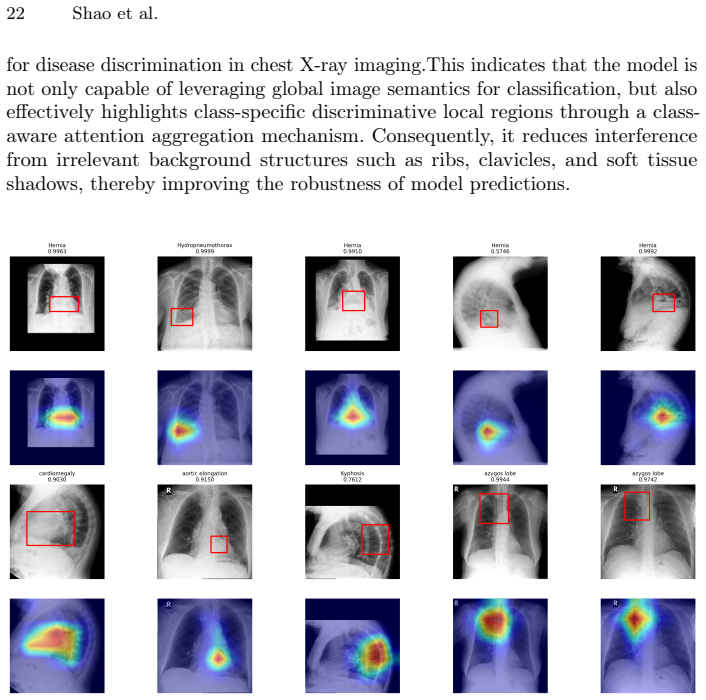
- Class-specific attention maps localize fine-grained lesion regions more effectively.
- Label co-occurrence modeling allows information from head classes to support tail classes.
Where Pith is reading between the lines
- The same generative-plus-graph approach could transfer to other long-tailed medical imaging tasks such as CT or MRI classification.
- The diffusion model’s semantic constraints might be relaxed or tightened to study the trade-off between sample diversity and label fidelity.
- Replacing the graph convolution with a learned attention graph could test whether explicit co-occurrence statistics are necessary.
Load-bearing premise
The synthetic tail-class images preserve pathology-consistent semantics and do not introduce artifacts that degrade the downstream classifier.
What would settle it
An experiment in which adding the generated images produces no gain or a loss in tail-class mAP on a held-out set of real images, or in which radiologists flag semantic inconsistencies between the synthetic samples and real pathology.
Figures


read the original abstract
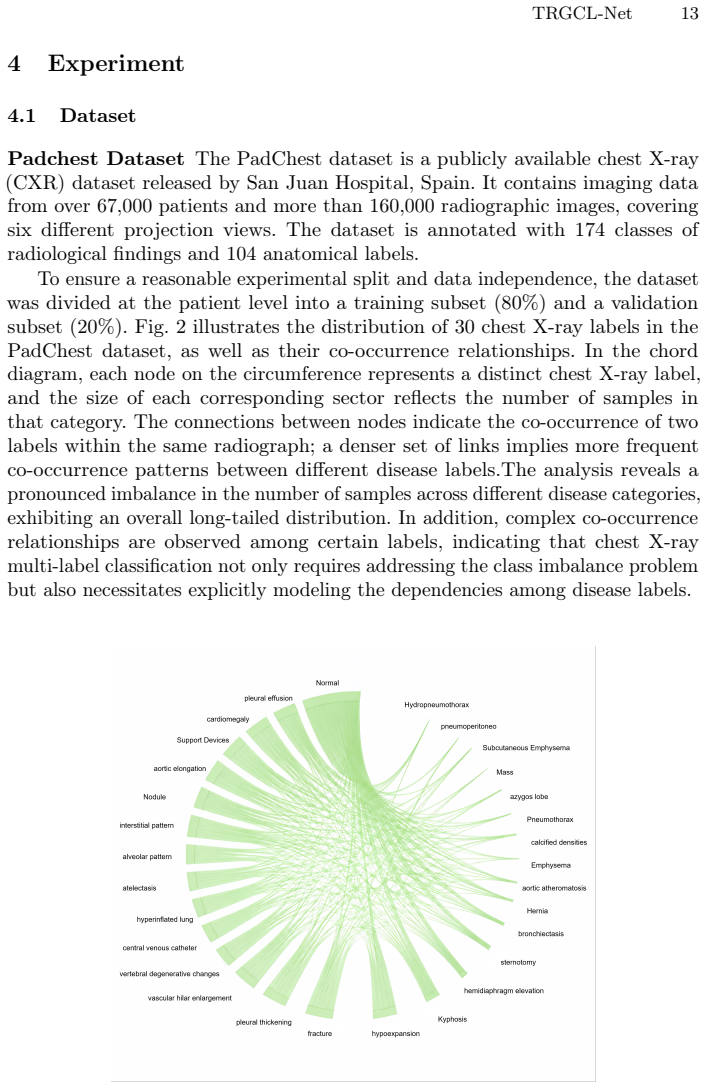
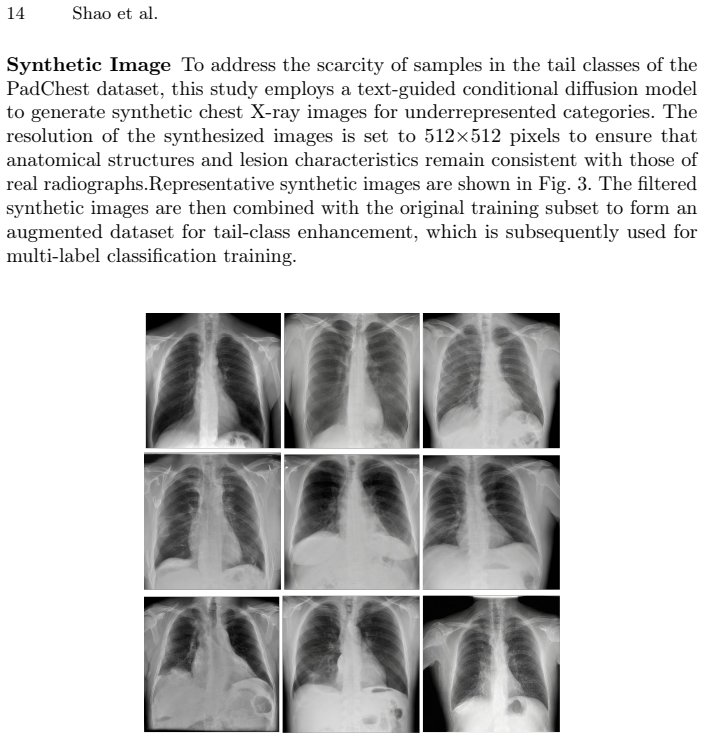
Chest X-ray multi-label classification is a core task in intelligent medical imaging diagnosis. However, real clinical data often exhibit extreme long-tailed distributions, leading to degraded performance on rare diseases in tail classes. This issue is not only driven by data scarcity but also by two intrinsic factors:1) attenuation of tail-class lesion representations under complex anatomical backgrounds, and 2) dominance of head classes in modeling label co-occurrence relationships. To address these challenges, we propose TRCGL-Net. First, a learnable text-guided conditional diffusion model is employed to generate high-quality tail-class chest X-ray image samples under disease semantic constraints, improving data diversity and realism of rare disease patterns while alleviating class imbalance and preserving pathology-consistent semantics.Second, a channel reweighting mechanism is introduced to perform feature recalibration by emphasizing disease-relevant feature channels, thereby improving feature discriminability under long-tailed distributions.A class-aware attention mechanism is further applied to generate class-specific attention maps, enabling the model to localize disease-relevant regions and focus on fine-grained lesion areas.Finally, a graph convolution network based on label co occurrence is introduced to establish an information propagation mechanism among categories. Experiments on the PadChest dataset show that the proposed method achieves a tail-class mAP of 0.4904, an overall mAP of 0.4408, and an mAUC of 0.8989, outperforming state-of-the-art methods. TRCGL-Net effectively improves recognition performance for rare diseases under long-tailed distributions and mitigates the impact of extreme class imbalance in chest X-ray multi-label classification.
Editorial analysis
A structured set of objections, weighed in public.
Referee Report
Summary. The manuscript proposes TRCGL-Net for long-tailed multi-label chest X-ray classification. It uses a learnable text-guided conditional diffusion model to generate tail-class samples under disease semantic constraints, a channel reweighting mechanism for feature recalibration, a class-aware attention mechanism for localizing lesion areas, and a graph convolution network based on label co-occurrence for information propagation. On the PadChest dataset, it reports tail-class mAP of 0.4904, overall mAP of 0.4408, and mAUC of 0.8989, outperforming state-of-the-art methods.
Significance. If the generative augmentation produces pathology-consistent samples that demonstrably improve tail-class performance without introducing artifacts, and if the other modules contribute independently, the work could meaningfully advance handling of extreme class imbalance in medical multi-label tasks. The combination of conditional diffusion with attention and GCN-based co-occurrence modeling targets two stated intrinsic factors (representation attenuation and head-class dominance) in a coherent way.
major comments (2)
- [Abstract] Abstract: The headline performance numbers (tail mAP 0.4904, overall mAP 0.4408, mAUC 0.8989) are stated without any experimental protocol, baseline details, statistical tests, ablation results, or dataset split information, so it is impossible to attribute gains to the diffusion model versus the channel reweighting, class-aware attention, or GCN modules.
- [Abstract] Abstract: The central claim that the text-guided diffusion model 'preserves pathology-consistent semantics' while alleviating imbalance lacks any supporting quantitative evidence (e.g., pathology-specific distribution metrics, radiologist ratings of generated vs. real images, or an ablation isolating the generative component), leaving open the possibility that reported gains arise from non-generative modules or from artifacts on this particular PadChest split.
Simulated Author's Rebuttal
We thank the referee for the constructive comments on our manuscript. We address each major comment below and will revise the abstract accordingly to improve clarity and context while preserving its conciseness.
read point-by-point responses
-
Referee: [Abstract] Abstract: The headline performance numbers (tail mAP 0.4904, overall mAP 0.4408, mAUC 0.8989) are stated without any experimental protocol, baseline details, statistical tests, ablation results, or dataset split information, so it is impossible to attribute gains to the diffusion model versus the channel reweighting, class-aware attention, or GCN modules.
Authors: We agree that the abstract would benefit from additional context on the experimental setup. The full manuscript details the PadChest dataset, the train/validation/test splits, comparison against multiple state-of-the-art baselines, ablation studies isolating each component (including the diffusion model), and evaluation metrics in Sections 4 and 5. In the revised version we will expand the abstract with a brief clause such as 'evaluated on PadChest with ablations demonstrating module contributions' to help readers attribute gains without exceeding typical abstract length limits. revision: yes
-
Referee: [Abstract] Abstract: The central claim that the text-guided diffusion model 'preserves pathology-consistent semantics' while alleviating imbalance lacks any supporting quantitative evidence (e.g., pathology-specific distribution metrics, radiologist ratings of generated vs. real images, or an ablation isolating the generative component), leaving open the possibility that reported gains arise from non-generative modules or from artifacts on this particular PadChest split.
Authors: The manuscript supports the claim through ablation experiments that isolate the generative augmentation's contribution to tail-class mAP gains, along with qualitative examples of generated images. We will revise the abstract to reference these ablations explicitly. The current study does not include radiologist ratings or pathology-specific distribution metrics such as FID per disease; these would require additional expert evaluation and are noted as potential future work rather than part of the present evidence. revision: partial
Circularity Check
No circularity: empirical framework with independent components
full rationale
The paper presents TRCGL-Net as a composite architecture (text-guided diffusion for tail-class augmentation, channel reweighting, class-aware attention, and GCN on label co-occurrence) whose performance is measured empirically on PadChest. No equations, fitted parameters renamed as predictions, or self-citation chains are described that would reduce any claimed result to its inputs by construction. The abstract and skeptic summary supply no load-bearing derivation that collapses; results are reported as experimental outcomes (tail mAP 0.4904 etc.) rather than algebraic identities.
Axiom & Free-Parameter Ledger
axioms (1)
- domain assumption A learnable text-guided conditional diffusion model can generate high-quality, pathology-consistent tail-class chest X-ray samples under disease semantic constraints.
Reference graph
Works this paper leans on
-
[1]
Overview of the cxr-lt 2026 challenge: Multi-center long-tailed and zero shot chest x-ray classification
Hexin Dong, Yi Lin, Pengyu Zhou, Xuan Zhong Feng, Alan Clint Legasto, Mingquan Lin, Hao Chen, Yuzhe Yang, George Shih, and Yifan Peng. Overview of the cxr-lt 2026 challenge: Multi-center long-tailed and zero shot chest x-ray classification. In 2026 IEEE 23rd International Symposium on Biomedical Imaging (ISBI), pages 1–4. IEEE, 2026
2026
-
[2]
Towards long-tailed, multi-label disease classification from chest x-ray: Overview of the cxr-lt challenge.Medical Image Analysis, 97:103224, 2024
Gregory Holste, Yiliang Zhou, Song Wang, Ajay Jaiswal, Mingquan Lin, Sherry Zhuge, Yuzhe Yang, Dongkyun Kim, Trong-Hieu Nguyen-Mau, Minh-Triet Tran, et al. Towards long-tailed, multi-label disease classification from chest x-ray: Overview of the cxr-lt challenge.Medical Image Analysis, 97:103224, 2024. TRGCL-Net 25
2024
-
[3]
Long- tailed multi-label classification with noisy label of thoracic diseases from chest x-ray
Haoran Lai, Qingsong Yao, Zhiyang He, Xiaodong Tao, and S Kevin Zhou. Long- tailed multi-label classification with noisy label of thoracic diseases from chest x-ray. In2024 IEEE International Symposium on Biomedical Imaging (ISBI), pages 1–5. IEEE, 2024
2024
-
[4]
Multi-label chest x-ray image classification with single positive labels
Jiayin Xiao, Si Li, Tongxu Lin, Jian Zhu, Xiaochen Yuan, David Dagan Feng, and Bin Sheng. Multi-label chest x-ray image classification with single positive labels. IEEE transactions on medical imaging, 43(12):4404–4418, 2024
2024
-
[5]
Multi-label disease detection in chest x-ray imaging using a fine-tuned convnextv2 with a customized classifier
Kangzhe Xiong, Yuyun Tu, Xinping Rao, Xiang Zou, and Yingkui Du. Multi-label disease detection in chest x-ray imaging using a fine-tuned convnextv2 with a customized classifier. InInformatics, volume 12, page 80. MDPI, 2025
2025
-
[6]
CheXNet: Radiologist-Level Pneumonia Detection on Chest X-Rays with Deep Learning
Pranav Rajpurkar, Jeremy Irvin, Kaylie Zhu, Brandon Yang, Hershel Mehta, Tony Duan, Daisy Ding, Aarti Bagul, Curtis Langlotz, Katie Shpanskaya, et al. Chexnet: Radiologist-level pneumonia detection on chest x-rays with deep learning. arxiv. arXiv preprint arXiv:1711.05225, 10, 2017
work page internal anchor Pith review Pith/arXiv arXiv 2017
-
[7]
An optimized transformer model for efficient detection of thoracic diseases in chest x-rays with multi-scale feature fusion.Plos one, 20(5):e0323239, 2025
Shasha Yu and Peng Zhou. An optimized transformer model for efficient detection of thoracic diseases in chest x-rays with multi-scale feature fusion.Plos one, 20(5):e0323239, 2025
2025
-
[8]
Ievit: An enhanced vision transformer architecture for chest x-ray image classification.Computer Methods and Programs in Biomedicine, 226:107141, 2022
Gabriel Iluebe Okolo, Stamos Katsigiannis, and Naeem Ramzan. Ievit: An enhanced vision transformer architecture for chest x-ray image classification.Computer Methods and Programs in Biomedicine, 226:107141, 2022
2022
-
[9]
Label correlation transformer for automated chest x-ray diagnosis with reliable inter- pretability.La radiologia medica, 128(6):726–733, 2023
Zexuan Sun, Linhao Qu, Jiazheng Luo, Zhijian Song, and Manning Wang. Label correlation transformer for automated chest x-ray diagnosis with reliable inter- pretability.La radiologia medica, 128(6):726–733, 2023
2023
-
[10]
Comparison of deep learning approaches for multi-label chest x-ray classification.Scientific reports, 9(1):6381, 2019
Ivo M Baltruschat, Hannes Nickisch, Michael Grass, Tobias Knopp, and Axel Saalbach. Comparison of deep learning approaches for multi-label chest x-ray classification.Scientific reports, 9(1):6381, 2019
2019
-
[11]
Feng Hong, Tianjie Dai, Jiangchao Yao, Ya Zhang, and Yanfeng Wang. Bag of tricks for long-tailed multi-label classification on chest x-rays.arXiv preprint arXiv:2308.08853, 2023
-
[12]
Enhancing multi-label long-tailed classification on chest x- rays through ml-gcn augmentation
HyeRyeong Seo, MinHyuk Lee, WooJin Cheong, HyeKyung Yoon, SoHyung Kim, and MyungJoo Kang. Enhancing multi-label long-tailed classification on chest x- rays through ml-gcn augmentation. InProceedings of the IEEE/CVF international conference on computer vision, pages 2747–2756, 2023
2023
-
[13]
Padchest: A large chest x-ray image dataset with multi-label annotated reports
Aurelia Bustos, Antonio Pertusa, Jose-Maria Salinas, and Maria De La Iglesia-Vaya. Padchest: A large chest x-ray image dataset with multi-label annotated reports. Medical image analysis, 66:101797, 2020
2020
-
[14]
Nikhileswara Rao Sulake. Loss design and architecture selection for long-tailed multi-label chest x-ray classification.arXiv preprint arXiv:2603.02294, 2026
-
[15]
Chin-Wei Huang, Mu-Yi Shen, Kuan-Chang Shih, Shih-Chih Lin, Chi-Yu Chen, and Po-Chih Kuo. Ltcxnet: Advancing chest x-ray analysis with solutions for long-tailed multi-label classification and fairness challenges.arXiv preprint arXiv:2411.10746, 2024
-
[16]
Evaluation of deep convolutional generative adversarial networks for data augmentation of chest x-ray images.Future Internet, 13(1):8, 2020
Sagar Kora Venu and Sridhar Ravula. Evaluation of deep convolutional generative adversarial networks for data augmentation of chest x-ray images.Future Internet, 13(1):8, 2020
2020
-
[17]
Qing Xu and Wenting Duan. Dualattnet: Synergistic fusion of image-level and fine- grained disease attention for multi-label lesion detection in chest x-rays.Computers in Biology and Medicine, 168:107742, 2024
2024
-
[18]
Automated thorax disease diagnosis using multi-branch residual attention network.Scientific Reports, 14(1):11865, 2024
Dongfang Li, Hua Huo, Shupei Jiao, Xiaowei Sun, and Shuya Chen. Automated thorax disease diagnosis using multi-branch residual attention network.Scientific Reports, 14(1):11865, 2024. 26 Shao et al
2024
-
[19]
John M Statheros, Hairong Wang, and Richard Klein. Clarity: A vision transformer for multi-label classification and weakly-supervised localization of chest x-ray pathologies.arXiv preprint arXiv:2512.16700, 2025
-
[20]
Bingzhi Chen, Jinxing Li, Guangming Lu, Hongbing Yu, and David Zhang. Label co-occurrence learning with graph convolutional networks for multi-label chest x-ray image classification.IEEE journal of biomedical and health informatics, 24(8):2292–2302, 2020
2020
-
[21]
Lanting Li, Peng Cao, Jinzhu Yang, and Osmar R Zaiane. Modeling global and local label correlation with graph convolutional networks for multi-label chest x-ray image classification.Medical & Biological Engineering & Computing, 60(9):2567–2588, 2022
2022
-
[22]
Label semantic improvement with graph convolutional networks for multi- label chest x-ray image classification
Dachuan Cai, Huijuan Lu, Zhuijun Chai, Renfeng Wang, Wenjie Zhu, and Yudong Yao. Label semantic improvement with graph convolutional networks for multi- label chest x-ray image classification. In2023 13th International Conference on Information Technology in Medicine and Education (ITME), pages 711–717. IEEE, 2023
2023
-
[23]
Graph guided multiscale cross attention for multilabel chest x ray classification.Scientific Reports, 2026
Guokun Shi, Zijian Wang, Yucheng Shi, Jingwen Pan, Liping Sun, Fang Fang, and Li Jin. Graph guided multiscale cross attention for multilabel chest x ray classification.Scientific Reports, 2026
2026
-
[25]
Deep residual learning for image recognition: A survey.Applied sciences, 12(18):8972, 2022
Muhammad Shafiq and Zhaoquan Gu. Deep residual learning for image recognition: A survey.Applied sciences, 12(18):8972, 2022
2022
-
[26]
Efficientnet: Rethinking model scaling for convolutional neural networks
Mingxing Tan and Quoc Le. Efficientnet: Rethinking model scaling for convolutional neural networks. InInternational conference on machine learning, pages 6105–6114. PMLR, 2019
2019
-
[27]
A convnet for the 2020s
Zhuang Liu, Hanzi Mao, Chao-Yuan Wu, Christoph Feichtenhofer, Trevor Darrell, and Saining Xie. A convnet for the 2020s. InProceedings of the IEEE/CVF conference on computer vision and pattern recognition, pages 11976–11986, 2022
2022
-
[28]
An Image is Worth 16x16 Words: Transformers for Image Recognition at Scale
Alexey Dosovitskiy, Lucas Beyer, Alexander Kolesnikov, Dirk Weissenborn, Xiaohua Zhai, Thomas Unterthiner, Mostafa Dehghani, Matthias Minderer, Georg Heigold, Sylvain Gelly, et al. An image is worth 16x16 words: Transformers for image recognition at scale.arXiv preprint arXiv:2010.11929, 2020
work page internal anchor Pith review Pith/arXiv arXiv 2010
-
[29]
Learning transferable visual models from natural language supervision
Alec Radford, Jong Wook Kim, Chris Hallacy, Aditya Ramesh, Gabriel Goh, Sandhini Agarwal, Girish Sastry, Amanda Askell, Pamela Mishkin, Jack Clark, et al. Learning transferable visual models from natural language supervision. In International conference on machine learning, pages 8748–8763. PmLR, 2021
2021
-
[30]
Handling supervision scarcity in chest x-ray classification: Long-tailed and zero-shot learning
Ha-Hieu Pham, Hai-Dang Nguyen, Thanh-Huy Nguyen, Min Xu, Ulas Bagci, Trung-Nghia Le, and Huy-Hieu Pham. Handling supervision scarcity in chest x-ray classification: Long-tailed and zero-shot learning. In2026 IEEE 23rd International Symposium on Biomedical Imaging (ISBI), pages 1–4. IEEE, 2026
2026
discussion (0)
Sign in with ORCID, Apple, or X to comment. Anyone can read and Pith papers without signing in.