Understanding eccentric temperate giants: an in-depth study of the architecture and stellar obliquity of the TOI-2134 system
Pith reviewed 2026-07-02 05:21 UTC · model grok-4.3
The pith
New TESS and RV data confirm TOI-2134 planets and detect 59-degree obliquity for the outer one
A machine-rendered reading of the paper's core claim, the machinery that carries it, and where it could break.
Core claim
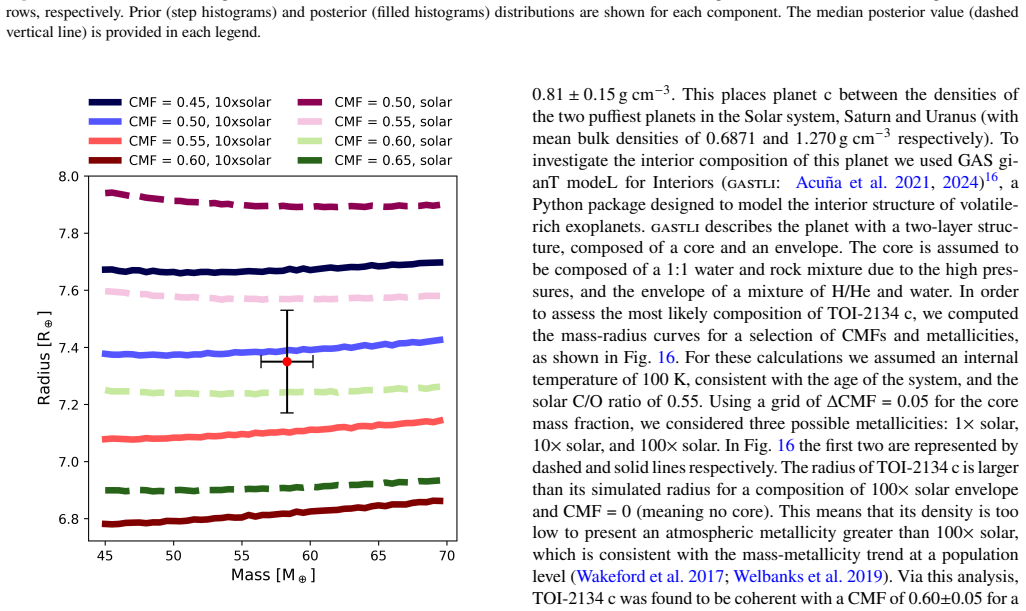
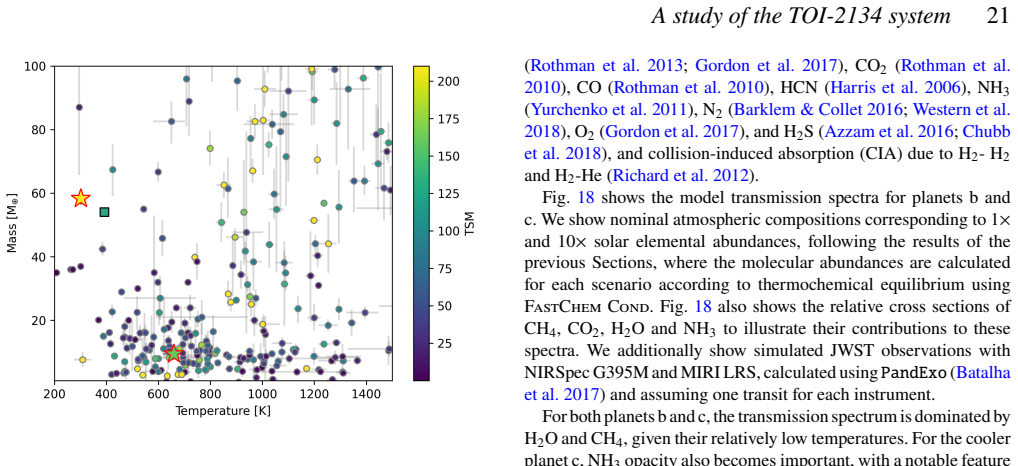
The authors confirm an inner planet with mass 9.37±0.54 Earth masses, radius 2.735±0.068 Earth radii, and a near-circular 9.229198-day orbit, plus an outer planet with mass 58.3±1.9 Earth masses, radius 7.35±0.18 Earth radii, 95.85284-day period, and eccentricity 0.31. They report a 59±31 degree obliquity for the outer planet at 4.7-sigma significance and attribute the long-term radial-velocity trend to a stellar magnetic cycle.
What carries the argument
Joint modeling of multi-sector TESS photometry and multi-instrument radial velocities, together with Rossiter-McLaughlin observations to measure stellar obliquity.
If this is right
- The refined eccentricity removes prior degeneracies for dynamical stability analyses of the pair.
- The measured obliquity for the outer planet constrains possible past scattering or migration pathways.
- The updated masses and radii permit direct calculation of bulk densities for interior models.
- The system architecture assessment identifies which additional planets could still hide in the data.
Where Pith is reading between the lines
- If the obliquity is primordial rather than excited, it would favor in-situ formation or disk-driven migration over high-eccentricity channels for this temperate giant.
- Longer radial-velocity baselines could test whether the trend is truly cyclic or contains an additional planetary signal.
- Detection of similar misalignments in other eccentric sub-Saturn systems would suggest a common pathway for generating obliquity in multi-planet architectures.
Load-bearing premise
The long-term radial velocity trend arises from a stellar magnetic cycle rather than an additional unseen companion.
What would settle it
Independent photometry or activity indicators that correlate with the radial-velocity trend, or a failure to recover the Rossiter-McLaughlin signal for the outer planet in new observations.
Figures






read the original abstract
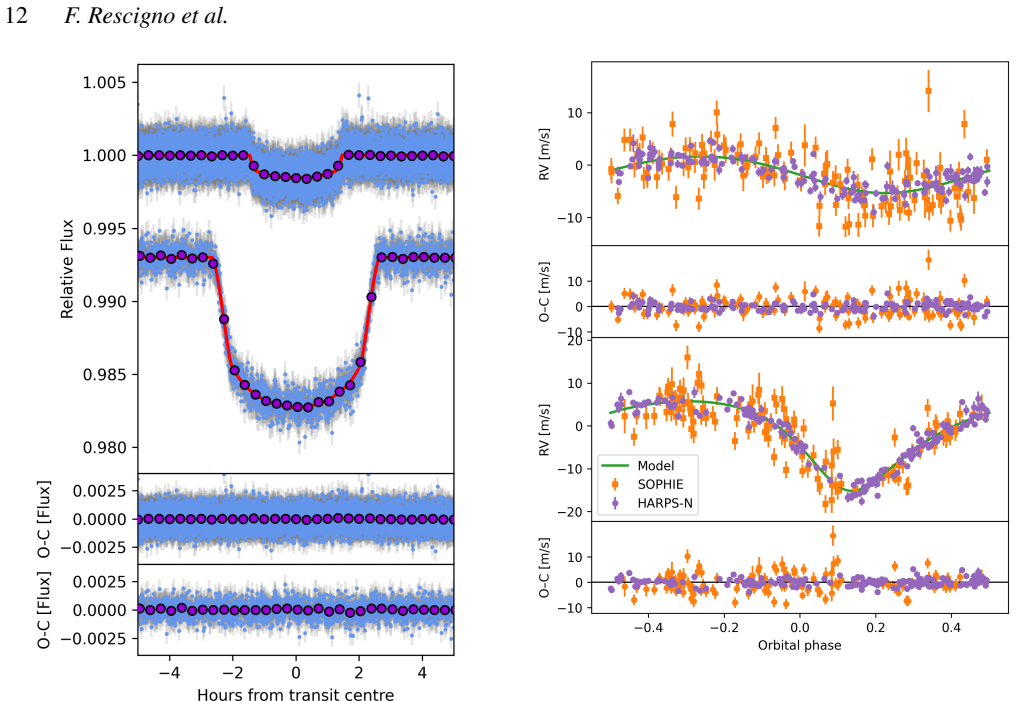
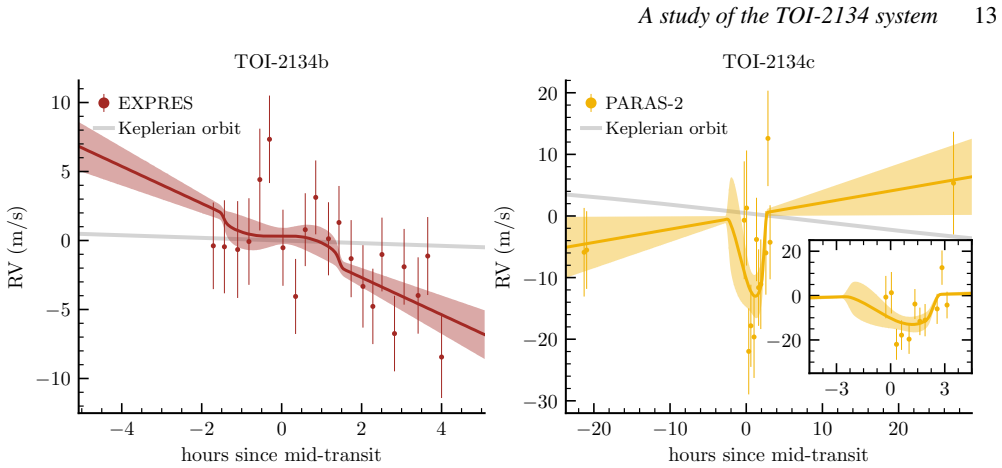
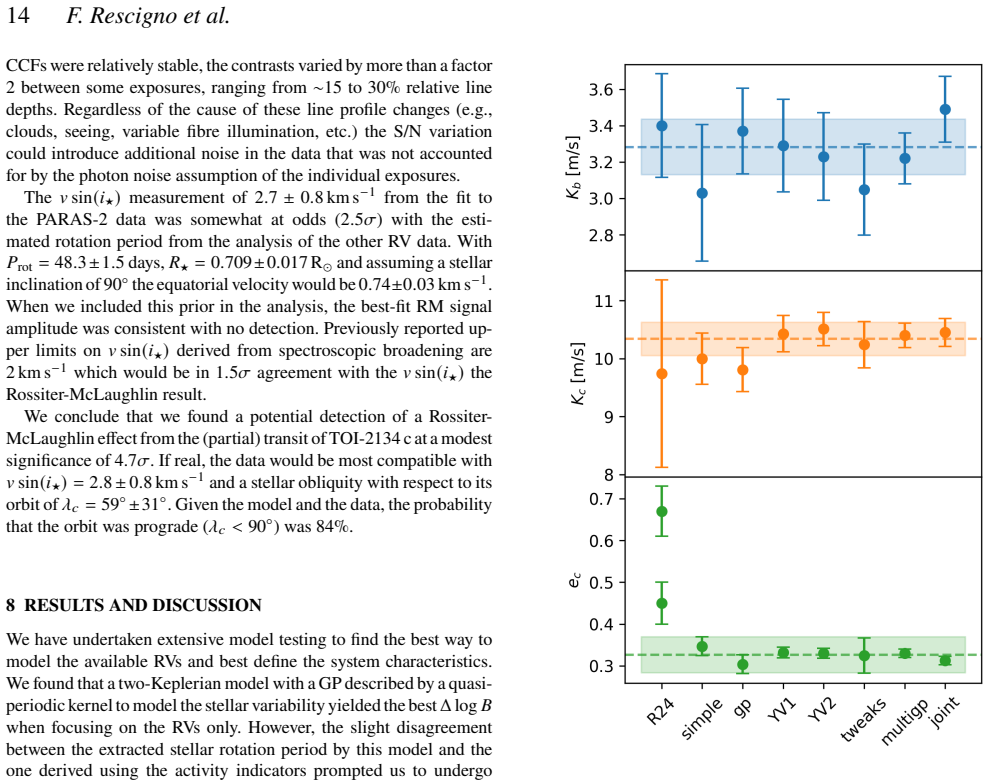
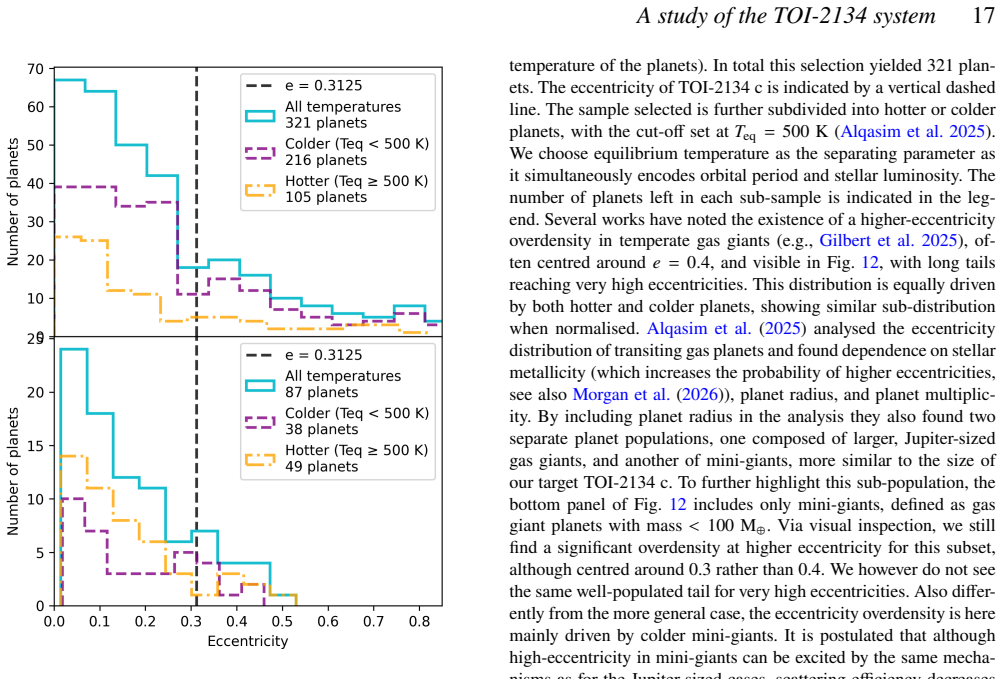
We revisit the TOI-2134 planetary system with three new high-cadence TESS sectors and 98 more spectra. This new analysis confirms the two orbiting planets by simultaneously modelling a total of eight sectors of corrected TESS photometry and 280 HARPS-N and SOPHIE radial velocities: an inner mini-Neptune in a near-circular $9.229198\pm0.000003$ days orbit, and an outer temperate sub-Saturn orbiting with a $95.852840\pm0.000042$ days period and eccentricity of $0.31\pm0.01$. The masses and radii of the planets were computed to be $9.37\pm0.54$ Me and $2.735\pm0.068$ Re for planet b, and $58.3\pm1.9$ Me and $7.35\pm0.18$ Re for planet c. The new data not only improves the detection significance and precisions on the planetary orbits, but also breaks the original multimodality in the eccentricity solution for the outer planet. We also detect a long-term trend in the radial velocity data, which we attribute to a stellar magnetic cycle. We investigate the spin-orbit alignment of the system via observations of the Rossiter-McLaughlin effect for TOI-2134~b with EXPRES and TOI-2134~c with PARAS-2. No RM effect was detected for planet b, but we find a 4.7$\sigma$ detection of a $59\pm31^{\circ}$ obliquity for planet c. Finally, we examine the architecture of the system, assess its completeness, investigate the planetary interior, and their suitability for follow-up atmospheric analysis.
Editorial analysis
A structured set of objections, weighed in public.
Referee Report
Summary. The manuscript reports new TESS photometry (eight sectors) and 280 radial velocities from HARPS-N, SOPHIE, EXPRES, and PARAS-2 for the TOI-2134 system. It confirms an inner mini-Neptune (planet b: P=9.229198±0.000003 d, near-circular) and outer temperate sub-Saturn (planet c: P=95.852840±0.000042 d, e=0.31±0.01), derives masses 9.37±0.54 M⊕ and 58.3±1.9 M⊕ with radii 2.735±0.068 R⊕ and 7.35±0.18 R⊕, breaks the prior eccentricity multimodality for c, attributes a long-term RV trend to a stellar magnetic cycle, and reports a 4.7σ RM detection of 59±31° obliquity for planet c while assessing system architecture and atmospheric follow-up potential.
Significance. If the two-planet solution and obliquity measurement hold, the work supplies one of the best-characterized temperate sub-Saturns with a measured spin-orbit angle, directly constraining migration and dynamical history models. The improved eccentricity constraint and RM result add to the small sample of obliquity measurements for planets beyond the hot-Jupiter regime.
major comments (1)
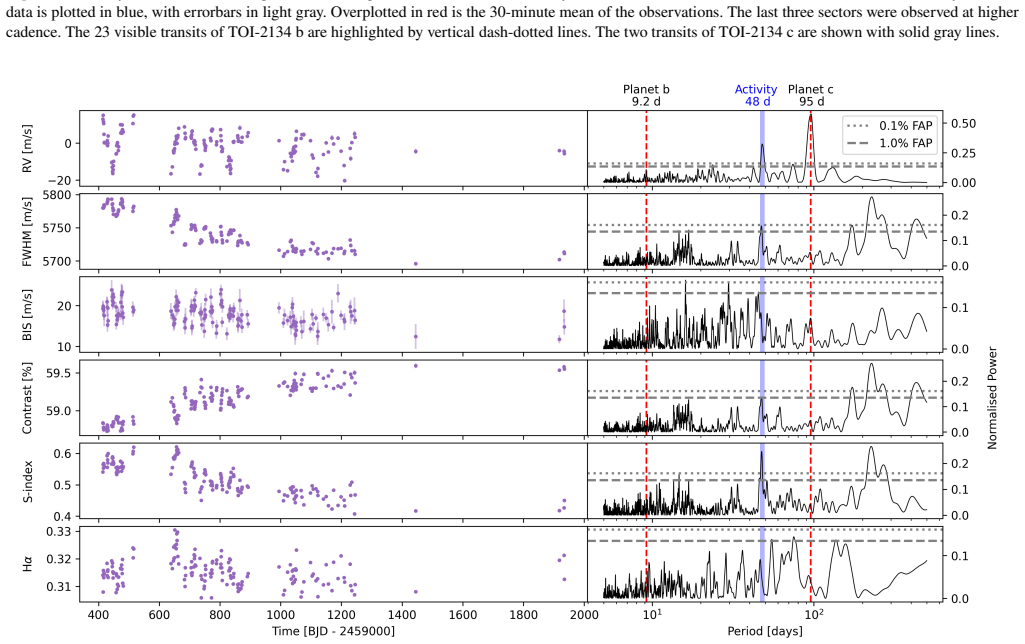
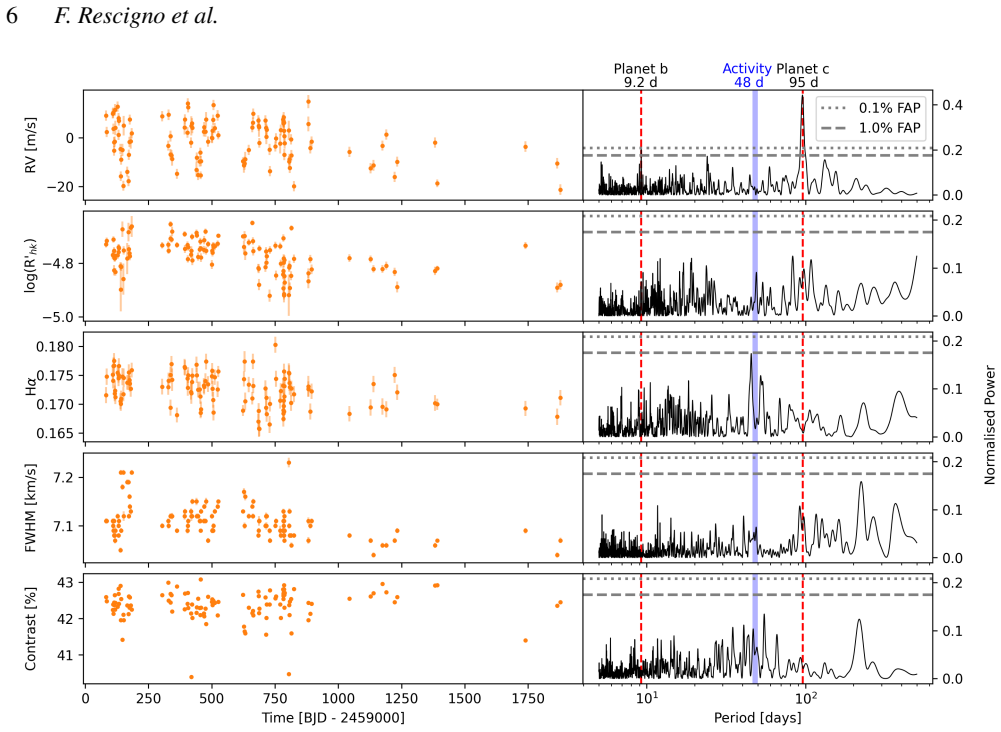
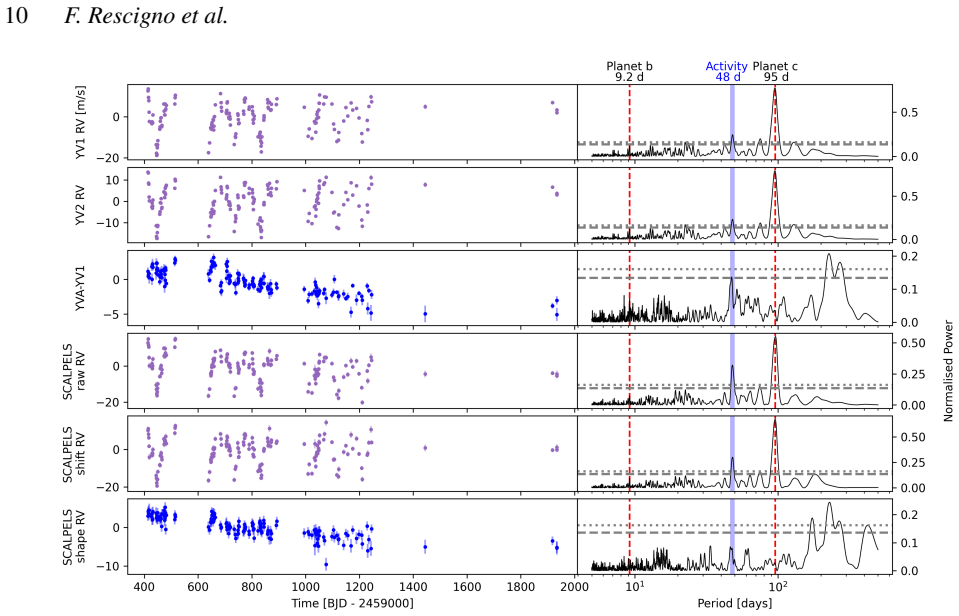
- [Abstract and RV modeling section] Abstract and radial-velocity modeling section: the long-term RV trend is attributed to a stellar magnetic cycle, yet no correlation analysis with activity indicators (log R'HK, S-index) or contemporaneous photometry is described. This assumption is load-bearing for the claim of exactly two planets, as an unmodeled long-period companion would alter the two-Keplerian solution, the eccentricity posterior, and the RM obliquity interpretation.
Simulated Author's Rebuttal
We thank the referee for their careful reading of the manuscript and for highlighting this important point regarding the long-term RV trend. We address the comment below and will revise the manuscript to strengthen the supporting analysis.
read point-by-point responses
-
Referee: [Abstract and RV modeling section] Abstract and radial-velocity modeling section: the long-term RV trend is attributed to a stellar magnetic cycle, yet no correlation analysis with activity indicators (log R'HK, S-index) or contemporaneous photometry is described. This assumption is load-bearing for the claim of exactly two planets, as an unmodeled long-period companion would alter the two-Keplerian solution, the eccentricity posterior, and the RM obliquity interpretation.
Authors: We agree that the current manuscript does not present a quantitative correlation analysis between the long-term RV trend and stellar activity indicators. In the revised manuscript we will add this analysis in the RV modeling section, including Spearman rank correlations (and associated p-values) between the RV residuals after subtracting the two-planet model and the log R'HK and S-index values measured from the HARPS-N and SOPHIE spectra. We will also examine any available contemporaneous photometry from TESS or ground-based surveys for photometric activity proxies. If the correlations are significant and consistent with a magnetic-cycle timescale, this will directly support the attribution; if not, we will discuss the implications for possible additional companions. The two-planet solution itself remains anchored by the eight-sector TESS photometry and the clear Keplerian signals, but we acknowledge that a more robust treatment of the trend is needed to fully secure the eccentricity and obliquity results. revision: yes
Circularity Check
No significant circularity detected; central results are direct model fits to new external observations
full rationale
The paper's derivation chain consists of simultaneous modeling of eight TESS sectors and 280 new+archival RVs from HARPS-N, SOPHIE, EXPRES, and PARAS-2 to extract orbital elements, masses, radii, and the RM obliquity for planet c. These quantities are obtained by fitting Keplerian models plus a trend term directly to the fresh data; no step reduces a claimed prediction back to a previously fitted parameter by construction, nor does any load-bearing premise rest on a self-citation chain. The attribution of the long-term RV trend to a magnetic cycle is an interpretive choice rather than a mathematical reduction, and the eccentricity multimodality breaking is a direct consequence of the added observations. The analysis is therefore self-contained against external benchmarks.
Axiom & Free-Parameter Ledger
free parameters (1)
- orbital periods, eccentricities, masses, radii
axioms (2)
- domain assumption Standard Keplerian orbit model and limb-darkening assumptions hold for the RM effect analysis
- domain assumption Long-term RV trend originates from stellar magnetic cycle rather than additional body
Reference graph
Works this paper leans on
-
[1]
All you need is Love numbers: simultaneous measurement of the oblateness and atmospheric composition of a warm gas giant
-
[2]
Towards a new era in giant exoplanet characterisation. , keywords =. doi:10.1051/0004-6361/202244827 , archivePrefix =. 2211.05468 , primaryClass =
-
[3]
HAT-P-26b: A Neptune-Mass Exoplanet with a Well Constrained Heavy Element Abundance
HAT-P-26b: A Neptune-mass exoplanet with a well-constrained heavy element abundance. Science , keywords =. doi:10.1126/science.aah4668 , archivePrefix =. 1705.04354 , primaryClass =
work page internal anchor Pith review Pith/arXiv arXiv doi:10.1126/science.aah4668
-
[4]
Mass-Metallicity Trends in Transiting Exoplanets from Atmospheric Abundances of H _ 2 O, Na, and K. , keywords =. doi:10.3847/2041-8213/ab5a89 , archivePrefix =. 1912.04904 , primaryClass =
-
[5]
Separating planetary reflex Doppler shifts from stellar variability in the wavelength domain. , keywords =. doi:10.1093/mnras/stab1323 , archivePrefix =. 2011.00018 , primaryClass =
-
[6]
Sub-m s ^ -1 upper limits from a deep HARPS-N radial-velocity search for planets orbiting HD 166620 and HD 144579. , keywords =. doi:10.1093/mnras/stad2381 , archivePrefix =. 2308.01348 , primaryClass =
-
[7]
The impact of two non-transiting planets and stellar activity on mass determinations for the super-Earth CoRoT-7b. , keywords =. doi:10.1093/mnras/stac1814 , archivePrefix =. 2206.14216 , primaryClass =
-
[8]
kima: Exoplanet detection in radial velocities
kima: Exoplanet detection in radial velocities. The Journal of Open Source Software , keywords =. doi:10.21105/joss.00487 , archivePrefix =. 1806.08305 , primaryClass =
work page internal anchor Pith review Pith/arXiv arXiv doi:10.21105/joss.00487
-
[9]
Astronomy & Astrophysics , author =
Planetary nebulae seen with. Astronomy & Astrophysics , author =. 2020 , pages =. doi:10.1051/0004-6361/201937118 , abstract =
-
[11]
Lowell Observatory Bulletin , author =
The. Lowell Observatory Bulletin , author =. 1979 , pages =
1979
-
[12]
The Astronomical Journal , author =
The. The Astronomical Journal , author =. 2019 , keywords =. doi:10.3847/1538-3881/ab3467 , abstract =
-
[13]
2020 , keywords =
VizieR Online Data Catalog , author =. 2020 , keywords =
2020
-
[14]
The Astronomical Journal , author =
Dwarf. The Astronomical Journal , author =. 1986 , keywords =. doi:10.1086/114146 , urldate =
-
[15]
JATIS , year = 2015, month = jan, volume =
The. Journal of Astronomical Telescopes, Instruments, and Systems , author =. 2014 , note =. doi:10.1117/1.JATIS.1.1.014003 , abstract =
work page internal anchor Pith review doi:10.1117/1.jatis.1.1.014003 2014
-
[16]
The Astrophysical Journal , author =. 2010 , note =. doi:10.1088/2041-8205/713/2/L87 , number =
-
[17]
Twicken, Joseph D. and Clarke, Bruce D. and Bryson, Stephen T. and Tenenbaum, Peter and Wu, Hayley and Jenkins, Jon M. and Girouard, Forrest and Klaus, Todd C. , editor =. Photometric analysis in the. Software and. 2010 , pages =. doi:10.1117/12.856790 , urldate =
-
[18]
and Twicken, Joseph D
Morris, Robert L. and Twicken, Joseph D. and Smith, Jeffrey C. and Clarke, Bruce D. and Jenkins, Jon M. and Bryson, Stephen T. and Girouard, Forrest and Klaus, Todd C. , month = mar, year =. Kepler
-
[19]
The Astrophysical Journal Letters , author =. 2019 , note =. doi:10.3847/2041-8213/ab322d , abstract =
-
[20]
Ground-based and Airborne Instrumentation for Astronomy IV , year = 2012, editor =
Harps-N: the new planet hunter at TNG. Ground-based and Airborne Instrumentation for Astronomy IV , year = 2012, editor =. doi:10.1117/12.925738 , adsurl =
-
[21]
Ground-based and Airborne Instrumentation for Astronomy V , year = 2014, editor =
HARPS-N @ TNG, two year harvesting data: performances and results. Ground-based and Airborne Instrumentation for Astronomy V , year = 2014, editor =. doi:10.1117/12.2055813 , adsurl =
-
[22]
Three years of HARPS-N high-resolution spectroscopy and precise radial velocity data for the Sun. , keywords =. doi:10.1051/0004-6361/202039350 , archivePrefix =. 2009.01945 , primaryClass =
-
[23]
Perruchot, S. and Kohler, D. and Bouchy, F. and Richaud, Y. and Richaud, P. and Moreaux, G. and Merzougui, M. and Sottile, R. and Hill, L. and Knispel, G. and Regal, X. and Meunier, J.-P. and Ilovaisky, S. and Le Coroller, H. and Gillet, D. and Schmitt, J. and Pepe, F. and Fleury, M. and Sosnowska, D. and Vors, P. and Mégevand, D. and Blanc, P. E. and Car...
-
[24]
Astronomy & Astrophysics , author =. 2013 , note =. doi:10.1051/0004-6361/201219979 , urldate =
-
[25]
Ground-based and Airborne Instrumentation for Astronomy VII , author =. 2018 , note =. doi:10.1117/12.2313055 , abstract =
-
[26]
Bulletin de la Societe Royale des Sciences de Liege , author =
The. Bulletin de la Societe Royale des Sciences de Liege , author =. 2024 , pages =. doi:10.25518/0037-9565.11602 , abstract =
-
[27]
Ground-based and Airborne Instrumentation for Astronomy II , year = 2008, editor =
PRL advanced radial-velocity all-sky search (PARAS): an efficient fiber-fed spectrograph for planet searches. Ground-based and Airborne Instrumentation for Astronomy II , year = 2008, editor =. doi:10.1117/12.788124 , adsurl =
-
[28]
The Astrophysical Journal , author =
The relation between stellar rotation rate and activity cycle periods , volume =. The Astrophysical Journal , author =. 1984 , keywords =. doi:10.1086/162735 , language =
-
[29]
The Astrophysical Journal , author =. 2012 , keywords =. doi:10.1088/2041-8205/747/2/L32 , number =
-
[30]
Astronomy & Astrophysics , author =
The generalised. Astronomy & Astrophysics , author =. 2009 , keywords =. doi:10.1051/0004-6361:200811296 , abstract =
-
[31]
Planets and Stellar Activity: Hide and Seek in the CoRoT-7 system
Planets and stellar activity: hide and seek in the CoRoT-7 system. , keywords =. doi:10.1093/mnras/stu1320 , archivePrefix =. 1407.1044 , primaryClass =
work page internal anchor Pith review Pith/arXiv arXiv doi:10.1093/mnras/stu1320
-
[32]
emcee:. Publications of the Astronomical Society of the Pacific , author =. 2013 , note =. doi:10.1086/670067 , abstract =
-
[33]
and Dixon, B
Rescigno, F. and Dixon, B. and Haywood, R. D. , month = oct, year =
-
[34]
The Astrophysical Journal , author =
Analytic. The Astrophysical Journal , author =. 2002 , note =. doi:10.1086/345520 , number =
-
[35]
Publications of the Astronomical Society of the Pacific , author =
batman :. Publications of the Astronomical Society of the Pacific , author =. 2015 , note =. doi:10.1086/683602 , language =
work page internal anchor Pith review doi:10.1086/683602 2015
-
[36]
Monthly Notices of the Royal Astronomical Society , author =
Efficient, uninformative sampling of limb darkening coefficients for two-parameter laws , volume =. Monthly Notices of the Royal Astronomical Society , author =. 2013 , note =. doi:10.1093/mnras/stt1435 , language =
-
[37]
Publications of the Astronomical Society of the Pacific , author =. 2013 , keywords =. doi:10.1086/669497 , abstract =
-
[38]
The Astronomical Journal , author =
An ultra-short period rocky super-. The Astronomical Journal , author =. 2018 , note =. doi:10.3847/1538-3881/aaa5b5 , abstract =
-
[39]
The GAPS programme with HARPS-N at TNG. XI. Pr 0211 in M 44: the first multi-planet system in an open cluster. , keywords =. doi:10.1051/0004-6361/201527933 , archivePrefix =. 1602.00009 , primaryClass =
work page internal anchor Pith review Pith/arXiv arXiv doi:10.1051/0004-6361/201527933
-
[41]
Dynesty: v2.1.4 , shorttitle =
Koposov, Sergey and Speagle, Josh and Barbary, Kyle and Ashton, Gregory and Bennett, Ed and Buchner, Johannes and Scheffler, Carl and Cook, Ben and Talbot, Colm and Guillochon, James and Cubillos, Patricio and Ramos, Andrés Asensio and Dartiailh, Matthieu and Ilya and Tollerud, Erik and Lang, Dustin and Johnson, Ben and jtmendel and Higson, Edward and Van...
-
[42]
Internaltional Statistical Institute , author =
Information measures and model selection , volume =. Internaltional Statistical Institute , author =. 1983 , pages =
1983
-
[43]
Communications in Statistics - Theory and Methods , author =
Further analysis of the data by. Communications in Statistics - Theory and Methods , author =. 1978 , note =. doi:10.1080/03610927808827599 , language =
-
[44]
The Astrophysical Journal , author =
Secretly. The Astrophysical Journal , author =. 2013 , pages =. doi:10.1088/0004-637X/774/2/147 , abstract =
-
[45]
Astronomy & Astrophysics , author =
The. Astronomy & Astrophysics , author =. 2023 , pages =. doi:10.1051/0004-6361/202346476 , abstract =
-
[46]
dfm/tinygp:
Foreman-Mackey, Daniel and Yu, Weixiang and Yadav, Sachin and Becker, McCoy Reynolds and Caplar, Neven and Huppenkothen, Daniela and Killestein, Thomas and Tronsgaard, René and Rashid, Theo and Schmerler, Steve , month = jan, year =. dfm/tinygp:
-
[47]
Monthly Notices of the Royal Astronomical Society , author =
A. Monthly Notices of the Royal Astronomical Society , author =. 2015 , note =. doi:10.1093/mnras/stv1428 , abstract =
-
[48]
Monthly Notices of the Royal Astronomical Society , author =
A. Monthly Notices of the Royal Astronomical Society , author =. 2021 , keywords =. doi:10.1093/mnras/stab2192 , abstract =
-
[49]
Monthly Notices of the Royal Astronomical Society , author =. 2022 , keywords =. doi:10.1093/mnras/stab2889 , abstract =
-
[50]
Astronomy & Astrophysics , author =
The. Astronomy & Astrophysics , author =. 2022 , note =. doi:10.1051/0004-6361/202243743 , abstract =
-
[51]
The Astrophysical Journal , author =. 2017 , note =. doi:10.3847/1538-4357/834/1/17 , abstract =
-
[52]
The Astrophysical Journal , author =. 2016 , note =. doi:10.3847/0004-637X/819/2/127 , abstract =
-
[53]
The Astrophysical Journal , author =. 2014 , note =. doi:10.1088/2041-8205/787/2/L29 , number =
-
[54]
Astronomy & Astrophysics , author =. 2021 , keywords =. doi:10.1051/0004-6361/202140986 , abstract =
-
[55]
Astronomy & Astrophysics , author =. 2023 , note =. doi:10.1051/0004-6361/202347232 , abstract =
-
[56]
Astronomy & Astrophysics , author =. 2020 , note =. doi:10.1051/0004-6361/202037722 , abstract =
-
[57]
Astronomy & Astrophysics , author =
Measuring precise radial velocities on individual spectral lines:. Astronomy & Astrophysics , author =. 2018 , keywords =. doi:10.1051/0004-6361/201833795 , abstract =
-
[58]
Astronomy & Astrophysics , author =
Stellar activity correction using. Astronomy & Astrophysics , author =. 2022 , note =. doi:10.1051/0004-6361/202142435 , abstract =
-
[59]
First unambiguous detection of ammonia in the atmosphere of a planetary mass companion with JWST/MIRI coronagraphs. , keywords =. doi:10.1051/0004-6361/202452695 , archivePrefix =. 2501.00104 , primaryClass =
-
[60]
FASTCHEM COND: equilibrium chemistry with condensation and rainout for cool planetary and stellar environments. , keywords =. doi:10.1093/mnras/stad3515 , archivePrefix =. 2309.02337 , primaryClass =
-
[61]
, archivePrefix = "arXiv", eprint =
genesis: new self-consistent models of exoplanetary spectra. , archivePrefix = "arXiv", eprint =. doi:10.1093/mnras/stx1601 , adsurl =
-
[62]
On the Temperature Profiles and Emission Spectra of Mini-Neptune Atmospheres. , keywords =. doi:10.3847/1538-4357/abbfb1 , archivePrefix =. 2009.11290 , primaryClass =
-
[63]
, year = 2010, month = oct, volume = 111, pages =
HITEMP, the high-temperature molecular spectroscopic database. , year = 2010, month = oct, volume = 111, pages =. doi:10.1016/j.jqsrt.2010.05.001 , adsurl =
-
[64]
Journal of Molecular Spectroscopy , archivePrefix = "arXiv", eprint =
Vibrational transition moments of CH _ 4 from first principles. Journal of Molecular Spectroscopy , archivePrefix = "arXiv", eprint =. doi:10.1016/j.jms.2013.05.014 , adsurl =
-
[65]
The rotation-vibration spectrum of methane up to 1500 K
ExoMol line lists - IV. The rotation-vibration spectrum of methane up to 1500 K. , archivePrefix = "arXiv", eprint =. doi:10.1093/mnras/stu326 , adsurl =
-
[66]
, year = 2013, month = nov, volume = 130, pages =
The HITRAN2012 molecular spectroscopic database. , year = 2013, month = nov, volume = 130, pages =. doi:10.1016/j.jqsrt.2013.07.002 , adsurl =
-
[67]
The HITRAN2016 molecular spectroscopic database. , keywords =. doi:10.1016/j.jqsrt.2017.06.038 , adsurl =
-
[68]
Improved HCN/HNC linelist, model atmospheres and synthetic spectra for WZ Cas. , eprint =. doi:10.1111/j.1365-2966.2005.09960.x , adsurl =
-
[69]
Thirty systems with space-based light curves
A variationally computed line list for hot NH _ 3. , archivePrefix = "arXiv", eprint =. doi:10.1111/j.1365-2966.2011.18261.x , adsurl =
-
[70]
, year = 2012, month = jul, volume =
C. Richard and I.E. Gordon and L.S. Rothman and M. Abel and L. Frommhold and M. Gustafsson and J.-M. Hartmann and C. Hermans and W.J. Lafferty and G.S. Orton and K.M. Smith and H. Tran. New section of the HITRAN database: Collision-induced absorption (CIA). Journal of Quantitative Spectroscopy and Radiative Transfer. 2012. doi:https://doi.org/10.1016/j.jq...
-
[71]
2023, ApJL, 956, L13, doi: 10.3847/2041-8213/acf577
Carbon-bearing Molecules in a Possible Hycean Atmosphere. , keywords =. doi:10.3847/2041-8213/acf577 , archivePrefix =. 2309.05566 , primaryClass =
-
[72]
2024, A&A, 683, L2, doi: 10.1051/0004-6361/202348238
Possible Hycean conditions in the sub-Neptune TOI-270 d. , keywords =. doi:10.1051/0004-6361/202348238 , archivePrefix =. 2403.03244 , primaryClass =
-
[73]
JWST Reveals CH _4 , CO _2 , and H _2 O in a Metal-rich Miscible Atmosphere on a Two-Earth-Radius Exoplanet. arXiv e-prints , keywords =. doi:10.48550/arXiv.2403.03325 , archivePrefix =. 2403.03325 , primaryClass =
-
[74]
PandExo: A Community Tool for Transiting Exoplanet Science with JWST & HST
PandExo: A Community Tool for Transiting Exoplanet Science with JWST & HST. , keywords =. doi:10.1088/1538-3873/aa65b0 , archivePrefix =. 1702.01820 , primaryClass =
work page internal anchor Pith review Pith/arXiv arXiv doi:10.1088/1538-3873/aa65b0
-
[75]
A high internal heat flux and large core in a warm Neptune exoplanet. , keywords =. doi:10.1038/s41586-024-07514-w , archivePrefix =. 2405.11018 , primaryClass =
-
[76]
A Second Visit to Eps Ind Ab with JWST: New Photometry Confirms Ammonia and Suggests Thick Clouds in the Exoplanet Atmosphere of the Closest Super-Jupiter. , keywords =. doi:10.3847/2041-8213/ae5823 , adsurl =
-
[77]
The Compositions of the HR 8799 Planets Reflect Accretion of Both Solids and Metal-enriched Gas. , keywords =. doi:10.3847/1538-4357/ae448f , archivePrefix =. 2602.09422 , primaryClass =
-
[78]
Compositional diversity in the atmospheres of hot Neptunes, with application to GJ 436b
Compositional Diversity in the Atmospheres of Hot Neptunes, with Application to GJ 436b. , keywords =. doi:10.1088/0004-637X/777/1/34 , archivePrefix =. 1306.5178 , primaryClass =
work page internal anchor Pith review Pith/arXiv arXiv doi:10.1088/0004-637x/777/1/34
-
[79]
Partition functions and equilibrium constants for diatomic molecules and atoms of astrophysical interest. , keywords =. doi:10.1051/0004-6361/201526961 , archivePrefix =. 1602.03304 , primaryClass =
work page internal anchor Pith review Pith/arXiv arXiv doi:10.1051/0004-6361/201526961
-
[80]
The spectrum of N$_2$ from 4,500 to 15,700 cm$^{-1}$ revisited with PGOPHER
The spectrum of N _ 2 from 4,500 to 15,700 cm ^ -1 revisited with PGOPHER. , keywords =. doi:10.1016/j.jqsrt.2018.07.017 , archivePrefix =. 1905.02528 , primaryClass =
work page internal anchor Pith review Pith/arXiv arXiv doi:10.1016/j.jqsrt.2018.07.017 2018
-
[81]
ExoMol molecular line lists - XVI: The rotation-vibration spectrum of hot H$_2$S
ExoMol molecular line lists - XVI. The rotation-vibration spectrum of hot H _ 2 S. , keywords =. doi:10.1093/mnras/stw1133 , archivePrefix =. 1607.00499 , primaryClass =
work page internal anchor Pith review Pith/arXiv arXiv doi:10.1093/mnras/stw1133
-
[82]
MARVEL analysis of the measured high-resolution rovibrational spectra of C2H2
MARVEL analysis of the measured high-resolution rovibrational spectra of C _ 2 H _ 2. , keywords =. doi:10.1016/j.jqsrt.2017.08.018 , archivePrefix =. 1709.03470 , primaryClass =
work page internal anchor Pith review Pith/arXiv arXiv doi:10.1016/j.jqsrt.2017.08.018 2017
discussion (0)
Sign in with ORCID, Apple, or X to comment. Anyone can read and Pith papers without signing in.