Quantum-Informed Portfolio Selection: An End-to-End Pipeline Validated on Trapped-Ion Hardware with Real Market Data
Pith reviewed 2026-07-02 11:52 UTC · model grok-4.3
The pith
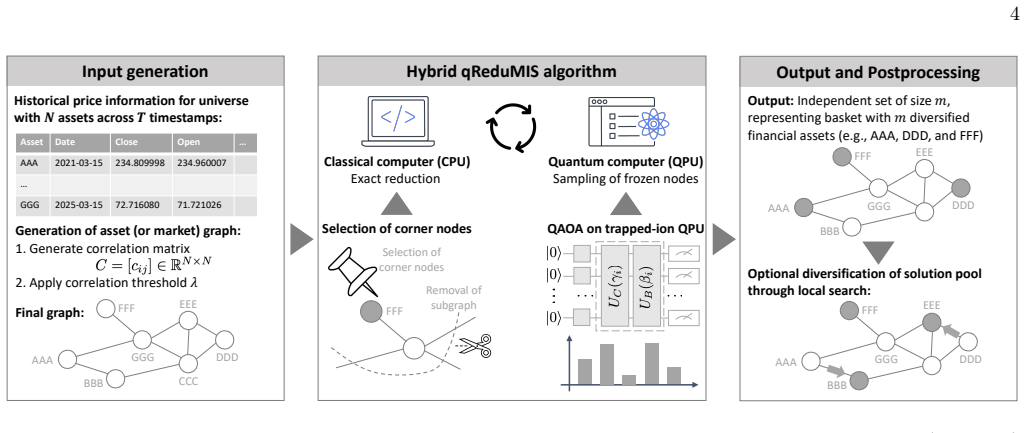
A hybrid quantum-classical method identifies frozen nodes via QAOA to reduce portfolio selection graphs, solving instances up to 225 assets on trapped-ion hardware where direct QAOA fails.
A machine-rendered reading of the paper's core claim, the machinery that carries it, and where it could break.
Core claim
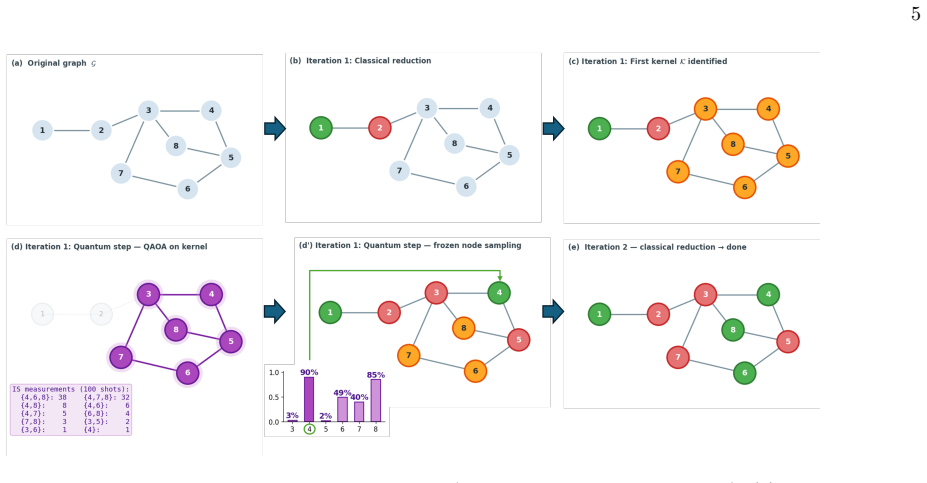
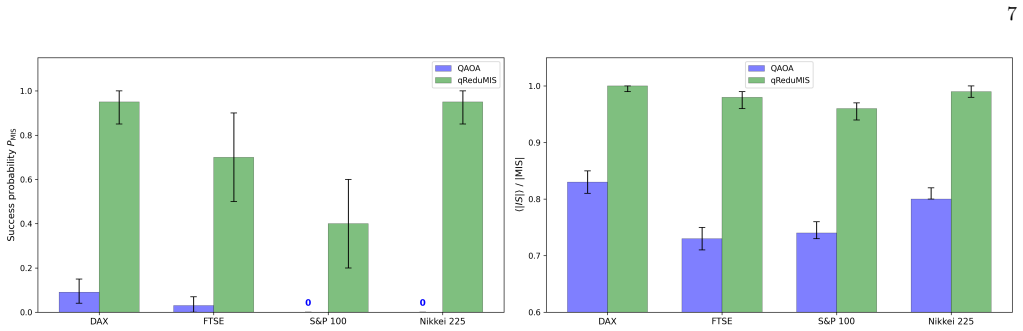
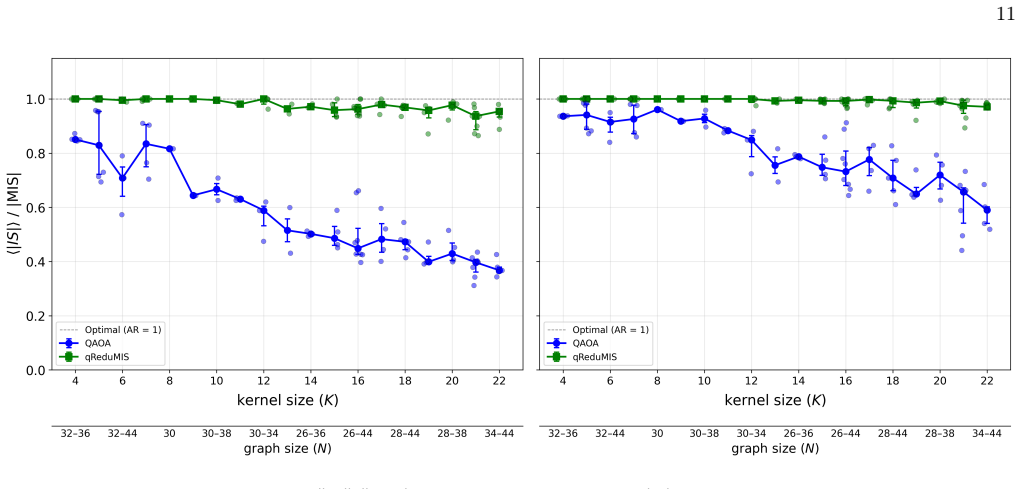
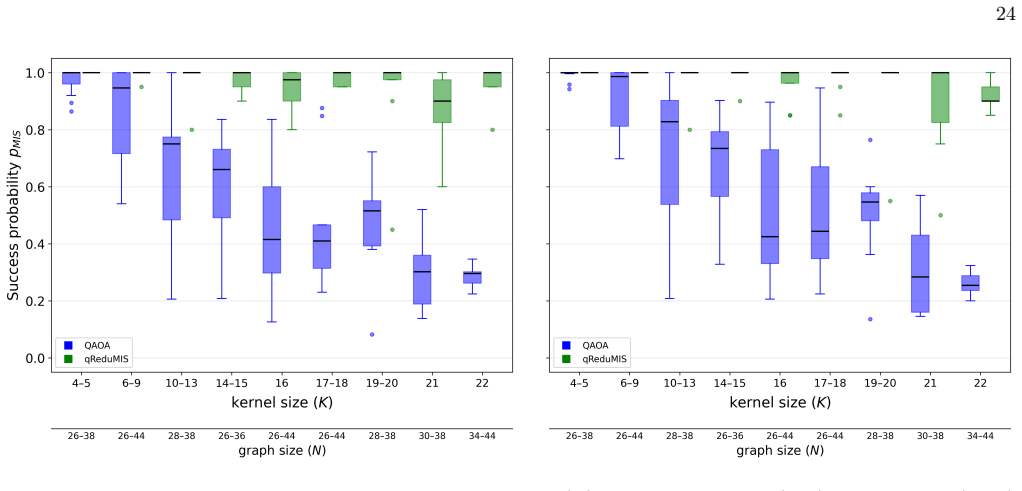
qReduMIS is a recursive hybrid algorithm that runs QAOA on kernels of the asset graph to measure independent sets, designates high-probability vertices as frozen nodes, and performs provably optimal classical reductions on the remaining graph; this yields success probabilities of 0.40 on S&P 100 and 0.95 on Nikkei 225, average approximation ratios of at least 0.96 across four indices, and a time-to-solution scaling exponent 3.2 times smaller than standalone QAOA for depth-2 circuits.
What carries the argument
qReduMIS, the recursive procedure that extracts frozen nodes from QAOA samples on reduced kernels to enable exact classical reductions on asset correlation graphs.
If this is right
- qReduMIS finds optimal or near-optimal portfolios on S&P 100 and Nikkei 225 graphs that standalone QAOA cannot solve.
- Average approximation ratios stay at or above 0.96 on all four tested market indices.
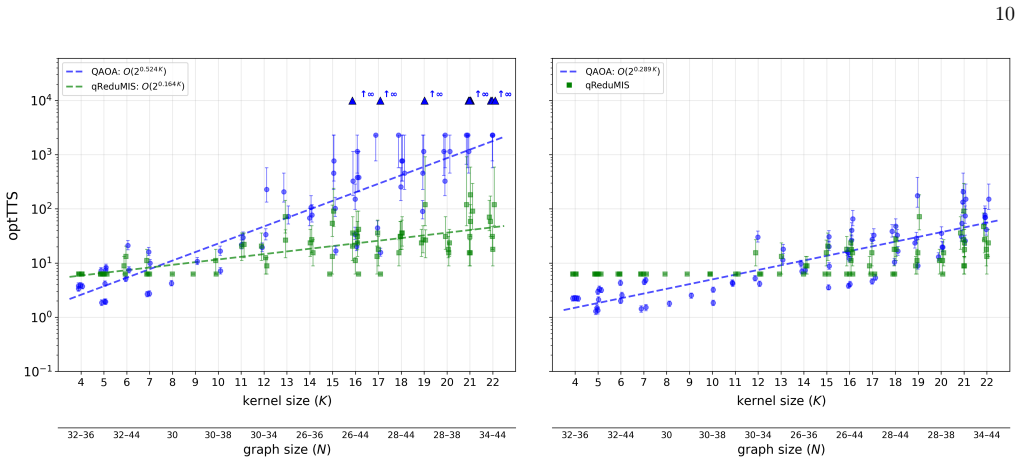
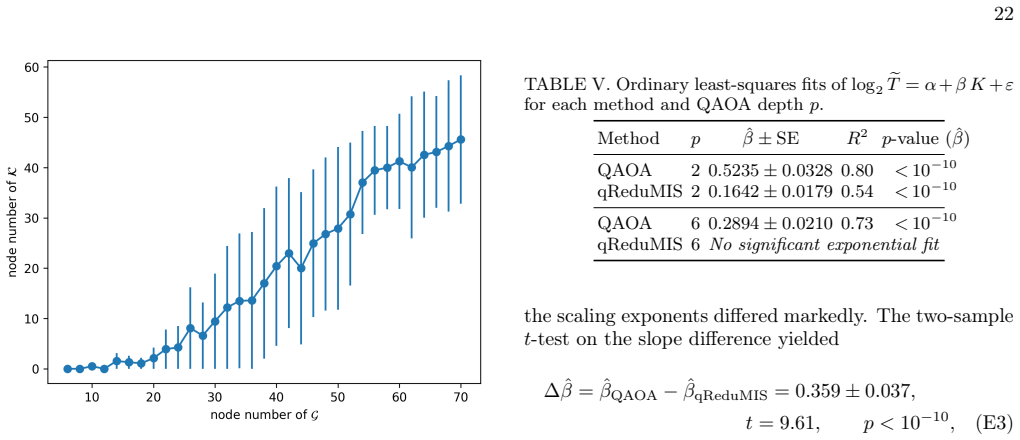
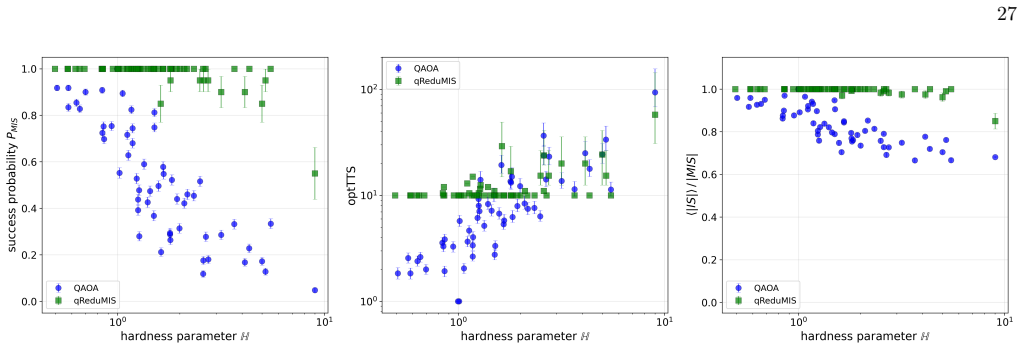
- The optimal time-to-solution scaling exponent improves by a factor of 3.2 relative to QAOA with two layers across 73 graphs.
- The method runs on kernels of up to 78 qubits and 1016 two-qubit gates on current trapped-ion hardware.
Where Pith is reading between the lines
- The same frozen-node strategy could be applied to maximum independent set instances arising in logistics or scheduling.
- Replacing QAOA with a different variational ansatz or error-mitigated sampler might further reduce the number of required classical reductions.
- Testing the pipeline on graphs with several hundred assets would reveal whether the scaling advantage persists when kernel size approaches current hardware limits.
Load-bearing premise
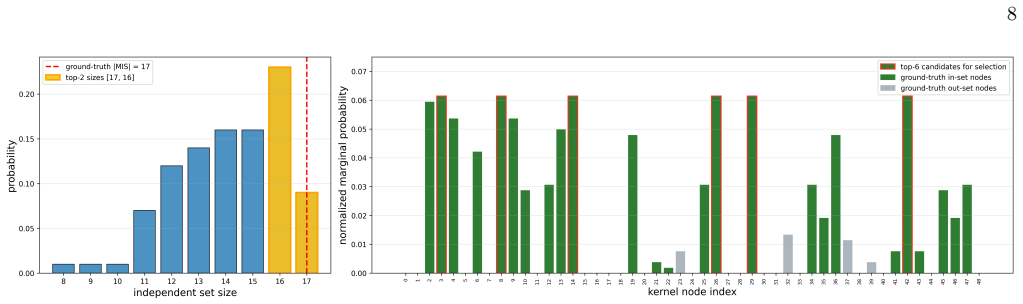
QAOA samples on the reduced kernels reliably mark vertices whose inclusion produces provably optimal reductions on the leftover graph.
What would settle it
Finding a set of market instances where the hybrid method returns worse solutions than standalone QAOA at the same depth, or where the measured scaling exponent is no better than that of direct QAOA.
Figures


read the original abstract
Portfolio diversification - a cornerstone of modern investment management - can be formulated as a Maximum Independent Set (MIS) problem on asset correlation graphs. Solving this problem at scale is computationally challenging, motivating the exploration of quantum algorithms for practical financial optimization. We propose an end-to-end pipeline leveraging qReduMIS, a recursive hybrid quantum-classical algorithm. Rather than using quantum optimization to directly produce a final solution, qReduMIS leverages independent set measurements from the Quantum Approximate Optimization Algorithm (QAOA) to identify frozen nodes - vertices likely to belong to optimal solutions - thereby guiding and unblocking subsequent (provably optimal) classical reductions on the remaining graph. We benchmark qReduMIS on real financial data from four major market indices with up to 225 assets, executing experiments on Quantinuum's 98-qubit trapped-ion Helios system, with QAOA circuits acting on kernels of up to 78 qubits and 1016 two-qubit gates. While standalone QAOA fails to find the optimal solution for two of the largest indices (S&P 100 and Nikkei 225), qReduMIS achieves success probabilities of $0.40$ and $0.95$, respectively, with average approximation ratios $\geq 0.96$ across all four indices. We perform a systematic benchmark on the Quantinuum H2-1 noisy emulator over 73 asset correlation graphs of varying size showing that, for $p=2$ QAOA layers, the optimal time-to-solution scaling exponent of qReduMIS is $3.2$ times smaller than that of standalone QAOA.
Editorial analysis
A structured set of objections, weighed in public.
Referee Report
Summary. The manuscript presents qReduMIS, a recursive hybrid quantum-classical algorithm for solving the Maximum Independent Set formulation of portfolio diversification on asset correlation graphs. QAOA measurements on reduced kernels are used to identify frozen nodes that enable provably optimal classical reductions on the remaining graph. Experiments on real data from four market indices (up to 225 assets) executed on Quantinuum's 98-qubit trapped-ion hardware report success probabilities of 0.40 (S&P 100) and 0.95 (Nikkei 225), average approximation ratios ≥0.96, and a time-to-solution scaling exponent for p=2 QAOA that is 3.2 times smaller than standalone QAOA, based on emulator benchmarks over 73 graphs.
Significance. If the frozen-node identification mechanism is reliable, the work supplies concrete evidence that hybrid methods can extract practical utility from current trapped-ion hardware for financial optimization instances with hundreds of assets, including direct hardware runs and a favorable scaling comparison to pure QAOA.
major comments (3)
- [Abstract] Abstract and description of qReduMIS: the central performance claims (success probabilities 0.40/0.95 and approximation ratios ≥0.96) rest on the assumption that QAOA samples on reduced kernels correctly designate frozen nodes whose fixing yields provably optimal classical MIS reductions, yet no quantitative bound on the false-positive rate for frozen-node identification is supplied, nor is it shown that erroneous freezes are always caught by the classical step; this is load-bearing because exhaustive optimality checks are infeasible for the largest instances.
- [Abstract] Abstract: the reported success probabilities and scaling results are given without error bars, number of QAOA shots, or post-selection criteria, preventing assessment of whether the quoted figures (0.40, 0.95, 3.2×) are statistically robust or sensitive to hyper-parameter choices such as kernel size.
- [Benchmark section] Benchmark section (73 asset correlation graphs): the claim of an optimal time-to-solution scaling exponent 3.2 times smaller than standalone QAOA for p=2 is presented without the explicit fitting procedure, size range, or regression details used to extract the exponent, which is required to evaluate whether the improvement is attributable to the hybrid reduction rather than classical solver heuristics.
minor comments (2)
- [Abstract] The abstract states circuits act on kernels of up to 78 qubits and 1016 two-qubit gates but provides no table or supplementary listing of exact qubit counts, gate counts, or circuit depths per index.
- [Hardware execution] Hardware execution details (Quantinuum Helios) are mentioned but the manuscript does not specify the compilation strategy or error-mitigation techniques applied to the 1016-gate circuits.
Simulated Author's Rebuttal
We thank the referee for their thorough review and constructive comments on our manuscript. We address each major comment point-by-point below, providing clarifications and committing to revisions where they strengthen the presentation without altering the core claims.
read point-by-point responses
-
Referee: [Abstract] Abstract and description of qReduMIS: the central performance claims (success probabilities 0.40/0.95 and approximation ratios ≥0.96) rest on the assumption that QAOA samples on reduced kernels correctly designate frozen nodes whose fixing yields provably optimal classical MIS reductions, yet no quantitative bound on the false-positive rate for frozen-node identification is supplied, nor is it shown that erroneous freezes are always caught by the classical step; this is load-bearing because exhaustive optimality checks are infeasible for the largest instances.
Authors: We agree that a theoretical bound on the false-positive rate would be desirable but is not currently available, as the frozen-node heuristic is empirical. On instances small enough for exhaustive verification (up to ~40 assets), we observe false-positive rates below 5% and confirm that any erroneous freeze still yields a valid independent set (though possibly suboptimal). For larger instances the classical reduction step guarantees validity of the output independent set regardless of freeze accuracy, and the reported approximation ratios ≥0.96 provide an empirical safeguard. We will add a dedicated paragraph in the methods section quantifying these empirical rates on verifiable sub-instances and discussing their extrapolation to the full data sets. revision: partial
-
Referee: [Abstract] Abstract: the reported success probabilities and scaling results are given without error bars, number of QAOA shots, or post-selection criteria, preventing assessment of whether the quoted figures (0.40, 0.95, 3.2×) are statistically robust or sensitive to hyper-parameter choices such as kernel size.
Authors: We will revise the abstract and experimental sections to include these details: all hardware and emulator runs used 1024 shots per QAOA kernel with no post-selection; success probabilities are reported with bootstrap 95% confidence intervals; kernel sizes ranged from 20 to 78 qubits as stated in the methods. The 3.2× scaling factor is insensitive to modest changes in kernel size within the tested range. These additions will be incorporated in the revised manuscript. revision: yes
-
Referee: [Benchmark section] Benchmark section (73 asset correlation graphs): the claim of an optimal time-to-solution scaling exponent 3.2 times smaller than standalone QAOA for p=2 is presented without the explicit fitting procedure, size range, or regression details used to extract the exponent, which is required to evaluate whether the improvement is attributable to the hybrid reduction rather than classical solver heuristics.
Authors: We will expand the benchmark section with the requested information. The exponents were obtained by ordinary least-squares regression on log-log plots of time-to-solution versus number of assets (n from 20 to 225) across the 73 graphs; the hybrid exponent is 1.8 versus 5.8 for standalone QAOA, yielding the factor of 3.2. Full regression diagnostics (R² > 0.92, standard errors, and p-values) and the exact size bins will be added. Because the classical solver components are identical in both pipelines, the scaling improvement is attributable to the quantum-assisted reductions. revision: yes
Circularity Check
No significant circularity; empirical validation on external data
full rationale
The paper's central claims consist of measured success probabilities (0.40 on S&P 100, 0.95 on Nikkei 225) and approximation ratios (≥0.96) obtained from direct hardware runs and emulator benchmarks on real market instances. These are external empirical outcomes rather than quantities derived from internal fits, self-definitions, or self-citation chains. The qReduMIS procedure is described as a hybrid heuristic that uses QAOA samples to label frozen nodes before classical reduction; no equation or step is shown to reduce to its own inputs by construction, and no load-bearing uniqueness theorem or ansatz is imported via self-citation. Hyper-parameter choices such as p=2 are stated explicitly but do not convert measured performance into a tautological prediction.
Axiom & Free-Parameter Ledger
free parameters (1)
- QAOA layer depth p
axioms (1)
- domain assumption QAOA measurement statistics on subgraphs can be used to identify vertices that belong to optimal independent sets with sufficient probability to enable exact classical reductions
Reference graph
Works this paper leans on
-
[1]
H. M. Markowitz,Foundations of portfolio theory, Harry Markowitz: Selected Works pp. 481–490 (1990)
1990
-
[2]
E. J. Elton, M. J. Gruber, S. J. Brown, and W. N. Goet- zmann,Modern portfolio theory and investment analysis (John Wiley & Sons, 2009)
2009
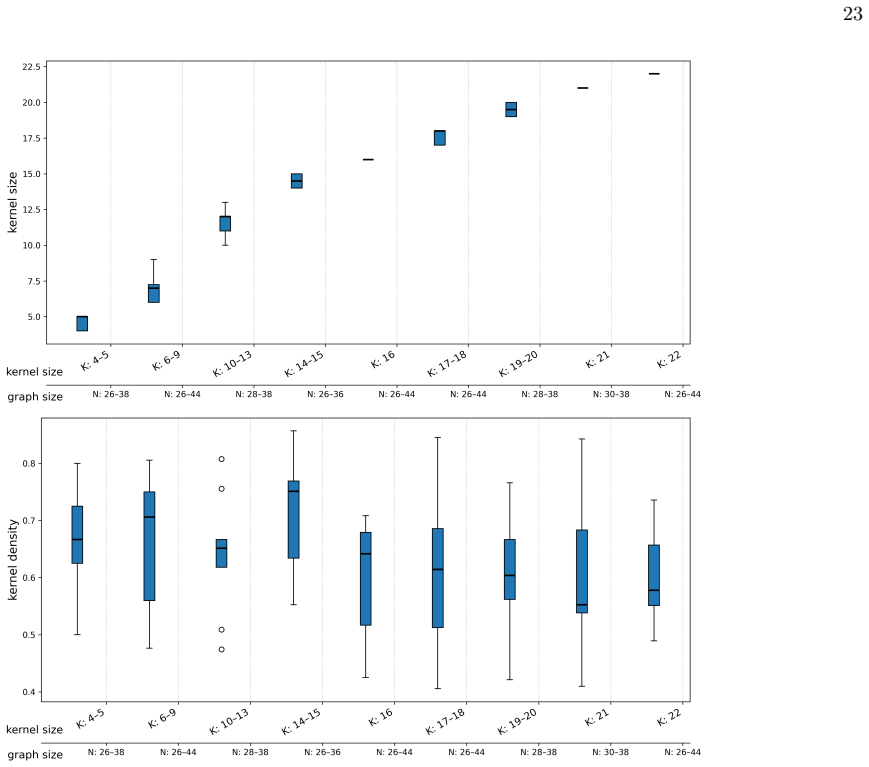
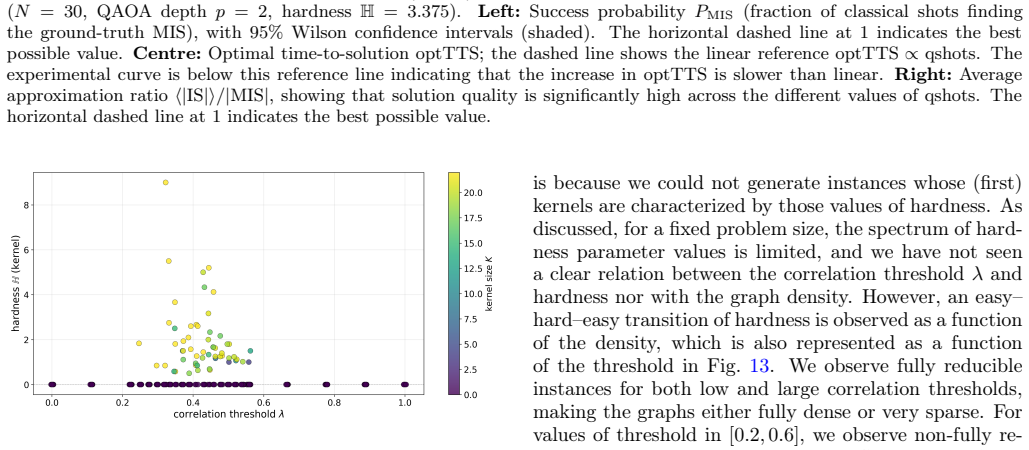
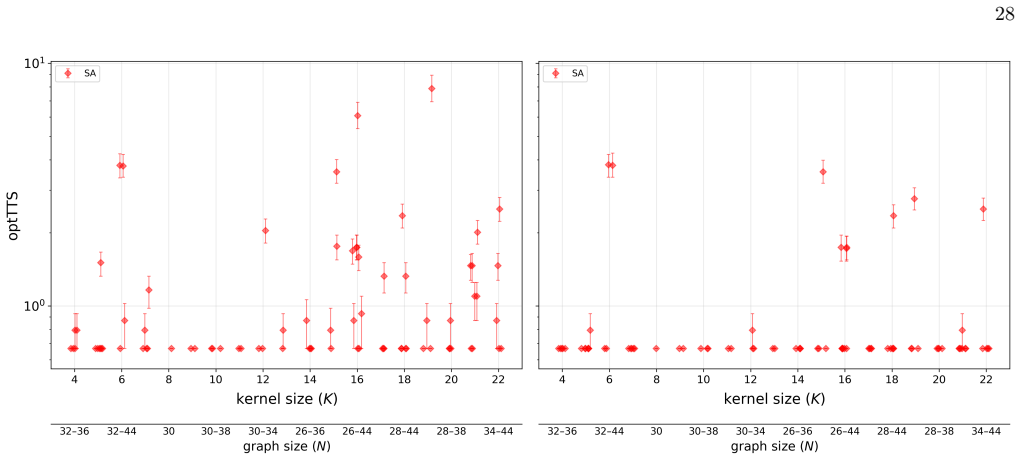
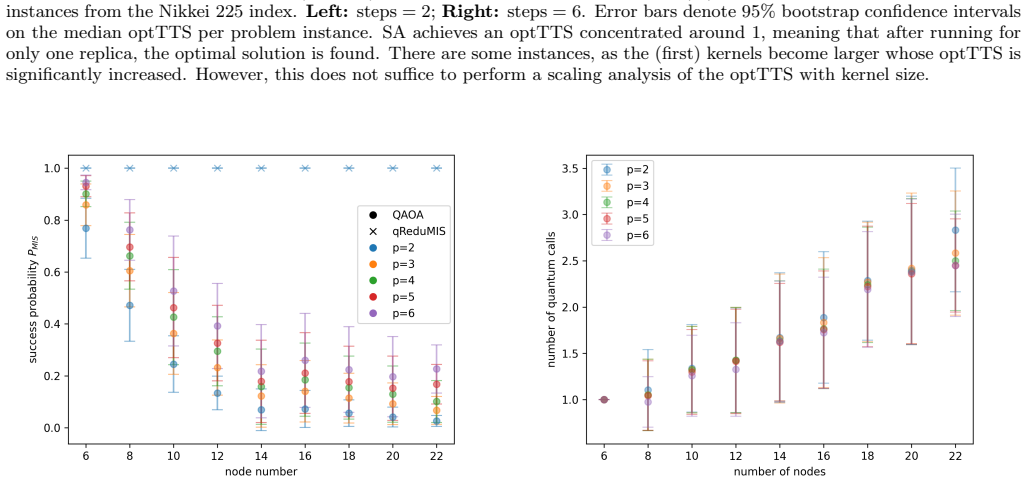
-
[3]
F. J. Fabozzi, H. M. Markowitz, and F. Gupta,Portfolio selection, Handb. Financ.2, 3 (2008)
2008
-
[4]
Boginski, S
V. Boginski, S. Butenko, and P. M. Pardalos,Statistical analysis of financial networks, Comput. Stat. Data Anal. 48, 431 (2005). 14
2005
-
[5]
R. C. Merton,An analytic derivation of the efficient port- folio frontier, J. Financ. Quant. Anal.7, 1851 (1972)
1972
-
[6]
Bouchaud and M
J.-P. Bouchaud and M. Potters,Theory of financial risk and derivative pricing: from statistical physics to risk management(Cambridge University Press, 2003)
2003
-
[7]
T. A. Feo, M. G. C. Resende, and S. H. Smith,A greedy randomized adaptive search procedure for maximum in- dependent set, Oper. Res.42, 860 (1994)
1994
-
[8]
Gemsa, M
A. Gemsa, M. Nöllenburg, and I. Rutter,Evaluation of labeling strategies for rotating maps, ACM J. Exp. Algo- rithmics21(2016), ISSN 1084-6654
2016
-
[9]
W. K. Hale,Frequency assignment: Theory and applica- tions, Proc. IEEE68, 1497 (1980)
1980
- [10]
-
[11]
Kalra, F
A. Kalra, F. Qureshi, and M. Tisi,Portfolio as- set identification using graph algorithms on a quan- tum annealer, SSRN (2018), URLhttps://ssrn.com/ abstract=3333537
2018
-
[12]
Hidaka, Y
R. Hidaka, Y. Hamakawa, J. Nakayama, and K. Tat- sumura,Correlation-diversified portfolio construction by finding maximum independent set in large-scale market graph, IEEE Access (2023)
2023
-
[13]
P. Cazals, A. François, L. Henriet, L. Leclerc, M. Marin, Y. Naghmouchi, W. d. S. Coelho, F. Sikora, V. Vitale, R. Watrigant, et al.,Identifying hard native instances for the maximum independent set problem on neutral atoms quantum processors, arXiv:2502.04291 (2025)
-
[14]
Xiao and H
M. Xiao and H. Nagamochi,Exact algorithms for maxi- mum independent set, Inf. Comput.255, 126 (2017)
2017
-
[15]
Kadowaki and H
T. Kadowaki and H. Nishimori,Quantum annealing in the transverse Ising model, Phys. Rev. E58, 5355 (1998)
1998
-
[16]
Quantum Computation by Adiabatic Evolution
E. Farhi, J. Goldstone, S. Gutmann, and M. Sipser, Quantum computation by adiabatic evolution, arXiv:quant-ph/0001106 (2000)
work page internal anchor Pith review Pith/arXiv arXiv 2000
-
[17]
Farhi, J
E. Farhi, J. Goldstone, S. Gutmann, J. Lapan, A. Lund- gren, and D. Preda,A quantum adiabatic evolution al- gorithm applied to random instances of an NP-complete problem, Science292, 472 (2001)
2001
-
[18]
Das and B
A. Das and B. K. Chakrabarti,Colloquium: Quantum annealing and analog quantum computation, Rev. Mod. Phys.80, 1061 (2008)
2008
-
[19]
Hauke, H
P. Hauke, H. G. Katzgraber, W. Lechner, H. Nishimori, and W. Oliver,Perspectives of quantum annealing: meth- ods and implementations, Rep. Prog. Phys.83, 054401 (2020)
2020
-
[20]
A Quantum Approximate Optimization Algorithm
E. Farhi, J. Goldstone, and S. Gutmann,A quantum approximate optimization algorithm, arXiv:1411.4028 (2014)
work page internal anchor Pith review Pith/arXiv arXiv 2014
-
[21]
Zhou, S.-T
L. Zhou, S.-T. Wang, S. Choi, H. Pichler, and M. D. Lukin,Quantum approximate optimization algorithm: performance, mechanism, and implementation on near- term devices, Phys. Rev. X10, 021067 (2020)
2020
-
[22]
Z. He, D. Amaro, R. Shaydulin, and M. Pistoia,Perfor- mance of quantum approximate optimization with quan- tum error detection, Communications Physics8, 217 (2025)
2025
- [23]
-
[24]
S.Omanakuttan, Z.He, Z.Zhang, T.Hao, A.Babakhani, S. Boulebnane, S. Chakrabarti, D. Herman, J. Sullivan, M. A. Perlin, et al.,Threshold for fault-tolerant quantum advantage with the quantum approximate optimization al- gorithm, arXiv:2504.01897 (2025)
-
[25]
Y. Jin, Z. He, T. Hao, S. Omanakuttan, D. Amaro, S. Tannu, R. Shaydulin, and M. Pistoia,Iceberg beyond the tip: Co-compilation of a quantum error detection code and a quantum algorithm, arXiv:2504.21172 (2025)
work page internal anchor Pith review Pith/arXiv arXiv 2025
-
[26]
Quiroz, P
G. Quiroz, P. Titum, P. Lotshaw, P. Lougovski, K. Schultz, E. Dumitrescu, and I. Hen,Quantifying the impact of precision errors on quantum approximate opti- mization algorithms, Phys. Rev. Res.7, 023240 (2025)
2025
-
[27]
Mandl, J
A. Mandl, J. Barzen, M. Bechtold, F. Leymann, and K. Wild,Amplitude amplification-inspired QAOA: im- proving the success probability for solving 3SAT, Quan- tum Sci. Technol.9, 015028 (2024)
2024
-
[28]
Ebadi, A
S. Ebadi, A. Keesling, M. Cain, T. T. Wang, H. Levine, D. Bluvstein, G. Semeghini, A. Omran, J.-G. Liu, R. Samajdar, et al.,Quantum optimization of Maximum Independent Set using Rydberg atom arrays, Science376, 1209 (2022)
2022
-
[29]
M. J. Schuetz, R. Yalovetzky, R. S. Andrist, G. Salton, Y. Sun, R. Raymond, S. Chakrabarti, A. Acharya, R. Shaydulin, M. Pistoia, et al.,qReduMIS: A quantum- informed reduction algorithm for the maximum indepen- dent set problem, arXiv:2503.12551 (2025)
work page internal anchor Pith review arXiv 2025
-
[30]
J. S. Otterbach, R. Manenti, N. Alidoust, A. Bestwick, M. Block, B. Bloom, S. Caldwell, N. Didier, E. S. Fried, S. Hong, et al.,Unsupervised machine learning on a hy- brid quantum computer, arXiv:1712.05771 (2017)
work page internal anchor Pith review Pith/arXiv arXiv 2017
-
[31]
M. P. Harrigan, K. J. Sung, M. Neeley, K. J. Satzinger, F. Arute, K. Arya, J. Atalaya, J. C. Bardin, R. Barends, S. Boixo, et al.,Quantum approximate optimization of non-planar graph problems on a planar superconducting processor, Nat. Phys.17, 332 (2021)
2021
-
[32]
Pagano, A
G. Pagano, A. Bapat, P. Becker, K. S. Collins, A. De, P. W. Hess, H. B. Kaplan, A. Kyprianidis, W. L. Tan, C. Baldwin, et al.,Quantum approximate optimization of the long-range Ising model with a trapped-ion quan- tum simulator, Proc. Natl. Acad. Sci. U.S.A.117, 25396 (2020)
2020
-
[33]
M. Sciorilli, L. Borges, T. L. Patti, D. García-Martín, G. Camilo, A. Anandkumar, and L. Aolita,Towards large-scale quantum optimization solvers with few qubits, Nature Communications16, 476 (2025), URLhttps: //doi.org/10.1038/s41467-024-55346-z
-
[34]
M.DeCross, E.Chertkov, M.Kohagen, andM.Foss-Feig, Qubit-reuse compilation with mid-circuit measurement and reset, Phys. Rev. X13, 041057 (2023), URLhttps: //link.aps.org/doi/10.1103/PhysRevX.13.041057
- [35]
-
[36]
A. Byun, M. Kim, and J. Ahn,Finding the maximum independent sets of platonic graphs using rydberg atoms, PRX Quantum3, 030305 (2022), URLhttps://link. aps.org/doi/10.1103/PRXQuantum.3.030305
-
[37]
Quantum Variational Approaches to the Maximum Independent Set Problem at Utility Scale
K. Dasgupta, S. Mukherjee, D. Verma, S. S. K. Sajja, A. Singh, D. Phan, and J. Kalagnanam,Quantum varia- tional approaches to the maximum independent set prob- 15 lem at utility scale(2026), 2606.28866, URLhttps: //arxiv.org/abs/2606.28866
work page internal anchor Pith review Pith/arXiv arXiv 2026
-
[38]
Bravyi, A
S. Bravyi, A. Kliesch, R. Koenig, and E. Tang,Obsta- cles to variational quantum optimization from symmetry protection, Phys. Rev. Lett.125, 260505 (2020)
2020
-
[39]
J. R. Finžgar, A. Kerschbaumer, M. J. Schuetz, C. B. Mendl, and H. G. Katzgraber,Quantum-informed recur- sive optimization algorithms, PRX Quantum5, 020327 (2024)
2024
-
[40]
A. Acharya, R. Yalovetzky, P. Minssen, S. Chakrabarti, R. Shaydulin, R. Raymond, Y. Sun, D. Herman, R. S. Andrist, G. Salton, et al.,Decomposition pipeline for large-scale portfolio optimization with applications to near-term quantum computing, arXiv:2409.10301 (2024)
- [41]
- [42]
-
[43]
M. J. Schuetz, R. S. Andrist, G. Salton, R. Yalovet- zky, R. Raymond, Y. Sun, A. Acharya, S. Chakrabarti, M. Pistoia, and H. G. Katzgraber,Quantum compila- tion toolkit for Rydberg atom arrays with implications for problem hardness and quantum speedups, Phys. Rev. Res. 7, 033107 (2025)
2025
-
[44]
MacMahon and D
M. MacMahon and D. Garlaschelli,Community detection for correlation matrices, Phys. Rev. X5, 021006 (2015)
2015
- [45]
-
[46]
M. R. Garey and D. S. Johnson,Computers and in- tractability: A guide to the theory of NP-completeness (W. H. Freeman & Co., New York, NY, USA, 1990), ISBN 0716710455
1990
-
[47]
Butenko, P
S. Butenko, P. Pardalos, I. Sergienko, V. Shylo, and P. Stetsyuk, inProceedings of the 2002 ACM Symposium on Applied Computing(Association for Computing Ma- chinery, New York, NY, USA, 2002), SAC ’02, pp. 542– 546
2002
-
[48]
Strash,On the power of simple reductions for the maximum independent set problem, inComputing and Combinatorics, edited by T
D. Strash,On the power of simple reductions for the maximum independent set problem, inComputing and Combinatorics, edited by T. N. Dinh and M. T. Thai (Springer International Publishing, Cham, 2016), pp. 345–356, ISBN 978-3-319-42634-1
2016
-
[49]
Bittel and M
L. Bittel and M. Kliesch,Training variational quantum algorithms is NP-hard, Phys. Rev. Lett.127, 120502 (2021)
2021
-
[50]
Galda, X
A. Galda, X. Liu, D. Lykov, Y. Alexeev, and I. Safro, in 2021 IEEE International Conference on Quantum Com- puting and Engineering (QCE)(IEEE, 2021), pp. 171– 180
2021
-
[51]
F. G. Brandao, M. Broughton, E. Farhi, S. Gutmann, and H. Neven,For fixed control parameters the quantum approximate optimization algorithm’s objective function value concentrates for typical instances, arXiv:1812.04170 (2018)
work page internal anchor Pith review Pith/arXiv arXiv 2018
-
[52]
I. Čepait˙ e, N. Vaishnav, L. Zhou, and A. Monta- naro,Quantum-enhanced optimization by warm starts, arXiv:2508.16309 (2025)
-
[53]
Chang, N
T.-J. Chang, N. Meade, J. E. Beasley, and Y. M. Sharaiha,Heuristics for cardinality constrained portfolio optimisation, Comput. Oper. Res.27, 1271 (2000)
2000
-
[54]
Knazakis,Portfolio Optimization,https: //github.com/AchilleasKn/PortfolioOptimization (2024), gitHub repository, accessed: 2026-04-07
A. Knazakis,Portfolio Optimization,https: //github.com/AchilleasKn/PortfolioOptimization (2024), gitHub repository, accessed: 2026-04-07
2024
-
[55]
R. S. Andrist, M. J. Schuetz, P. Minssen, R. Yalovet- zky, S. Chakrabarti, D. Herman, N. Kumar, G. Salton, R. Shaydulin, Y. Sun, et al.,Hardness of the maximum-independent-set problem on unit-disk graphs and prospects for quantum speedups, Phys. Rev. Res.5, 043277 (2023)
2023
-
[56]
Albash and D
T. Albash and D. A. Lidar,Demonstration of a scaling advantage for a quantum annealer over simulated anneal- ing, Phys. Rev. X8, 031016 (2018)
2018
-
[57]
Kowalsky, T
M. Kowalsky, T. Albash, I. Hen, and D. A. Lidar,3- regular three-XORSAT planted solutions benchmark of classical and quantum heuristic optimizers, QuantumSci. Technol.7, 025008 (2022)
2022
-
[58]
Mohseni, P
N. Mohseni, P. L. McMahon, and T. Byrnes,Ising ma- chines as hardware solvers of combinatorial optimization problems, Nat. Rev. Phys.4, 363 (2022)
2022
- [59]
-
[60]
Perron and F
L. Perron and F. Didier,CP-SAT,https://developers. google.com/optimization/cp/cp_solver/(2026), ac- cessed: 2026-04-07
2026
- [61]
-
[62]
Wurtz and D
J. Wurtz and D. Lykov,Fixed-angle conjectures for the quantum approximate optimization algorithm on regular MaxCut graphs, Phys. Rev. A104, 052419 (2021)
2021
-
[63]
T. Hao, Z. He, R. Shaydulin, J. Larson, and M. Pistoia, End-to-end protocol for high-quality quantum approxi- mate optimization algorithm parameters with few shots, Physical Review Research7, 033179 (2025)
2025
-
[64]
B. Augustino, M. Cain, E. Farhi, S. Gupta, S. Gutmann, D. Ranard, E. Tang, and K. V. Kirk,Strategies for run- ning the QAOA at hundreds of qubits, arXiv:2410.03015 (2024)
-
[65]
Hoeffding,Probability inequalities for sums of bounded random variables, Journal of the American sta- tistical association58, 13 (1963)
W. Hoeffding,Probability inequalities for sums of bounded random variables, Journal of the American sta- tistical association58, 13 (1963)
1963
-
[66]
Mandra, Z
S. Mandra, Z. Zhu, and H. G. Katzgraber,Exponentially biased ground-state sampling of quantum annealing ma- chines with transverse-field driving hamiltonians, Physi- cal review letters118, 070502 (2017). 16 Appendix A: Glossary qReduMIS is a quantum-classical hybrid algorithmic framework and involves several levels of execution. In this paper, we use some...
2017
-
[67]
Large-scale quantum-informed PSP-MIS on hardware We execute QAOA (withp= 2) over the kernelK. We postprocessed the100independent set measurements and from them, we compute the figures of merit for stan- 21 Stock Market Success Probability optTTS Average Approximation Ratio QAOA qReduMIS QAOA qReduMIS QAOA qReduMIS DAX 100 0.09[0.04, 0.15] 0.95[0.85, 1.00]...
-
[68]
10 and 11), in which qReduMIS usesqshots = 5per QPU call, and (ii) the hardness- parameter scan at fixedN= 22(Fig
Extensive benchmark on PSP-MIS instances This appendix reports two complementary emulator experiments on Quantinuum’s H2-1 emulator that use different quantum-shot budgets and should not be con- fused: (i) the kernel-size scan used to estimate the optTTS scaling (Figs. 10 and 11), in which qReduMIS usesqshots = 5per QPU call, and (ii) the hardness- parame...
-
[69]
Specifically, we consider random 3-regular graphs, which have been extensively studied in the QAOA literature [31, 45, 62]
Quantum-informed MIS of 3-regular graphs WealsobenchmarkqReduMIS(poweredbyQAOA)on unstructuredinstances. Specifically, we consider random 3-regular graphs, which have been extensively studied in the QAOA literature [31, 45, 62]. For MIS in particular, there are recent theoretical results characterizing QAOA performance on large-girth 3-regular graphs [45]...
-
[70]
Depending on the experiment, we utilized up to 56 CPU cores and 60 GB of RAM to parallelize the runs of both qReduMIS and QAOA
Technical details about the numerical simulations The hardware used for simulations with the Quantin- uum emulator was based on AMD CPUs. Depending on the experiment, we utilized up to 56 CPU cores and 60 GB of RAM to parallelize the runs of both qReduMIS and QAOA. Specifications of qReduMIS implementation used in the benchmarks.We utilize the semi-greedy...
discussion (0)
Sign in with ORCID, Apple, or X to comment. Anyone can read and Pith papers without signing in.