Galaxy Clusters Selected via the Sunyaev-Zel'dovich Effect in 5 year data from the SPT-3G Main Survey
Pith reviewed 2026-07-02 06:17 UTC · model grok-4.3
The pith
The paper presents a catalog of 7190 confirmed galaxy clusters selected via the Sunyaev-Zel'dovich effect from five years of SPT-3G observations.
A machine-rendered reading of the paper's core claim, the machinery that carries it, and where it could break.
Core claim
The central claim is a catalog of 8892 SZ cluster candidates above detection significance ξ=4 (expected purity >82 percent), with 7190 confirmed as real clusters; the sample covers masses 7.9×10^13 to 1.6×10^15 solar masses per h70 and redshifts 0.037 to roughly 2, achieving a surface density of 4.5 confirmed clusters per square degree and 2-4 times higher per-cluster signal-to-noise than prior SPT or ACT catalogs.
What carries the argument
Detection of the thermal Sunyaev-Zel'dovich effect, which produces a frequency-dependent temperature decrement in the cosmic microwave background proportional to the integrated electron pressure along the line of sight through a cluster.
If this is right
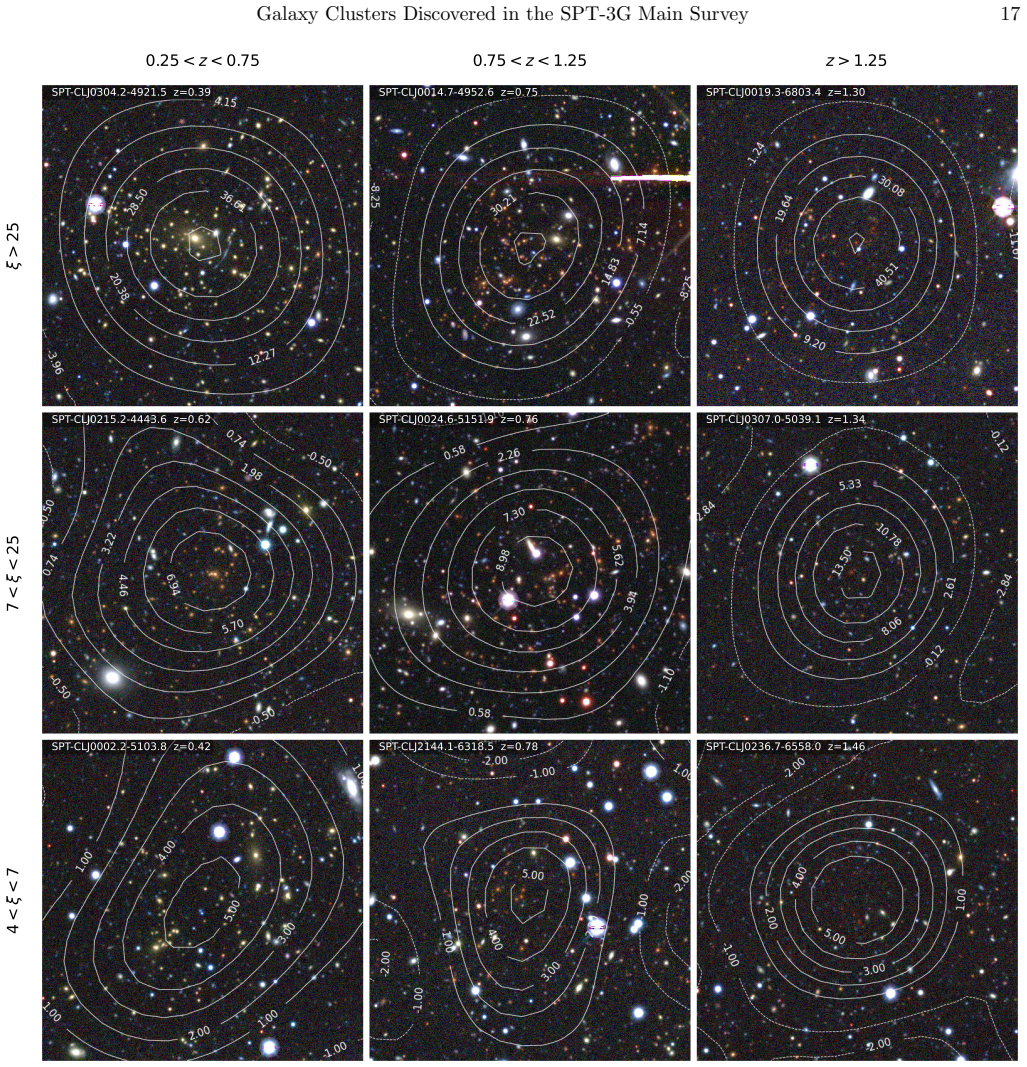
- The catalog contains 1780 clusters above redshift 1 and 271 above redshift 1.5, extending the reach of SZ selection into the epoch when clusters first assembled.
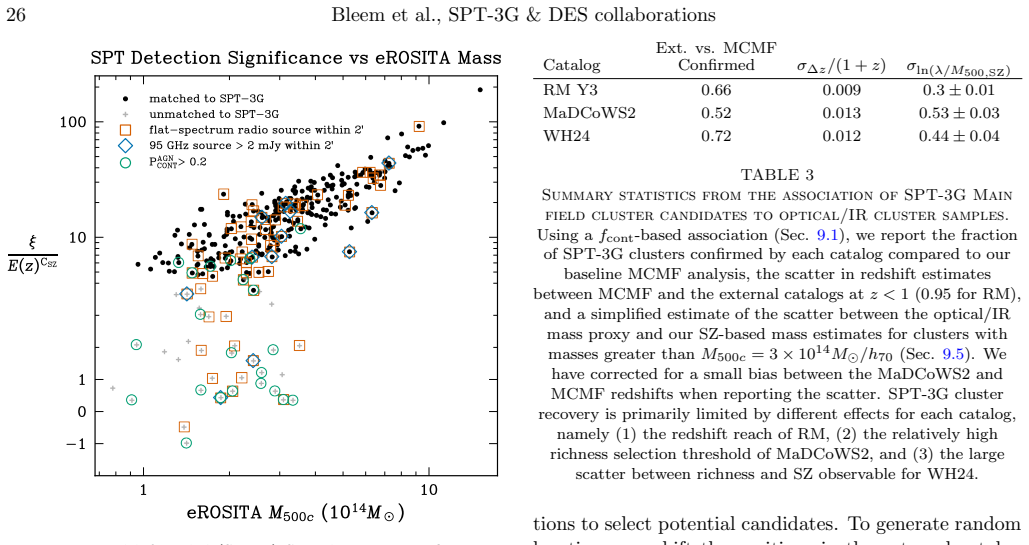
- Cross-matches yield 1279 clusters in common with the eRASS1 X-ray catalog, with mass estimates in relatively good agreement.
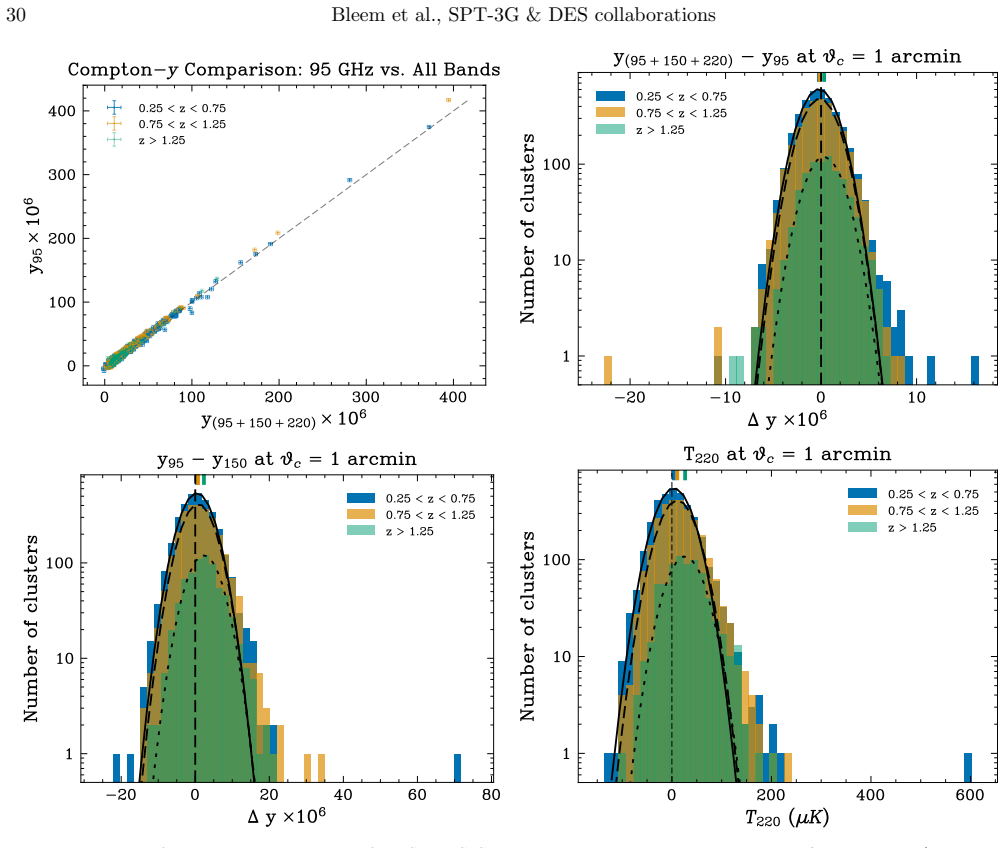
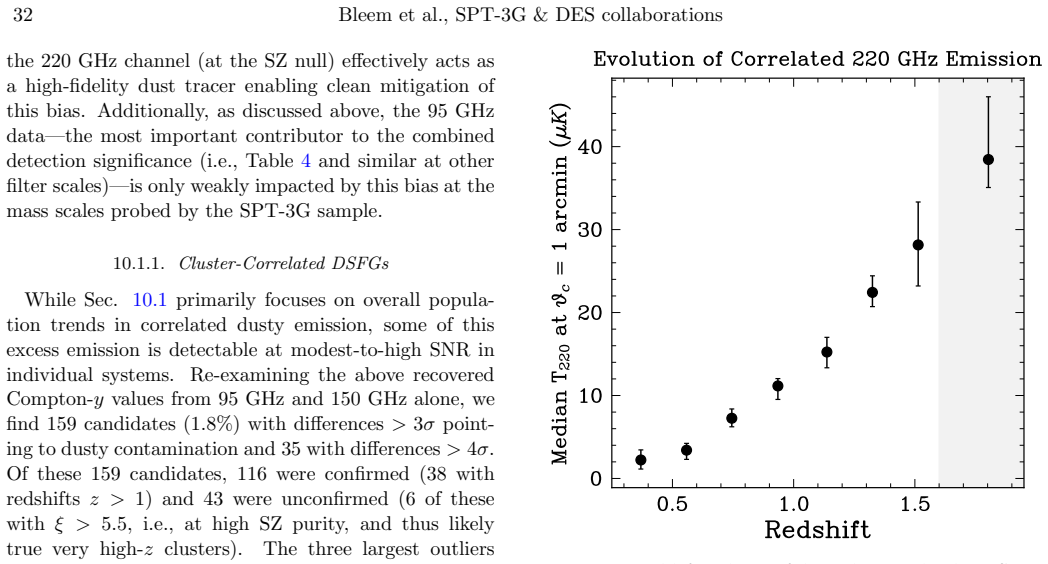
- Validation tests reveal a seventeen-fold increase in 220 GHz emission for clusters at z approximately 1.5 compared with z approximately 0.25, indicating stronger correlated dusty emission at higher redshift.
- A subset of clusters is identified as candidate strong gravitational lenses for follow-up study.
Where Pith is reading between the lines
- The higher cluster density and improved mass reach could tighten cosmological constraints on structure growth when combined with weak-lensing or velocity-dispersion mass calibration.
- The redshift-dependent dusty emission trend suggests that multi-frequency modeling will become increasingly important for SZ surveys targeting z greater than 1.
- The flagged lens candidates provide a ready target list for high-resolution imaging to measure cluster masses independently of the SZ signal.
Load-bearing premise
Optical and infrared imaging reliably distinguishes true clusters from false detections across the full redshift range, especially above redshift 1.
What would settle it
Finding that the number of clusters confirmed at z greater than 1.5 falls well below the expected count from the purity estimates, or that SPT and eROSITA mass estimates show large systematic offsets for the same objects.
Figures

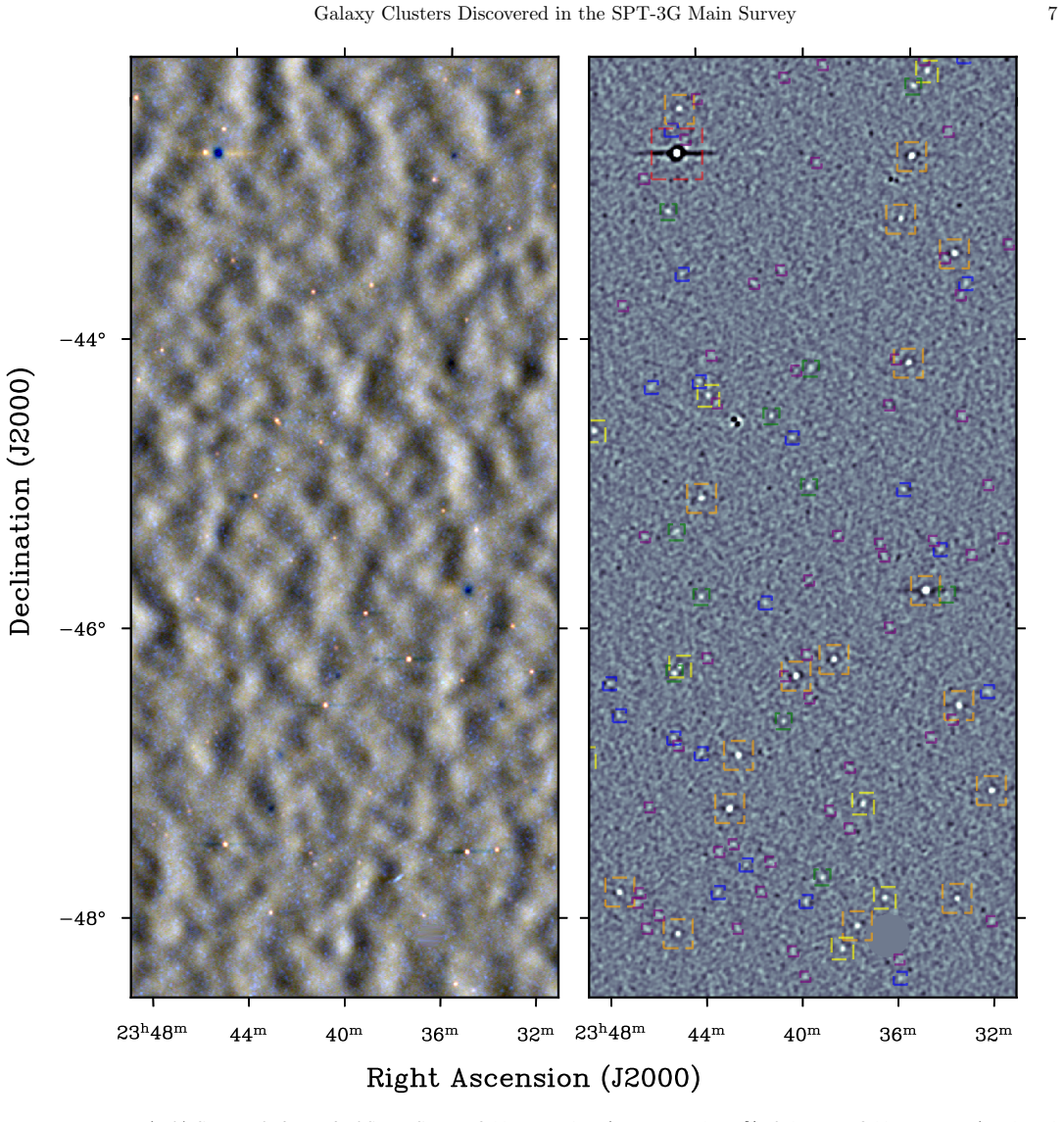
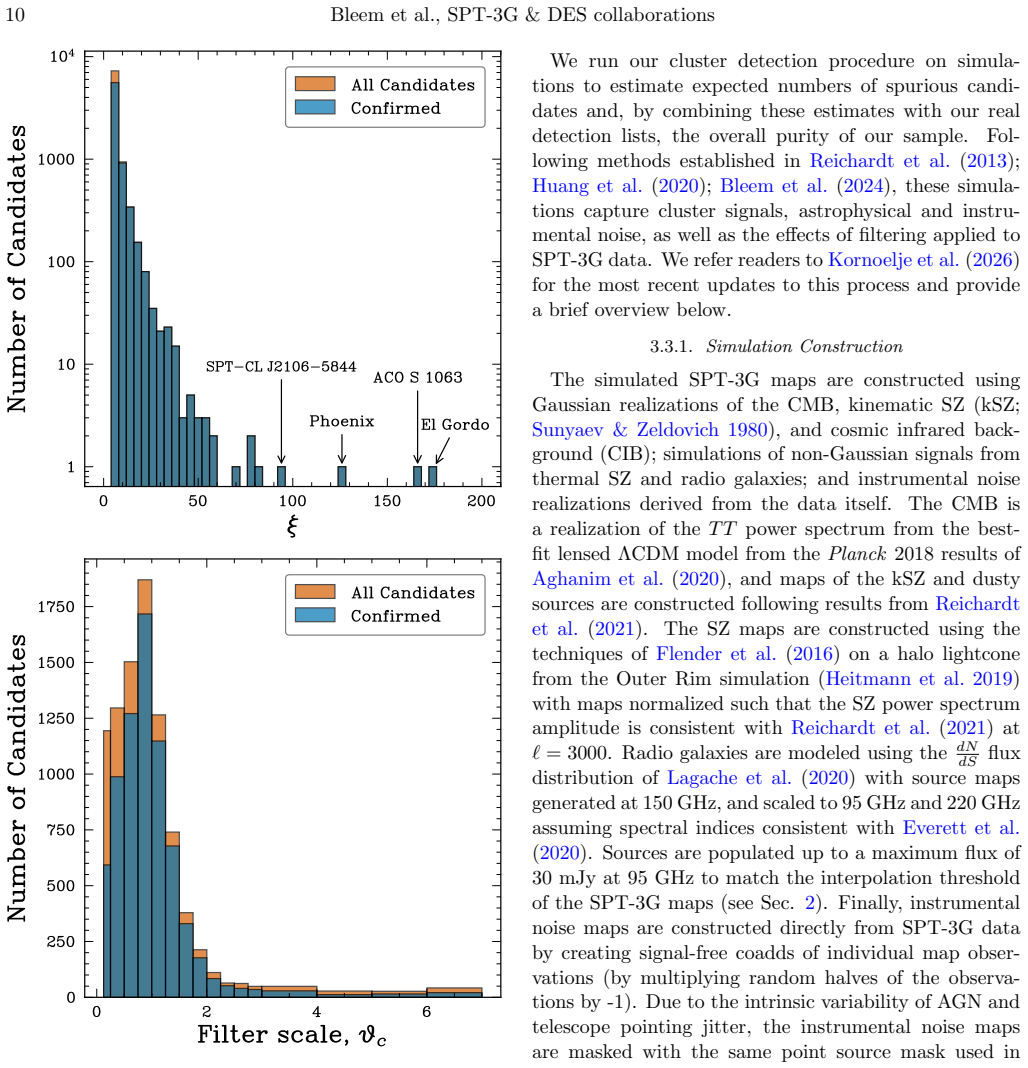

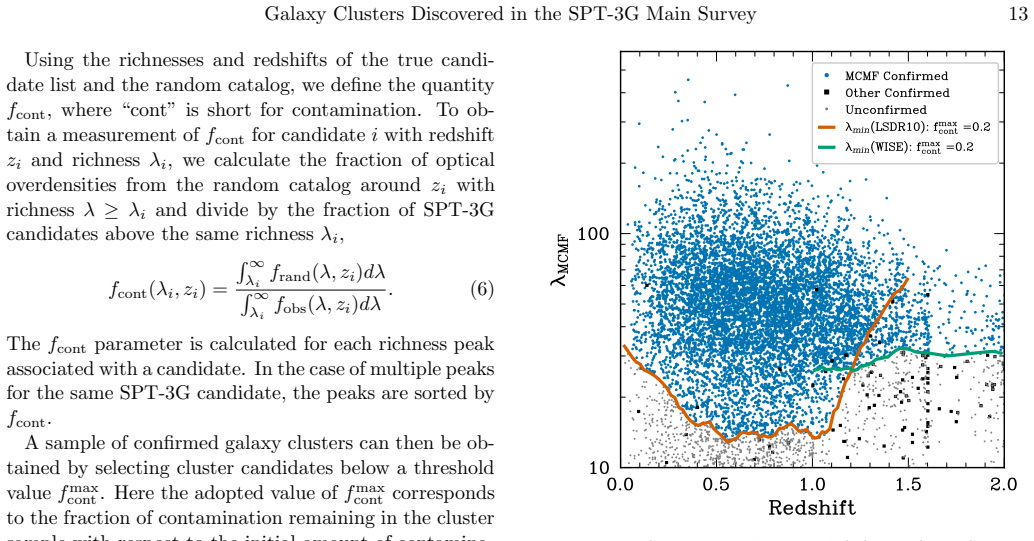
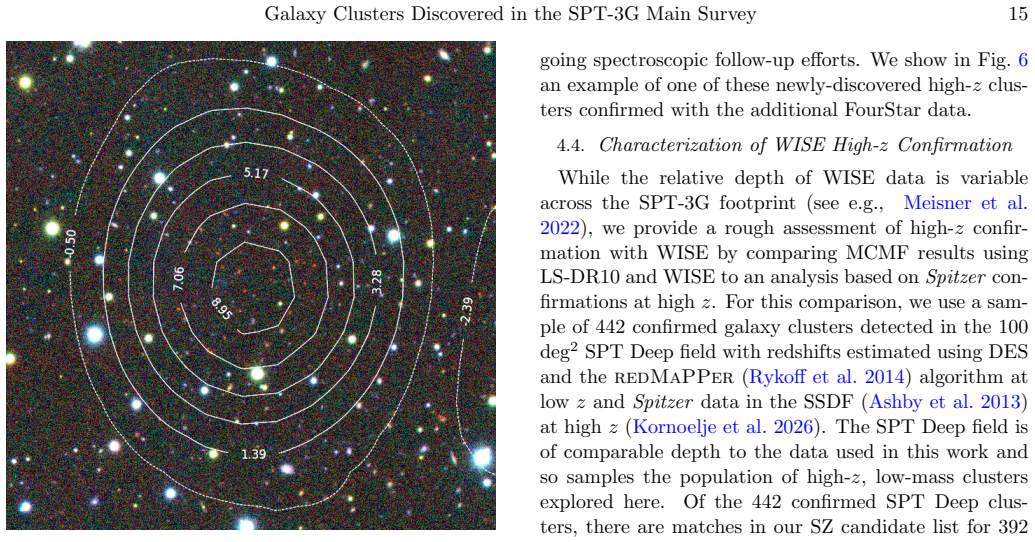




read the original abstract
We report a new galaxy cluster catalog, selected using the thermal Sunyaev-Zel'dovich (SZ) effect, from 5 years of observations of the SPT-3G Main field. Drawn from arcminute-resolution data with white noise levels of 3.2, 2.5, and 8.9 $\mu$K-arcmin at 95, 150, and 220 GHz, respectively, the sample consists of 8,892 cluster candidates detected above significance $\xi=4$, with an expected purity of $>82\%$ (4,480 at $\xi\ge5$ with purity $>99\%$). Using optical and infrared data we have confirmed 7,190 candidates as clusters. The sample spans a mass range $7.9 \times 10^{13}$ $M_\odot/h_{70}$ \ $< M_\textrm{500c} < $ $1.6 \times 10^{15}$ $M_\odot/h_{70}$ with a median mass of $1.65 \times 10^{14}$ $M_\odot/h_{70}$, and a redshift range of $0.037<z\lesssim 2$ with a median redshift of $z_{\textrm{med}}$ = 0.73; 1,780 clusters are at $z>1$ and 271 at $z>1.5$. Compared to previous SZ cluster samples from South Pole Telescope and Atacama Cosmology Telescope data, the SPT-3G sample is highly consistent in mass and redshift but is significantly deeper, with per-cluster detection signal-to-noise 2-4 times higher and a cluster density of 4.5 confirmed clusters/deg$^2$. We cross match with eRASS1 cluster and point source catalogs, finding 1,279 and 1,319 matches, respectively. The SPT and eROSITA cluster mass estimates are in relatively good agreement. We perform a series of validation checks using both internal data splits and comparisons to external samples. These tests show increasing correlated (dusty) emission with redshift, with a $\sim17\times$ larger 220 GHz temperature increment for clusters at $z\sim1.5$ than $z\sim0.25$, but only weak evidence for correlated synchrotron emission. Finally, a number of clusters are flagged as candidate strong gravitational lenses.
Editorial analysis
A structured set of objections, weighed in public.
Referee Report
Summary. The manuscript reports a new SZ-selected galaxy cluster catalog from 5 years of SPT-3G Main Survey observations. It contains 8,892 candidates detected at ξ ≥ 4 (expected purity >82%) and 4,480 at ξ ≥ 5 (purity >99%), with 7,190 confirmed as clusters via optical and infrared data. The sample spans 7.9×10^13 M⊙/h70 < M500c < 1.6×10^15 M⊙/h70 (median 1.65×10^14 M⊙/h70) and 0.037 < z ≲ 2 (median z=0.73), including 1,780 clusters at z>1. It includes cross-matches with eRASS1 (1,279 clusters, 1,319 point sources), internal validation splits, and notes on redshift-dependent dusty emission.
Significance. If the reported purities and confirmations hold, this catalog is a substantial advance over prior SPT and ACT SZ samples due to its greater depth, 2-4× higher per-cluster S/N, and cluster density of 4.5 confirmed clusters/deg². The large high-redshift subsample and eRASS1 cross-matches support improved cosmological constraints and studies of cluster astrophysics at z>1. The validation checks using data splits and external comparisons add credibility to the catalog's utility.
minor comments (3)
- The abstract and text use ξ for detection significance without an explicit definition or reference to its construction in the methods section; adding a brief equation or citation to prior SPT papers would improve clarity for readers.
- Mass and redshift ranges are reported with h70 and M500c; ensure consistent notation and units are used throughout all tables and figures.
- The statement on increasing correlated dusty emission (∼17× larger 220 GHz increment at z∼1.5 vs z∼0.25) is presented without an accompanying figure or table quantifying the trend; a supplemental plot would strengthen the validation section.
Simulated Author's Rebuttal
We thank the referee for their positive assessment of the manuscript and their recommendation to accept. We are pleased that the referee finds the catalog to be a substantial advance and that the validation checks add credibility.
Circularity Check
No significant circularity in derivation chain
full rationale
This is an observational catalog paper reporting counts of SZ-selected cluster candidates, confirmation statistics via optical/IR data, mass/redshift ranges, and validation checks against external catalogs. No equations, fitted parameters, or self-citation chains are invoked to derive the headline numbers; the reported quantities are direct outputs of the detection and confirmation pipeline rather than predictions that reduce to inputs by construction. The paper is self-contained against external benchmarks with no load-bearing self-referential steps.
Axiom & Free-Parameter Ledger
free parameters (2)
- significance threshold ξ=4
- purity estimates from simulations
axioms (2)
- domain assumption The thermal SZ effect dominates the detected signal in galaxy clusters
- domain assumption Optical and infrared data provide reliable cluster confirmation
Reference graph
Works this paper leans on
-
[1]
Shear-selected Clusters from the Deep Lens Survey. III. Masses from Weak Lensing. , archivePrefix = "arXiv", eprint =. doi:10.1088/0004-637X/702/1/603 , adsurl =
-
[2]
The Seventh Data Release of the Sloan Digital Sky Survey
The Seventh Data Release of the Sloan Digital Sky Survey. , archivePrefix = "arXiv", eprint =. doi:10.1088/0067-0049/182/2/543 , adsurl =
work page internal anchor Pith review doi:10.1088/0067-0049/182/2/543
-
[3]
Astroparticle Physics , year = 2015, month = mar, volume = 63, pages =
Inflation physics from the cosmic microwave background and large scale structure. Astroparticle Physics , year = 2015, month = mar, volume = 63, pages =. doi:10.1016/j.astropartphys.2014.05.013 , adsurl =
-
[4]
Astroparticle Physics , year = 2015, month = mar, volume = 63, pages =
Neutrino physics from the cosmic microwave background and large scale structure. Astroparticle Physics , year = 2015, month = mar, volume = 63, pages =. doi:10.1016/j.astropartphys.2014.05.014 , adsurl =
-
[5]
ArXiv e-prints , archivePrefix = "arXiv", eprint =
CMB-S4 Science Book, First Edition. ArXiv e-prints , archivePrefix = "arXiv", eprint =
-
[6]
arXiv e-prints , keywords =
CMB-S4 Science Case, Reference Design, and Project Plan. arXiv e-prints , keywords =. 2019
2019
-
[7]
The base models and a new line index system
The VIMOS-VLT Deep Survey: evolution in the halo occupation number since z \ 1. , archivePrefix = "arXiv", eprint =. doi:10.1111/j.1365-2966.2010.16764.x , adsurl =
-
[8]
Physics Letters B , year = 1983, month = jan, volume =
A cosmological bound on the invisible axion. Physics Letters B , year = 1983, month = jan, volume =. doi:10.1016/0370-2693(83)90638-X , adsurl =
-
[9]
, archivePrefix = "arXiv", eprint =
Cosmology from cosmic shear with Dark Energy Survey Science Verification data. , archivePrefix = "arXiv", eprint =. doi:10.1103/PhysRevD.94.022001 , adsurl =
-
[10]
Dark Energy Survey Year 1 Results: A Precise H0 Measurement from DES Y1, BAO, and D/H Data
Dark Energy Survey Year 1 Results: A Precise H _ 0 Estimate from DES Y1, BAO, and D/H Data. , keywords =. 2018. doi:10.1093/mnras/sty1939 , archivePrefix =. 1711.00403 , primaryClass =
work page internal anchor Pith review Pith/arXiv arXiv doi:10.1093/mnras/sty1939 2018
-
[11]
The Dark Energy Survey Data Release 1
The Dark Energy Survey: Data Release 1. The Astrophysical Journal Supplement Series , keywords =. 2018. doi:10.3847/1538-4365/aae9f0 , archivePrefix =. 1801.03181 , primaryClass =
work page internal anchor Pith review Pith/arXiv arXiv doi:10.3847/1538-4365/aae9f0 2018
-
[12]
Dark Energy Survey year 1 results: Joint analysis of galaxy clustering, galaxy lensing, and CMB lensing two-point functions. , keywords =. 2019. doi:10.1103/PhysRevD.100.023541 , archivePrefix =. 1810.02322 , primaryClass =
-
[13]
The Dark Energy Survey Data Release 2. , keywords =. doi:10.3847/1538-4365/ac00b3 , archivePrefix =. 2101.05765 , primaryClass =
-
[14]
Dark Energy Survey Year 3 Results: Cosmological Constraints from Galaxy Clustering and Weak Lensing
Dark Energy Survey Year 3 results: Cosmological constraints from galaxy clustering and weak lensing. , keywords =. doi:10.1103/PhysRevD.105.023520 , archivePrefix =. 2105.13549 , primaryClass =
work page internal anchor Pith review Pith/arXiv arXiv doi:10.1103/physrevd.105.023520
-
[15]
Joint analysis of Dark Energy Survey Year 3 data and CMB lensing from SPT and Planck. III. Combined cosmological constraints. , keywords =. doi:10.1103/PhysRevD.107.023531 , archivePrefix =. 2206.10824 , primaryClass =
-
[16]
DES Y3 + KiDS-1000: Consistent cosmology combining cosmic shear surveys. The Open Journal of Astrophysics , keywords =. doi:10.21105/astro.2305.17173 , archivePrefix =. 2305.17173 , primaryClass =
-
[17]
Cosmology intertwined: A review of the particle physics, astrophysics, and cosmology associated with the cosmological tensions and anomalies. Journal of High Energy Astrophysics , keywords =. doi:10.1016/j.jheap.2022.04.002 , archivePrefix =. 2203.06142 , primaryClass =
work page internal anchor Pith review Pith/arXiv arXiv doi:10.1016/j.jheap.2022.04.002 2022
-
[18]
The second catalog of flaring gamma-ray sources from the Fermi All-sky Variability Analysis
The Second Catalog of Flaring Gamma-Ray Sources from the Fermi All-sky Variability Analysis. , keywords =. doi:10.3847/1538-4357/aa8092 , archivePrefix =. 1612.03165 , primaryClass =
work page internal anchor Pith review Pith/arXiv arXiv doi:10.3847/1538-4357/aa8092
-
[19]
arXiv e-prints , keywords =
Abdollahi, Soheila and others , title = ". arXiv e-prints , keywords =
-
[20]
Measurement of neutrino and antineutrino oscillations by the T2K experiment including a new additional sample of _ e interactions at the far detector. , keywords =. 2017. doi:10.1103/PhysRevD.96.092006 , archivePrefix =. 1707.01048 , primaryClass =
work page internal anchor Pith review Pith/arXiv arXiv doi:10.1103/physrevd.96.092006 2017
-
[21]
, year = 1958, month = may, volume = 3, pages =
The Distribution of Rich Clusters of Galaxies. , year = 1958, month = may, volume = 3, pages =. doi:10.1086/190036 , adsurl =
-
[22]
A catalog of rich clusters of galaxies. , keywords =. doi:10.1086/191333 , adsurl =
-
[23]
, archivePrefix = "arXiv", eprint =
Characterizing and Propagating Modeling Uncertainties in Photometrically Derived Redshift Distributions. , archivePrefix = "arXiv", eprint =. doi:10.1088/0004-637X/734/1/36 , adsurl =
-
[24]
Correlations Between the WMAP and MAXIMA Cosmic Microwave Background Anisotropy Maps , journal =
-
[25]
Partially constrained internal linear combination: A method for low-noise CMB foreground mitigation. , keywords =. doi:10.1103/PhysRevD.103.103510 , archivePrefix =. 2012.04032 , primaryClass =
-
[26]
arXiv e-prints , keywords =
First measurement of neutrino oscillation parameters using neutrinos and antineutrinos by NOvA. arXiv e-prints , keywords =. 2019
2019
-
[27]
Gauge-invariant second-order perturbations and non-Gaussianity from inflation. Nuclear Physics B , eprint =. doi:10.1016/S0550-3213(03)00550-9 , adsurl =
-
[28]
Next Generation Redshift Surveys and the Origin of Cosmic Acceleration
doi:10.1103/PhysRevD.78.043514 , Eid =. arXiv , Author =:0803.2236 , Journal =
work page internal anchor Pith review Pith/arXiv arXiv doi:10.1103/physrevd.78.043514
-
[29]
Acquaviva, Viviana and Gawiser, Eric , journal =. How to falsify the. 2010 , month =. doi:10.1103/PhysRevD.82.082001 , url =
-
[30]
Improved Upper Limit on Degree-scale CMB B-mode Polarization Power from the 670 Square-degree POLARBEAR Survey. , keywords =. doi:10.3847/1538-4357/ac6809 , archivePrefix =. 2203.02495 , primaryClass =
-
[31]
Adam, R. and Bartalucci, I. and Pratt, G. W. and Ade, P. and Andr\'. Mapping the kinetic Sunyaev-Zel'dovich effect toward MACS J0717.5+3745 with NIKA , volume=. 2017 , month=. doi:10.1051/0004-6361/201629182 , journal=
-
[32]
The XXL Survey. XX. The 365 cluster catalogue. , keywords =. 2018. doi:10.1051/0004-6361/201731606 , archivePrefix =. 1810.03849 , primaryClass =
work page internal anchor Pith review Pith/arXiv arXiv doi:10.1051/0004-6361/201731606 2018
-
[33]
Natural inflation: Particle physics models, power-law spectra for large-scale structure, and constraints from the Cosmic Background Explorer. , keywords =. doi:10.1103/PhysRevD.47.426 , archivePrefix =. hep-ph/9207245 , primaryClass =
work page internal anchor Pith review Pith/arXiv arXiv doi:10.1103/physrevd.47.426
-
[34]
Physical Review Letters , archivePrefix = "arXiv", eprint =
Measurement of _ μ and _ e Events in an Off-Axis Horn-Focused Neutrino Beam. Physical Review Letters , archivePrefix = "arXiv", eprint =. doi:10.1103/PhysRevLett.102.211801 , adsurl =
-
[35]
, archivePrefix = "arXiv", eprint =
Power-law Template for Infrared Point-source Clustering. , archivePrefix = "arXiv", eprint =. doi:10.1088/0004-637X/752/2/120 , adsurl =
-
[36]
2012, , 427, 127, 10.1111/j.1365-2966.2012.21948.x
Modelling the correlation between the thermal Sunyaev Zel'dovich effect and the cosmic infrared background. , archivePrefix = "arXiv", eprint =. doi:10.1111/j.1365-2966.2012.21664.x , adsurl =
-
[37]
, archivePrefix = "arXiv", eprint =
Constraining thermal dust emission in distant galaxies with number counts and angular power spectra. , archivePrefix = "arXiv", eprint =. doi:10.1093/mnras/stt1703 , adsurl =
-
[38]
, archivePrefix = "arXiv", eprint =
Quantifying Discordance in the 2015 Planck CMB Spectrum. , archivePrefix = "arXiv", eprint =. doi:10.3847/0004-637X/818/2/132 , adsurl =
-
[39]
, archivePrefix = "arXiv", eprint =
Elucidating CDM: Impact of Baryon Acoustic Oscillation Measurements on the Hubble Constant Discrepancy. , archivePrefix = "arXiv", eprint =. doi:10.3847/1538-4357/aaa1ed , adsurl =
-
[40]
arXiv e-prints , keywords =
High H_0 Values from CMB E-mode Data: A Clue for Resolving the Hubble Tension?. arXiv e-prints , keywords =
-
[41]
Society of Photo-Optical Instrumentation Engineers (SPIE) Conference Series , year = 2006, series =
A review of metal mesh filters. Society of Photo-Optical Instrumentation Engineers (SPIE) Conference Series , year = 2006, series =. doi:10.1117/12.673162 , adsurl =
-
[42]
The Simons Observatory: Science goals and forecasts
The Simons Observatory: science goals and forecasts. , keywords =. 2019. doi:10.1088/1475-7516/2019/02/056 , archivePrefix =. 1808.07445 , primaryClass =
work page internal anchor Pith review Pith/arXiv arXiv doi:10.1088/1475-7516/2019/02/056 2019
-
[43]
P. A. R. Ade and Z. Ahmed and M. Amiri and D. Barkats and R. Basu Thakur and C. A. Bischoff and D. Beck and J. J. Bock and H. Boenish and E. Bullock and V. Buza and J. R. Cheshire IV and J. Connors and J. Cornelison and M. Crumrine and A. Cukierman and E. V. Denison and M. Dierickx and L. Duband and M. Eiben and S. Fatigoni and J. P. Filippini and S. Flie...
-
[44]
ADMX Collaboration and Bartram , C. and Braine , T. and Burns , E. and Cervantes , R. and Crisosto , N. and Du , N. and Korandla , H. and Leum , G. and Mohapatra , P. and Nitta , T. and Rosenberg , L. J and Rybka , G. and Yang , J. and Clarke , John and Siddiqi , I. and Agrawal , A. and Dixit , A. V. and Awida , M. H. and Chou , A. S. and Hollister , M. a...
-
[45]
Cosmology with Sunyaev-Zel'dovich observations from space
"Cosmology with Sunyaev-Zel'dovich observations from space." , journal =
-
[46]
PACT. I. Combining ACT and Planck data for improved extraction of tSZ signal. , keywords =. doi:10.1051/0004-6361/201935271 , archivePrefix =. 1902.00350 , primaryClass =
-
[47]
Aghanim, N. and Akrami, Y. and Ashdown, M. and Aumont, J. and Baccigalupi, C. and Ballardini, M. and Banday, A. J. and Barreiro, R. B. and Bartolo, N. and Basak, S. and Benabed, K. and Bernard, J.-P. and Bersanelli, M. and Bielewicz, P. and Bock, J. J. and Bond, J. R. and Borrill, J. and Bouchet, F. R. and Boulanger, F. and Bucher, M. and Burigana, C. and...
-
[48]
Laboratory Results on Millimeter-Wave Absorption in Silicate Grain Materials at Cryogenic Temperatures. , keywords =. doi:10.1086/177217 , adsurl =
-
[49]
New technological development for far-infrared bolometer arrays. Proc. SPIE Vol. 3698, p. 284-290, Infrared Technology and Applications XXV, Bjorn F. Andresen; Marija Strojnik Scholl; Eds. , year = 1999, month = jul, pages =
1999
-
[50]
On the Location of the -Ray Outburst Emission in the BL Lacertae Object AO 0235+164 Through Observations Across the Electromagnetic Spectrum. , keywords =. doi:10.1088/2041-8205/735/1/L10 , archivePrefix =. 1105.0549 , primaryClass =
work page internal anchor Pith review Pith/arXiv arXiv doi:10.1088/2041-8205/735/1/l10 2041
-
[51]
Evidence for neutrino oscillations from the observation of _ e appearance in a _ ? beam. , eprint =. doi:10.1103/PhysRevD.64.112007 , adsurl =
-
[52]
Event Excess in the MiniBooNE Search for _ μ _ e Oscillations. , keywords =. doi:10.1103/PhysRevLett.105.181801 , adsurl =
-
[53]
The Spectrum of Integrated Millimeter Flux of the Magellanic Clouds and 30 Doradus from TopHat and DIRBE Data. , eprint =. doi:10.1086/377601 , adsurl =
-
[54]
Ahmad, Q. R. and Allen, R. C. and Andersen, T. C. and D.Anglin, J. and Barton, J. C. and Beier, E. W. and Bercovitch, M. and Bigu, J. and Biller, S. D. and Black, R. A. and Blevis, I. and Boardman, R. J. and Boger, J. and Bonvin, E. and Boulay, M. G. and Bowler, M. G. and Bowles, T. J. and Brice, S. J. and Browne, M. C. and Bullard, T. V. and B\"uhler, G....
-
[55]
BICEP3: a 95 GHz refracting telescope for degree-scale CMB polarization
BICEP3: a 95GHz refracting telescope for degree-scale CMB polarization. Society of Photo-Optical Instrumentation Engineers (SPIE) Conference Series , year = 2014, series =. doi:10.1117/12.2057224 , adsurl =. arXiv:1407.5928 , primaryClass = "astro-ph.IM", month = aug, eid =
work page internal anchor Pith review Pith/arXiv arXiv doi:10.1117/12.2057224 2014
-
[56]
The Atacama Cosmology Telescope: DR4 maps and cosmological parameters. , keywords =. doi:10.1088/1475-7516/2020/12/047 , archivePrefix =. 2007.07288 , primaryClass =
-
[57]
Akeson, R. L. Millimeter Interferometric Polarimetry of Magnetic Field Structure in Protostellar Condensations
-
[58]
Nature Phys. , number =. 2022 , Bdsk-Url-1 =. doi:10.1038/s41567-021-01463-1 , eprint =
-
[59]
Akeson, R. L. and Carlstrom, J. E. and Phillips, J. A. and Woody, D. P. Millimeter Interferometric Polarization Imaging of the Young Stellar Object NGC-1333 IRAS-4A
-
[60]
Akeson, R. L. and Carlstrom, J. E. Magnetic Field Structure in Protostellar Envelopes
-
[61]
, archivePrefix = "arXiv", eprint =
Galaxy Clusters as a Probe of Early Dark Energy. , archivePrefix = "arXiv", eprint =. doi:10.1088/0004-637X/727/2/87 , adsurl =
-
[62]
, archivePrefix = "arXiv", eprint =
The clustering of galaxies in the completed SDSS-III Baryon Oscillation Spectroscopic Survey: cosmological analysis of the DR12 galaxy sample. , archivePrefix = "arXiv", eprint =. doi:10.1093/mnras/stx721 , adsurl =
-
[63]
Completed SDSS-IV extended Baryon Oscillation Spectroscopic Survey: Cosmological implications from two decades of spectroscopic surveys at the Apache Point Observatory. , keywords =. doi:10.1103/PhysRevD.103.083533 , archivePrefix =. 2007.08991 , primaryClass =
work page internal anchor Pith review Pith/arXiv arXiv doi:10.1103/physrevd.103.083533 2007
-
[64]
Star Formation and AGN Activity in Galaxy Clusters from z=1-2: a Multi-Wavelength Analysis Featuring Herschel/PACS. The Astrophysical Journal , keywords =. 2016. doi:10.3847/0004-637X/825/1/72 , archivePrefix =. 1604.03564 , primaryClass =
work page internal anchor Pith review Pith/arXiv arXiv doi:10.3847/0004-637x/825/1/72 2016
-
[65]
From Clusters to Proto-Clusters: The Infrared Perspective on Environmental Galaxy Evolution. Universe , keywords =. doi:10.3390/universe8110554 , archivePrefix =. 2209.02781 , primaryClass =
-
[66]
and Steinhardt, P
Albrecht, A. and Steinhardt, P. J. COSMOLOGY FOR GRAND UNIFIED THEORIES WITH RADIATIVELY INDUCED SYMMETRY BREAKING. Phys. Rev. Lett. 1982
1982
-
[67]
Causality and the microwave background
Andreas Albrecht and David Coulson and Pedro Ferreira and Joao Magueijo. Causality and the microwave background. Phys. Rev. Lett. 1996
1996
-
[68]
ArXiv Astrophysics e-prints , eprint =
Report of the Dark Energy Task Force. ArXiv Astrophysics e-prints , eprint =
-
[69]
Physical Review Letters , archivePrefix = "arXiv", eprint =
Cosmic Curvature from de Sitter Equilibrium Cosmology. Physical Review Letters , archivePrefix = "arXiv", eprint =. doi:10.1103/PhysRevLett.107.151102 , adsurl =
-
[70]
, year = 1979, month = oct, volume = 281, pages =
An evolution free test for non-zero cosmological constant. , year = 1979, month = oct, volume = 281, pages =. doi:10.1038/281358a0 , adsurl =
-
[71]
Inflationary birefringence and baryogenesis , volume=
Alexander, Stephon , year=. Inflationary birefringence and baryogenesis , volume=. International Journal of Modern Physics D , publisher=. doi:10.1142/s0218271816400137 , number=
-
[72]
Improved constraints on dark energy from Chandra X-ray observations of the largest relaxed galaxy clusters. , archivePrefix = "arXiv", eprint =. doi:10.1111/j.1365-2966.2007.12610.x , adsurl =
-
[73]
Constraints on dark energy from Chandra observations of the largest relaxed galaxy clusters. , year = 2004, month = sep, volume = 353, pages =. doi:10.1111/j.1365-2966.2004.08080.x , adsurl =
-
[74]
, year = 1998, month = jul, volume = 297, pages =
The Impact of Cooling Flows on the T_X - L_ Bol Relation for the Most Luminous Clusters. , year = 1998, month = jul, volume = 297, pages =
1998
-
[75]
, archivePrefix = "arXiv", eprint =
Cosmological Parameters from Observations of Galaxy Clusters. , archivePrefix = "arXiv", eprint =. doi:10.1146/annurev-astro-081710-102514 , adsurl =
-
[76]
Journal of Astrophysics and Astronomy , archivePrefix = "arXiv", eprint =
Radio Band Observations of Blazar Variability. Journal of Astrophysics and Astronomy , archivePrefix = "arXiv", eprint =. doi:10.1007/s12036-011-9025-4 , adsurl =
-
[77]
The evolution of galaxies in radio-selected groups. , keywords =. doi:10.1086/172305 , adsurl =
-
[78]
Observational future of cosmological scalar-tensor theories. , keywords =. doi:10.1103/PhysRevD.95.063502 , archivePrefix =. 1610.09290 , primaryClass =
-
[79]
A unified pseudo-$C_\ell$ framework
A unified pseudo-C _ framework. , keywords =. doi:10.1093/mnras/stz093 , archivePrefix =. 1809.09603 , primaryClass =
work page internal anchor Pith review Pith/arXiv arXiv doi:10.1093/mnras/stz093
-
[80]
ALMA Observations of Asteroid 3 Juno at 60 Kilometer Resolution
The 2014 ALMA Long Baseline Campaign: Observations of Asteroid 3 Juno at 60 Kilometer Resolution. , keywords =. doi:10.1088/2041-8205/808/1/L2 , archivePrefix =. 1503.02650 , primaryClass =
work page internal anchor Pith review Pith/arXiv arXiv doi:10.1088/2041-8205/808/1/l2 2014
discussion (0)
Sign in with ORCID, Apple, or X to comment. Anyone can read and Pith papers without signing in.