Extreme outflow velocities and weak UV emission lines indicate quasars shedding their dust cocoons
Pith reviewed 2026-07-03 19:45 UTC · model grok-4.3
The pith
Quasars with extreme blueshifted outflows and weak UV lines are shedding dust cocoons viewed through disc winds.
A machine-rendered reading of the paper's core claim, the machinery that carries it, and where it could break.
Core claim
These objects are weak emission-line quasars observed through the disc wind, caught emerging from their dust cocoons. Dust grains in the disc wind are shattered into smaller particles, producing the UV-steeper extinction curve observed along the outflow. The spectral features, extreme outflow velocities, and low polarizations are accounted for by this geometry and process during the shedding phase.
What carries the argument
The low-inclination disc wind in which dust grains are shattered into smaller particles during cocoon shedding.
If this is right
- The combination of high-speed outflows up to 0.16c and weak UV emission lines marks quasars in the cocoon-shedding transitional stage.
- Low-inclination views through the disc wind explain both the absorption troughs and the specific extinction properties simultaneously.
- Dust shattering in the outflow produces the UV-steeper extinction curves measured in half the sample.
- The process links the observed spectral peculiarities directly to the geometry of the emerging disc wind.
Where Pith is reading between the lines
- Searches for quasars with extreme BAL velocities combined with flat continua could identify more objects in this phase.
- The dust-shattering process may affect the overall dust budget and feedback efficiency in the host galaxy during this quasar stage.
- Multi-epoch polarimetry on additional candidates could further test whether inclination controls the observed extinction steepness.
Load-bearing premise
The steeper extinction curves and low polarizations are produced by dust shattering in an outflowing disc wind viewed at low inclination rather than by other dust geometries or intrinsic differences.
What would settle it
Finding similar objects that show high polarization or standard SMC-like extinction when observed at higher inclinations would falsify the low-inclination disc wind shattering model.
Figures

read the original abstract
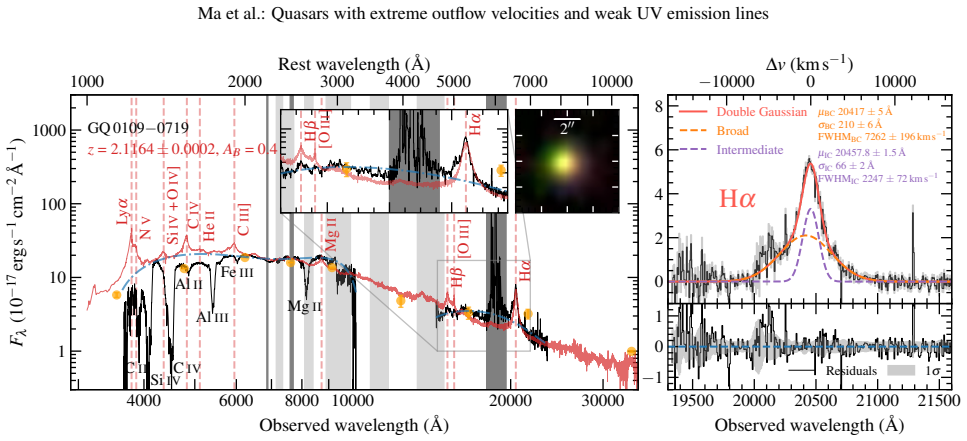
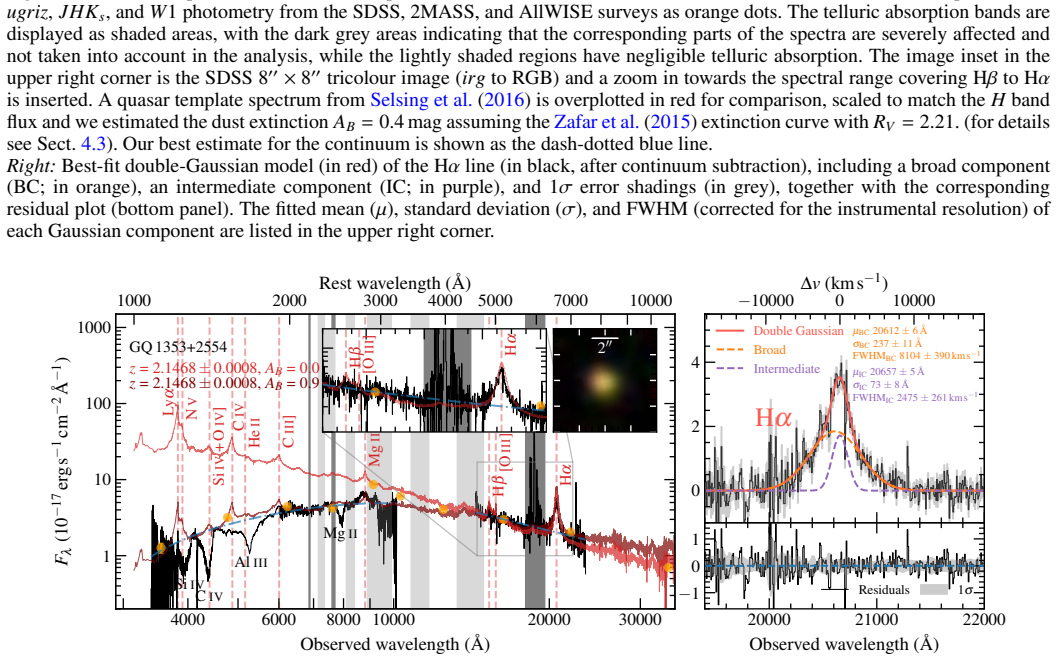
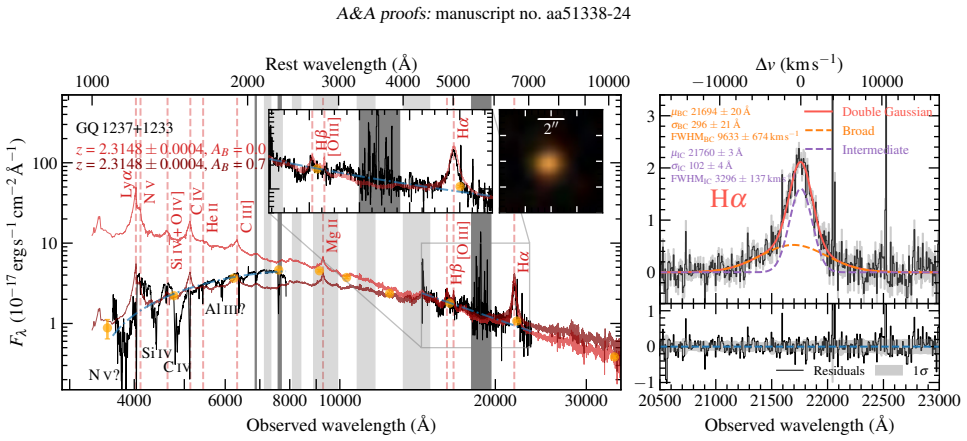
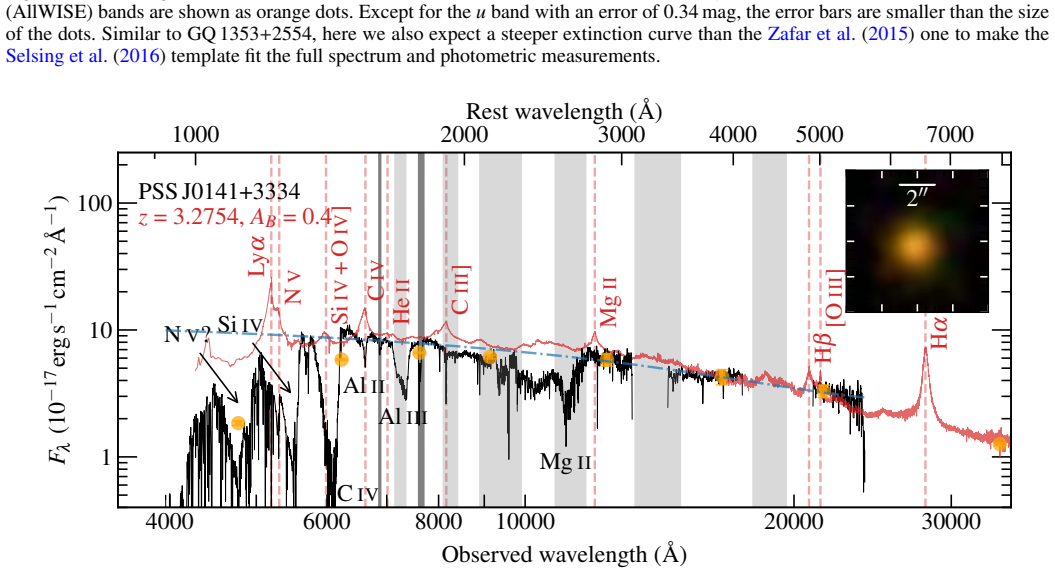
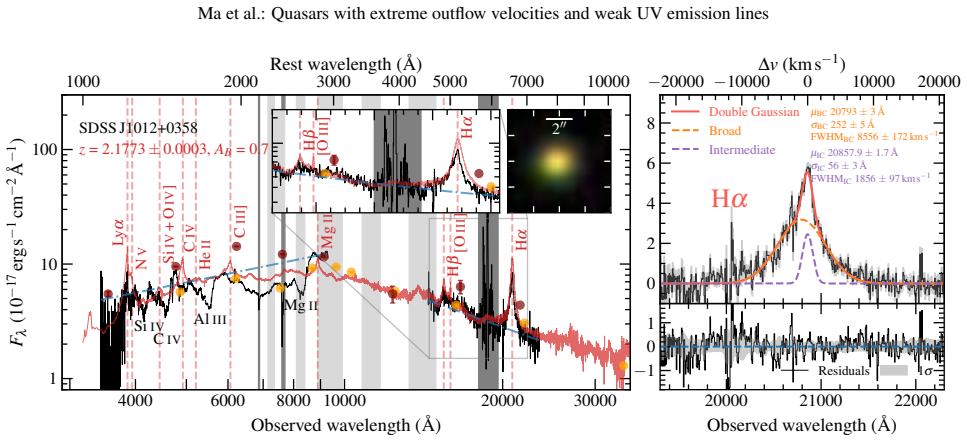
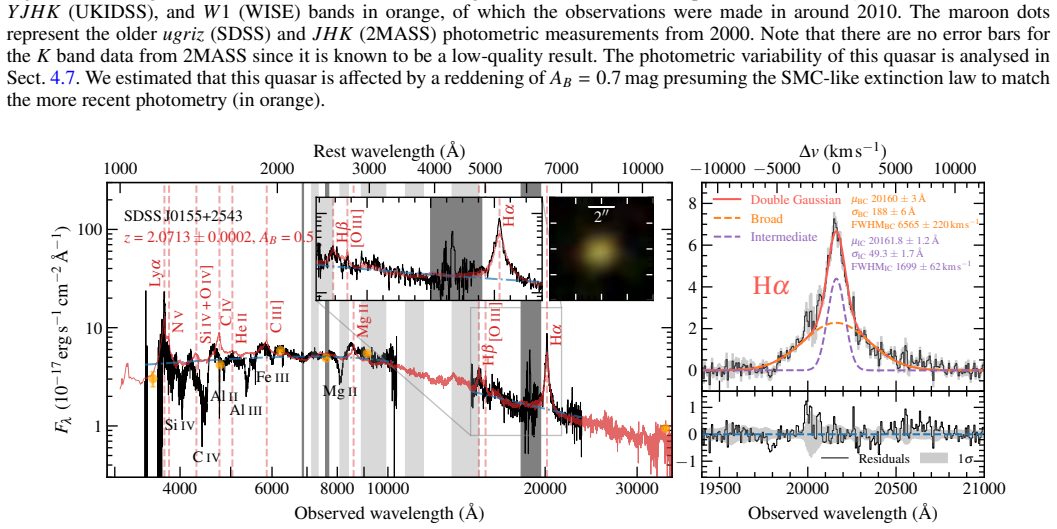
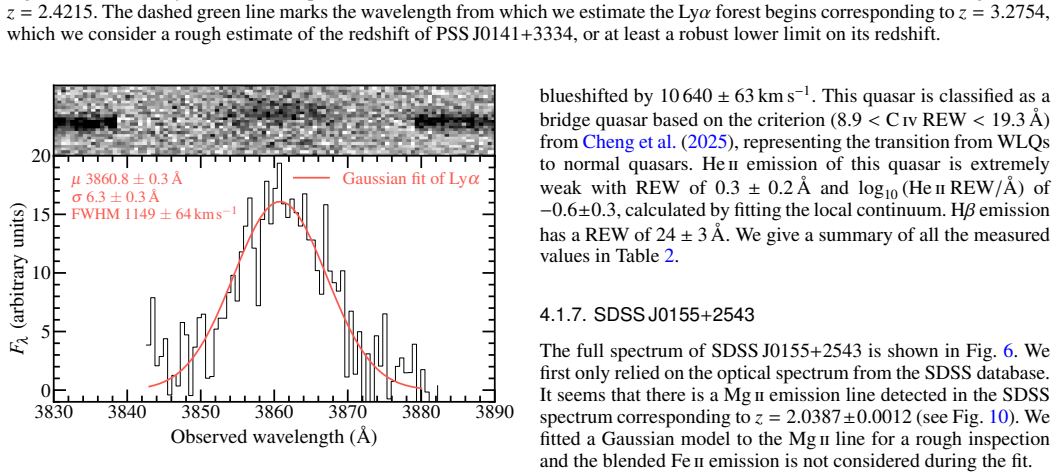
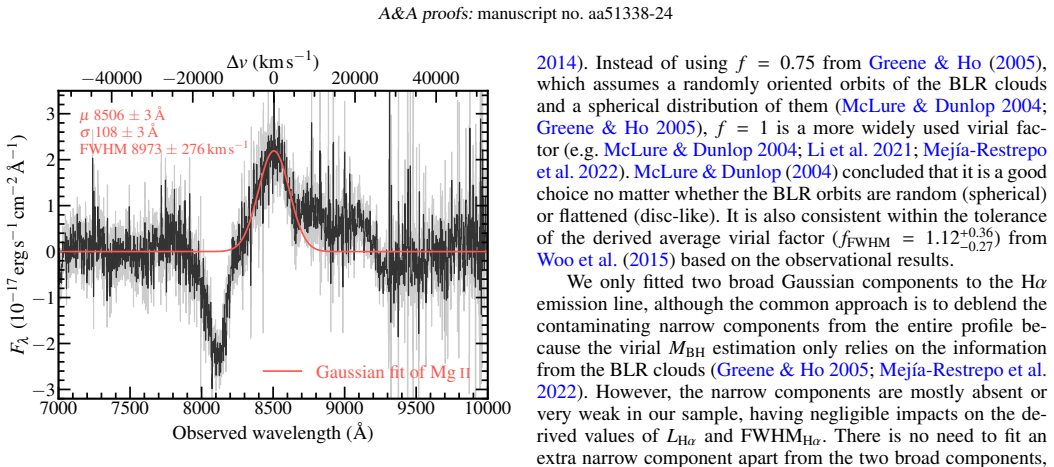
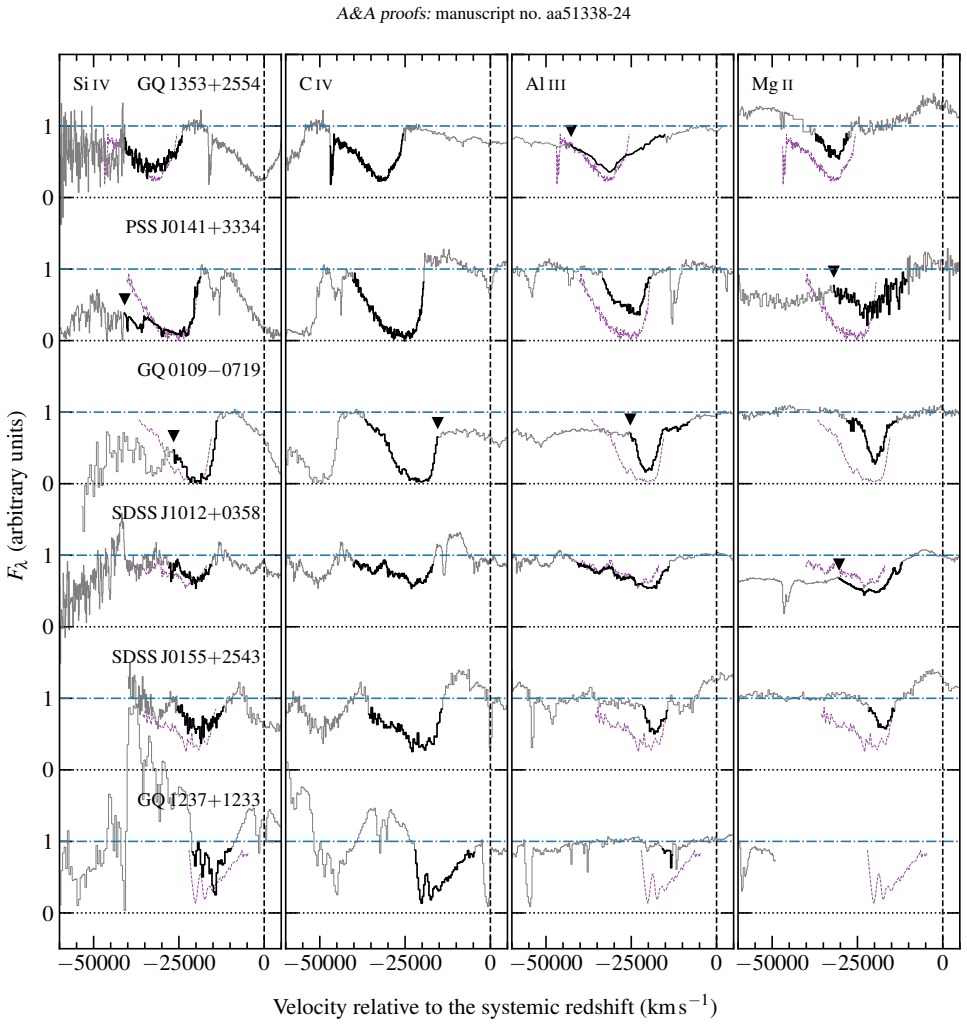
The recently discovered low-ionisation broad absorption line (LoBAL) quasar GQ 1309$+$2904 is unusual due to its very broad, highly blueshifted absorption troughs and an absence of broad emission lines except for ${\mathrm{H} \alpha}$. In this paper, we present observations of six quasars that appear very similar to GQ 1309$+$2904 in the rest-frame ultraviolet (UV). We measure the systemic redshifts of these quasars to be $z\approx$ 2.07--3.28 from detected ${\mathrm{H} \alpha}$ emission lines. We confirm that all targets are quasars with highly blueshifted BALs possessing high-speed outflows with velocities up to $\sim 0.16\,c$, and five of them are confidently identified as LoBAL quasars. Based on ${\mathrm{H} \alpha}$ emission, black hole masses and Eddington ratios of these quasars are $M_{\mathrm{BH}} \approx 10^{8.7}$--$10^{9.4}\,M_{\odot}$ and $L_{\mathrm{bol}} / L_{\mathrm{Edd}} \approx$ 0.14--0.34, indicating that their central black holes are very massive and active. Every quasar in our sample exhibits a very flat or reddened continuum. The spectral shapes of three objects are well-fitted by a normal quasar composite reddened by a Small-Magellanic-Cloud-like (SMC-like) extinction curve, while the other three require a steeper extinction law. Broad-band ($BVR$) polarimetry for two of the latter group (plus GQ 1309$+$2904) reveals their low polarisations, consistent with low inclination (more face-on) angles. We propose that these objects are weak emission-line quasars (WLQs) observed through the disc wind, caught emerging from their dust cocoons. As quasars shed their cocoons, dust grains in the disc wind are shattered into smaller particles, producing the UV-steeper extinction curve observed along the outflow. We present a schematic illustration of this shedding process that can account for the peculiar spectral features observed in our sample.
Editorial analysis
A structured set of objections, weighed in public.
Referee Report
Summary. The paper reports new optical/near-IR spectroscopy and BVR polarimetry for six quasars at z≈2.07–3.28 that resemble the unusual LoBAL GQ 1309+2904. Systemic redshifts are measured from Hα, confirming high-velocity (up to ~0.16c) blueshifted BAL troughs and identifying five as LoBALs. Black-hole masses and Eddington ratios are derived as M_BH≈10^8.7–10^9.4 M_⊙ and L_bol/L_Edd≈0.14–0.34. Continuum shapes are fitted with SMC-like extinction for three objects and steeper UV extinction for the remaining three; the latter three (plus the prototype) show low polarization consistent with low inclination. The authors propose these sources are WLQs viewed through an outflowing disc wind while emerging from dust cocoons, with grain shattering in the wind producing the steeper extinction curve.
Significance. If the proposed scenario is correct, the work supplies a new observational sample of extreme-outflow quasars and a physically motivated evolutionary picture connecting weak UV lines, high-velocity winds, and dust properties during the cocoon-shedding phase. The Hα-based redshift, velocity, and mass measurements follow standard methods and are robust; the new data expand the known population of such objects and offer a falsifiable model involving grain-size evolution in disc winds.
major comments (3)
- [continuum-fitting section] The statement that three objects 'require a steeper extinction law' (abstract and continuum-fitting section) is not supported by reported χ² values, degrees of freedom, or explicit comparison against alternative curves (e.g., MW, LMC, or power-law modifications). Without these statistics it is unclear whether the steeper law is uniquely demanded or whether intrinsic continuum differences could suffice.
- [polarimetry results and interpretation section] Low BVR polarization is taken as direct evidence for low-inclination viewing through the disc wind (polarimetry results and interpretation section). No radiative-transfer calculations are presented that demonstrate the observed polarization levels are inconsistent with higher-inclination BAL geometries once wind optical depth and scattering are included; this assumption is load-bearing for the face-on disc-wind geometry.
- [discussion and schematic] The central claim that dust shattering in the outflow produces the UV-steepened extinction (discussion and schematic) rests on the qualitative inference without forward-modelled grain-size distributions or predicted extinction curves. No quantitative test excludes other explanations such as different grain compositions or sight-line geometries.
minor comments (2)
- [abstract] The velocity range 'up to ∼0.16c' is stated in the abstract but would be clearer if the maximum velocity for each object were tabulated alongside the BAL measurements.
- [schematic illustration] The schematic illustration of the shedding process would benefit from explicit labels for viewing angle and wind direction to aid readers in connecting it to the polarization and extinction arguments.
Simulated Author's Rebuttal
We thank the referee for their constructive and detailed comments on our manuscript. We address each major comment below and indicate the revisions we will implement to improve the clarity and robustness of our analysis and interpretations.
read point-by-point responses
-
Referee: [continuum-fitting section] The statement that three objects 'require a steeper extinction law' (abstract and continuum-fitting section) is not supported by reported χ² values, degrees of freedom, or explicit comparison against alternative curves (e.g., MW, LMC, or power-law modifications). Without these statistics it is unclear whether the steeper law is uniquely demanded or whether intrinsic continuum differences could suffice.
Authors: We agree that quantitative fit statistics are needed to support the claim. In the revised manuscript we will add χ²/dof values for the SMC-like fits versus the steeper UV extinction law for the three objects, along with explicit comparisons to MW and LMC curves. These additions will demonstrate that the steeper law yields a statistically superior match to the observed UV continuum slopes. revision: yes
-
Referee: [polarimetry results and interpretation section] Low BVR polarization is taken as direct evidence for low-inclination viewing through the disc wind (polarimetry results and interpretation section). No radiative-transfer calculations are presented that demonstrate the observed polarization levels are inconsistent with higher-inclination BAL geometries once wind optical depth and scattering are included; this assumption is load-bearing for the face-on disc-wind geometry.
Authors: The low measured polarizations (<2%) align with expectations for low-inclination sight lines, consistent with published polarization studies of BAL and non-BAL quasars. While new radiative-transfer calculations are beyond the scope of this observational paper, we will expand the discussion to cite relevant literature on polarization in disc-wind geometries and explicitly note the assumption. This will clarify the supporting evidence without overclaiming. revision: partial
-
Referee: [discussion and schematic] The central claim that dust shattering in the outflow produces the UV-steepened extinction (discussion and schematic) rests on the qualitative inference without forward-modelled grain-size distributions or predicted extinction curves. No quantitative test excludes other explanations such as different grain compositions or sight-line geometries.
Authors: The dust-shattering scenario is offered as a physically motivated hypothesis linking the extreme outflows, WLQ features, and extinction properties. We will revise the discussion to state this explicitly as a proposal, discuss alternative explanations (grain composition, geometry), and outline testable predictions for future work. Full forward modeling of grain distributions lies outside the present study but is a natural extension. revision: partial
Circularity Check
No significant circularity; central claims rest on new observations and interpretive proposal
full rationale
The manuscript reports new redshift measurements from Hα, outflow velocities from BAL troughs, black-hole mass and Eddington-ratio estimates, continuum fits using SMC-like and steeper extinction curves, and BVR polarimetry values. These quantities are derived directly from the spectra and polarimetric data. The unifying interpretation—that the objects are WLQs viewed through a disc wind where grain shattering produces the steeper UV extinction—is explicitly labeled a proposal and schematic illustration rather than a mathematical derivation. No equations, fitted parameters, or uniqueness theorems are shown to reduce to the input data by construction, and no self-citation chain is invoked to justify the physical picture. The chain is therefore self-contained against the external observations.
Axiom & Free-Parameter Ledger
axioms (2)
- domain assumption H-alpha emission traces the systemic redshift of the quasar host
- domain assumption Standard SMC-like and steeper extinction curves can be applied to quasar continua without additional components
invented entities (1)
-
dust cocoons
no independent evidence
Reference graph
Works this paper leans on
-
[1]
The Physical Properties of Low-redshift FeLoBAL Quasars. III. The Location and Geometry of the Outflows. , keywords =. doi:10.3847/1538-4357/ac854c , archivePrefix =. 2208.02834 , primaryClass =
-
[2]
The Physical Properties of Low-redshift FeLoBAL Quasars. II. The Rest-frame Optical Emission Line Properties. , keywords =. doi:10.3847/1538-4357/ac7e50 , archivePrefix =. 2205.12946 , primaryClass =
-
[3]
QSO MUSEUM I: A sample of 61 extended Ly$\alpha$-emission nebulae surrounding $z\sim3$ quasars
QSO MUSEUM I: a sample of 61 extended Ly -emission nebulae surrounding z 3 quasars. , keywords =. doi:10.1093/mnras/sty2827 , archivePrefix =. 1808.10857 , primaryClass =
work page internal anchor Pith review Pith/arXiv arXiv doi:10.1093/mnras/sty2827
-
[4]
Gaia-assisted discovery of a detached low-ionisation BAL quasar with very large ejection velocities. , keywords =. doi:10.1051/0004-6361/201936957 , archivePrefix =. 1912.10649 , primaryClass =
-
[5]
, keywords =
A composite QSO spectrum. , keywords =
-
[6]
Composite Spectra from the FIRST Bright Quasar Survey
Composite Spectra from the FIRST Bright Quasar Survey. , keywords =. doi:10.1086/318309 , archivePrefix =. astro-ph/0008396 , primaryClass =
work page internal anchor Pith review Pith/arXiv arXiv doi:10.1086/318309
-
[7]
An X-shooter composite of bright 1 < z < 2 quasars from UV to infrared
An X-Shooter composite of bright 1 < z < 2 quasars from UV to infrared. , keywords =. doi:10.1051/0004-6361/201527096 , archivePrefix =. 1510.08058 , primaryClass =
work page internal anchor Pith review Pith/arXiv arXiv doi:10.1051/0004-6361/201527096
-
[8]
Peculiar Broad Absorption Line Quasars found in DPOSS
Peculiar Broad Absorption Line Quasars Found in The Digitized Palomar Observatory Sky Survey. , keywords =. doi:10.1086/375763 , archivePrefix =. astro-ph/0304166 , primaryClass =
work page internal anchor Pith review Pith/arXiv arXiv doi:10.1086/375763
-
[9]
, year = 1992, month = sep, volume =
Extended Ly-alpha emission around quasars at Z>3.6. , year = 1992, month = sep, volume =. doi:10.1093/mnras/258.1.23P , adsurl =
-
[10]
Extended LY alpha emission from a damped LY alpha absorber at z=1.93, and the relation between damped LY alpha absorbers and Lyman-break galaxies. , keywords =. doi:10.1046/j.1365-8711.1999.02520.x , archivePrefix =. astro-ph/9812434 , primaryClass =
-
[11]
Extended Lyman alpha emission around bright quasars
Extended Lyman- emission around bright quasars. , keywords =. doi:10.1051/0004-6361:20065318 , archivePrefix =. astro-ph/0603835 , primaryClass =
work page internal anchor Pith review Pith/arXiv arXiv doi:10.1051/0004-6361:20065318
-
[12]
Unusual Broad Absorption Line Quasars from the Sloan Digital Sky Survey
Unusual Broad Absorption Line Quasars from the Sloan Digital Sky Survey. , keywords =. doi:10.1086/340546 , archivePrefix =. astro-ph/0203252 , primaryClass =
work page internal anchor Pith review Pith/arXiv arXiv doi:10.1086/340546
-
[13]
Spectroscopy of Spatially Extended Material around High-Redshift Radio-loud Quasars. , keywords =. doi:10.1086/170660 , adsurl =
-
[14]
Optical/Near-infrared Selection of Red Quasi-stellar Objects: Evidence for Steep Extinction Curves toward Galactic Centers?. , keywords =. doi:10.1088/0067-0049/204/1/6 , archivePrefix =. 1207.1193 , primaryClass =
work page internal anchor Pith review Pith/arXiv arXiv doi:10.1088/0067-0049/204/1/6
-
[15]
The Extended High A(V) Quasar Survey: Searching for Dusty Absorbers toward Mid-infrared-selected Quasars. , keywords =. doi:10.3847/0004-637X/832/1/49 , archivePrefix =. 1608.08404 , primaryClass =
work page internal anchor Pith review Pith/arXiv arXiv doi:10.3847/0004-637x/832/1/49
-
[16]
Spectroscopic classification of a complete sample of astrometrically-selected quasar candidates using Gaia DR2. , keywords =. doi:10.1051/0004-6361/202039262 , archivePrefix =. 2010.05934 , primaryClass =
-
[17]
The Sloan Digital Sky Survey Quasar Catalog: Sixteenth Data Release. , keywords =. doi:10.3847/1538-4365/aba623 , archivePrefix =. 2007.09001 , primaryClass =
-
[18]
A quasar reddened by a sub-parsec-sized, metal-rich and dusty cloud in a damped Lyman absorber at z = 2.13. , keywords =. doi:10.1093/mnras/stv2346 , archivePrefix =. 1510.04695 , primaryClass =
work page internal anchor Pith review Pith/arXiv arXiv doi:10.1093/mnras/stv2346
-
[19]
Gaia-assisted selection of a quasar reddened by dust in an extremely strong damped Lyman- absorber at z = 2.226. , keywords =. doi:10.1051/0004-6361/201935108 , archivePrefix =. 1904.01686 , primaryClass =
work page internal anchor Pith review Pith/arXiv arXiv doi:10.1051/0004-6361/201935108 1904
-
[20]
The High A _ V Quasar Survey: A z = 2.027 metal-rich damped Lyman- absorber towards a red quasar at z = 3.21. , keywords =. doi:10.1051/0004-6361/201730726 , archivePrefix =. 1706.07016 , primaryClass =
work page internal anchor Pith review Pith/arXiv arXiv doi:10.1051/0004-6361/201730726
-
[21]
A quasar hiding behind two dusty absorbers. Quantifying the selection bias of metal-rich, damped Ly absorption systems. , keywords =. doi:10.1051/0004-6361/201731964 , archivePrefix =. 1803.09805 , primaryClass =
work page internal anchor Pith review Pith/arXiv arXiv doi:10.1051/0004-6361/201731964
-
[22]
The Physical Properties of Low-redshift FeLoBAL Quasars. I. Spectral-synthesis Analysis of the Broad Absorption-line (BAL) Outflows Using SimBAL. , keywords =. doi:10.3847/1538-4357/ac61d9 , archivePrefix =. 2203.11964 , primaryClass =
-
[23]
The Messenger , year = 2000, month = mar, volume =
Spectral PSF subtraction I: the SPSF look-up-table method. The Messenger , year = 2000, month = mar, volume =
2000
-
[24]
An optimal extraction algorithm for CCD spectroscopy. , keywords =. doi:10.1086/131801 , adsurl =
-
[25]
C IV Absorption Systems in QSO Spectra: Is the Character of Systems with Z abs approximately equal to Z EM Different from Those with Z abs Z em?. , keywords =. doi:10.1086/164440 , adsurl =
-
[26]
Systematic QSO Emission-Line Velocity Shifts and New Unbiased Redshifts. , keywords =. doi:10.1086/191642 , adsurl =
-
[27]
Statistics of QSO Broad Emission-Line Profiles. II. The C IV lambda 1549, C iii] lambda 1909, and MG II lambda 2798 Lines. , keywords =. doi:10.1086/173794 , adsurl =
-
[28]
Low-Ionization Broad Absorption Lines in Quasars. , keywords =. doi:10.1086/172980 , adsurl =
-
[29]
, year = 1963, month = mar, volume =
3C 273 : A Star-Like Object with Large Red-Shift. , year = 1963, month = mar, volume =. doi:10.1038/1971040a0 , adsurl =
-
[30]
A dusty compact object bridging galaxies and quasars at cosmic dawn. , keywords =. doi:10.1038/s41586-022-04454-1 , archivePrefix =. 2204.06393 , primaryClass =
-
[31]
Observation of three QSOs with broad, detached absorption features. , keywords =. doi:10.1086/158004 , adsurl =
-
[32]
, keywords =
Polarization properties of a sample of broad absorption line and gravitationally lensed quasars. , keywords =
-
[33]
Double Image Polarimeter Ultra Fast: Simultaneous Three-color (BV R) Polarimeter with Electron-multiplying Charge-coupled Devices. , keywords =. doi:10.3847/1538-3881/abc74f , adsurl =
-
[34]
Optical polarization signatures of black hole X-ray binaries. , keywords =. doi:10.1093/mnras/stac1470 , archivePrefix =. 2205.12121 , primaryClass =
-
[35]
A Luminous Quasar at Redshift 7.642. , keywords =. doi:10.3847/2041-8213/abd8c6 , archivePrefix =. 2101.03179 , primaryClass =
-
[36]
Estimating Black Hole Masses in Active Galaxies Using the Halpha Emission Line
Estimating Black Hole Masses in Active Galaxies Using the H Emission Line. , keywords =. doi:10.1086/431897 , archivePrefix =. astro-ph/0508335 , primaryClass =
work page internal anchor Pith review Pith/arXiv arXiv doi:10.1086/431897
-
[37]
BASS. XXV. DR2 Broad-line-based Black Hole Mass Estimates and Biases from Obscuration. , keywords =. doi:10.3847/1538-4365/ac6602 , archivePrefix =. 2204.05321 , primaryClass =
-
[38]
FIRST-2MASS Red Quasars: Transitional Objects Emerging from the Dust
FIRST-2MASS Red Quasars: Transitional Objects Emerging from the Dust. , keywords =. doi:10.1088/0004-637X/757/1/51 , archivePrefix =. 1207.2175 , primaryClass =
work page internal anchor Pith review Pith/arXiv arXiv doi:10.1088/0004-637x/757/1/51
-
[39]
The FIRST-2MASS Red Quasar Survey. II. An Anomalously High Fraction of LoBALs in Searches for Dust-Reddened Quasars. , keywords =. doi:10.1088/0004-637X/698/2/1095 , archivePrefix =. 0808.3668 , primaryClass =
work page internal anchor Pith review Pith/arXiv arXiv doi:10.1088/0004-637x/698/2/1095
-
[40]
Improved redshifts for SDSS quasar spectra. , keywords =. doi:10.1111/j.1365-2966.2010.16648.x , archivePrefix =. 1003.3017 , primaryClass =
-
[41]
Major Mergers Host the Most Luminous Red Quasars at z ~ 2: A Hubble Space Telescope WFC3/IR Study
Major Mergers Host the Most-luminous Red Quasars at z -0.5ex 2: A Hubble Space Telescope WFC3/IR Study. , keywords =. doi:10.1088/0004-637X/806/2/218 , archivePrefix =. 1504.02111 , primaryClass =
work page internal anchor Pith review Pith/arXiv arXiv doi:10.1088/0004-637x/806/2/218
-
[42]
Detecting and Characterizing Young Quasars. I. Systemic Redshifts and Proximity Zone Measurements. , keywords =. doi:10.3847/1538-4357/aba52e , archivePrefix =. 2002.01811 , primaryClass =
-
[43]
The Sloan Digital Sky Survey Reverberation Mapping Project: Velocity Shifts of Quasar Emission Lines
The Sloan Digital Sky Survey Reverberation Mapping Project: Velocity Shifts of Quasar Emission Lines. , keywords =. doi:10.3847/0004-637X/831/1/7 , archivePrefix =. 1602.03894 , primaryClass =
work page internal anchor Pith review Pith/arXiv arXiv doi:10.3847/0004-637x/831/1/7
-
[44]
The mass of quasars. Bulletin of the Astronomical Society of India , keywords =. doi:10.48550/arXiv.1302.2643 , archivePrefix =. 1302.2643 , primaryClass =
work page internal anchor Pith review Pith/arXiv arXiv doi:10.48550/arxiv.1302.2643
-
[45]
Heavily reddened type 1 quasars at z > 2 - I. Evidence for significant obscured black hole growth at the highest quasar luminosities. , keywords =. doi:10.1093/mnras/stu2649 , archivePrefix =. 1501.00815 , primaryClass =
work page internal anchor Pith review Pith/arXiv arXiv doi:10.1093/mnras/stu2649
-
[46]
Unification of Luminous Type 1 Quasars through CIV Emission
Unification of Luminous Type 1 Quasars through C IV Emission. , keywords =. doi:10.1088/0004-6256/141/5/167 , archivePrefix =. 1011.2282 , primaryClass =
work page internal anchor Pith review Pith/arXiv arXiv doi:10.1088/0004-6256/141/5/167
-
[47]
Discovery of H alpha absorption in the unusual broad absorption line quasar SDSS J083942.11+380526.3
Discovery of H Absorption in the Unusual Broad Absorption Line Quasar SDSS J083942.11+380526.3. , keywords =. doi:10.1086/507438 , archivePrefix =. astro-ph/0607036 , primaryClass =
work page internal anchor Pith review Pith/arXiv arXiv doi:10.1086/507438
-
[48]
Accurate Systemic Redshifts and Outflow Speeds for Extremely Red Quasars (ERQs). arXiv e-prints , keywords =. doi:10.48550/arXiv.2305.11223 , archivePrefix =. 2305.11223 , primaryClass =
-
[49]
Blueshifted [O III] Emission: Indications of a Dynamic NLR
Blueshifted [O III] Emission: Indications of a Dynamic Narrow-Line Region. , keywords =. doi:10.1086/431722 , archivePrefix =. astro-ph/0505127 , primaryClass =
work page internal anchor Pith review Pith/arXiv arXiv doi:10.1086/431722
-
[50]
Broad Emission Line Shifts in Quasars: An Orientation Measure for Radio-Quiet Quasars?
Broad Emission-Line Shifts in Quasars: An Orientation Measure for Radio-Quiet Quasars?. , keywords =. doi:10.1086/341167 , archivePrefix =. astro-ph/0204162 , primaryClass =
work page internal anchor Pith review Pith/arXiv arXiv doi:10.1086/341167
-
[51]
An ultra-dense fast outflow in a quasar at z=2.4
An ultra-dense fast outflow in a quasar at z = 2.4. , keywords =. doi:10.1093/mnras/stx311 , archivePrefix =. 1605.08046 , primaryClass =
work page internal anchor Pith review Pith/arXiv arXiv doi:10.1093/mnras/stx311
-
[52]
The Black Hole Mass Scale of Classical and Pseudo Bulges in Active Galaxies
The Black Hole Mass Scale of Classical and Pseudo Bulges in Active Galaxies. , keywords =. doi:10.1088/0004-637X/789/1/17 , archivePrefix =. 1406.6137 , primaryClass =
work page internal anchor Pith review Pith/arXiv arXiv doi:10.1088/0004-637x/789/1/17
-
[53]
The cosmological evolution of quasar black hole masses. , keywords =. doi:10.1111/j.1365-2966.2004.08034.x , archivePrefix =. astro-ph/0310267 , primaryClass =
-
[54]
The black hole mass - stellar velocity dispersion relation of narrow-line Seyfert 1 galaxies
The Black Hole Mass-Stellar Velocity Dispersion Relation of Narrow-line Seyfert 1 Galaxies. , keywords =. doi:10.1088/0004-637X/801/1/38 , archivePrefix =. 1412.7225 , primaryClass =
work page internal anchor Pith review Pith/arXiv arXiv doi:10.1088/0004-637x/801/1/38
-
[55]
Reverberation Mapping of Two Luminous Quasars: The Broad-line Region Structure and Black Hole Mass. , keywords =. doi:10.3847/1538-4357/ac116e , archivePrefix =. 2106.05655 , primaryClass =
-
[56]
The largest black holes and the most luminous galaxies
The Largest Black Holes and the Most Luminous Galaxies. , keywords =. doi:10.1086/368012 , archivePrefix =. astro-ph/0210548 , primaryClass =
work page internal anchor Pith review Pith/arXiv arXiv doi:10.1086/368012
-
[57]
Reverberation Measurements for 17 Quasars and the Size-Mass-Luminosity Relations in Active Galactic Nuclei. , keywords =. doi:10.1086/308704 , archivePrefix =. astro-ph/9911476 , primaryClass =
work page internal anchor Pith review Pith/arXiv arXiv doi:10.1086/308704
-
[58]
Comparing and calibrating black hole mass estimators for distant active galactic nuclei
Comparing and Calibrating Black Hole Mass Estimators for Distant Active Galactic Nuclei. , keywords =. doi:10.1086/524349 , archivePrefix =. 0710.1839 , primaryClass =
work page internal anchor Pith review Pith/arXiv arXiv doi:10.1086/524349
-
[59]
Cosmic Evolution of Mass Accretion Rate and Metalicity in Active Galactic Nuclei
Cosmic Evolution of Mass Accretion Rate and Metallicity in Active Galactic Nuclei. , keywords =. doi:10.1086/509650 , archivePrefix =. astro-ph/0607654 , primaryClass =
work page internal anchor Pith review Pith/arXiv arXiv doi:10.1086/509650
-
[60]
The Eleventh and Twelfth Data Releases of the Sloan Digital Sky Survey: Final Data from SDSS-III
The Eleventh and Twelfth Data Releases of the Sloan Digital Sky Survey: Final Data from SDSS-III. , keywords =. doi:10.1088/0067-0049/219/1/12 , archivePrefix =. 1501.00963 , primaryClass =
work page internal anchor Pith review Pith/arXiv arXiv doi:10.1088/0067-0049/219/1/12
-
[61]
The Pan-STARRS1 Surveys. arXiv e-prints , keywords =. doi:10.48550/arXiv.1612.05560 , archivePrefix =. 1612.05560 , primaryClass =
work page internal anchor Pith review Pith/arXiv arXiv doi:10.48550/arxiv.1612.05560
-
[62]
The Pan-STARRS1 Photometric System
The Pan-STARRS1 Photometric System. , keywords =. doi:10.1088/0004-637X/750/2/99 , archivePrefix =. 1203.0297 , primaryClass =
work page internal anchor Pith review Pith/arXiv arXiv doi:10.1088/0004-637x/750/2/99
-
[63]
The Two Micron All Sky Survey (2MASS). , keywords =. doi:10.1086/498708 , adsurl =
-
[64]
The UKIRT Infrared Deep Sky Survey (UKIDSS). , keywords =. doi:10.1111/j.1365-2966.2007.12040.x , archivePrefix =. astro-ph/0604426 , primaryClass =
-
[65]
The Wide-field Infrared Survey Explorer (WISE): Mission Description and Initial On-orbit Performance
The Wide-field Infrared Survey Explorer (WISE): Mission Description and Initial On-orbit Performance. , keywords =. doi:10.1088/0004-6256/140/6/1868 , archivePrefix =. 1008.0031 , primaryClass =
work page internal anchor Pith review Pith/arXiv arXiv doi:10.1088/0004-6256/140/6/1868
-
[66]
VizieR Online Data Catalog , keywords =
VizieR Online Data Catalog: AllWISE Data Release (Cutri+ 2013). VizieR Online Data Catalog , keywords =
2013
-
[67]
VizieR Online Data Catalog , keywords =
VizieR Online Data Catalog: 2MASS All-Sky Catalog of Point Sources (Cutri+ 2003). VizieR Online Data Catalog , keywords =
2003
-
[68]
The United Kingdom Infrared Telescope Infrared Deep Sky Survey First Data Release. , keywords =. doi:10.1111/j.1365-2966.2006.11284.x , archivePrefix =. astro-ph/0610191 , primaryClass =
-
[69]
The 16th Data Release of the Sloan Digital Sky Surveys: First Release from the APOGEE-2 Southern Survey and Full Release of eBOSS Spectra. , keywords =. doi:10.3847/1538-4365/ab929e , archivePrefix =. 1912.02905 , primaryClass =
-
[70]
Atomic Data for Resonance Absorption Lines. I. Wavelengths Longward of the Lyman Limit. , keywords =. doi:10.1086/191601 , adsurl =
-
[71]
Double Troughs in Broad Absorption Line Quasars and LY alpha --N V Line Locking. , keywords =. doi:10.1086/191825 , adsurl =
-
[72]
Red and Reddened Quasars in the Sloan Digital Sky Survey
Red and Reddened Quasars in the Sloan Digital Sky Survey. , keywords =. doi:10.1086/377014 , archivePrefix =. astro-ph/0305305 , primaryClass =
work page internal anchor Pith review Pith/arXiv arXiv doi:10.1086/377014
-
[73]
Dust Reddening in SDSS Quasars
Dust Reddening in Sloan Digital Sky Survey Quasars. , keywords =. doi:10.1086/423291 , archivePrefix =. astro-ph/0406293 , primaryClass =
work page internal anchor Pith review Pith/arXiv arXiv doi:10.1086/423291
-
[74]
The effect of dust bias on the census of neutral gas and metals in the high-redshift Universe due to SDSS-II quasar colour selection. , keywords =. doi:10.1093/mnras/stz1120 , archivePrefix =. 1904.06966 , primaryClass =
work page internal anchor Pith review Pith/arXiv arXiv doi:10.1093/mnras/stz1120 1904
-
[75]
Composite Quasar Spectra From the Sloan Digital Sky Survey
Composite Quasar Spectra from the Sloan Digital Sky Survey. , keywords =. doi:10.1086/321167 , archivePrefix =. astro-ph/0105231 , primaryClass =
work page internal anchor Pith review Pith/arXiv arXiv doi:10.1086/321167
-
[76]
Interstellar Dust from the Milky Way to the Magellanic Clouds. , keywords =. doi:10.1086/171637 , adsurl =
-
[77]
Vanishing Absorption and Blueshifted Emission in FeLoBAL Quasars
Vanishing absorption and blueshifted emission in FeLoBAL quasars. , keywords =. doi:10.1093/mnras/stw634 , archivePrefix =. 1604.06977 , primaryClass =
work page internal anchor Pith review Pith/arXiv arXiv doi:10.1093/mnras/stw634
-
[78]
The Blueshift Of Civ Broad Emission Line In Qsos
The Blueshift of the C IV Broad Emission Line in QSOs. , keywords =. doi:10.3847/1538-3881/ab0956 , archivePrefix =. 1903.08830 , primaryClass =
work page internal anchor Pith review Pith/arXiv arXiv doi:10.3847/1538-3881/ab0956 1903
-
[79]
The average absorption properties of broad absorption line quasars at 800 < _ rest < 3000 A , and the underlying physical parameters. , keywords =. doi:10.1093/mnras/stt582 , archivePrefix =. 1304.0986 , primaryClass =
work page internal anchor Pith review Pith/arXiv arXiv doi:10.1093/mnras/stt582
-
[80]
The most luminous blue quasars at 3.0 < z < 3.3. II. C IV/X-ray emission and accretion disc physics. , keywords =. doi:10.1051/0004-6361/202141356 , archivePrefix =. 2107.02806 , primaryClass =
discussion (0)
Sign in with ORCID, Apple, or X to comment. Anyone can read and Pith papers without signing in.