Evaluating Glanceable Multi-Device Family Health Tracking with Smartwatches and Home Displays
Pith reviewed 2026-07-03 07:11 UTC · model grok-4.3
The pith
Home displays increase family mood and goal tracking frequency compared to smartwatches alone.
A machine-rendered reading of the paper's core claim, the machinery that carries it, and where it could break.
Core claim
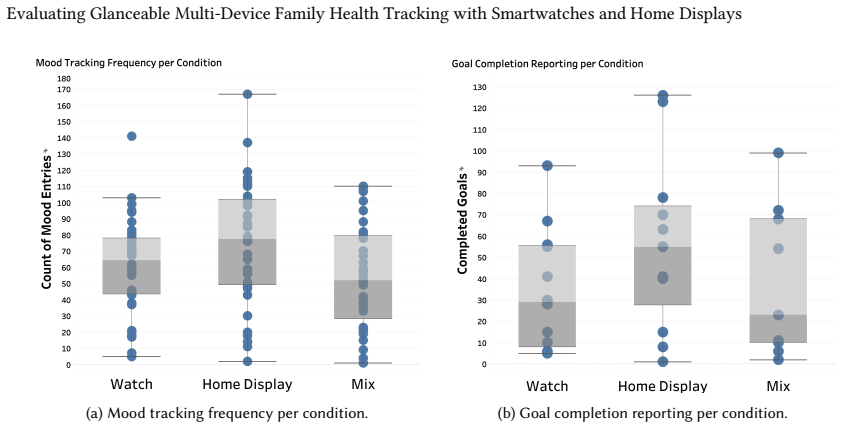
Mood tracking and goal reporting were significantly more frequent with the home display present compared to smartwatch-only use, while multi-device redundancy accommodated diversity in routines, mobility patterns, and device preferences among members in the same family.
What carries the argument
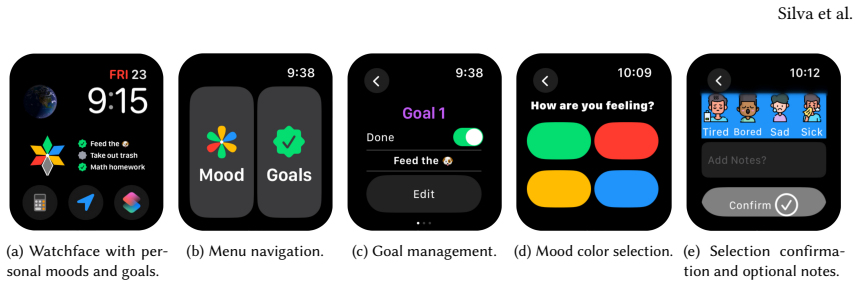
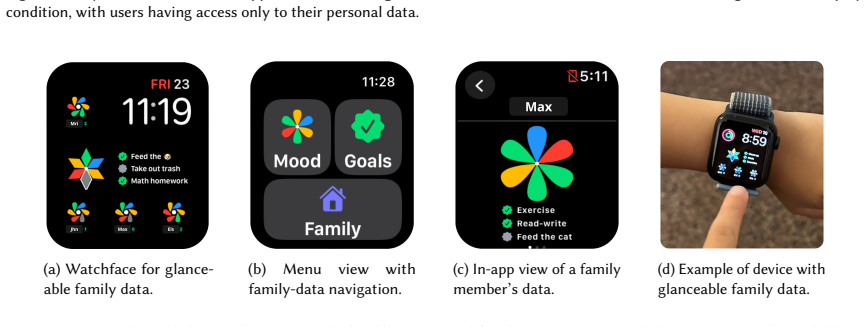
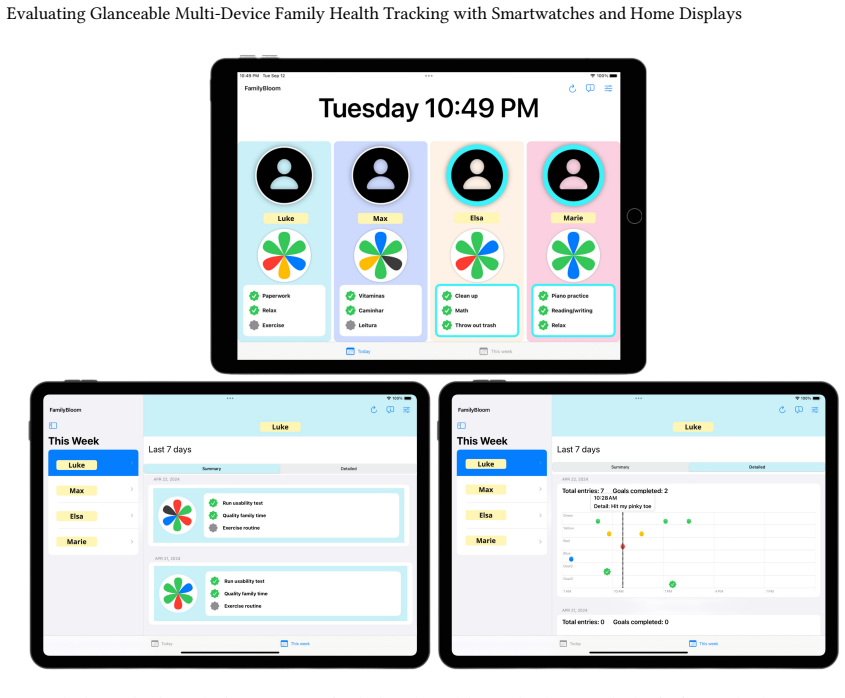
Glanceable multi-device access to shared mood and goal data, where smartwatches support opportunistic awareness apart from home and displays provide reminders and collaboration cues during family routines.
If this is right
- Adding home displays raises the rate of mood and goal reports relative to watches alone.
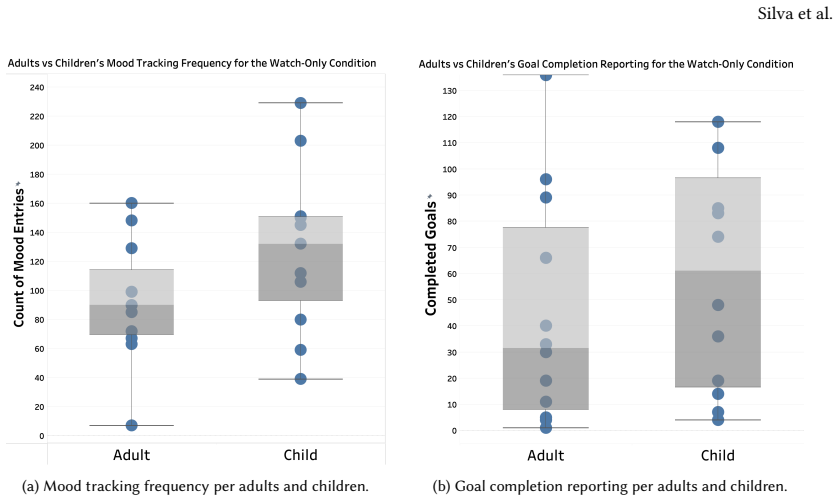
- Children maintain more consistent tracking than adults across all three designs.
- Smartwatch glanceability enables awareness of family data while members are separated.
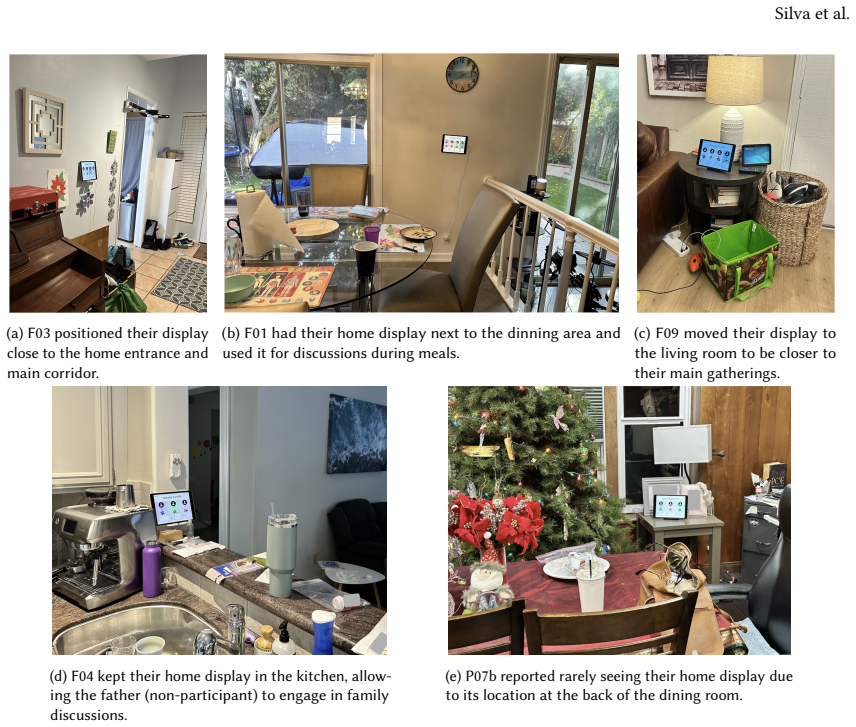
- Home displays help include family members who avoid wearing devices.
Where Pith is reading between the lines
- Systems for family health data may need to treat device choice as a way to match individual habits rather than enforce one form factor.
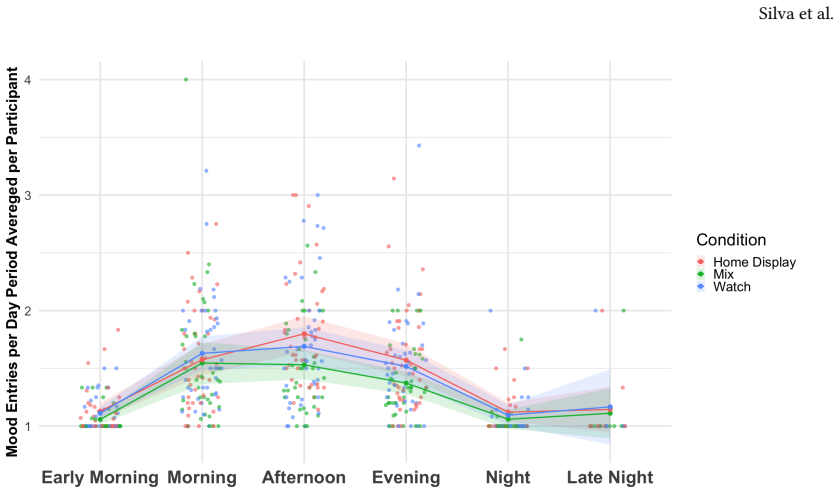
- The afternoon peak and weekend drop in tracking suggest timing notifications to daily patterns could be tested next.
- The observed drop in tracking over weeks points to a need for designs that adapt over longer periods without losing engagement.
Load-bearing premise
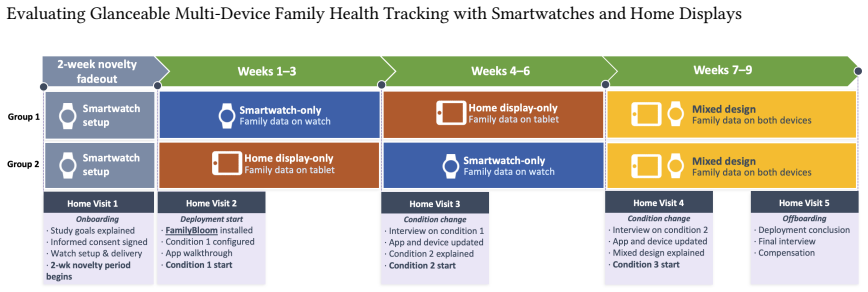
Alternating the three designs over nine weeks produces comparable conditions across families without order effects, fatigue, or external influences substantially changing the observed frequency differences.
What would settle it
A replication study that assigns devices simultaneously or for longer fixed periods and finds no reliable difference in tracking rates between display-present and smartwatch-only conditions would falsify the frequency claim.
Figures

read the original abstract
While ubiquitous computing research has explored diverse devices for personal health tracking, we know less about multi-device designs for family informatics, where health management is inherently collaborative. To understand how families adopt and perceive ubiquitous access to shared health data across contexts, we evaluated smartwatch-only, home display-only, and combined designs for tracking moods and goals, domains central to family health behavior regulation. 44 people across 12 families alternated between these designs over nine weeks. Log analysis revealed that mood tracking and goal reporting were significantly more frequent with the home display present compared to smartwatch-only use, despite an overall decline in mood tracking over time. Tracking peaked in afternoons, dropped on weekends, and occurred 2.6X more at home, with children tracking more consistently than adults across all designs. From interview analysis, we learned how family data glanceability on smartwatches supported opportunistic tracking and awareness while apart, whereas displays reminded families to self-track and collaborate during home routines including members that avoided wearables (e.g., non-participants). Multi-device redundancy accommodated diversity in routines, mobility patterns, and device preferences among members in the same family. We discuss opportunities for multi-device family informatics that accommodates different preferences through inclusive, glanceable, and adaptable ubiquitous data sharing.
Editorial analysis
A structured set of objections, weighed in public.
Referee Report
Summary. The paper reports a 9-week within-subjects crossover field study with 12 families (44 participants) comparing smartwatch-only, home-display-only, and combined designs for shared mood and goal tracking. Log analysis shows mood/goal tracking is significantly more frequent when a home display is present versus smartwatch-only (2.6X higher at home), with afternoon peaks, weekend drops, and more consistent child tracking; interviews describe glanceability benefits, redundancy for diverse routines/preferences, and inclusion of non-wearable users.
Significance. If the device-presence effect is isolated from sequence confounds, the work supplies concrete evidence that multi-device redundancy improves engagement and inclusivity in family health informatics. The longitudinal mixed-methods design with 12 families and explicit attention to mobility and non-participant inclusion is a positive contribution to ubiquitous computing and CSCW.
major comments (2)
- [Methods] Methods (study design paragraph): the alternating of three conditions over nine weeks is described without counterbalancing details (Latin square or equivalent) or confirmation that the mixed-effects model for tracking frequency included week/order as fixed effects or interactions. Given the reported overall decline in tracking over time, this omission leaves open the possibility that sequence or fatigue effects drive the reported display-present advantage.
- [Results] Results (log analysis subsection): the claim of 'significantly more frequent' tracking with the home display does not report whether carry-over tests were performed or whether the model controlled for the noted temporal decline; without these, the central quantitative contrast between conditions cannot be isolated from time-based confounds.
minor comments (2)
- [Abstract] Abstract: the 2.6X multiplier and significance statements would benefit from parenthetical reporting of the exact statistical test and effect size for immediate clarity.
- [Figures] Figure captions (log frequency plots): axis labels and error bars should explicitly state whether they represent per-family or per-participant aggregates.
Simulated Author's Rebuttal
We thank the referee for their detailed and constructive feedback on our manuscript. The two major comments both concern potential sequence or time-based confounds in our within-subjects design; we address each below and will revise the paper to supply the requested methodological details and statistical controls.
read point-by-point responses
-
Referee: [Methods] Methods (study design paragraph): the alternating of three conditions over nine weeks is described without counterbalancing details (Latin square or equivalent) or confirmation that the mixed-effects model for tracking frequency included week/order as fixed effects or interactions. Given the reported overall decline in tracking over time, this omission leaves open the possibility that sequence or fatigue effects drive the reported display-present advantage.
Authors: We agree that these details were omitted. The 12 families were assigned to condition orders via a Latin-square counterbalancing scheme so that each of the six possible sequences appeared twice. The linear mixed-effects models for daily tracking counts included week (centered) as a fixed effect, condition, and their interaction; family and participant were random effects. We will expand the Methods section to describe the Latin-square assignment and the exact model specification, including the week-by-condition interaction term. revision: yes
-
Referee: [Results] Results (log analysis subsection): the claim of 'significantly more frequent' tracking with the home display does not report whether carry-over tests were performed or whether the model controlled for the noted temporal decline; without these, the central quantitative contrast between conditions cannot be isolated from time-based confounds.
Authors: We will add the requested reporting. The model already contained week as a fixed effect to account for the observed temporal decline; the condition-by-week interaction was non-significant, indicating no differential carry-over. We will insert a short paragraph in the log-analysis subsection that states the model terms, reports the non-significant interaction, and confirms that the main effect of display presence remains significant after controlling for week. revision: yes
Circularity Check
Empirical user study with no mathematical derivations or self-referential reductions
full rationale
This is a standard HCI field study reporting log frequencies and interview themes from 44 participants across 12 families. No equations, parameters, predictions, or uniqueness theorems appear in the text. All central claims (higher tracking with home display, multi-device redundancy) are presented as direct observations from the collected logs and interviews rather than derived from prior self-citations or fitted inputs. The study design notes an overall decline over time but does not reduce any result to a self-defined quantity.
Axiom & Free-Parameter Ledger
axioms (2)
- standard math Standard statistical tests can establish significant differences in tracking frequency from the log data.
- domain assumption Interview themes accurately reflect participants' perceptions of glanceability and collaboration.
Reference graph
Works this paper leans on
-
[1]
Amid Ayobi, Paul Marshall, and Anna L. Cox. 2020. Trackly: A Customisable and Pictorial Self-Tracking App to Support Agency in Multiple Sclerosis Self-Care. InProceedings of the SIGCHI Conference on Human Factors in Computing Systems (CHI 2020). ACM, New York, NY, USA, 1–15. doi:10.1145/3313831.3376809
-
[2]
Amid Ayobi, Tobias Sonne, Paul Marshall, and Anna L. Cox. 2018. Flexible and Mindful Self-Tracking: Design Implications from Paper Bullet Journals. InProceedings of the SIGCHI Conference on Human Factors in Computing Systems (CHI 2018), Vol. 2018-April. ACM, New York, NY, USA, 1–14. doi:10.1145/3173574.3173602
-
[3]
Richard Q. Bell. 1979. Parent, child, and reciprocal influences.American Psychologist34, 10 (oct 1979), 821–826. doi:10.1037/0003-066X.34.10.821
-
[4]
Jerica M Berge, Craig Meyer, Richard F MacLehose, Renee Crichlow, and Dianne Neumark-Sztainer. 2015. All in the family: Correlations between parents’ and adolescent siblings’ weight and weight-related behaviors.Obesity23, 4 (2015), 833–839
2015
-
[5]
Virginia Braun and Victoria Clarke. 2006. Using thematic analysis in psychology.Qualitative Research in Psychology3, 2 (2006), 77–101. doi:10.1191/1478088706qp063oa
-
[6]
Nathalie Bressa, Jo Vermeulen, and Wesley Willett. 2022. Data Every Day: Designing and Living with Personal Situated Visualizations. InCHI Conference on Human Factors in Computing Systems. ACM, New York, NY, USA, 1–18. doi:10.1145/3491102.3517737
-
[7]
Taylor, Shahram Izadi, Abigail Sellen, Joseph Jofish’ Kaye, and Rachel Eardley
Barry Brown, Alex S. Taylor, Shahram Izadi, Abigail Sellen, Joseph Jofish’ Kaye, and Rachel Eardley. 2007. Locating Family Values: A Field Trial of the Whereabouts Clock. InUbiComp 2007: Ubiquitous Computing, John Krumm, Gregory D. Abowd, Aruna Seneviratne, and Thomas Strang (Eds.). Springer Berlin Heidelberg, Berlin, Heidelberg, 354–371. Silva et al
2007
-
[8]
A.J. Bernheim Brush, Kori M. Inkpen, and Kimberly Tee. 2008. SPARCS: Exploring Sharing Suggestions to Enhance Family Connectedness. In Proceedings of the ACM conference on Computer supported cooperative work (CSCW 2008). ACM Press, New York, New York, USA, 629. doi:10.1145/ 1460563.1460661
-
[9]
A. J. Bernheim Brush and Kori M. Inkpen. 2007. Yours, Mine and Ours? Sharing and Use of Technology in Domestic Environments. InUbiComp 2007: Ubiquitous Computing, John Krumm, Gregory D. Abowd, Aruna Seneviratne, and Thomas Strang (Eds.). Springer Berlin Heidelberg, Berlin, Heidelberg, 109–126
2007
-
[10]
Elisabeth Bügelmayer and Daniel D Schnitzlein. 2018. Is it the family or the neighborhood? Evidence from sibling and neighbor correlations in youth education and health.The Journal of Economic Inequality16, 3 (2018), 369–388
2018
-
[11]
Yoon Jeong Cha, Jiongyu Chen, Yasemin Gunal, Qiying Zhu, Mark W Newman, and Sun Young Park. 2025. Collaborative Health-Tracking Technologies for Children and Parents: A Review of Current Studies and Directions for Future Research. InProceedings of the 2025 CHI Conference on Human Factors in Computing Systems (CHI ’25). Association for Computing Machinery,...
-
[12]
I Like My Own Watch Independence
Sydney Charitos, Lauren Thompson, Amberly Brigden, Abby Russell, Petr Slovak, and Jon Bird. 2025.“I Like My Own Watch Independence”: Exploring Low-Burden Customisation of a Technology Probe by Children with ADHD and their Parents. Association for Computing Machinery, New York, NY, USA, 728–742. https://doi.org/10.1145/3713043.3733254
-
[13]
Pei-Yu (Peggy) Chi and Yang Li. 2015. Weave: Scripting Cross-Device Wearable Interaction . InProceedings of the SIGCHI Conference on Human Factors in Computing Systems (CHI 2015), Vol. 2015-April. ACM, New York, NY, USA, 3923–3932. doi:10.1145/2702123.2702451
-
[14]
Epstein, Felicia Cordeiro, Matthew Kay, Gregory D
Eun Kyoung Choe, Saeed Abdullah, Mashfiqui Rabbi, Edison Thomaz, Daniel A. Epstein, Felicia Cordeiro, Matthew Kay, Gregory D. Abowd, Tanzeem Choudhury, James Fogarty, Bongshin Lee, Mark Matthews, and Julie A. Kientz. 2017. Semi-Automated Tracking: A Balanced Approach for Self-Monitoring Applications.IEEE Pervasive Computing16, 1 (jan 2017), 74–84. doi:10....
-
[15]
Peter Classi, Denái Milton, Sarah Ward, Khaled Sarsour, and Joseph Johnston. 2012. Social and emotional difficulties in children with ADHD and the impact on school attendance and healthcare utilization.Child and Adolescent Psychiatry and Mental Health6, 1 (2012), 33. doi:10.1186/1753-2000-6-33
-
[16]
Stuart R. Cobb and Ceri H. Davies. 2013. Neurodevelopmental disorders.Neuropharmacology68 (may 2013), 1. doi:10.1016/j.neuropharm.2013.02.001
-
[17]
Epstein, Edison Thomaz, Elizabeth Bales, Arvind K
Felicia Cordeiro, Daniel A. Epstein, Edison Thomaz, Elizabeth Bales, Arvind K. Jagannathan, Gregory D. Abowd, and James Fogarty. 2015. Barriers and Negative Nudges. InProceedings of the ACM Conference on Human Factors in Computing Systems (CHI 2015), Vol. 2015-April. ACM, New York, NY, USA, 1159–1162. doi:10.1145/2702123.2702155
-
[18]
Eggenberger, Patricia Young, and Norma Krumwiede
Sharon Denham, Sandra K. Eggenberger, Patricia Young, and Norma Krumwiede. 2015. Family-Focused Nursing Care.FA Davis(2015)
2015
-
[19]
Linda Di Geronimo, Maria Husmann, and Moira C Norrie. 2016. Surveying personal device ecosystems with cross-device applications in mind. In PerDis 2016 - Proceedings of the 5th ACM International Symposium on Pervasive Displays. 220–227. doi:10.1145/2914920.2915028
-
[20]
Serge Egelman, A.J. Bernheim Brush, and Kori M. Inkpen. 2008. Family accounts: a new paradigm for user accounts within the home environment. InProceedings of the 2008 ACM Conference on Computer Supported Cooperative Work(San Diego, CA, USA)(CSCW ’08). Association for Computing Machinery, New York, NY, USA, 669–678. doi:10.1145/1460563.1460666
-
[21]
Epstein, Clara Caldeira, Mayara Costa Figueiredo, Lucas M
Daniel A. Epstein, Clara Caldeira, Mayara Costa Figueiredo, Lucas M. Silva, Xi Lu, Lucretia Williams, Jong Ho Lee, Qingyang Li, Simran Ahuja, Qiuer Chen, Craig Hilby, Sazeda Sultana, Payam Dowlat Yari, Elizabeth V. Eikey, and Yunan Chen. 2020. Mapping and Taking Stock of the Personal Informatics Literature.Proceedings of the ACM on Interactive, Mobile, We...
-
[22]
Daniel A Epstein, Monica Caraway, Chuck Johnston, An Ping, James Fogarty, and Sean A Munson. 2016. Beyond Abandonment to Next Steps. In Proceedings of the ACM Conference on Human Factors in Computing Systems (CHI 2016). ACM, New York, NY, USA, 1109–1113. doi:10.1145/2858036. 2858045
-
[23]
Epstein, An Ping, James Fogarty, and Sean A
Daniel A. Epstein, An Ping, James Fogarty, and Sean A. Munson. 2015. A Lived Informatics Model of Personal Informatics. InProceedings of the 2015 ACM International Joint Conference on Pervasive and Ubiquitous Computing (UbiComp 2015). Association for Computing Machinery, Inc, New York, New York, USA, 731–742. doi:10.1145/2750858.2804250
-
[24]
Stephen V Faraone and Henrik Larsson. 2019. Genetics of attention deficit hyperactivity disorder.Molecular psychiatry24, 4 (2019), 562–575
2019
-
[25]
Mayara Figueiredo and Yunan Chen. 2021. Health data in fertility care: An ecological perspective. InConference on Human Factors in Computing Systems - Proceedings. ACM, 17. doi:10.1145/3411764.3445189
-
[26]
Jon Froehlich, Leah Findlater, Marilyn Ostergren, Solai Ramanathan, Josh Peterson, Inness Wragg, Eric Larson, Fabia Fu, Mazhengmin Bai, Shwetak Patel, and James A. Landay. 2012. The design and evaluation of prototype eco-feedback displays for fixture-level water usage data. InProceedings of the SIGCHI Conference on Human Factors in Computing Systems(Austi...
-
[27]
M. Gisladottir and E. K. Svavarsdottir. 2017. The effectiveness of therapeutic conversation intervention for caregivers of ado- lescents with ADHD: a quasi-experimental design.Journal of Psychiatric and Mental Health Nursing24, 1 (2017), 15–27. arXiv:https://onlinelibrary.wiley.com/doi/pdf/10.1111/jpm.12335 doi:10.1111/jpm.12335
-
[28]
Ruben Gouveia and Daniel A. Epstein. 2023. This Watchface Fits with my Tattoos: Investigating Customisation Needs and Preferences in Personal Tracking. InProceedings of the 2023 CHI Conference on Human Factors in Computing Systems (CHI ’23). ACM, New York, NY, USA. doi:10.1145/3544548.3580955 Evaluating Glanceable Multi-Device Family Health Tracking with ...
-
[29]
Rúben Gouveia, Fábio Pereira, Evangelos Karapanos, Sean A. Munson, and Marc Hassenzahl. 2016. Exploring the design space of glanceable feedback for physical activity trackers. InProceedings of the 2016 ACM International Joint Conference on Pervasive and Ubiquitous Computing (Heidelberg, Germany)(UbiComp ’16). Association for Computing Machinery, New York,...
-
[30]
Dennis Grevenstein, Matthias Bluemke, Jochen Schweitzer, and Corina Aguilar-Raab. 2019. Better family relationships—-higher well-being: The connection between relationship quality and health related resources.Mental health & prevention14 (2019), 200160
2019
-
[31]
Andrea Grimes, Desney Tan, and Dan Morris. 2009. Toward Technologies that Support Family Reflections on Health. InGROUP’09 - Proceedings of the 2009 ACM SIGCHI International Conference on Supporting Group Work. ACM Press, New York, New York, USA, 311–320. doi:10.1145/1531674.1531721
-
[32]
Amanda C. Gulsrud, Laudan B. Jahromi, and Connie Kasari. 2010. The Co-Regulation of Emotions Between Mothers and their Children with Autism.Journal of Autism and Developmental Disorders40, 2 (feb 2010), 227–237. doi:10.1007/s10803-009-0861-x
-
[33]
Mariannn (Maz) Hardey. 2022. Tracking the trackers: Self-tracking in households as social practice.DIGITAL HEALTH8 (jan 2022), 205520762210931. doi:10.1177/20552076221093131
-
[34]
Emily A Hennessy, Blair T Johnson, Rebecca L Acabchuk, Kiran McCloskey, and Jania Stewart-James. 2020. Self-regulation mechanisms in health behavior change: A systematic meta-review of meta-analyses, 2006–2017.Health psychology review14, 1 (2020), 6–42
2020
-
[35]
Matthew K Hong, Lauren Wilcox, Daniel Machado, Thomas A Olson, and Stephen F Simoneaux. 2016. Care partnerships: Toward technology to support teens’ participation in their health care. InConference on Human Factors in Computing Systems - Proceedings. ACM, New York, NY, USA, 5337–5349. doi:10.1145/2858036.2858508
-
[36]
Stacy Hsueh, Danielle Van Dusen, Anat Caspi, and Jennifer Mankoff. 2025. Minor Resistance: The Everyday Politics and Power Dynamics of Assistive Technology Adoption. InProceedings of the 27th International ACM SIGACCESS Conference on Computers and Accessibility (ASSETS ’25). Association for Computing Machinery, New York, NY, USA, Article 57, 16 pages. doi...
-
[37]
Sangsu Jang, Kyung-Ryong Lee, Geonil Goh, Dohee Kim, Gahui Yun, Nanum Kim, Byeol Kim Lux, Choong-Wan Woo, Hyungsook Kim, and Young-Woo Park. 2023. Design and field trial of EmotionFrame: exploring self-journaling experiences in homes for archiving personal feelings about daily events.Human–Computer Interaction0, 0 (2023), 1–26. doi:10.1080/07370024.2023.2219259
-
[38]
Tero Jokela, Jarno Ojala, and Thomas Olsson. 2015. A Diary Study on Combining Multiple Information Devices in Everyday Activities and Tasks. InProceedings of the ACM Conference on Human Factors in Computing Systems (CHI 2015), Vol. 2015-April. ACM, New York, NY, USA, 3903–3912. doi:10.1145/2702123.2702211
-
[39]
Jasmine Jones, Ye Yuan, and Svetlana Yarosh. 2022. Be Consistent, Work the Program, Be Present Every Day: Exploring Technologies for Self-Tracking in Early Recovery.Proc. ACM Interact. Mob. Wearable Ubiquitous Technol.5, 4, Article 164 (Dec. 2022), 26 pages. doi:10.1145/3494955
-
[40]
Armağan Karahanoğlu and Çiğdem Erbuğ. 2011. Perceived qualities of smart wearables: determinants of user acceptance. InProceedings of the 2011 Conference on Designing Pleasurable Products and Interfaces(Milano, Italy)(DPPI ’11). Association for Computing Machinery, New York, NY, USA, Article 26, 8 pages. doi:10.1145/2347504.2347533
-
[41]
Fahim Kawsar and A.J. Bernheim Brush. 2013. Home computing unplugged: why, where and when people use different connected devices at home. InProceedings of the 2013 ACM International Joint Conference on Pervasive and Ubiquitous Computing(Zurich, Switzerland)(UbiComp ’13). Association for Computing Machinery, New York, NY, USA, 627–636. doi:10.1145/2493432.2493494
-
[42]
Fahim Kawsar and J. Bernheim Brush. 2013. Home computing unplugged: Why, where and when people use different connected devices at home. InUbiComp 2013 - Proceedings of the 2013 ACM International Joint Conference on Pervasive and Ubiquitous Computing. 627–636. doi:10.1145/2493432. 2493494
-
[43]
Elizabeth Kaziunas, Mark S Ackerman, Silvia Lindtner, and Joyce M Lee. 2017. Caring through data: Attending to the social and emotional experiences of health datafication. InProceedings of the ACM Conference on Computer Supported Cooperative Work (CSCW 2017). ACM, New York, NY, USA, 2260–2272. doi:10.1145/2998181.2998303
-
[44]
Conroy, Hernisa Kacorri, and Eun Kyoung Choe
Young-Ho Kim, Diana Chou, Bongshin Lee, Margaret Danilovich, Amanda Lazar, David E. Conroy, Hernisa Kacorri, and Eun Kyoung Choe. 2022. MyMove: Facilitating Older Adults to Collect In-Situ Activity Labels on a Smartwatch with Speech. InProceedings of the 2022 CHI Conference on Human Factors in Computing Systems(New Orleans, LA, USA)(CHI ’22). Association ...
-
[45]
Young-Ho Kim, Jae Ho Jeon, Bongshin Lee, Eun Kyoung Choe, and Jinwook Seo. 2017. OmniTrack: A Flexible Self-Tracking Approach Leveraging Semi-Automated Tracking.Proceedings of the ACM on Interactive, Mobile, Wearable and Ubiquitous Technologies (IMWUT 2017)1, 3 (2017), 1–28. doi:10.1145/3130930
-
[46]
Young-Ho Kim, Bongshin Lee, Arjun Srinivasan, Eun Kyoung Choe, Young-Ho Kim, Bongshin Lee, Arjun Srinivasan, and Eun Kyoung Choe. 2021. Data@Hand: Fostering Visual Exploration of Personal Data on Smartphones Leveraging Speech and Touch Interaction.Proceedings of the SIGCHI Conference on Human Factors in Computing Systems (CHI 2021) (CHI ’21)21 (jan 2021)....
-
[47]
Amanda Lazar, Christian Koehler, Joshua Tanenbaum, and David H Nguyen. 2015. Why we use and abandon smart devices. InUbiComp 2015 - Proceedings of the 2015 ACM International Joint Conference on Pervasive and Ubiquitous Computing. 635–646. doi:10.1145/2750858.2804288
-
[48]
Ha Le, Veronika Potter, Rithika Lakshminarayanan, Varun Mishra, and Stephen Intille. 2025. Feasibility and Utility of Multimodal Micro Ecological Momentary Assessment on a Smartwatch. InProceedings of the 2025 CHI Conference on Human Factors in Computing Systems (CHI ’25). Association for Computing Machinery, New York, NY, USA, Article 1182, 22 pages. doi...
-
[49]
Hyunsoo Lee, Yugyeong Jung, Youwon Shin, Hyesoo Park, Woohyeok Choi, and Uichin Lee. 2024. FamilyScope: Visualizing Affective Aspects of Family Social Interactions using Passive Sensor Data.Proc. ACM Hum.-Comput. Interact.8, CSCW1, Article 57 (April 2024), 27 pages. doi:10.1145/ Silva et al. 3637334
2024
-
[50]
Ian Li, Anind Dey, and Jodi Forlizzi. 2010. A Stage-Based Model of Personal Informatics Systems.Conference on Human Factors in Computing Systems - Proceedings1 (2010), 557–566. doi:10.1145/1753326.1753409
-
[51]
Qingyang Li, Clara Caldeira, Daniel A Epstein, and Yunan Chen. 2020. Supporting Caring among Intergenerational Family Members through Family Fitness Tracking. InProceedings of the 14th EAI International Conference on Pervasive Computing Technologies for Healthcare, Vol. 14. ACM, New York, NY, USA, 1–10. doi:10.1145/3421937.3422018
-
[52]
Siân E Lindley, Richard Banks, Richard Harper, Anab Jain, Tim Regan, Abigail Sellen, and Alex S Taylor. 2009. Resilience in the face of innovation: Household trials with BubbleBoard.International Journal of Human-Computer Studies67, 2 (2009), 154–164
2009
-
[53]
Epstein, and Alexandra Papoutsaki
Julianne Louie, Tara Mukund, Chau Vu, Daniel A. Epstein, and Alexandra Papoutsaki. 2025. Understanding Temporality of Reflection in Personal Informatics through Baby Tracking. InProceedings of the 2025 CHI Conference on Human Factors in Computing Systems (CHI ’25). Association for Computing Machinery, New York, NY, USA, Article 1191, 18 pages. doi:10.1145...
-
[54]
Alex Jiahong Lu. 2022. Toward everyday negotiation and resistance under data-driven surveillance.Interactions29, 2 (Feb. 2022), 34–38. doi:10.1145/3516427
-
[55]
Yuhan Luo. 2021. Designing Multimodal Self-Tracking Technologies to Promote Data Capture and Self-Reflection. Virtual Event, USA. ACM, 11–15. doi:10.1145/3468002.3468232
-
[56]
Yuhan Luo, Bongshin Lee, and Eun Kyoung Choe. 2020. TandemTrack: Shaping Consistent Exercise Experience by Complementing a Mobile App with a Smart Speaker. InProceedings of the SIGCHI Conference on Human Factors in Computing Systems (CHI 2020). ACM, New York, NY, USA, 1–13. doi:10.1145/3313831.3376616
-
[57]
Junhyung Moon, Sukhyun Lee, Youngchan Kim, Juhee Go, Han Mo Ku, Yeohyun Jung, Seonyeong Hwang, Bongshin Lee, Yong Seung Lee, Hyun-Kyung Lee, Kyoungwoo Lee, and Eun Kyoung Choe. 2025. FluidTrack: Investigating Child-Parent Collaborative Tracking for Pediatric Voiding Dysfunction Management. InProceedings of the 2025 CHI Conference on Human Factors in Compu...
-
[58]
Murnane, Jaime Snyder, Stephen Voida, Matthew J
Elizabeth L. Murnane, Jaime Snyder, Stephen Voida, Matthew J. Bietz, Mark Matthews, Sean Munson, and Laura R. Pina. 2018. Social Issues in Personal Informatics: Design, Data, and Infrastructure. InCompanion of the 2018 ACM Conference on Computer Supported Cooperative Work and Social Computing(Jersey City, NJ, USA)(CSCW ’18 Companion). Association for Comp...
-
[59]
Michael Nebeling. 2017. XDBrowser 2.0: Semi-Automatic Generation of Cross-Device Interfaces. InProceedings of the SIGCHI Conference on Human Factors in Computing Systems (CHI 2017), Vol. 2017-May. ACM, New York, NY, USA, 4574–4584. doi:10.1145/3025453.3025547
-
[60]
Michael Nebeling and Anind K Dey. 2016. XDBrowser. InProceedings of the SIGCHI Conference on Human Factors in Computing Systems (CHI 2016). ACM, New York, NY, USA, 5494–5505. doi:10.1145/2858036.2858048
-
[61]
Carman Neustaedter and A. J. Bernheim Brush. 2006. "LINC-ing" the family: the participatory design of an inkable family calendar. InProceedings of the SIGCHI Conference on Human Factors in Computing Systems(Montréal, Québec, Canada)(CHI ’06). Association for Computing Machinery, New York, NY, USA, 141–150. doi:10.1145/1124772.1124796
-
[62]
Carman Neustaedter, A. J. Bernheim Brush, and Saul Greenberg. 2009. The Calendar is Crucial: Coordination and Awareness through the Family Calendar.ACM Transactions on Computer-Human Interaction16, 1 (apr 2009), 1–48. doi:10.1145/1502800.1502806
-
[63]
Sarah Nikkhah, Swaroop John, Krishna Supradeep Yalamarti, Emily L. Mueller, and Andrew D. Miller. 2022. Family Care Coordination in the Children’s Hospital: Phases and Cycles in the Pediatric Cancer Caregiving Journey.Proc. ACM Hum.-Comput. Interact.6, CSCW2, Article 296 (Nov. 2022), 30 pages. doi:10.1145/3555187
-
[64]
Katie O’Leary, Tao Dong, Julia Katherine Haines, Michael Gilbert, Elizabeth F Churchill, and Jeffrey Nichols. 2017. The Moving Context Kit: Designing for Context Shifts in Multi-device Experiences. InDIS 2017 - Proceedings of the 2017 ACM Conference on Designing Interactive Systems. ACM, New York, NY, USA, 309–320. doi:10.1145/3064663.3064768
-
[65]
Işil Oygür, Daniel A. Epstein, and Yunan Chen. 2020. Raising the Responsible Child: Collaborative Work in the Use of Activity Trackers for Children. Proc. ACM Hum.-Comput. Interact.4, CSCW2, Article 157 (oct 2020), 23 pages. doi:10.1145/3415228
-
[66]
Iþil Oygür, Zhaoyuan Su, Daniel A. Epstein, and Yunan Chen. 2021. The Lived Experience of Child-Owned Wearables: Comparing Children’s and Parents’ Perspectives on Activity Tracking. InProceedings of the SIGCHI Conference on Human Factors in Computing Systems (CHI 2021). ACM, New York, NY, USA, 1–12. doi:10.1145/3411764.3445376
-
[67]
Laura Pina, Sang-Wha Sien, Clarissa Song, Teresa M. Ward, James Fogarty, Sean A. Munson, and Julie A. Kientz. 2020. DreamCatcher: Exploring How Parents and School-Age Children can Track and Review Sleep Information Together.Proc. ACM Hum.-Comput. Interact.4, CSCW1, Article 70 (may 2020), 25 pages. doi:10.1145/3392882
-
[68]
Pina, Sang-Wha Sien, Teresa Ward, Jason C
Laura R. Pina, Sang-Wha Sien, Teresa Ward, Jason C. Yip, Sean A. Munson, James Fogarty, and Julie A. Kientz. 2017. From Personal Informatics to Family Informatics: Understanding Family Practices around Health Monitoring. InProceedings of the 2017 ACM Conference on Computer Supported Cooperative Work and Social Computing(Portland, Oregon, USA)(CSCW ’17). A...
-
[69]
Stefania Pizza, Barry Brown, Donald McMillan, and Airi Lampinen. 2016. Smartwatch in vivo. InProceedings of the SIGCHI Conference on Human Factors in Computing Systems (CHI 2016). ACM, New York, NY, USA, 5456–5469. doi:10.1145/2858036.2858522 Evaluating Glanceable Multi-Device Family Health Tracking with Smartwatches and Home Displays
-
[70]
Richards, Adrian Choi, and Gabriela Marcu
Olivia K. Richards, Adrian Choi, and Gabriela Marcu. 2021. Shared Understanding in Care Coordination for Children’s Behavioral Health.Proc. ACM Hum.-Comput. Interact.5, CSCW1, Article 21 (apr 2021), 25 pages. doi:10.1145/3449095
-
[71]
Olivia K. Richards and Tiffany C. Veinot. 2025. Reconceptualizing Technology for Chronic Disease Management Activities in the Family: Supporting Collective Routines.ACM Trans. Comput.-Hum. Interact.32, 3, Article 23 (June 2025), 82 pages. doi:10.1145/3719347
-
[73]
Herman Saksono, Carmen Castaneda-Sceppa, Jessica Hoffman, Vivien Morris, Magy Seif El-Nasr, and Andrea G. Parker. 2020. Storywell: Designing for Family Fitness App Motivation by Using Social Rewards and Reflection. InProceedings of the 2020 CHI Conference on Human Factors in Computing Systems(Honolulu, HI, USA)(CHI ’20). Association for Computing Machiner...
-
[74]
Herman Saksono, Carmen Castaneda-Sceppa, Jessica Hoffman, Magy Seif El-Nasr, Vivien Morris, and Andrea G. Parker. 2019. Social Reflections on Fitness Tracking Data: A Study with Families in Low-SES Neighborhoods. InProceedings of the 2019 CHI Conference on Human Factors in Computing Systems(Glasgow, Scotland Uk)(CHI ’19). Association for Computing Machine...
-
[75]
Herman Saksono and Andrea G. Parker. 2024. Socio-Cognitive Framework for Personal Informatics: A Preliminary Framework for Socially-Enabled Health Technologies.ACM Trans. Comput.-Hum. Interact.31, 3, Article 42 (Aug. 2024), 41 pages. doi:10.1145/3674504
-
[76]
Hoffman, Cathy Wirth, and Andrea G
Herman Saksono, Ashwini Ranade, Geeta Kamarthi, Carmen Castaneda-Sceppa, Jessica A. Hoffman, Cathy Wirth, and Andrea G. Parker. 2015. Spaceship Launch: Designing a Collaborative Exergame for Families. InProceedings of the 18th ACM Conference on Computer Supported Cooperative Work & Social Computing(Vancouver, BC, Canada)(CSCW ’15). Association for Computi...
-
[77]
Matthew R Sanders and Karen M T Turner. 2018. The Importance of Parenting in Influencing the Lives of Children. InHandbook of Parenting and Child Development Across the Lifespan. Springer International Publishing, Cham, 3–26. doi:10.1007/978-3-319-94598-9_1
-
[78]
Christopher L. Schaefbauer, Danish U. Khan, Amy Le, Garrett Sczechowski, and Katie A. Siek. 2015. Snack Buddy: Supporting Healthy Snacking in Low Socioeconomic Status Families. InProceedings of the 18th ACM Conference on Computer Supported Cooperative Work & Social Computing (Vancouver, BC, Canada)(CSCW ’15). Association for Computing Machinery, New York,...
-
[79]
Andreas Seiderer, Simon Flutura, and Elisabeth André. 2017. Development of a Mobile Multi-device Nutrition Logger. (2017). doi:10.1145/3141788. 3141790
-
[80]
Abigail Sellen, Rachel Eardley, Shahram Izadi, and Richard Harper. 2006. The whereabouts clock: early testing of a situated awareness device. InCHI ’06 Extended Abstracts on Human Factors in Computing Systems(Montréal, Québec, Canada)(CHI EA ’06). Association for Computing Machinery, New York, NY, USA, 1307–1312. doi:10.1145/1125451.1125694
-
[81]
Abigail Sellen, Richard Harper, Rachel Eardley, Shahram Izadi, Tim Regan, Alex S. Taylor, and Ken R. Wood. 2006. HomeNote: supporting situated messaging in the home. InProceedings of the 2006 20th Anniversary Conference on Computer Supported Cooperative Work(Banff, Alberta, Canada) (CSCW ’06). Association for Computing Machinery, New York, NY, USA, 383–39...
discussion (0)
Sign in with ORCID, Apple, or X to comment. Anyone can read and Pith papers without signing in.