Congestion-Based Slot Pricing in a Railway Auction Game
Pith reviewed 2026-07-03 03:22 UTC · model grok-4.3
The pith
Corrective pricing added to congestion charges in railway slot auctions does not stop large operators from requesting many slots.
A machine-rendered reading of the paper's core claim, the machinery that carries it, and where it could break.
Core claim
The congestion-based base price increases with aggregate demand and the asymmetric corrective adjustment is actively triggered, yet agents representing large operators persist with high-request strategies. Post-session debriefs indicate that decisions reflect the assigned operator role and strategic motives such as preserving market presence and raising rivals' costs, operating alongside short-term profit maximisation. The authors therefore state that corrective pricing is necessary but not sufficient to neutralise strategic dominance in this multi-agent setting.
What carries the argument
The asymmetric corrective adjustment layered on a congestion-based base price, which penalises the agent requesting the most slots and rewards the agent requesting the fewest.
If this is right
- The mechanism preserves transparency and responds to overall congestion levels as intended.
- Strategic motives such as market-presence preservation continue alongside profit maximisation.
- Additional design elements will be needed for mechanism design under asymmetric budgets.
- Analytical validation and larger-scale multi-agent experiments are required next.
Where Pith is reading between the lines
- The same pricing structure might need explicit budget or capacity caps to handle size differences more effectively.
- Running the game with real monetary payoffs could test whether persistence of high requests weakens.
- The pattern may appear in other allocation settings where a few large agents compete for a congested resource.
Load-bearing premise
Observations from two structured sessions with domain experts acting as operator-agents are enough to show that large operators will keep using high-request strategies in actual railway markets.
What would settle it
A larger experiment or real pilot in which large operators measurably reduce their slot requests over repeated rounds under the same pricing rule would show that the corrective adjustment is in fact sufficient.
Figures
read the original abstract
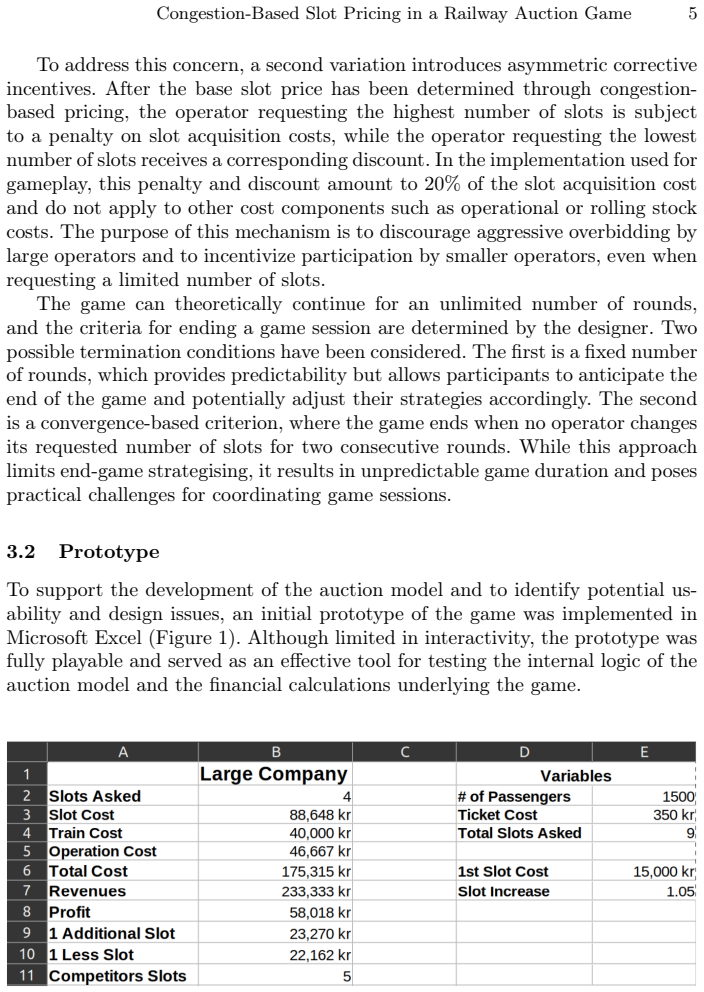
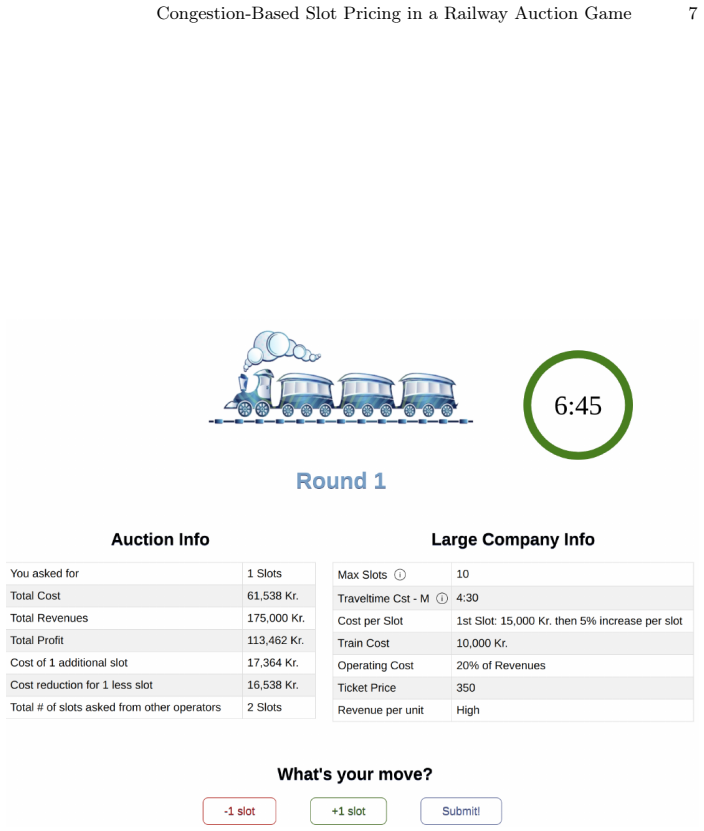
We present a multi-agent system for studying the allocation of discrete, congested resources among heterogeneous strategic agents, motivated by the problem of railway slot allocation under deregulation. Multiple operator-agents, differing in size and capacity, interact through a shared auction mechanism over repeated rounds under time-constrained decision-making. The mechanism combines a congestion-based base price that increases with aggregate demand with an asymmetric corrective adjustment that penalises the agent requesting the most slots and rewards the agent requesting the fewest, and is designed to mitigate strategic dominance by large agents while preserving transparency and congestion sensitivity. We formulate the interaction as a repeated game with incomplete information and implement the system as a real-time, web-based multi-agent environment in which human participants control individual agents and observe live marginal-cost and competitor feedback. We report exploratory observations from two structured sessions with domain experts acting as operator-agents. The congestion mechanism responds to aggregate demand as designed and the corrective incentives are actively triggered, but agents representing large operators persist with high-request strategies despite the penalty, suggesting that corrective pricing is necessary but not sufficient to neutralise strategic dominance in this multi-agent setting. A post-session debrief indicates that participants' decisions were driven by the assumed agent role rather than personal disposition, and provides qualitative support for strategic motives, such as preserving market presence and raising rivals' costs, operating alongside short-term profit maximisation. We discuss implications for multi-agent mechanism design under asymmetric budgets and outline directions for analytical validation and larger-scale multi-agent experiments.
Editorial analysis
A structured set of objections, weighed in public.
Referee Report
Summary. The paper presents a multi-agent auction mechanism for railway slot allocation that combines a congestion-based base price (increasing with aggregate demand) with an asymmetric corrective adjustment penalizing the largest requester and rewarding the smallest. It formulates the setting as a repeated game with incomplete information, implements the mechanism in a real-time web-based environment allowing human participants to control heterogeneous operator-agents, and reports qualitative observations from two structured sessions with domain experts. The observations indicate that the pricing components function as designed and are triggered, yet agents representing large operators continue high-request strategies, leading to the claim that corrective pricing is necessary but not sufficient to neutralize strategic dominance. A post-session debrief is cited as qualitative support for motives such as market presence and raising rivals' costs.
Significance. If substantiated, the work would illustrate limitations of purely pricing-based interventions in asymmetric multi-agent resource allocation settings and provide a reusable platform for studying repeated strategic interactions under time pressure and incomplete information. The implemented web-based multi-agent environment with live marginal-cost and competitor feedback is a concrete contribution that could support future controlled experiments. However, the current evidence base is exploratory and qualitative, limiting immediate implications for mechanism design.
major comments (2)
- [Abstract / Observations section] Abstract and the paragraph beginning 'We report exploratory observations from two structured sessions': the central claim that 'corrective pricing is necessary but not sufficient' is supported solely by qualitative notes from two sessions. No request frequencies, payoff differentials, statistical tests, controls for learning effects, or comparisons against a no-correction baseline are reported, so the persistence of high-request strategies cannot be attributed to an inherent mechanism limitation rather than session-specific factors.
- [Mechanism description / Game formulation] The formulation as a repeated game with incomplete information is stated but no equilibrium analysis, best-response derivation, or even a simple payoff matrix for the two-agent case is provided to bound or predict the observed persistence; the claim therefore rests entirely on the two-session narrative rather than on any derived property of the mechanism.
minor comments (2)
- [Abstract] The abstract states that participants' decisions were 'driven by the assumed agent role rather than personal disposition' but provides no detail on how role instructions were worded or debrief questions phrased, making it difficult to assess demand effects.
- [Mechanism description] Notation for the congestion price and corrective adjustment is introduced but never given explicit functional forms or parameter values, hindering reproducibility of the implemented system.
Simulated Author's Rebuttal
We thank the referee for the constructive comments highlighting the exploratory nature of the study. We agree that the evidence base is qualitative and will revise the manuscript to ensure claims are appropriately tempered. We address each major comment point by point below.
read point-by-point responses
-
Referee: [Abstract / Observations section] Abstract and the paragraph beginning 'We report exploratory observations from two structured sessions': the central claim that 'corrective pricing is necessary but not sufficient' is supported solely by qualitative notes from two sessions. No request frequencies, payoff differentials, statistical tests, controls for learning effects, or comparisons against a no-correction baseline are reported, so the persistence of high-request strategies cannot be attributed to an inherent mechanism limitation rather than session-specific factors.
Authors: We agree that the central claim rests on qualitative observations from two sessions without quantitative metrics, statistical tests, or baseline comparisons. The manuscript already describes the work as exploratory, but we will revise the abstract and the observations paragraph to state more explicitly that the persistence of high-request strategies is a preliminary observation from these sessions and does not constitute statistical evidence of an inherent mechanism limitation. This revision will make the tentative nature of the suggestion clear. revision: yes
-
Referee: [Mechanism description / Game formulation] The formulation as a repeated game with incomplete information is stated but no equilibrium analysis, best-response derivation, or even a simple payoff matrix for the two-agent case is provided to bound or predict the observed persistence; the claim therefore rests entirely on the two-session narrative rather than on any derived property of the mechanism.
Authors: We acknowledge that no equilibrium analysis, best-response derivation, or payoff matrix is provided. The paper's focus is the design and real-time implementation of the congestion-based auction mechanism in a web-based multi-agent environment, together with qualitative observations from human-expert sessions under time pressure. The repeated-game formulation with incomplete information is included only to contextualize the setting; a full theoretical analysis lies outside the current scope. We will add a clarifying sentence in the game formulation section noting that equilibrium analysis is reserved for future work. revision: partial
Circularity Check
No circularity; descriptive mechanism plus qualitative observations only
full rationale
The manuscript describes an implemented auction mechanism and reports observations from two expert sessions. No equations, fitted parameters, predictions, or derivations appear in the provided text. The central claim (corrective pricing necessary but not sufficient) is presented as an interpretation of session outcomes rather than a quantity derived from or equivalent to any internal definition or self-citation. No load-bearing steps reduce by construction to inputs.
Axiom & Free-Parameter Ledger
Reference graph
Works this paper leans on
-
[1]
Transportation Research Part A: Policy and Practice132, 452–464 (2020)
Ait Ali, A., Warg, J., Eliasson, J.: Pricing commercial train path requests based on societal costs. Transportation Research Part A: Policy and Practice132, 452–464 (2020)
2020
-
[2]
MIT press (1995)
Aumann, R.J., Maschler, M., Stearns, R.E.: Repeated games with incomplete in- formation. MIT press (1995)
1995
-
[3]
Competition and Regulation in Network Industries1(2), 163–196 (2006)
Borndörfer, R., Grötschel, M., Lukac, S., Mitusch, K., Schlechte, T., Schultz, S., Tanner, A.: An auctioning approach to railway slot allocation. Competition and Regulation in Network Industries1(2), 163–196 (2006)
2006
-
[4]
Available at SSRN 5007501 (2023)
Broman, E., Eliasson, J., Meijer, S., Roungas, B.: A track slot auction serious game. Available at SSRN 5007501 (2023)
2023
-
[5]
Trans- portation Research Part E: Logistics and Transportation Review49(1), 176–189 (2013)
Harrod, S.: Auction pricing of network access for north american railways. Trans- portation Research Part E: Logistics and Transportation Review49(1), 176–189 (2013)
2013
-
[6]
Simulation & Gaming p
de Wijse-van Heeswijk, M., Klabbers, J.H., Meijer, S.: Advancing the role of the facilitator in game science: A systems theory approach to learning and adaptation in rule-based and open games. Simulation & Gaming p. 10468781251384139 (2025)
2025
-
[7]
In: 2025 Winter Simulation Conference (WSC)
Meijer, S., Lukosch, H., de Wijse-van Heeswijk, M., Klabbers, J.: Positioning game science for gaming and simulation: A reflection on the research philosophical un- derpinnings. In: 2025 Winter Simulation Conference (WSC). pp. 2204–2215. IEEE (2025)
2025
-
[8]
Simulation & Gaming50(2), 180–201 (2019) Congestion-Based Slot Pricing in a Railway Auction Game 13
Roungas, B., Bekius, F., Meijer, S.: The game between game theory and gaming simulations: design choices. Simulation & Gaming50(2), 180–201 (2019) Congestion-Based Slot Pricing in a Railway Auction Game 13
2019
-
[9]
Journal of Simulation15(3), 177–190 (2021)
Roungas, B., Bekius, F., Verbraeck, A., Meijer, S.: Improving the decision-making qualities of gaming simulations. Journal of Simulation15(3), 177–190 (2021)
2021
-
[10]
In: International Simulation and Gaming Association Conference (2021)
Roungas, B., Dahlberg, H., Broman, E., Lundström, F., Meijer, S.: An auction game for railway capacity allocation. In: International Simulation and Gaming Association Conference (2021)
2021
-
[11]
In: SIMUL 2017: The Ninth International Conference On Advances In System Simulation
Roungas, B., Meijer, S., Verbraeck, A.: A framework for simulation validation & verification method selection. In: SIMUL 2017: The Ninth International Conference On Advances In System Simulation. pp. 35–40 (2017)
2017
-
[12]
International Journal on Advances in Systems and Measurements11(1), 137–152 (2018)
Roungas, B., Meijer, S.A., Verbraeck, A.: A framework for optimizing simulation model validation & verification. International Journal on Advances in Systems and Measurements11(1), 137–152 (2018)
2018
-
[13]
Schlechte, T., Tanner, A.: Railway capacity auctions with dual prices. Tech. Rep. 10-10, ZIB (2010)
2010
discussion (0)
Sign in with ORCID, Apple, or X to comment. Anyone can read and Pith papers without signing in.