SPLC: Social Preference Learning for Crowd Robot Navigation
Pith reviewed 2026-07-03 12:06 UTC · model grok-4.3
The pith
Social preference feedback generates automatic data to replace manual reward design in offline RL for crowd robot navigation.
A machine-rendered reading of the paper's core claim, the machinery that carries it, and where it could break.
Core claim
Offline reinforcement learning for crowd robot navigation struggles with reward function design because of intricate pedestrian dynamics. SPLC introduces a social preference feedback mechanism that automatically generates preference data through principled evaluation criteria. This accounts for pedestrian intricacies, reduces reward bias, and systematically quantifies social norms to produce compliant robot behavior without manual reward engineering.
What carries the argument
Social preference feedback mechanism that automatically generates preference data from principled preference evaluation criteria.
If this is right
- Integrating SPLC with offline RL methods yields consistent gains on standard performance metrics.
- The approach enables systematic quantification of broad social norms rather than narrow reward terms.
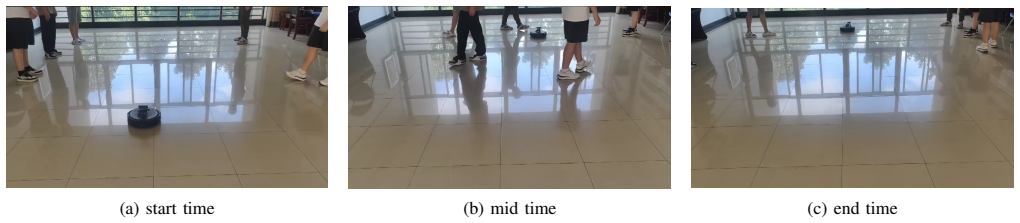
- Real-world deployment on platforms such as TurtleBot4 demonstrates practical effectiveness in human-robot coexistence.
- Elimination of detailed reward design reduces engineering effort while still supporting socially compliant navigation.
Where Pith is reading between the lines
- The preference data pipeline could be applied to other human-interaction robotics tasks where reward specification is equally difficult.
- Refining the evaluation criteria over time might allow the system to adapt to cultural or situational variations in social norms.
- Offline RL training sets collected via this method may serve as reusable benchmarks for testing new social-compliance algorithms.
Load-bearing premise
Principled preference evaluation criteria can be defined ahead of time and will produce unbiased data that accurately captures human social norms across different crowd situations.
What would settle it
A controlled experiment in which SPLC-augmented offline RL shows no measurable gain in social compliance metrics over standard offline RL baselines that still use manually designed rewards.
Figures

read the original abstract
Offline reinforcement learning (RL) holds significant potential for crowd robot navigation in human-robot coexistence applications. However, the inherent complexity of pedestrian motion renders the design of effective reward functions for promoting socially compliant robot behaviors a persistent challenge. This paper proposes a Social Preference Learning for Crowd Robot Navigation (SPLC) algorithm to eliminate the need for detailed reward design. Its core innovation lies in the introduction of a social preference feedback mechanism to automatically generate preference data through principled preference evaluation criteria. By explicitly accounting for the intricacies of pedestrian dynamics, the pipeline mitigates the reward bias and facilitates the systematic quantification of broad social norms, thereby fostering socially compliant behaviors. Extensive experiments integrating SPLC with offline RL methods demonstrate consistent improvements over state-of-the-art baselines across standard performance metrics. Furthermore, real-world experiments on the TurtleBot4 further validate the effectiveness of SPLC in practical human-robot coexistence settings. Our code and video demos are available at https://github.com/sklus949/SPLC.
Editorial analysis
A structured set of objections, weighed in public.
Referee Report
Summary. The paper proposes the SPLC algorithm for offline RL-based crowd robot navigation. Its core contribution is a social preference feedback mechanism that automatically generates preference data via pre-defined principled preference evaluation criteria, eliminating the need for hand-crafted reward functions. The approach is claimed to mitigate reward bias by accounting for pedestrian dynamics and quantifying social norms, with extensive experiments showing consistent improvements over SOTA baselines on standard metrics and real-world validation on a TurtleBot4 platform.
Significance. If the preference criteria can be rigorously shown to be generalizable and free of embedded bias, the method could meaningfully advance reward-free social navigation by providing a systematic way to incorporate human norms into offline RL pipelines for human-robot coexistence.
major comments (2)
- [Abstract] Abstract: the central claim that the pipeline 'mitigates the reward bias' via 'principled preference evaluation criteria' is load-bearing, yet the abstract provides no derivation, ablation, or human-validation step demonstrating that these criteria are objective, generalizable across crowd densities, or free of designer bias; without this, the mechanism risks relocating rather than removing the core difficulty.
- [Abstract] Abstract: the assertion of 'consistent improvements over state-of-the-art baselines across standard performance metrics' and 'real-world experiments' is presented without any quantitative results, tables, or implementation details on how the criteria are operationalized, making it impossible to assess whether the reported gains are supported or attributable to the proposed mechanism.
minor comments (1)
- The abstract references 'standard performance metrics' and 'extensive experiments' but supplies no specifics on datasets, baselines, or exact metrics used.
Simulated Author's Rebuttal
We thank the referee for the constructive feedback on the abstract. We address the two major comments point by point below and agree to revise the abstract accordingly.
read point-by-point responses
-
Referee: [Abstract] Abstract: the central claim that the pipeline 'mitigates the reward bias' via 'principled preference evaluation criteria' is load-bearing, yet the abstract provides no derivation, ablation, or human-validation step demonstrating that these criteria are objective, generalizable across crowd densities, or free of designer bias; without this, the mechanism risks relocating rather than removing the core difficulty.
Authors: We agree that the abstract's brevity precludes including derivations, ablations, or explicit validation steps. The manuscript details the pre-defined preference evaluation criteria and their grounding in pedestrian dynamics in Section 3, with experimental support in Section 4. However, the criteria are designer-specified, so we cannot claim they are entirely free of bias or proven generalizable without additional human studies. We will revise the abstract to temper the claim to 'helps mitigate reward bias through explicit modeling of pedestrian dynamics' and add a reference to the supporting sections. revision: yes
-
Referee: [Abstract] Abstract: the assertion of 'consistent improvements over state-of-the-art baselines across standard performance metrics' and 'real-world experiments' is presented without any quantitative results, tables, or implementation details on how the criteria are operationalized, making it impossible to assess whether the reported gains are supported or attributable to the proposed mechanism.
Authors: Abstracts conventionally omit quantitative tables and implementation details for conciseness. The full paper provides these in Sections 4 and 5, including tables comparing metrics and real-world TurtleBot4 results. We will revise the abstract to incorporate brief quantitative highlights (e.g., average improvement percentages on key metrics) and a short clause on criteria operationalization to better substantiate the claims. revision: yes
Circularity Check
No significant circularity; derivation relies on external pre-defined criteria
full rationale
The provided abstract and description contain no equations, derivations, or self-citations that reduce any claimed result to its own inputs by construction. The core mechanism invokes 'principled preference evaluation criteria' defined in advance to generate preference data, presented as an external input rather than a fitted or self-referential quantity. No load-bearing step equates a prediction to a fit, renames a known result, or imports uniqueness via author self-citation. The method is therefore self-contained against external benchmarks, with claimed improvements over baselines treated as independent validation.
Axiom & Free-Parameter Ledger
axioms (1)
- domain assumption Social norms relevant to robot navigation can be captured by a set of principled preference evaluation criteria that do not require per-scenario tuning.
Reference graph
Works this paper leans on
-
[1]
Social force model for pedestrian dynam- ics,
D. Helbing and P. Molnar, “Social force model for pedestrian dynam- ics,”Physical review E, vol. 51, no. 5, p. 4282, 1995
1995
-
[2]
Reciprocal velocity obsta- cles for real-time multi-agent navigation,
J. Van den Berg, M. Lin, and D. Manocha, “Reciprocal velocity obsta- cles for real-time multi-agent navigation,” in2008 IEEE international conference on robotics and automation. IEEE, 2008, pp. 1928–1935
2008
-
[3]
Reciprocal n-body collision avoidance,
J. Van Den Berg, S. J. Guy, M. Lin, and D. Manocha, “Reciprocal n-body collision avoidance,” inRobotics Research: The 14th Interna- tional Symposium ISRR. Springer, 2011, pp. 3–19
2011
-
[4]
Socially compliant mobile robot navigation via inverse reinforcement learning,
H. Kretzschmar, M. Spies, C. Sprunk, and W. Burgard, “Socially compliant mobile robot navigation via inverse reinforcement learning,” The International Journal of Robotics Research, vol. 35, no. 11, pp. 1289–1307, 2016
2016
-
[5]
Robot navigation in dense human crowds: the case for cooperation,
P. Trautman, J. Ma, R. M. Murray, and A. Krause, “Robot navigation in dense human crowds: the case for cooperation,” in2013 IEEE international conference on robotics and automation. IEEE, 2013, pp. 2153–2160
2013
-
[6]
Reinforcement learning-based dynamic obstacle avoidance and integration of path planning,
J. Choi, G. Lee, and C. Lee, “Reinforcement learning-based dynamic obstacle avoidance and integration of path planning,”Intelligent Ser- vice Robotics, vol. 14, pp. 663–677, 2021
2021
-
[7]
Motion planning among dynamic, decision-making agents with deep reinforcement learning,
M. Everett, Y . F. Chen, and J. P. How, “Motion planning among dynamic, decision-making agents with deep reinforcement learning,” in2018 IEEE/RSJ International Conference on Intelligent Robots and Systems (IROS). IEEE, 2018, pp. 3052–3059
2018
-
[8]
Crowd-robot interaction: Crowd-aware robot navigation with attention-based deep reinforce- ment learning,
C. Chen, Y . Liu, S. Kreiss, and A. Alahi, “Crowd-robot interaction: Crowd-aware robot navigation with attention-based deep reinforce- ment learning,” in2019 international conference on robotics and automation (ICRA). IEEE, 2019, pp. 6015–6022
2019
-
[9]
S. Liu, H. Xia, F. C. Pouria, K. Hong, N. Chakraborty, and K. R. Driggs-Campbell, “HEIGHT: Heterogeneous interaction graph trans- former for robot navigation in crowded and constrained environments,” CoRR, vol. abs/2411.12150, 2024
-
[10]
Offline reinforcement learning with implicit q-learning,
I. Kostrikov, A. Nair, and S. Levine, “Offline reinforcement learning with implicit q-learning,” inDeep RL Workshop NeurIPS 2021, 2021. [Online]. Available: https://openreview.net/forum?id=EblVBDNalKu
2021
-
[11]
Conservative Q- learning for offline reinforcement learning,
A. Kumar, A. Zhou, G. Tucker, and S. Levine, “Conservative Q- learning for offline reinforcement learning,”Advances in neural in- formation processing systems, vol. 33, pp. 1179–1191, 2020
2020
-
[12]
A minimalist approach to offline reinforce- ment learning,
S. Fujimoto and S. S. Gu, “A minimalist approach to offline reinforce- ment learning,”Advances in neural information processing systems, vol. 34, pp. 20 132–20 145, 2021
2021
-
[13]
Deep reinforcement learning for autonomous driving: A survey,
B. R. Kiran, I. Sobh, V . Talpaert, P. Mannion, A. A. Al Sallab, S. Yo- gamani, and P. Pérez, “Deep reinforcement learning for autonomous driving: A survey,”IEEE transactions on intelligent transportation systems, vol. 23, no. 6, pp. 4909–4926, 2021
2021
-
[14]
Hierarchical plan- ning through goal-conditioned offline reinforcement learning,
J. Li, C. Tang, M. Tomizuka, and W. Zhan, “Hierarchical plan- ning through goal-conditioned offline reinforcement learning,”IEEE Robotics and Automation Letters, vol. 7, no. 4, pp. 10 216–10 223, 2022
2022
-
[15]
Risk- sensitive mobile robot navigation in crowded environment via offline reinforcement learning,
J. Wu, Y . Wang, H. Asama, Q. An, and A. Yamashita, “Risk- sensitive mobile robot navigation in crowded environment via offline reinforcement learning,” in2023 IEEE/RSJ International Conference on Intelligent Robots and Systems (IROS). IEEE, 2023, pp. 7456– 7462
2023
-
[16]
V APOR: Legged robot navigation in unstructured outdoor environ- ments using offline reinforcement learning,
K. Weerakoon, A. J. Sathyamoorthy, M. Elnoor, and D. Manocha, “V APOR: Legged robot navigation in unstructured outdoor environ- ments using offline reinforcement learning,” in2024 IEEE Interna- tional Conference on Robotics and Automation (ICRA). IEEE, 2024, pp. 10 344–10 350
2024
-
[17]
On provably safe obstacle avoidance for autonomous robotic ground vehicles,
S. Mitsch, K. Ghorbal, and A. Platzer, “On provably safe obstacle avoidance for autonomous robotic ground vehicles,” inRobotics: Sci- ence and Systems IX, Technische Universität Berlin, Berlin, Germany, June 24-June 28, 2013, 2013
2013
-
[18]
Learning sampling distributions for robot motion planning,
B. Ichter, J. Harrison, and M. Pavone, “Learning sampling distributions for robot motion planning,” in2018 IEEE International Conference on Robotics and Automation (ICRA). IEEE, 2018, pp. 7087–7094
2018
-
[19]
Soc- navbench: A grounded simulation testing framework for evaluating social navigation,
A. Biswas, A. Wang, G. Silvera, A. Steinfeld, and H. Admoni, “Soc- navbench: A grounded simulation testing framework for evaluating social navigation,”ACM Transactions on Human-Robot Interaction (THRI), vol. 11, no. 3, pp. 1–24, 2022
2022
-
[20]
DRL-VO: Learning to navigate through crowded dynamic scenes using velocity obstacles,
Z. Xie and P. Dames, “DRL-VO: Learning to navigate through crowded dynamic scenes using velocity obstacles,”IEEE Transactions on Robotics, vol. 39, no. 4, pp. 2700–2719, 2023
2023
-
[21]
Decentralized structural-RNN for robot crowd navigation with deep reinforcement learning,
S. Liu, P. Chang, W. Liang, N. Chakraborty, and K. Driggs-Campbell, “Decentralized structural-RNN for robot crowd navigation with deep reinforcement learning,” in2021 IEEE international conference on robotics and automation (ICRA). IEEE, 2021, pp. 3517–3524
2021
-
[22]
Occlusion- aware crowd navigation using people as sensors,
Y .-J. Mun, M. Itkina, S. Liu, and K. Driggs-Campbell, “Occlusion- aware crowd navigation using people as sensors,”arXiv preprint arXiv:2210.00552, 2022
-
[23]
Navigating robots in dynamic environment with deep reinforcement learning,
Z. Zhou, Z. Zeng, L. Lang, W. Yao, H. Lu, Z. Zheng, and Z. Zhou, “Navigating robots in dynamic environment with deep reinforcement learning,”IEEE Transactions on Intelligent Transportation Systems, vol. 23, no. 12, pp. 25 201–25 211, 2022
2022
-
[24]
Attention is all you need,
A. Vaswani, N. Shazeer, N. Parmar, J. Uszkoreit, L. Jones, A. N. Gomez, Ł. Kaiser, and I. Polosukhin, “Attention is all you need,” Advances in neural information processing systems, vol. 30, 2017
2017
-
[25]
NaviSTAR: Socially aware robot navigation with hybrid spatio-temporal graph transformer and preference learning,
W. Wang, R. Wang, L. Mao, and B.-C. Min, “NaviSTAR: Socially aware robot navigation with hybrid spatio-temporal graph transformer and preference learning,” in2023 IEEE/RSJ International Conference on Intelligent Robots and Systems (IROS). IEEE, 2023, pp. 11 348– 11 355
2023
-
[26]
Learning relation in crowd using gated graph convolutional networks for DRL-based robot navigation,
H. Jiang, N. Bhujel, Z. Lin, K.-W. Wan, J. Li, S. Jayavelu, and X. Jiang, “Learning relation in crowd using gated graph convolutional networks for DRL-based robot navigation,”IEEE Transactions on Intelligent Transportation Systems, vol. 25, no. 6, pp. 5085–5095, 2023
2023
-
[27]
Deep reinforcement learning from human preferences,
P. F. Christiano, J. Leike, T. Brown, M. Martic, S. Legg, and D. Amodei, “Deep reinforcement learning from human preferences,” Advances in neural information processing systems, vol. 30, 2017
2017
-
[28]
Advances in preference- based reinforcement learning: A review,
Y . Abdelkareem, S. Shehata, and F. Karray, “Advances in preference- based reinforcement learning: A review,” in2022 IEEE international conference on systems, man, and cybernetics (SMC). IEEE, 2022, pp. 2527–2532
2022
-
[29]
A survey of reinforcement learning from human feedback,
T. Kaufmann, P. Weng, V . Bengs, and E. Hüllermeier, “A survey of reinforcement learning from human feedback,”Transactions on Machine Learning Research, 2024
2024
-
[30]
Chat with chatGPT on intelligent vehicles: An IEEE TIV perspective,
H. Du, S. Teng, H. Chen, J. Ma, X. Wang, C. Gou, B. Li, S. Ma, Q. Miao, X. Naet al., “Chat with chatGPT on intelligent vehicles: An IEEE TIV perspective,”IEEE Transactions on Intelligent V ehicles, vol. 8, no. 3, pp. 2020–2026, 2023
2020
-
[31]
6263–6289, PMLR, 2023, arXiv:2111.048502
A. Pacchiano, A. Saha, and J. Lee, “Dueling rl: reinforcement learning with trajectory preferences,”arXiv preprint arXiv:2111.04850, 2021
-
[32]
Skill preferences: Learning to extract and execute robotic skills from human feedback,
X. Wang, K. Lee, K. Hakhamaneshi, P. Abbeel, and M. Laskin, “Skill preferences: Learning to extract and execute robotic skills from human feedback,” inConference on robot learning. PMLR, 2022, pp. 1259– 1268
2022
-
[33]
Reinforcement learning with human feedback for realistic traffic simulation,
Y . Cao, B. Ivanovic, C. Xiao, and M. Pavone, “Reinforcement learning with human feedback for realistic traffic simulation,” in2024 IEEE international conference on robotics and automation (ICRA). IEEE, 2024, pp. 14 428–14 434
2024
-
[34]
Benchmarks and algo- rithms for offline preference-based reward learning,
D. Shin, A. D. Dragan, and D. S. Brown, “Benchmarks and algo- rithms for offline preference-based reward learning,”arXiv preprint arXiv:2301.01392, 2023
-
[35]
Preference transformer: Modeling human preferences using transformers for rl,
C. Kim, J. Park, J. Shin, H. Lee, P. Abbeel, and K. Lee, “Preference transformer: Modeling human preferences using transformers for RL,” arXiv preprint arXiv:2303.00957, 2023
-
[36]
Offline reward shaping with scaling human preference feedback for deep reinforcement learning,
J. Li, B. Luo, X. Xu, and T. Huang, “Offline reward shaping with scaling human preference feedback for deep reinforcement learning,” Neural Networks, vol. 181, p. 106848, 2025
2025
-
[37]
Decentralized non- communicating multiagent collision avoidance with deep reinforce- ment learning,
Y . F. Chen, M. Liu, M. Everett, and J. P. How, “Decentralized non- communicating multiagent collision avoidance with deep reinforce- ment learning,” in2017 IEEE international conference on robotics and automation (ICRA). IEEE, 2017, pp. 285–292
2017
-
[38]
Path-following navigation in crowds with deep reinforcement learning,
H. Fu, Q. Wang, and H. He, “Path-following navigation in crowds with deep reinforcement learning,”IEEE Internet of Things Journal, vol. 11, no. 11, pp. 20 236–20 245, 2024
2024
-
[39]
Rank analysis of incomplete block designs: I. the method of paired comparisons,
R. A. Bradley and M. E. Terry, “Rank analysis of incomplete block designs: I. the method of paired comparisons,”Biometrika, vol. 39, no. 3/4, pp. 324–345, 1952. [Online]. Available: http://www.jstor.org/stable/2334029
-
[40]
Mixing corrupted preferences for robust and feedback-efficient preference-based reinforcement learning,
J. Heo, Y . J. Lee, J. Kim, M. G. Kwak, Y . J. Park, and S. B. Kim, “Mixing corrupted preferences for robust and feedback-efficient preference-based reinforcement learning,”Knowledge-Based Systems, vol. 309, p. 112824, 2025
2025
-
[41]
CORL: Research-oriented deep offline reinforcement learning li- brary,
D. Tarasov, A. Nikulin, D. Akimov, V . Kurenkov, and S. Kolesnikov, “CORL: Research-oriented deep offline reinforcement learning li- brary,”Advances in Neural Information Processing Systems, vol. 36, pp. 30 997–31 020, 2023
2023
discussion (0)
Sign in with ORCID, Apple, or X to comment. Anyone can read and Pith papers without signing in.